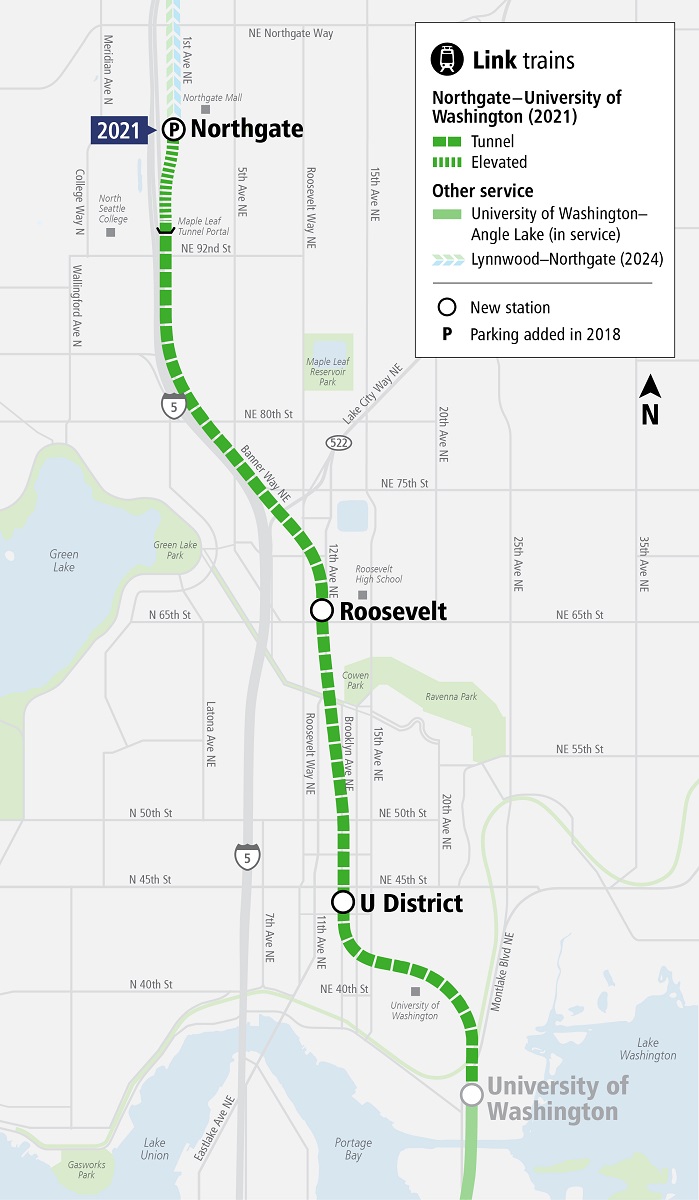
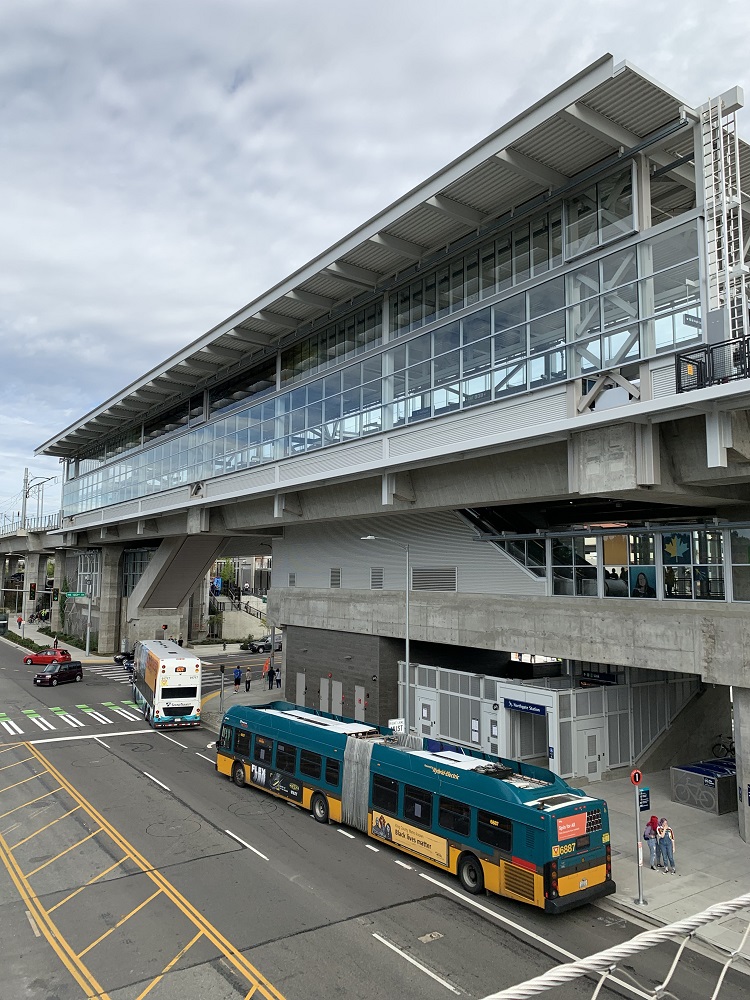
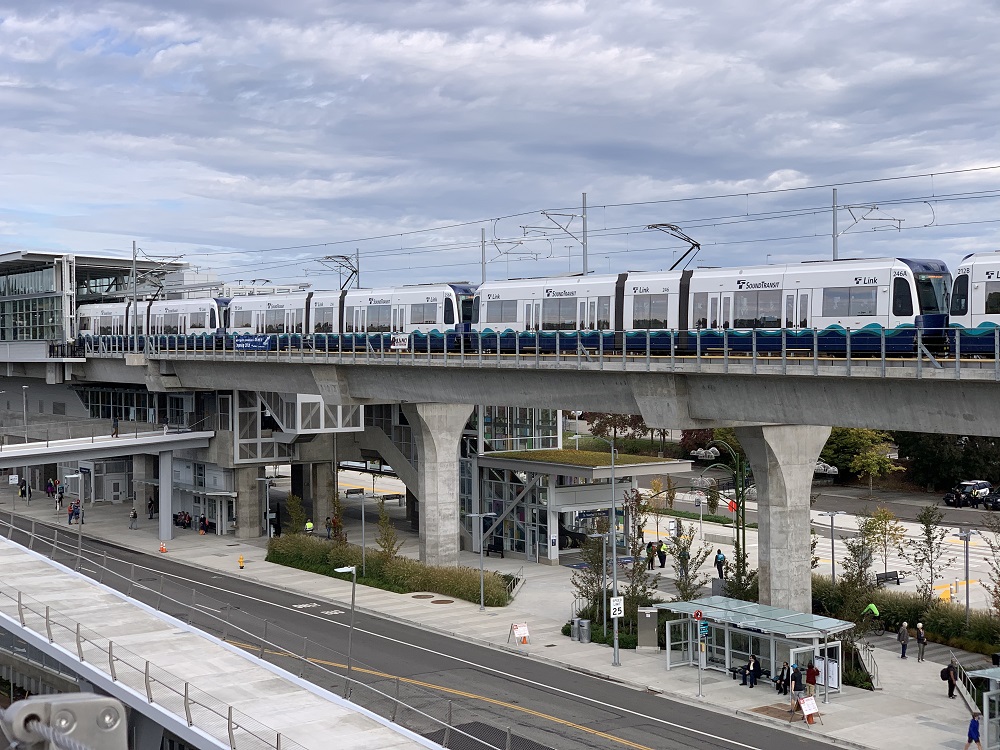
Today marked the opening of the 4.3-mile extension of the Seattle area’s Link light rail system towards the north, with three new stations: U District, Roosevelt and Northgate. These are the final stations in the system that was proposed to voters in 1996. So it took twenty-five years to get it all planned and built, a lot longer and much more expensive than planned, but it’s here at last. The price tag for this last phase was $1.9 billion.
Central Line is now called Line 1 with its 19 stations. Line 2 to Bellevue is under construction and will open in two years in 2023.
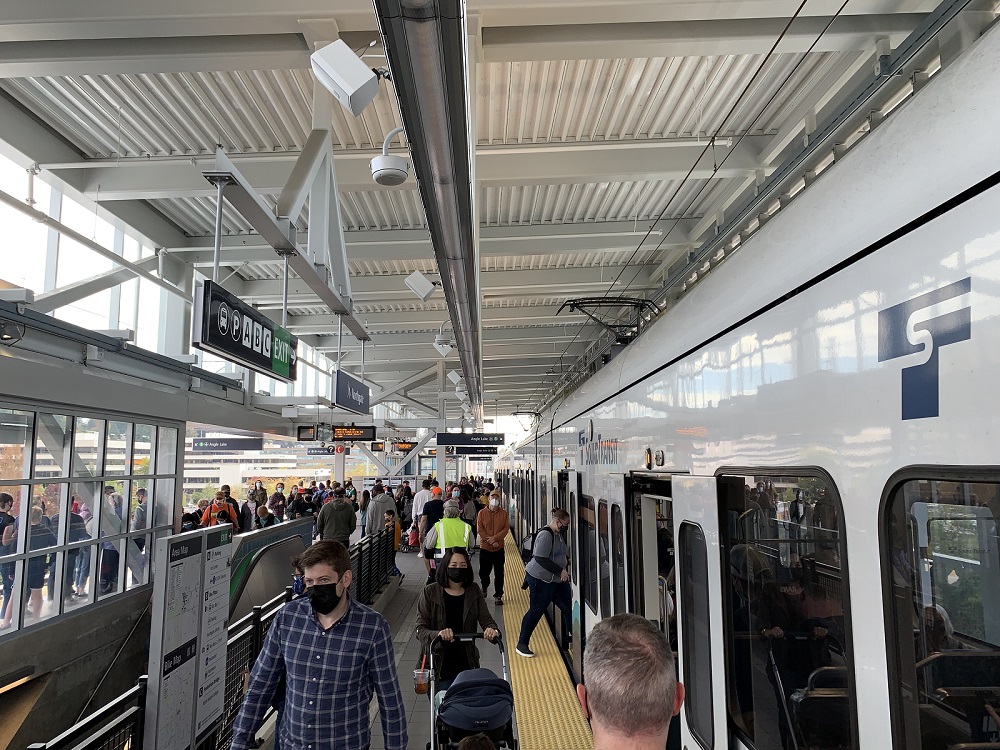
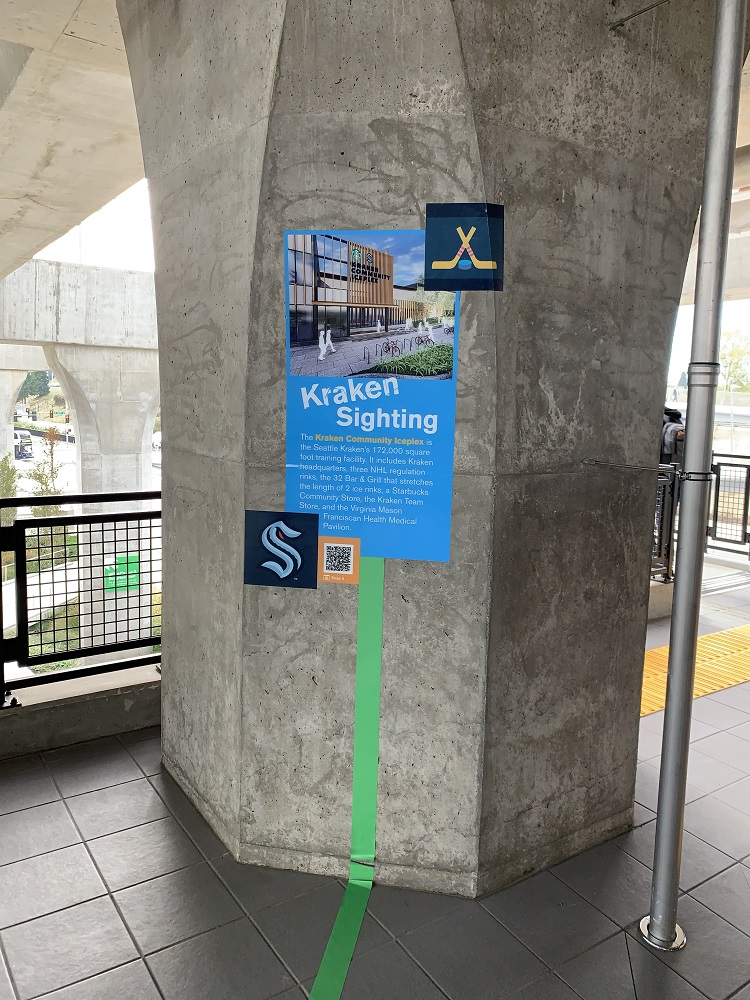
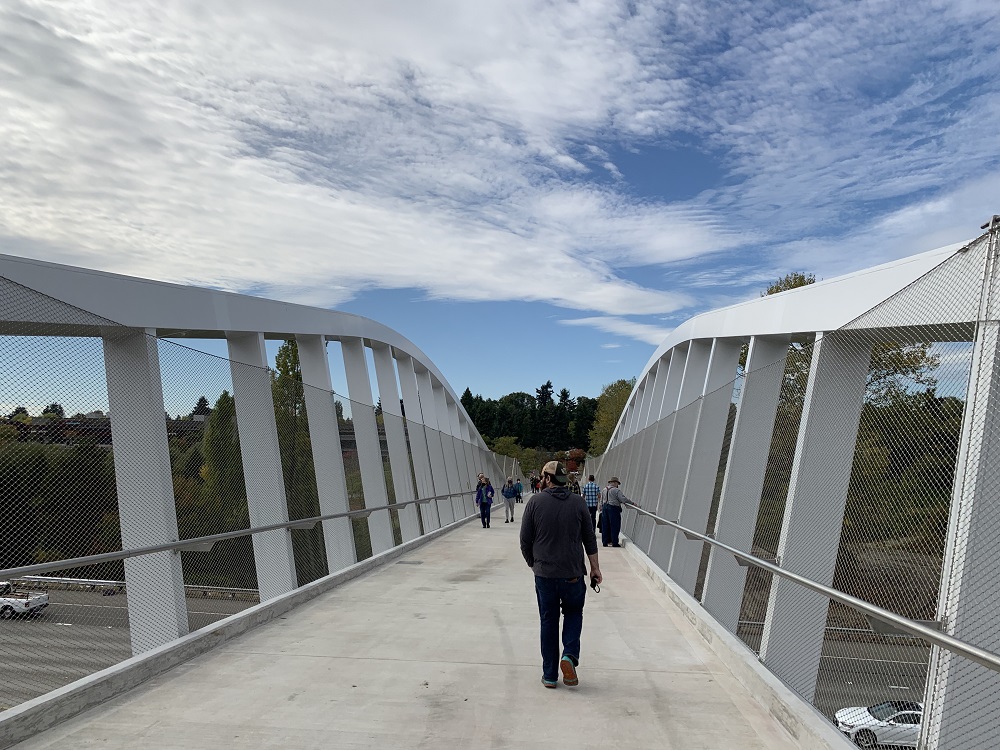
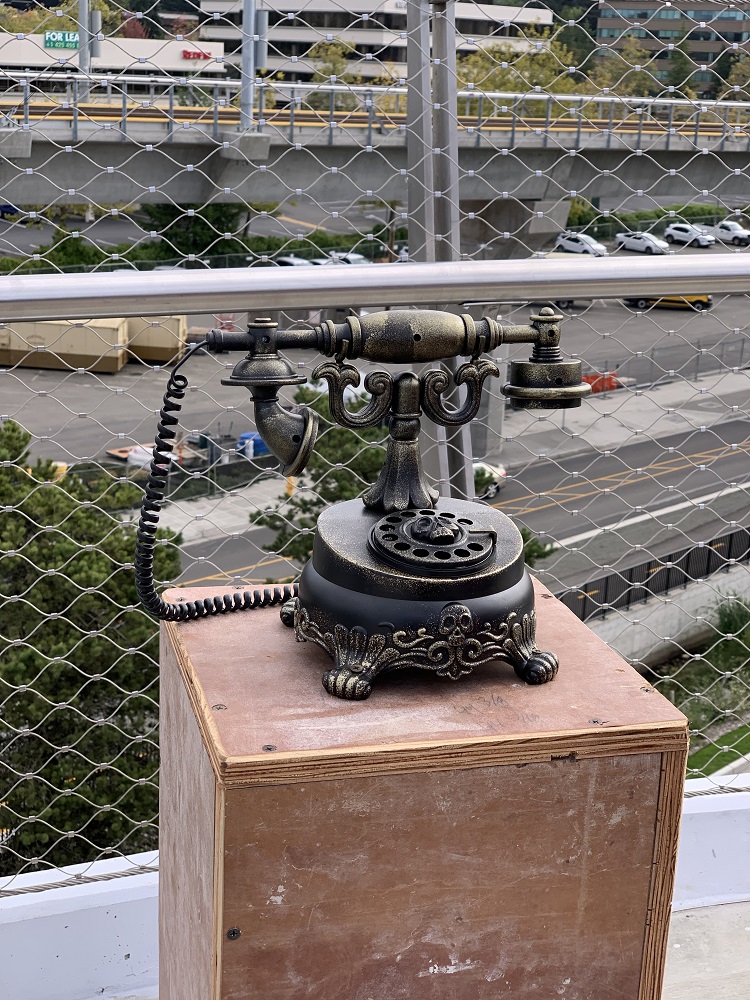
Bryan, Gary & I made a run to Northgate and back. (I will stop at the Roosevelt and U District stations some time later and take some pictures. These latter two are both underground). Here’s the elevated platform of the Northgate station. There are escalators and stairs to street level, and a connection to a new, large pedestrian/ biking bridge across Interstate 5 to the Seattle North College campus.Roosevelt and U-District are underground, and Northgate is above ground. Construction to the north continues, with the extension to Lynnwood slated to open in 2024.The Kraken Community Iceplex (the training facility for the Seattle Kraken) is nearby Northgate station. The Northgate shopping mall is getting a make-over, and some 4,000 new apartment units are under construction as well.Northgate station is elevated above street level. Changes to existing bus routes have been made to stop at the three new stations.A new train with four cars entering Northgate station. Sound Transit has started to purchase these newer technology train cars from Siemens Mobility (they entered into service in May 2021). The model name is S700, and these cars cost around $4.5 million each.The new John Lewis Memorial Bridge (pedestrian/ biking bridge) across Interstate 5 to the North Seattle College campus spans some 1,900 feet.This weird rotary-dial phone was set up as a curiosity (I think), at the entrance of the bridge.
I realized on Sunday, driving around in the pouring rain, that’s it’s a new experience for me in my car (it’s been dry ever since I had gotten the car at the end of June).
The windshield wipers switch on automatically, but at times they seem to be a little too frantic (enthusiastic?) with the wiping. I intervene then, and adjust the wiper frequency down a notch.
I like the stalk on the right of the steering wheel to push on*, to get to the wiper controls (and not to have to go through the console screen selections).
*Tesla’s new steering wheel on the Model S and X has none of that, as the steering column is not equipped with any stalk.
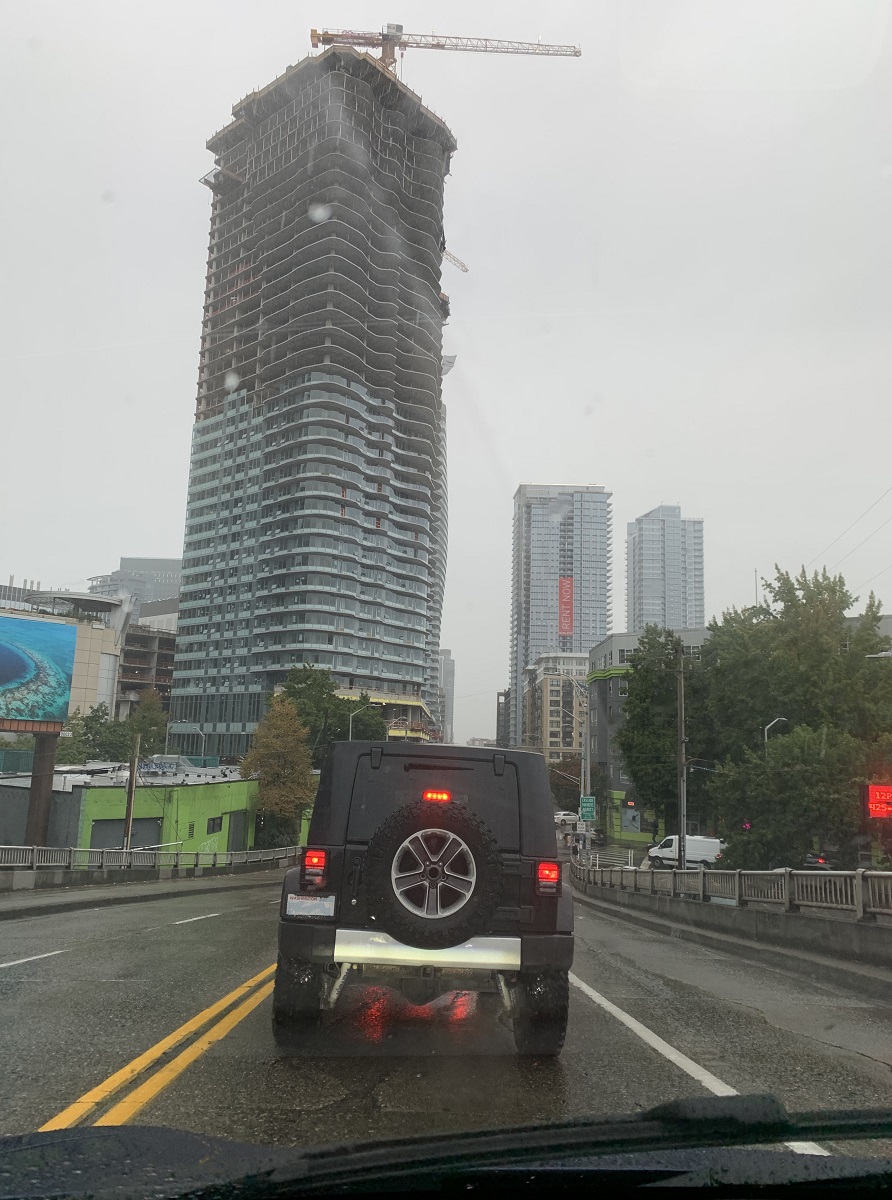
I am on Denny Way, waiting at the traffic light to turn left, to get to I-5 South. Looks like the 1200 Stewart St apartment tower has topped out (45 floors of apartments). The twin towers in the distance on the right, are part of the 1120 Denny Way apartments (construction is just about complete).
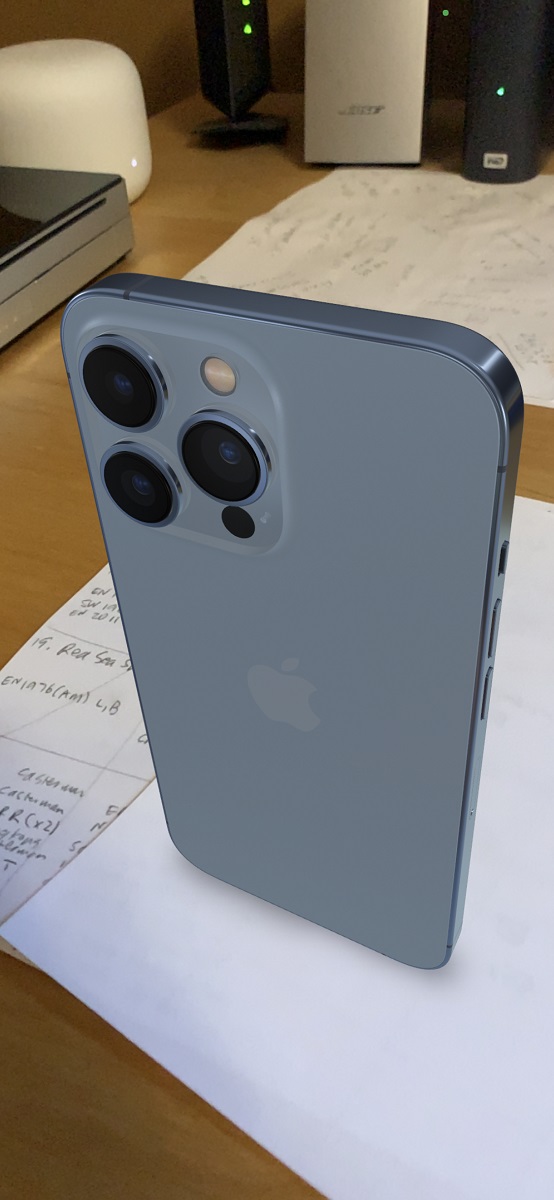
The new iPhone 13 Pro, rendered in augmented reality on my desk by Apple’s website.
‘One or more items in your order will be ready for pickup at Apple, University Village’
– Text message from Apple, complete with map and QR code
I took this message to believe my new phone and its leather case were ready for pickup.
The phone was indicated as ‘available’ on Friday when I placed the order. And did Tim Cook not say (at the Apple event, Sept. 14) that there would be enough phones out of the gate, this year?
Long story short: I left the store without my phone. (It’s not a big deal. It’s just an illustration of how the best-laid plans can go off the rails).
Inside the store after a long, long wait for the phone to show up: No— they did not have it— and would not have it for another four weeks.
I suppose I could have double-checked online if both my items were ready, before going out to the store.
In hindsight, the other red flag was that my credit card was charged only for the case as I placed the order on Friday, but not for the phone .. but I thought that was because they would check the condition of my trade-in phone, and then finalize the charge amount today.
So the message & QR code they had sent out, the time slot of 11.45- 12 noon for the pickup, the careful choreography in the Apple store, was all for just picking up a phone case.
Back at home came the e-mail from Apple with my receipt, and the standard invitation to provide feedback of ‘my experience at the Apple store’.
I basically wrote back:
‘I took your text message & QR code as confirmation that both phone and case were ready for pickup.
Why on earth would your ordering program assume I would want to come in to your store, fight the traffic piling up for the University of Washington football game nearby, to come in and pick up only the case for the phone?
Somewhere along the line there should have been a clear message saying that the phone would be unavailable/ not ready for pickup’.
P.S./ Two days later There was in fact in e-mail sent out by Apple on Friday, that stated that the phone was not available. So yes, I should have checked the status of my order inside the e-mail before I went out to the store.
‘We took a break in the spring of 1982 and now we’ve decided it’s time to end it. They say it’s foolhardy to wait more than 40 years between albums, so we’ve recorded a follow-up to The Visitors.’
– ABBA, at the announcement of their first new album in 39 years
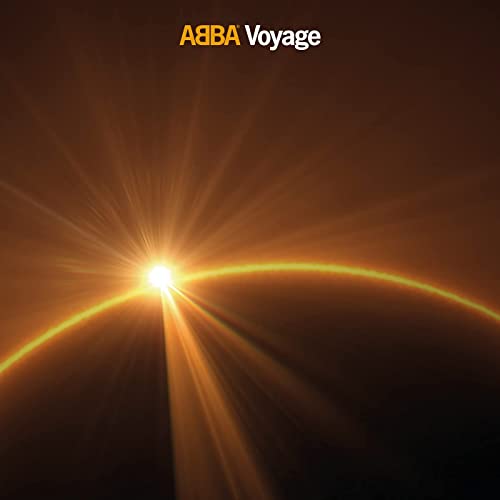
The new album is due Nov. 5. This is the image of the cover on Amazon.
The suspense is over for ABBA fans, and hey! a whole new reunion album of their music is coming. (At first it was just a new song or two that were promised.)
As far as I understand, the 80’s supergroup made themselves into avatars for a virtual world tour, so that they would not have the hassle of traveling the world over in the flesh (and in a pandemic). Who can blame them for not wanting to travel for work? I do not.
Bjorn Ulvaeus and Benny Andersson in a live-stream of the ABBA Voyage announcement at Grona Lund, Stockholm. [Photo by Fredrik Persson/TT News Agency / AFP]Looking good .. Björn Ulvaeus (76), Agnetha Faltskog (71), Anni-Frid Lyngstad (75) and Benny Andersson (74). Those are the high-tech costumes that had enabled the motion-captured visuals of their younger selves. Benny joked that he should have asked Agnetha and Anni-Frid if they can still sing before tackling the project (they can), and said it was wonderful to experience the camaraderie of collaborating on an album again.
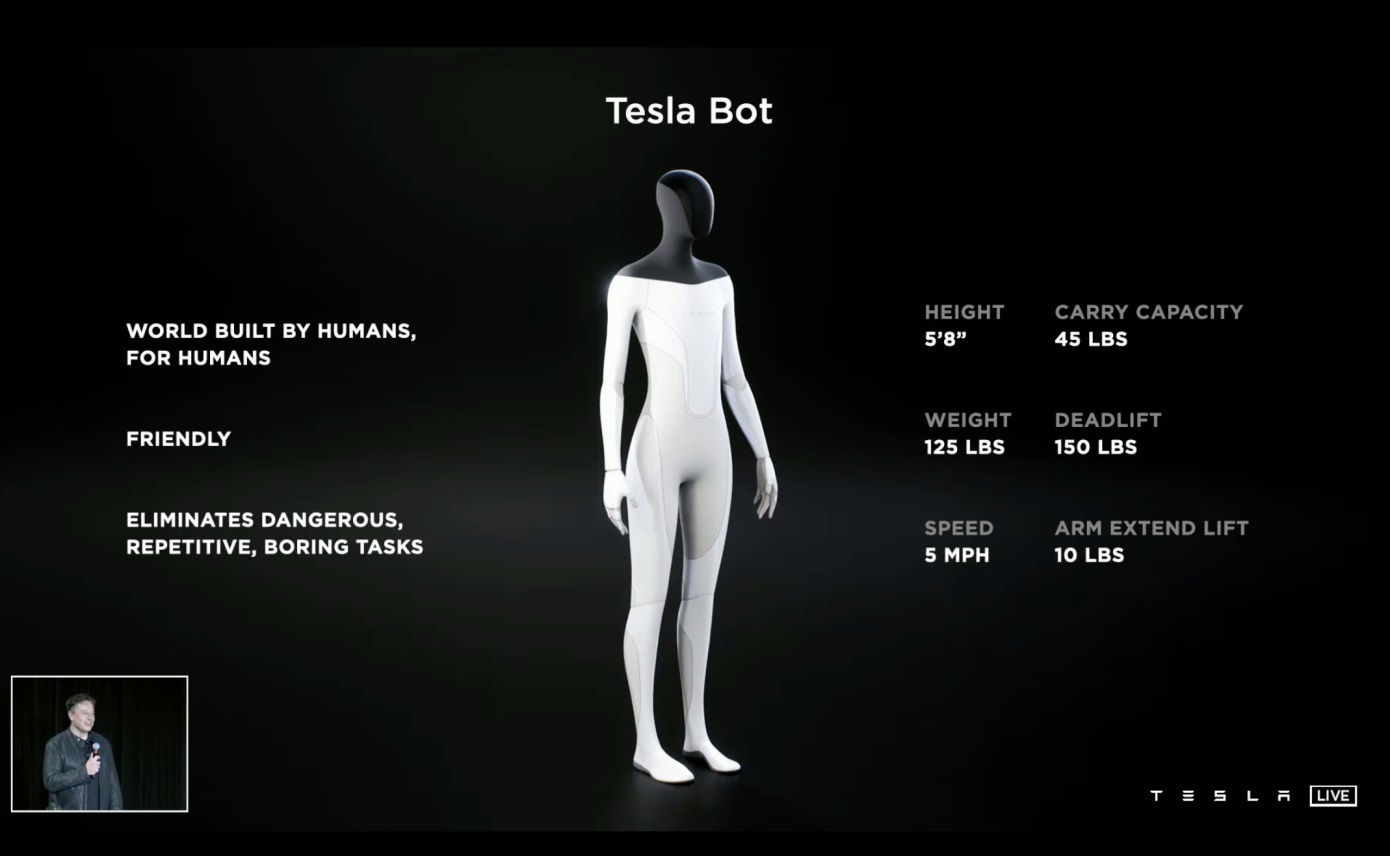
‘It’s intended to be friendly, of course, and navigate a world built for humans. We’re setting it such that at a mechanical and physical level, you can run away from it and most likely overpower it’
– Elon Musk describing the Tesla Bot
Yesterday, Tesla hosted what was billed as ‘AI’ (Artificial Intelligence) Day, in the same vein as last year’s Battery Day. The intention was/ is to draw attention to Tesla’s prowess in developing the AI that will power self-driving cars. It’s good for marketing & promoting the Tesla brand, and for attracting talented people from fields such as Machine Learning, to join Tesla.
After the presentation and just before questions, ‘one more thing’ was announced: the Tesla Bot, a ‘definitely real humanoid robot’. Tesla Bot will leverage some of the hardware and software used in Tesla’s cars, it was said. The robot will be able to do unsafe, repetitive and boring tasks, ‘essentially helping the company solve the problem of labor to some extent’.
Hmm. Is this thing for real? I think I go with the view of technology news website The Verge: ‘Don’t overthink it: Elon Musk’s Tesla Bot is a joke’.
The Tesla Bot is a skinny humanoid robot, not very fast, and not all that strong. A human dressed up as a Tesla Bot jumped around and made some moves on the stage, to demonstrate what the Tesla Bot would be able to do. The Verge notes that ‘Boston Dynamics, a company which makes Atlas, the most advanced bipedal robot in the world (unveiled in 2013), has never described these machines as anything but R&D. Atlas, says Boston Dynamics, is simply a way to push the cutting edge of robotics: it’s not even close to commercial deployment’.
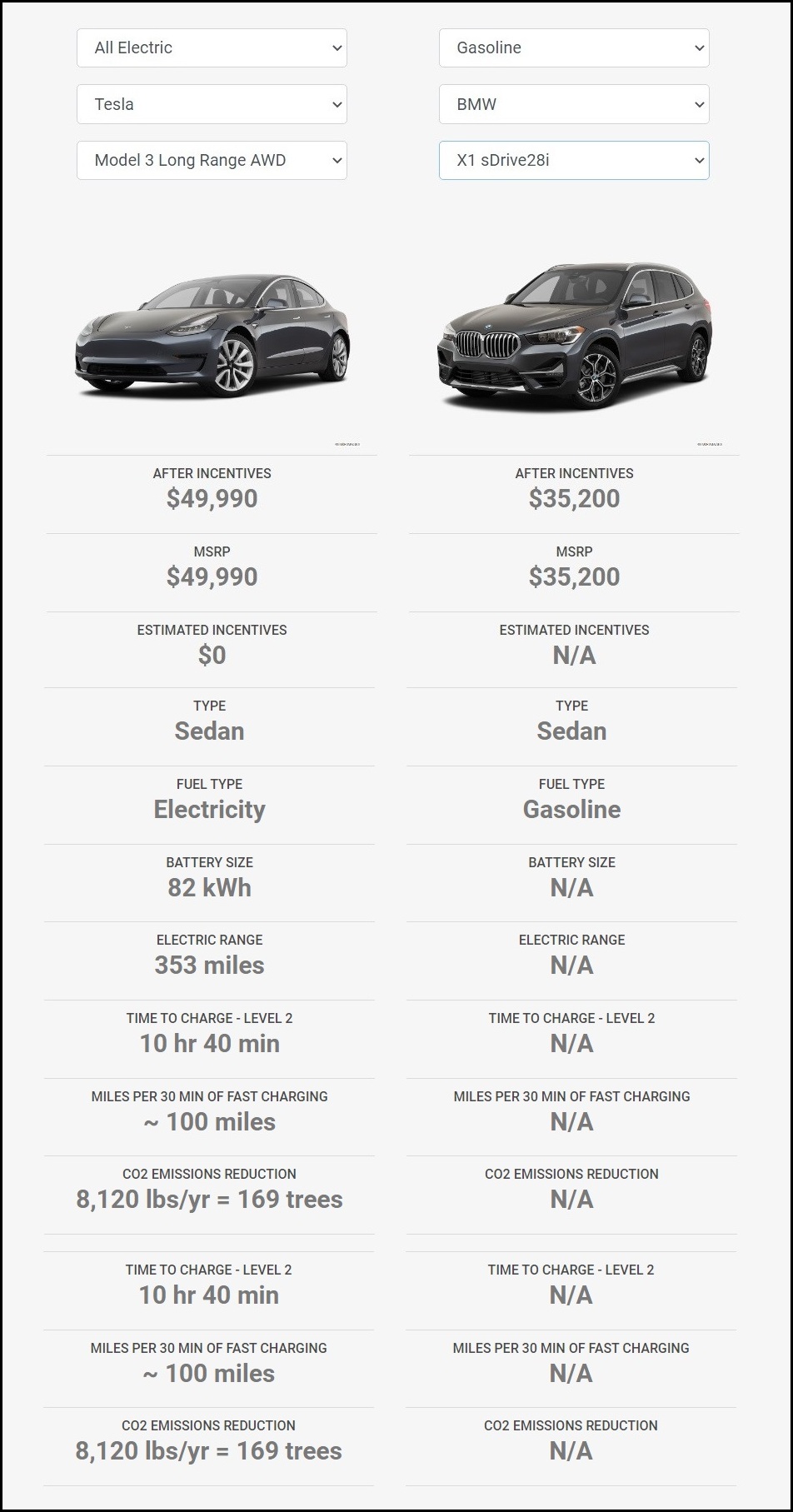
The Puget Sound Energy (electric utility) website has a cost calculator for equivalent electric and internal combustion engine ‘ICE ‘(gasoline) vehicles.
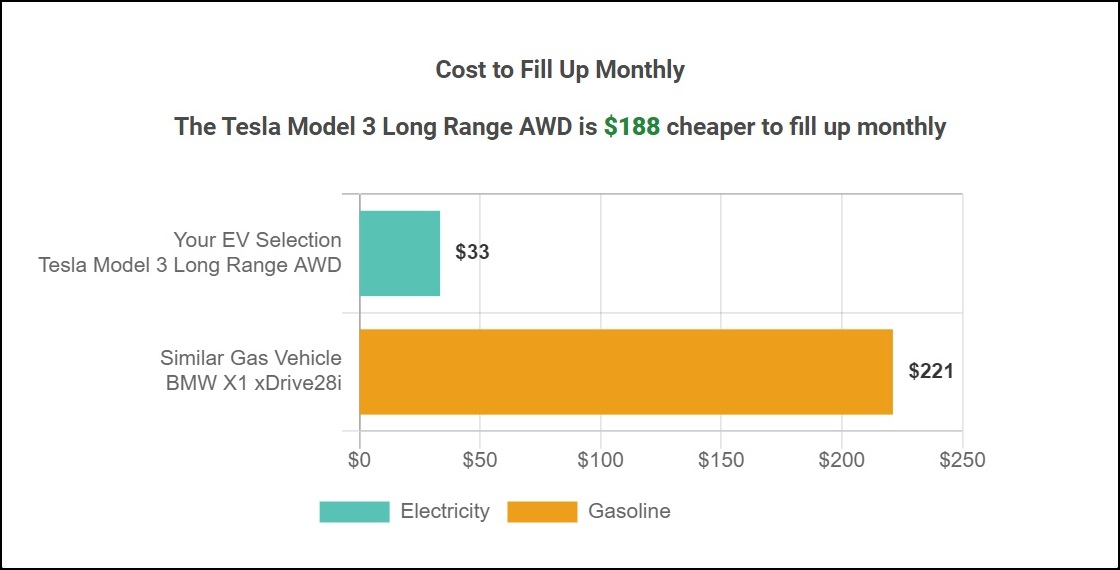
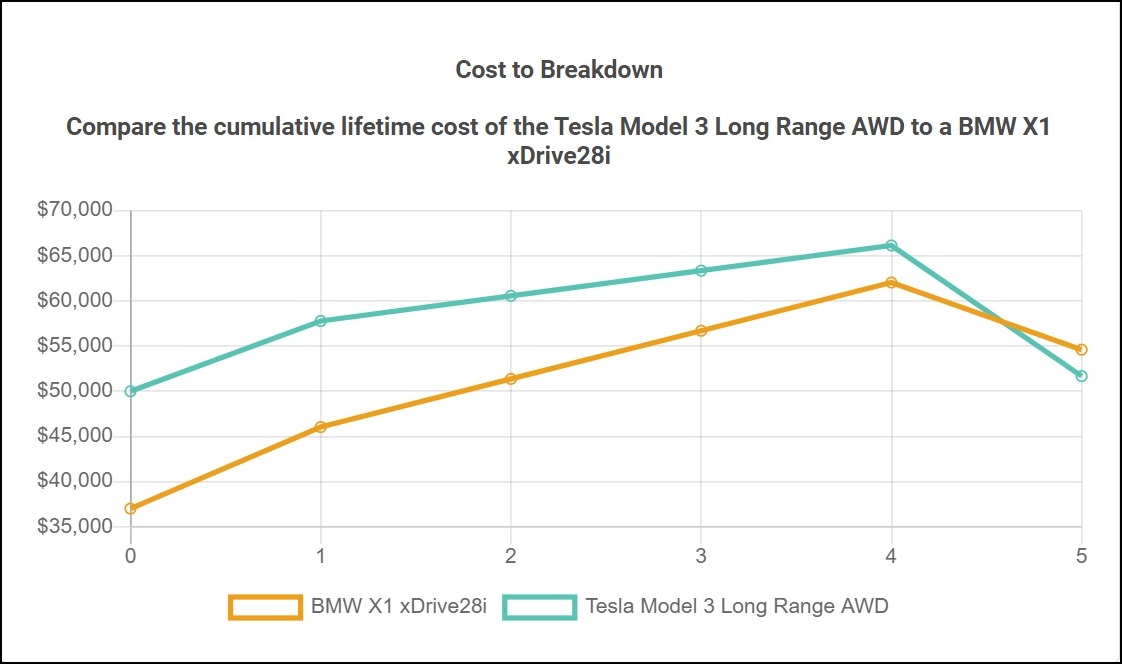
Here are the results for a Tesla Model 3 Long-range vs. a BMW X1 sDrive2Bi. Bottom line for me: It’s no contest. The Tesla wins from Day One (zero emissions), and outright from a total cost of ownership perspective, after 4 years.
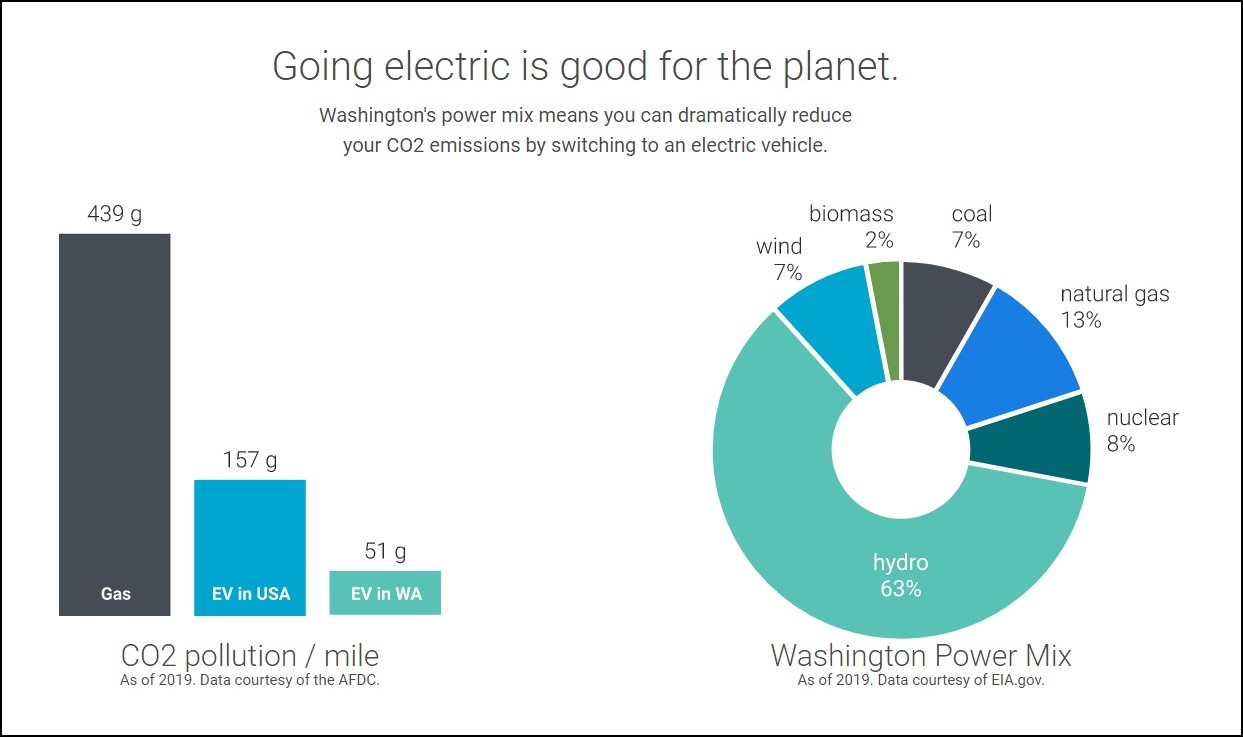
A typical gas-burning passenger car puts 4 US tons of CO2 (carbon dioxide) into the atmosphere every year: 20 pounds for every gallon of gasoline burnt. It seems impossible that a gallon of gasoline (about 6.3 pounds), could produce 20 pounds of CO2. However, most of the weight of the CO2 doesn’t come from the gasoline itself, but from the oxygen in the air that it combines with.
The PSE website figured that the X1 sDrive2Bi is equivalent to the Tesla re: style, size and class. OK, but technically these two are a world apart, as this chart shows. The last line is the most important.When it comes to charging the battery, or filling up with gas, the owner of the Tesla saves money from the get-go. Assumptions: Electricity Rate $0.107/kWh | Gas Price $4.60/ gal | Sales Tax 10%Some $3k Cost-of-Ownership savings over 5 years for the Tesla Model 3. Gas is easily 5 times more than the cost of electricity, and maintenance for the internal combustion engine-car is double than that for the electric car. Assumptions: Purchase Method: Cash | Mileage15,000 miles per Year | Sales Tax 10%Before 5 years, the lifetime cost of ownership of the Tesla is less than that of the BMW, and the gap will increase every year after that.In Washington State we are blessed with relatively green electricity generation, so going with an electric vehicle dramatically reduces the CO2 emissions of the driver.
I was out of milk and eggs, and thought to go check out the new Amazon Fresh store on 23rd Avenue & Jackson St.
The technology that Amazon had built into the ‘dash carts’ works fine, and made for a smooth experience. Is it something that will save me so much time that I will come back to the store just for that? I don’t think so— but then I have the luxury of extra time in my day, and I can avoid the crowds at stores (by going at a quiet time).
The store is in a long rectangular space (35,000 sq ft) and has a decent selection of items. Nice selection of fruit and vegetables.Here’s the high-tech ‘dash cart’ that is used in the store. It’s optional to use; they have regular carts as well. I logged into my Amazon account on my smartphone, and from there generated a QR code on the phone. This code is scanned by the cart, and then the shopper is good to go. Those built-in white lights front & back of the cart are scanners, and picks up what item is lowered into the cart. (There is a scale in the cart as well, to help it figure out if you put one or 2 items in, or maybe changed your mind and put one back on the shelf). I think if all else fails, the scanner on the right of the screen can also be used. P.S. Don’t judge my choices of food :). I buy cheap milk and expensive butter (Kerrygold from Ireland), and expensive eggs (free range, ‘Humane Certified’). They did not have my brand of Greek yogurt (Fage) that I buy in the big 35 oz. tubs.For fresh produce, the PLU code needs to be entered, and the quantity. 15c a banana is a bargain, but I can only eat so many before all the rest go bad— so I bought 5. When I was done shopping, I just pushed my cart through an automated finishing lane. The system rang me up and e-mailed the receipt to me. These dash carts cannot be taken out of the store, so the bags would have to be transferred to a regular cart if needed. I brought my own bags, but the store had dash carts available with paper bags at the ready in them, as well.
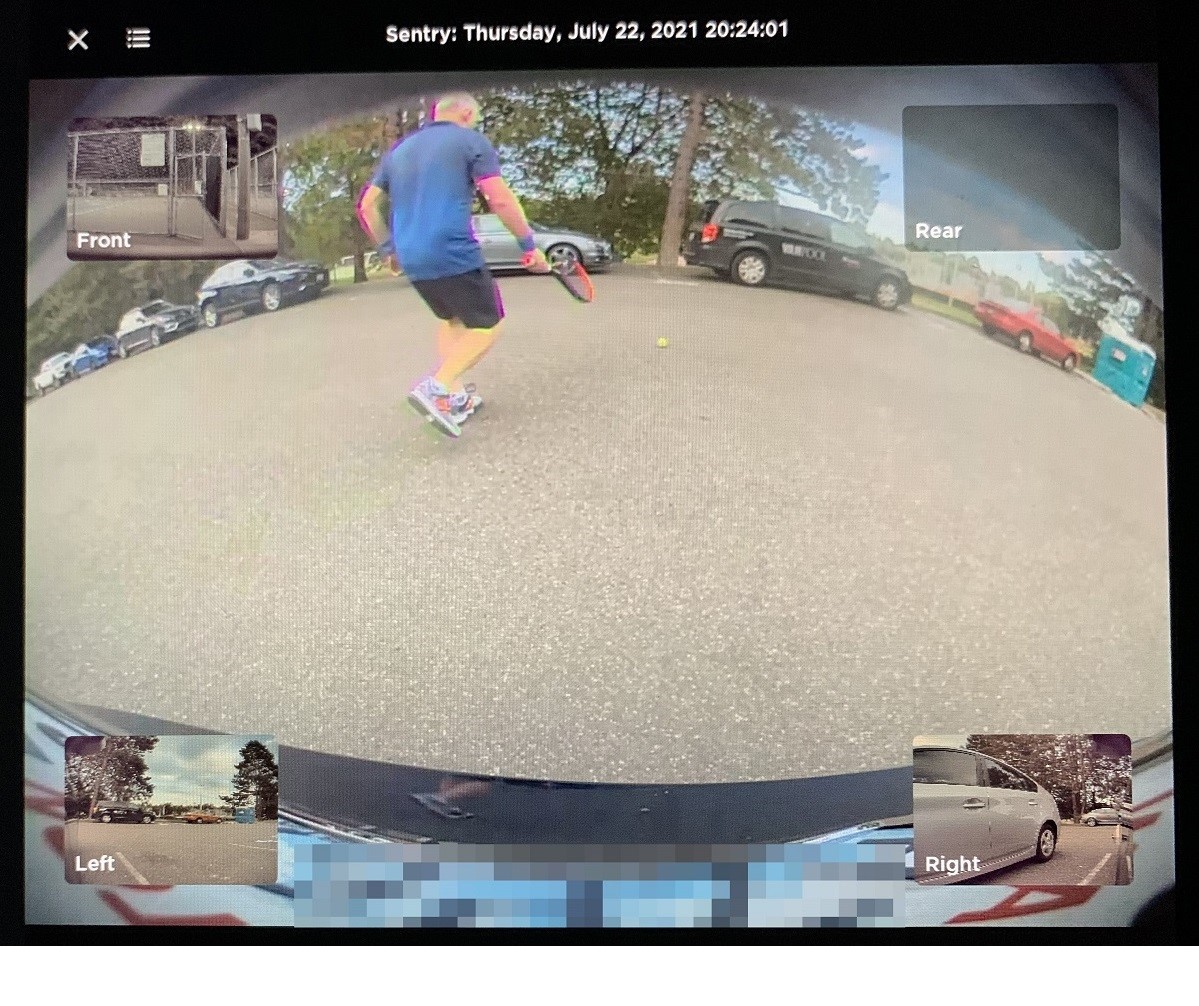
I discovered footage of myself on my car’s sentry video log. The ‘suspicious motion’ behind my car is me :). I am retrieving a tennis ball that had bounced out of the tennis courts by Lower Woodland Park, and landed behind my car.
When suspicious motion near the car is detected, the front & rear and left & right cameras begin recording. A lot of entries are generated simply by people parking their cars next to yours, and getting in or out of their cars.
If a significant threat is detected— a break-in or a collision— the alarm system will also activate, and the will be owner notified via the smartphone app that an incident has occurred.
I had groceries on the back seat of the car when I pulled into my garage tonight. I stepped out of the car, took the groceries out, closed the door, and put the charging cable in.
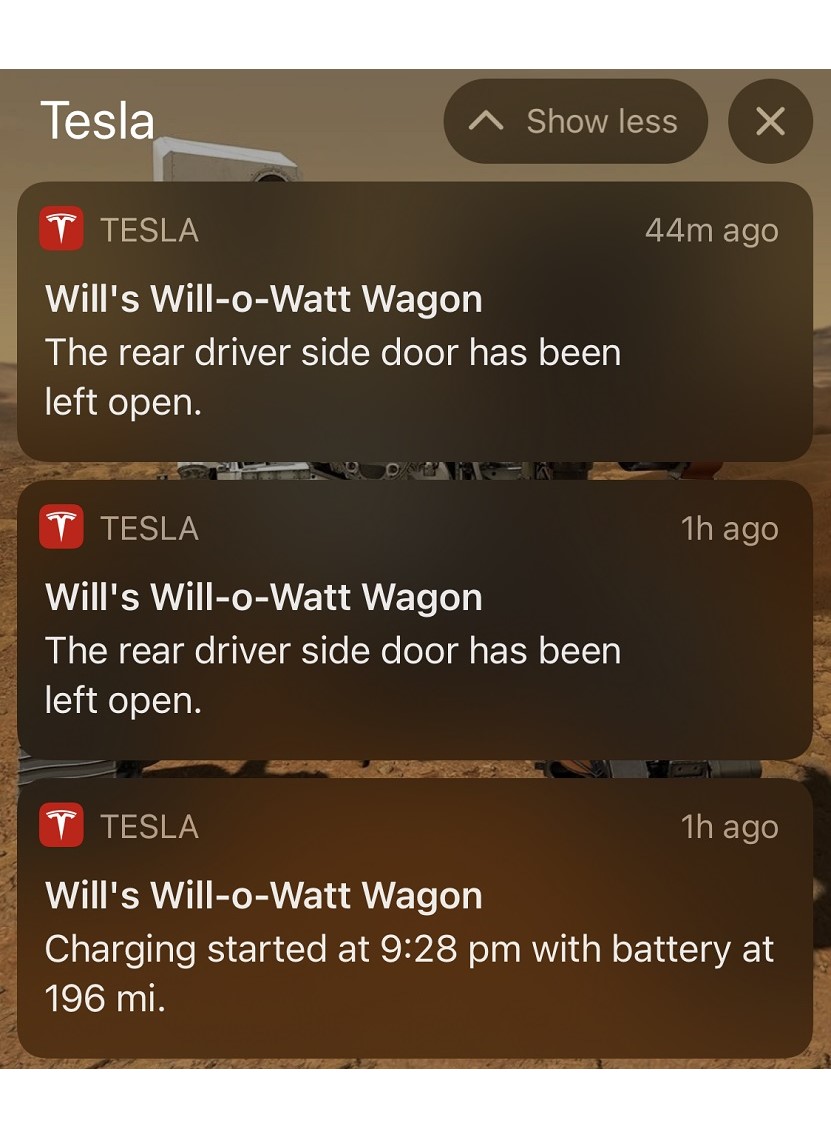
As I stepped into the house, the car reported ‘The rear driver side door has been left open’ on my phone. Well, it was open for a minute or two but I’m sure I closed it, I thought. I popped my head into the open garage door. Yup, it’s closed.
But 16 mins later the message came again, and I went and took a closer look.
Sure enough: the car was right. The door was ostensibly ‘closed’, but not latched properly (firmly). So to the car, the door was open.
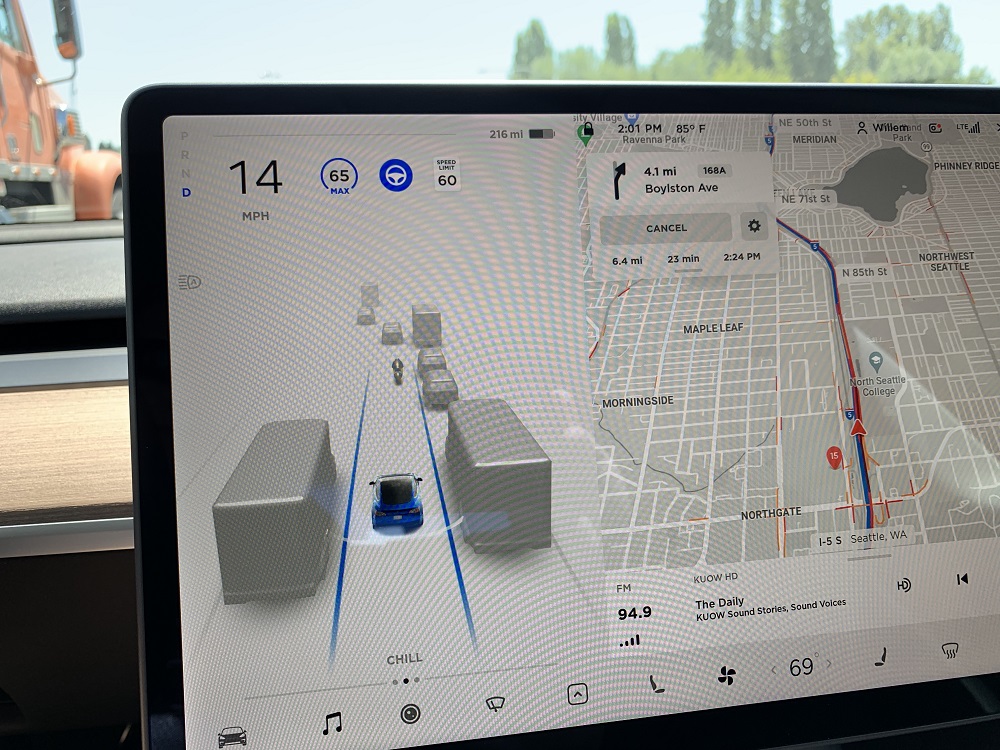
Here’s my navigation screen as I drove south on Interstate 5 towards the city in heavy traffic today. It was 2.01 pm and 85 °F (29.5 °C) outside.
I am getting more confident using the standard autopilot function of my car (that is, autosteer to stay in the lane, and using adaptive cruise control).
(Apologies for the Moiré pattern in the picture). Lots of trucks around me, and we’re down to 14 mph. (To the right of the ’14’ it says that the car’s cameras read the speed limit as 60 mph. My top speed setting is +5 mph above the speed limit. So the car will not exceed 65 mph). Autopilot keeps me centered in the lane, and keeps 3 car lengths between me and the vehicle in front of me. (The gap can be adjusted all the way up to 7 car lengths, but then you frustrate the drivers behind you, since it appears as if you’re not paying attention to the traffic in front of you!). I still have to keep my hands on the wheel, even though the car steers, accelerates & brakes by itself. There’s a motorcycle in front of me. Traffic soon ground to a halt, and the motorcyclist had to put his feet on the highway as he stopped. Then traffic ahead started moving again, and my car automatically followed. Very nice!
It was time for the Will-o-Watt Wagon (my car’s name on the Tesla app) to get out of the city and take the long road for a trip to Ellensburg today.
I used my car’s standard Autopilot functions extensively for the first time, on today’s drive. Standard Autopilot means letting the car steer, accelerate, and brake within its lane. It was a good learning experience —and definitely a little hair-raising at times, such as trusting the car to stay in the lane on a curve in the road, with vehicles in the lanes next to you, and oncoming traffic as well.
The primary skill to master with standard Autopilot is to allow the car to steer itself, while still having one’s hands on the wheel. If the driver holds the wheel too firmly, the car interprets it as an override, and cancels the Autopilot steering. If, on the other hand, the car cannot detect that the driver is holding the wheel, it issues a message— a series of messages, actually, ending with an alarm and a screen with red hands on the wheel that says ‘Autosteer Unavailable For The Rest Of This Drive’. I managed to avoid ending up in that dog box and state! Success!
P.S. News broke today that Tesla has officially launched its Full Self-Driving subscription package for $199 per month. Full Self-Driving is really ‘Almost Full Self-Driving’, since the driver really still needs to hold the wheel. However, it is a really big step up from standard Autopilot, in that the car will stop, start and navigate by itself. So it will stop at intersections and traffic lights, wait for traffic or the green light, and go by itself, and turn on the turn signal for turns and lane changes where needed.
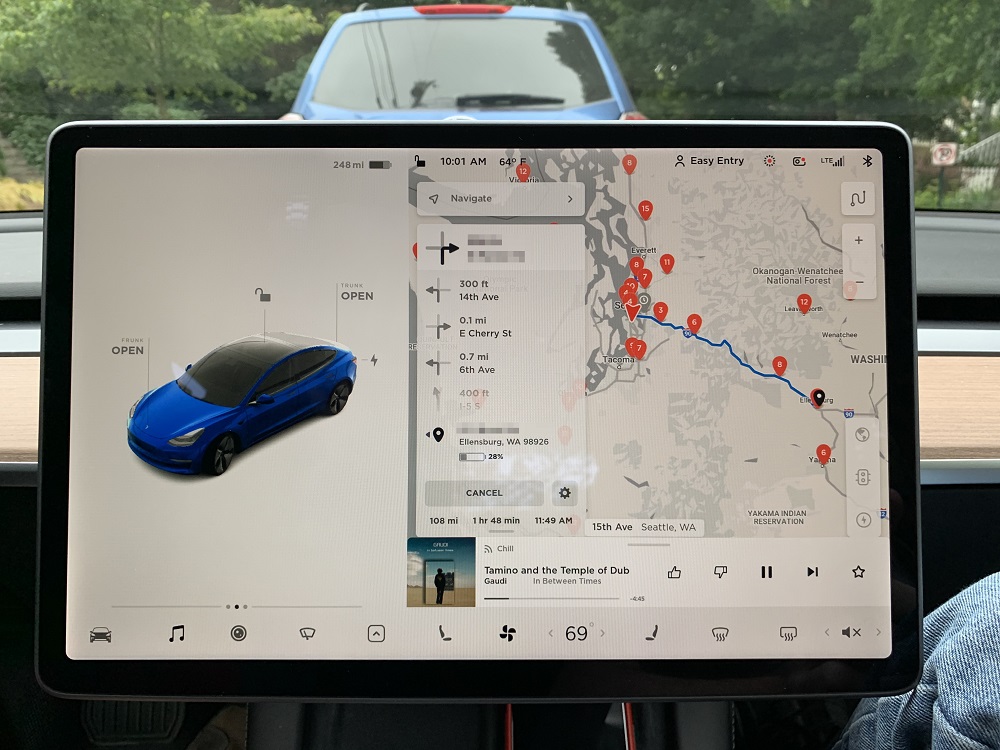
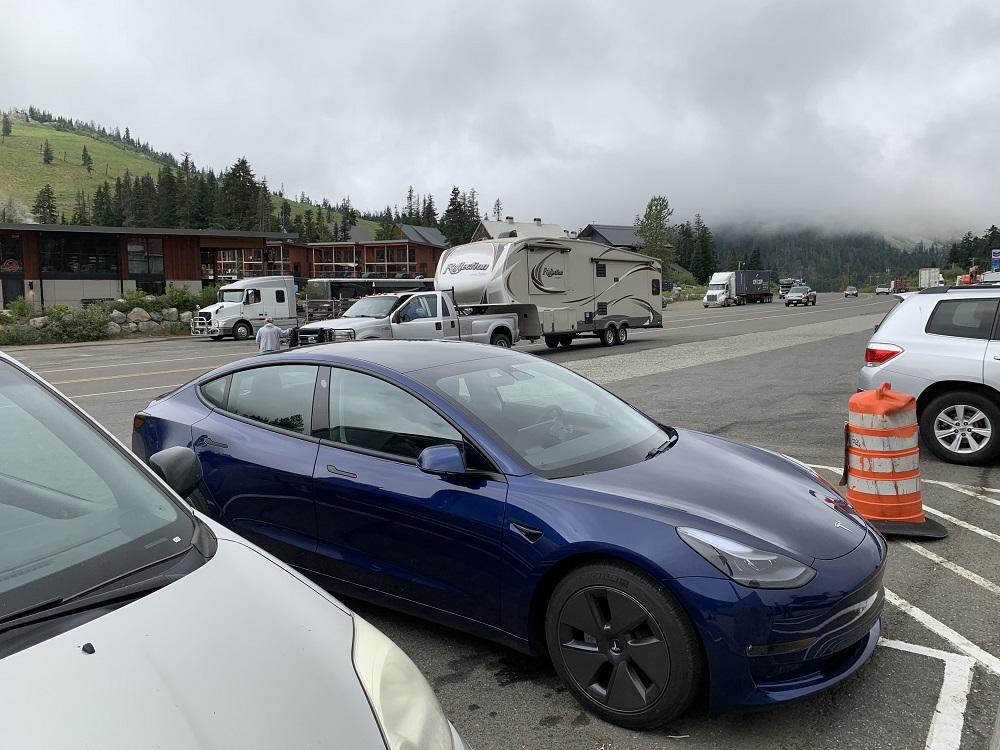
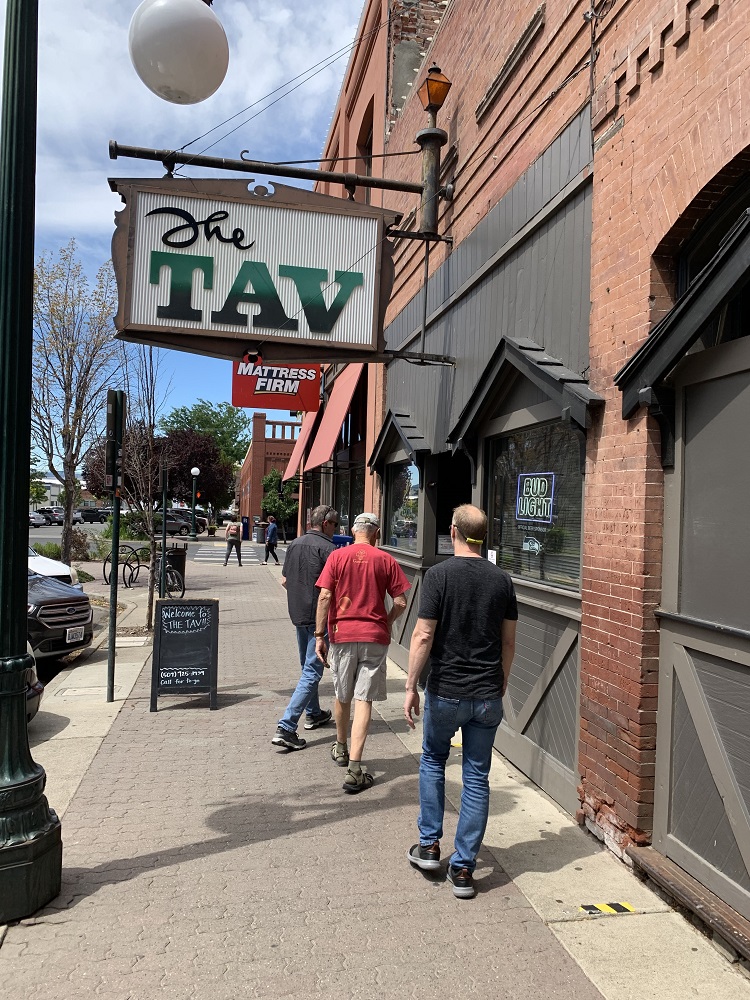
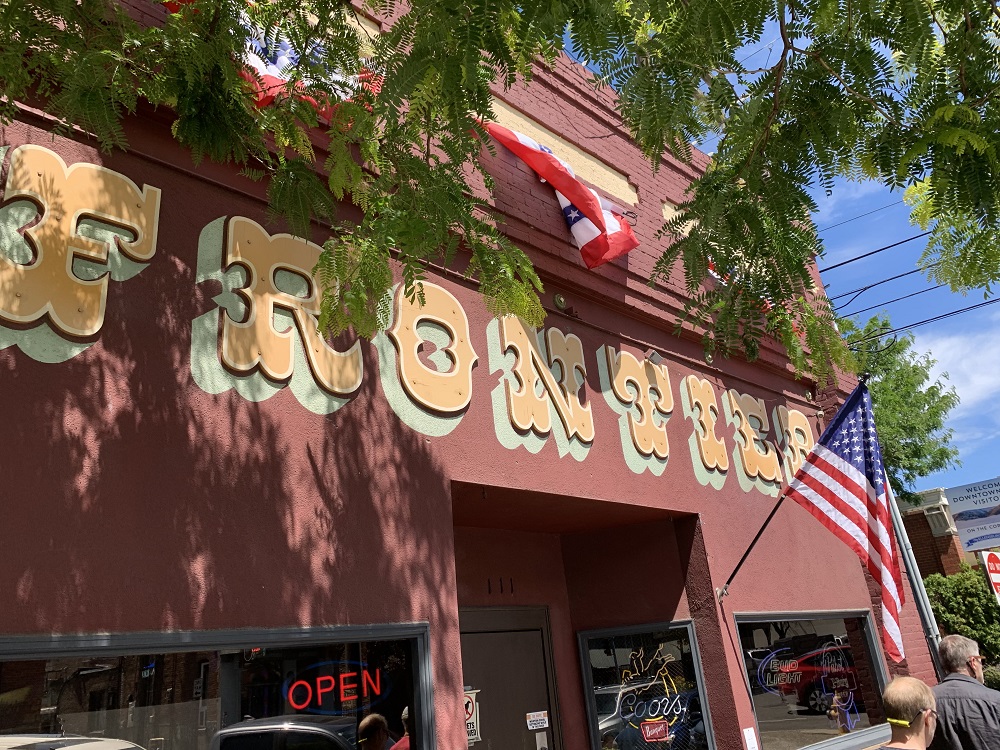
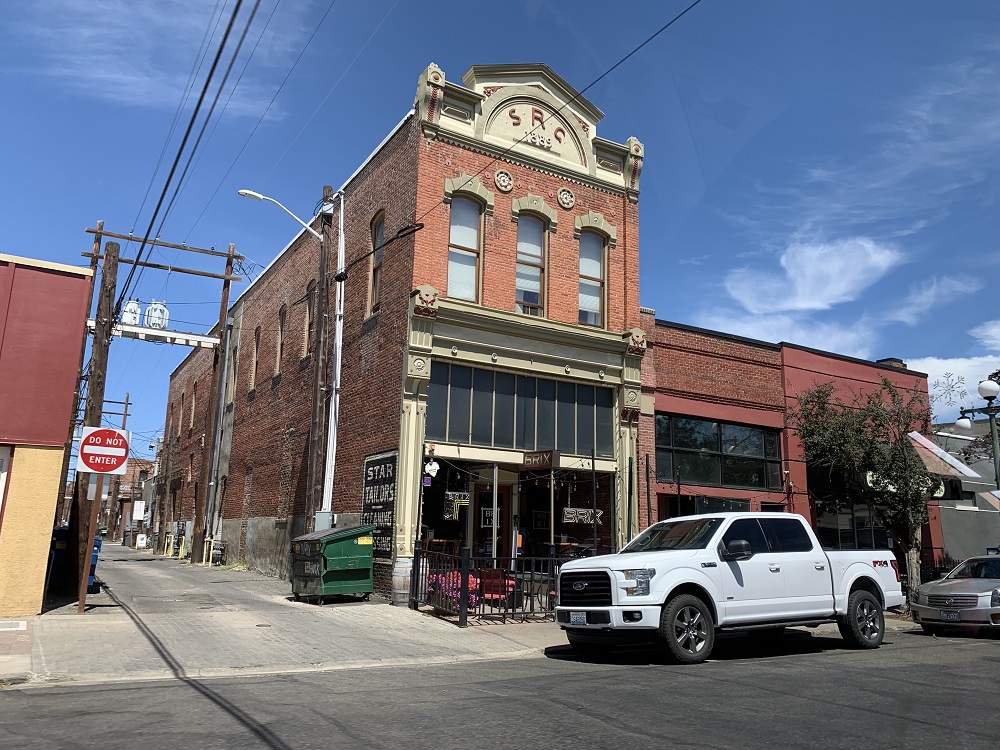
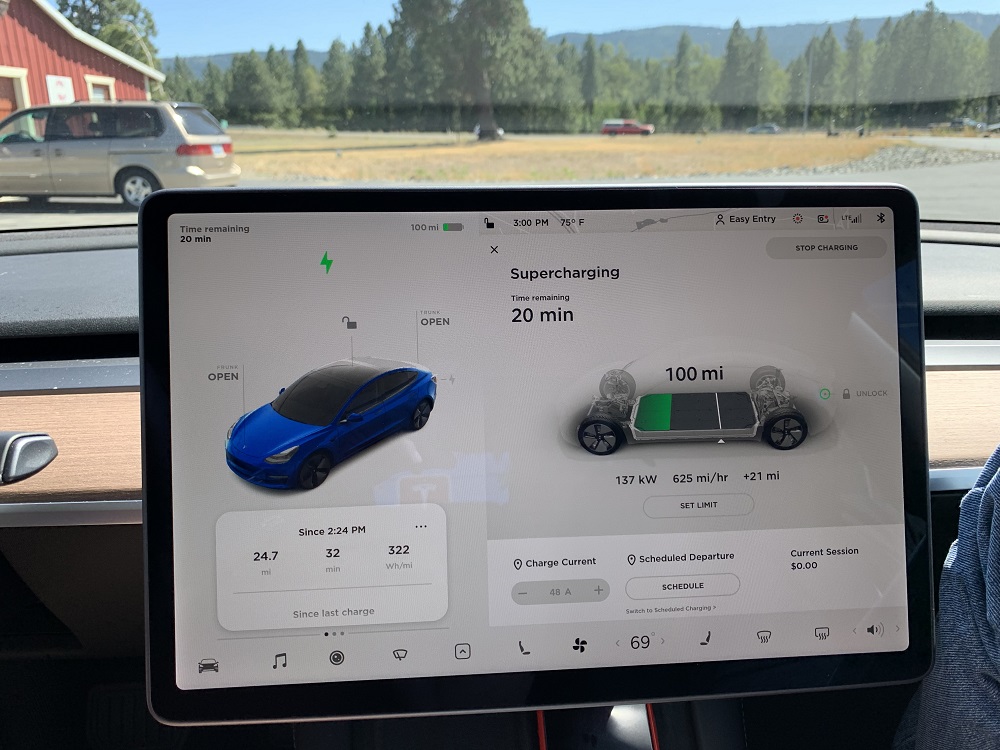
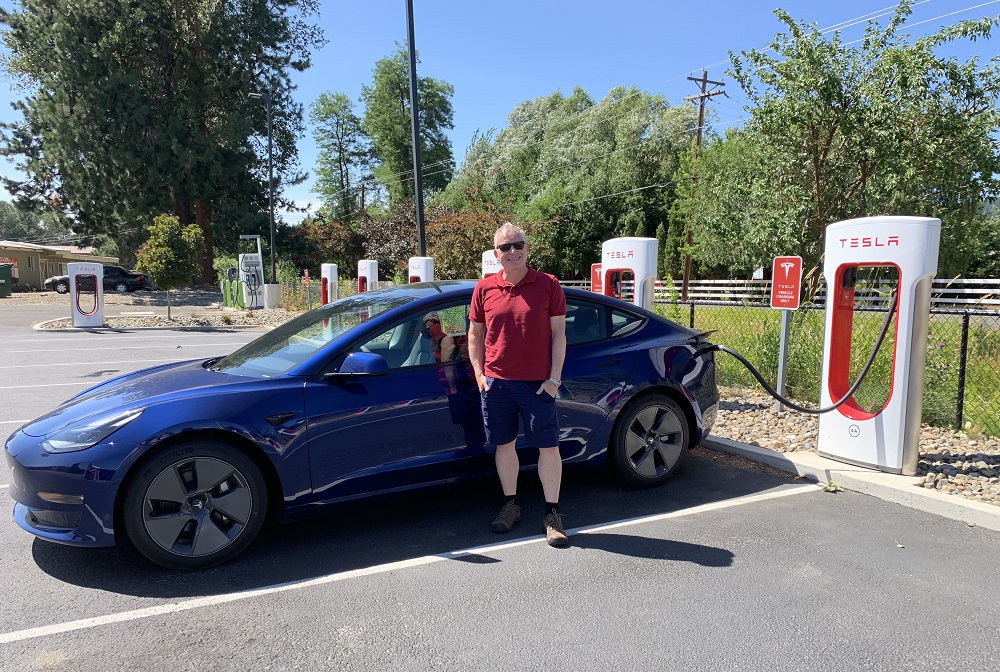
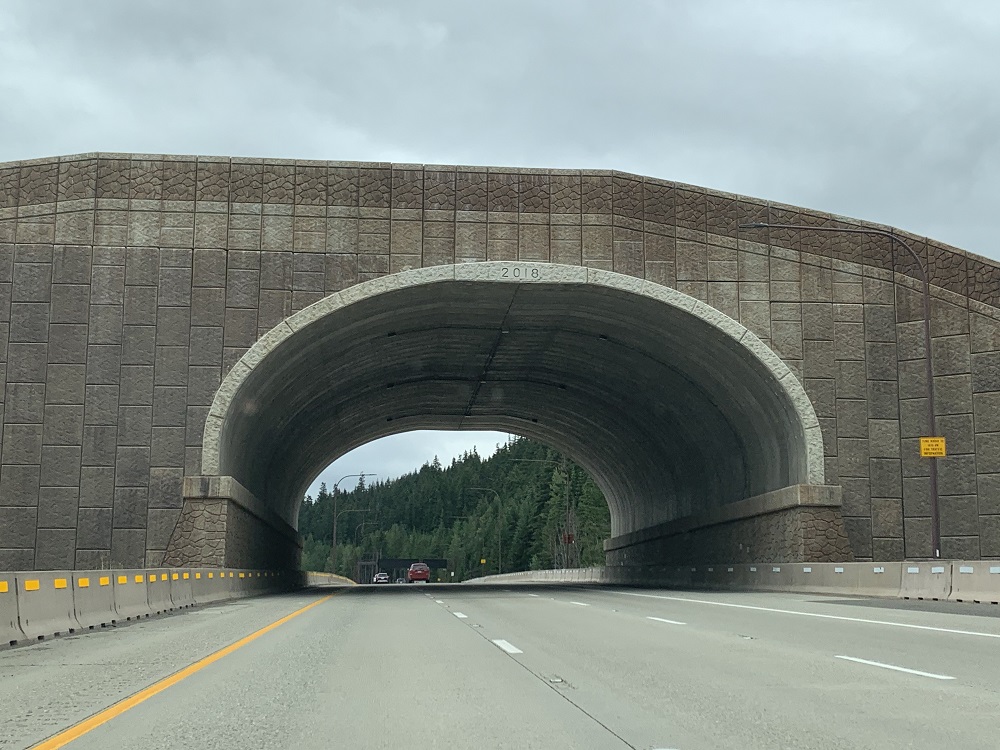
Bryan, Gary and I are ready to go. I punched in the destination address (Bryan’s dad’s in Ellensburg) and up pops the navigation map with the superchargers highlighted in red. It’s only 110 miles to Ellensburg, so we did not need to stop to charge the car on the way there. The screen says there is 248 miles on the battery, and that there will still be 28% of charge left by the time we arrive at our destination.Here’s the rest stop at Snoqualmie Pass (elev. 2,726 ft) off of I-90. The low clouds we had in the city are really low here! Those slopes in the background, on the left, are the ski slopes of The Summit at Snoqualmie ski resort, and would be covered in snow come winter time.Stepping into The Tav in Ellensburg for lunch. A ‘down-home watering hole offering American pub grub, tap brews, simple cocktails, pool & pinball’, says the restaurant’s online description.Frontier Tavern with its Wild West style lettering and red-white-and-blues is right next door to The Tav.Downtown Ellensburg is full of charming old red brick buildings. This one on West 3rd Avenue is dated 1889 and down below is the Brix Wine Bar & Restaurant.So now we’re on our way back, and we took State Route 10 into Cle Elum where a Tesla supercharger was located, to add miles to my car’s battery. The charging screen shows that the charger is working at 137 kW, and adding miles at a rate of 625 mi/hr. So it can add more than a 100 miles of range with just 10 minutes of charging (wow). We stayed for 15 minutes and that was more than enough to get us back to Seattle.I had to pose for a classic Tesla charger picture at the Cle Elum supercharger, of course. There are 8 charging stations. That first charger (on the left in the picture) is positioned so that a car that is towing something, can just pull straight into the bay, instead of backing into the bay the way I had to.Making our way back over the mountain pass. This is the animal crossing over I-90 that was completed in 2018.
Tesla’s highly anticipated beta* version 9 of its Full Self-Driving software is out. This is the version of the software that is called Tesla Vision (camera) only; so it is not using the radar sensor’s input. (I don’t have FSD. I opted out of the FSD functions when I bought my car).
*A version of a piece of software that is made available for testing, typically by a limited number of users outside the company that is developing it, before its general release.
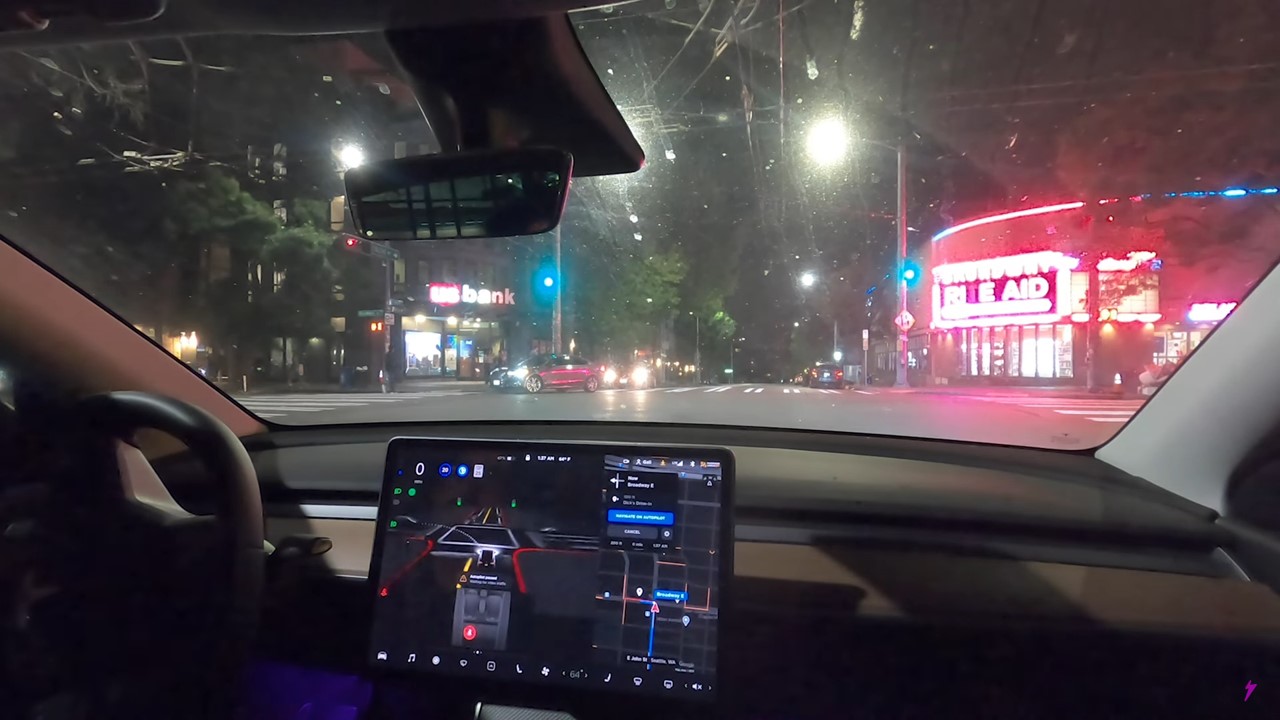
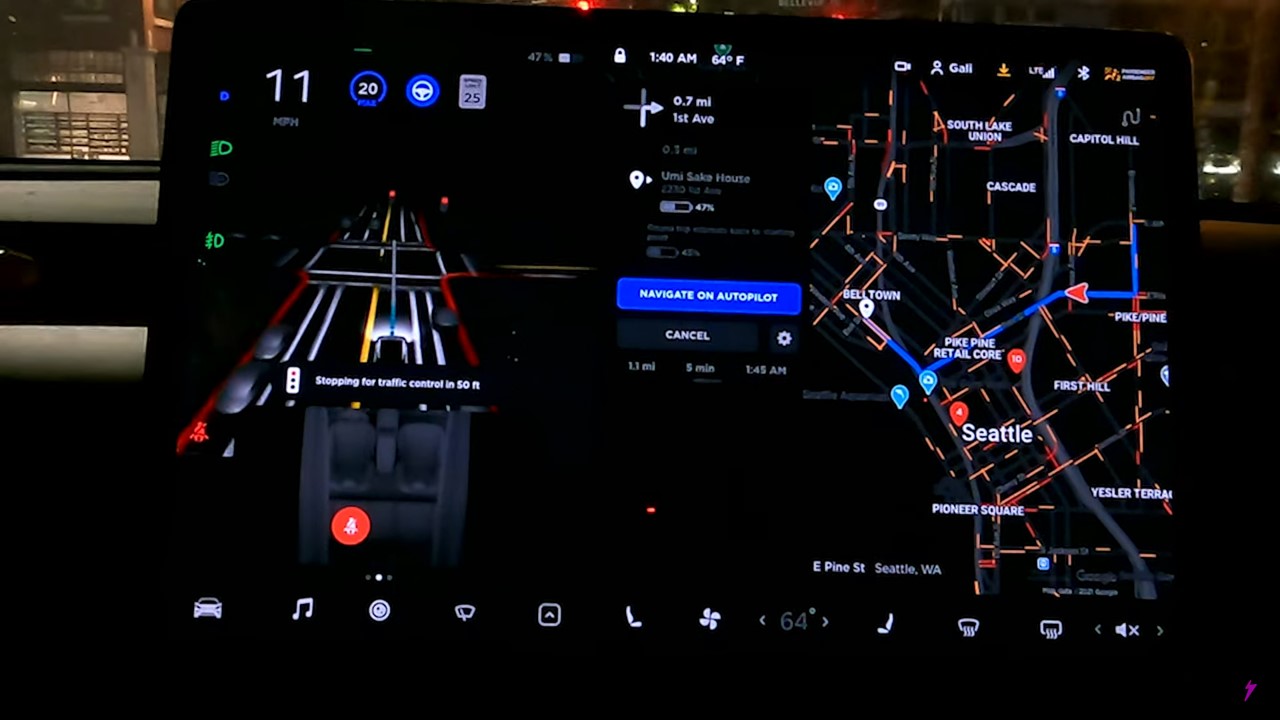
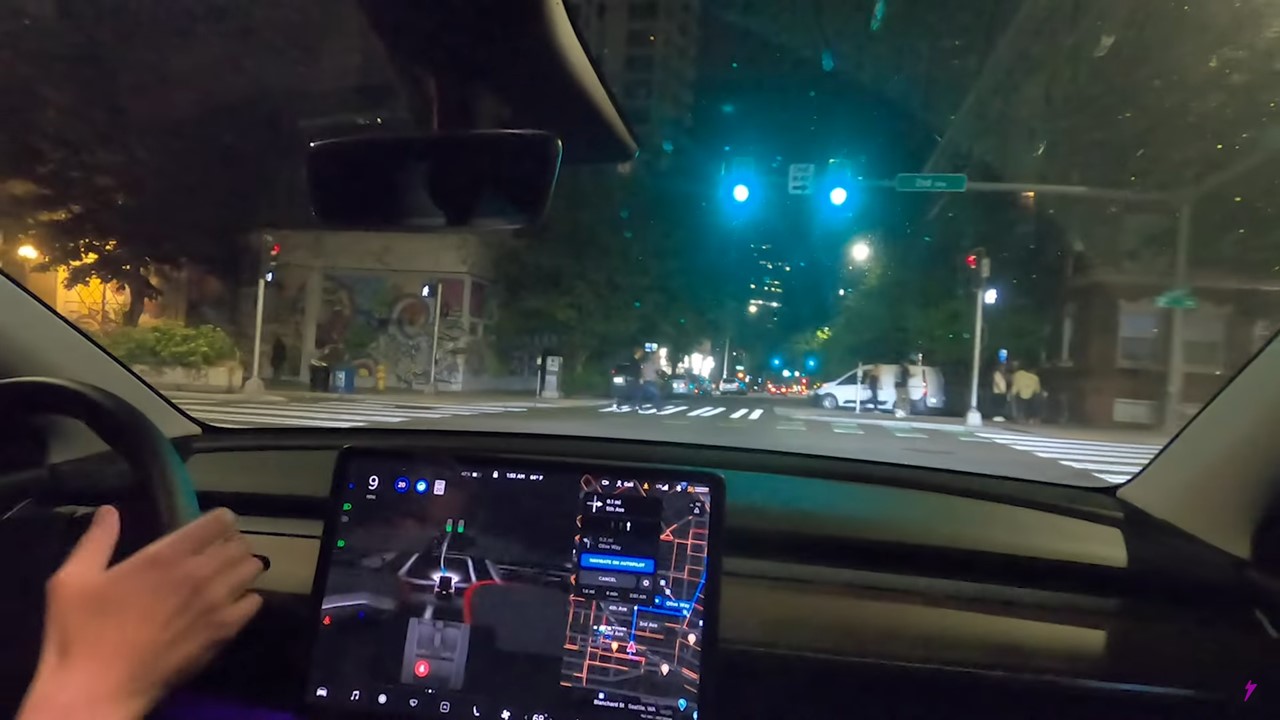
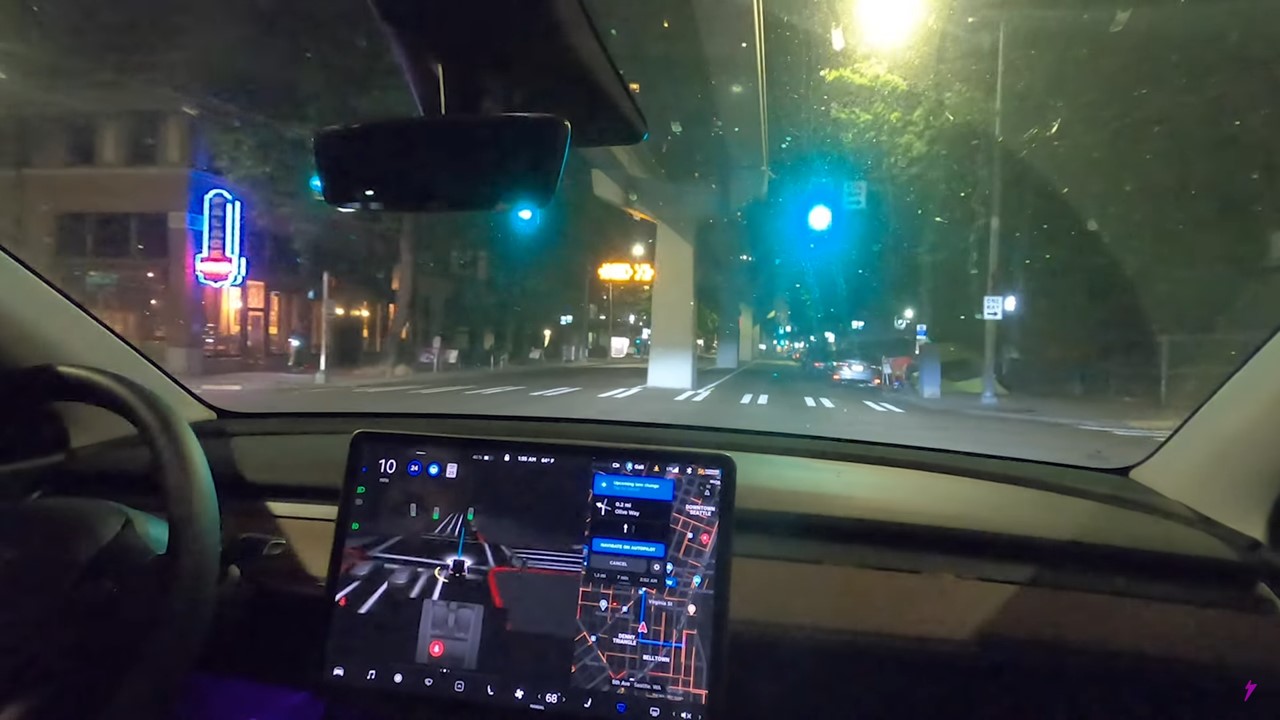
Gali @Gfilche on Twitter took his Model Y for a test drive through the streets on Capitol Hill here in Seattle at 2 a.m. this morning. Here are a few screen shots of a video (on YouTube channel HyperChange) that he posted shortly thereafter.
I know this intersection at East John St & Broadway well. It is always very busy, and even at this time of night there are some cars & pedestrians. The Tesla is about to turn left, and it waited for pedestrians to cross & for the oncoming traffic to turn. Then the light turned yellow, and it was not clear if the Tesla was going to stop or go. The driver intervened and pushed the brake. [Still from video on HyperChange channel on YouTube, posted on Jul 10]A closer look at the new look of the FSD Beta v9 interface. The edges of the road are marked in red, the median in yellow and the path of the car in blue. This is the black background for the night view; the day view would be white. [Still from video on HyperChange channel on YouTube, posted on Jul 10]It’s 2 a.m. in the morning, and drunk pedestrians are running across the street at this intersection, against the red stop light. The car has the green, but detected them, and slowed down; sped up again when the street was clear. [Still from video on HyperChange channel on YouTube, posted on Jul 10]Here are the monorail pillars that divide the two lanes on 5th Ave. This made for a scary moment: the beta version of the software seemed to NOT DETECT the pillars; they were not shown as obstacles in the interface the way they should have been. The car turned on the turn signal to initiate a lane change, at which point the driver intervened and overruled the car. So yes, looks like there are still a few SERIOUS flaws that have to be ironed out in the software. [Still from video on HyperChange channel on YouTube, posted on Jul 10]
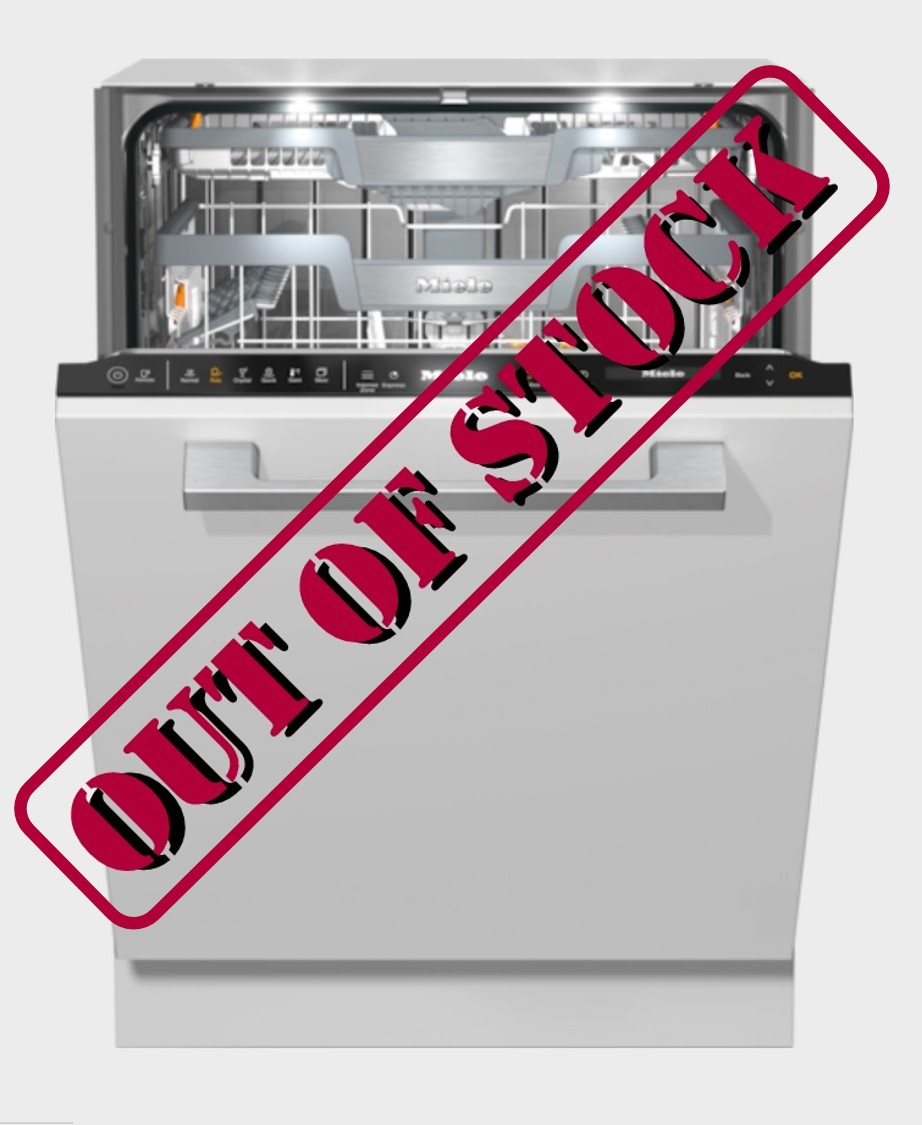
My dishwasher is 19 years old and kaput.
I thought I could just waltz into the Albert Lee appliance store today, and order a new dishwasher.
I was wrong.
There is a widespread home appliance shortage in stores: wall ovens, refrigerators, dishwashers.
I want a machine from German manufacturer Miele. ‘You can pay in full to get a place in line’, said the saleslady, ‘but be prepared to wait 4 to 6 months’.
At home I checked Amazon, Home Depot, Lowes, Best Buy. No dice. Looks like I might just have to wash my dishes by hand for a while.
I took my car to the Tesla Service Center this morning for two very minor repairs. A new owner gets 24 hours after delivery to report any defects, and then these are repaired free of charge. (In my case a tail light cover had a slight chip on the corner, and the trim on one door was slightly misaligned).
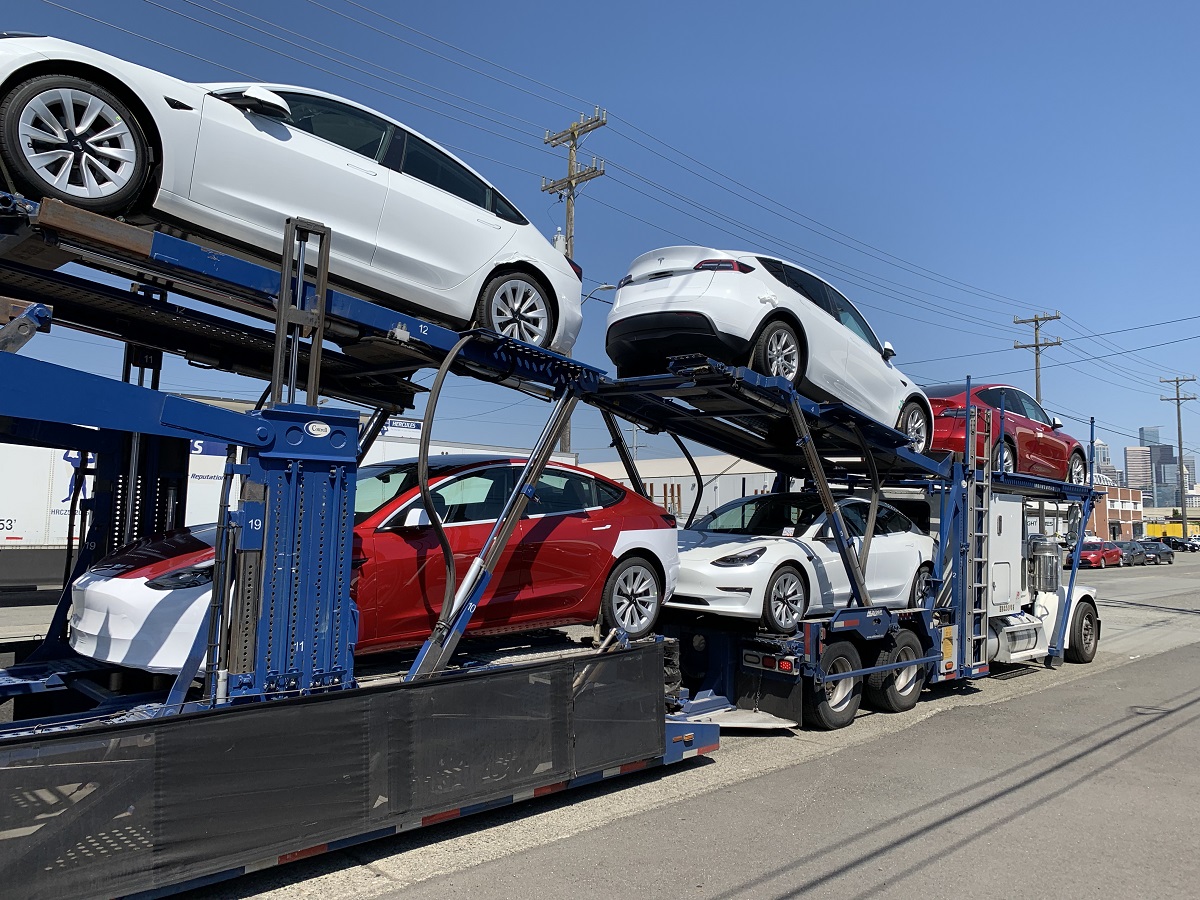
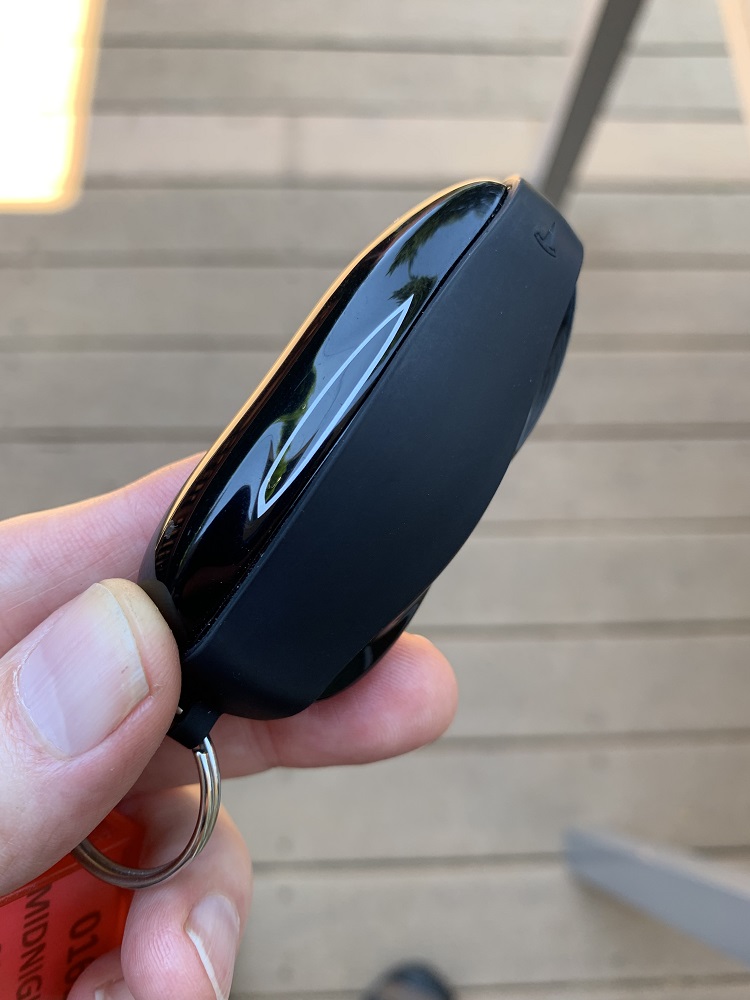
This car-carrying trailer full of red and white Model 3s (all with the 19’’ Sport wheels), was parked at the curb, by the Tesla Service Center at 2200 6th Ave South in SoDo (south of downtown). It must have made the trip to Seattle from the Tesla plant in Fremont, California (the only US plant where Model 3s are made).My loaner car was a Midnight Silver Metallic Model 3. A key fob (shaped like a Tesla car) came with my loaner car. I don’t have one for my car; my iPhone is my key fob. Not all smartphones work equally well as a key fob for the car, and so for some car owners, the Tesla key fob solves that problem (cost: $175). So the key fob gets me into the loaner car. Then there is also a PIN to enter on the touchscreen, to start driving. (I can set up a PIN for my own car as an extra layer of security if I wanted to, as well).
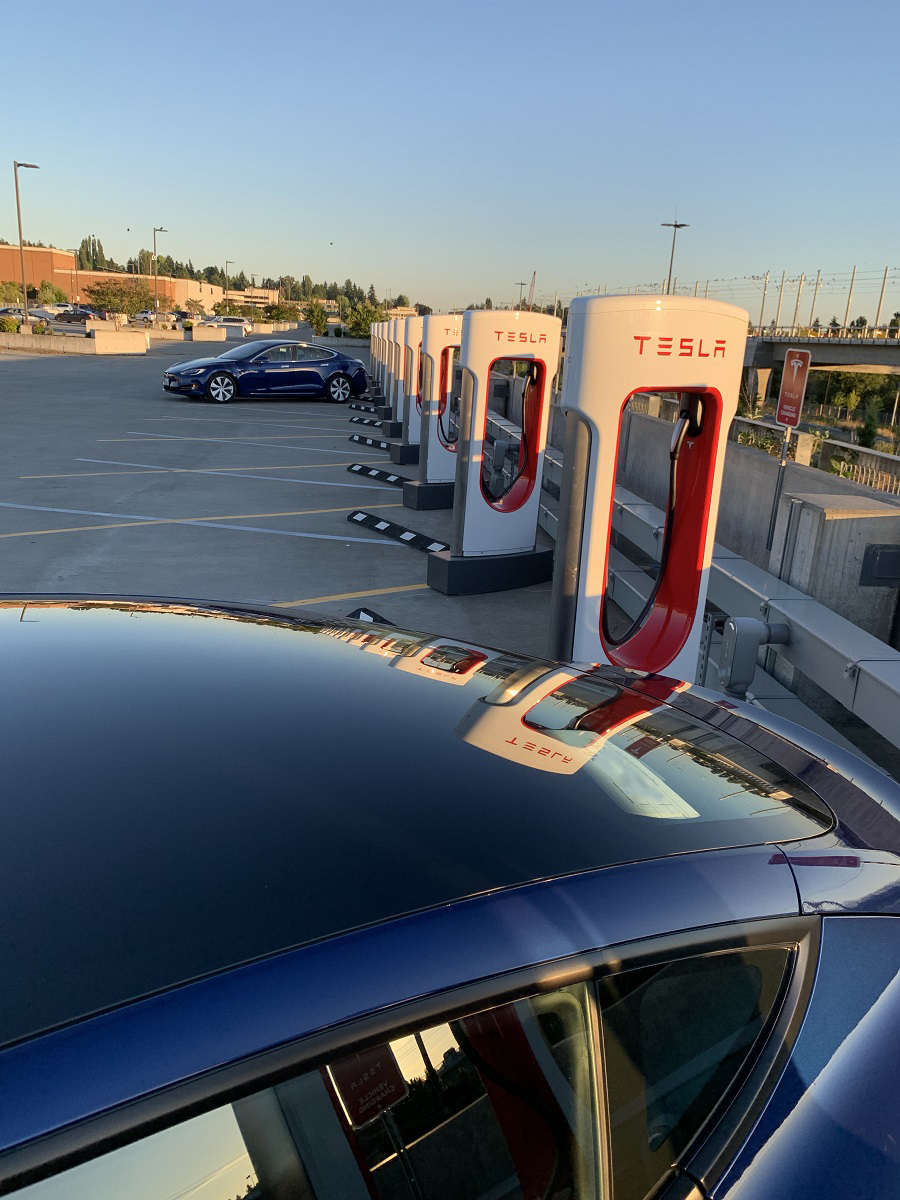
Here’s the Tesla supercharger station at the Northgate Mall off of Interstate 5.
It’s super-easy to supercharge the car. The hardest part for me is to back it nicely into the charging bay in one go. (It’s a new experience for me to use a car with a rear camera view for back-in parking, but I am learning quickly).
Park the car, plug it in. No credit card, no PIN, no thumb print or retina scan :), no nothing— the charger knows it’s your car, and how you will pay. Relax or go grab a coffee, and monitor to see when it’s done.
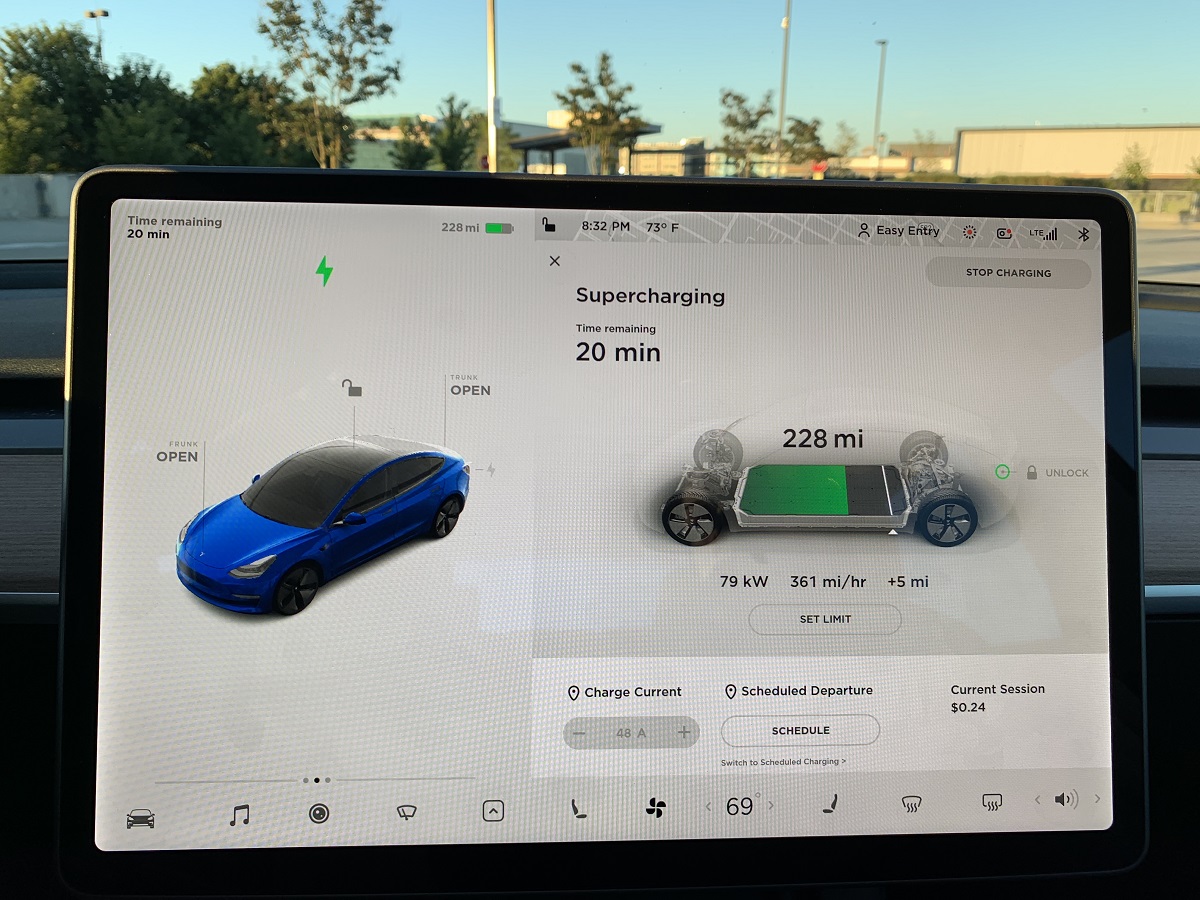
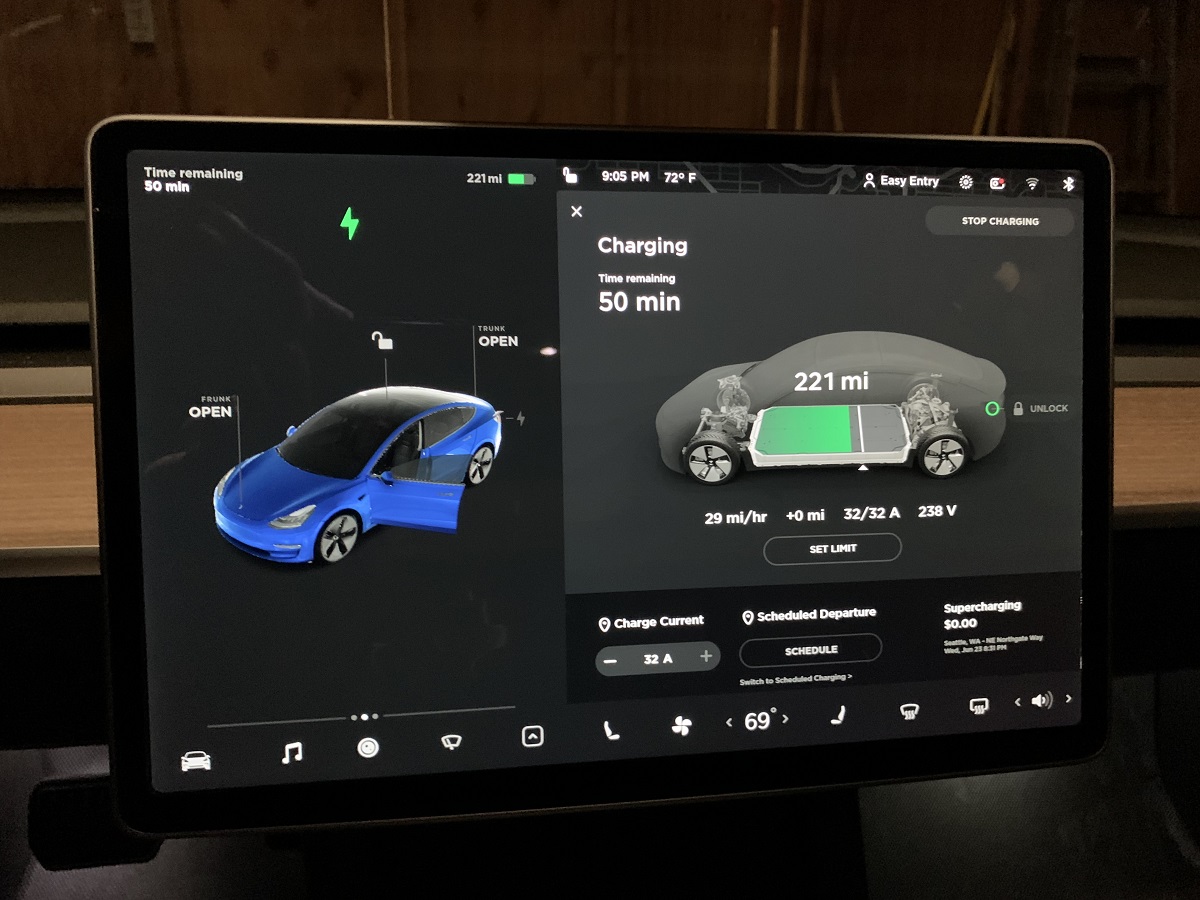
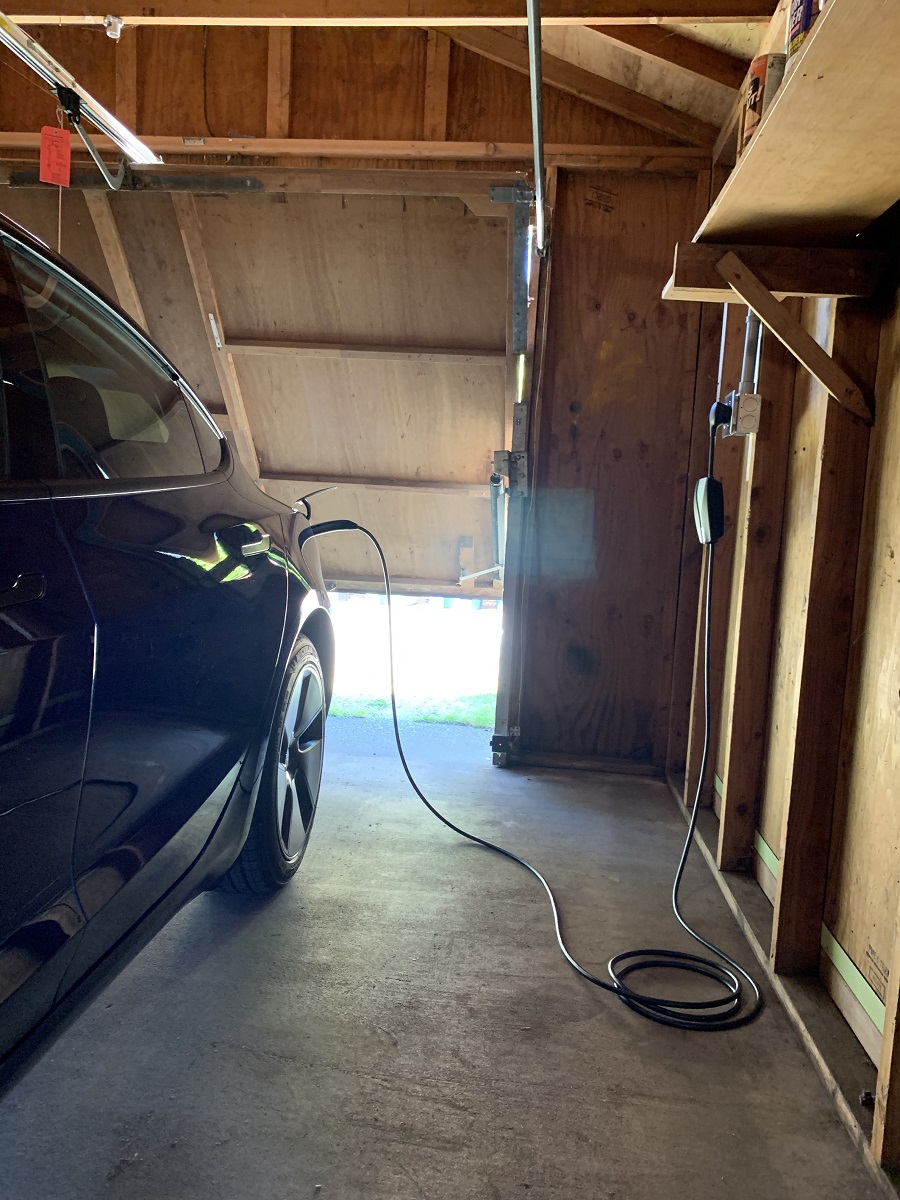
The supercharger station on top of the Northgate Mall parking garage has 16 charging bays, each rated at 250 kW.The status of the charging is shown inside the car (and on one’s phone). That charging rate of 79 kW or 361 mi/hr is 10 times the charging rate that I can get out of my 240 V outlet in my garage at home! The battery is never really charged to 100% (the white stripe on the car’s battery on the diagram shows when the charging will stop; that’s a preference & setting chosen by the driver). Maybe right before a long trip, one can try to charge closer to 100% at home. The charging rate slows down dramatically as the battery approach full capacity. While on a long trip, a battery charged to even just 70% or so, is usually more than enough to get one to the next supercharger. If you hog the charging bay with your car fully charged and ‘abandoned’, as you are take your sweet time at a nearby restaurant, you will be charged for occupying the bay.Here’s my car getting its first overnight/ everyday charge at home. It shows a charging rate of 29 mi/ hr, drawing 32 A of current at 238 V.Picture from Thursday morning. Plug it in when it’s in the garage; plug it out when leaving. (The charging stops automatically when it’s done. The car will not let you drive away with the charging cord still attached).
Well, the wait for my Tesla Model 3 (Long Range AWD) car was over on Wednesday.
A Tesla delivery person showed up with my car at my house shortly after 10.30 am. I signed some papers and handed over a check. We linked up my phone with the car, and that was it, for the delivery.
As for getting behind the steering wheel, completing the setup of the car on the touchscreen, and starting to drive it: I am very fortunate to have friends that have been Tesla owners for awhile, and that have provided me with invaluable pointers and ‘tech support’ from the day I had put in my order nine weeks ago. It would have been a very steep learning curve, with many stumbles, without them.
The 15-in. touchscreen shows the car’s position in traffic, its speed and a navigation map with (optional) driving directions. The screen is also the interface for entertainment and a host of other controls for the car.
There is a standard turn-signal stalk & a gear selector stalk (R N D P) by the steering wheel, and buttons on the wheel for volume control & the sideview mirrors.
Modern cars are all high-tech, but one can argue Teslas are a notch or two above that. The software that controls the car’s interface and functions will be updated from time to time through my home wi-fi network. The car has no key: your phone is the key. ‘The car knows you want to drive when you get in’, as Elon Musk likes to say. On long trips, the navigation map will work out which chargers to go to, and will indicate how many open chargers are available at nearby locations.
My car came standard with some Autopilot* functions – which I can choose to engage at any time. I opted out of getting the ‘Full Self-Driving’ functionality. (*Autopilot is an advanced driver assistance system: automated steering within a clearly marked lane, and matching the car’s speed with that of surrounding traffic. ‘Full Self-Driving’ is automated driving functionality that actively guides the car from a highway’s on-ramp to off-ramp, including lane changes, navigating interchanges, automatically engaging the turn signal and taking the correct exit).
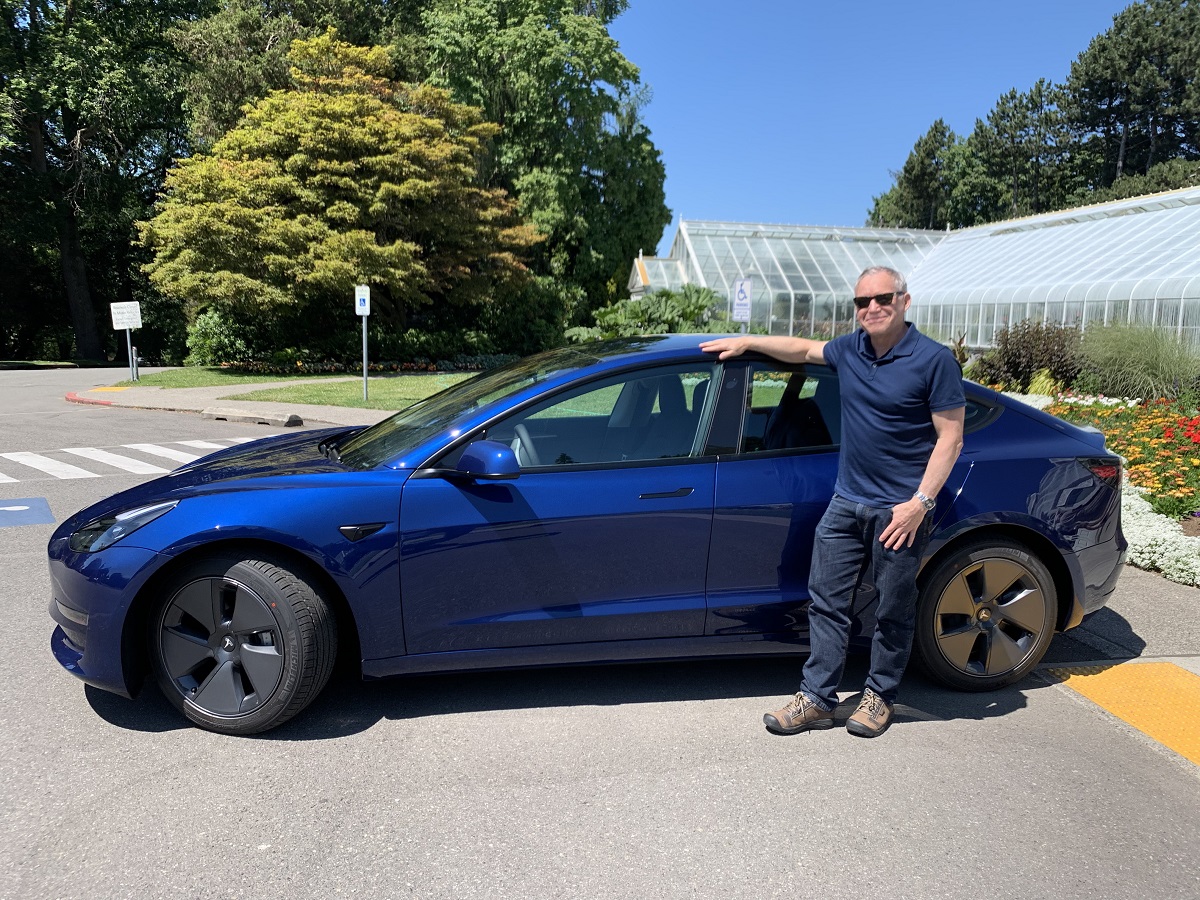
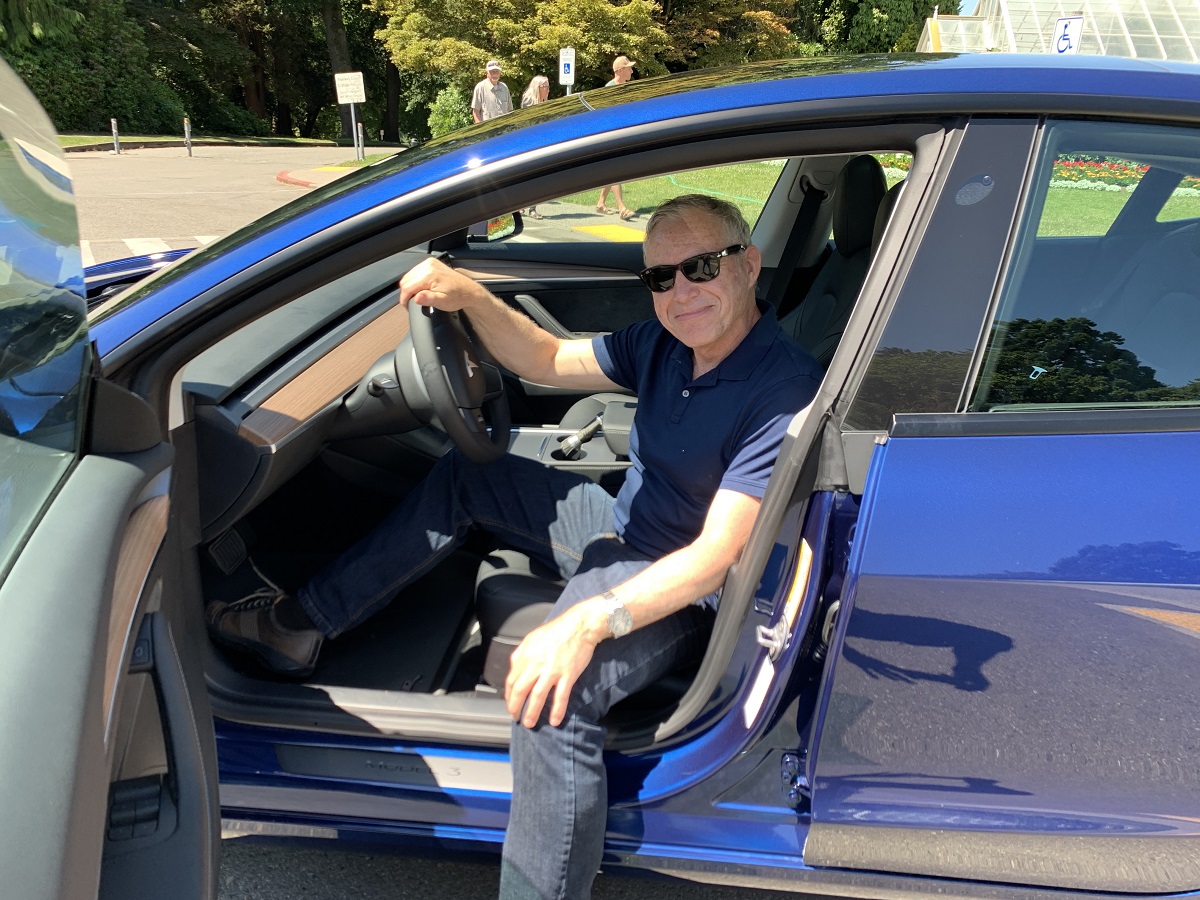
The picked the greenhouse at Volunteer Park as the backdrop for my ‘here’s my new car’ picture. It’s brand spanking new, un-scuffed and spotless only this one time, right?A peek inside the car. The dashboard is very clean — shockingly clean, I thought, during my test drive back in April — and devoid of control buttons and dials. The table below has some of the car’s features.
I love the high-tech, but at the end of the day I am just thrilled to have a car that drives on electricity. No more fill-ups at the gas station for me. I hope that in the not-too-distant-future, all the cars in the world can become electric.
Body
The body is mostly steel, with some aluminum. The 2021 Model 3 replaced the chrome door handles, side mirror trim, window trim, and camera covers with a black finish. It has a double-paned windshield, a powered trunk, and a new center console. Tinted glass roof with ultraviolet and infrared protection. Curb weight is 4,072 lb (1,847 kg).
Motors
Two electric motors (‘dual-motor all-wheel drive’).
Front motor: Alternating Current (AC) Induction.
Rear motor: Alternating Current (AC) Permanent Magnet.
Transmission
Automatic, one-speed fixed gear, 9:1 ratio.
Battery
82 kW-h capacity. Rated range of 353 miles (568 km).
Wheels
Aluminum, aerodynamic covers. Four-wheel disc brakes with anti-lock braking system; regenerative braking to extend battery power.
Controls inside
LCD touchscreen in landscape orientation that combines the instrument cluster and infotainment. Heating and air-conditioning cooling efficiency increased by heat pump with octovalve.
Another week, and still no call from the Tesla dealership (saying ‘your Tesla is ready for pickup’).
I still don’t have my vehicle identification number (VIN), though, so I did not really expect a call this week.
The VIN is needed to finalize/ update one’s auto insurance policy, prior to taking delivery of the car.
A Tesla bot or a Tesla person did send me an e-mail today, saying ‘We are working to get you behind the wheel of your Tesla as soon as possible‘.
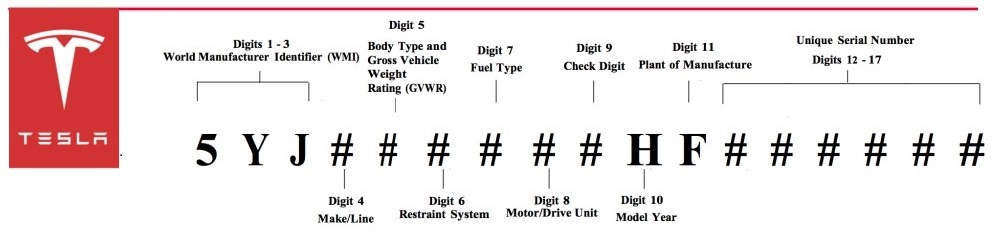
Here’s how to decode a Tesla VIN. 5YJ means Tesla made the car; I think Position (‘Digit’) 4 will be M; not sure of 5; 6 will be D for “Type 2 manual seatbelts (FR, SR*3), PODS.”; 7 will be E for Electric, not sure of 8 & 9; 10 will be M for 2021, as prescribed by the NHSTA; 11 will be F for Fremont; last come the 6 digits for a unique serial number. (This means any one plant will never produce more than 999,999 vehicles in any one model year, which seems a reasonable assumption!). [Information from Charles Benoit online at Electrek]
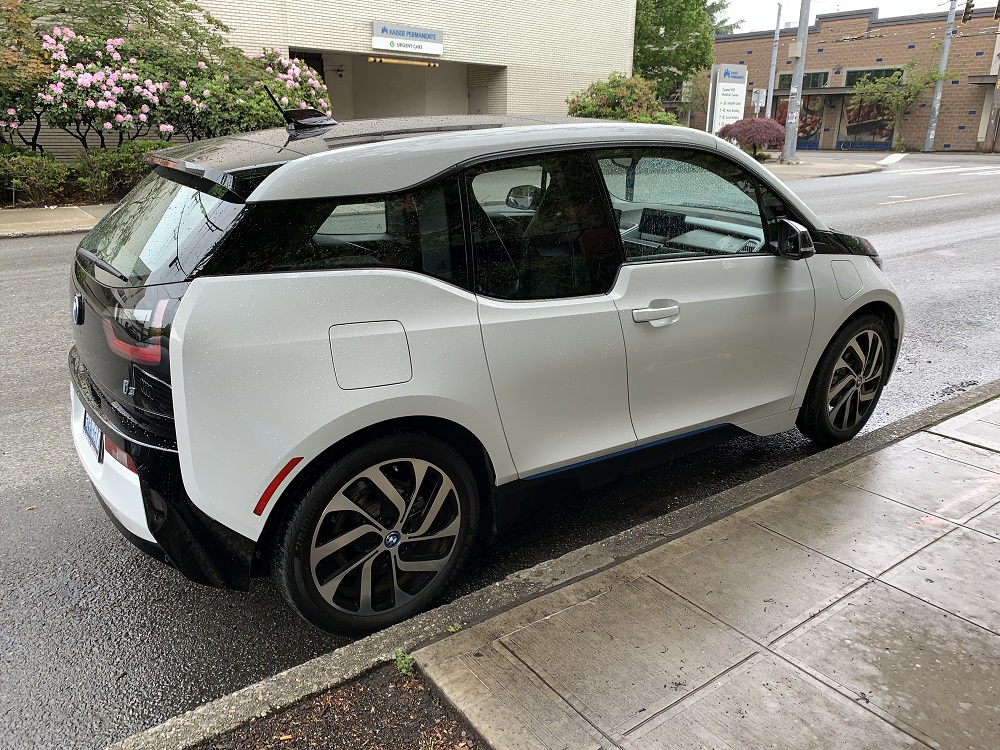
Here’s a new BMW i3 that I found this morning, on the way to the Safeway grocery store. (I tagged along for a little test drive of one in 2014).
I see more Tesla Model 3 cars here in the city than I do BMW i3 ones. Or could it be that I have eyes for Teslas only? That’s definitely possible.
I went to the BMW website and mocked up an order for a BMW i3, and the car actually comes to a few thousand more ($44,450 MSRP as built) than Tesla’s Model 3 Standard Range Plus (cheapest Model 3).
This for a compact car with a 153 mi range vs 263 mi for the Tesla & 42 kWh battery vs. 54 kWh. The BMW might be more suitable for navigating the narrow alleys and cobblestone streets of old European cities, though.
This is a 2021 BMW i3 (color: ‘Capparis White’). There is also a BMW i3s (for sport; increased power, handling, slightly different look). BMW still make both of these with gasoline engine ‘range extenders’ as well. These BMWs are all made in Leipzig, Germany. The first ones rolled off the production line there in Sept. 2013.
Apple announced today that iOS 15 will enable the iPhone wallet to store ID cards and driver’s licenses (and maybe vaccination records?).
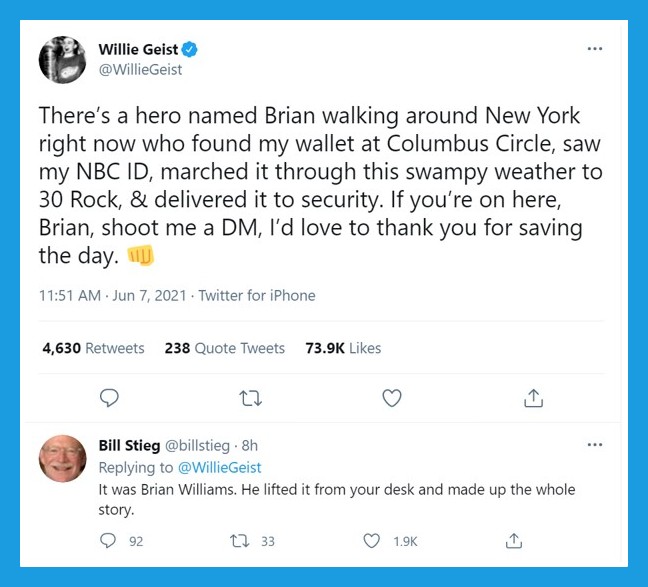
That’s good news for people like me and Willie Geist of NBC. (See below. He lost his wallet today).
It’s great that Willie Geist got his wallet back. The worst ‘lost wallet’ event that had happened to me, occurred in Aug. 2011, when mine was stolen out of my backpack in The Landmark mall in Hong Kong. An accomplice distracted me on an escalator, while the thief stole my wallet. My wallet should not have been in my backpack, of course! They must have watched me withdraw cash from an ATM, and saw exactly where I had put the wallet away. So $400 of cash gone, driver’s license and credit cards. In the hour or so it took me to get back to the hotel and call American Express, the thieves had spent $2,600 at the Louis Vuitton store. (AmEx credited the money back onto my card, dollar for dollar, and apologized for my distress).
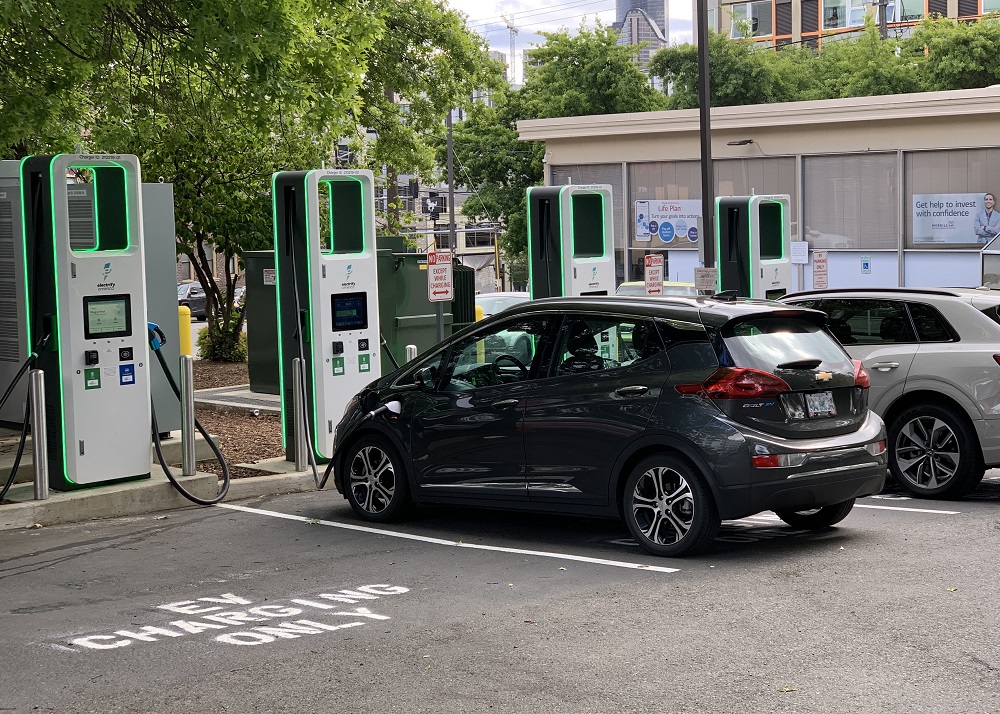
Here’s a little Chevy Bolt from Oregon getting charged at an Electrify America charging station here on East Madison Street on Capitol Hill.
It’s early days for building out the charging network. There are 612 of these EA stations across the country with 125 more coming online soon. (There are 168,000 gas stations in the United States).
These charging stations are for out-of-town or out-of-state travelers. In general, it’s much, much more expensive (up to 3x, 4x more) to charge one’s car at these stations, instead of at home.
On top of that, we have the cheapest electricity in the country here in Washington State at 8.53¢/ kWh (source: electricitylocal.com). At this station, the charging cost is $0.43/ kWh, or $0.31/ kWh plus a $4 monthly fee.
Tesla cars can be charged here, but Tesla has its own charging station network (cost is about $0.28/ kWh).
P.S. I see that Associated Press reports there are roughly 42,000 public charging stations in the United States, but only about 5,000 are considered direct-current fast chargers. The Biden administration is looking at incentives to encourage companies and governments to build 500,000 charging stations nationwide by 2030.
The Electrify America charging station at 1300 East Madison St here on Capitol Hill. The station offers two charging protocols: CHAdeMO which is a DC fast-charging protocol for Japanese vehicles like the Nissan Leaf and Mitsubishi iMiEV, and CCS (Combined Charging System) chargers which is also a DC fast-charging protocol, but for European and American cars. The “combined” term in the CCS name designates its capability to incorporate the Level 2 (J1772™ standard) plug and DC fast-charging connector into the same larger plug.