I unpacked my bags today, and started going through my mountain of junk mail.
It’s bitterly cold on the East Coast (Boston at -6 °F/ -21°C), and frozen iguanas are falling out of the trees in Florida. Zoologists say they will ‘thaw’ again and come back to life. Here is Seattle it was a balmy 49°F/ 9°C today, with rain.
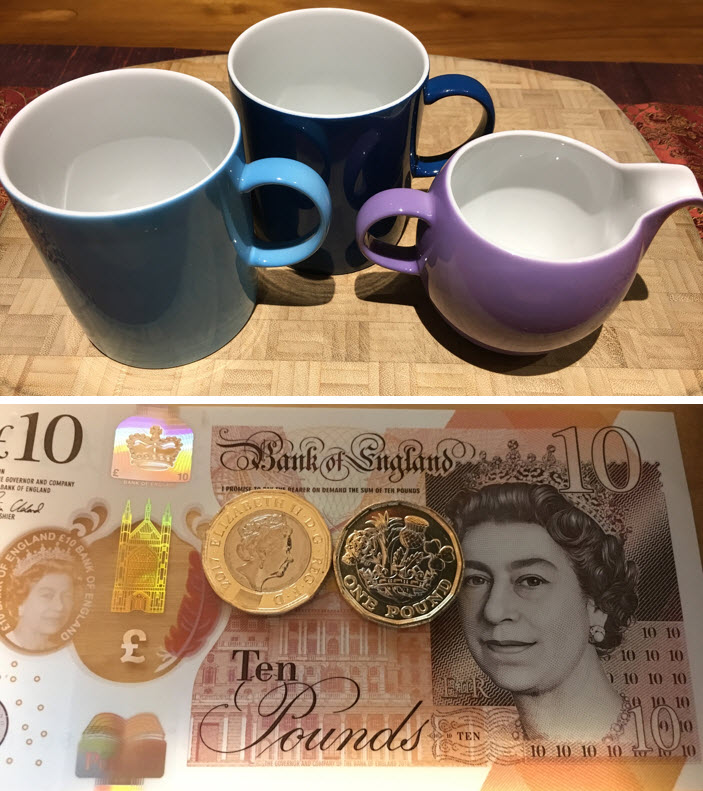
Top: My porcelain mugs and creamer survived in my luggage without breaking. It’s for my coffee in the morning, and from porcelain manufacturer Rosenthal’s factory in Selb in Bavaria, that dates back to 1879. I love the colors and the simple design. Bottom: I took advantage of my stop at Heathrow to get my grubby hands on the shiny new 12-sided one-pound coin, as well as the new £10 polymer note with its cool holographs. The first note printed was reportedly given to the Queen, the second note to Prince Philip, the third to Theresa May (Prime Minister), and the fourth to Philip Hammond (Chancellor of the Exchequer).
From the toy store at Heathrow airport: a cute little ‘Celebration’ teddy bear.
I’m home from my world travels, east and west, north and south.
Our flight to Seattle today went without incident. My checked bags that British Airways had held overnight, had made it onto my new flight as well.
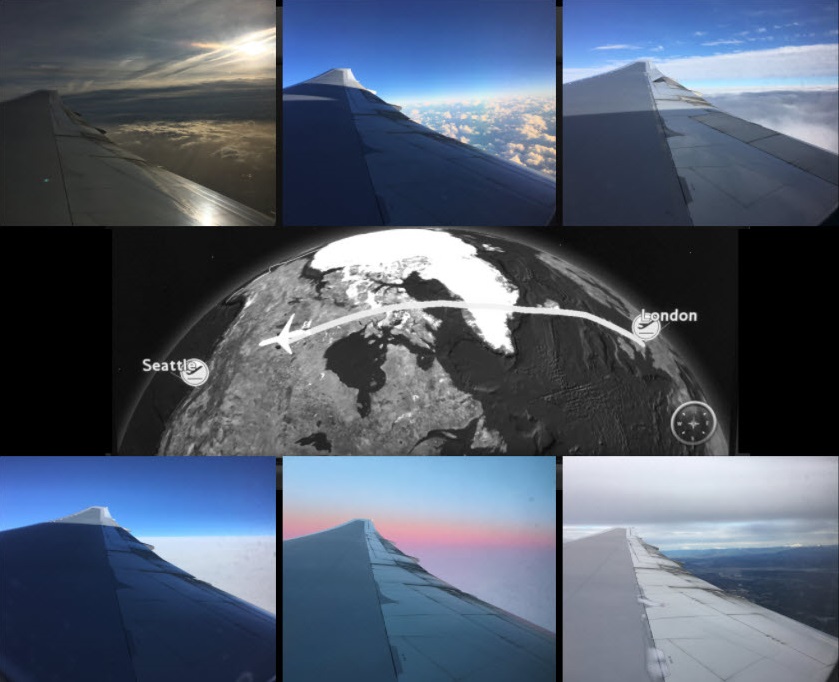
The flight path shows us about 7 hours into the 10 hr flight, crossing over Iceland, Greenland and Canada. I sat on the wing of the Boeing 777, and snapped the sky outside every few hours.
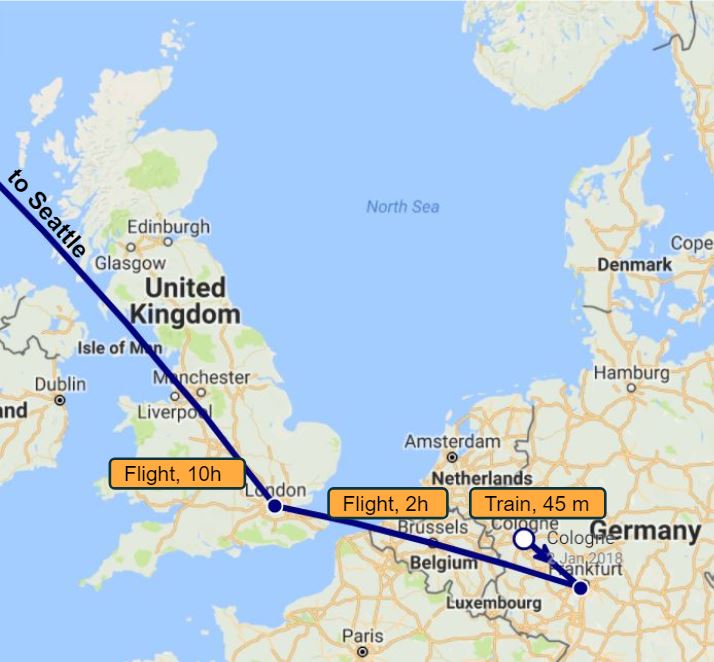
I missed my connection to Seattle. We left Frankfurt way too late. High gusting winds (across Europe today), delayed our departure by 50 minutes. Then upon arriving at Heathrow’s Terminal 5, we spent another 20 agonizing minutes on the tarmac, waiting for a gate to open.
As soon as I got off the plane, I made a run for it. There was still 10 minutes to spare to the Seattle departure time, but no-no-NO! – not enough time, they said at the security check point, stopping me. (Why is there another security checkpoint for connecting passengers? Maybe it’s a United States destination thing only.)
So now I stood in line at the British Airways counter for 40 minutes. Re-booked my ticket to Thursday. Exiting through passport control took even longer. One ‘crosses’ the UK Border into the UK (big bold letters at passport control). By the time I made it to the airport hotel it was four hours later. But hey! Today is done, tomorrow is another day, and I will have another shot at making it home.
Clockwise from top left: boarding the British Airways Airbus A320 at Frankfurt airport | Approaching Heathrow airport; that is the city of London and the Thames river below | Baggage claim but no bags for me: they hold it and will put it on the Thursday flight. Luckily I have a change of underwear and socks in my backpack! And I wear the British Airways emergency pack XL t-shirt as a night gown 🙂 | Our ‘HotelHoppa’ shuttle bus at Terminal 5.
7:00 am My bags are packed! I am taking the train back to Frankfurt this morning.
Shortly after twelve noon I will board British Airways to London, and then on to Seattle from there.
11:00 am I made it to Frankfurt Airport .. but Deutsche Bahn made me sweat a little. My original train was delayed by more than an hour, and then the rebooked train was late as well. Then my phone’s British Airways app said ‘Sorry, missed connection’ and I thought Oh no! the flight to London must be completely delayed. But no, there was on problem – it was just that the app could not find a network to connect to.
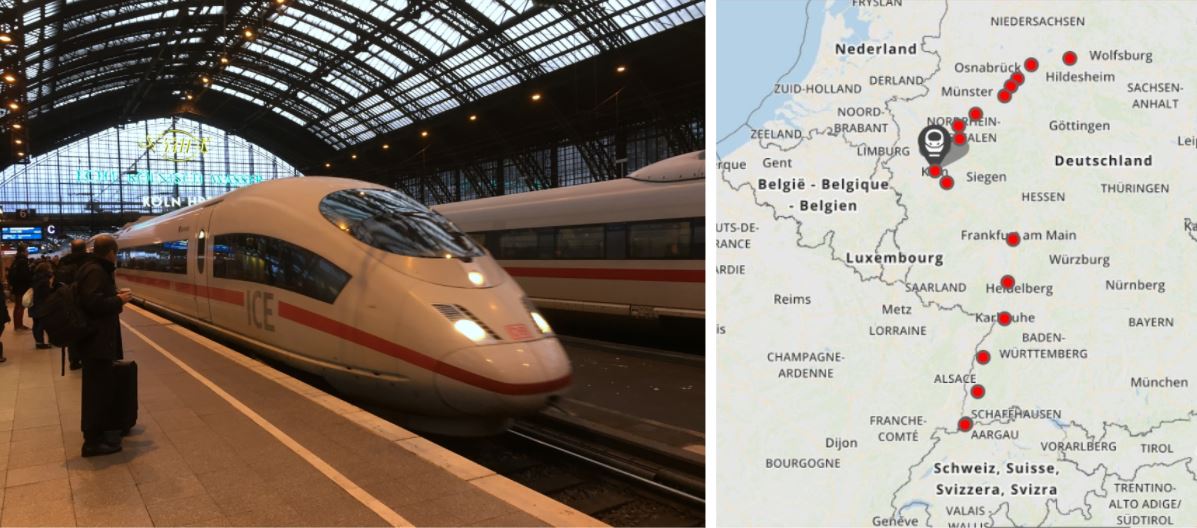
Here’s the ICE train at Cologne main train station. It came from Hannover, and was heading to Basel. Luckily it made stops in Cologne and at Frankfurt airport, and I could hop on.
Today was my last day in Cologne. The museums and shops were finally open again after being closed Sunday & Monday. I only made it to two museums, though: the Museum Ludwig and the Chocolate Museum.
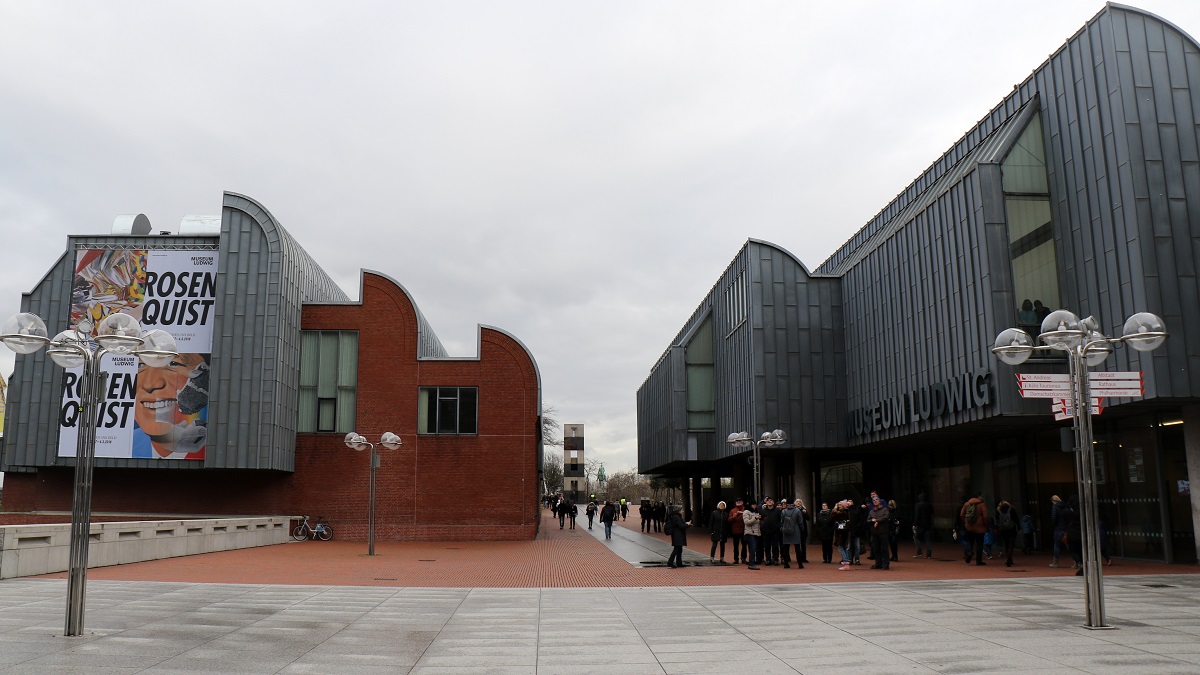
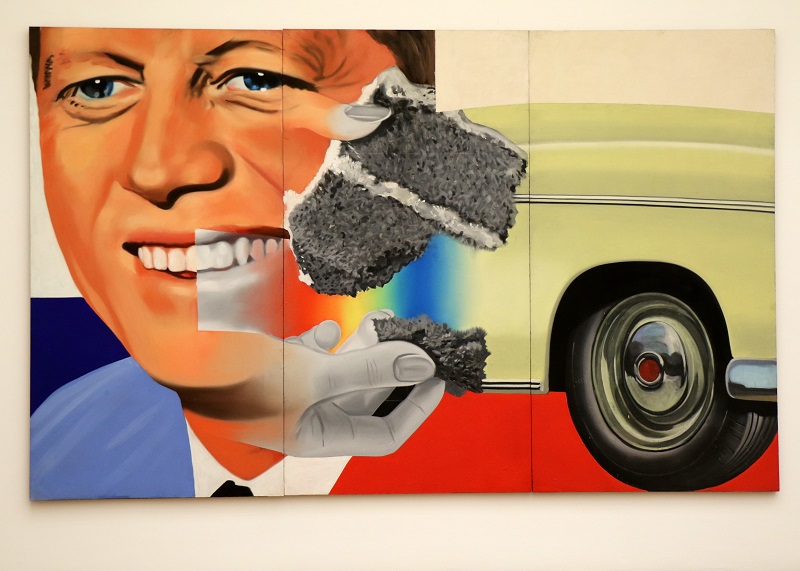
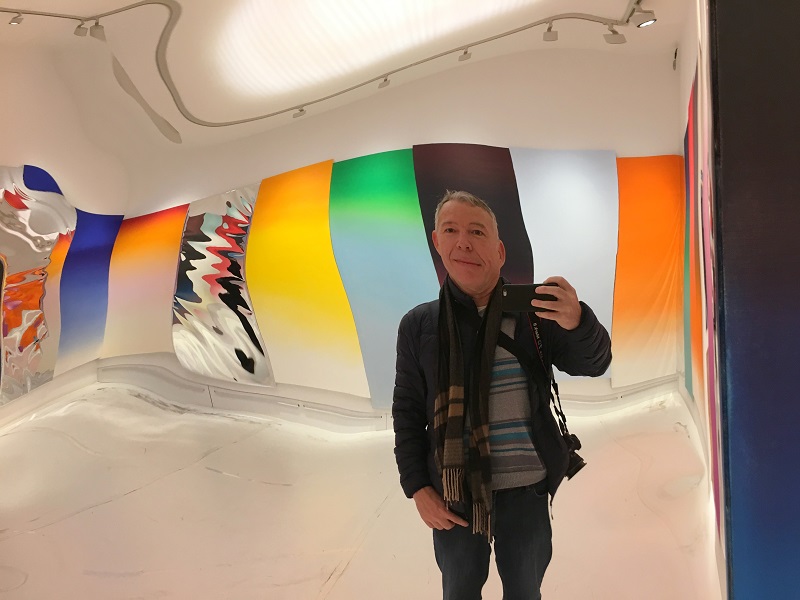
Museum Ludwig was established in 1976. This building near the Cologne Cathedral opened in 1986. The museum has artwork from the collections of lawyer Josef Haubrich (born 1889, died 1961) and of chocolate magnate Peter Ludwig (1925- 1996). It has one of the largest collection of Picasso’s artwork in Europe. The ‘Rosenquist’ sign on the left refers to a current exhibit of art of the American James Rosenquist, a pop-artist and contemporary of Andy Warhol and Roy Lichtenstein, who passed away in March 2017.One of Rosenquist’s best-known pieces from the early 1960s. It is called ‘President Elect’ and is a billboard-style painting, depicting John F Kennedy’s face alongside a rainbow, a yellow Chevrolet and a piece of cake.This is ‘inside’ a Rosenquist work called ‘Horizon Home Sweet Home’ (1970). It is a series of colored canvas panels on a room’s four walls. Some panels have aluminized mylar (plastic) stretched onto a frame, that creates distorted reflections of the other colored panels.
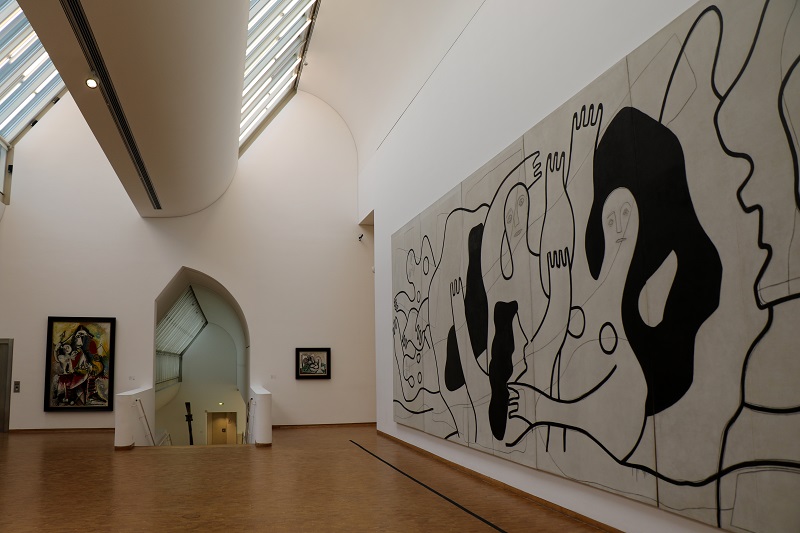
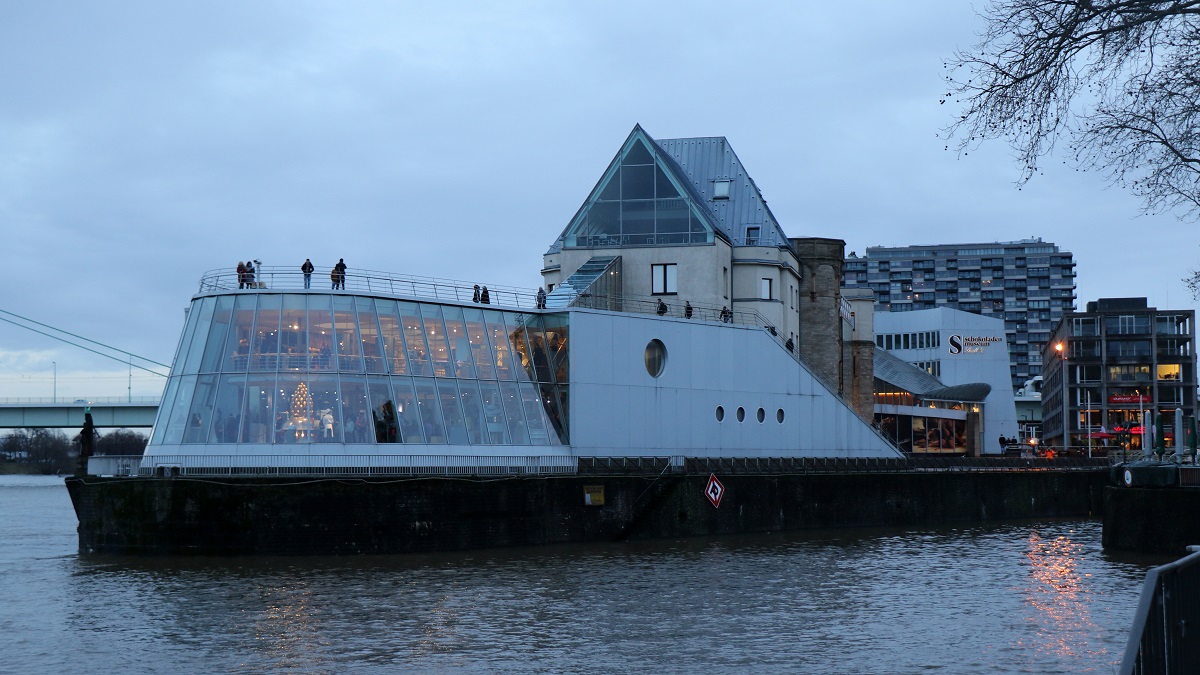
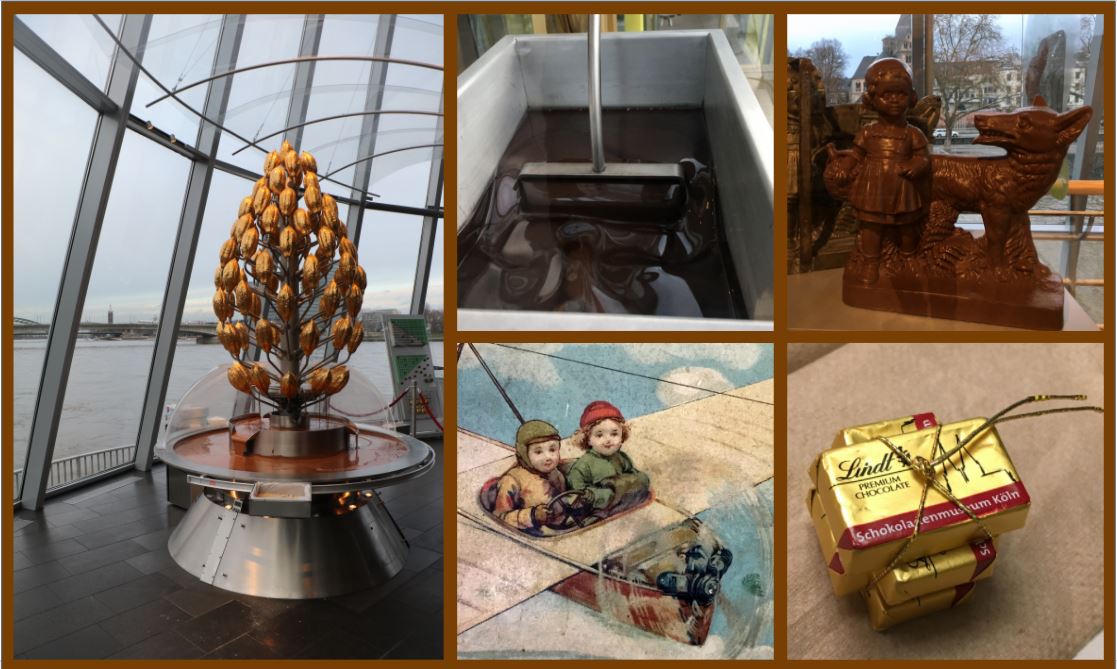
This is upstairs, and I thought the giant mural on the right is a Picasso, but it is not. The artist is Fernand Léger, a contemporary of Picasso, and the painting is called ‘Les Plongeurs'(The Divers), 1942.Here’s the Chocolate Museum. It is on the Rhine, and it looks like a river ship. It’s only 4.30 pm, but the sun is already setting.Sights inside the Chocolate Museum, clockwise from the left: giant cocoabean chocolate fountain | Molten chocolate with roller-stirrer driven by a simple motor, from Lindt | Red Riding Hood and the Wolf in chocolate | A little souvenir handed to one at the exit (entrance fee is €11/ US$13) | one of a large collection of charming old chocolate bar wrappers.
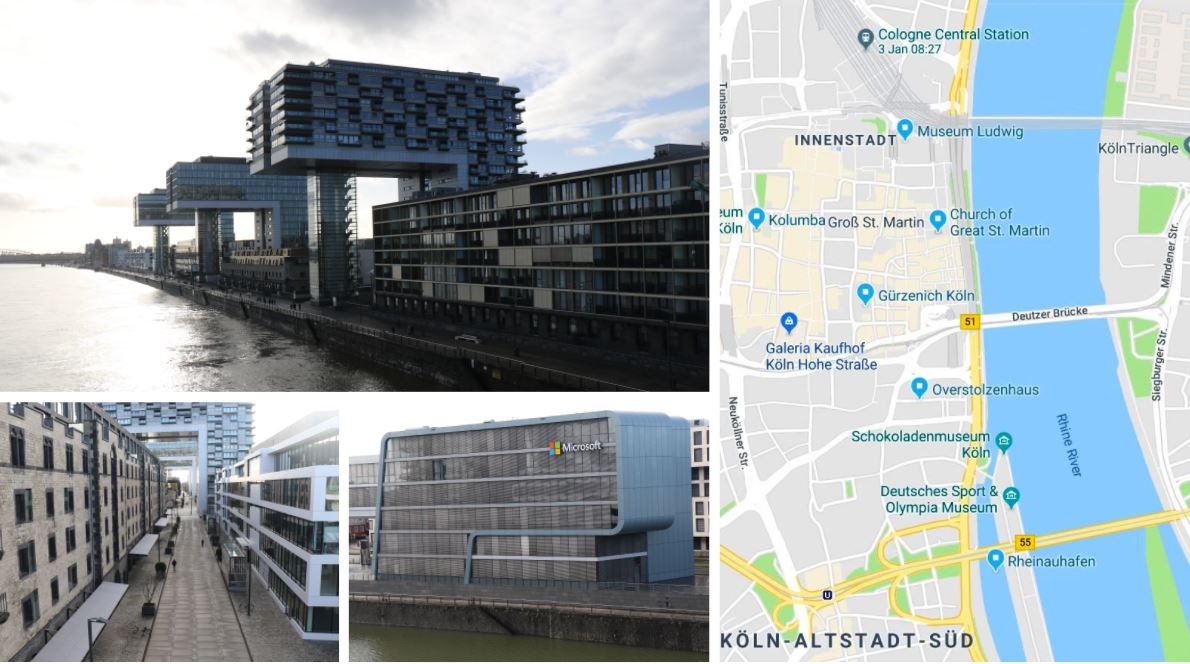
I spent some time in Rheinauhafen (‘Rhine old port’) today. It is a former port facility on the Rhine*, now rebuilt into modern condominiums, offices and commercial buildings. A Microsoft office building was completed in 2008, the main condominium building in 2009, and most of the other buildings a few years before that, or a few years later.
*Cologne is the largest city on the Rhine. Here in Cologne it is the Nieder-Rhein (the lower Rhine).
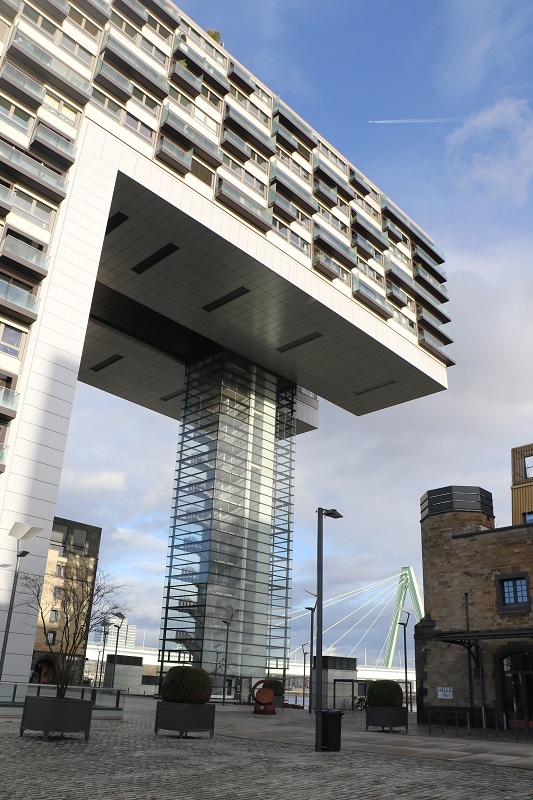
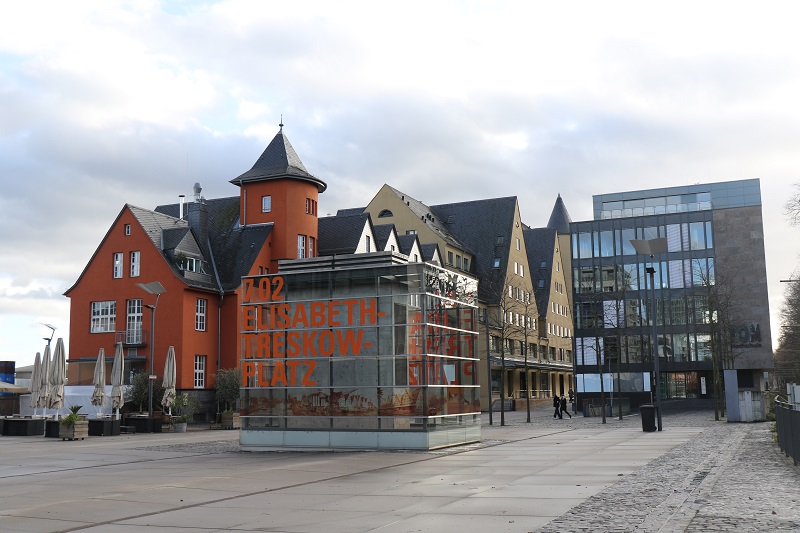
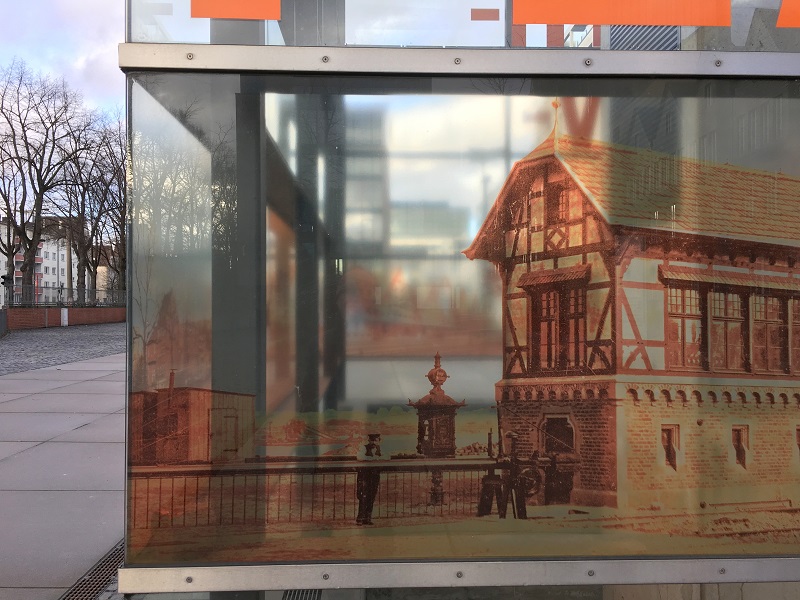
I did the best I could do with my photo of the three dramatic Kranhäuser (‘harbor crane’) buildings, shot into the sun. They each have two-part outrigger sections that rest only on a slender, fully glazed staircase tower. These are just below the Severin Bridge (yellow on the map), and on the little peninsula in the Rhine. The Microsoft office (picture bottom middle) is across the canal, on the true riverbank.A close-up of the residential building. The green triangular column and spans in the background are of the Severin Bridge. A realtor’s office advertised a few of the units that are for sale. Sample numbers: 2 bedroom, 130m2 (1,400 sqft) unit goes for €1.1 million (US$ 1.3 million). A 3-bedroom was for rent for €3,650 pm (US$ 4,400).These buildings are a little further down south from the Kranhäuser buildings. The ones on the left have an old or classic architecture, but they are almost brand new, from what I can tell. The modern brick and glass building on the right is a high-school. MY high school did not look like that! (I wish it did).I love this old sepia picture, printed onto the glass enclosure of a kiosk, with the – port worker? who was he? – resting his arms on the fence. A great way to acknowledge the rich history of the port.
I spent much more time walking today than I did on the trains on the U-bahn. It was good for sight-seeing, but I feel it in my legs and feet tonight.
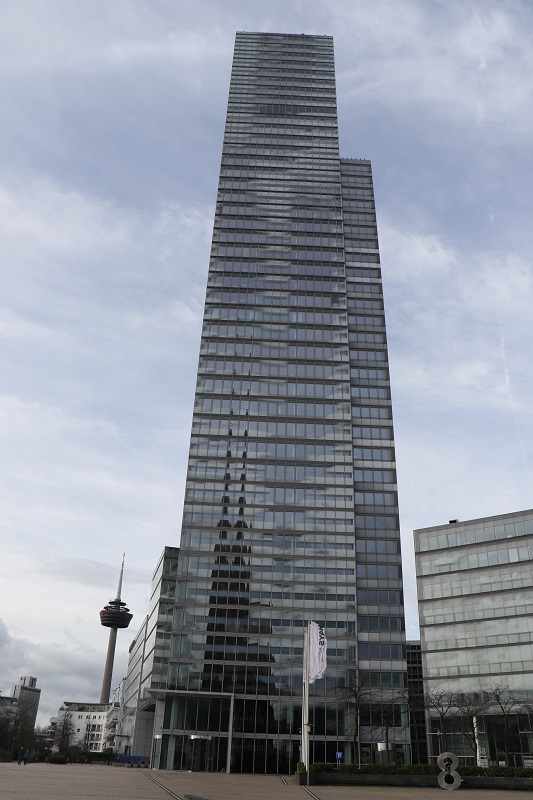
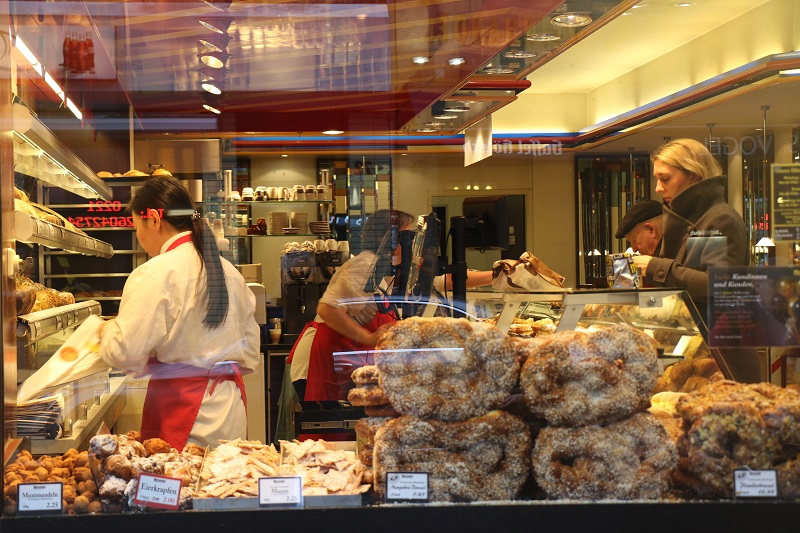
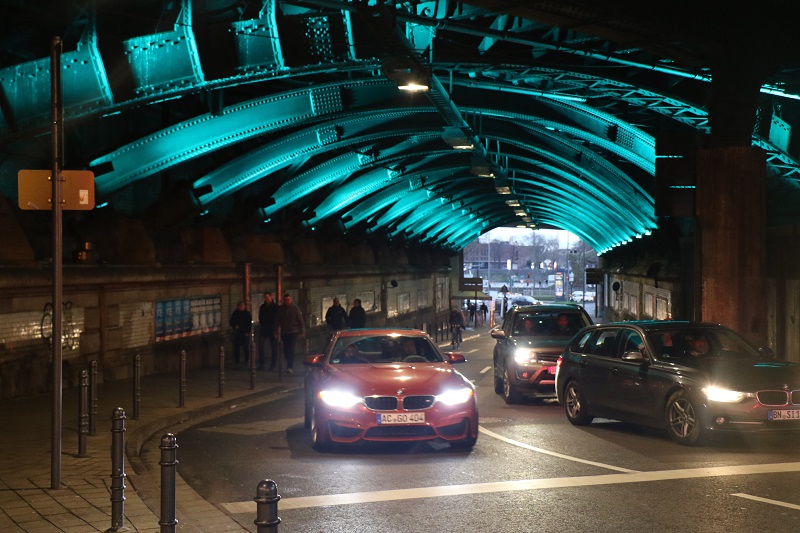
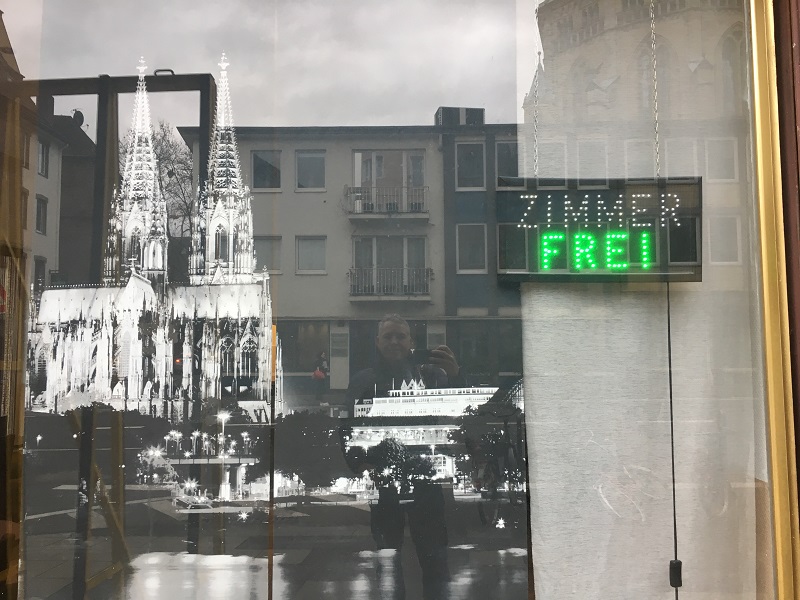
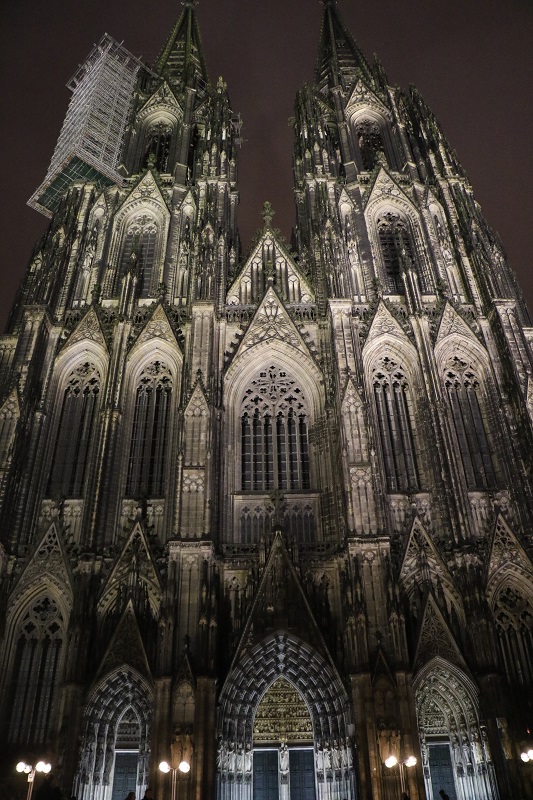
Here is a map of the Cologne altstadt (old city). Pictures clockwise from top left: St. Gereon’s Basilica is a Roman Catholic church. Rebuilt and added onto, its origins date back all the way to 612 A.D. | Gereons wall with gate: part of the medieval old city wall of Cologne | Cologne cathedral today. It is very large inside with beautiful stained class windows. | St. Aposteln is another one of 12 major Romanesque churches in the city of Cologne.Here is the Cologne Tower, a 44-storey office skyscraper in the Neustadt-Nord district. It opened in 2002. The image of Cologne Cathedral on the window panes is not a reflection, but artwork. On the left, in the distance, is the old Colonius telecommunications tower. It opened in 1981, but the restaurant and viewing area were closed in 1992, with no prospect of reopening. (Aw).This is one of the city’s many Merzenich bakeries (it’s a franchise), near Ebertsplatz. Check out the giant ‘plunderbrezels’ (‘plunder’ pretzels) in the window. They go for €10.95 ($13.14) each – but hey, enough to feed a family!It’s Germany, and so one sees BMWs everywhere, of course. This is under a bridge by the hauptbahnhof (main train station) with the old steel beams lit up in bluegreen.Here’s a ‘Find the Willem’ picture, a reflection in the window on Christophstreet. ‘Room Free’, says the sign. The Cologne cathedral is a picture inside, and the square windowed apartments is the reflection.
It rained this morning, but it cleared up later, and warmed up to 12 °C (54°F), which was a welcome change from Friday night.
I walked around the Neumarkt area, and Rudolfplatz, and went into a few stores, seeing that most stores close down on Sunday, and Monday, for New Year’s Day. Here are some pictures from Friday night and Saturday.
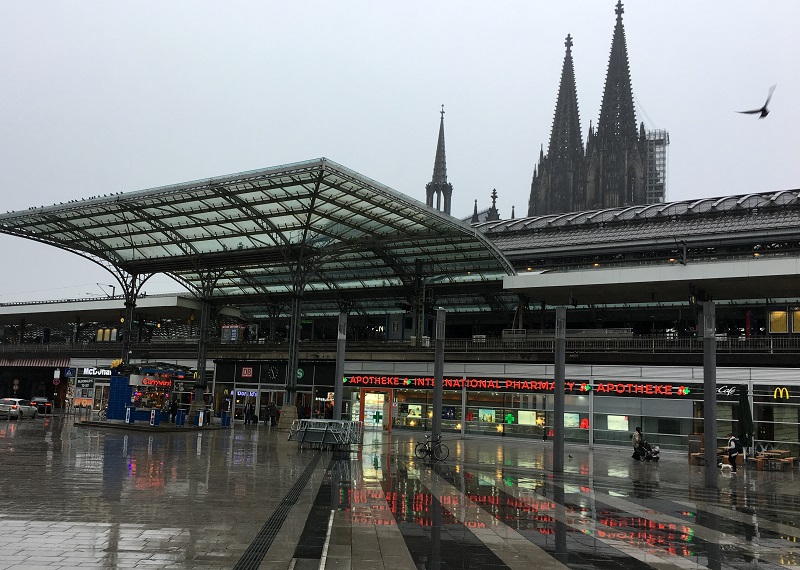
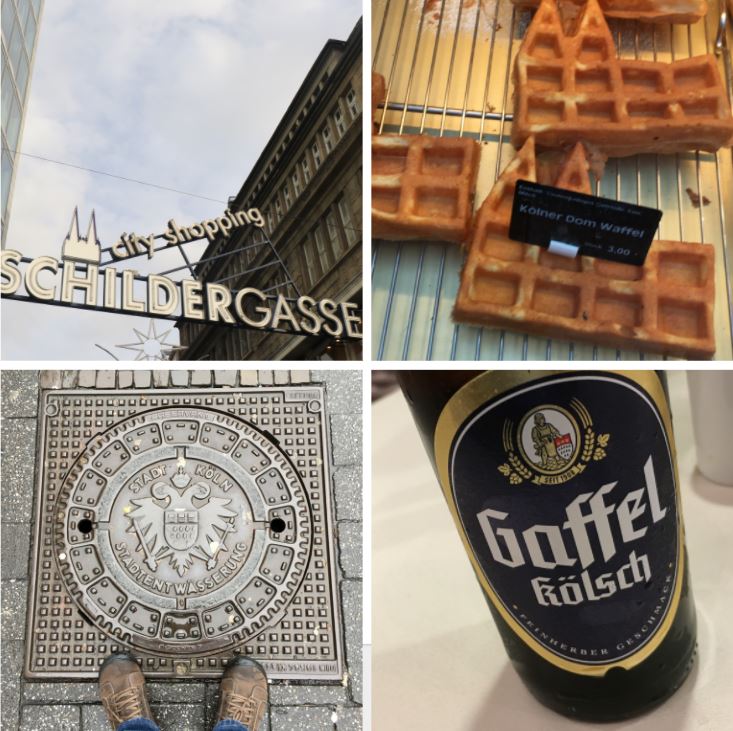
The awe-inspiring Kölner Dom (Cologne Cathedral) is right by the hauptbahnhof (main train station). Construction on this building started many centuries ago! – in 1248. It was the world’s tallest structure from 1880 to 1890, and is Germany’s most visited landmark. It suffered fourteen hits by aerial bombs during WWII – but did not collapse, and stood tall in an otherwise flattened city. The cathedral was declared a World Heritage site in 1996. I still have to go inside and take a few more daytime pictures.Here’s the hauptbahnhof (main train station), with the spires of the Kölner Dom behind it.Clockwise from Top Left: Schildergasse (Schilder alley) is near the Neumarkt station, and good for all kinds of shopping | Waffles in the shape of the Kölner Dom | Kölsch beer is brewed only around Cologne (it’s a light ale), and of course I had to have some | The coat of arms of Cologne on a man-hole cover. Those are two eagles, and the shield carries eleven black drops. Legend has it that they recall Cologne’s patron, Saint Ursula, a Britannic princess, and her legendary 11,000 virgin companions, who were martyred by Attila the Hun at Cologne for their Christian faith in 383.
Hey! I made it into Cologne. It was snowing lightly as we landed in Frankfurt. The snow had started to stick to the tarmac, and the de-icing trucks were just fanning out to go clear any layers of snow or ice.
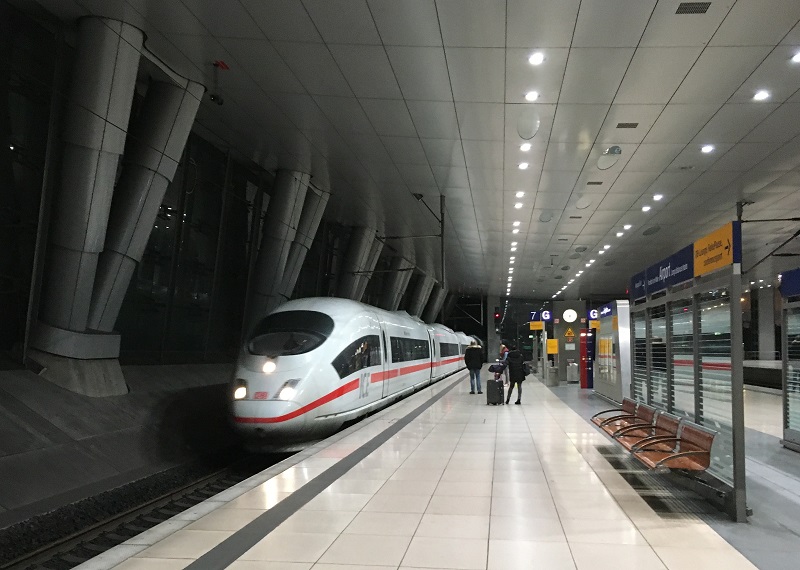
The intercity express train from Frankfurt to Cologne made short work of the 118 miles (190 km) from Frankfurt. The trip took only 50 minutes. These trains travel at speeds up to 186 mph (300 km/h)!
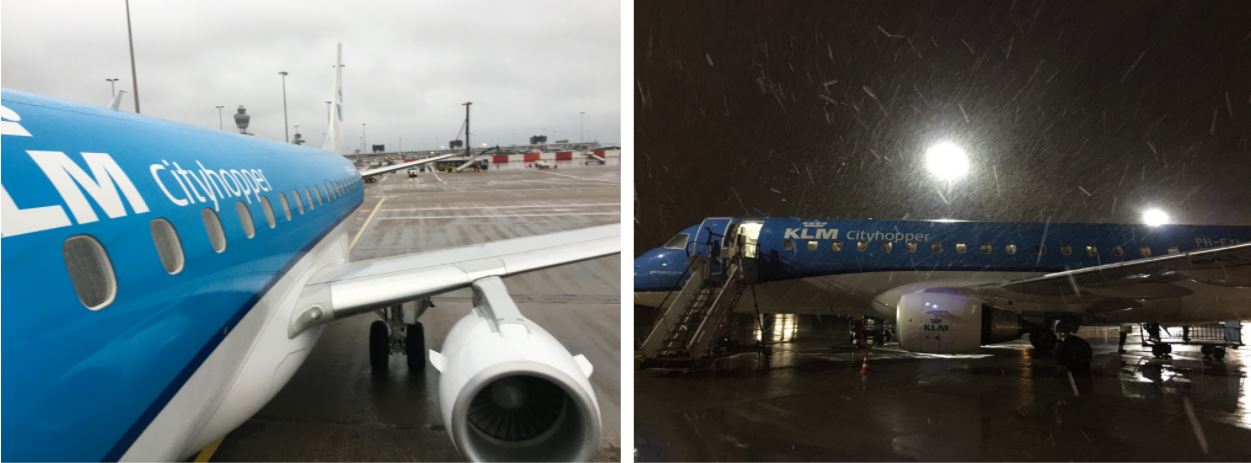
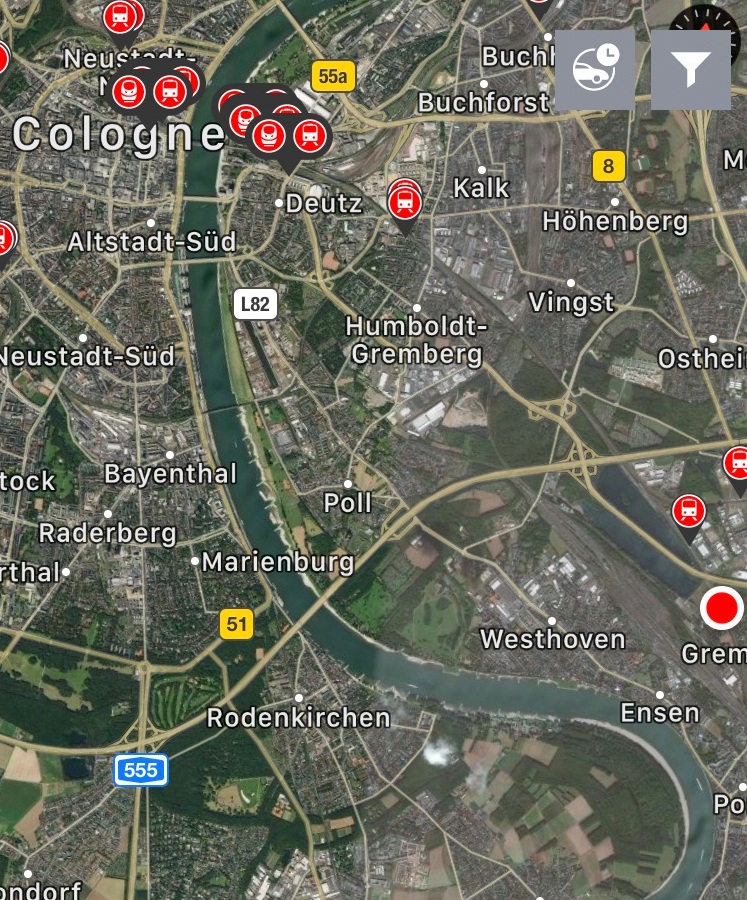
Left: The Embraer 190 ‘Cityhopper’ as we boarded in Amsterdam | Right: Arrival in Frankfurt with light snow (35 °F/ 2 °C).The Intercity Express train for Cologne, at Frankfurt airport’s ‘fernbahn’ (long-distance) station. It stops for only 3 minutes. You had better be ready to board! .. and stand at the right place on the platform! There is a diagram on the platform’s message board that shows the train car numbers, so that passengers can position themselves in the right place. Of course, if you mess up or run late, just board the train, and then walk through the train cars to find your car and your seat.This map is from Deutche Bahn’s app on my smart phone. There is wi-fi on the train (of course). I’m in the train (plain red dot on the bottom left; the other red dots are train stations). The thin gray line that the red dot sits on, is the track, and we are 5 minutes away from Cologne. (The river is the Rhine).
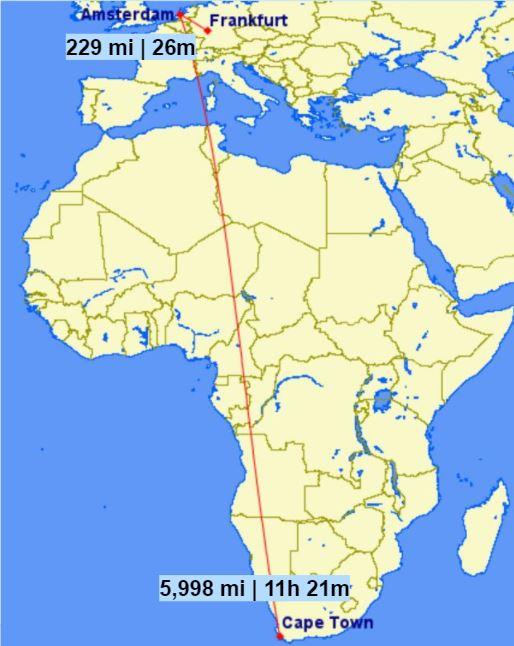
I arrived at Schiphol airport in Amsterdam. My layover is several hours, then a short hop to Frankfurt by air, from where I will take the train to Cologne.
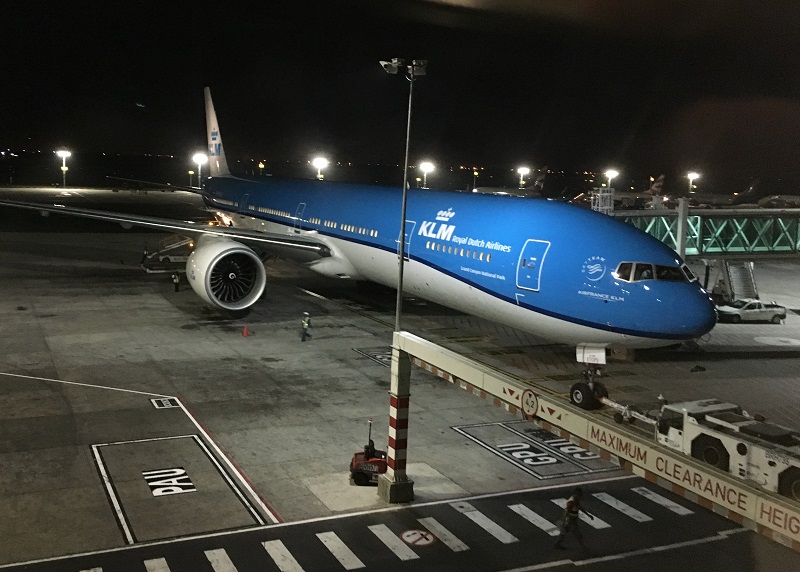
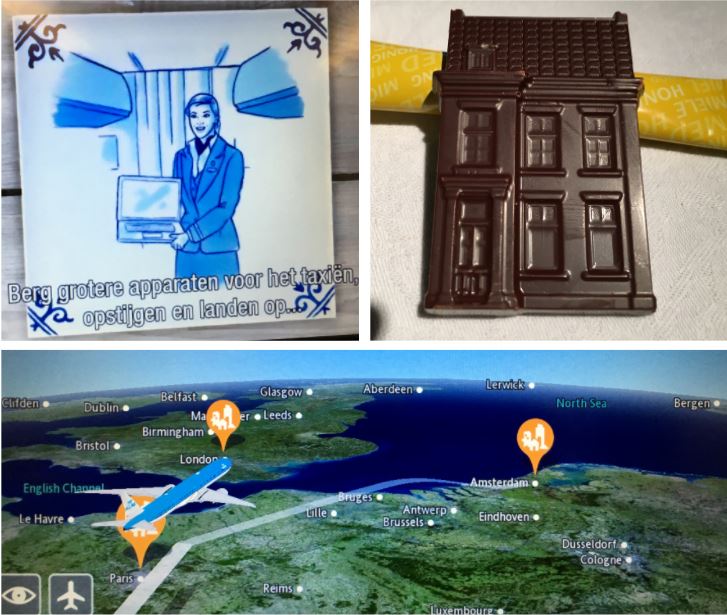
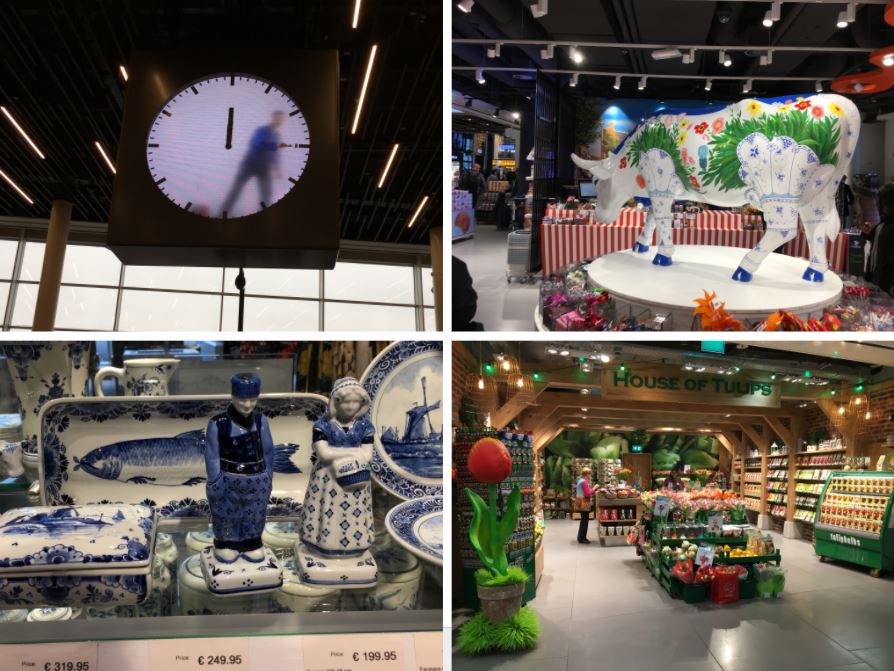
My magnificent flying machine, here at the gate at Cape Town International airport, was a Boeing 777. This airplane is named the Grand Canyon National Park (maybe KLM just kept the name that Boeing painted on it?).Top: The safety briefing video gave a nod to Royal Delft porcelain, with pictures in the cobalt blue and motifs in the corners | My little after dinner-chocolate as a 17th century Dutch house | Bottom: Approaching Amsterdam (shown by the flight simulator). I could almost have parachuted out to Cologne! – but then I guess I would not have my luggage. And the air is frigid this time of year.Scenes from the big public space called ‘Lounge 2’ at Schiphol aiport. Clockwise from top left: The lounge clock display has a ‘technician’ ‘inside’ behind the dial face, painting the minute hand of the clock every few minutes (it’s all computer imagery). | The cow is from the souvenir store. | I would have bought the beautiful Royal Delft porcelain farmer and his wife, but no, not for 200 Euros each. | I love the giant tulip at the House of Tulips store. Reminds me of the venus fly trap plant (named Audrey), in the 1986 movie Little Shop of Horrors.
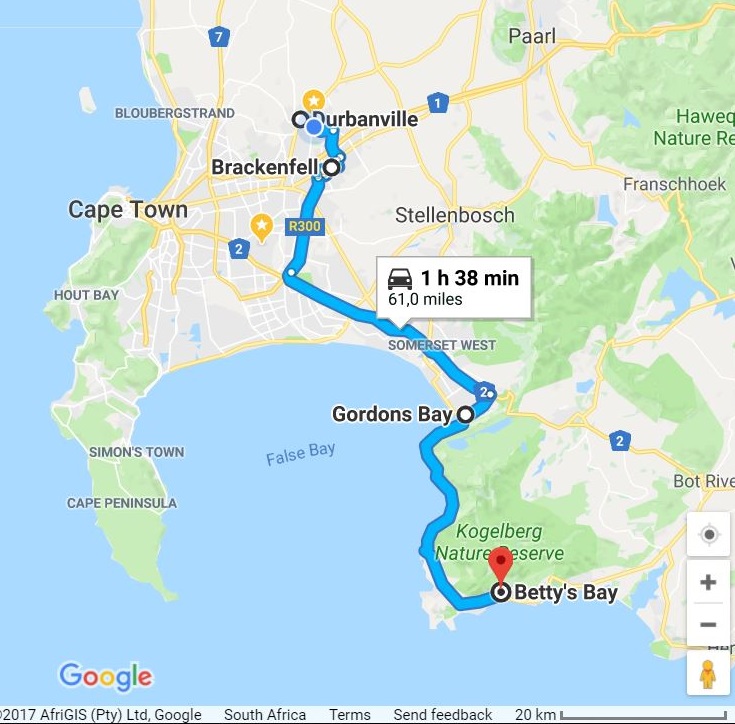
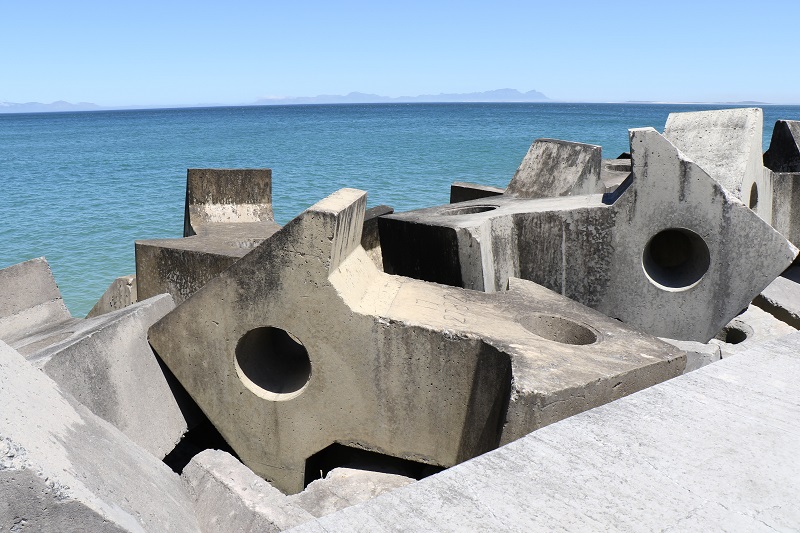
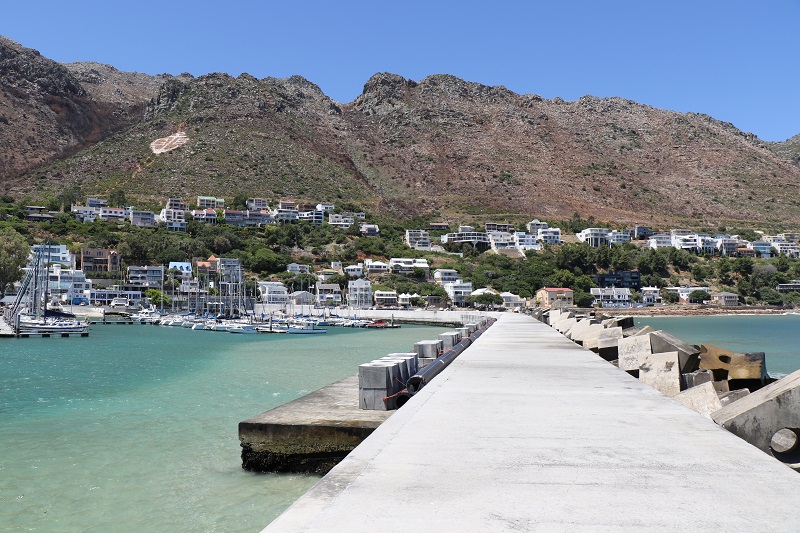
The drive down to Betty’s Bay from Durbanville is about an hour and 30 minutes.‘Dolosse’, invented in 1963 in South Africa, are concrete blocks in complex geometric shapes weighing up to 20 tons. They are used in large numbers to protect harbor walls from storms and the erosive force of ocean waves.Standing on the pier at the little harbor in Gordons Bay (on the left), and looking back. Look for the anchor and GB on the mountain. On the left of the pier are black pipeline segments for construction of a water desalination plant. On the right are ‘dolosse’, the interlocking cement breakwater structures. The little beach on the right is called Bikini Beach.
My friend Marlien and I drove to Gordons Bay and Betty’s Bay on Wednesday, all along the scenic coastline of False Bay. The South Easter* blew strongly at times, the way it usually does in December.
*Also called the Cape Doctor, since the wind blows away the smog accumulating in the Cape Town city bowl between the harbor and Table Mountain.
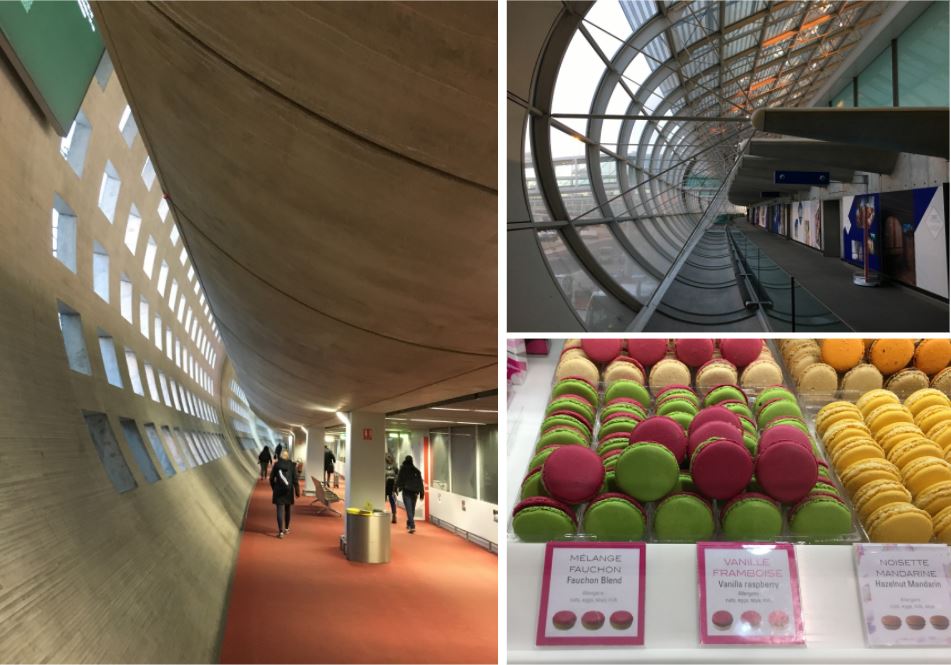
I arrived in Cape Town! The connection in Charles De Gaulle airport involved a long walk to the departure gate. I didn’t mind: good to get one’s circulation going after sitting in an airplane. And, I could check out some of the better insides of the departure terminal (which was not the case last time).
There are signs everywhere in Cape Town airport, and at the overnight hotel, that implore visitors to save water. ‘Every drop counts’. I will try to.
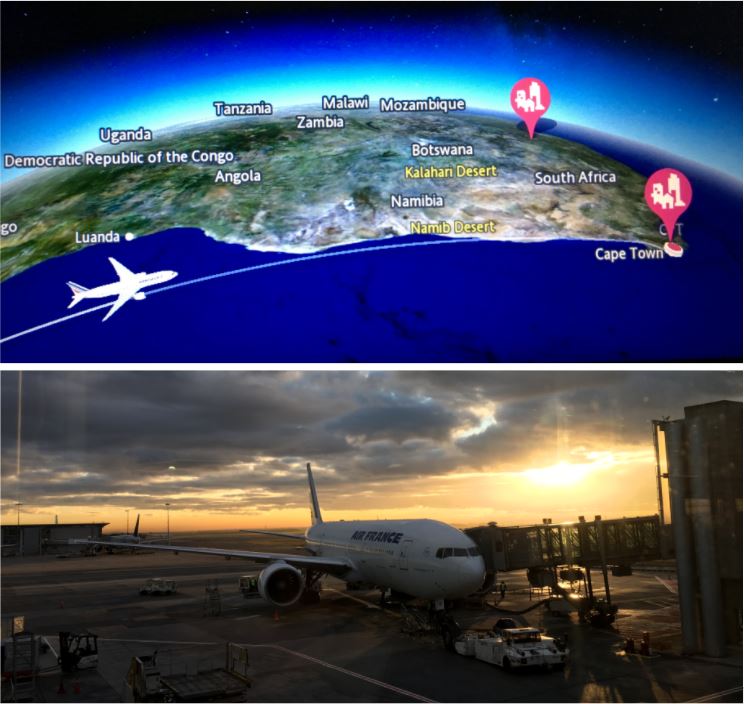
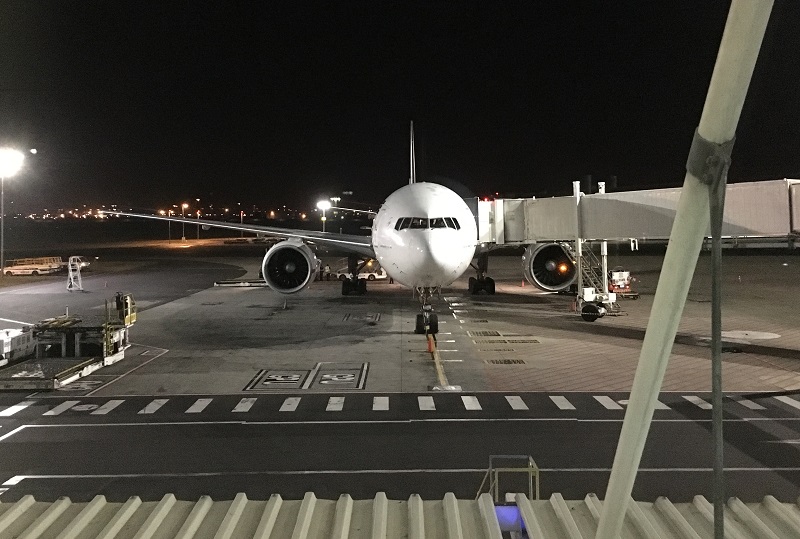
Sights inside Charles De Gaulle airport, on the way to the departure gate. Macaroons always make me think of French President Emmanuel Macron!Top: The flight tracker on the airplane showed us flying over Algiers (north Africa), but then bearing west and coming in over the sea towards Cape Town, skirting the coast of Angola and Namibia. Here we are about 5 hours away from arriving. (The other pink city blob is Johannesburg). Bottom: Our Boeing 777 at the gate at Charles De Gaulle.Here’s the Boeing 777 at the gate in Cape Town International Airport – almost 12 hours after departing Paris, and flying 9360 km (5,816 mi).
I am at Frankfurt Airport. I checked into an airport hotel on Monday night. My flight to Paris is early Tuesday morning, and there I will catch the Air France flight to Cape Town, South Africa.
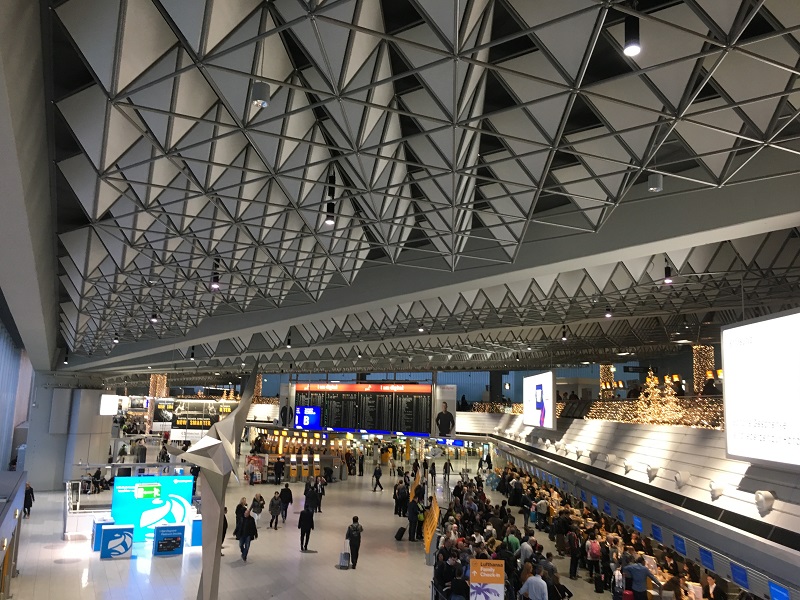
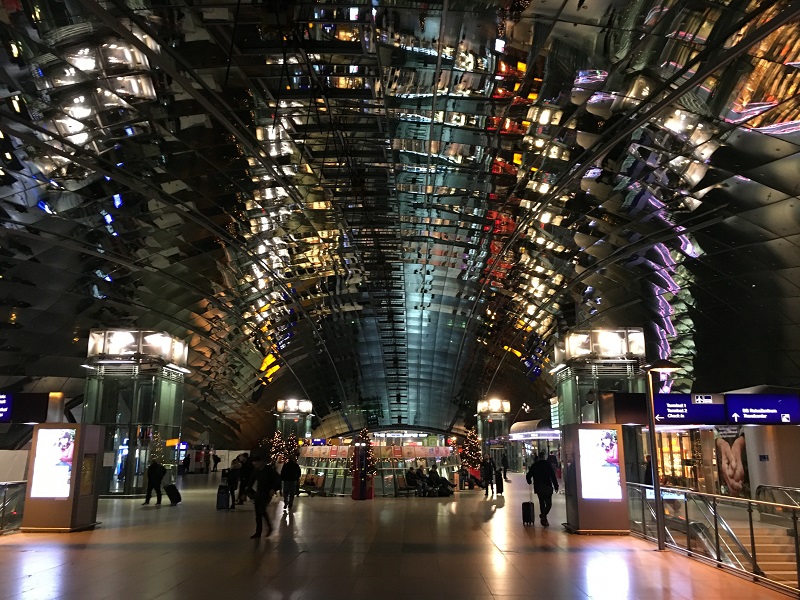
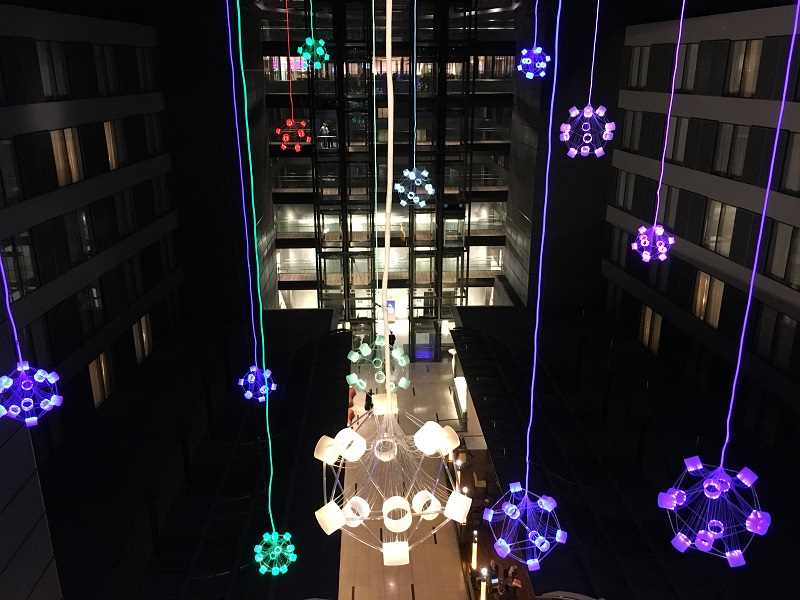
This is one of the departure halls in Terminal 1 at Frankfurt airport. I love the ‘industrial design’ look of the ceiling (maybe it’s a little dated for 2017?).This is the hotel side of the skybridge connecting the airport to the on-site hotels. Translucent by day, the glass panels making up the shell of the skybridge, turn into a mosaic of reflections by night.And here’s a late-night view down into the lobby of the Hilton Frankfurt Airport, from the tenth floor. The light fixtures are LED, and continuously change their colors. (I’m staying in the cheaper Hilton Garden Inn right next to the Hilton proper).
My movements on Monday were curtailed by persistent, soaking rain! I postponed my trips to the Geldmuseum (money museum) and Schloss Höchst (castle Höchst) until my return stop here, and spent some time in the Galleria Kaufhof, a classic department store with seven floors.
It seems the ravages of Amazon has not yet hit Germany, or at least not this store in particular. The store is a great experience, and besides – total square footage of department stores in Europe is roughly half that of the square footage in the United States. So: they may be safe for now.
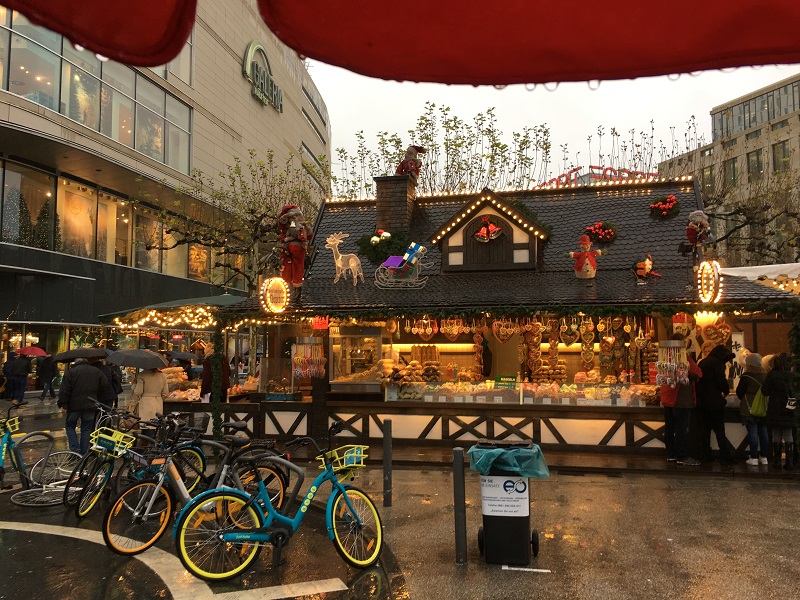
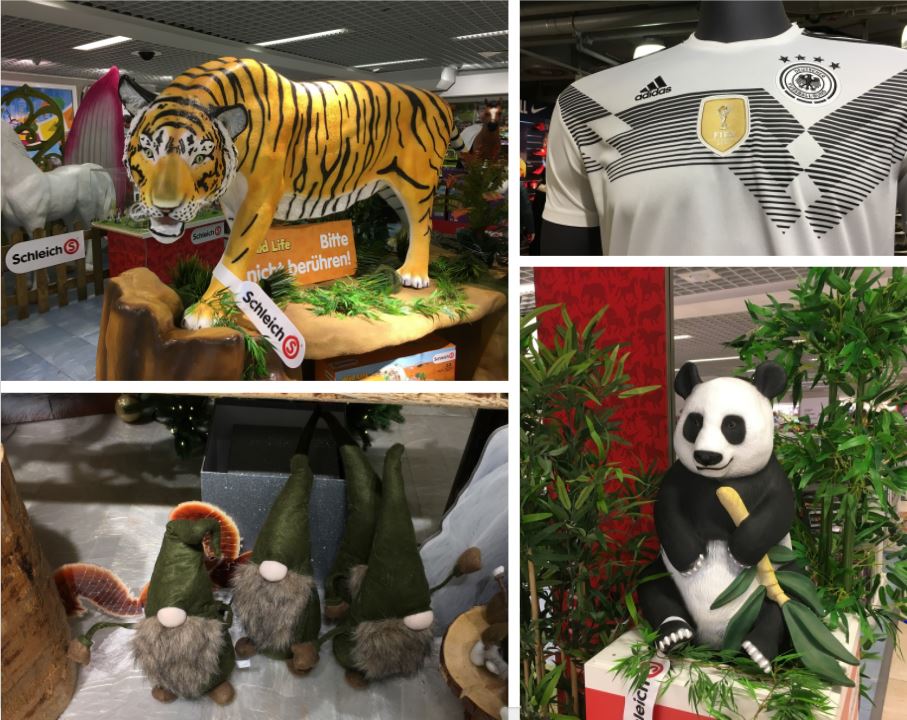
I’m taking refuge under a large umbrella across from a nice Christmas market stall. This is close to the MyZeil shopping mall, with the Galleria Kaufhof department store in the background.Inside the Galleria Kaufhof. CLockwise from top left: life-size tiger at the Schleich animal figurine display. Nice! | Adidas t-shirt featuring the Deutscher Fussballbund (German soccer federation) and touting their 2014 World Cup win | life-size Panda bear complete with bamboo, at the Schleich display | these cute creatures are German Christmas elves (?), I think. I guess they belong by the Christmas tree, but I’m not sure!
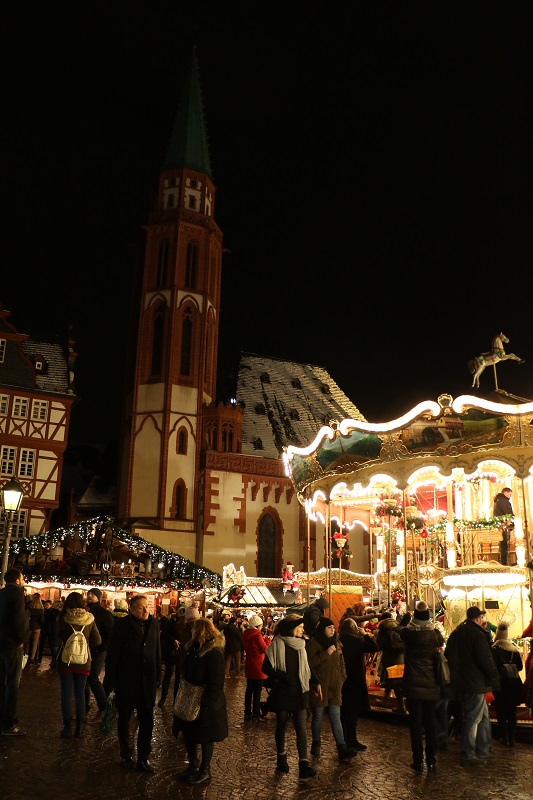
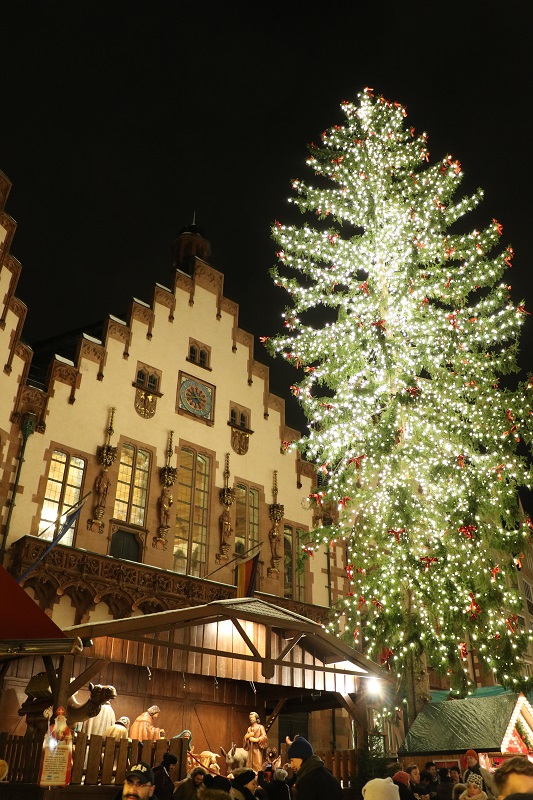
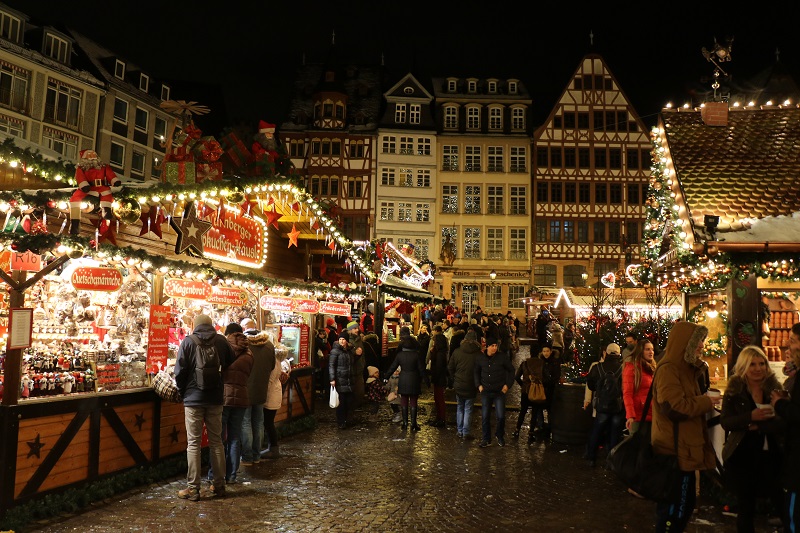
I made it to the Frankfurt Christmas market on Sunday night. The biggest one in the city is at the Römerberg, the public square in the old town, and seat of the Frankfurt city administration since the 15th century.
It was cold! .. but by evening the snow had stopped. Later, when I was already back in the hotel, a heavy downpour of rain later washed away just about all of the snow on the ground. I hope the stalls for the Römerberg vendors stayed dry inside!
The giant merry-go-round is one of the main attractions in the Romerberg square, and good for adults and kids.This giant Christmas tree was brought in (normally there are no trees on the square), and lit up brightly, with a nativity scene down below.And here are the stalls – several dozens of them, selling glühwein, coffee, pretzels, bratwurst and all kinds of Christmas souvenirs and decorations. One of my favorite ones was a set of wooden alphabet letter cut-outs, each letter made into a little train car with wheels and hookups front and back. Then one would think of a phrase, or simply a name, and buy the letters and build a little letter train for the mantelpiece.
I arrived in Frankfurt without incident. I had a short connection stop in Reykjavik (clear, 26°F/ -3°C). On the plane, we waited just a little bit for other connecting passengers, and to get the all-clear from Frankfurt. Snow was starting to fall as we arrived in Frankfurt at noon (32°F/ 0°C).
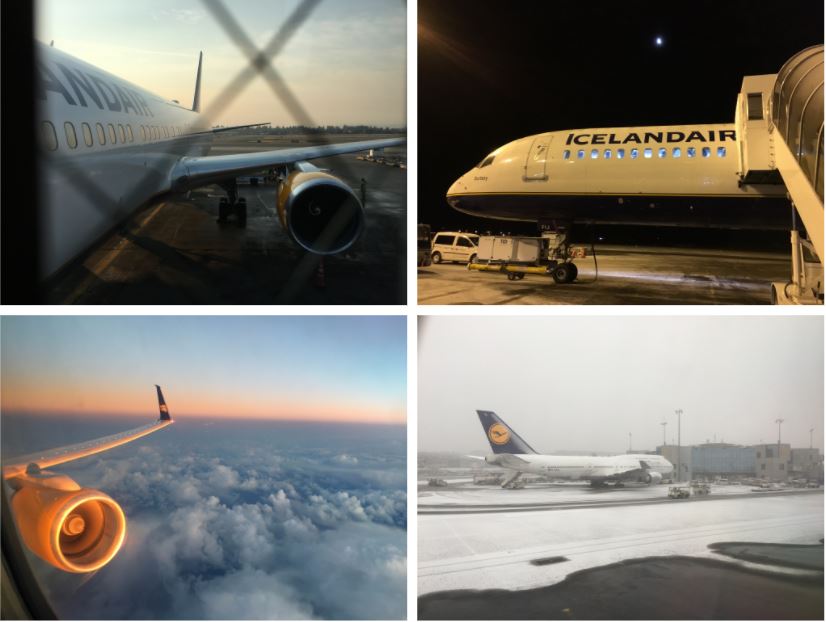
Clockwise from top left: Boarding Iceland Air’s Boeing 767 flying machine that took us to Reykjavik | Icy tarmac in Reykjavik as we board the ‘Surtsey’ Boeing 757 for Frankfurt. Surtsey is a volcanic island that appeared in 1963 south of Iceland. | Over Scotland, on the way to Frankfurt, flying southeast into the sunrise | View from the plane as we arrived in Frankfurt in steady, sifting snow that’s falling.
My bags are packed – more or less – for my departure on Saturday, for my journey down south to South Africa. I am making a two-night stop in Frankfurt on the way, and will end up in Cape Town by Tuesday night. Weather permitting (there is snow in the forecast for Frankfurt on Sunday), I will go to the Christmas market there on the Roemerberg, the old town square.
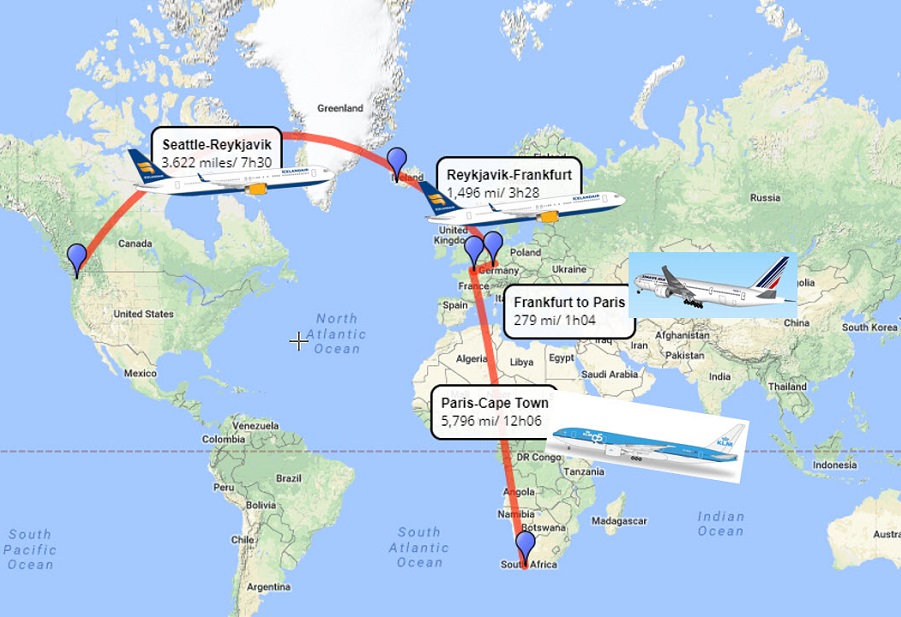
Here is my itinerary: on Iceland Air to Frankfurt via Reykjavik. Stay a day or two, then Air France to Paris, to fly from there to Cape Town a KLM Boeing 777.
You know with love comes strange currencies -from the song ‘Strange Currencies’, R.E.M. (1995)
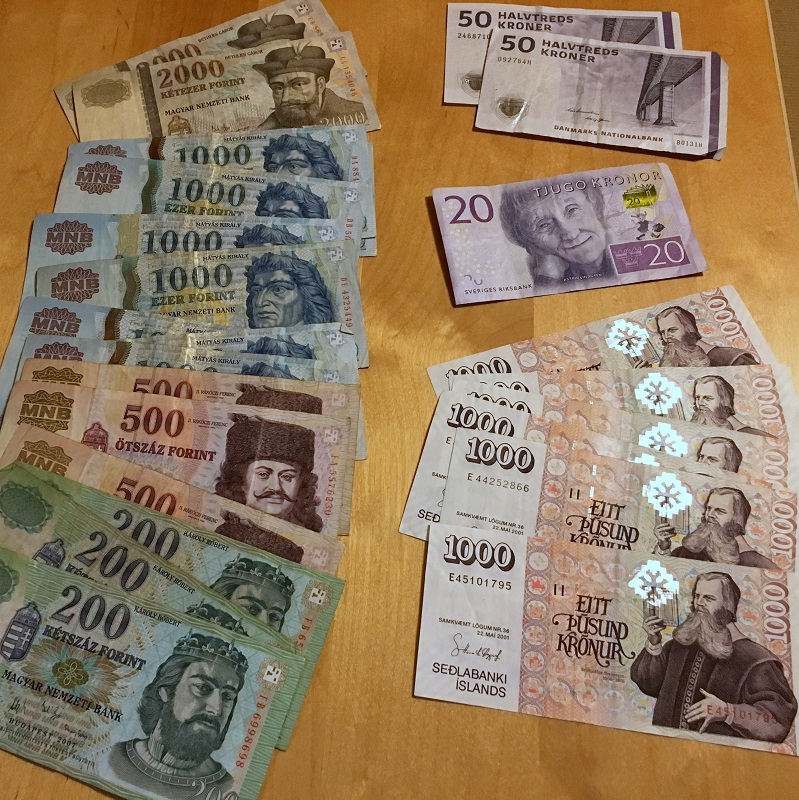
Also: with travel comes strange currencies. I sorted through my stash of foreign banknotes today, keeping the crisp new ones for my little amateur collection. I will exchange the others for Euros or US dollars at the airport, during my upcoming trip to South Africa.
I thought for sure, that by now the Hungarian forints that I got in Budapest in 2008, would be of no use – replaced by Euros – but no: they’re still good. The Hungarian government is in no hurry to adopt the Euro, apparently. I have Danish, Swedish and Icelandic krona notes as well, to exchange.
A bunch of notes, but not worth much! All those Hungarian forints on the left, Ft 12,100 in total, come to only US $45. The 6,000 Icelandic krona (bottom left) are worth US $58. Maybe I can spend these at Reykjavik airport when I stop there. The Danish & Swedish krona (top left) are only worth $10 or so.