
I remember reading in Alvin Toffler’s 1970 book called ‘Future Shock’ (reading it just a few years after 1970) about an automated, computerized home of the future. While the owner is away, the house monitors its own structural integrity and cross-references local data. Recognizing a structural vulnerability in the roof and receiving a weather alert that a severe storm is approaching, the house takes the initiative. Rather than waiting for the owner to return home to a leak, the house places a call to the owner’s mobile or office phone. It informs the owner of the impending storm, explains that the roof needs immediate attention, and asks for verbal or electronic permission to contact a technician to fix the issue before the rain starts.
It took 56 years, but it certainly looks like that future is here.
Here is what Eli Tan reports to the New York Times from San Francisco:
Last week, I answered a call from an unknown number. “I reached Anthem Dental and am about to connect you,” a voice piped up.
The call was from an artificial intelligence “agent” created by Meta, which owns Facebook and Instagram. Ten minutes earlier, the A.I. agent had called my dental insurer, given it my member ID, answered a security question and waited on hold before transferring me to the representative — just as I had asked it to.
I was surprised by how much easier the agent had made it to deal with insurance. It was one of many tasks that I accomplished with Muse, the A.I. agent app that Meta unveiled this month.
Muse is the first consumer A.I. agent from a major tech company that has become publicly available. The tech industry sees agents as the next frontier, far more capable than chatbots. Agents can roam the internet, sign in to websites, fill out spreadsheets and make phone calls on behalf of people — and that’s just the start.
Tan goes on to describe some of the dozens of day-to-day tasks that he had Muse perform. He had to trust Muse with his most personal data, which included connecting it to his bank accounts and email.
He gave acces to his credit card accounts to Muse and asked it to track his spending in Google sheets. Muse flagged two duplicate subscriptions and cancelled them. Muse used his email account to request a refund for a free newspaper trial that had expired, saving him $44.99.
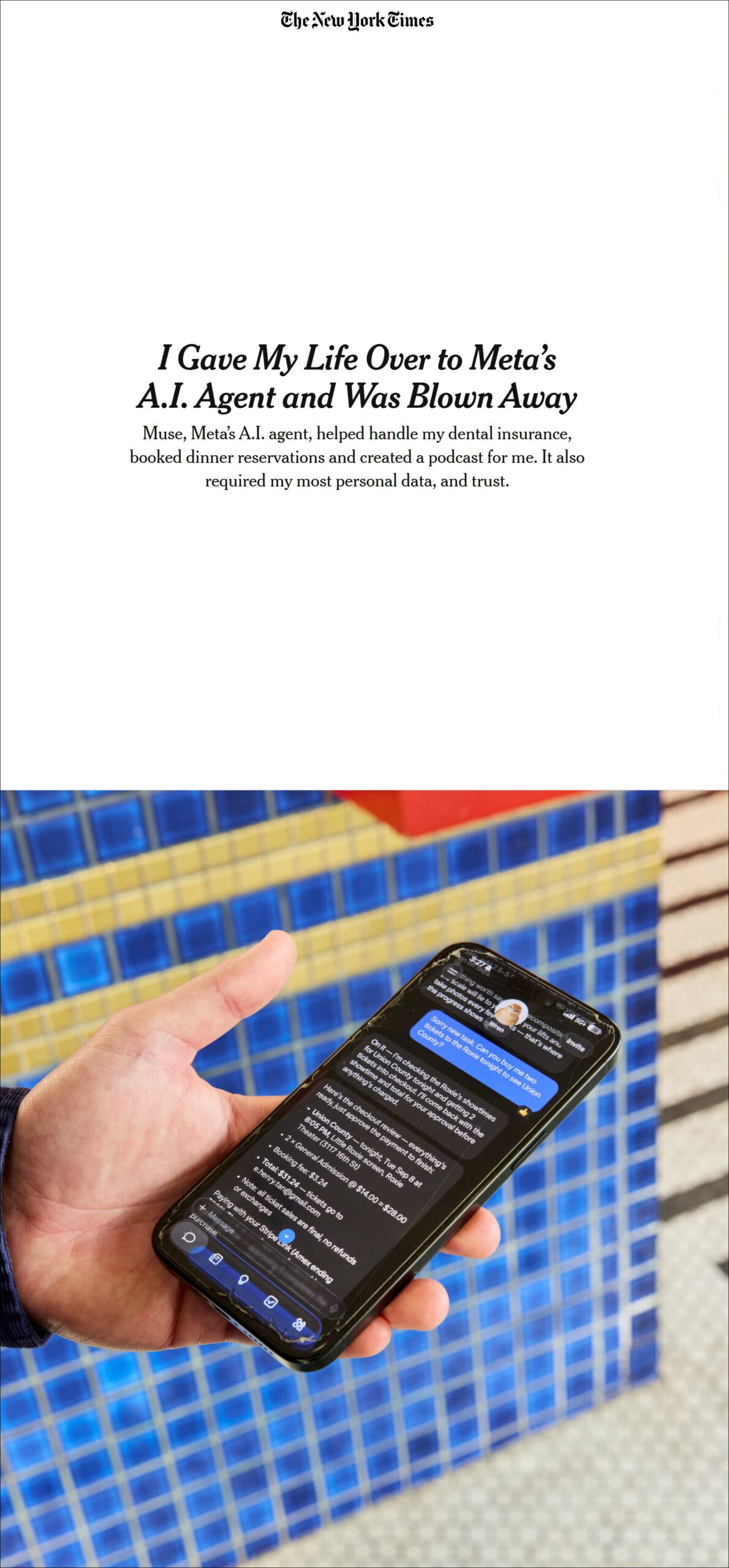
(First, may I observe that the writer could also let Muse shop for a new screen protector for his phone? 😉)
The bird at the top of the screen is Wren, the Muse assistant’s name. Wren can make phone calls using different personalities, with a male voice named Brett and a female voice named Hailey. (For now, only a limited number of users will be given access to the voice call feature). Wren also negotiated the purchase of items on Facebook’s marketplace, starting with a lowball offer and then picking up from the response if the seller is willing to negotiate or not.
The writer ends his report by noting that one of these purchases involved ‘a refreshing, in-person human conversation with the seller Ashley, something neither Wren nor any A.I. could ever provide’. He suspected ‘this might be another reason Muse might not immediately catch on — sometimes people just don’t want to have their personal lives automated, even if the technology is good enough’.