Monday/ US stock market correction: sooner, or later?

It has to be a matter of ‘when’, and not of ‘if’, when it comes to a 10% or 20% correction in the US equities market. Yale University economics professor Robert Shiller has an index called the CAPE: Cyclically Adjusted Price Earnings ratio (it takes inflation into account). The index has only been higher before the 1929 crash, and before the 2000 dot-com bubble. It is now over 30, and – if history repeats itself- it has to go back to the trend value of 16-something.  Sooner, or later.  We just do not know when.
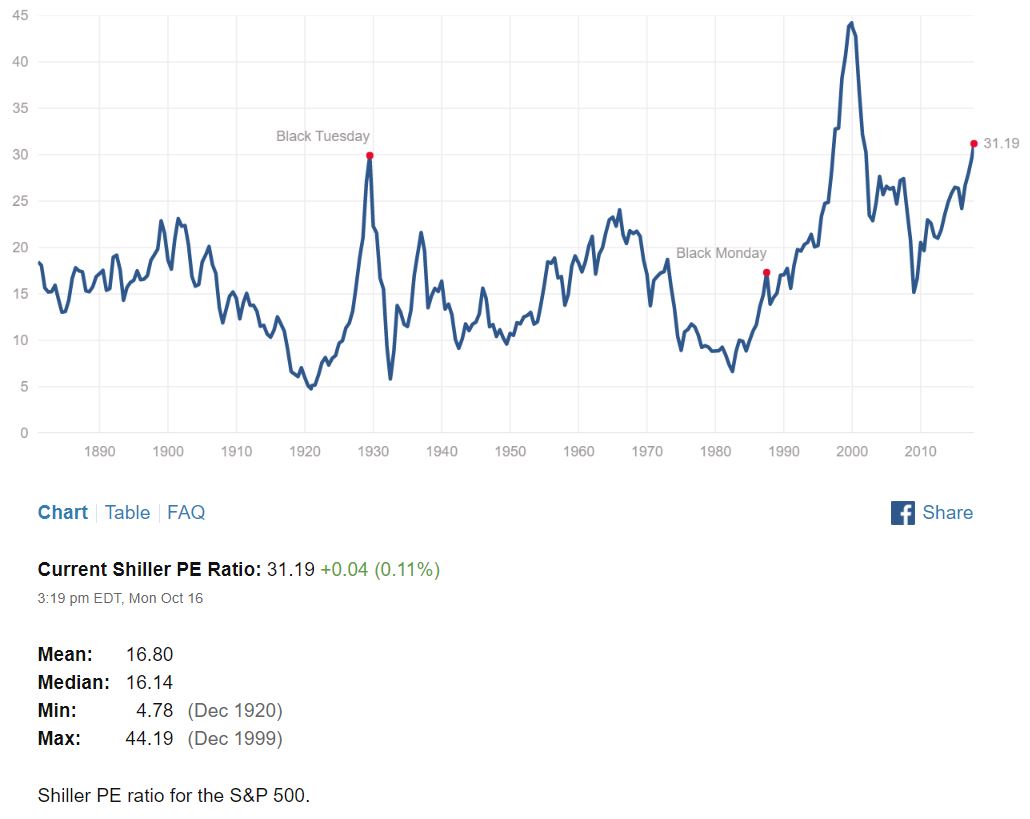
Graph compiled from Robert Shiller’s CAPE index data. Look at what happened after 2000 – the index went from 45 to 23. Then after the 2008 Financial Crisis, it went to 15.

Update Tue: the Dow Jones Industrial Average briefly crossed 23,000 for the first time on Tuesday.  There is already speculation that 25,000 is possible by June 2018.  (Agreed. But let’s add: 20,000 is also perfectly possible).

Screen shot at the close of the trading day Tuesday, from CNBC business channel. (Called the ‘stock market cheerleader channel’ by some analysts).


Sunday/ Seattle Times building update

I went down to South Lake Union today to check out the construction on the old Seattle Times Building’s site.

The original Seattle Times Building was completed in 1931 with offices and newspaper printing presses and all.  Operations stopped there in 2011, and were moved to Bothell (some 20 miles from of Seattle).  The real estate and buildings were sold in 2013 to a company from Vancouver.  The developer has to preserve the exterior facade and roof of the Seattle Times Building, since these were designated a Seattle city landmark in 1996.  It’s a little weird that only the exterior walls and roof of a building can be designated a landmark! .. but at least some semblance of the old building remains. The developer has already demolished all of the inside, and while the rooftop is not built on, it is getting a make-over with landscaping and seating.

Top left to right: The Seattle Times building in 1946; the side facade of the main building from behind (there is a support framework on the front); Art Deco elements on the side of the building and by the main entrance. Main picture: 1 Exterior landscaped amenity deck for building residents | 2 Double-height indoor amenity space adjacent to outdoor deck | 3 Tall landscaping elements kept back from roof deck perimeter to give priority to the landmark Seattle Times facade | 4 Bridge element connects roofdeck with podium over breezeway | 5 Display of Seattle Times industrial artifact.
Here is the proposed massing of the tower buildings around the Seattle Times Building (in red outline). ‘Massing’ in architecture refers to the perception of the general shapes, forms and sizes of a buildings.


Saturday/ reality or illusion?

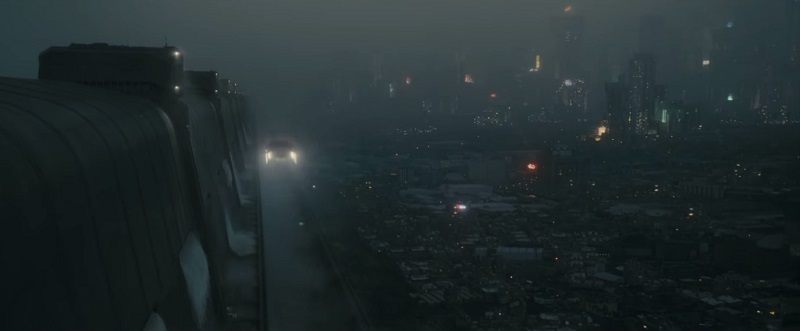
A dystopian Los Angeles in 2049 (seawall on the left). The film is neo-noir: dim lighting, crime and violence, night scenes, lots of rain and snow, and dark dramatic music.

We went to see the new ‘Bladerunner 2049’ movie on Saturday, and I liked it a lot.  Ryan Gosling is Officer K from the LAPD and hunts down replicants (robots that look and act like humans), then discovers he might be a very special replicant himself. Are his memories real or not? is a big part of the movie, as is the destroyed Earth backdrop. There was a Blackout (electromagnetic pulse) event in 2022 that destroyed all digital data records on Earth, and as a consequence Officer K has to knock on doors and ask people (and replicants) questions, to get information.

I loved the enormous fields of solar power generation stations in the opening scene, the massive seawall that protects LA from the sea, and the flying cars. There is also Officer K’s holographic girlfriend Joi (says she: ‘I missed you, baby sweet – what a day, hmm?’), and a cool holographic jukebox player. But in the final analysis, the movie is about what makes us human. A perennial science fiction question seems to be: could artificially intelligent (AI) creatures be made human, say, with implanted memories? What is illusion, and what is ‘reality’, anyway? As Albert Einstein famously said: ‘Reality is merely an illusion, albeit a very persistent one’. 


Friday the 13th/ flight 666 to HEL

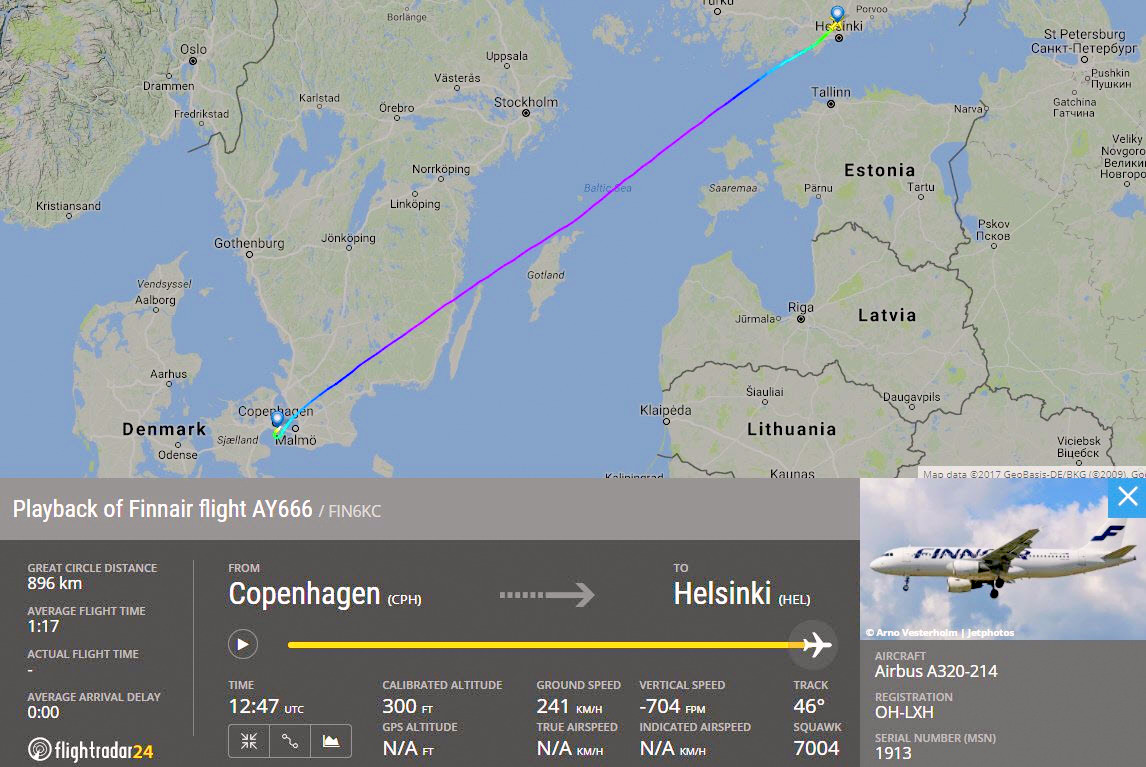
Today in Copenhagen: at about 13 o’clock on Friday the 13th, Finnair flight 666 took off to fly to HEL (Helsinki). The (regularly scheduled) flight arrived on time, safe and sound.  Alas, this was the last flight to Helsinki with this number. Finnair is said to have rearranged their flight numbers, so soon there will be no more flight 666s to HEL.

Flight 666 from Copenhagen (CPH) to Helsinki (HEL).

Thursday/ Trump’s war with the press & TV

President Trump has waged war with the media and the press since Day One of his presidency, and it just seems to get even worse.


So many things wrong with these tweets. NBC and the networks hold themselves to the highest standards, while Trump tweets out blatant lies and distortions almost every day.  2/3 of Americans think they are bad for the country. And by the way: there is no ‘license’ that can be revoked for the national networks, only for local TV stations. Also, the Executive Branch cannot even do that – it’s up to the Federal Communications Commission.

Graphic from Reporters Without Borders, based in Paris, France. The USA is ranked #43 of the world’s 180 countries. The notes state (accurately) that the First Amendment (states freedom of the press, and freedom of speech) is under increasing attack in the USA.

Wednesday/ no USA! in World Cup 2018

Oy vey, what a disappointment! Tuesday’s World Cup Qualifying soccer match of the USA vs. Trinidad & Tobago, ended in a 1-2 loss for the Americans.

After losses of 1-2 to Mexico and 0-4 to Costa Rica as well, it meant that for the first time since 1986, the USA did not qualify for the World Cup.  ‘You can’t get a draw, a tie, against Trinidad? You don’t deserve to go to the World Cup’, said an exasperated Taylor Twellman afterwards, in an epic rant on sports network ESPN.

Twitter (#USMNST) was set alight by soccer fans : video of chimpanzees kicking soccer balls; ‘well, they had to beat both Trinidad AND Tobago’; ‘dear Donald Trump, I’m getting tired of all the winning’; ‘On a side note, I’ve been to Trinidad and Tobago. It’s a lovely country’.

Lionel Messi. He scored all three goals in the match against Ecuador.

I see the Dutch team (called ‘Oranje’ for their orange jerseys) did not qualify, either. Aw.

The Argentinians came perilously close to the same fate, but they have superstar Lionel Messi, and he scored three goals in their critical match against Ecuador, securing their place in World Cup 2018.

South Africa’s ‘Bafana Bafana’ team is still in contention in Africa Group D, but will have to win both match-ups against Senegal in November.

Australia’s ‘Socceroos’ will travel to Honduras in a play-off match, in their quest for a fourth-consecutive World Cup appearance.


Tuesday/ here comes Qoobo

It’s World Mental Health Day today.  I see a Japanese company is marketing a 2-lb robotic cat-pillow-thing called Qoobo. The sensation of stroking the furry fabric, and the wagging ‘tail’ reaction is going to have a soothing effect, and make the day’s stress go away, they promise.  Well. Granted : no kitty litter box is good, but no cute cat face and paws, and no ears to tickle – no good.

The Qoobo cat (pillow with a tail, really) comes in two colors : husky grey or french brown. Is the model wistful? .. or is she thinking: ‘this is really dumb, to imagine this as a cat!’ ?

Monday/ California’s wildfires

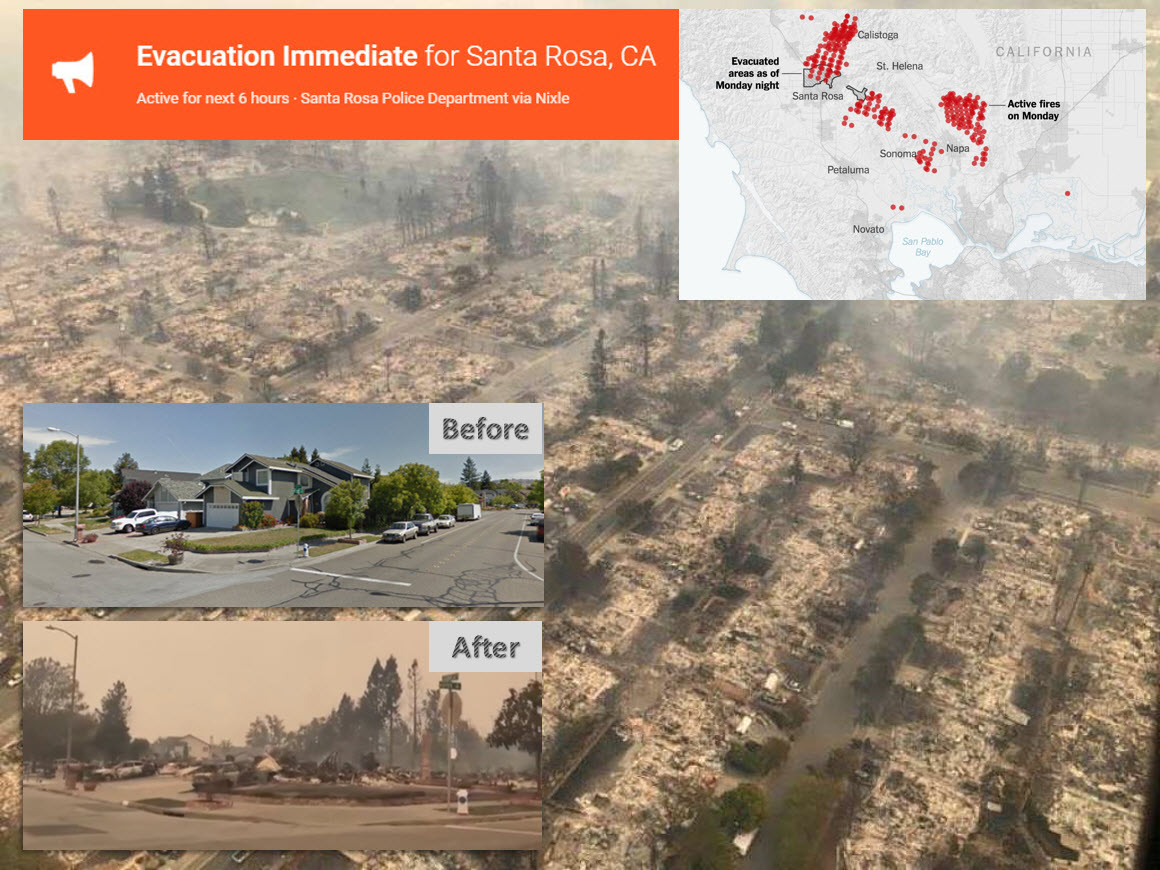
Man! Hurricanes, floods (and Las Vegas) have already made 2017 an annus horribilis. Even so, Sunday and Monday brought more disaster : one of the most destructive fire emergencies in California’s history.  Some 15 fast-moving wildfires have now scorched 94,000 acres (146 sq mi) and destroyed 1,500 buildings.  At least 10 people were killed, over 100 were taken to hospitals, and some 20,000 were forced to evacuate.

The main picture from a California Highway Patrol helicopter, shows the total destruction in a Santa Rosa neighborhood. From a video clip frame, I used the street signs & fire hydrant on the After picture, to find the ‘Before’ picture (on Google Street View) of the beautiful houses there, now all burnt to ashes. Santa Rosa is one hour north of San Francisco (map from the New York Times). Most residents were under immediate evacuation orders.

Sunday/ light jacket weather

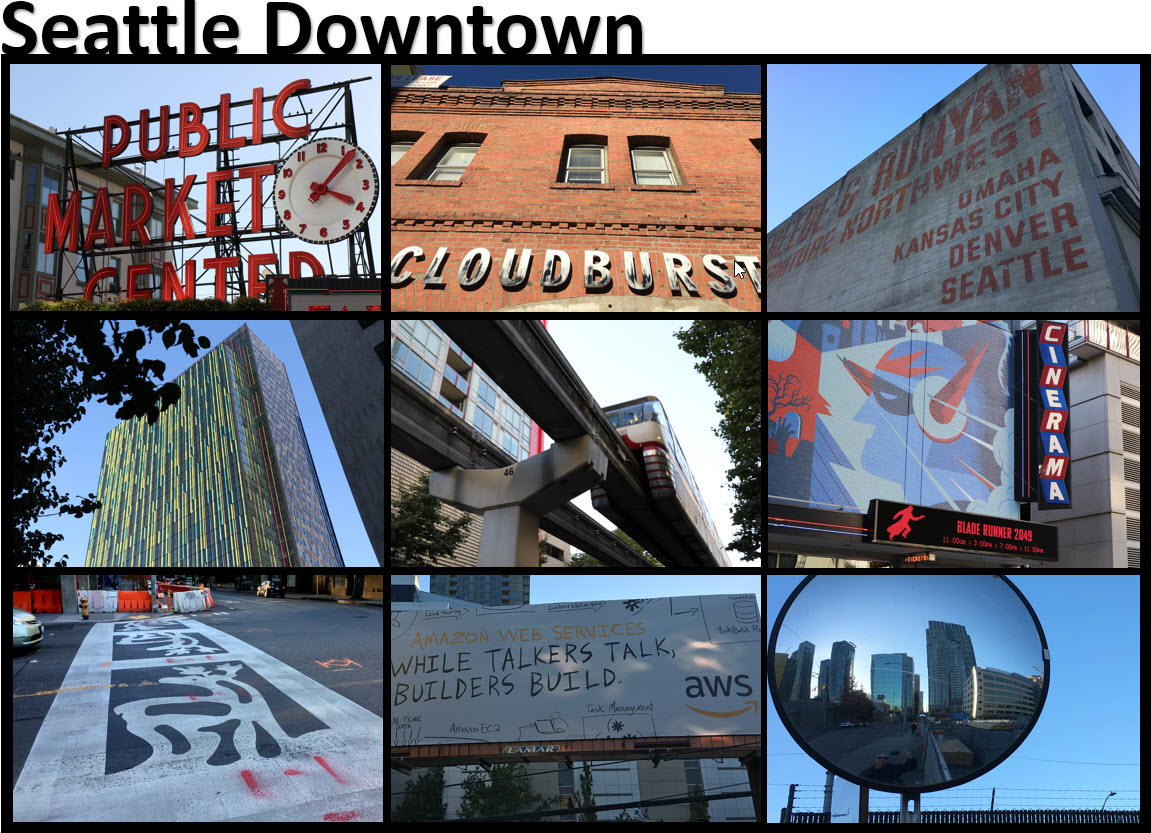
Here’s a collage of pictures from my random walk around Seattle downtown this afternoon.  It was sunny but only 60°F/ 15°C, so ‘light jacket’ weather. ‘Scarf weather’ is coming, sometime in November.

Clockwise from top left: iconic Pike Place Market sign | Cloudburst microbrewery on Western Ave, with a hole-in-the-wall beer hall downstairs | long-ago furniture store turned into offices | Bladerunner 2049 at the Cinerama (will go see it there next weekend) | construction truck mirror near Denny Way | new billboard for Amazon Web Services off Denny Way | is this a ‘Christmas’ pedestrian crossing? this at c/r of Boren & Howell | yellow & green on Amazon Tower II | monorail from Space Needle, going to downtown.

Saturday/ the Immortal Game

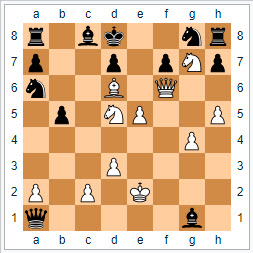
From Wikipedia: The final board, and checkmate of the black king in the Immortal Game, despite black’s considerable advantage in pieces.

We watched Bladerunner (1982)* last night, since we plan to see the new Bladerunner 2049 that just started running in theaters.

The movie showed its age a little (of course), but it became a cult flick and one that has been extensively discussed on the internet.

Anyway – I see the chess game from the movie is actually borrowed from one of the most famous games in all of chess history, called ‘The Immortal Game‘.

The game was played by Adolf Anderssen and Lionel Kieseritzky on 21 June 1851 in London, during a break of the first international tournament. Anderssen gave up both rooks and a bishop, then his queen, checkmating his opponent with his three remaining minor pieces.

*From Wikipedia : Blade Runner is a 1982 American neo-noir science fiction film directed by Ridley Scott and starring Harrison Ford, Rutger Hauer, Sean Young, and Edward James Olmos. The script was written by Hampton Fancher and David Peoples, and is a loose adaptation of the 1968 novel ‘Do Androids Dream of Electric Sheep’ by Philip K. Dick. Set in a dystopian Los Angeles in 2019, the story depicts a future in which synthetic humans known as replicants are bio-engineered by the powerful Tyrell Corporation to work on off-world colonies. When a fugitive group of replicants led by Roy Batty (Hauer) escape back to Earth, burnt-out LA cop Rick Deckard (Ford) reluctantly accepts one last assignment to hunt them down. During his investigations, Deckard meets Rachael (Young), an advanced replicant who causes him to question his mission.

Friday/ the end of the cruise season

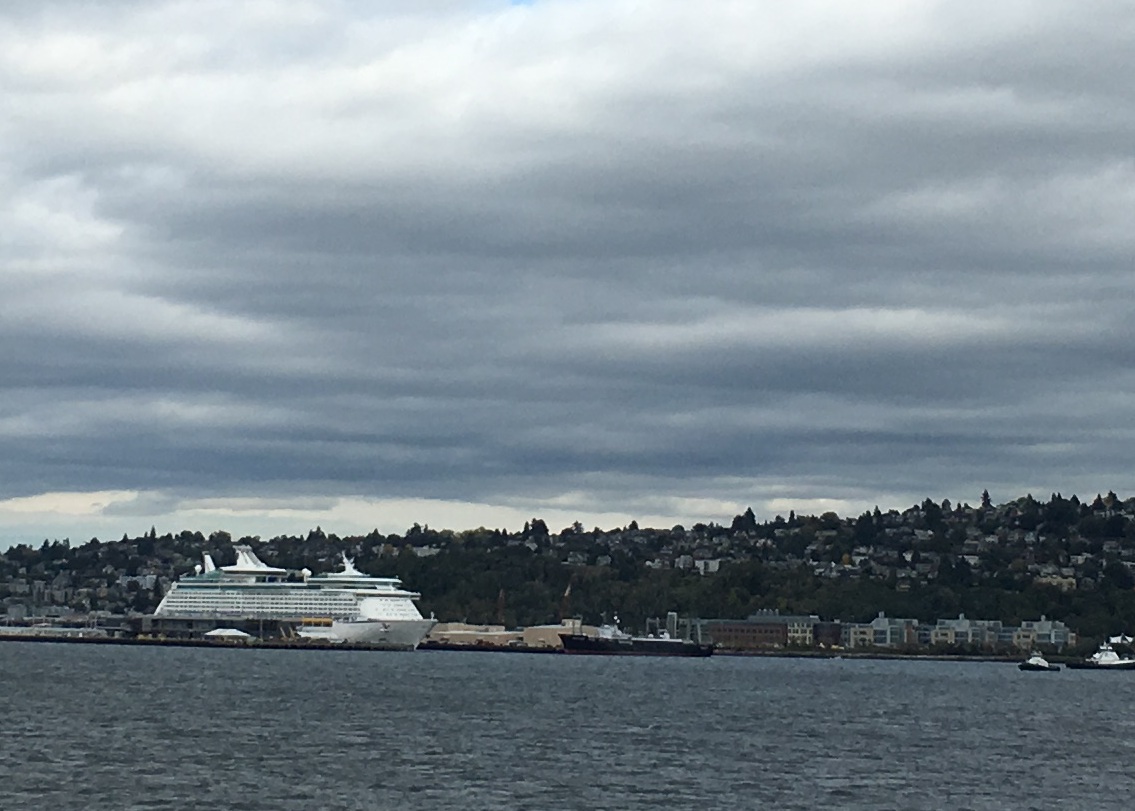
Royal Caribbean’s Explorer of the Seas (built 1999, passengers 3,825) was at the Seattle cruise terminal at Pier 91 on Friday. This one was the very last of the cruise ships for the season.

It was blustery and cool on the top deck of the ferry as we came in on Friday afternoon to Seattle from Bainbridge Island.

We spotted a cruise ship, unusual for October. The 2017 cruise season is now over, and the 2018 season will start in May.

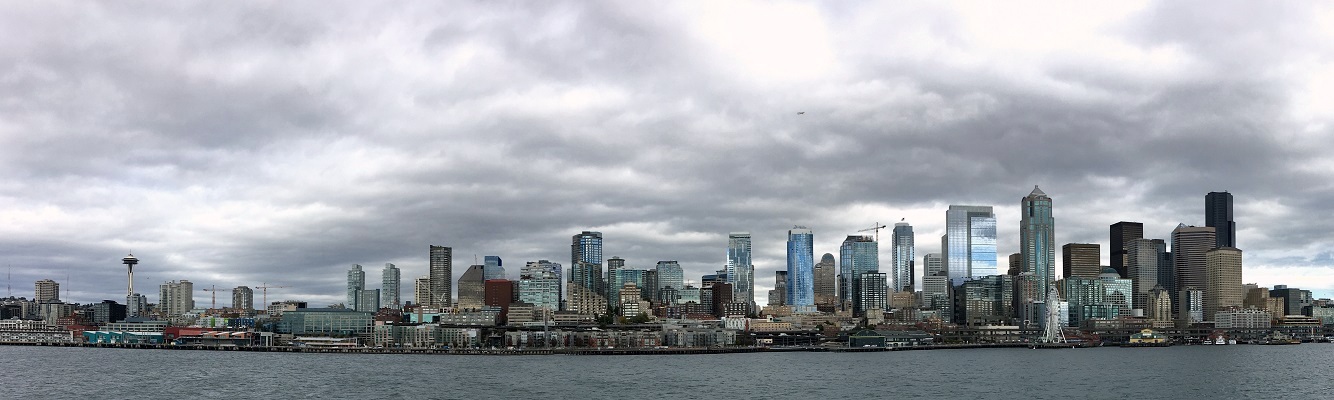
The Seattle skyline, seen from the ferry. Thursday’s blue skies gave way to lots of low clouds.

Thursday/ Norwegian Point

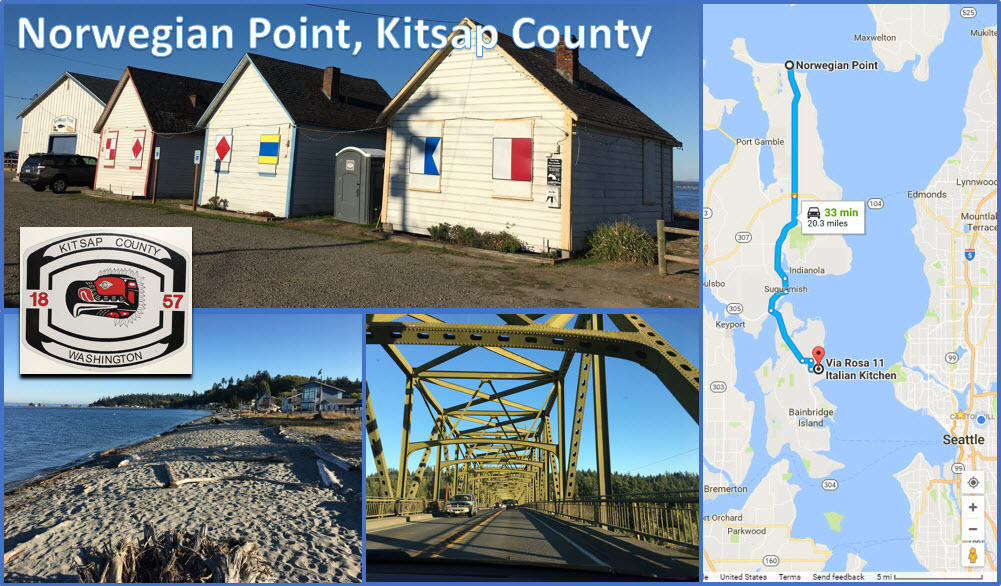
Bryan and I made a run out to Kitsap peninsula for dinner with friends. We stopped at Norwegian Point to catch a little of the beautiful fall weather, and then made it down to Bainbridge Island for dinner at a restaurant-store called Via Rosa 11: great wood-fired pizza, and other Italian food.

Norwegian Point’s little storage houses with their colorful maritime flags; the Kitsap County logo* from a ballot box/ mail box right there; the view from Norwegian Point looking south west; the bridge crossing at Agate Point onto Bainbridge Island. *As far as I can tell this is a depiction of a thunderbird (rainbird), a legendary creature in certain North American indigenous peoples’ history and culture.

Wednesday/ a ‘moron’

NBC reported on Wednesday that Secretary of State Rex Tillerson called President Trump a ‘moron’* in public. This was in July, at the Pentagon, after Trump had left a meeting. Shortly after that VP Mike Pence had to talk Tillerson into staying on and not quitting.     *It’s actually worse than that .. whispers are that it was ‘f-ing moron’.  The political publication The Hill tells NBC to come clean and report the exact phrase that was used.

Anyway, does it matter? Both Tillerson and Trump denied on Wednesday that anything was amiss.  (Tillerson: the President is a ‘smart man’; Trump: NBC is ‘fake news’, ‘totally made-up’). Right.  I will go with NBC’s version, to believe.

It does matter. It’s not good that there is such a rift between the President and his Secretary of State.  And Trump seems to routinely undermine his cabinet’s efforts by tweeting totally contradicting policy points of view.  Example: I told Rex Tillerson, our wonderful Secretary of State, that he is wasting his time trying to negotiate with Little Rocket Man .. Save your energy Rex, we’ll do what has to be done!  

Tuesday/ my new silver shadows

I am trying again to add greenery to the front of my house, and my gardener recommended astelias (‘silver shadow’).  I have to keep an eye on them and keep them watered, since the rainy season is not yet in full swing here.

The young Astelia (‘silver shadows’) in front of my house.  (The darker ones in between are fillers until the astelia gets bigger. They go by several names, such as coral bells and amethyst). The astelia (sliver shadow) is originally from New Zealand, and an evergreen perennial that forms a clump to 3 feet tall by about 4 feet wide with bold, metallic silvery-green recurved leaves.

Monday/ only in Alaska

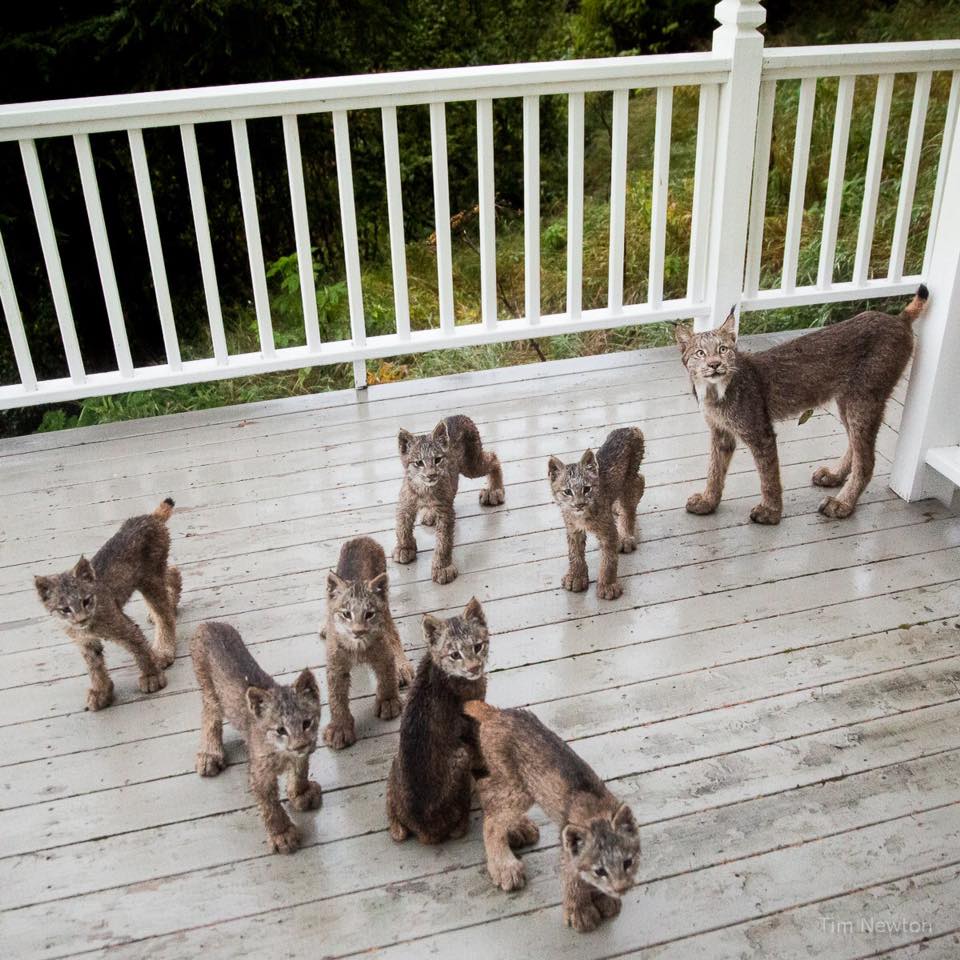
Check out this mama lynx and her seven kittens that visited Tim Newton’s porch in Alaska.  (They picked the right porch! He is a photographer).  These are called Canada lynxes.  Its cousin from the lynx genus, further south in North America, is the bobcat. Other species of medium-sized wild cats are the Eurasian lynx and the Iberian lynx, the Indian jungle cat, and Africa’s caracal, which we have in South Africa as well.

[Photo by Tim Newton] Anchorage resident Tim Newton awoke to the sound of something running across his deck in the area of Flattop, last Tuesday at 7:30 a.m. So naturally, he went to check it out.

Sunday/ massacre in Las Vegas

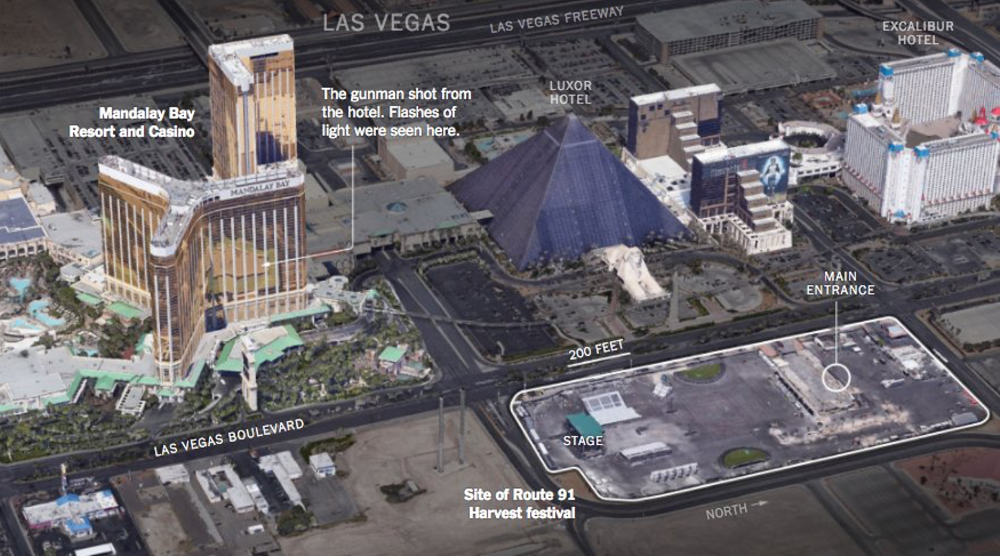
From the New York Times, compiled by Quoctrung Bui and Margot Sanger-Katz. Assault weapons should be banned, as should high-capacity magazines.

A gunman sprayed 22,000 country music concert goers with bullets from machine gun fire from his Las Vegas hotel room on Sunday night at 10.08 pm, for almost  10 minutes.

The sheriff from Clark County in Las Vegas just had a news conference (Monday morning), said the ‘body count’ was up to 58, maybe 59, then corrected himself and said ‘number of deceased’.  Well, it’s a massacre, and the body count as of now is 58, with 515 wounded.   The gunman  was a 64 yr old white male, US citizen – they usually are white males & US citizens, the gunmen in these frequent events in the United States. He used bullets designed to do maximum damage. He then committed suicide.  The President called it an ‘act of pure evil’ and offered his condolences.  The gunman’s brother could not point to anything that triggered him. Congress is not expected to anything, at all.

Graphic from the New York Times. The shooter was on the 32nd floor of the Mandalay Bay hotel.


Saturday/ Trump’s swamp, Exhibit A

Price took a Gulfstream C-37B (same as G550 in the picture) owned by the Department of Defense for a weeklong trip in late May through Africa and Europe. The six legs of travel, which represented about 30 hours of flight time, were projected to cost $311,418.25, according to an invoice reviewed by Politico.com.

‘Drain the Swamp!’ was Donald Trump’s rallying cry during his campaign. Well, the swamp is alive and well. Trump’s Health & Human Services (HHS) secretary Tom Price, finally quit on Friday. He brought a scandal onto himself with his ultra-exorbitant travel expenses.  The feat he pulled off: pile up expenses to the tune of $1,000,000 of overseas trips and the more than two dozen trips he has taken on private planes domestically since May.  This is after he cut the HHS travel annual budget of $4.9 million by $663,000 (15%).  And for comparison, his predecessor Kathleen Sibelius, took one private plane flight in all of her 5-year tenure.

Even so, it appears Price’s ultimate sin was not being able to repeal Obamacare (that is: take away healthcare money for millions of Americans), and so he had to go.

Friday/ Lake Lenore & Dry Falls

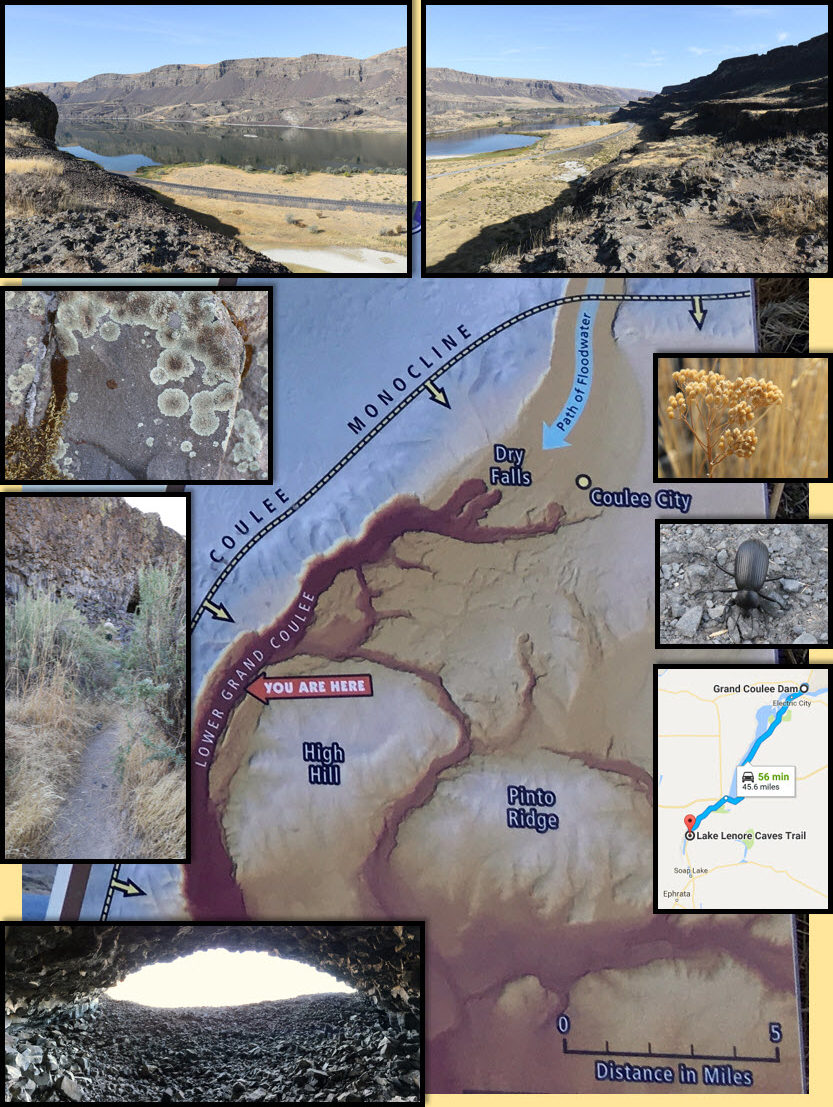
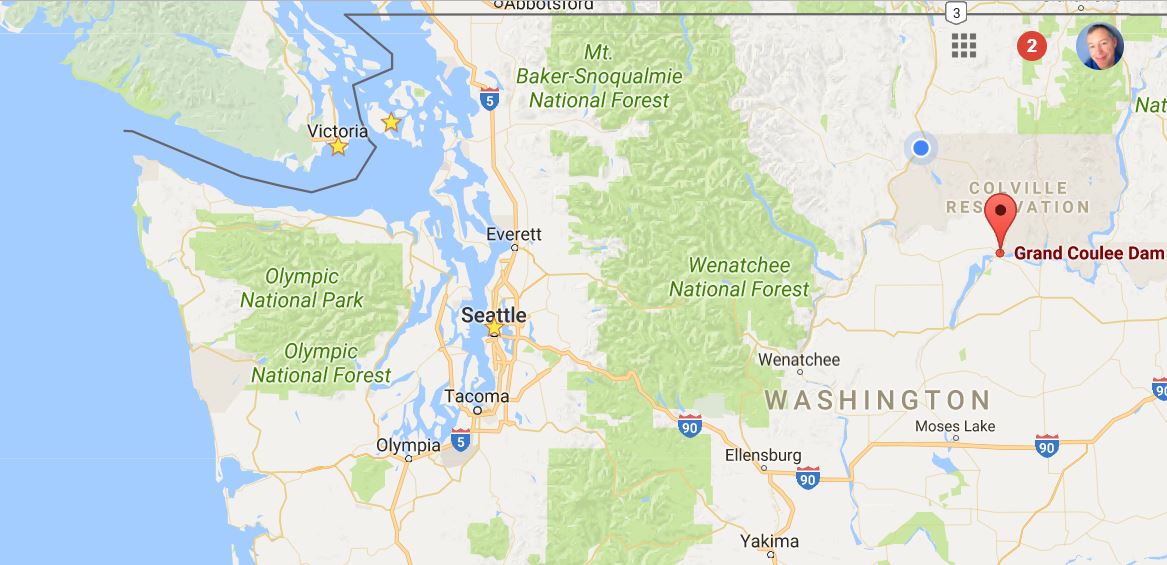
(These pictures are from Wednesday).  We made a stop at Lake Lenore on Wednesday. Lake Lenore is a long, narrow lake (8 mi long, 15ft deep) formed by the Missoula Floods in the lower Coulee just north of the town of Soap Lake. There is a trail that leads up to caves in the basalt rock.

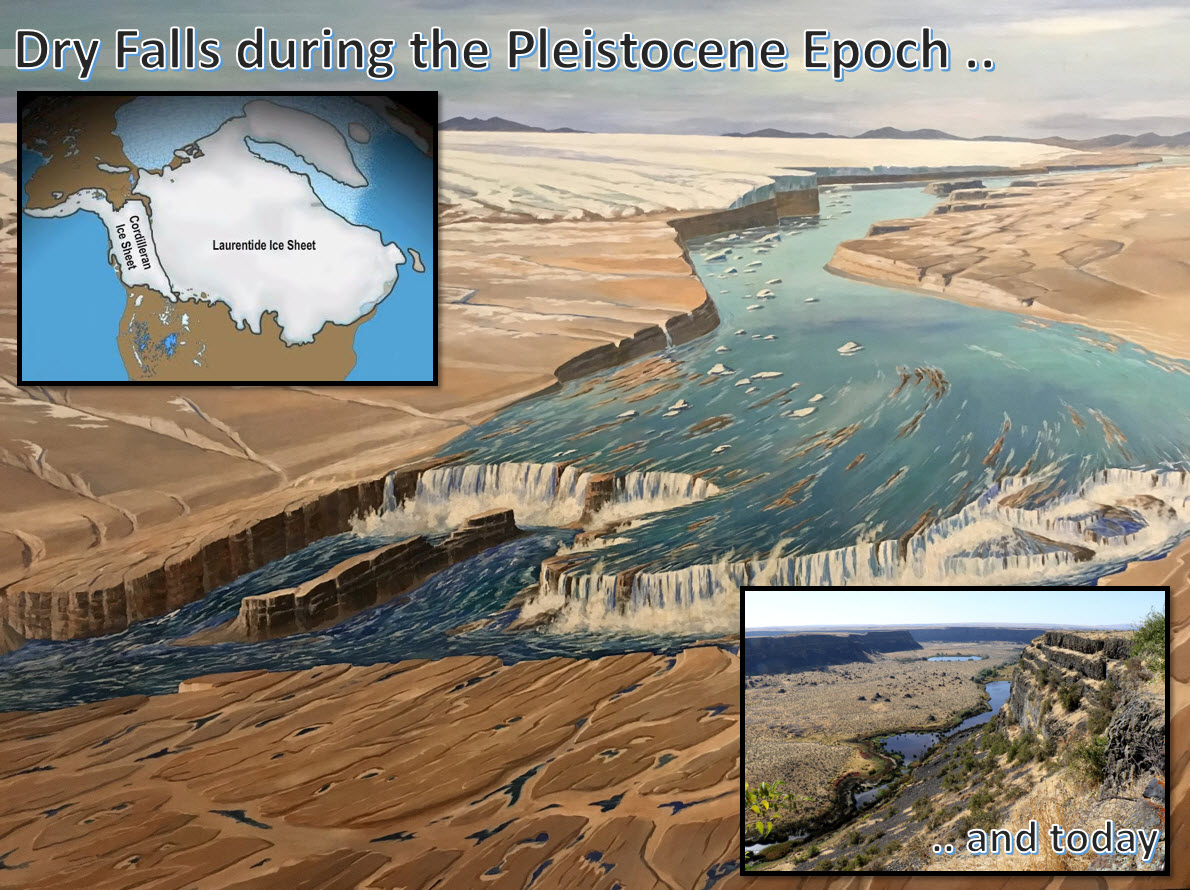
Driving further up north on Highway 17 brings one to Dry Falls, named for the massive waterfalls that existed there during the Pleistocene Epoch, when ice sheets and glaciers covered huge parts of Earth’s surface.  This area was at the southern end of the Cordilleran ice sheet, and the melting of the glaciers carved out the coulees in the basalt rock that we see today.

Clockwise from the top: looking southwest & northwest toward the ‘coulee monocline’ bluffs over Lake Lenore, with Highway 17 below; dry vegetation and a black beetle; Lake Lenore lies alongside Highway 17; view from inside one of the caves formed by the plucking out of pieces of the basal rock by the rushing Missoula Flood waters; footpath to the caves; beautiful lichen. Lichens are composite organisms that emerge from algae or cyanobacteria living among the filaments of two fungi in a mutually beneficial symbiotic relationship.
The main picture is from inside the visitor center at Dry Falls. The picture that I took (bottom right) is the view looking south, away from the cliffs of the Dry Falls. The Pleistocene Epoch began about 2.6 million years ago and lasted until about 11,700 years ago. The most recent Ice Age occurred then (there have been at least FIVE in Earth’s history). At the time of the Pleistocene, the continents had moved to their current positions. Large parts of the northern continents were covered by glaciers, but they did not just sit there. There was a lot of movement over time, and there were about 20 cycles when the glaciers would advance and retreat as they thawed and refroze.


Thursday/ the North Cascades

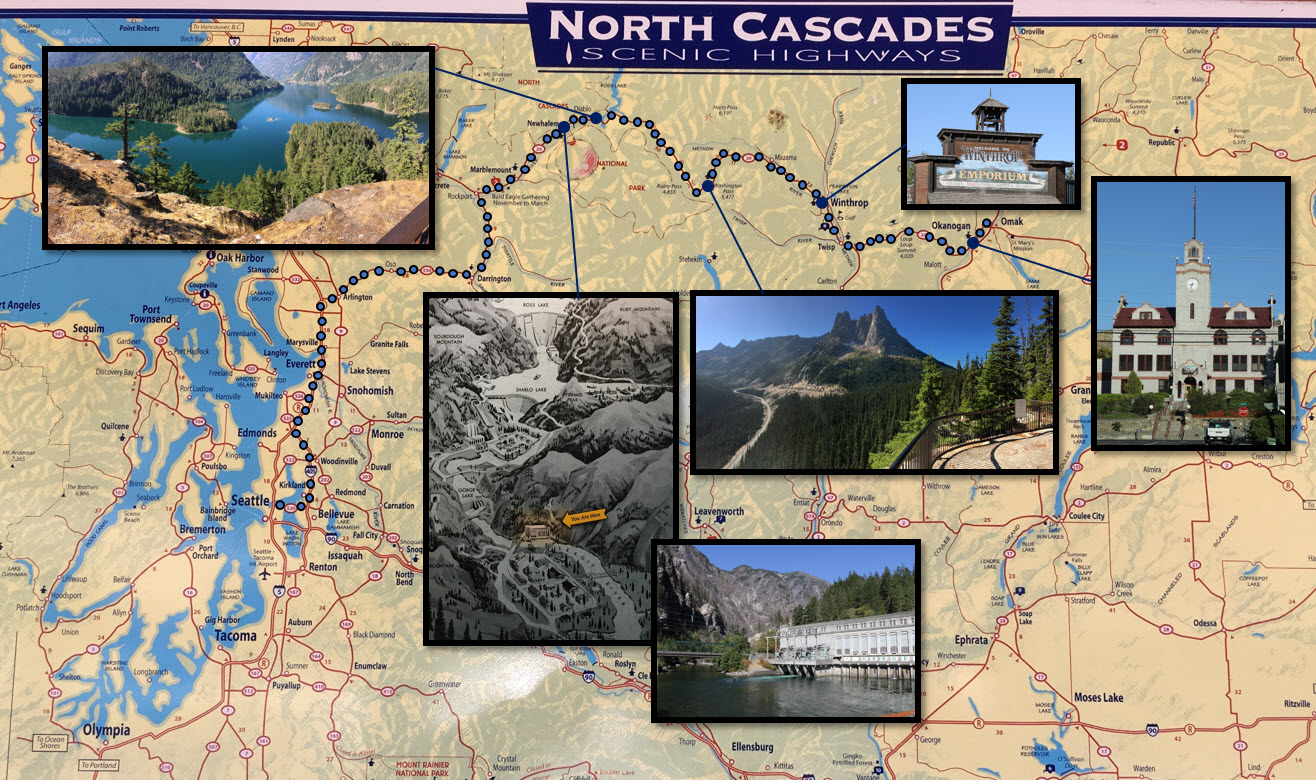
We stayed over in the town of Omak on Wednesday night, and made our way back to Seattle on Thursday over the North Cascades* with Highway 20.  It’s about a 5 hr drive without stops, to go from Omak to Twisp, Winthrop, Newhalem, Darrington and then with I-5 (or I-405) to Seattle.  It was a crisp morning when we started back from Omak (47 °F/ 8°C), but back in Seattle it was a record warm day for Sept 28 at (85°F/ 29 °C).

*The Cascade Range or ‘Cascades’ is a major mountain range of western North America, extending from southern British Columbia in Canada through Washington State and Oregon and into Northern California.

Clockwise from top left: view over the Skagit River Valley, with the Diablo Dam’s dam wall directly ahead; vintage ‘Wild West’ storefront in Winthrop; town hall of Okanogan; viewpoint in Washington Pass on Highway 20, with the Early Winter Spires (7,807 ft / 2 380 m); at Newhalem by the Gorge Dam and Power station; the diagram shows the Ross Dam and the Diablo Dam as well.
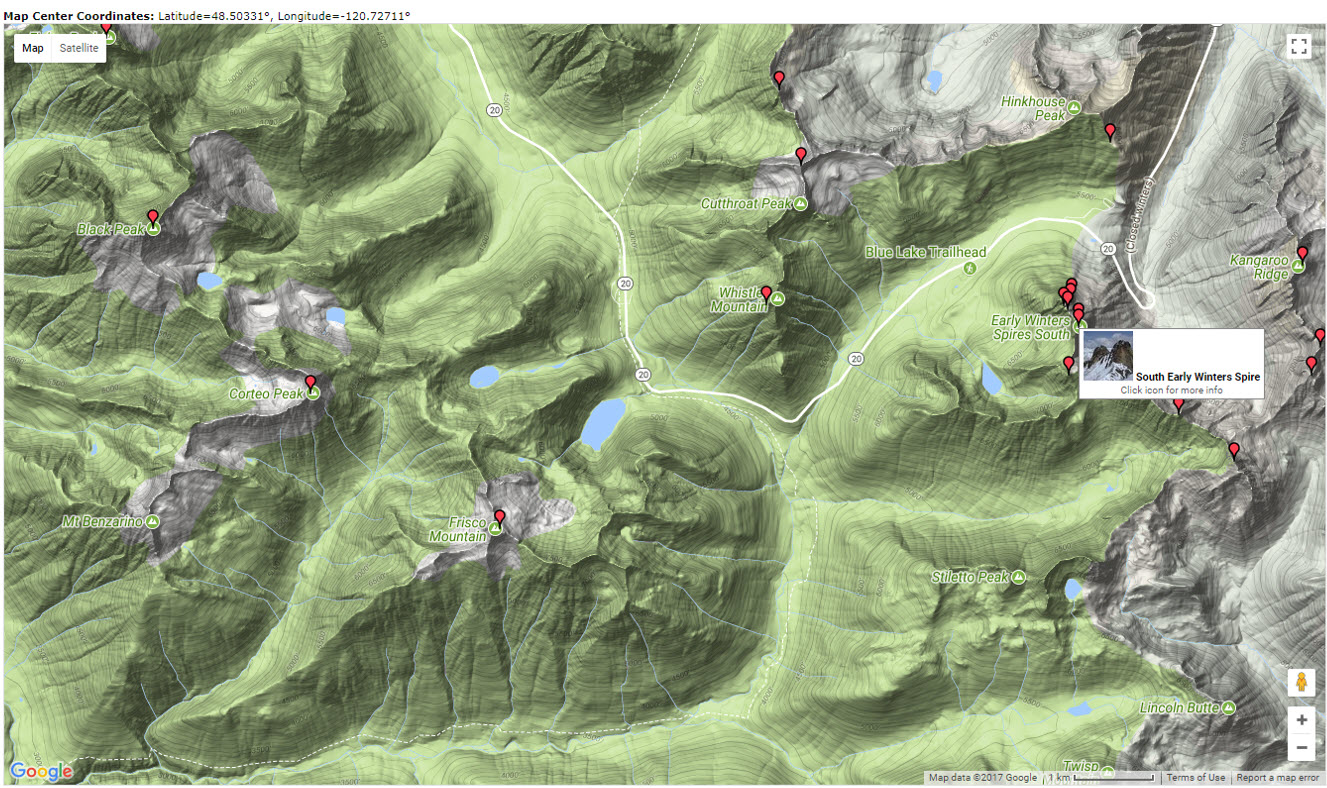
Here’s a cool topographical map that I generated with a Google search for ‘Early Winter Spires’ that shows how Highway 20 follows the lowest contour lines through the North Cascades. The web site is http://www.summitpost.org.   There is a hairpin bend in the road by the Spires, and the map also shows several alpine lakes. These are lakes or reservoirs at high altitudes, usually starting around 5,000 feet (1,500 m). These is still snow and ice visible further up, from small glaciers. Highway 20 gets so much snow in winter that it is completely closed for traffic, sometimes only opening again as late as June.
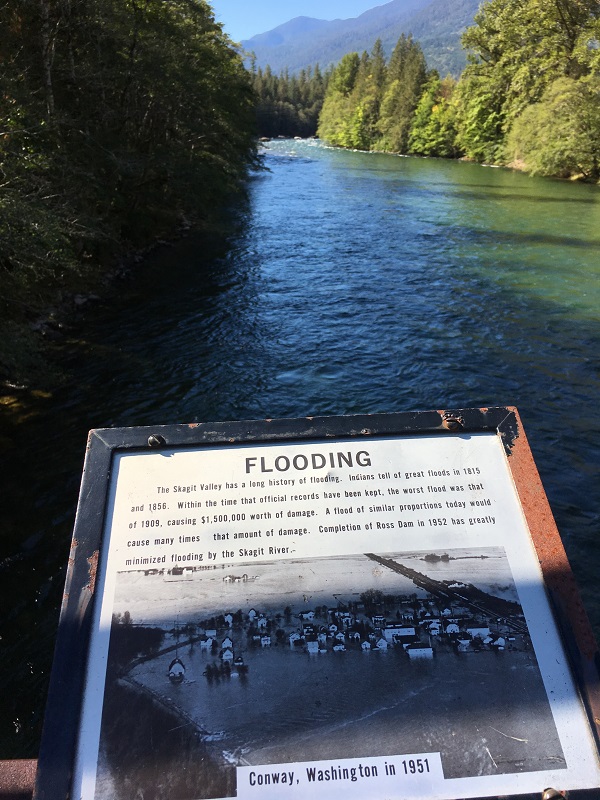
View from a foot bridge overlooking the Skagit River at Newhalem; this is just downstream of the Gorge Dam. Flooding in the Skagit Valley has become a rare event due to the three dams that had been built upstream in the Skagit River (the Gorge, the Diablo, the Ross).

Wednesday/ Grand Coulee Dam

The Grand Coulee Dam was constructed shortly after the Great Depression, and provided jobs to thousands. At first feared to be a white elephant of sorts (it produced lots of electric power with not quite enough demand for it), it was put to good use during World War II. It provided power to Boeing Company in Seattle, to shipbuilders in Portland, Oregon, and to an aluminum smelter in Spokane on the border with Montana.

A coulee is a kind of valley or drainage zone. The Grand Coulee is an ancient river bed in north-central Washington State. And the Grand Coulee Dam is a massive concrete gravity dam on the Columbia River, built to produce hydroelectric power and to provide irrigation water. Only the Three Gorges dam in the Yangtze River in Hubei province, China, is a bigger dam in terms of concrete used for the dam wall and construction.

The original dam was constructed from 1933 to 1940 at a cost of $300 million. The Third Power Plant, constructed from 1967 to 1980, cost $700 million.  If the dam were constructed today, it would cost $8.26 billion.  The dam today generates some 20 billion kW-hrs of electricity every year, distributed to 11 states.

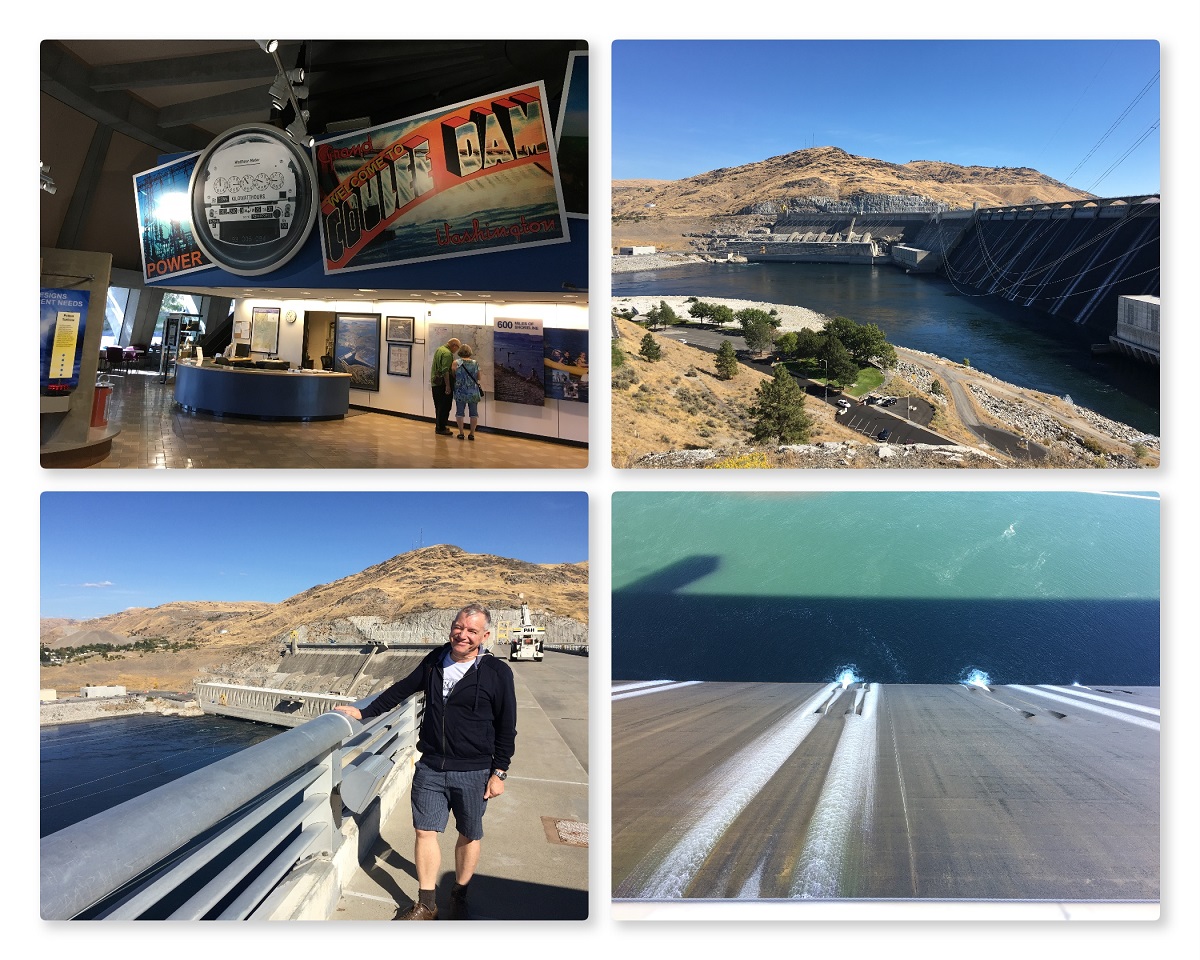
Clockwise from the top: Inside the visitors center; the dam wall with the eleven spillways and several 230 kV transmission lines strung out in front of the wall; looking vertically down from the dam wall (a little water is spilling from spill tubes in the dam wall); on top of the dam wall during a tour of the dam.
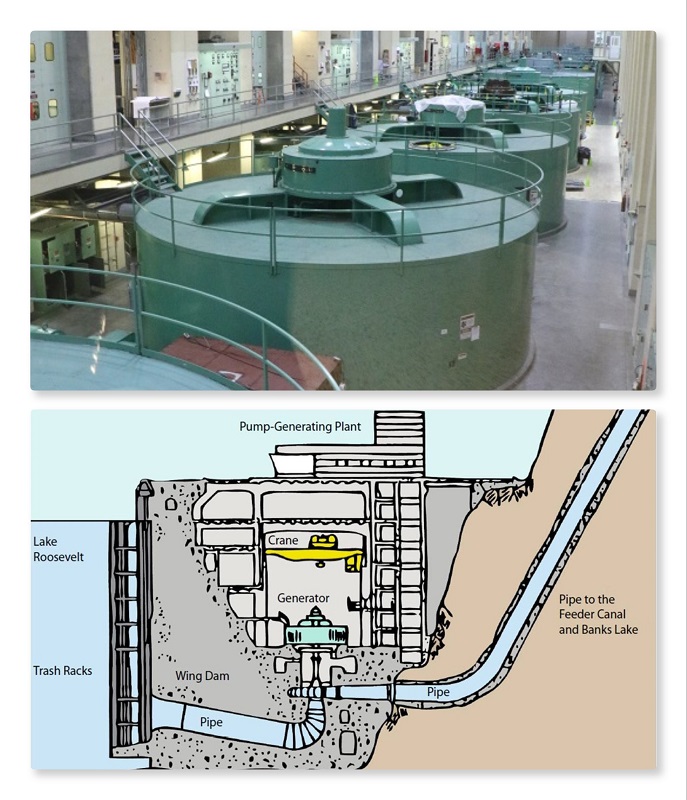
On top is a picture from inside the Pump-Generating Plant, during our tour. The green silos are huge: 5 stories tall and housing enormous pumps that pump water uphill to a man-made irrigation lake called Banks Lake. At the far end are units that look very similar, but that can act as generators as well (when water from Banks Lake flow back through it), as shown in the diagram in the bottom.