I need to die before I’m dead when my heart is still fertile and red before I eat the darkened soil of doubt
give me two lips and bright ink for tongue to write the earth one vast love letter swollen with the milk of mercy
– From the poem ‘Rebel Song’ by Breyten Breytenbach
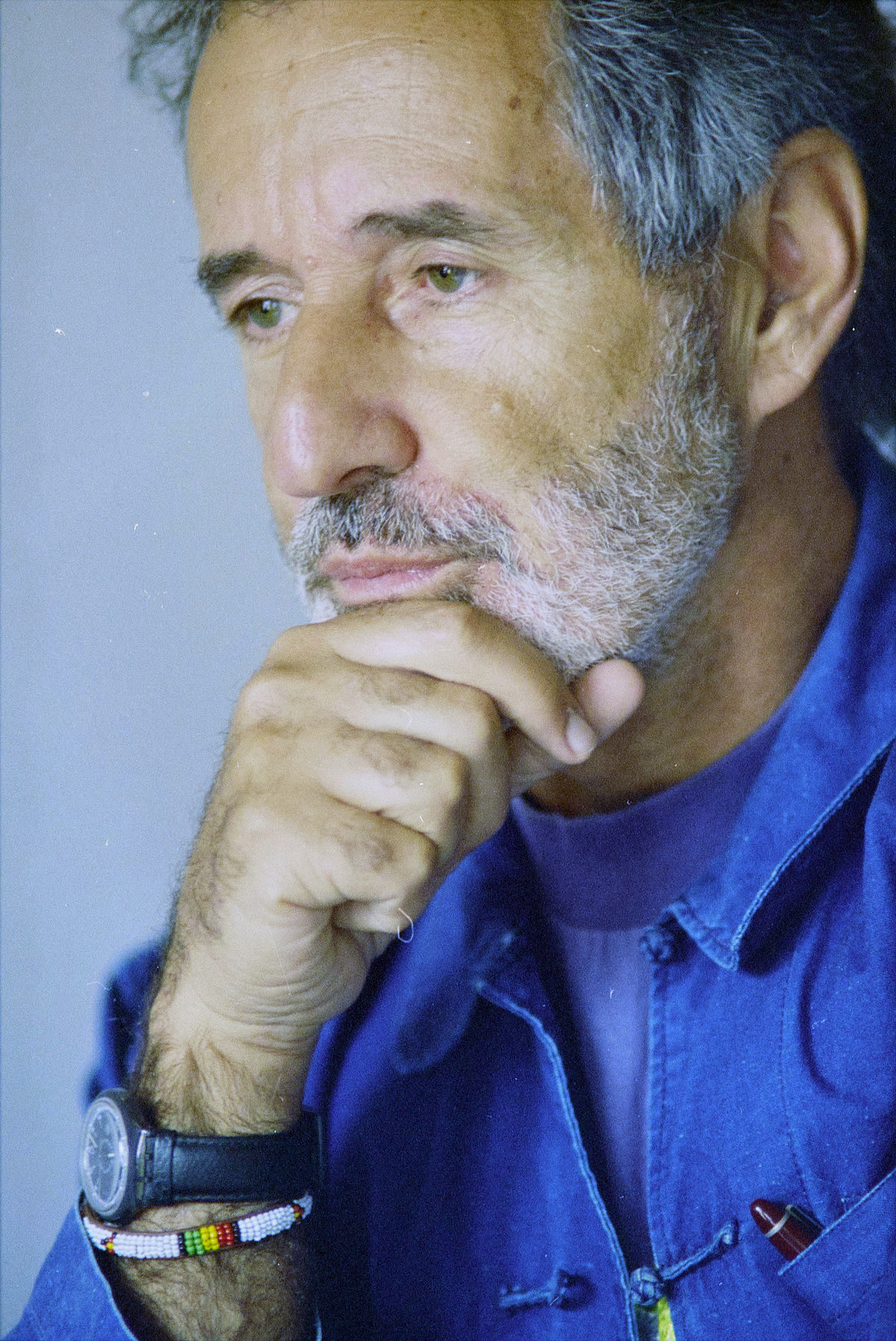
Breytenbach in 1995 ‘Breytenbach was a political dissenter against the ruling National Party and its white supremacist policy of apartheid in the early 1960s. He was a founding member of the dissident literary movement of Afrikaner writers, the Sestigers in 1961, and participated in protests against the exclusion of black youth from educational pathways’. [Picture and text from Wikipedia]The iconic South African writer and activist Breyten Breytenbach passed away in Paris, France, yesterday (he was 85). His wife Yolande was by his side.
Breytenbach wrote mostly in Afrikaans, but also in English. He was a fierce critic of apartheid as he embarked on his long and illustrious career, as a writer that would redefine the Afrikaans literary landscape.
In 1960, Breytenbach left South Africa under a self-imposed exile.
After a two-year tour of Europe, he settled in France (he later became a French citizen).
In 1962 he married a French woman of Vietnamese ancestry, Yolande: a criminal act under South African law at the time.
The Prohibition of Mixed Marriages Act of 1949 and Immorality Act (1950) made it a criminal offence for a person to have any sexual relations with a person of a different race.
In 1975, Breytenbach was arrested in South Africa after travelling there on a false passport. His intention was to help black Africans organize trade unions, and to recruit members for a branch of the African National Congress (ANC) for white people. He sentenced to nine years’ imprisonment for high treason, the first two in solitary confinement in in Pretoria Central Prison’s maximum security wing. He was released after seven years, thanks to a campaign led by former French President Francois Mitterand.
In 1984, his memoir The True Confessions of an Albino Terrorist was published, describing aspects of his imprisonment.
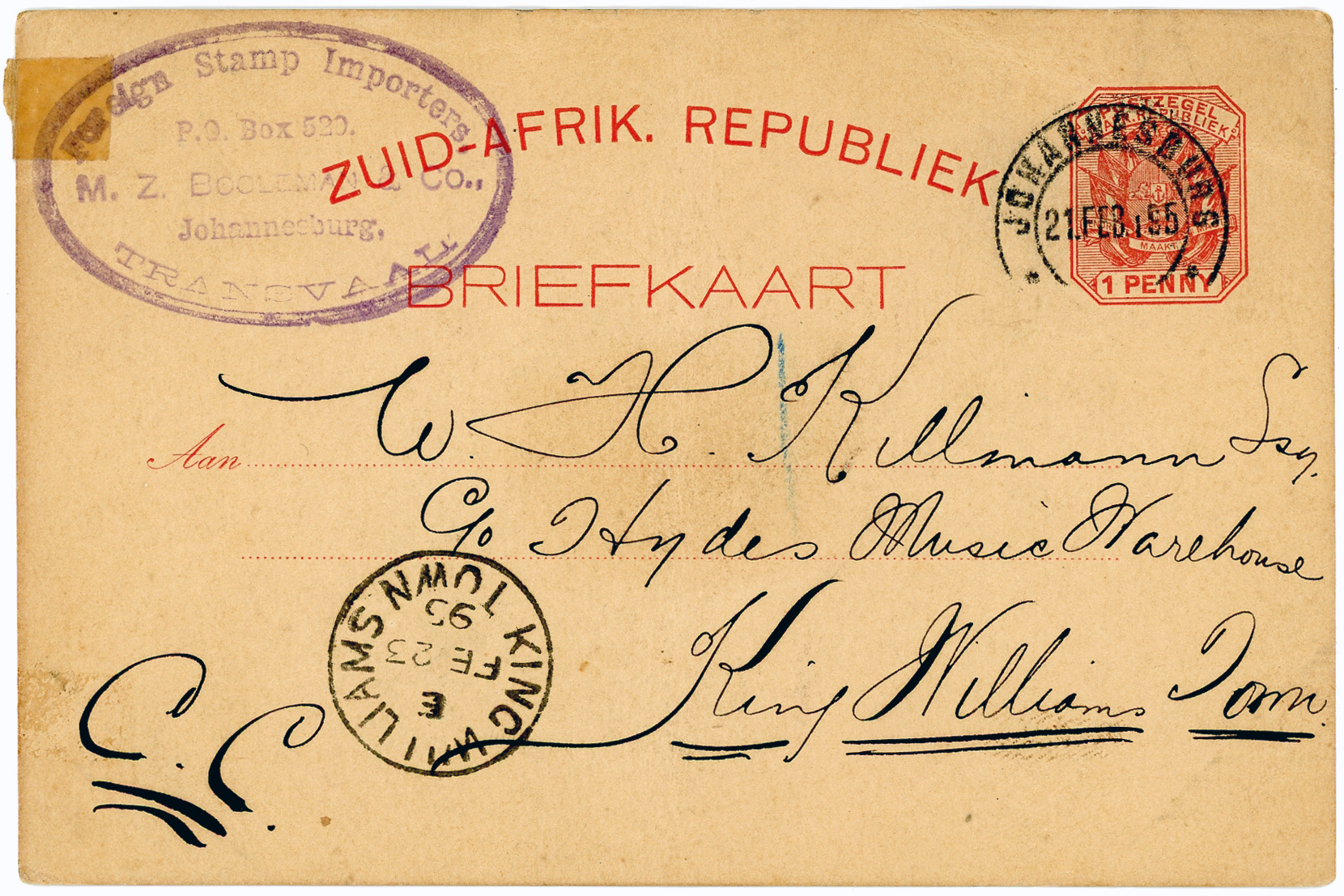
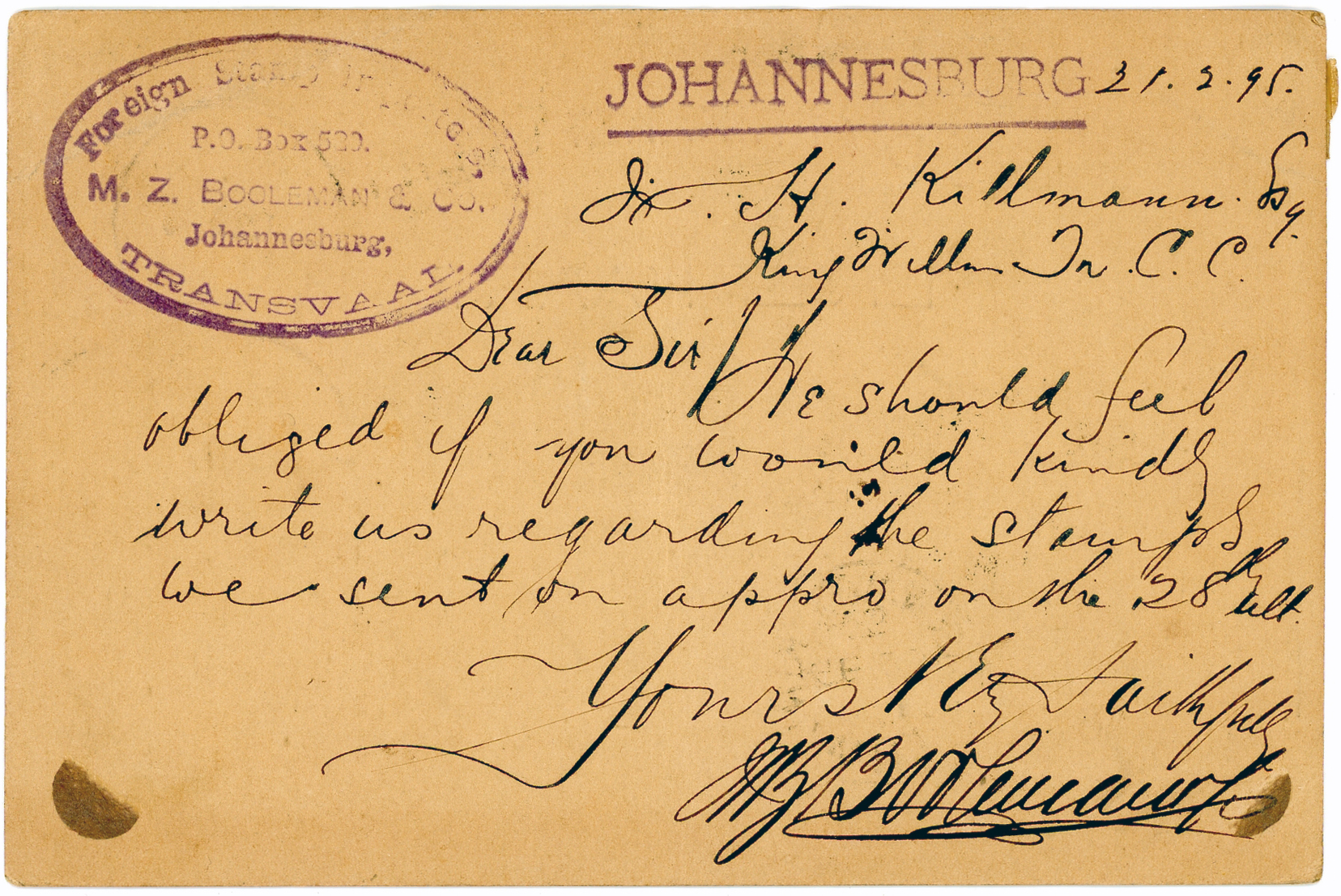
I don’t collect whole pieces of mail (such as envelopes, first day covers and post cards), but I found this post card that was for sale on Ebay impossible to resist.
This post card (‘Briefkaart’) is Afrikaans only and doesn’t bother to offer English wording (later ones were bilingual, and did). Check out the gorgeous cursive writing, an art form lost in the century that followed. The card was mailed in 1895, in Johannesburg, City of Gold, ‘El Dorado’ for real— founded only nine years prior, in 1886. (In that year the Witwatersrand Gold Rush started, which led to the establishment of Johannesburg). Just a few years earlier still, the outcome of the First Boer War (1880-81) had led to the temporary independence of the South African Republic (‘Zuid-Afrikaanse Republiek’) from the British Empire.
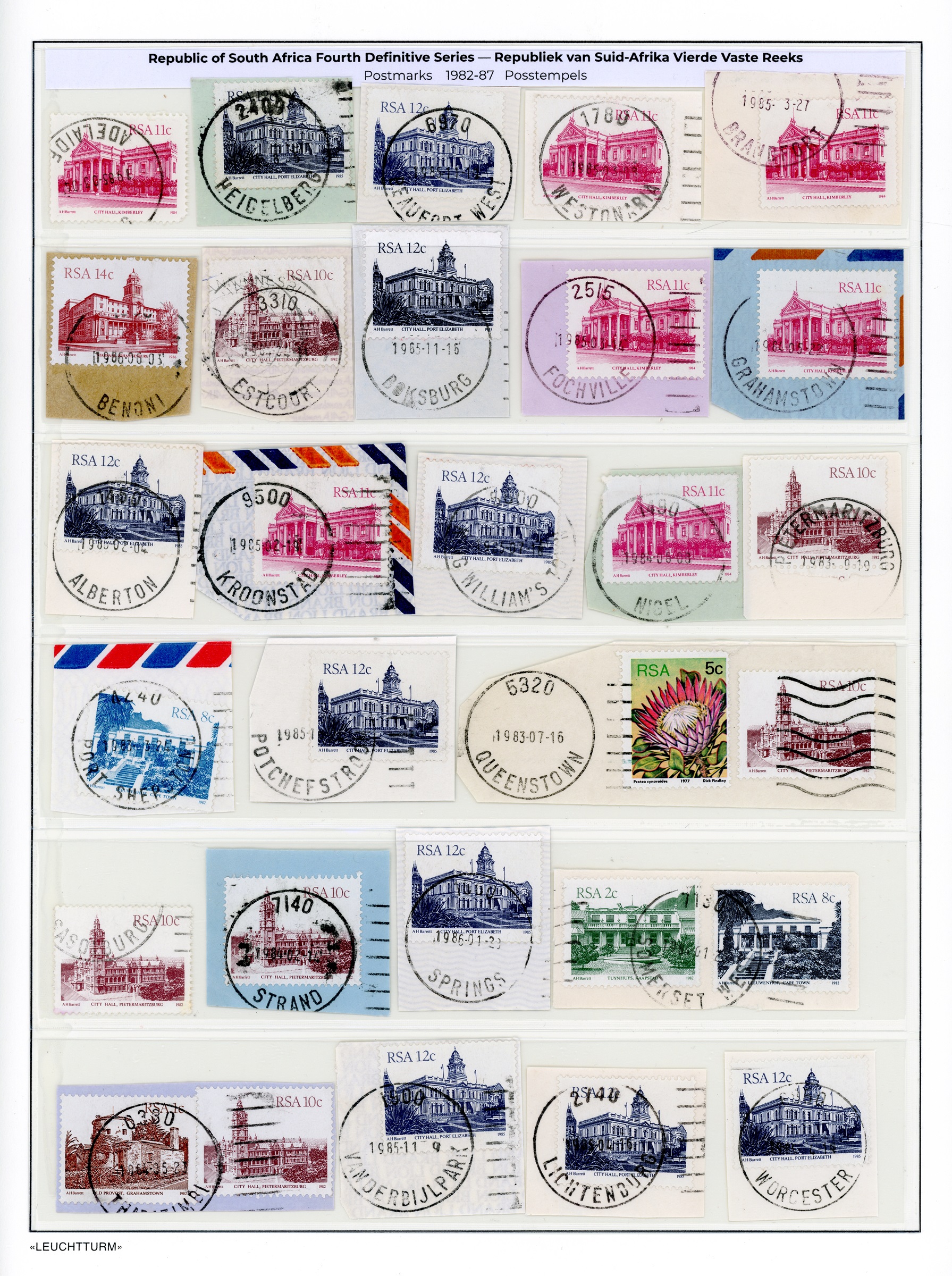
I still have shoeboxes full of South African stamps on paper cutouts, and I dunk them batch by batch into water to separate the stamp from the paper.
Those that have nice postmarks on (place name and date), I keep on the paper, though.
Below is such a page.
Some of these postmarks belong completely to history.
The cities and towns that they denote have been renamed in recent years.
Fourth Definitive Issue (1982-87)— South African Buildings Issued Jul. 15, 1982 Perf. 14½x14, 14×14½ | Litho. and Recess Printing | No watermark 564 A229 1c Brown (’84) | Old Provost, Grahamstown 566 A229 2c Green | Tuynhuys, Cape Town 574 A229 8c Intense Blue (’83) | Leeuwenhof, Cape Town 576 A229 10c Light red-brown | City Hall, Pietermaritzburg 578 A229 11c Cerise (’84) | City Hall, Kimberley 579 A229 12c Deep Ultramarine (’85) | City Hall, Port Elizabeth 580 A229 14c Rose brown (’86) | Johannesburg City Hall (Note- Only the stamps in the picture are listed here; several others were issued as part of the fourth definitive series). [Source: 2021 Scott Standard Postage Stamp Catalogue, Vol. 6A]
Postmarks: ADELAIDE, HEIDELBERG, BEAUFORT WEST, WESTONARIA, BRANDFORT (Winnie Mandela since 2021), BENONI, ESTCOURT, BOKSBURG, FOCHVILLE, GRAHAMSTOWN (now also known as Makhanda), ALBERTON, KROONSTAD, KING WILLIAM’S TOWN (Qonce since 2021), NIGEL, PIETERMATIZBURG, PORT SHEPSTONE, POTCHEFSTROOM, QUEENSTOWN (Komani since 2016), SASOLBURG, STRAND, SPRINGS (now part of the City of Ekurhuleni), SOMERSET WEST, THBAZIMBI, VANDERBIJLPARK, LICHTENBURG, WORCESTER.
Some 50 million voters have already cast their ballots for the 2024 US Elections (one third of the electorate).
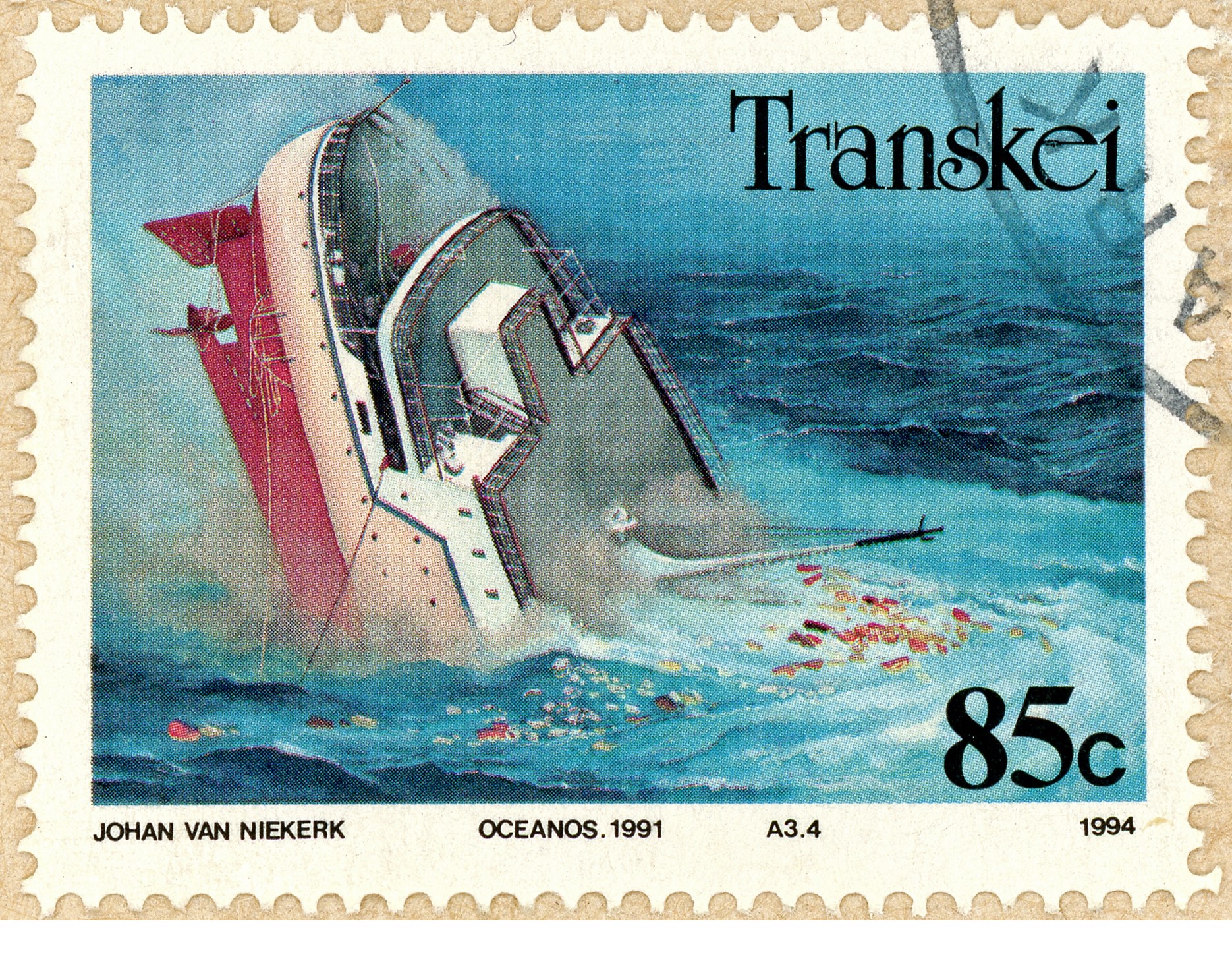
I came across this stamp in my shoebox with on-paper stamps today.
1994 Modern Shipwrecks Issued Mar. 18, 1994 by Transkei, from the final set of stamps issued by Transkei* Perf. 14½ x14 | Litho. | No watermark 301 A62 85c |Multicolored | Oceanos**, 1991 *Transkei was a self-governing tribal homeland in South Africa from 1976 to 1994 in the Eastern Cape province. Transkei ceased to exist on Apr. 27, 1994. It was reincorporated into the Republic of South Africa after the 1994 national election. **MTS Oceanos was a French-built and Greek-owned cruise ship that sank in 1991 off the coast of South Africa when she suffered uncontrolled flooding. Friends of my parents were on the ship as she was going under 😱, and came away on a lifeboat with nothing other than the clothes that they had been wearing. [Sources: Scott Standard Postage Stamp Catalog, Vol. 6A, Wikipedia]
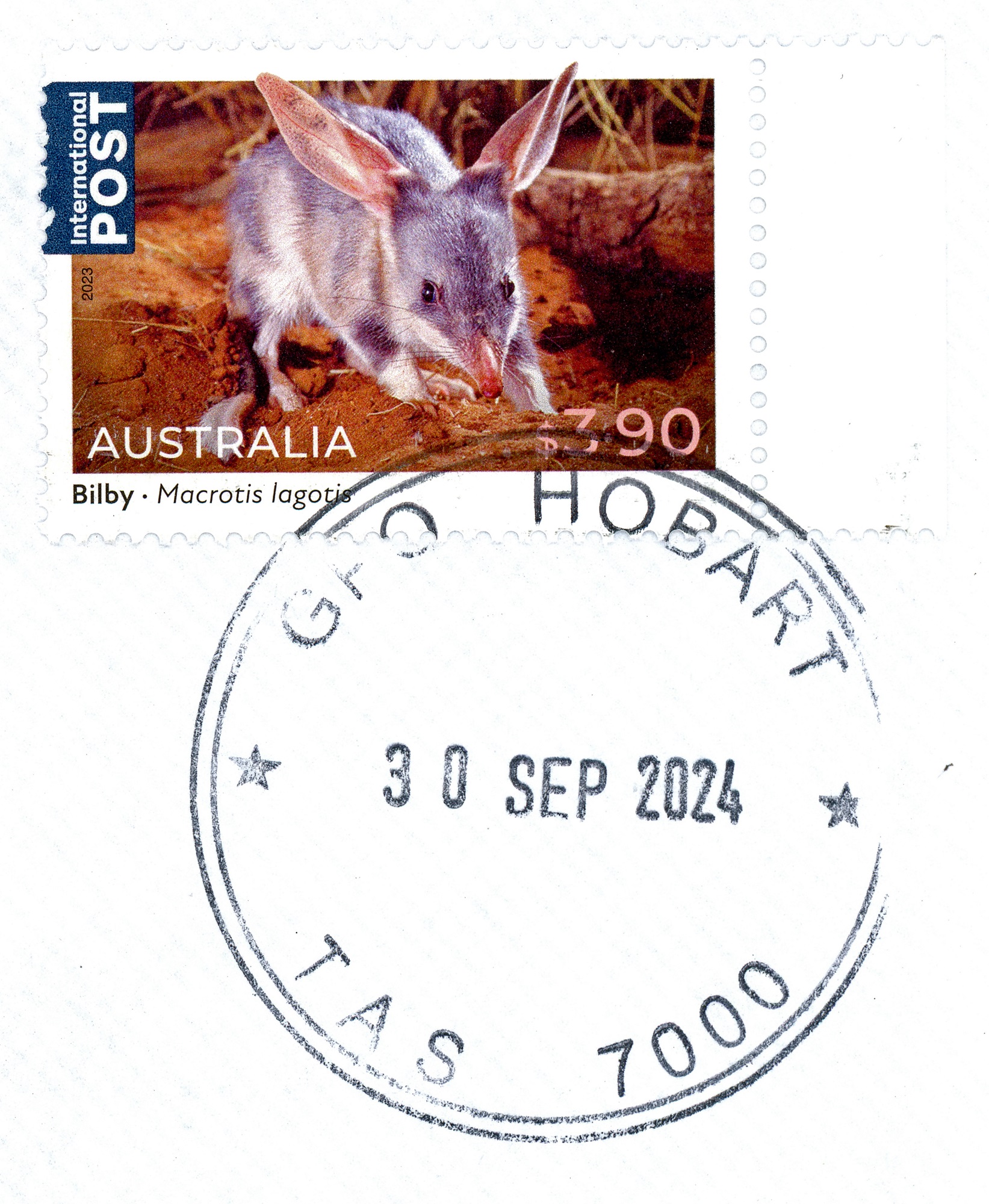
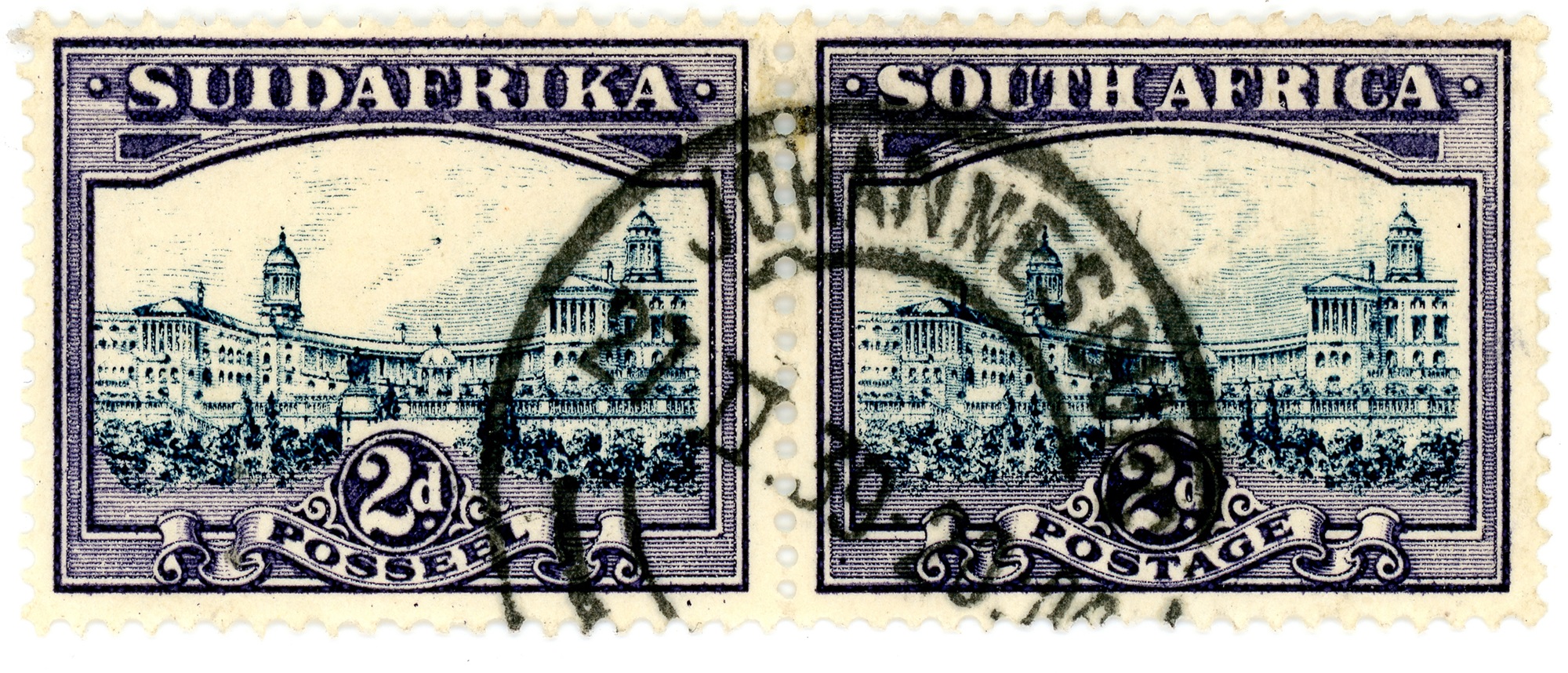
There was mail from an Ebay seller in Tasmania, Australia, in my mailbox today— with a single pair of South African stamps inside.
2023 Australia’s Native Animals – International Stamps Issued Jun. 26, 2023 Perf. 13¾ x 14½ |Design: Jason Watts Engraving/RA Printing | No watermark No. 4205 AUS$ 3.90 |Multi-colored |Bilby (Macrotis lagotis) Notes: The bilby (Macrotis lagotis) is a desert-dwelling marsupial about the size of a rabbit. It was once widely distributed through arid and semi-arid Australia, but wild populations are now restricted to spinifex grassland in Western Australia and the Northern Territory, and to a small region of southwestern Queensland. [Sources:stampworld.com, Australia Post Stamp Bulletin No 384]1930-1945 South Africa Definitive Issue (designs redrawn) Issued Sep. 1, 1938 Perf. 15×14 |Photogravure |Wmk. Multiple Springbok heads Se-tenant pair of Afrikaans & English inscribed stamps SACC 43c 2d |Blue and violet |Union Buildings, Pretoria [Source: The South Africa Stamp Colour Catalogue, 1988]
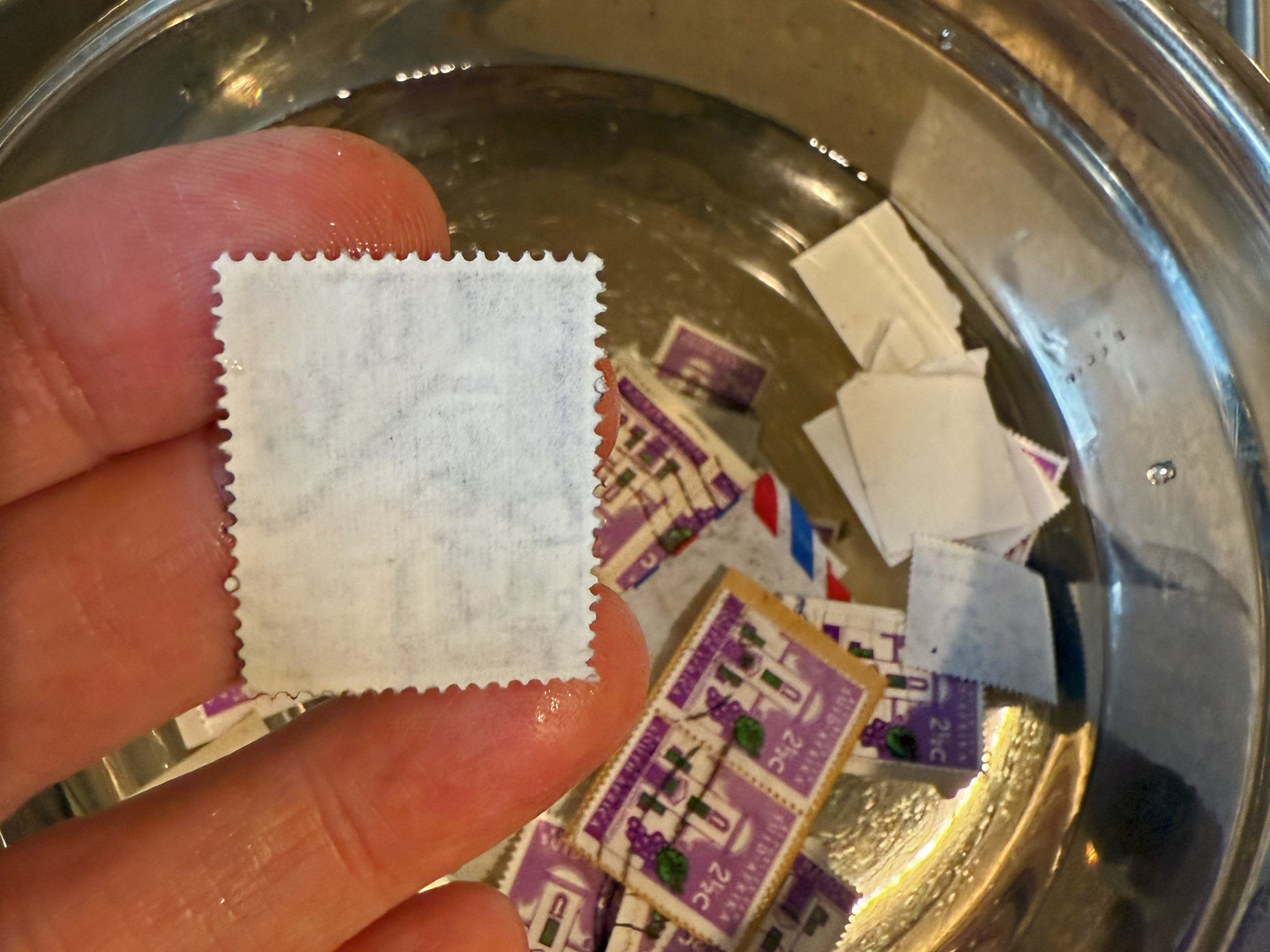
I still dunk a batch of used stamps from my large stash into warm water now and again— to separate them from the paper they were pasted on.
The stamps are put on paper towels to dry out until they are damp, and then I press them between sheets of paper under a stack of heavy books for 24 hours.
There’s the watermark, the RSA (Republic of South Africa) in a rounded triangle, embedded in the paper* used for printing the purple 2½c stamp down below in the water. It’s a very delicate process, separating the stamp from the paper, and then gently rubbing the back with one’s fingertips until it is no longer slippery (meaning that all the glue has been rubbed off). Is that something that Tesla’s Optimus robot will ever be able to do for me— put the stamps in the water, gently rub the backs to get the glue off, dry them out, and press them under books before bringing them up to my study for me? I seriously doubt it.
* These watermarks were probably made with a so-called dandy roll. During the wet-paper phase of the paper-making process, a light roller is pressed onto the paper. The repeating pattern is embossed into the paper, compressing and thinning the fibers in that area. The thinner areas allow more light to pass through, making the watermark visible.
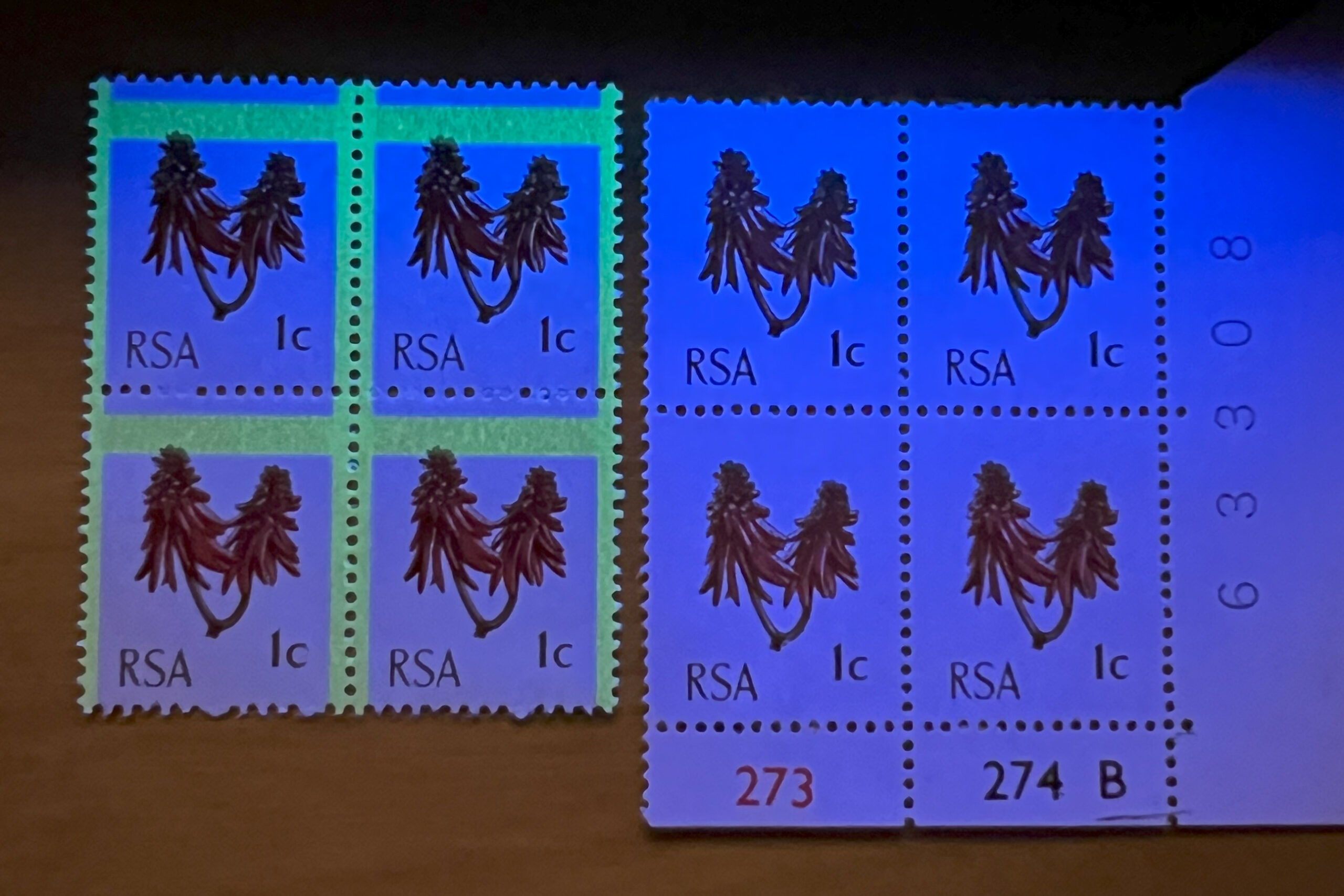
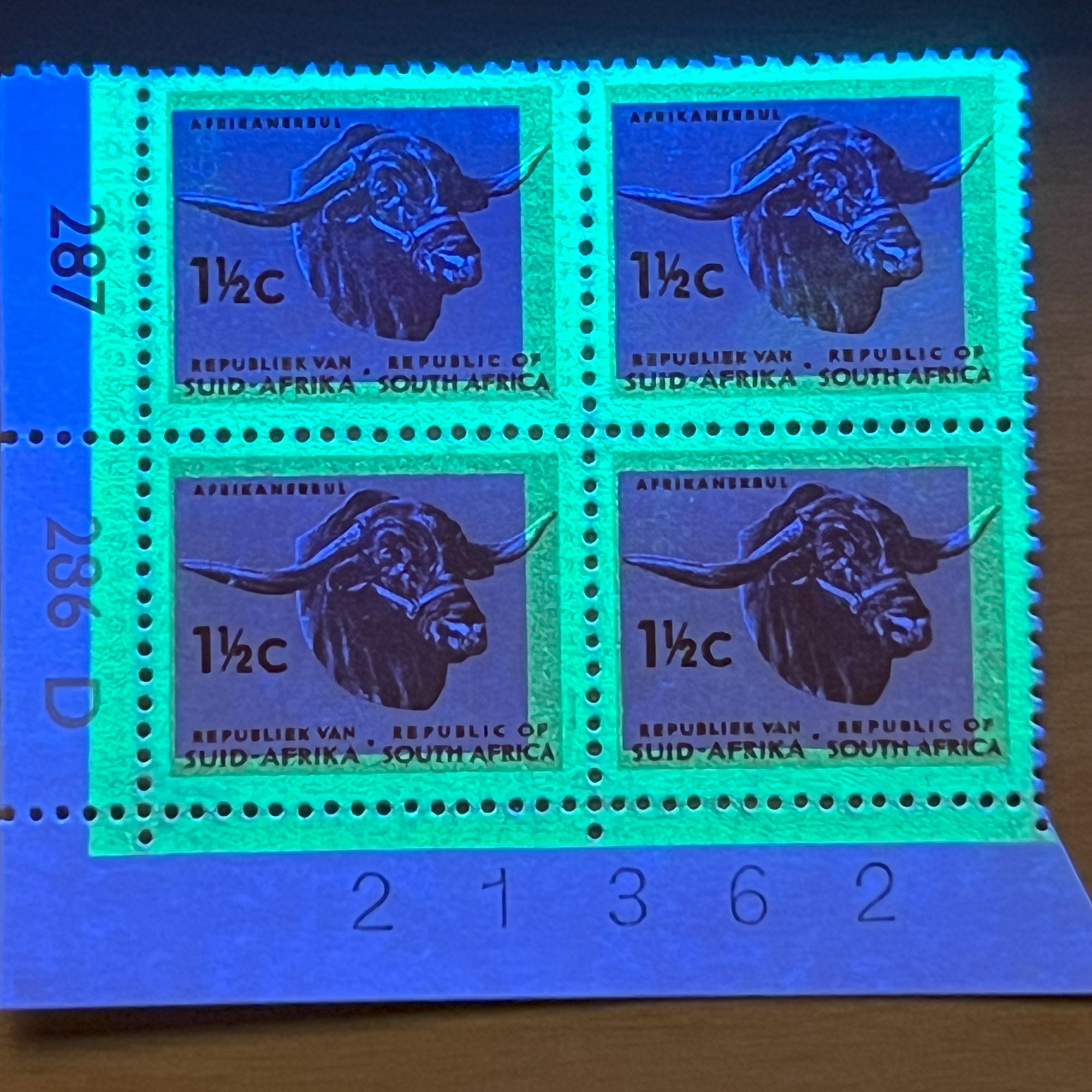
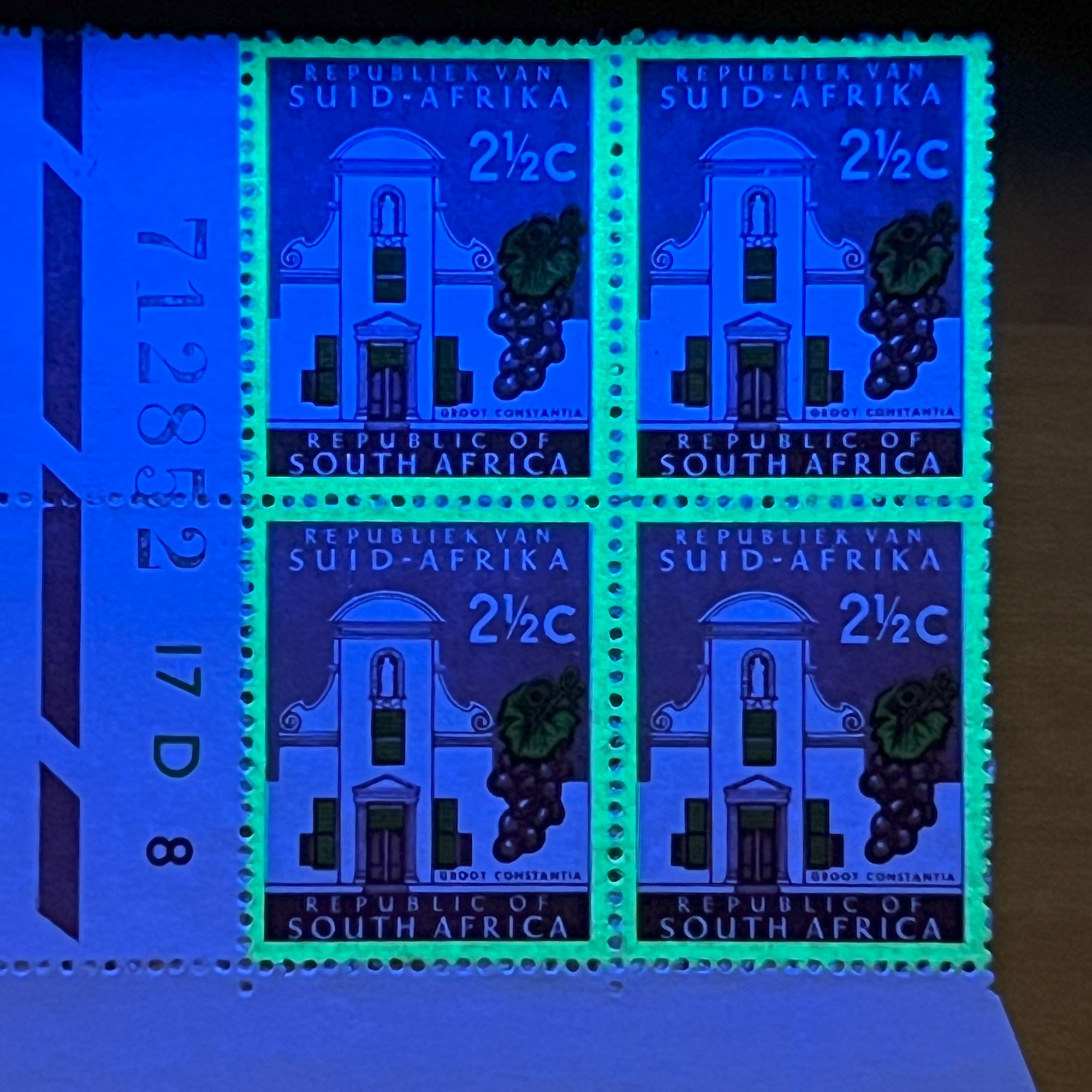
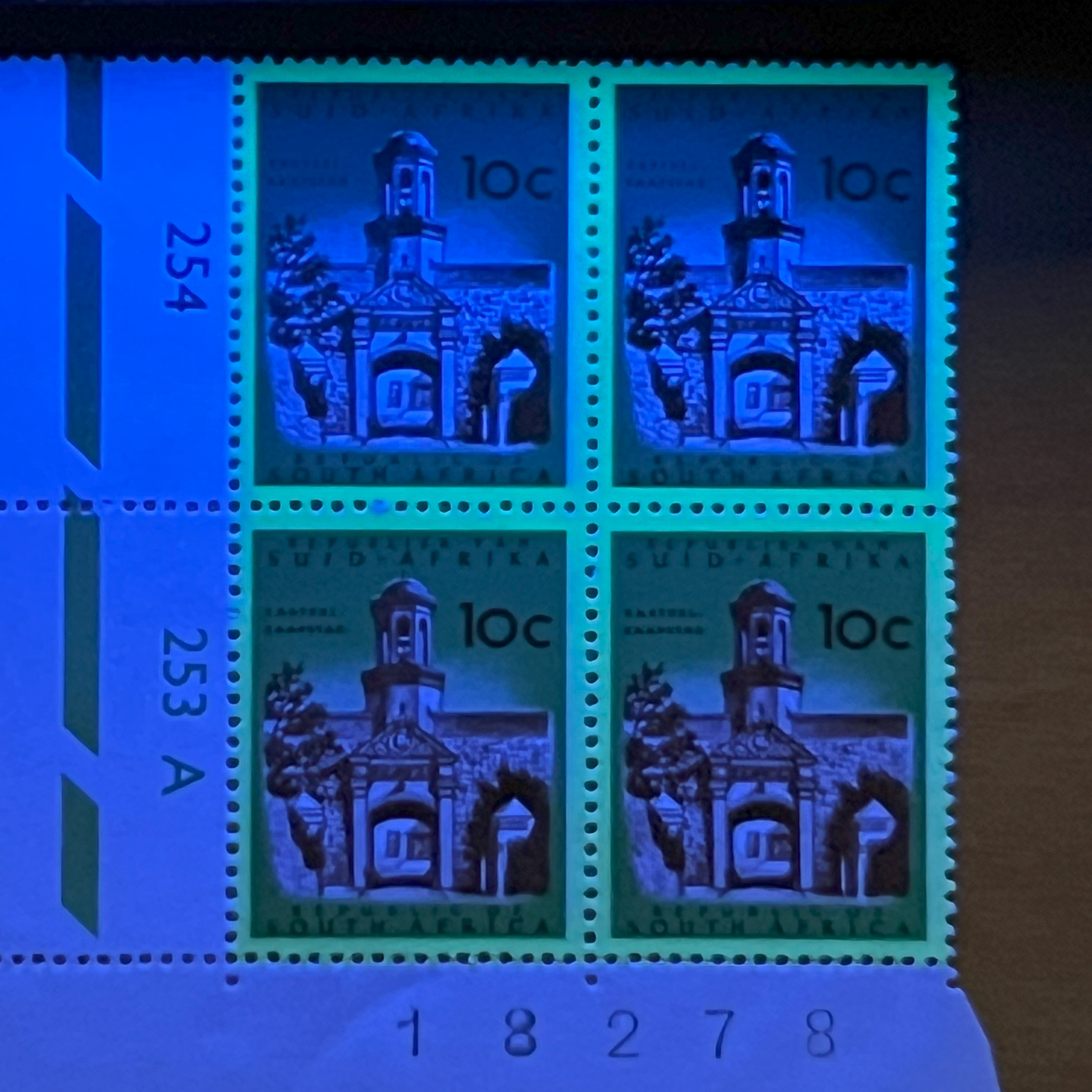
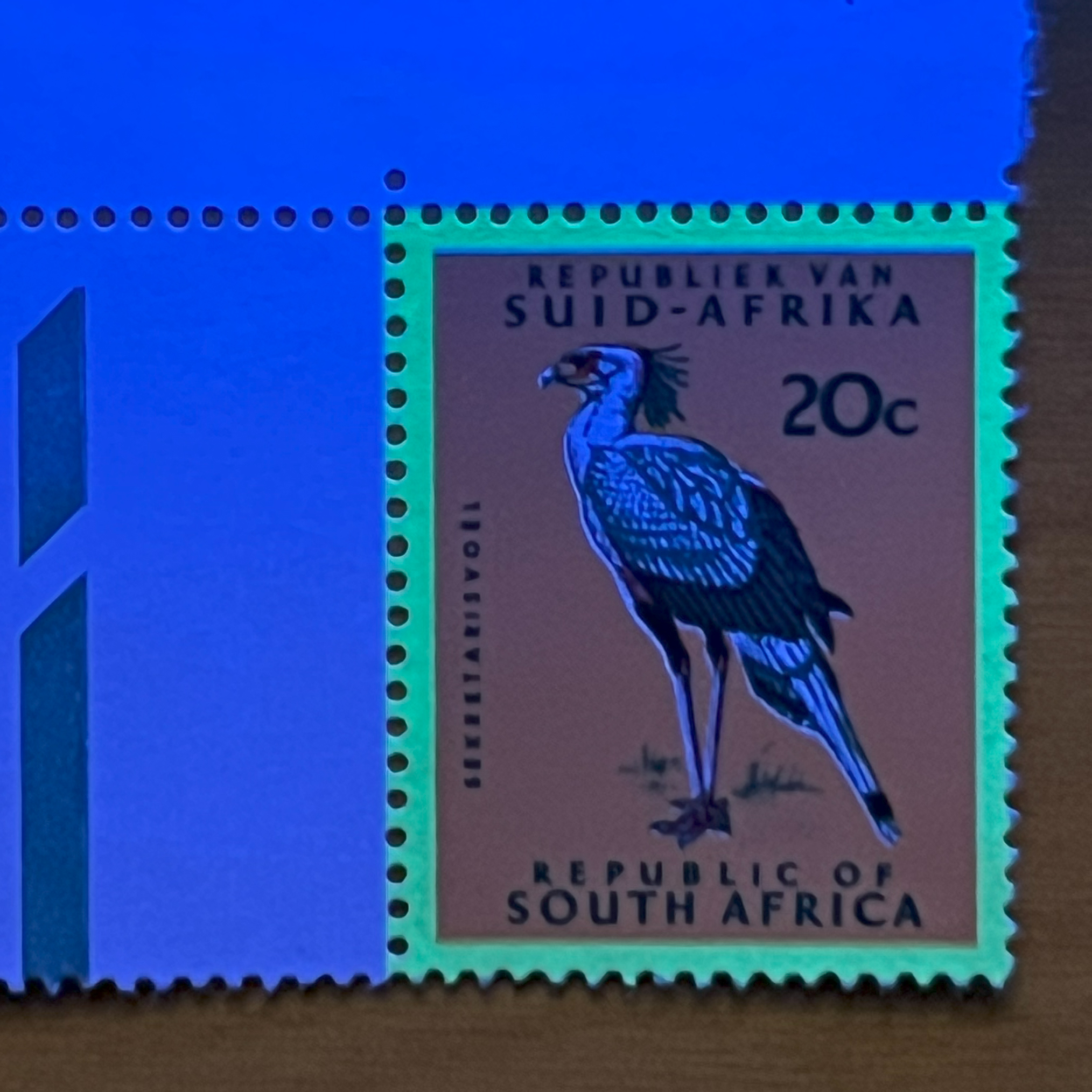
My little ultraviolet lamp arrived today: one that is specifically designed to inspect postage stamps. (My pictures below).
Starting in 1969, South Africa began to add phosphorescent frames to stamps from its first definitive series of stamps*. Starting in 1971, the phosphorescent element appeared throughout the paper. It is almost impossible to distinguish between these two types of stamps without the aid of an ultraviolet lamp.
*Definitive series of stamps for the Republic of South Africa. The Union of South Africa became the Republic of South Africa in 1961 when it gained its independence from Great Britain.
Republic of South Africa First Definitive Series, Redrawn Issued 1969-1972 Perf. 14×13½ Photogravure, chalk-surfaced paper, printed with phosphor bands 282 168 ½c New blue, carmine-red and yellow ochre | African Pygmy Kingfisher [Source: Stanley Gibbons Stamp Catalogue: Commonwealth & British Empire Stamps, 2016 Edition]Republic of South Africa First Definitive Series, Redrawn Issued 1969-1972 Perf. 13½x14 Photogravure, chalk-surfaced paper, printed with phosphor bands (LEFT, issued 1969, with bands badly misplaced! ) and without phosphor bands (RIGHT, issued 1971) 277 169 1c Rose-red & olive brown | Coral tree flowers [Source: Stanley Gibbons Stamp Catalogue: Commonwealth & British Empire Stamps, 2016 Edition]Republic of South Africa First Definitive Series, Redrawn Issued 1969-1972 Perf. 14×13½ Photogravure, chalk-surfaced paper, printed with phosphor bands 284 132 1½c Red brown and light purple | Afrikaner bull [Source: Stanley Gibbons Stamp Catalogue: Commonwealth & British Empire Stamps, 2016 Edition]Republic of South Africa First Definitive Series, Redrawn Issued 1969-1972 Perf. 14 Photogravure, chalk-surfaced paper, printed with phosphor bands 285 133 2c Ultramarine and yellow | Pouring gold [Source: Stanley Gibbons Stamp Catalogue: Commonwealth & British Empire Stamps, 2016 Edition]Republic of South Africa First Definitive Series, Redrawn Issued 1969-1972 Perf. 14 Photogravure, chalk-surfaced paper, printed with phosphor bands 286 134 2½c Violet and green | Groot Constantia wine estate [Source: Stanley Gibbons Stamp Catalogue: Commonwealth & British Empire Stamps, 2016 Edition]Republic of South Africa First Definitive Series, Redrawn Issued 1969-1972 Perf. 14 Photogravure, chalk-surfaced paper, printed with phosphor bands 287 135 3c Red and deep blue |Burchell’s gonolek [Source: Stanley Gibbons Stamp Catalogue: Commonwealth & British Empire Stamps, 2016 Edition]Republic of South Africa First Definitive Series, Redrawn Issued 1969-1972 Perf. 14 Photogravure, chalk-surfaced paper, printed with phosphor bands 293 138 10c Brown and pale green | Cape Town Castle gate [Source: Stanley Gibbons Stamp Catalogue: Commonwealth & British Empire Stamps, 2016 Edition]Republic of South Africa First Definitive Series, Redrawn Issued 1969-1972 Perf. 14 Photogravure, chalk-surfaced paper, printed with phosphor bands 294 139 20c Turquoise-blue, carmine and brown orange| Secretary Bird [Source: Stanley Gibbons Stamp Catalogue: Commonwealth & British Empire Stamps, 2016 Edition]
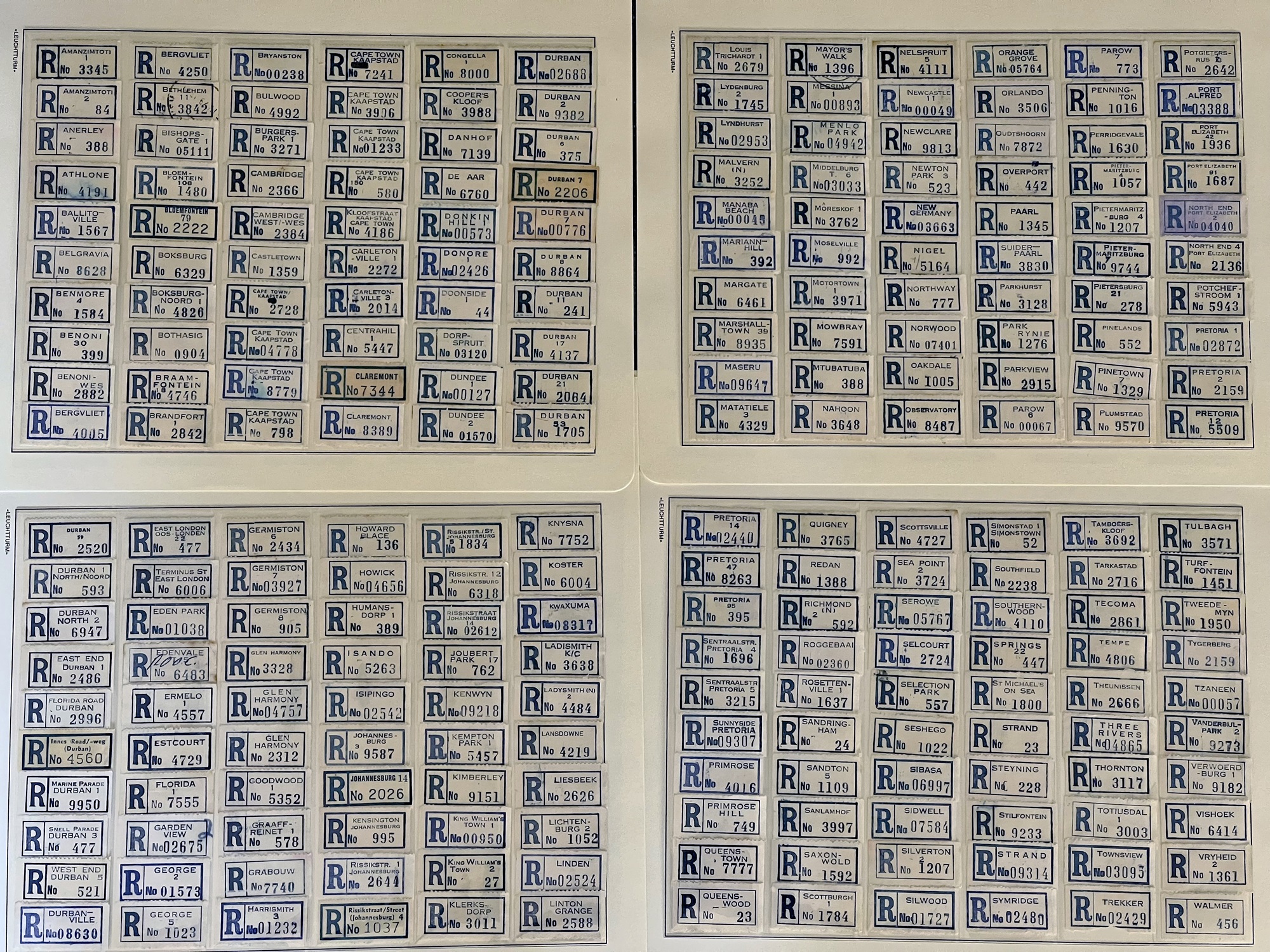
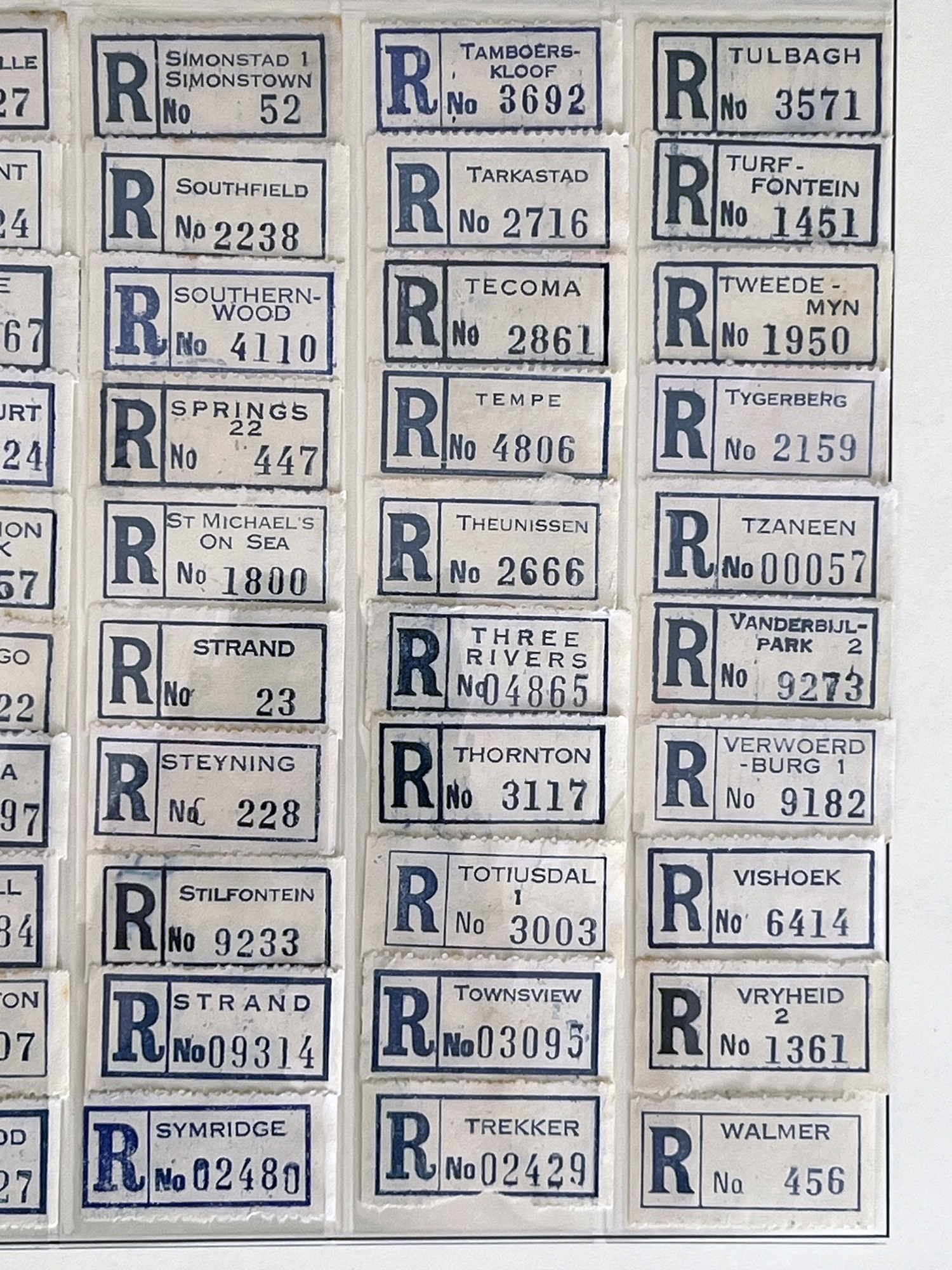
Below is my four-page collection of the South African Post Office labels.
These labels were widely used by post offices use to track registered mail from the 1940s until about 2000.
After that, computer-generated labels with numbers and barcodes became the standard— with no city name or post office name.
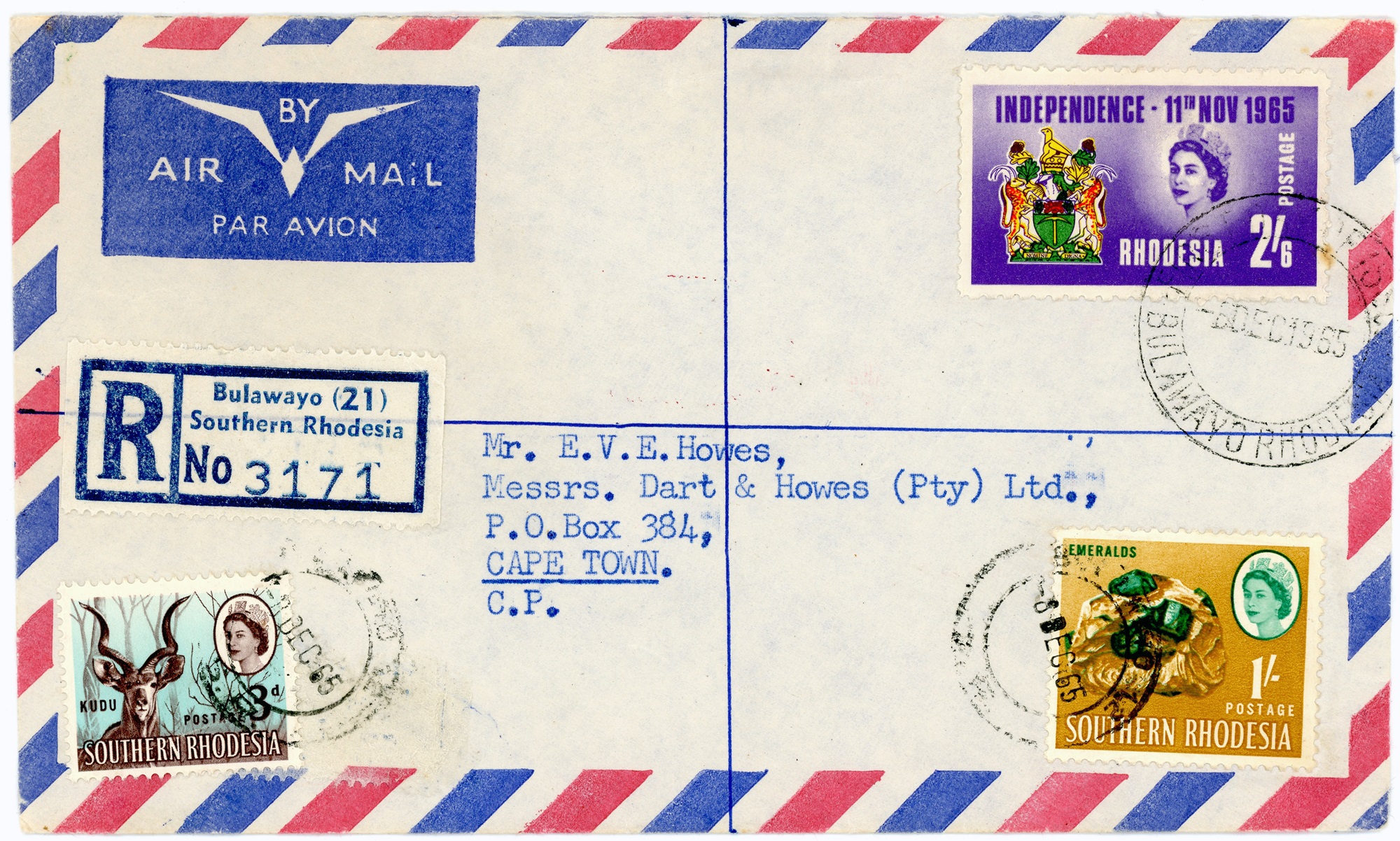
Registered air mail from Bulawayo, Rhodesia to Cape Town, South Africa, postmarked Dec 8, 1965. Rhodesia was the de facto successor state to the British colony of Southern Rhodesia, and in 1980 became modern-day Zimbabwe.The yellowed labels are probably from the 1950s or 60s. The font of the boxed letter R changed a few times over the years.A closer look. Look for the label called THREE RIVERS. Three Rivers is the suburb in Vereeniging, Gauteng province, South Africa, where I grew up and went to elementary school and high school. I am sure that registration labels exist that show VEREENIGING (for Vereeniging’s main post office). With a little luck, I should be able to find one to put into this collection.
.. being President of the United States*— or to collect stamps. *President Biden sent a cease-and-desist letter of sorts to House Democrats today, telling them to support him in the election.
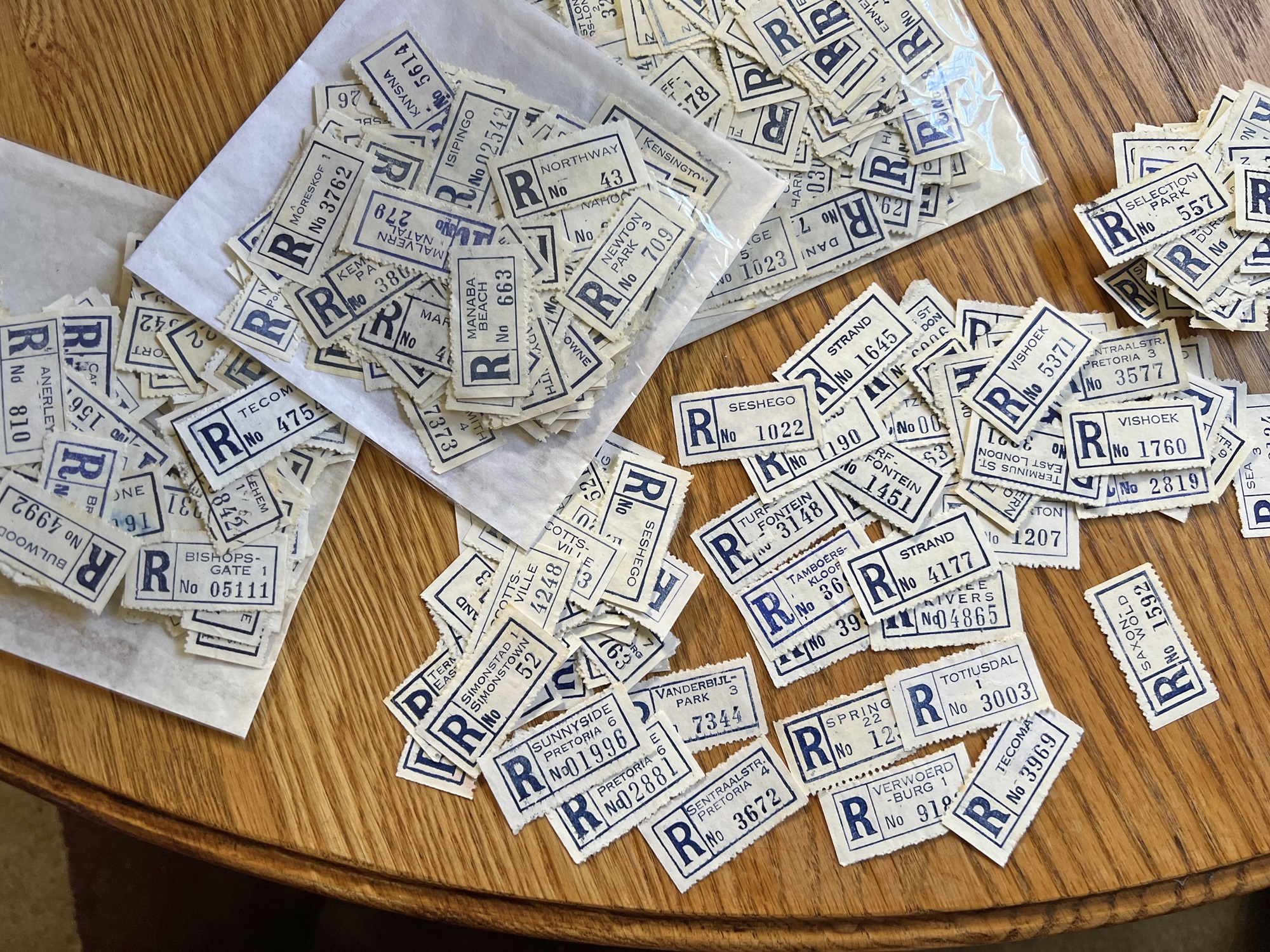
In the mean time it’s Christmas in July for me, because my latest two purchases from the UK landed on my porch today.
These are old labels used for registered letters or mail pieces in South Africa. (Obsolete: printed barcodes without the sending city or town’s name on the label, are used nowadays). I am still deciding if some of them will make it into one of my stamp albums. Look for the label VERWOERD- BURG 1 at the bottom of the picture. Verwoerdburg in Gauteng Province, now goes by Centurion. It was named for H.F. Verwoerd, prime minister of South Africa widely seen as the architect of apartheid. Verwoerd was assassinated in 1966. Then there is TECOMA— not to be confused with Tacoma, Washington State 😁— a post office in East London, Eastern Cape Province, that has been permanently shuttered.This is just part of a massive collection of mint issues from the 50s , 60s and 70s for South Africa and South West Africa (now Namibia). I have almost all of these already, but some in my album are used stamps with heavy cancellation marks, and I can add a few control blocks to my collection (four stamps with the margins from the original printed sheet).
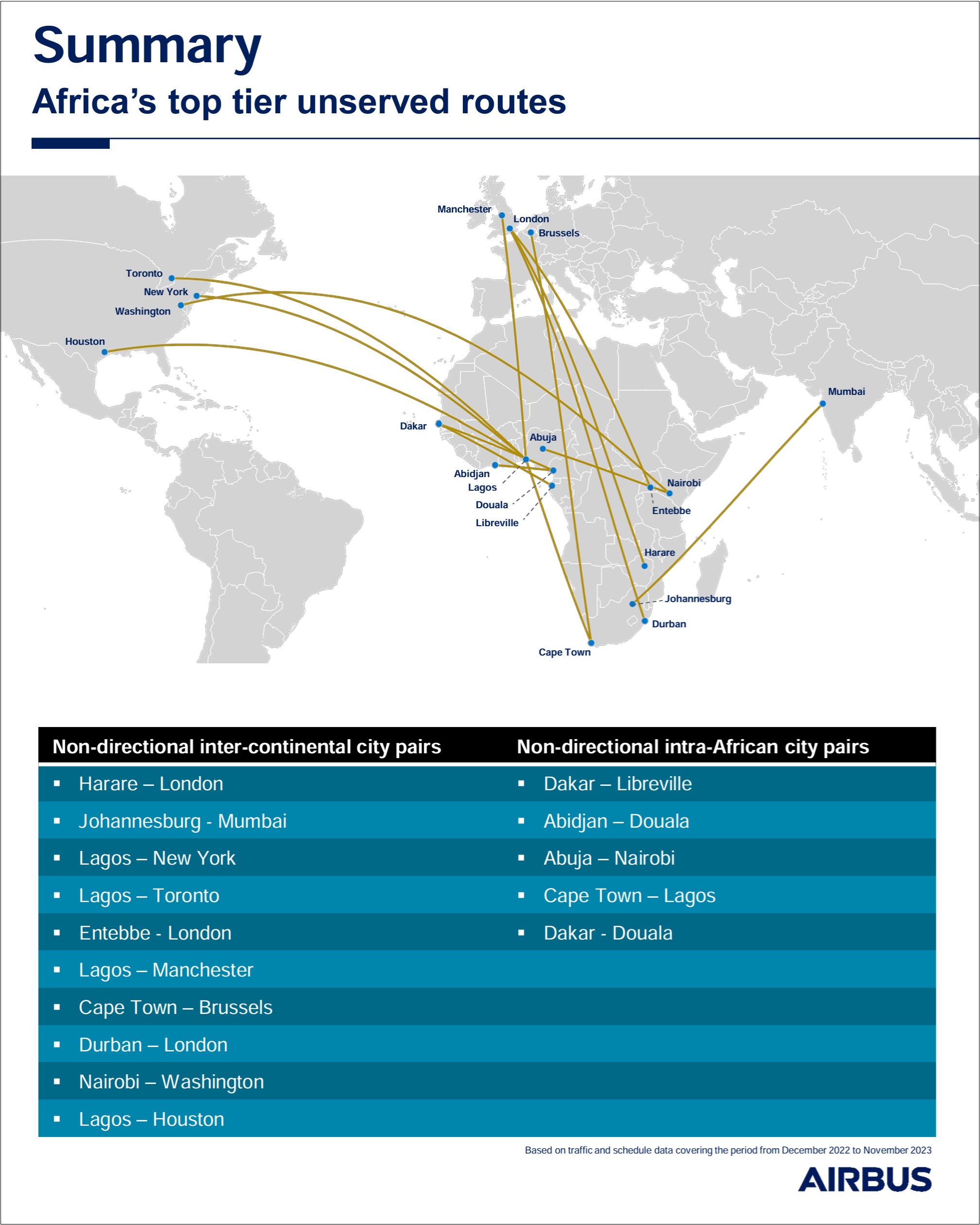
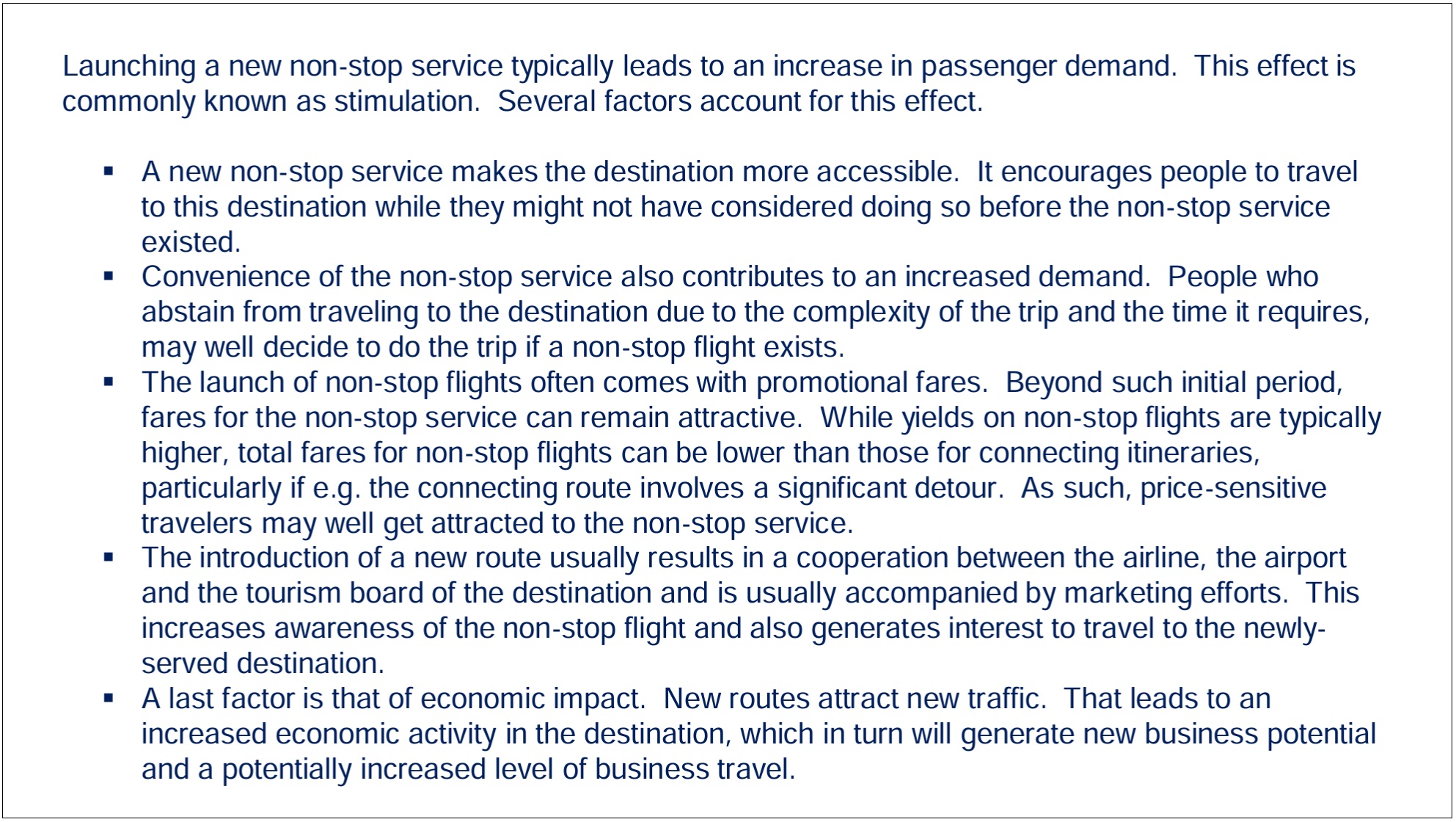
Airbus has released the results of a study that documents which air routes to African cities are underserved (extracts from the report below).
Factors at play are constraints on the number of flights due to bilateral agreements that are in place, challenges with capacity at airports, and economic variables such as the profitability of these routes.
Just in general, Airbus reports that the expectation is for air travel worldwide to increase by about 4.1% over the next 20 years, which would mean some 1,180 new aircraft need to be built, and 15,000 additional pilots would be needed.
It looks like Johannesburg is seen by Airbus to be adequately served by direct flights from Europe, but that a few more direct flights from Europe to Cape Town should be added. Is it technically possible to fly direct from Seattle to Cape Town (10,200 miles)? I’m not sure it is. Maybe. From cabinzero.com, as of Aug. 2023: At the moment, the world’s longest nonstop flight is the route between New York and Singapore. With a calculated distance of 15,349 km (9,537 miles) and almost 19 hours of flying, the route operated by Singapore Airlines is the longest in the world.
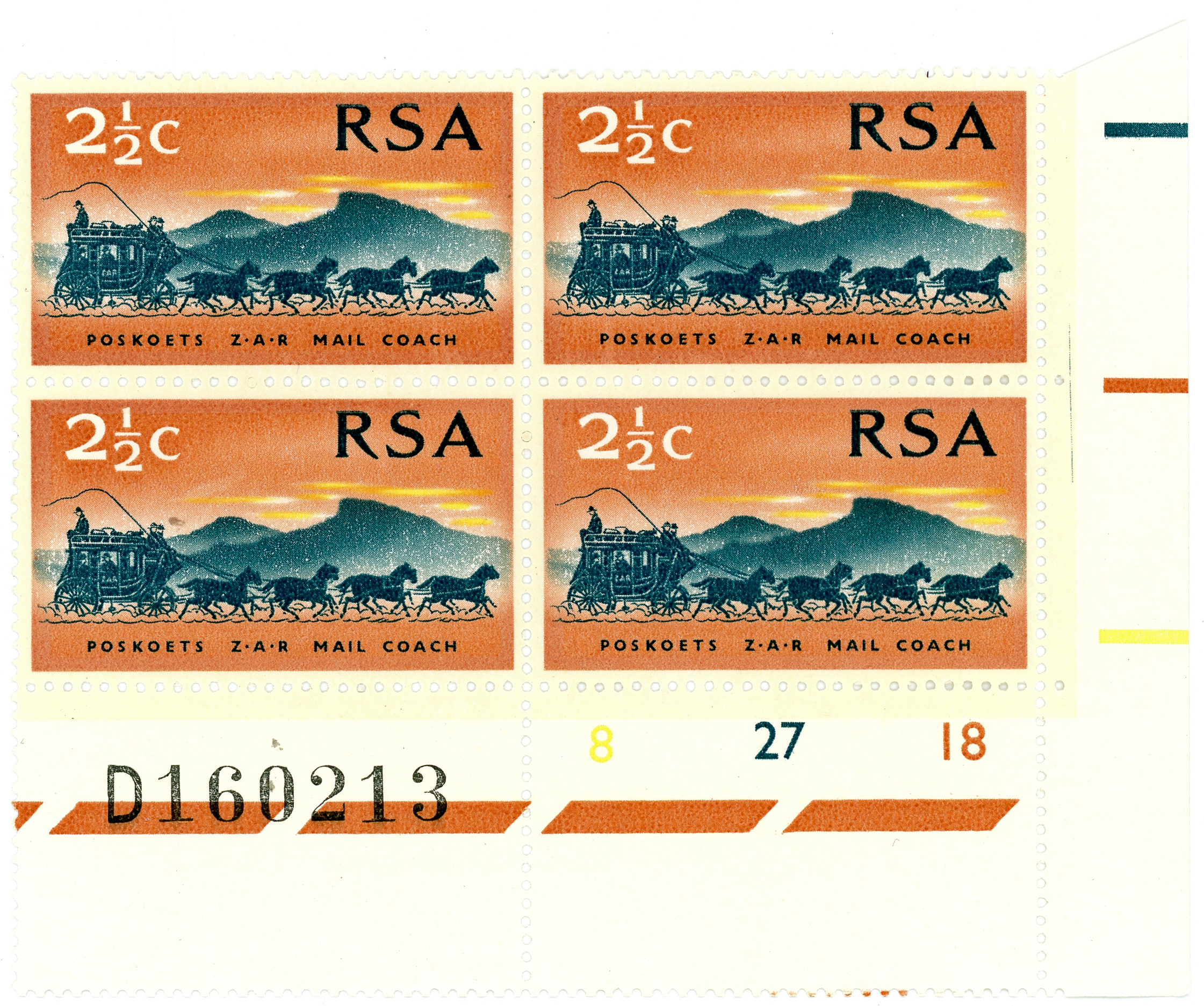
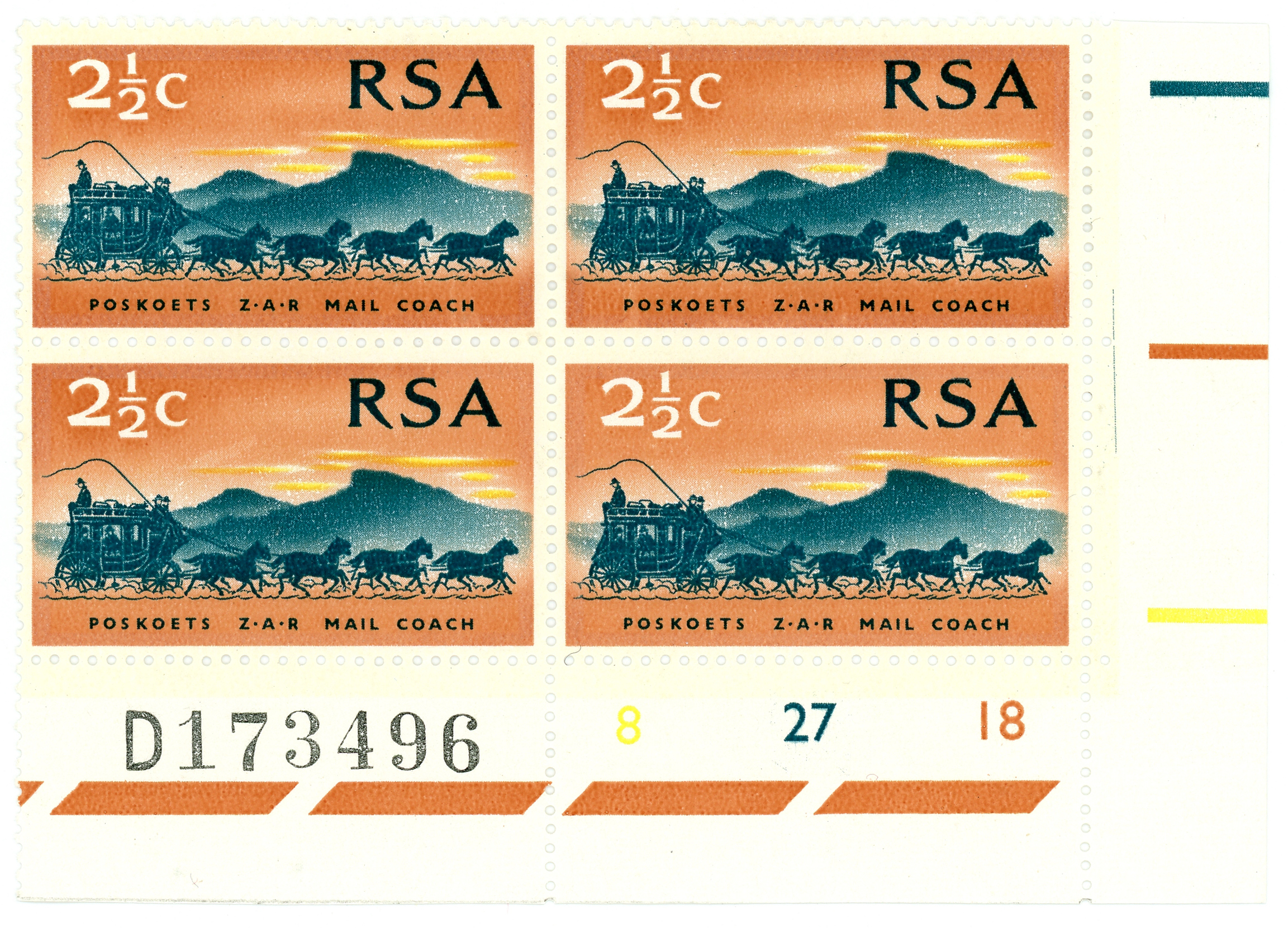
I already had this 1969 stamp from South Africa, but these control blocks were for sale for just a few dollars, and I bought them.
The two control blocks were printed on different types of postage stamp paper.
(Are these two distinctly different postage stamps— and should the philatelist put one of each in his or her album? I say yes: if you have both types, put both in your album.)
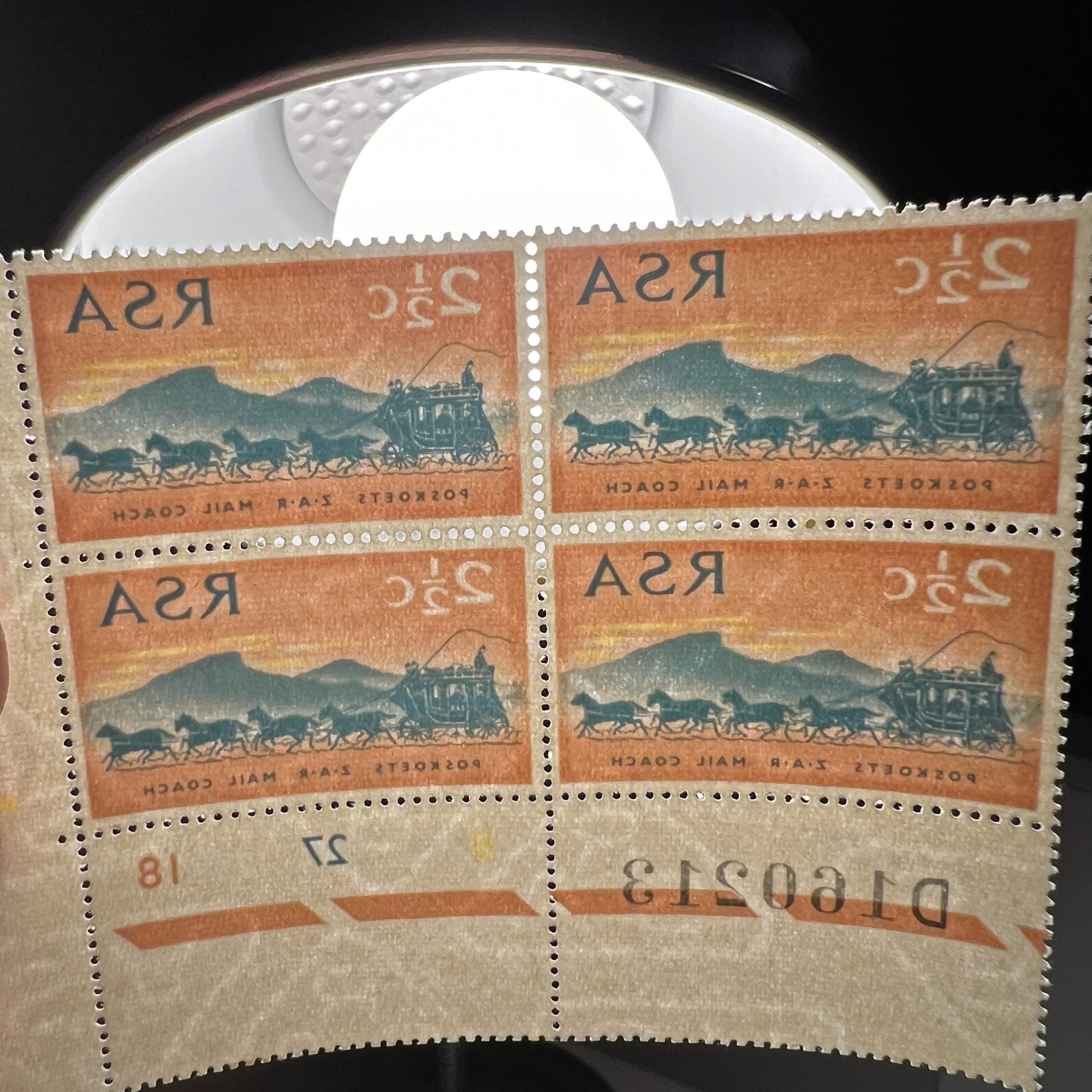
When the stamps are held up against a light, it’s easy to see the watermark clearly, in the white margins of the block.
These are some of the last South African stamps issued with watermarks.
In the United States, stamps with watermarks were issued only for a short time— from 1895 to 1916.
Stagecoach of 1869 on Harrison Paper Issued Oct 6, 1969 Perf. 13½x14 | Photogravure printing on Harrison paper | Watermark RSA in triangle 357 A140 2½c Ocher, Prussian blue & yellow Harrison paper has a grey or fluorescent back.Stagecoach of 1869 on Swiss Paper Issued Oct 6, 1969 Perf. 13½x14 | Photogravure printing on Swiss paper | Watermark RSA in triangle 357 A140 2½c Ocher, Prussian blue & yellow Swiss paper has a dull pink non-fluorescent back. It’s hard to tell from these scanned images, but comparing the physical paper with the Harrison paper, the Swiss paper seems to look just a touch whiter.Watermark is a tiled pattern of tête-bêche* rounded triangles with R inside at the top and SA at the bottom. RSA for Republic of South Africa. *Upright and upside down next to each other
The election result in South Africa is now official.
The ANC party claimed only 159 out of the 400 seats in parliament, down 71 seats from 2019.
Under the constitution, the newly elected parliament must convene within two weeks of the results being declared, and one of its first acts must be to choose the nation’s next president.
Coalition talks are underway behind closed doors.
Hopefully a deal can be struck between the ANC and the DA: a pivot to the center.
Few analysts expect an ANC-MK tie-up, given the bitter acrimony between them.
That would be President Cyril Ramaphosa in the middle, advised-admonished by ANC Secretary-General Fikile Mbalula. The MK on the green phone stands for Mkhonto weSizwe, the corrupt ex-president Zuma’s new party. The DA on the blue phone stands for Democratic Alliance, the party governing Western Cape Province, that came in second in the elections. [Cartoon by Niel van Vuuren in South Africa’s Beeld newspaper]
Welp.
With 96% of the votes counted in South Africa’s national election of Wednesday, it is clear that the predictions (of the demise of the African National Congress majority) had become true, and then some.
The party that had once commanded 70% of the electorate’s support (in 2004), and still got 57% of the national vote in 2019, will now scrape in with barely 40% of the vote.
Yes, they still have the biggest share, but for the first time since South Africa became a full democracy in 1994, there will be a coalition government.
The African National Congress (ANC) still has widespread support, but not in the Western Cape province (DA 53%, ANC 21%), and not in KwaZulu-Natal province (M.K. 46%, ANC 18%). M.K. is uMkhonto weSizwe, ex-president’s Jacob Zuma’s political party. A coalition between the ANC and the Democratic Alliance (DA) may be the best for the country, but will the ANC be willing to make concessions, such as letting the DA be in charge of key national departments such as National Treasury, Health and and Home Affairs? [Graphic from IEC dashboard at https://results.elections.org.za/dashboards/npe/]
It was election day in South Africa, and the vote counting is under way. Out of a population of 62 million, a record 27.8 million voters have been registered.
The main party leaders are (from bbc.com/news): African National Congress/ANC: Cyril Ramaphosa – union leader, mine boss, president; Democratic Alliance/ DA: John Steenhuisen – the man vowing to ‘rescue’ South Africa; Economic Freedom Front/ EFF: Julius Malema – the radical agenda-setter; uMkhonto weSizwe/ MK: Jacob Zuma – ex-president, spent time in jail, the political wildcard.
Citizens vote for political parties, though— and then the national assembly of 400 representatives, based on the outcome of the national election, will vote for a president. A simple majority of 201 suffices.
The Big Question for 2024: will national support for President Cyril Ramaphosa’s ANC party fall below 50% for the first time since 1994?
We will soon know. (The final results should be available by Sunday, or earlier). If that is the case, the ANC will have to form a coalition with other parties to choose a president and form a governing majority. I cannot see that even in this scenario, anyone other than Ramaphosa will become president. But hopefully the ANC’s majority power (that they had abused ever after Mandela had left office in 1999), will be reined in.
Whoah. Every voter gets three ballots: National, Provincial and Regional. It is a minor accomplishment just to find your party on each of the ballots. South Africa’s election management body, the Independent Electoral Commission (IEC), had cleared 14,889 candidates, including 70 political parties and 11 independents, to contest 887 seats in the May 29 vote. [Picture posted by Rene Vollgraaff@vollgraaffR on X]
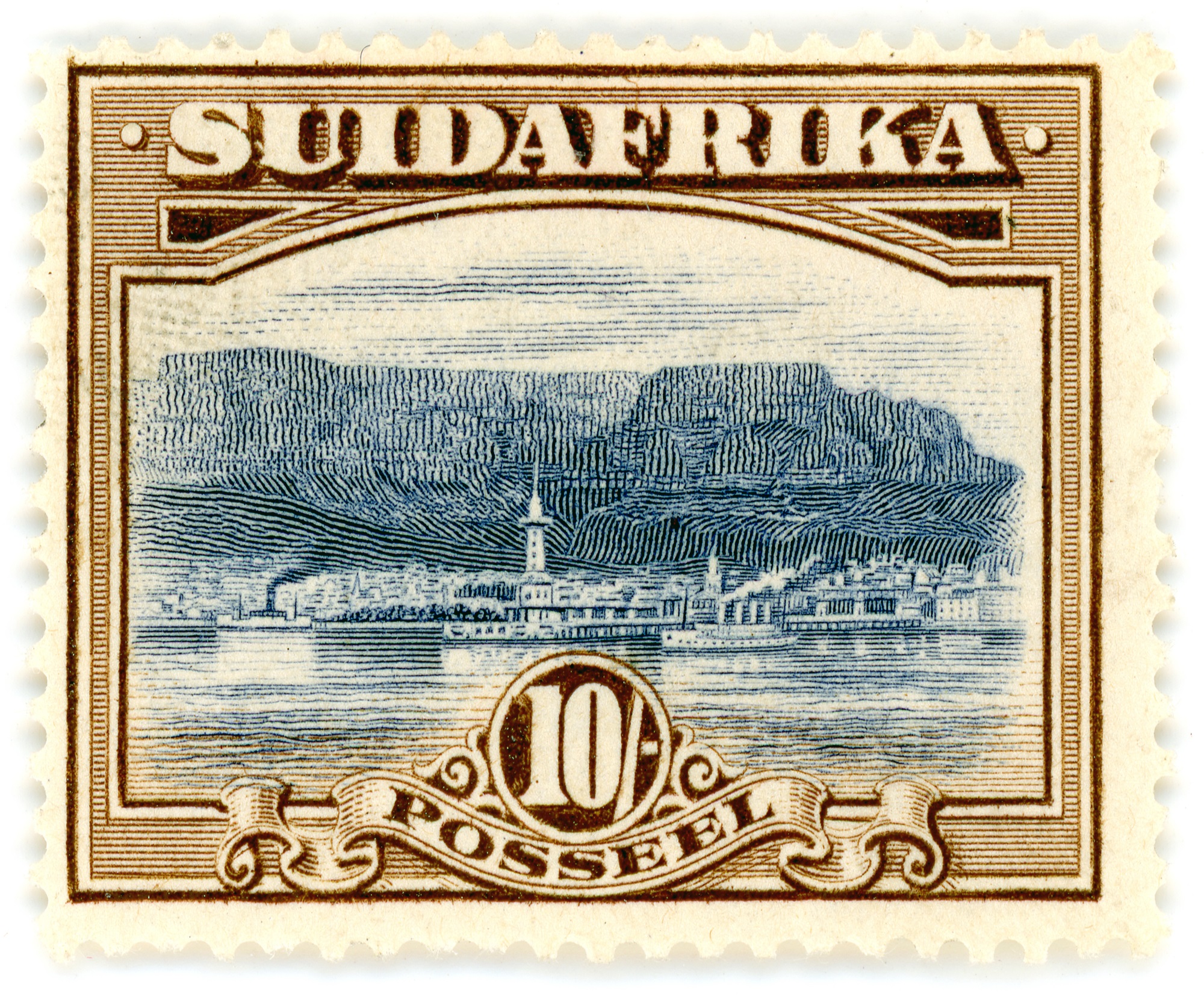
I bought this single stamp from a seller in Canada.
It’s the highest value stamp (10 shillings) in the series known as the 1927-1930 London Pictorials; the last South African stamps printed in London.
(After that stamps were printed in South Africa).
The Afrikaans-English se-tenant (joined) stamp pairs are very expensive (up to $200), but the single ones are $10 or so.
I’m still looking for an English one with ‘SOUTH AFRICA’ inscribed at the top.
From the 1927-1930 London Pictorials Issued 1927, Mar. 1 Perf. 14 | Engraved printing | Wmk. Multiple springbok’s heads 29 16 | 10sh | Bright blue and brown | Cape Town, Table Mountain and Table Bay [Source: 2016 Stanley Gibbons Stamp Catalogue for Commonwealth & British Empire Stamps 1840-1970) My notes: The prominent white tower might be Mouille Point Lighthouse— built in 1842 but demolished in 1908. To its right and further back would be Cape Town City Hall, a large Edwardian building built from honey-colored oolitic limestone imported from Bath in England, and located on the Grand Parade. It was completed in 1905 and is still there today.
Hey! Amazon opened its online doors in South Africa today.
The Books section has a language filter— necessary for a country with 11 official languages.
I searched for Afrikaans books, and specifically for the beloved Afrikaans poet and author C.J. Langenhoven (1873-1932).
I did find the book Loeloeraai, but right now it is out of stock on amazon.co.za.
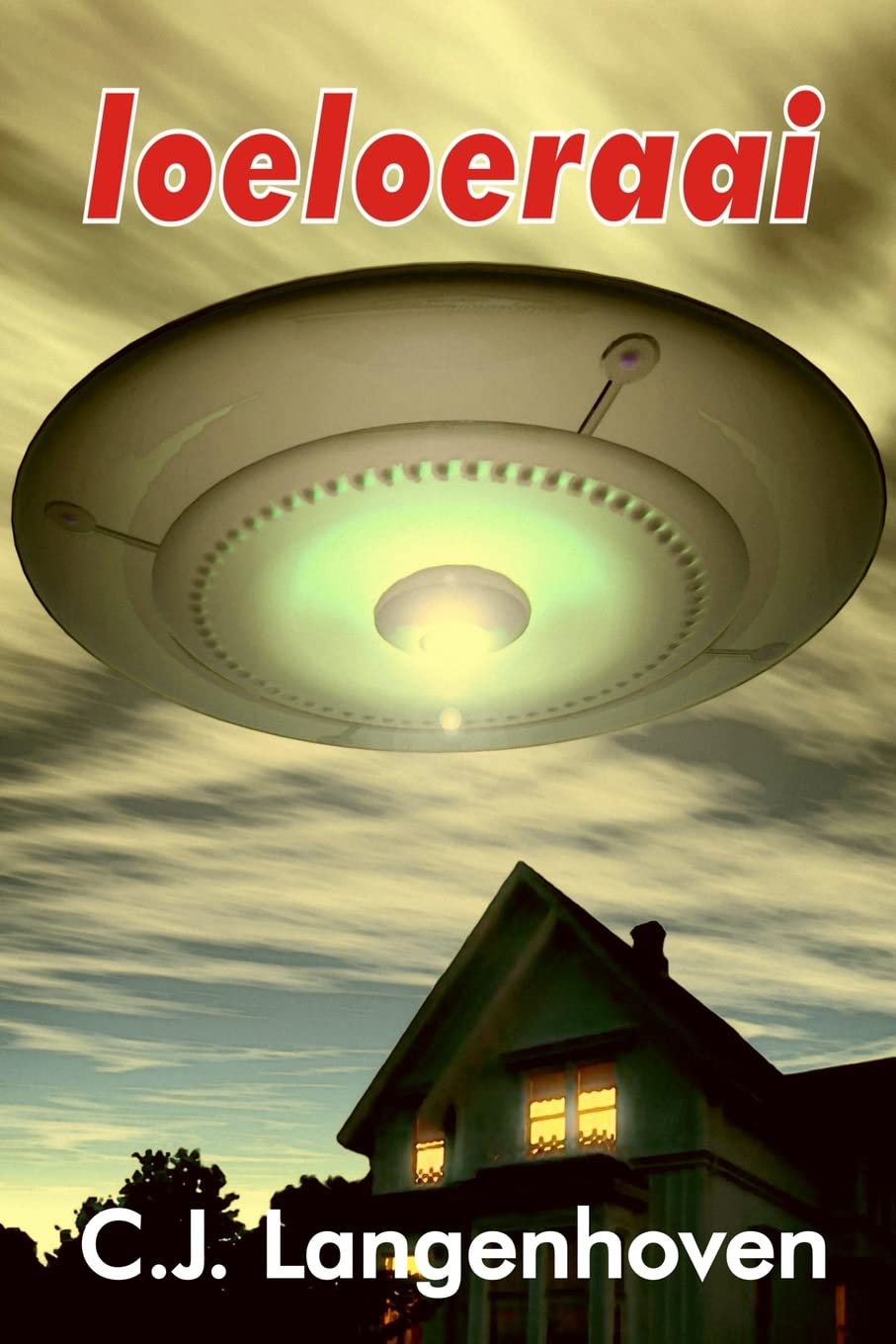
Loeloeraai (say ‘lu-lu-rye’) was published in 1923. (This the cover of a modern reprint of the book). It is believed to be the very first Afrikaans science fiction novel. Most of the colorful characters in the book are from Langenhoven’s other books: Kerneels, Vroutjie (‘wifey’), their daughter Engela, his uncle Stoffel, his brother-in-law Watwo, Herrie (Kerneels’s tame elephant) and Jakhals (Kerneels’s dog). The other main character is Loeloeraai— an unexpected visitor from Venus that lands at Kerneels’s homestead on his farm. At first, Kerneels is very leery of the alien, but realizes over time that Loeloeraai has no ill intentions. (Other humans that learn of Loeloeraai wants the alien locked up in jail). Loeloeraai’s visit is ostensibly to learn more of Earth, but the alien’s interaction with humans educate them about their greed, self-interest and cruelty. The novel illustrates what was known of the universe at the time, and also what was still unknown.
Congrats to the owner and team for Mystik Dan, the winner of the 150th Kentucky Derby, by a nose.
Run, horsies, run! These are wildebeest, actually: large African antelopes of the family Bovidae. From an updated issue of the 1926-27 London Pictorial definitive series (the first series of stamps were printed in London, thereafter by South Africa government printers in Pretoria) Issued Jan. 1950 Perf. 15×14 | Screened rotogravure | Afr. & Eng. inscriptions for South Africa | Wmk Multiple Springbok heads SG120 13 | 1 shilling | Brown & chalky blue | Black and blue wildebeest [Source: 2016 Stanley Gibbons Stamp Catalogue- Commonwealth & British Empire Stamps]
2019 The 25th Anniversary of Democracy Issued 26 April, 2019 Minisheet (105 x 65mm) Perf. 12¼ No watermark Design: Rachel-Mari Ackermann
Here is a summary of what is going on in South Africa and its politics in the final few weeks before the election there on May 29.
From the Washington Post Editorial Board, written for the newspaper’s Opinion column on April 17, 2024: South Africa’s ANC is headed for a reckoning at the ballot box. That’s good.
There’s a lot of good news coming out of Africa. Eleven of the world’s 20 fastest-growing economies are African, and the continent’s overall gross domestic product growth is expected to outpace the global average this year and next.
Unfortunately, the good news doesn’t extend to South Africa, the continent’s most industrialized economy and its leading democracy. Growth is flat, and the country barely avoided a recession last year. Officially, nearly one-third of working-age South Africans are unemployed, but the real rate is likely higher. Crime is staggering. South Africa has the highest income inequality in the world. Its productivity is hampered by a nationwide electricity shortage leading to daily rolling blackouts. Last month, the country’s largest city, Johannesburg, was hit by an unprecedented water shortage partly because of crumbling infrastructure.
The African National Congress bears most of the blame. South Africa’s ruling party for the past 30 years, since the country’s first all-race elections, the ANC was once unassailable as the party of the country’s first Black president, Nelson Mandela, and the vanguard of the liberation movement that ended the abhorrent apartheid regime.
But after three decades of unchallenged power, the ANC has become ossified, unresponsive, and tainted by corruption and failure to deliver basic services. Kickbacks for state contracts have become rampant, especially during the disastrous administration of Jacob Zuma, who faced multiple indictments and allegations of corrupt dealings and who was briefly imprisoned before being questionably paroled. Last month, the powerful speaker of the national assembly and ANC member, Nosiviwe Mapisa-Nqakula, was accused by prosecutors of taking $135,000 in bribes when she served as defense minister. She resigned Wednesday.
Now many young South Africans appear to be turning against the ANC. National elections are due May 29, and most signs and surveys suggest the ANC might for the first time lose its absolute majority in Parliament. That would be a good thing.
What happens after the election will be a crucial test for the country’s young democracy and will have implications across the continent for other struggling democracies. South Africa has no experience with a coalition government. How the various parties navigate the uncertainty — and even if the ANC would accept a loss of its complete control — point to a fraught post-election period.
To be sure, the ANC is still a massive voter turnout machine that commands loyalty among the older generation. Its leaders, including President Cyril Ramaphosa, like to remind voters that many of the country’s problems stem from the inequalities of the repugnant apartheid regime. But among younger voters, that message falls short.
If the ANC lands just a few seats shy of a majority, it could assemble a coalition with independents and tiny parties. But if its losses are bigger — and some projections put its support as low as 40 percent — then the ANC will need to join forces with one of the larger established parties to maintain its hold on government. Which way the ANC turns will determine its economic direction as well as its future foreign policy, including relations with the United States.
The current main opposition party, the Democratic Alliance, is expected to come in second. An ANC-DA alliance would likely ensure a centrist-liberal economic policy scaling back the state’s heavy role in the economy. The DA has also been more critical of Russia’s invasion of Ukraine than the ANC, which has adopted a neutral position. The DA runs the provincial government in Western Cape, considered in public opinion surveys to be South Africa’s best-run province. But the Democratic Alliance suffers from the stigma of being seen as the party favored by the country’s White minority.
Another party poised to do well is an ANC offshoot, the Economic Freedom Fighters, which advocates a blend of Marxist economic policies and land confiscation. Its fiery, charismatic leader, Julius Malema, is also given to harsh, violence-tinged rhetoric. An ANC alliance with the EFF would mean a sharp turn to a far-left, socialist and anti-Western agenda.
The wild card is Mr. Zuma, who has formed a new party, uMkhonto weSizwe, which is expected to peel away votes from the ANC in Mr. Zuma’s native KwaZulu-Natal province. Mr. Zuma retains a significant base. His supporters have also shown a penchant for violence, as in 2021 when Zuma supporters rioted against his arrest. There are fears of a repeat of violence if his new party fares poorly.
Some within the ANC are sanguine about the party losing its majority, calling it the natural evolution of a vibrant democracy. If South Africa’s leaders cultivate this sort of perspective, the country is likely to weather the uncertainty, emerge stronger and — once again — serve as a democratic model for others to emulate.
South African Constitution (1996) Art. 47.1.e.
1. Every citizen who is qualified to vote for the National Assembly is eligible to be a member of the Assembly, except ..
e. anyone who, after this section took effect, is convicted of an offence and sentenced to more than 12 months imprisonment without the option of a fine, either in the Republic, or outside the Republic if the conduct constituting the offence would have been an offence in the Republic, but no one may be regarded as having been sentenced until an appeal against the conviction or sentence has been determined, or until the time for an appeal has expired. A disqualification under this paragraph ends five years after the sentence has been completed.
This year, general elections will be held in South Africa on 29 May to elect a new National Assembly as well as the provincial legislature in each province.
It’s been 30 years since Nelson Mandela was elected South Africa’s first democratic president. The African National Congress has in been in power all this time.
Let’s just say that after Mandela left office in 1999, the ANC has not exactly covered themselves in glory.
Jacob Zuma (elected in 2009) and his ANC cronies in particular, engaged in racketeering, money laundering, and fraud on a grand scale.
Zuma spent time in jail 2021, but only two months of his full sentence of 15 months. This was due to a ‘remission’ program approved by the current president, Cyril Ramaphosa (the equivalent of a ‘pardon’ in the US).
Now 82 years old, Zuma is back in politics. He wants to become president again.
South Africa’s election court ruled that he cannot be disqualified by the 12 month rule in Art. 47.1.e. of the South African constitution.
Cartoon of an imagined phone call between candidates for presidential elections in America and in South Africa. Zuma broke from the ANC and is the de facto leader of a brand-new political party called uMkhonto weSizwe (abbr. MKP, and meaning ‘Spear of the Nation’). Here’s Antony Sguazzin reporting for bloomberg.com: Support for South Africa’s ruling African National Congress is plunging and a party backed by former President Jacob Zuma may become the country’s third-biggest after next month’s election, a new opinion poll shows. The ANC, which has ruled South Africa since the end of apartheid, may garner just 37% of the vote on May 29, while Zuma’s uMkhonto weSizwe Party, or MKP, may get 13%, the Social Research Foundation said in comments sent to Bloomberg on Wednesday, citing a poll it carried out this month. [Cartoon by Niel van Vuuren for Beeld newspaper]
There was mail from the Royal Mail in Great Britain for me today— with South African stamps inside, of course.
I looked up the details of the stamps used on the envelopes.
Birth Centenary of Sir Winston Churchill Issued 1974, Oct. 9. | Perf.14×15 | ‘All-over’ phosphor Gum 962 444 4½p | Prussian Blue, pale turqoise-green and silver | Churchill in Royal Yacht Squadron Uniform [Source: 1997 Stanley Gibbons Stamp Catalogue Part I Volume I]King Charles III Definitive Stamps Issued 2023 | Perf. 15×14½ | Gravure print with phosphor bars | Bar-coded | Self-adhesive £2.20 Dark green Portrait of His Majesty King Charles III [Source: royalmail.com]