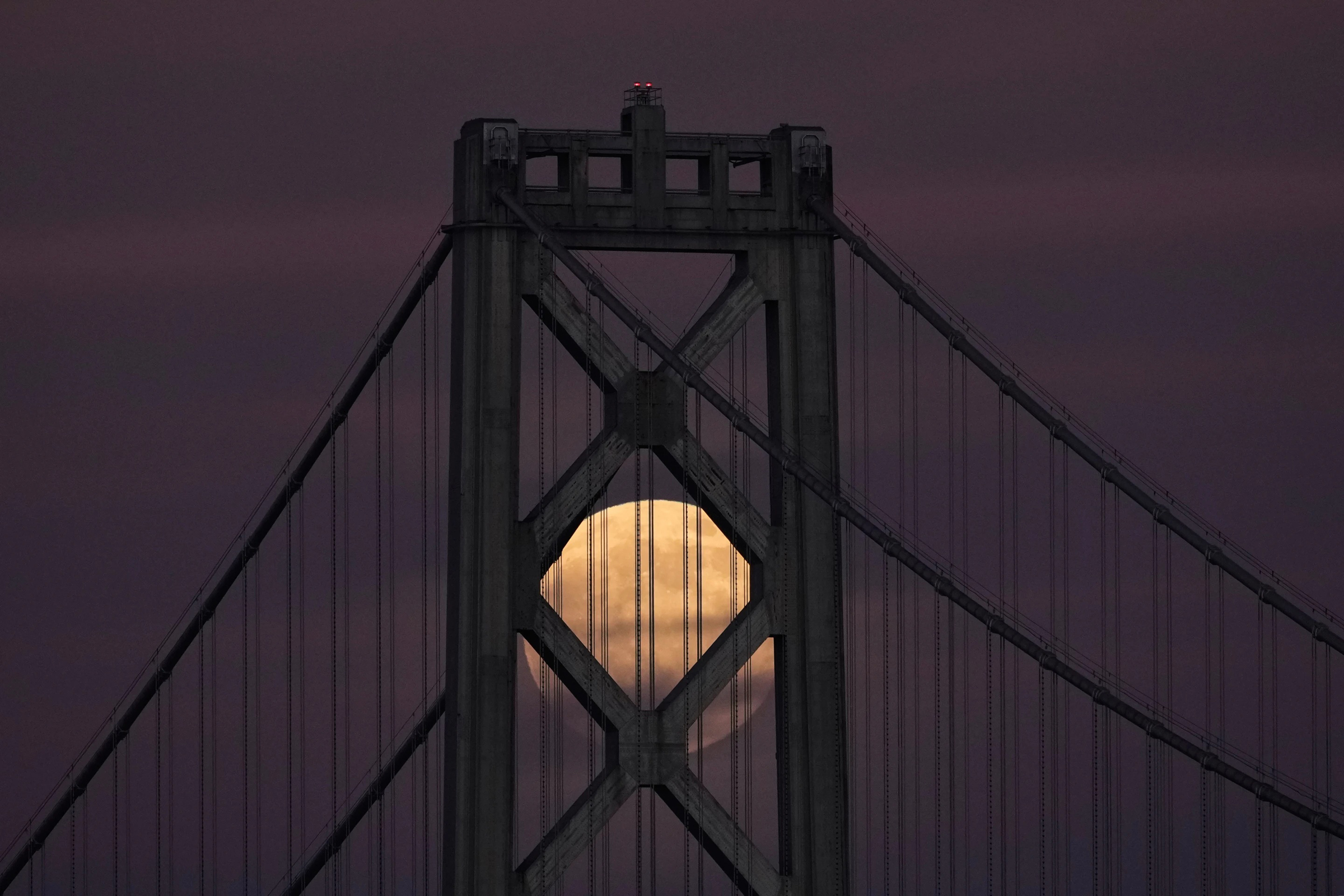
Tonight the last supermoon* of the year— and the third in a consecutive sequence— is out. (There will be a fourth supermoon in this same celestial series in January 2026).
We have cloud cover and lots of rain here in the city in Seattle tonight, so for now I can only look for pictures of the supermoon online.
*A supermoon is a full moon that occurs when the Moon is at or near its closest point to Earth in its elliptical orbit, a point called perigee. This proximity makes the Moon appear slightly brighter and larger than an average full moon, although the difference may be difficult to notice with the naked eye. The term can also technically apply to a new moon, but it is typically associated with the visible full moon.
[Google AI Overview]
A supermoon, the last full moon of the year, rises behind the San Francisco-Oakland Bay Bridge, Thursday, Dec. 4, 2025, in San Francisco. This one is called the Cold Moon. [Associated Press Photo/ Godofredo A. Vásquez]
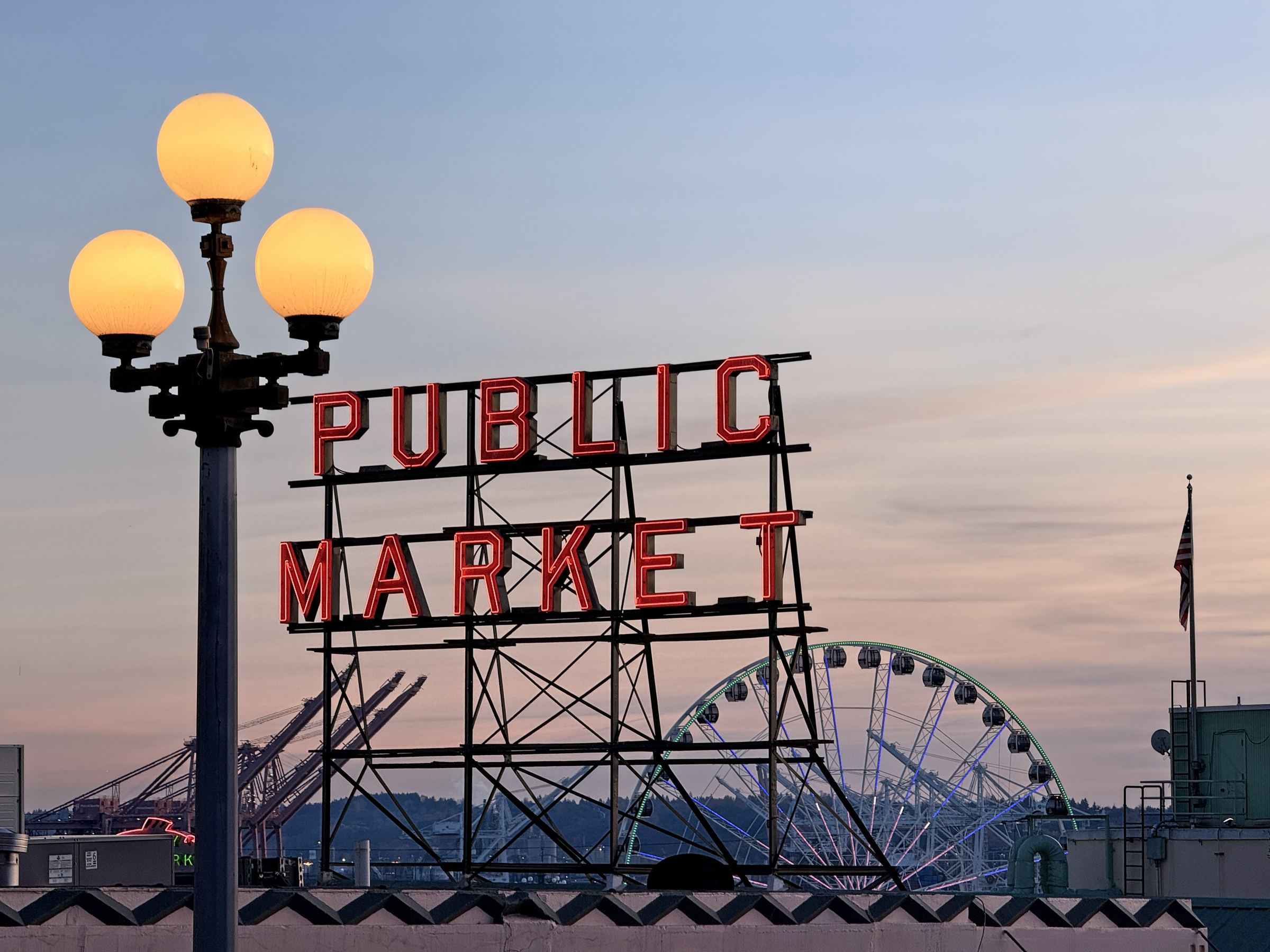
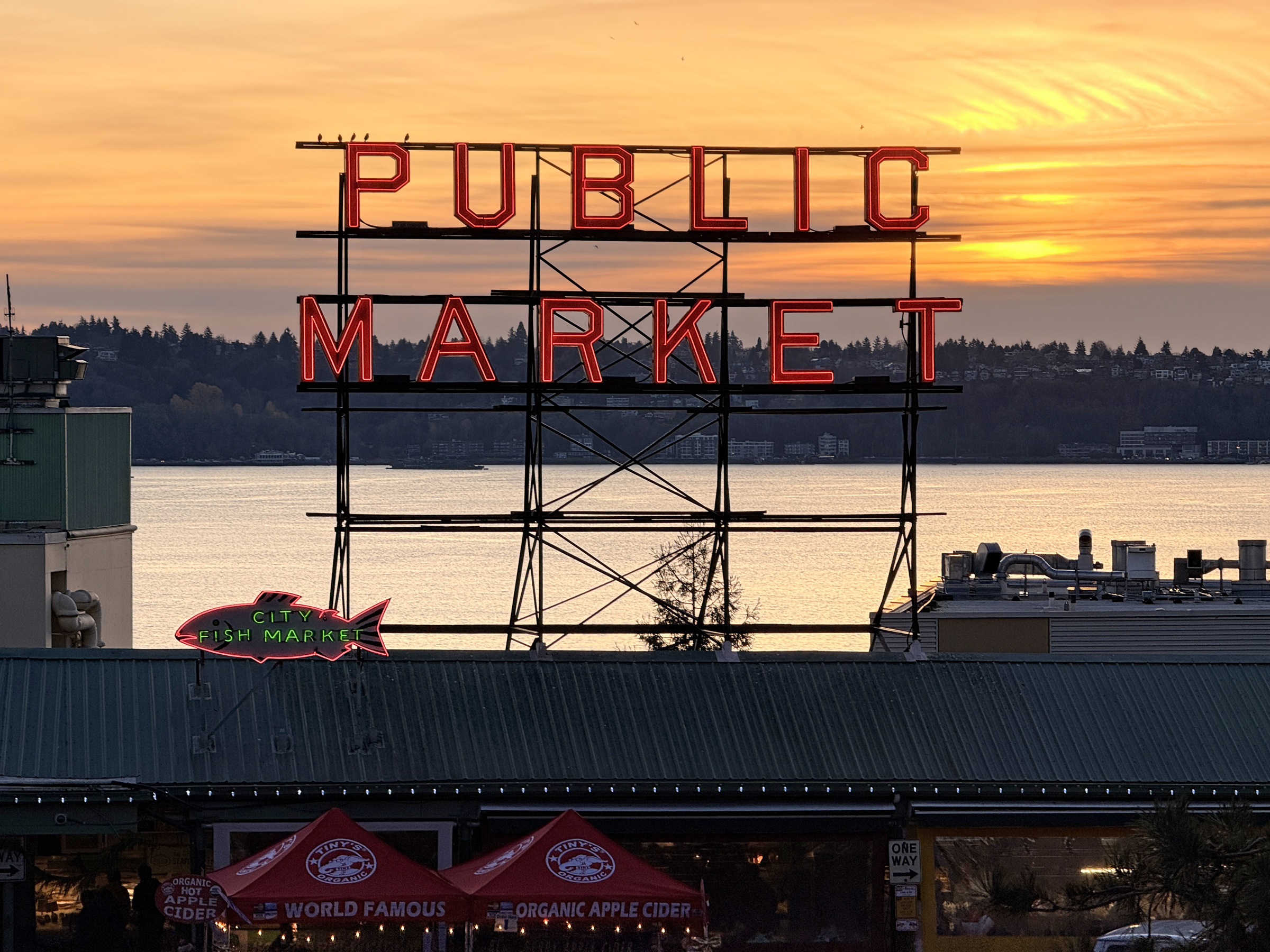
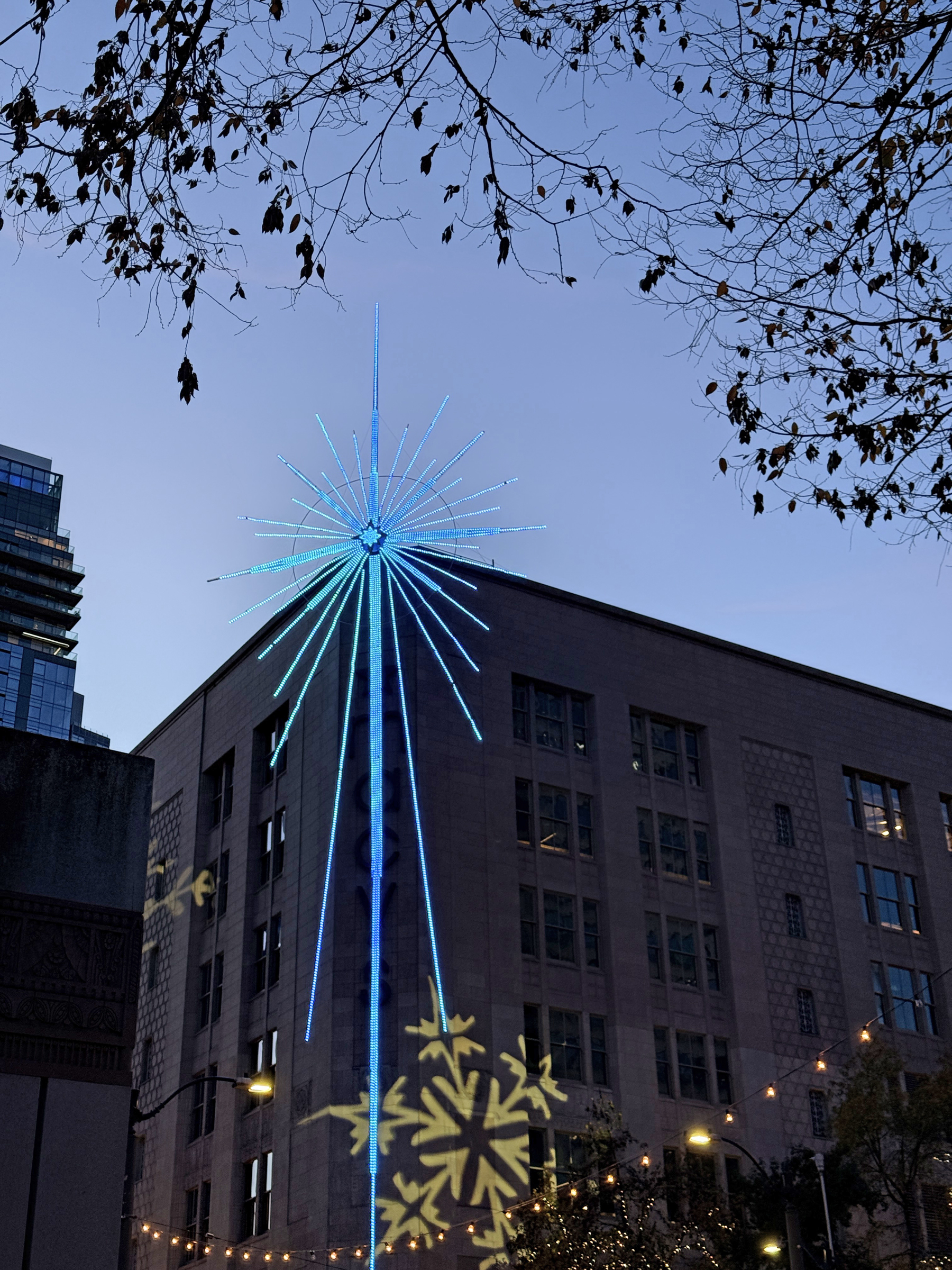
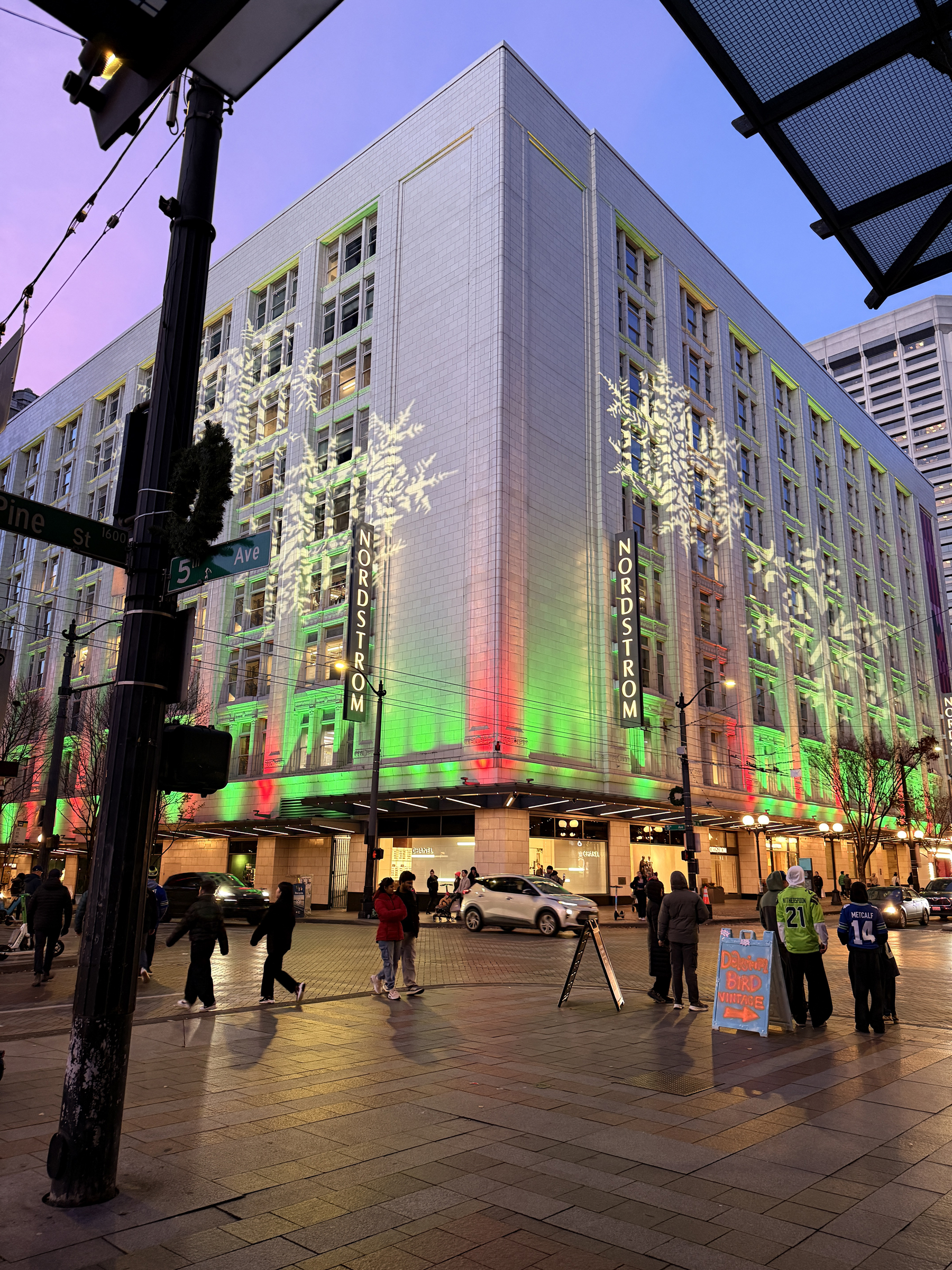
I took the No 10 bus to Westlake Center at sunset to check out the Christmas tree and its lights. (Pike Place Market is just a few blocks away).
There were not a lot of people around, probably because it was chilly (43°F/ 6°C). A few Seahawks fans were back from Lumen Field, where the Hawks took out the Minnesota Vikings 26-0 tonight.
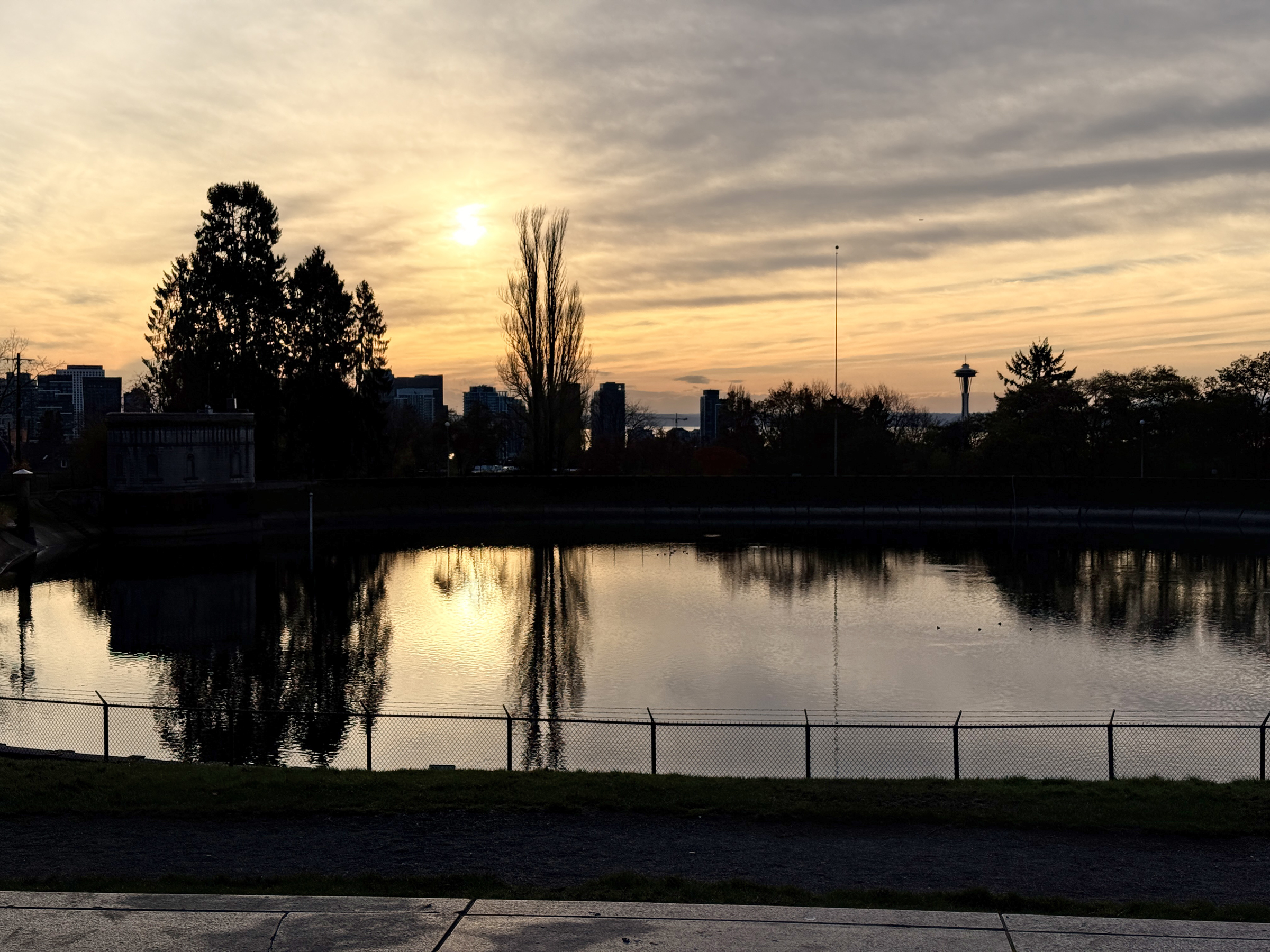
Here is the sun today, with about 45 minutes of daylight remaining.
The days are now 9 hours 5 minutes long, with sunset at 4.27 pm.
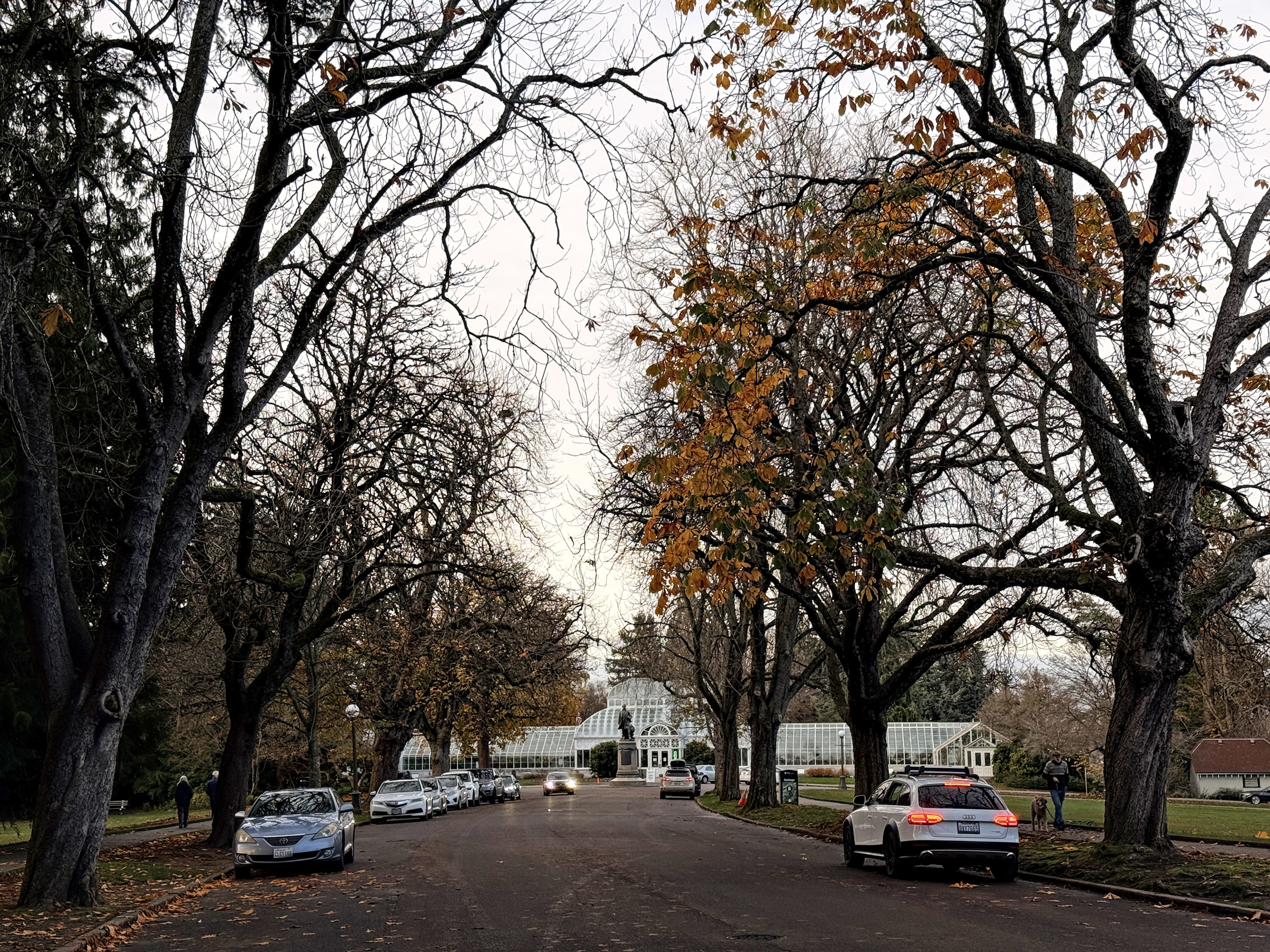
The trees that lead to the Volunteer Park Conservatory are now mostly bare of their leaves.
It’s been 50 years since the launch of Viking I, the first US spacecraft ever to land successfully on Mars.
Research from recent years suggests that the lander touched down where a Martian megatsunami deposited materials 3.4 billion years ago.
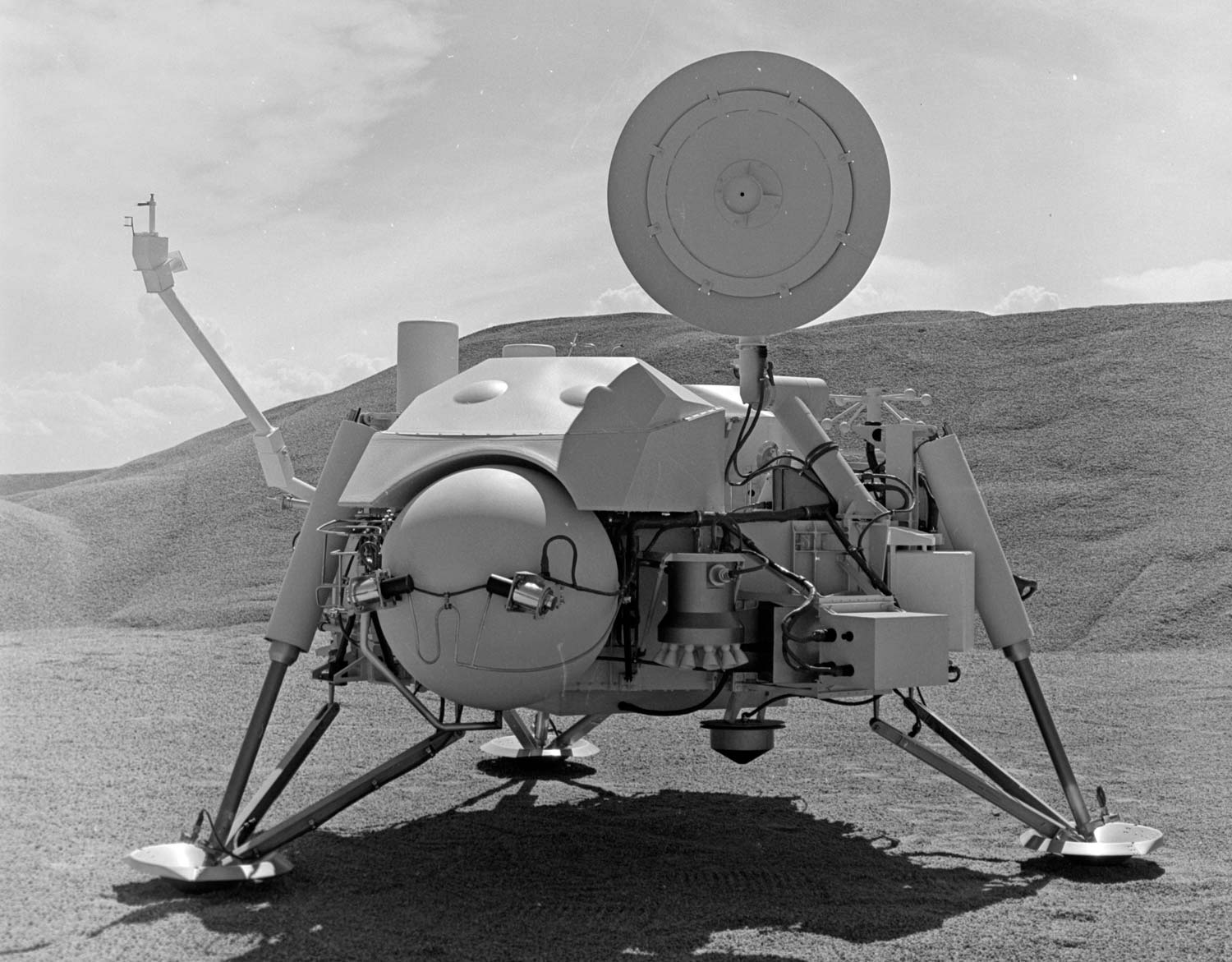
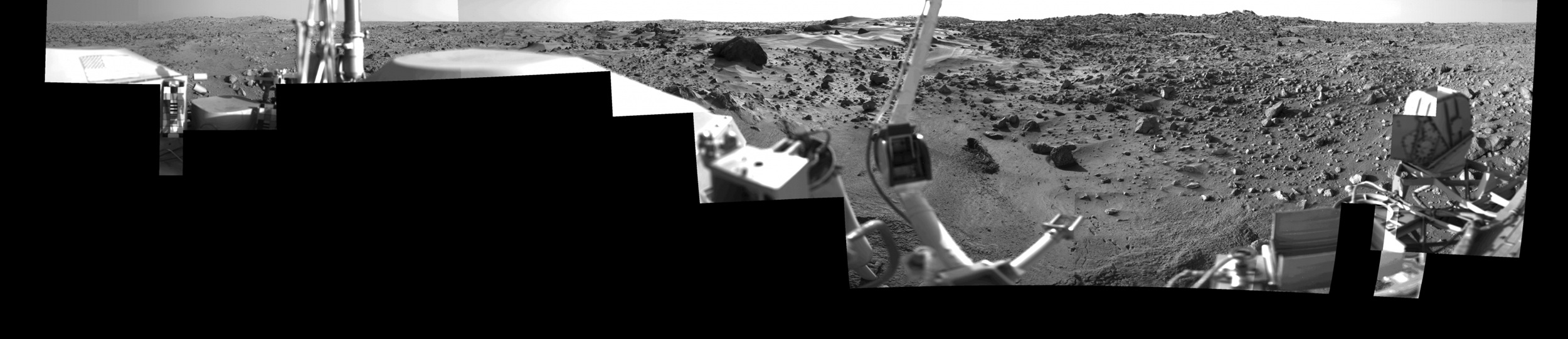
A model of Viking 1. (The remains of the original Viking 1 lander are on the surface of Mars, where it had landed on July 20, 1976. It was a stationary lander and did not roam around. It did have an orbiter with solar panels that completed 1,485 orbits around Mars. While it no longer transmits data, the orbiter continues to orbit the planet!) Construction of the Viking 1 spacecraft was done primarily by the private company Martin Marietta (now Lockheed Martin). The team worked for six years to build the ground-breaking spacecraft. The cost came to roughly $1 billion— about $6 billion in today’s dollars. [Image from Lockheed Martin, posted on space.com]The Mars landscape, as seen from the camera of the Viking I lander. [Image from California Science Center website]This timeline was compiled for MSN online by Dede Wilson:
1. The Historic Liftoff
The countdown ended in a roar of fire and smoke as Viking 1 lifted off from Cape Canaveral on August 20, 1975. The Titan IIIE-Centaur rocket carried both an orbiter and a lander, marking NASA’s boldest step toward exploring Mars.
2. The Long Cruise to Mars
Viking 1 traveled nearly 11 months through space before arriving at Mars. This interplanetary cruiseinvolved careful navigation to ensure the spacecraft reached its target orbit with pinpoint accuracy.
3. Mars Orbit Arrival
On June 19, 1976, Viking 1’s orbiter fired its engine to settle into orbit around Mars. From this vantage point, it began photographing the surface to find a safe and scientifically valuable landing site.
4. The First Soft Landing on Mars
On July 20, 1976, exactly seven years after Apollo 11’s Moon landing, Viking 1’s lander touched down in Chryse Planitia, becoming the first fully successful Mars lander in history.
5. Stunning Panoramas of a New World
Viking 1 sent back the first high-resolution panoramic photos of Mars, revealing a rocky, rust-colored landscape beneath a salmon-pink sky, images that captured the imagination of people worldwide.
6. Searching for Life
Equipped with biology experiments, Viking 1 attempted to detect signs of life in Martian soil. The results were puzzling: some tests gave unexpected positive readings, but most indicated no organics, sparking debates that continue to this day.
7. Mapping Mars from Above
The orbiter mapped vast swaths of the planet, from giant volcanoes like Olympus Mons to canyons deeper than Earth’s Grand Canyon. These images shaped our understanding of Martian geology.
8. Years of Operation
Viking 1’s lander operated for over six Earth years (2,245 Martian sols) making it the longest-running Mars surface mission until 2010, when NASA’s Opportunity rover broke the record.
9. A Sudden Goodbye
In November 1982, a faulty command ended communications with the lander. The orbiter had already completed its mission, but Viking 1’s contributions to science remained secure.
10. Inspiring Future Mars Missions
From Pathfinder to Perseverance, every Mars mission since Viking 1 has built on its legacy. It proved we could land safely, operate for years, and study Mars in depth.
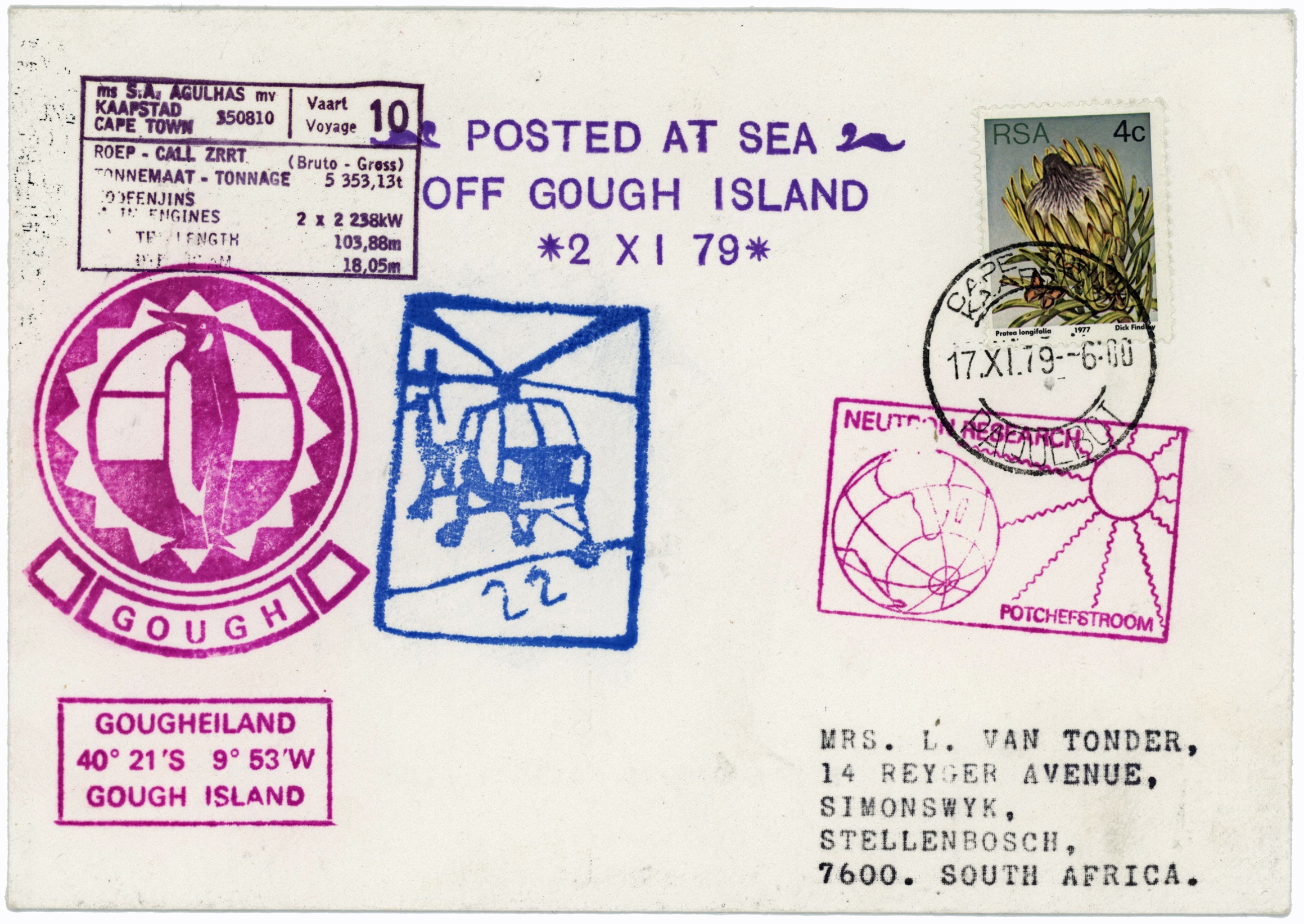
Check out this cool 1979 envelope.
It was mailed paquebot off Gough Island, with all kinds of outrageous postmarks on the envelope.
Paquebot cancellations on postage stamps indicate that the mail was posted on a ship at sea and canceled at the ship’s next port of call. The term paquebot is French for “packet boat” (steam ship, steam vessel) and signifies that the mail was handled according to international regulations for mail posted on vessels. These cancellations are distinct from regular postmarks and are often sought after by collectors.
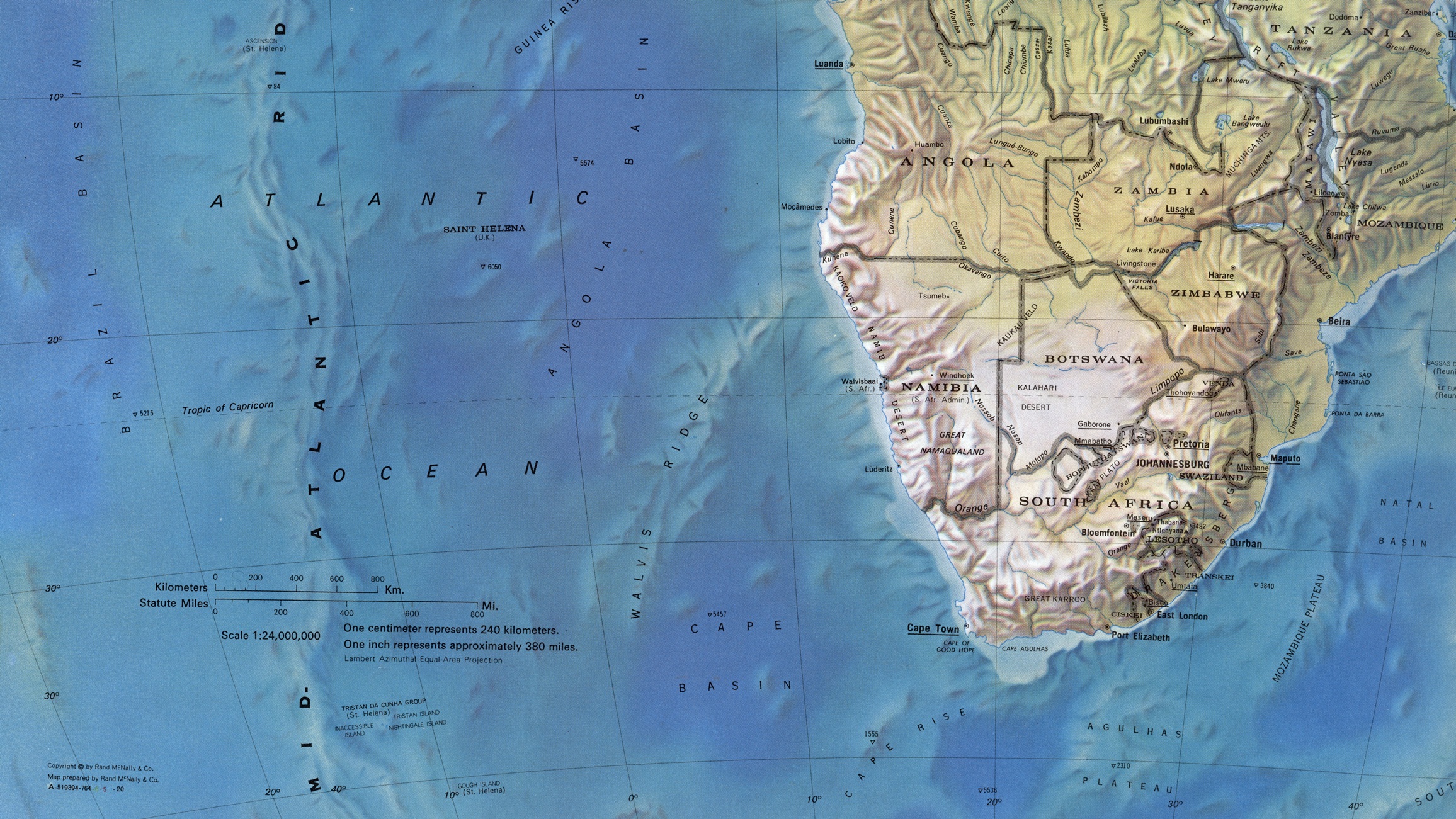
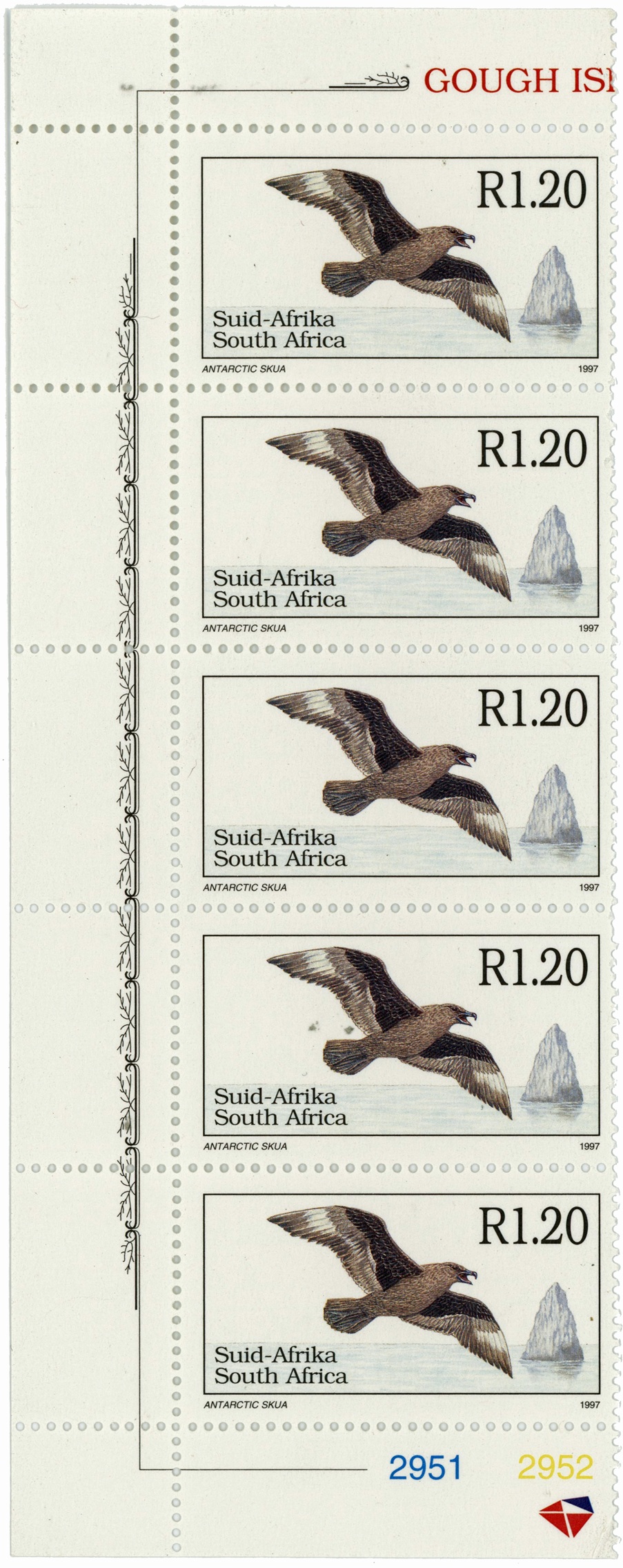
Postmarks and stamp on envelope— S.A. Agulhas is a South African ice-strengthened training ship and former polar research vessel. She was built by Mitsubishi Heavy Industries in Shimonoseki, Japan, in 1978. S.A. Agulhas retired from Antarctic service in April 2012 when the replacement vessel, S. A. Agulhas II, was commissioned. She was transferred to the South African Maritime Safety Authority as a training ship. Mailed paquebot off Gough Island on Nov. 2, 1979. Penguin and Gough Island coordinates. Gough Island is home to northern rockhopper penguins (Eudyptes moseleyi). Neutron research postmark from University of Potchefstroom in South Africa. The main scientific station on Gough Island is a South African weather station, which has been in operation since 1956. The Physics department at Potch University studied cosmic rays. Cosmic rays are primarily composed of high-energy particles, with about 90% being protons (hydrogen nuclei). Neutrons are secondary particles that are knocked out of atoms in the earth’s atmosphere. The blue helicopter postmark is most likely a commemorative or mission-specific cachet used on mail handled during the 1979 Gough Island expedition. The 22 might refer to a flight number or a team identification. The Cape Town postmark of Nov. 17, 1979 likely marks the arrival of the vessel there, at which time it was dispatched to the street address in Stellenbosch. The 4c stamp is from South Africa’s Third Definitive Series Issued May 27, 1977 |4c Protea longifolia |Perf. 12½ |Photogravure |Fluorescent paper |No watermarkLook at the bottom of this map for Gough Island. The island is also known historically as Gonçalo Álvares, and is a rugged volcanic island (area 35 mi²) in the South Atlantic Ocean. It is a dependency of the Tristan da Cunha island group and part of the British overseas territory of Saint Helena, Ascension and Tristan da Cunha. Nobody lives on Gough Island except for the workers of a weather station, which is usually six people. The South African National Antarctic Programme has maintained the island with British permission since 1956. [From Wikipedia] [Map in Lambert azimuthal equal-area projection by Rand McNally and published in 1984 in an atlas by Encyclopdia Britannica]One of these stamps would have fitted the envelope perfectly. Unfortunately, it would be 18 more years after 1979 before these stamps featuring the Antarctic skua would be issued.
South Africa Sixth Definitive Series (Endangered Fauna, Redrawn) Issued Aug. 27, 1997 |R1.20 Antarctic skua (additional value to series first issued in 1993) |Perf. 14×14¼ |Lithography |Coated paper |No Watermark
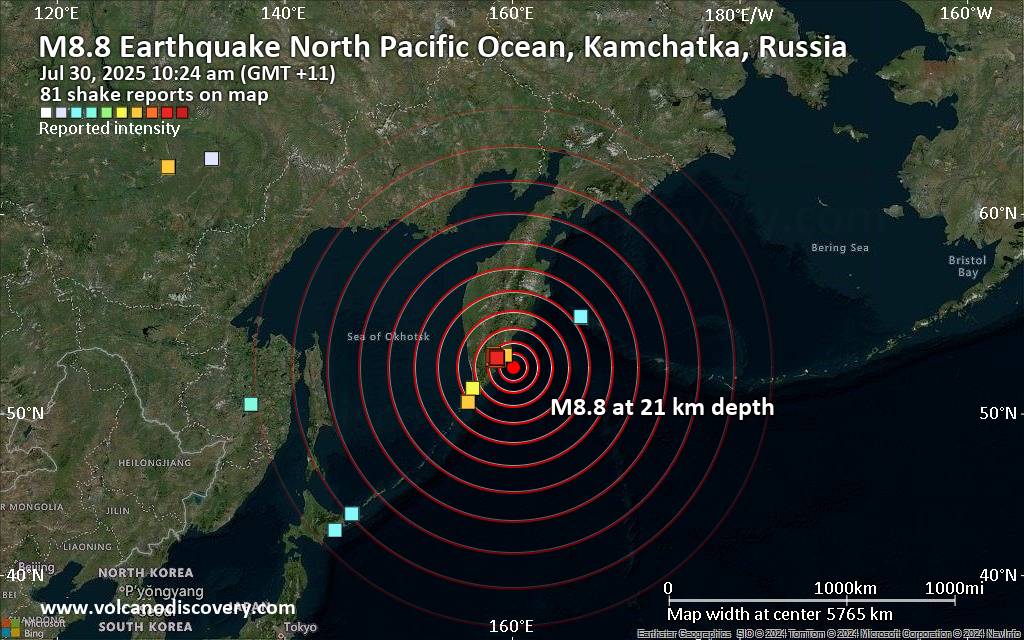
My phone and watch buzzed a dozen times from my Japan-based NHK app tonight, with tsunami warnings (because of the 8.8 earthquake on the Kamchatka peninsula).
By now the first waves have reached Hokkaido in the north of Japan, though, and it seems the waves will be no more than a few feet high.
Why was this the case? I asked Chat GPT’s AI chatbot. Great question — and a very reasonable one, given how large-magnitude earthquakes like the 8.8 off the Kamchatka Peninsula can sometimes generate devastating tsunamis. But not all big earthquakes produce massive waves. Here’s why this particular one likely produced only a small tsunami (a few feet): 1. It was very deep 2. It was likely within the subducting slab 3. The tsunami threat is highly dependent on the type of fault motion 4. Energy was spread over a wide area
Magnitude: 8.8 Depth: 21 km 13 mi Time: GMT 2025-07-29 23:24:50.842 Epicenter: 2025 Kamchatka Peninsula, Russia Earthquake Agency: USGS (United States Geological Survey)
For this extremely strong earthquake, 64 aftershocks (above mag. 2) have been detected so far. The strongest was a magnitude 7.2 quake that hit 53 seconds after the mainshock in 81 km (50 mi) distance, in 94 km southeast of Vilyuchinsk, Yelizovsky District, Kamchatka, Russia, on Wednesday, Jul 30, 2025 on 11:25 am (Kamchatka local time GMT +12). The most recent aftershock occurred 5 hours ago 217 km south of Petropavlovsk-Kamchatskiy, Kamchatka, Russia, and had a magnitude of 4.9.
The majority of reports came from Petropavlovsk-Kamchatskiy (58 reports), a city with more than 180,000 inhabitants in Kamchatka in 119 km (74 mi) distance northwest of the epicenter, Russia, Yelizovo (10 reports), a town with 41,000 inhabitants in 140 km (87 mi) distance northwest of the epicenter, and Yakutsk (4 reports) (2,085 km or 1,295 mi to the northwest) in Sakha. [Source: volcanodiscovery.com]
Cade Metz reports from San Francisco for the New York Times: An artificial intelligence system built by Google DeepMind, the tech giant’s primary artificial intelligence lab, has achieved “gold medal” status in the annual International Mathematical Olympiad, a premier math competition for high school students.
It was the first time a machine — which solved five of the six problems at the 2025 competition, held in Australia this month — reached that level of success, Google said in a blog post on Monday.
Google said Deep Think had spent the same amount of time with the I.M.O. as human participants did: 4½ hours. But the company declined to say how much money, processing power or electricity had been used to complete the test.
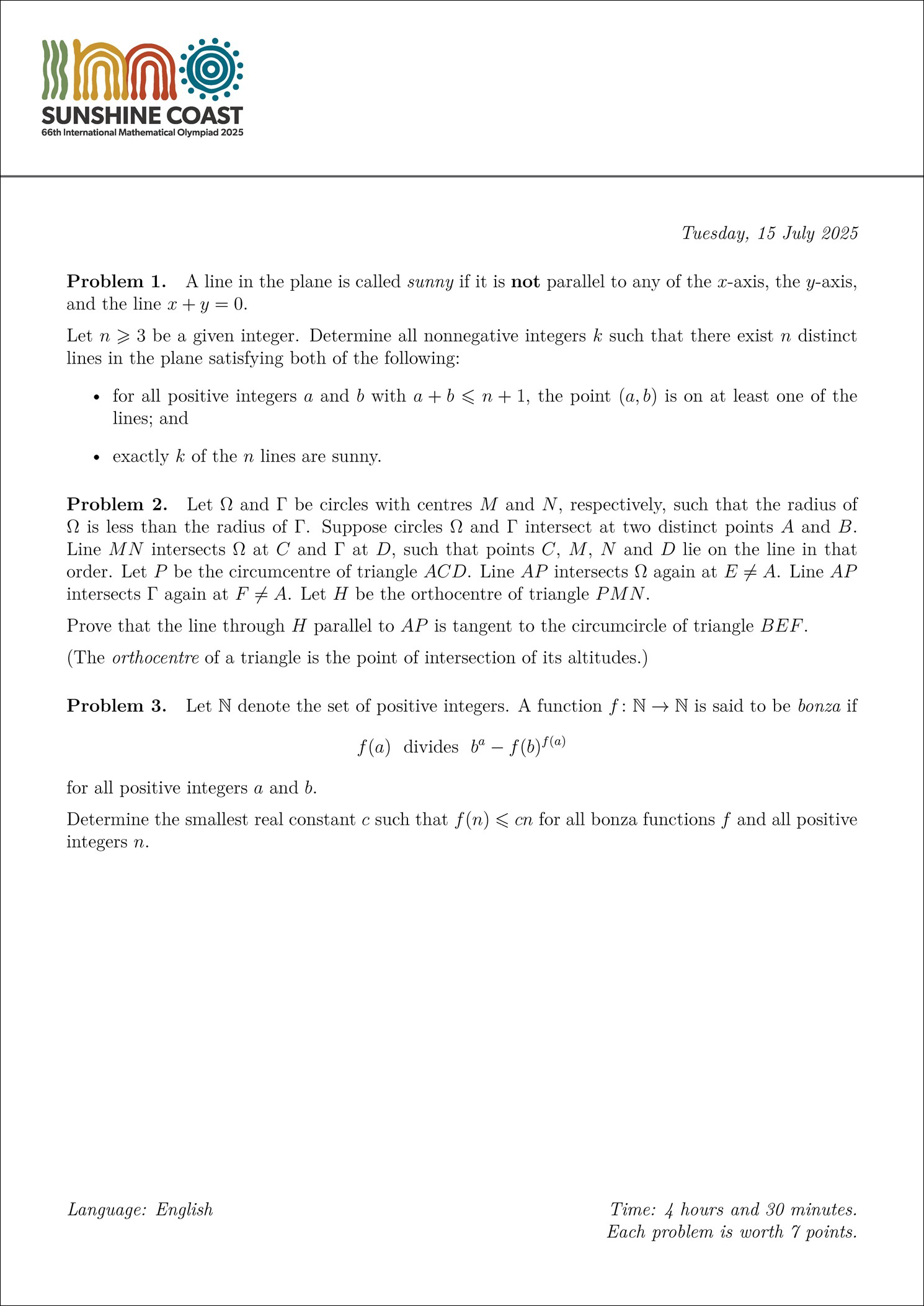
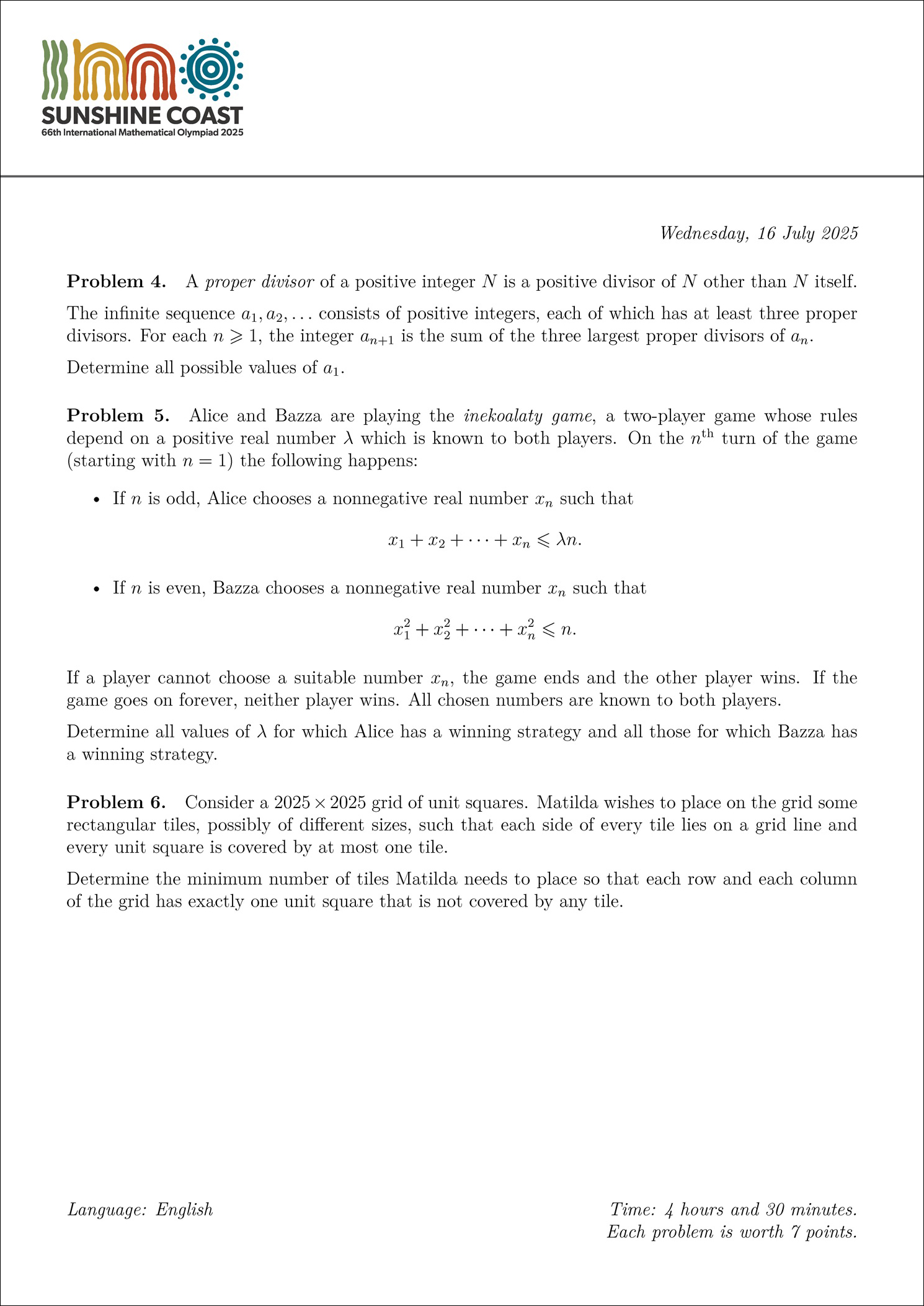
I looked up the problems online, and here they are.
Oof. Should I give it a go, and put in two sessions of 4½ hours each?
I think I’d better not. I might damage my self-esteem. 😆
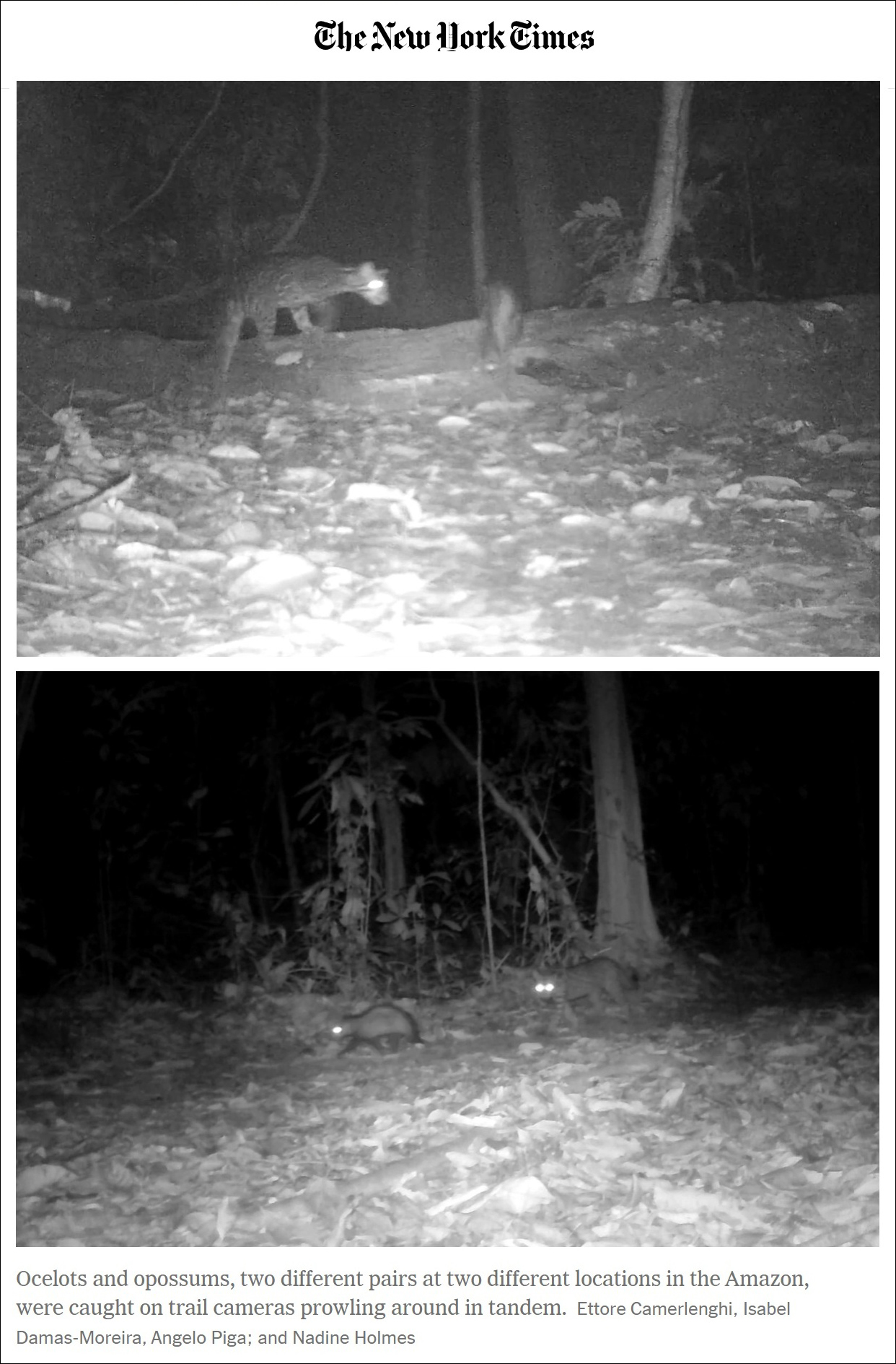
Clarissa Brincat writes in the Science section of the New York Times of July 15, 2025: Researchers at Cocha Cashu Biological Station in southeastern Peru set up a camera trap to study bird behavior, but they got a surprise guest appearance instead: an ocelot trailing an opossum through the jungle at night.
The ocelot, a wild cat slightly larger than a house cat, and the common opossum, a marsupial, are usually predator and prey. But in this video, they moved in tandem— like two old friends walking home from a bar.
Intrigued, they contacted researchers in other parts of the Amazon who turned up three additional, nearly identical videos from different locations and years.
… Opossums’ attraction to ocelots remains a mystery, but Dr. Damas-Moreira and her colleagues suspect there’s something that draws both animals. One hypothesis is “chemical camouflage.” “Opossums have a strong smell, and a close-by ocelot might help hide the opossum’s scent from bigger predators, or the opossum’s odor might mask the ocelot’s presence from prey,” said Ettore Camerlenghi, an evolutionary biologist and ecologist at ETH Zurich and an author of the study. Opossums are also resistant to the venom of pit vipers, a snake that lives in the Amazon. Ocelots lack that defense, and teaming up could give both animals an edge when hunting, Dr. Camerlenghi said. In North America, a similar alliance exists between coyotes and badgers, who buddy up to hunt squirrels.
[Stills from videoclips in the New York Times article ‘Videos From the Amazon Reveal an Unexpected Animal Friendship’]
There is an interstellar comet in our solar system, only the third known time it has happened.
Kenneth Chang writes for the New York Times: For only the third time, astronomers have found something passing through our solar system that came from outside the solar system.
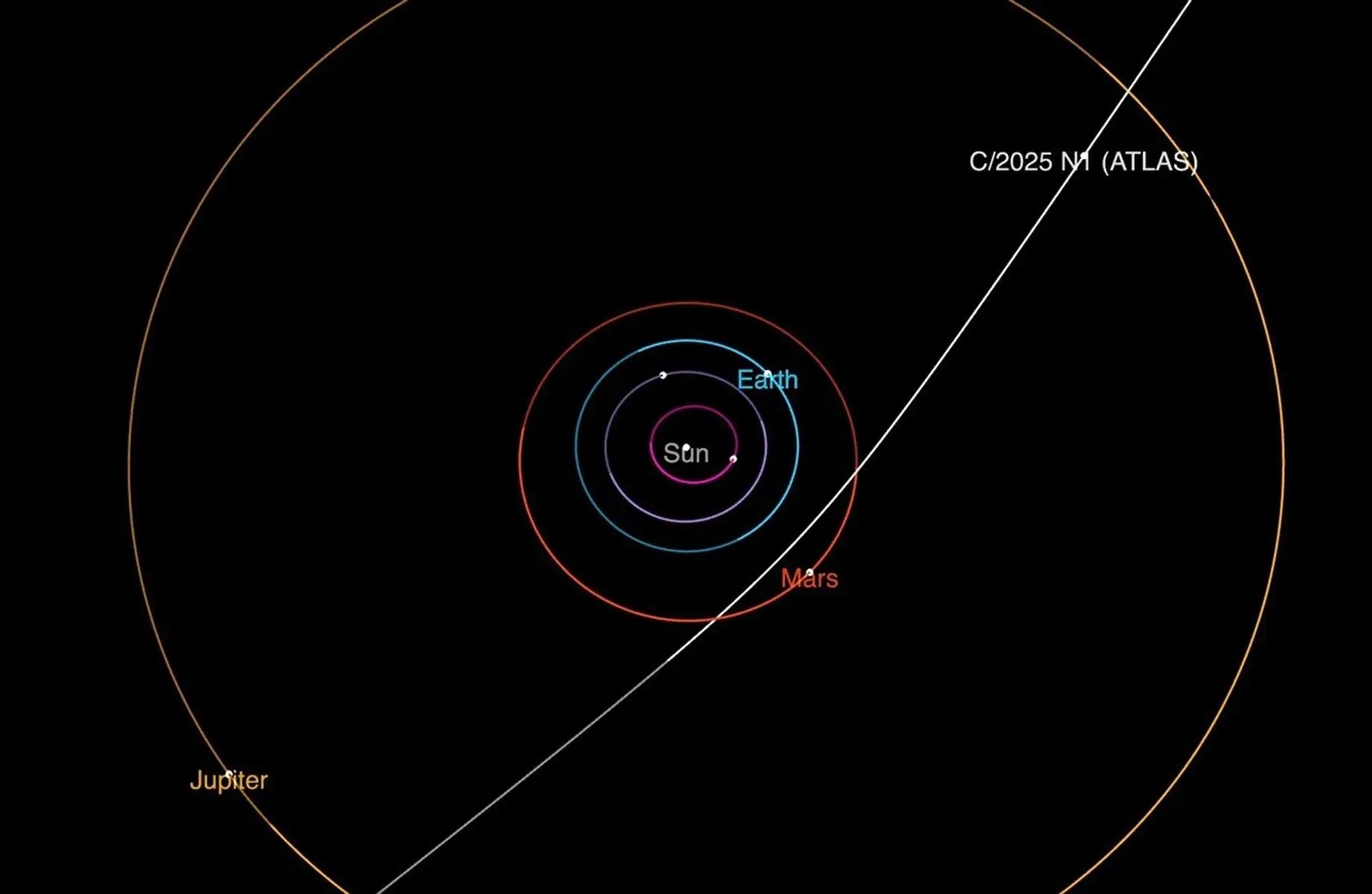
This interstellar object, known as 3I/ATLAS, is still pretty far from the sun, currently located between the orbits of the asteroid belt and Jupiter but heading toward the inner solar system.
“This thing is traveling pretty fast” said Paul Chodas, director of the Center for Near Earth Object Studies at NASA’s Jet Propulsion Laboratory in California.
Relative to the sun, it is currently moving at about 130,000 miles per hour and it will continue to accelerate as the sun’s gravity pulls on it. The first known interstellar object was Oumuamua, which traveled through the solar system in 2017. In 2019, Borisov, a comet of interstellar origin, passed by.
A diagram shows the projected trajectory of the interstellar comet 3I/ATLAS, labeled C/2025 N1 here, as it travels through our solar system. It is not yet known how big it is, but it will pass well clear of Earth. Its closest approach to Earth will occur in December, at a distance of 160 million miles. [From an article in the New York Times. Diagram by NASA/JPL-Caltech]
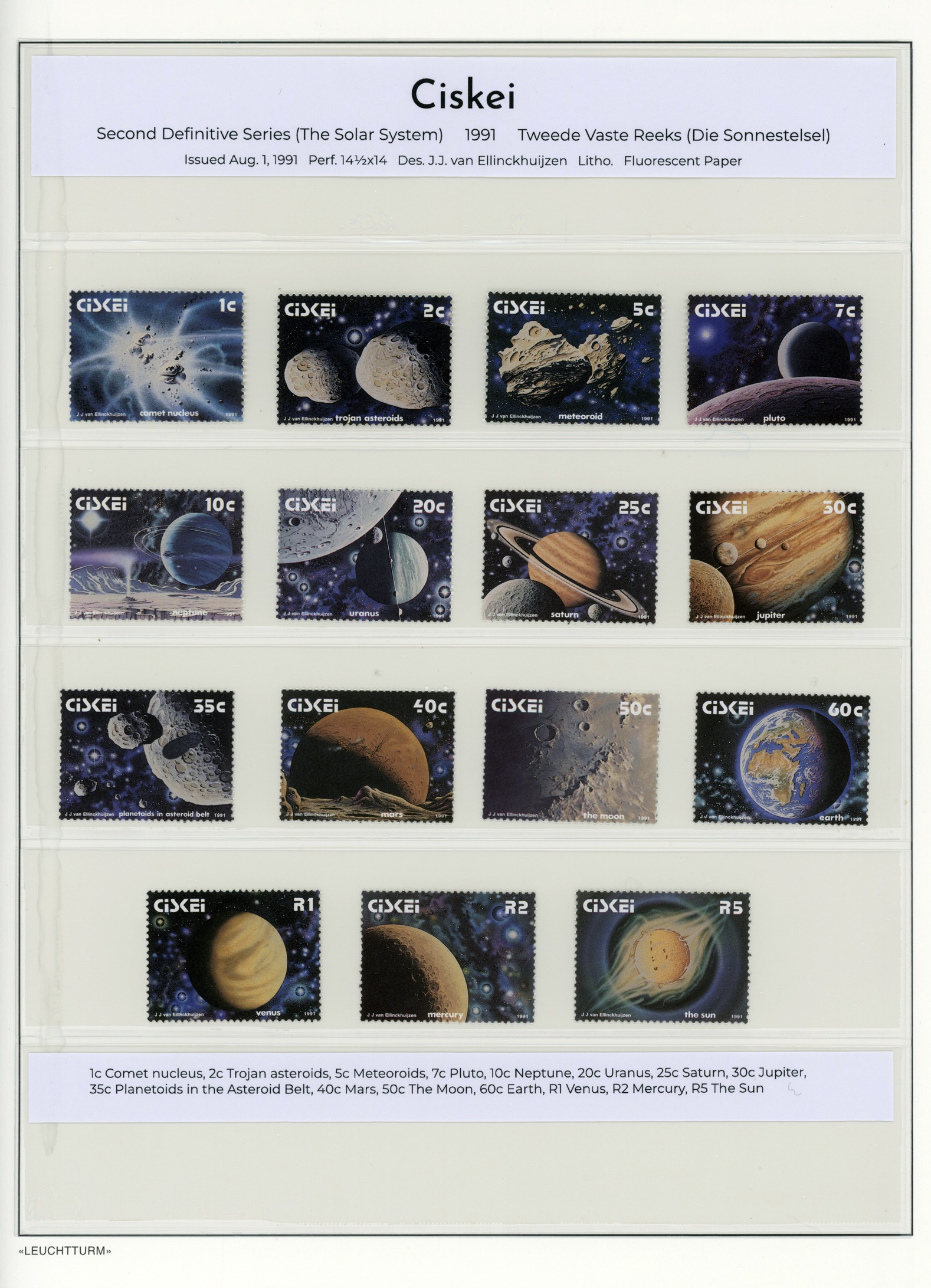
I have expanded my South African stamp collection to include the four Bantustans (homelands) that had issued postage stamps from 1976 to 1994. Technically these are not stamps from South Africa.
Although these stamps were denominated in South African Rand, they were not valid for mail that was sent from outside the homelands.
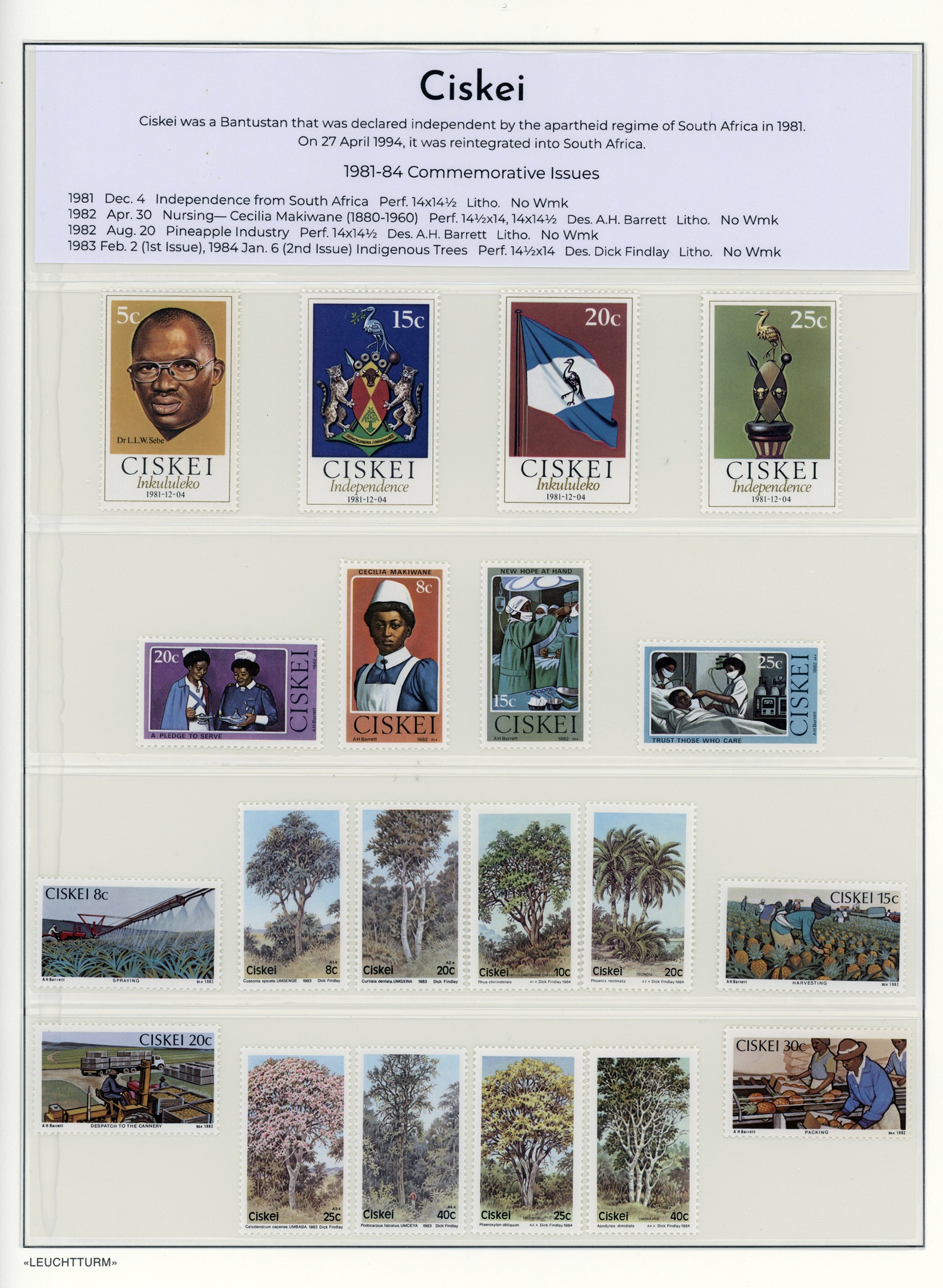
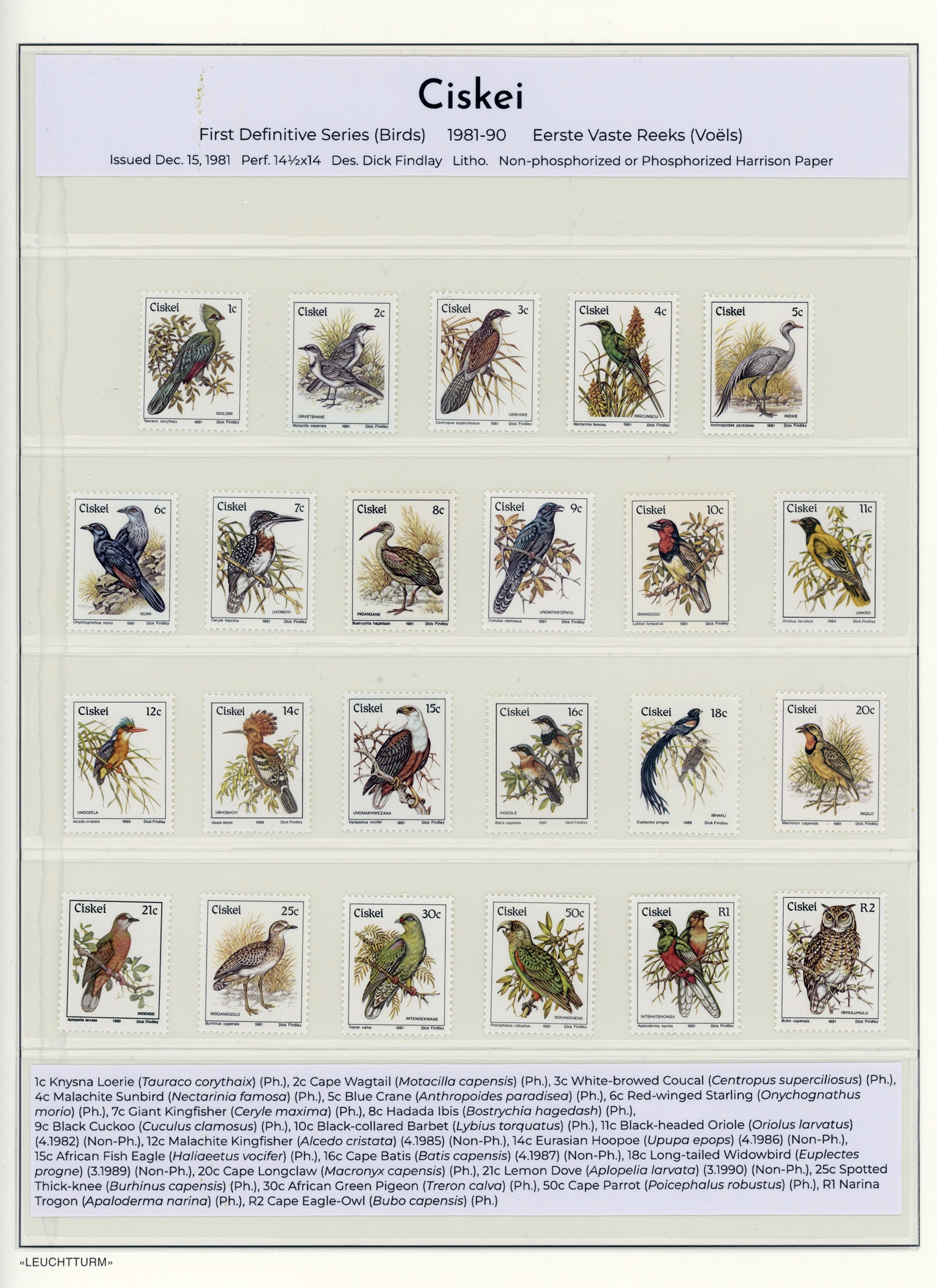
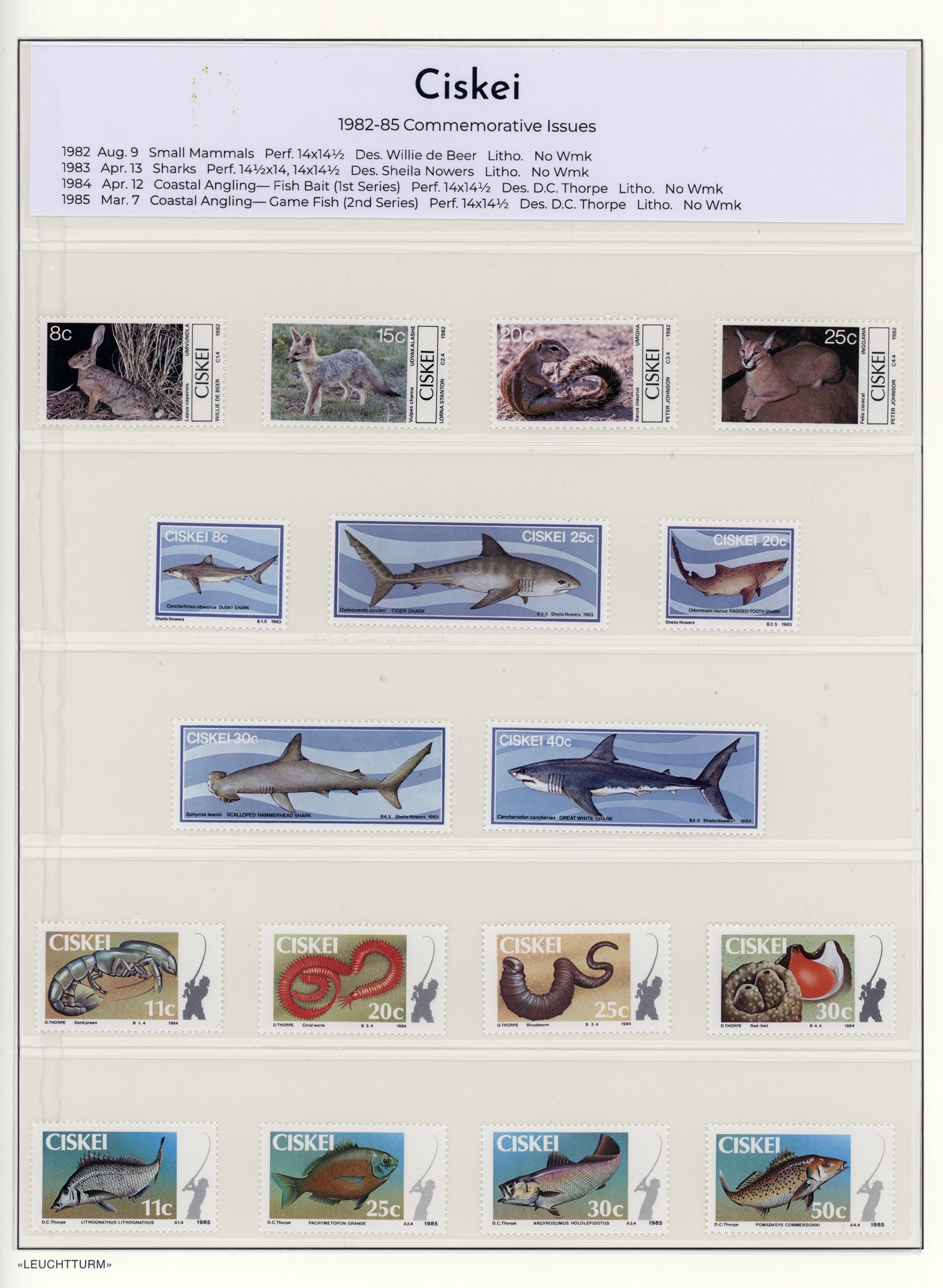
Below is a sampler of pages from my collection for Ciskei.
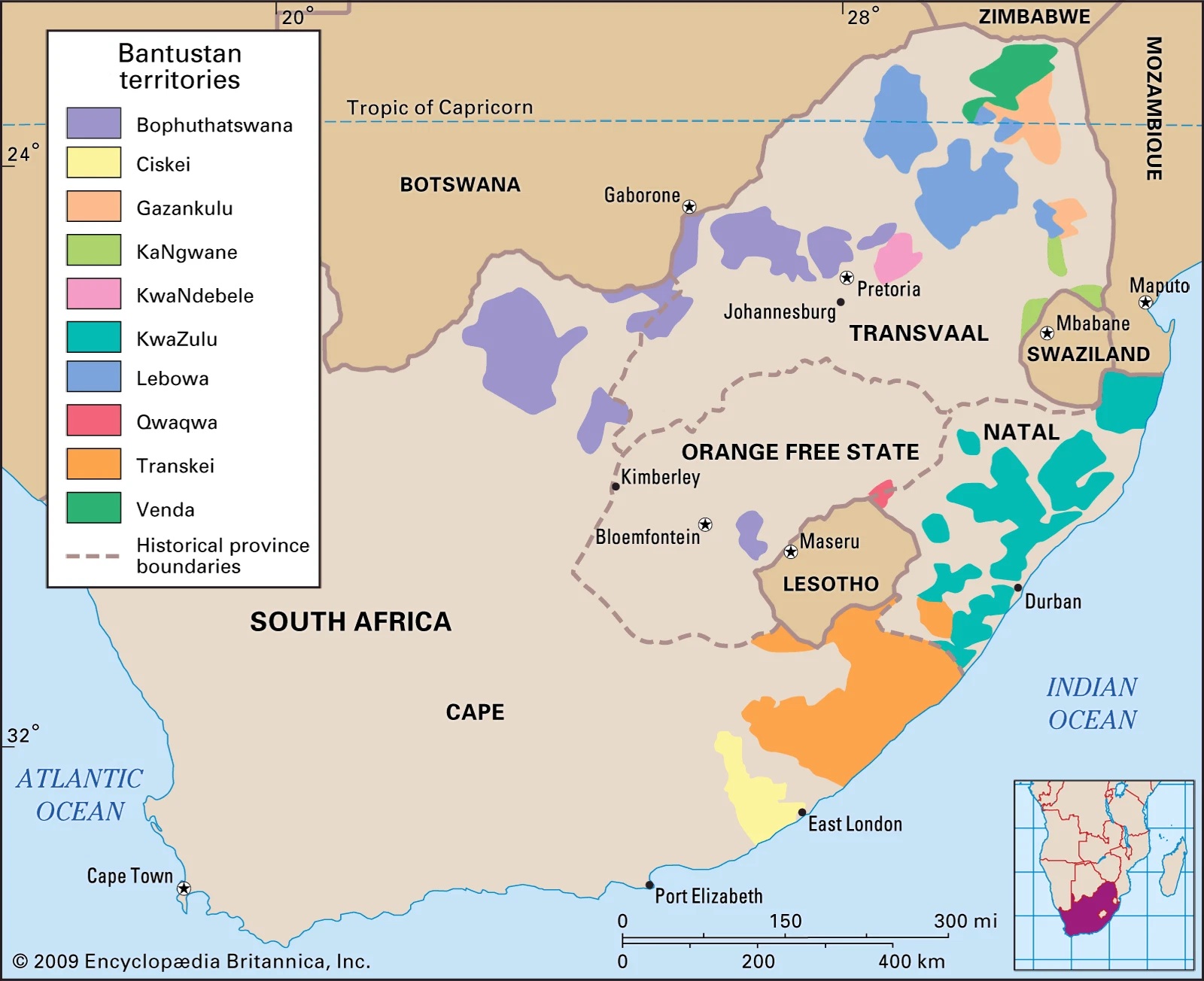
First, a little history. This is what South Africa looked like before the first democratic election of 1994. The four main provinces were established in 1910, and the Bantustans (homelands) were established by the South African apartheid government. After the 1994 election, the Bantustans ceased to exist, and were reincorporated into South Africa. Nine new provinces were established: Eastern Cape, Free State, Gauteng, KwaZulu-Natal, Limpopo, Mpumalanga, Northern Cape, North West, and Western Cape.
[More from Wikipedia: Bantustan]- A Bantustan (also known as a Bantu homeland, a black homeland, a black state or simply known as a homeland) was a territory that the National Party administration of the Union of South Africa (1910–1961) and later the Republic of South Africa (1961–1994) set aside for black inhabitants of South Africa and South West Africa (now Namibia), as a part of its policy of apartheid. The government of South Africa declared that four of the South African Bantustans were independent—Transkei, Bophuthatswana, Venda, and Ciskei (the so-called “TBVC States”), but this declaration was never recognized by anti-apartheid forces in South Africa or by any international government. Other Bantustans (like KwaZulu, Lebowa, and QwaQwa) were assigned “autonomy” but never granted “independence”.
A deadly, record-setting heat wave was continuing to blast most of the eastern U.S. on Tuesday, June 24, forecasters said, with temperatures soaring to near 100 degrees for tens of millions of people.
– USA Today
We’re still escaping the heat here in Seattle, with a relatively mild high of 79°F (26°C) here today.
Here is a mathematics-and-ice-cream cartoon from today’s Seattle Times, from cartoonist Bob Thaves.
Euclid is generally considered with Archimedes and Apollonius of Perga to be among the greatest mathematicians of antiquity. Euclid’s book ‘The Elements’ was a comprehensive compilation and explanation of all the known mathematics of his time, and the earliest known discussion of geometry. The Elements is often considered after the Bible as the most frequently translated, published, and studied book in the history of the Western World. [From Wikipedia]
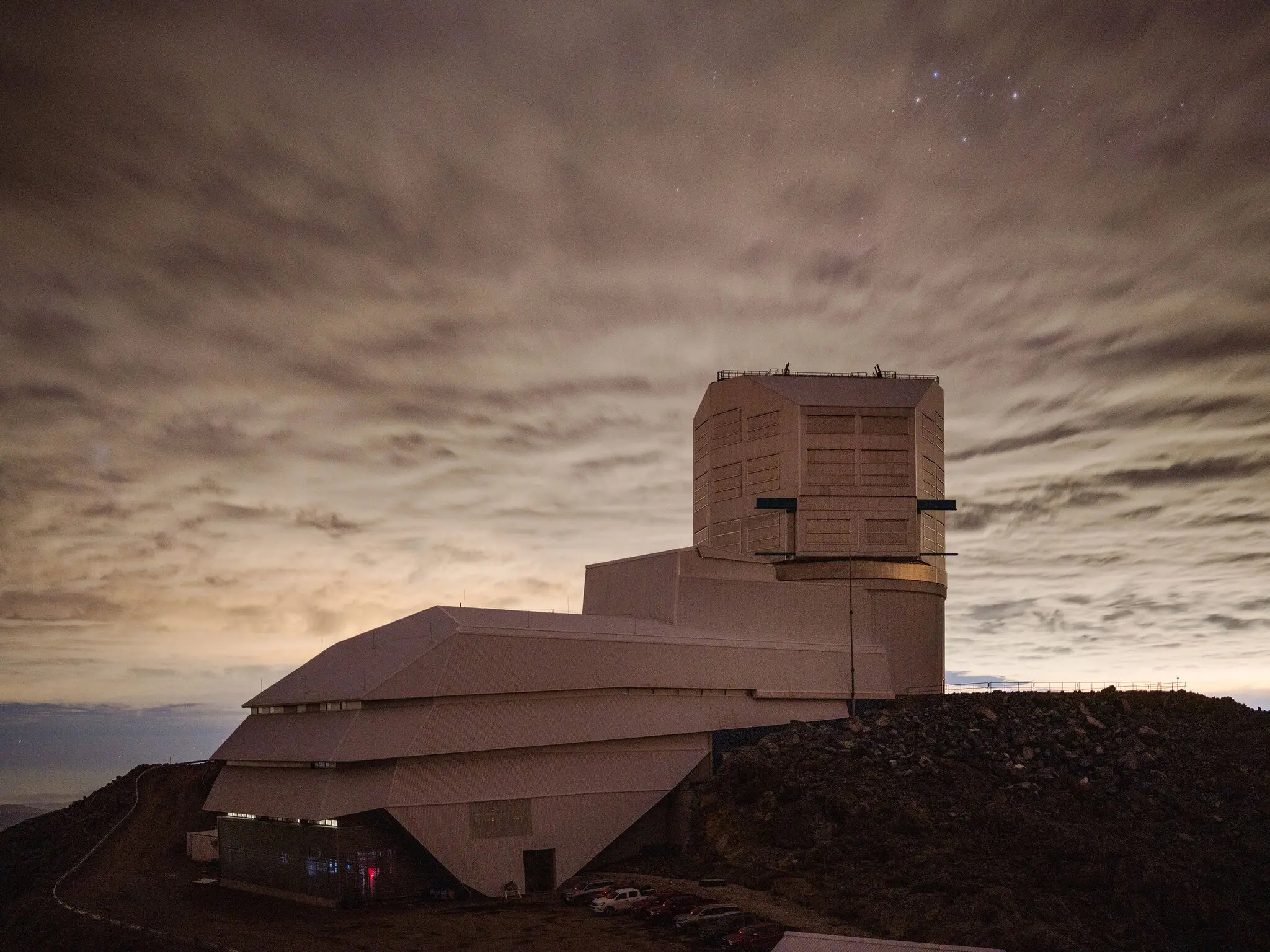
The first images of the brand new Vera C. Rubin Observatory in Chile have come in.
The completion of the telescope’s construction has been two decades in the making. It was built on a mountain in northern Chile, in the foothills of the Andes, and on the edge of the Atacama Desert. The altitude and dry atmosphere around it provide clear skies for observing the cosmos.
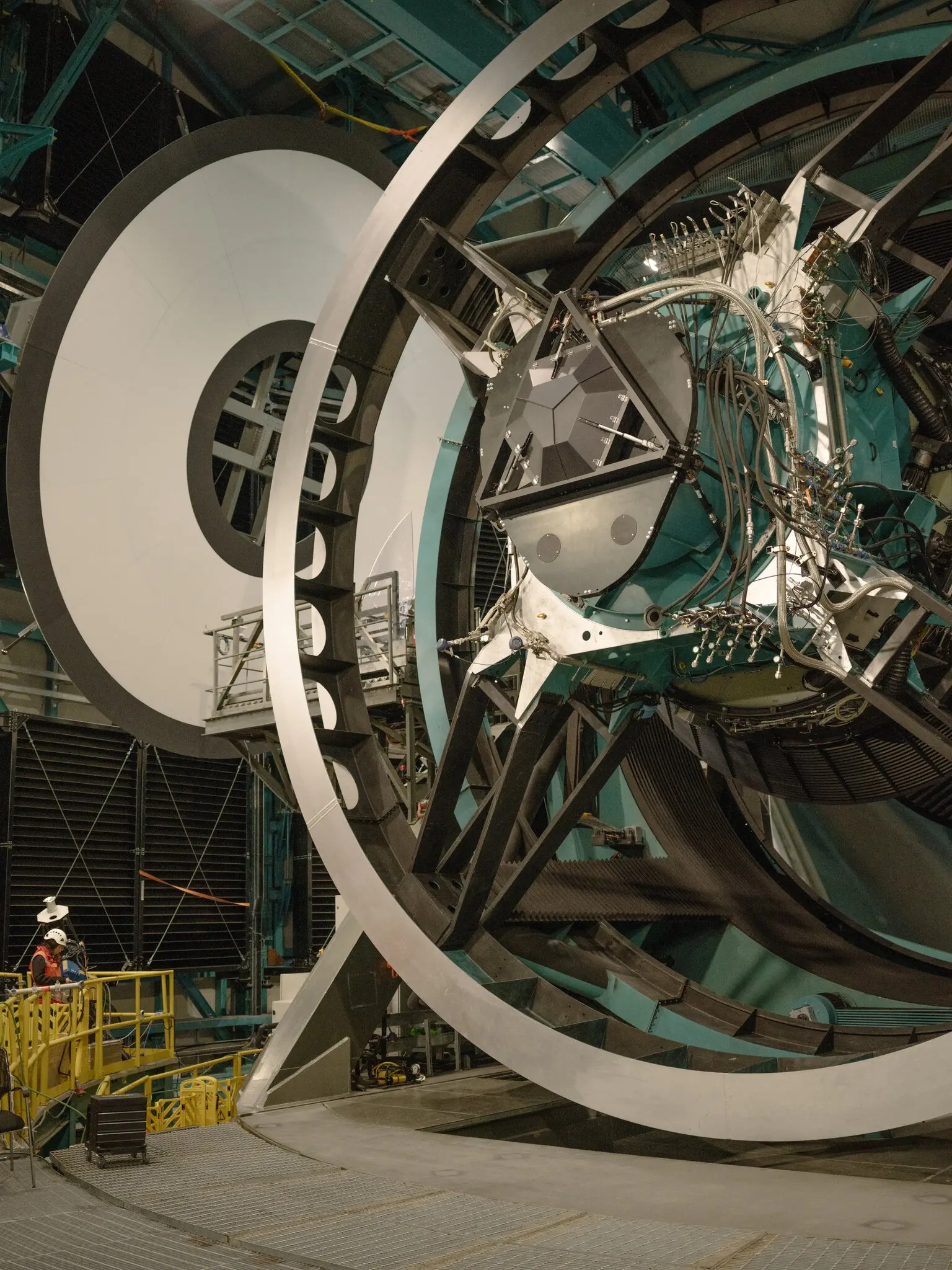
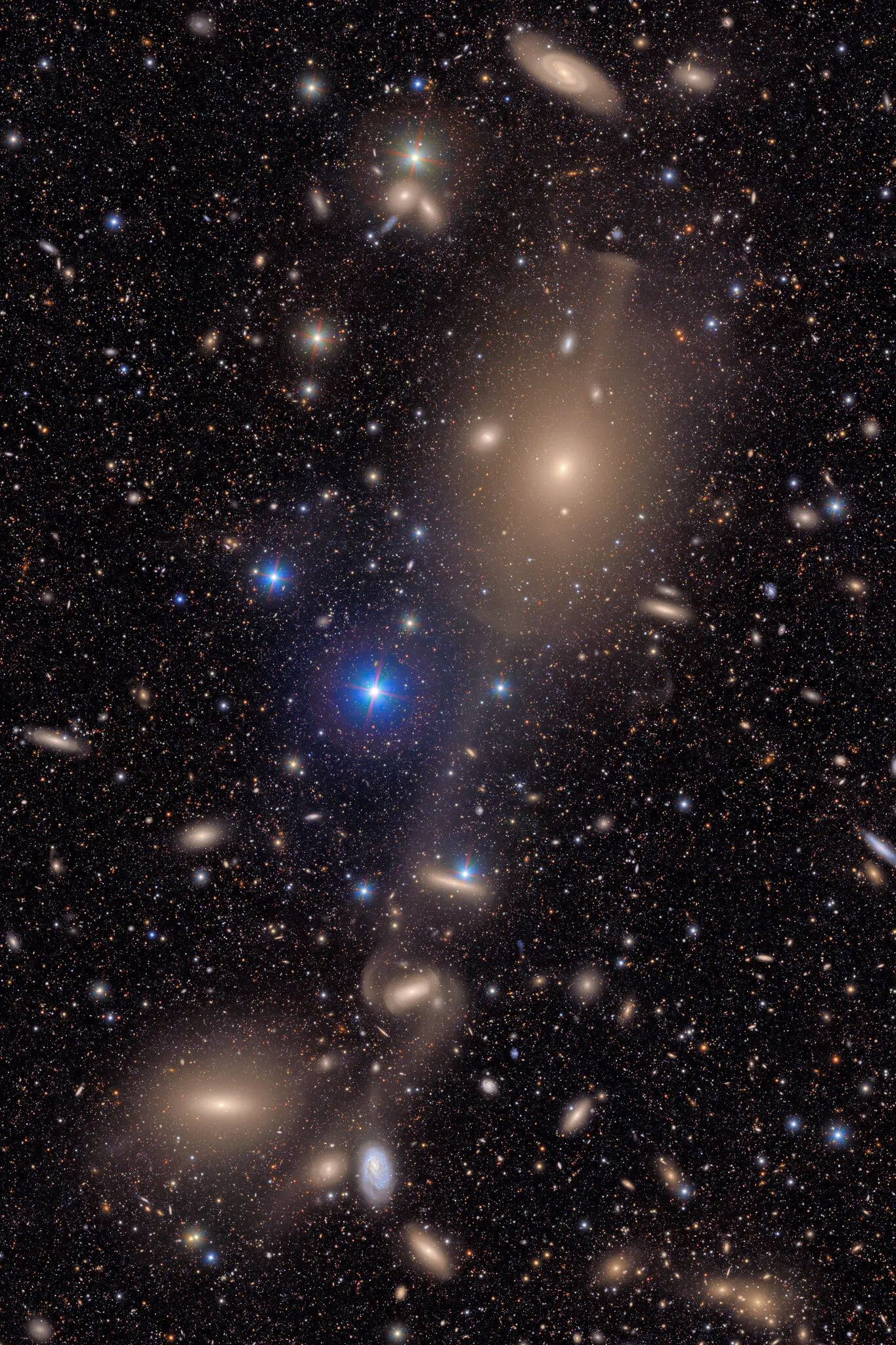
From Kenneth Chang and Katrina Miller’s reporting in the New York Times: Rubin is far from the largest telescope in the world, but it is a technological marvel. The main structure of the telescope, with a 28-foot-wide primary mirror, an 11-foot-wide secondary mirror and the world’s largest digital camera, floats on a thin layer of oil. Magnetic motors twirl the 300-ton structure around — at full speed, it could complete one full rotation in a little more than half a minute. Its unique design means Rubin can gaze deep, wide and fast, allowing the telescope to quickly pan across the sky, taking some 1,000 photos per night. By scanning the entire sky every three to four days for 10 years, it will discover millions of exploding stars, space rocks flying past and patches of warped space-time that produce distorted, fun-house views of distant galaxies.
The Vera C. Rubin Observatory, Cerro Pachón, Chile. [Marcos Zegers for The New York Times]A view of the observatory’s telescope mount assembly. The white disk is used for calibration of the camera. [Marcos Zegers for The New York Times]With its 3.2 billion-pixel camera, the Rubin Observatory captures extremely detailed photographs such as this small piece of a much larger image of the Virgo Cluster, a group of galaxies some 55 million light-years away. [Image from Vera C. Rubin Observatory/NSF/DOE]
We had a little bit of June gloom this morning with cool weather and low clouds.
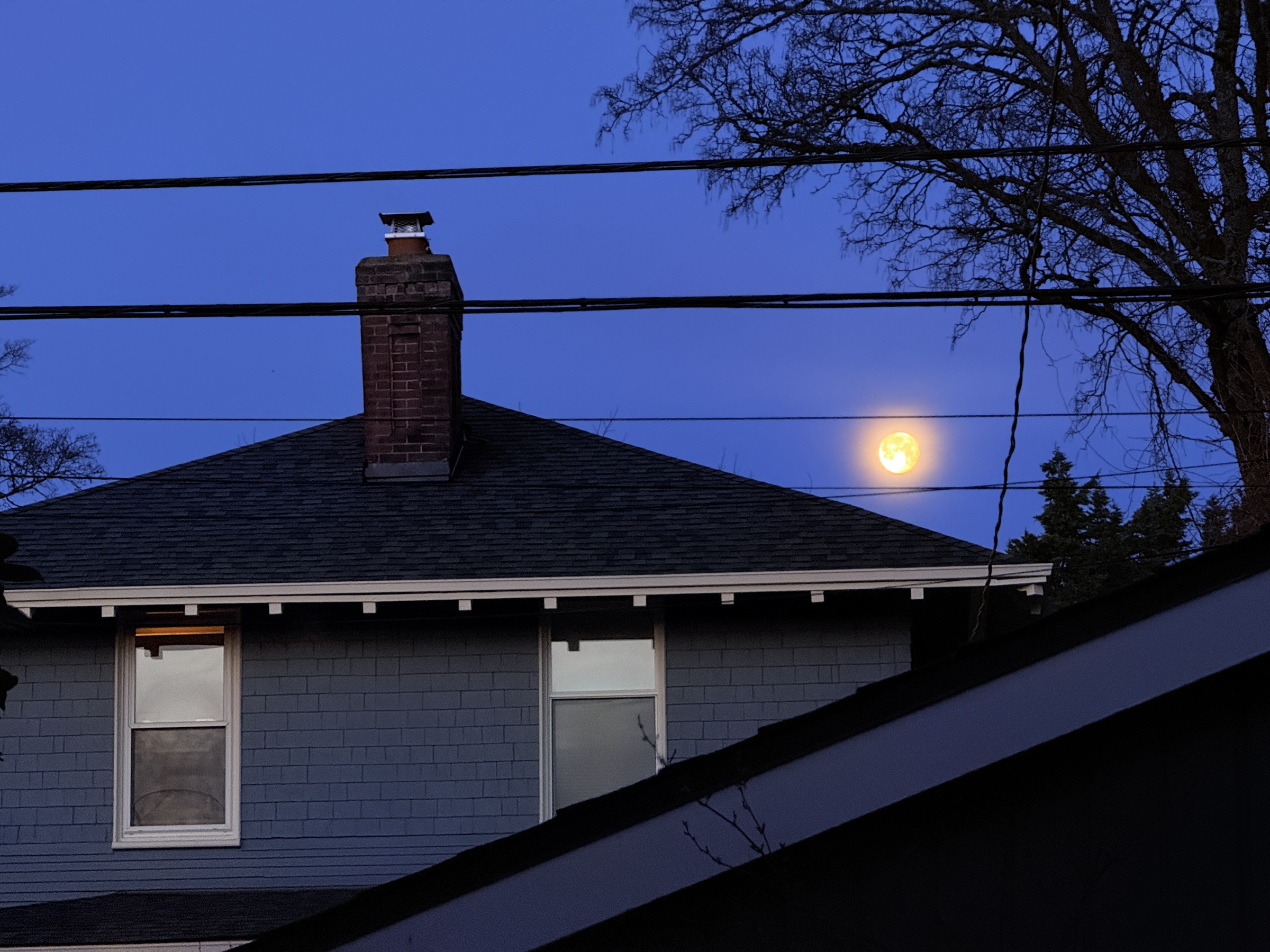
The clouds are mostly gone now, so maybe I will get a good look at Junes’s Strawberry Moon* tonight.
*Named thus not because of the reddish glow, but because strawberries are harvested in June.
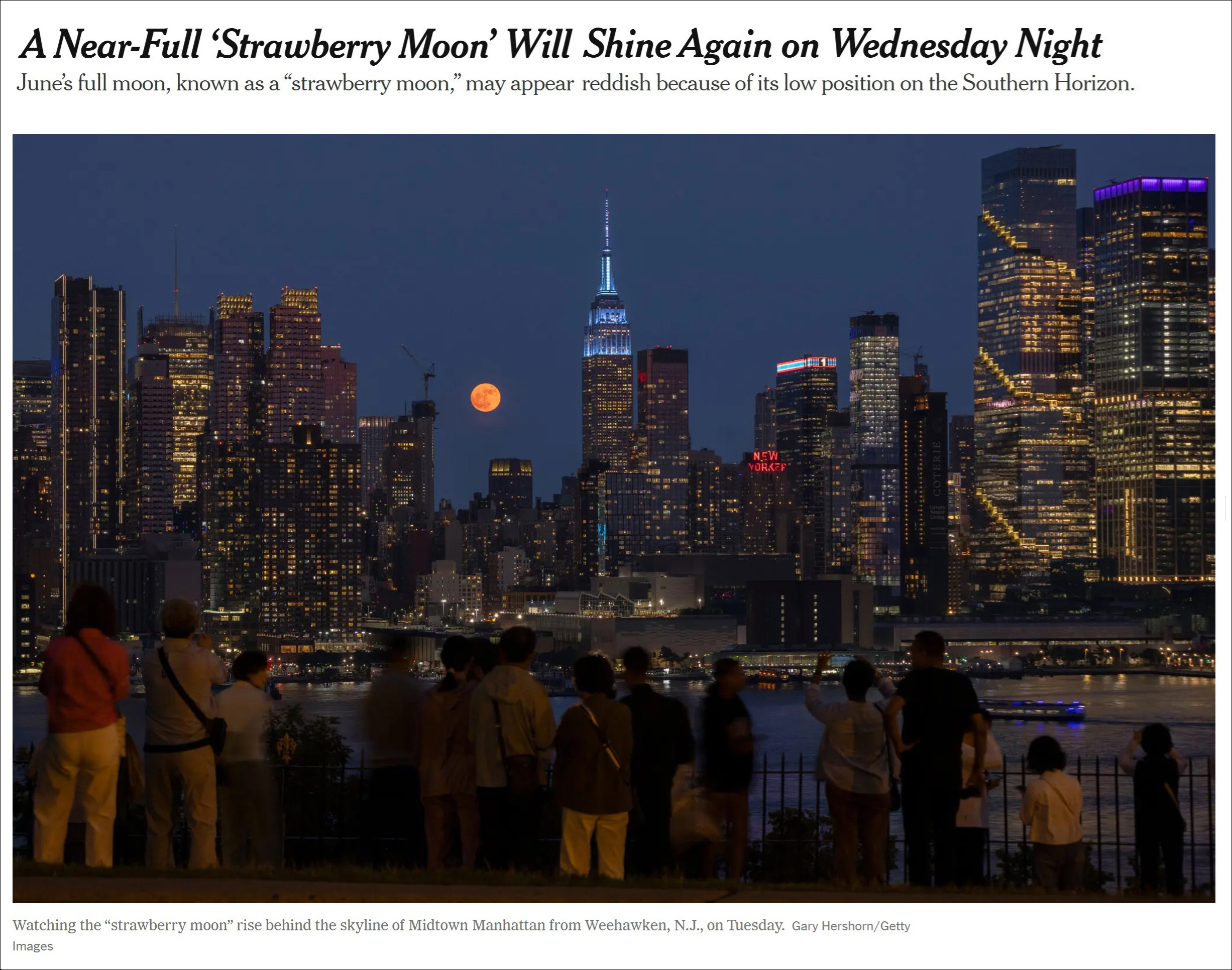
Headlines from the New York Times with photo by Gary Hershorn/ Getty Images
The weather was cool today (55°F / 13°C), with a light rain— just enough to form pearly droplets on plants with large, waxy leaves.
I believe these are redwood sorrel (Oxalis oregana) leaves.
It made me look up the surface tension* of water again (see table below). Water has the highest surface tension of almost all common liquids. There is mercury of course, that blows all the competition away. On the low end, liquid helium stands alone with virtually no surface tension, and in a state of superfluidity it flows without friction or viscosity.
*Surface tension is the tendency of liquid surfaces at rest to shrink into the minimum surface area possible. Surface tension is what allows objects with a higher density than water such as razor blades and insects to float on a water surface without becoming even partly submerged. [Wikipedia]
Happy Friday.
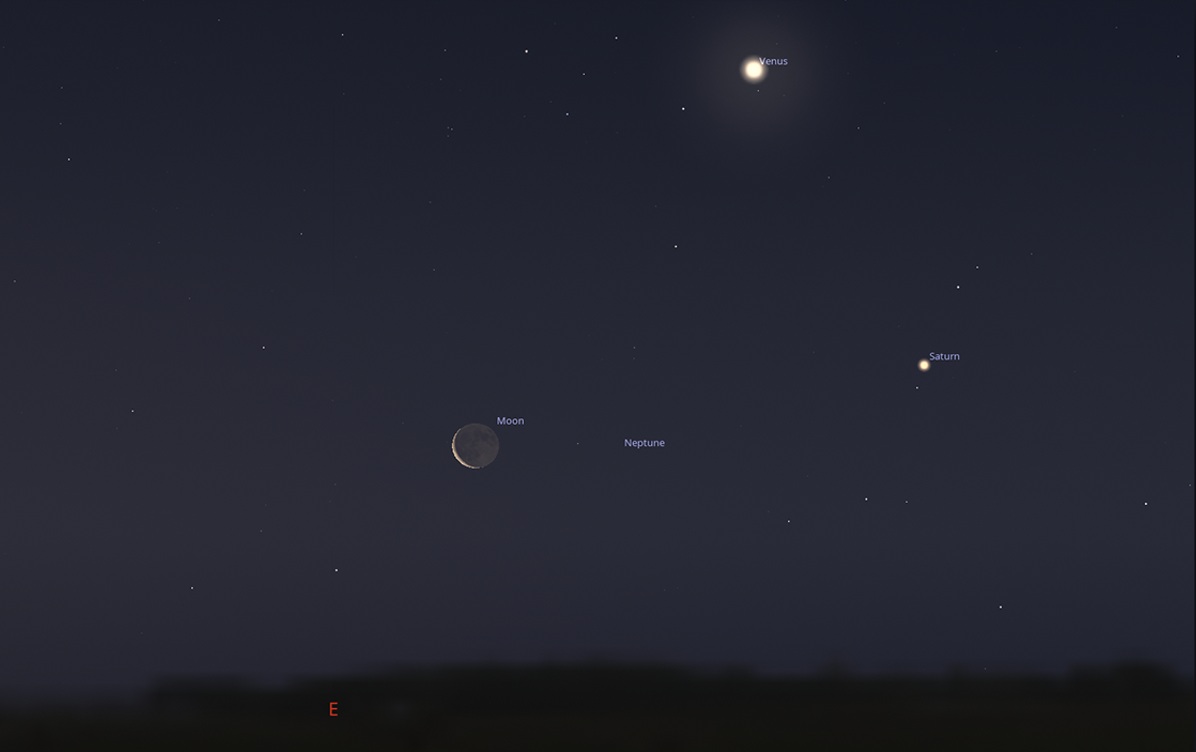
I got up early this morning and went outside to look for the crescent moon, Venus, and Saturn close together in the sky, but didn’t see anything.
They might have been too low on the horizon for me to see here from my house.
This is an image generated by Stellarium’s planetarium software for April 25, 2025, at 5:30 a.m. CDT, of the conjunction of the crescent moon, Venus and Saturn. These three together, form what has been billed as a cosmic “smiley face.” It takes a little imagination to see the smiley face, but OK— we’ll go with it. I believe the red E at the bottom of the image stands for Earth. [Brenda Culbertson via Stellarium]
While inspecting K2-18b, Dr. Madhusudhan and his colleagues discovered it had many of the molecules they had predicted a Hycean planet would possess. In 2023, they reported they had also detected faint hints of another molecule, and one of huge potential importance: dimethyl sulfide (CH₃)₂S, which is made of sulfur, carbon, and hydrogen.
On Earth, the only known source of dimethyl sulfide is life. In the ocean, for instance, certain forms of algae produce the compound, which wafts into the air and adds to the sea’s distinctive odor. Long before the Webb telescope was launched, astrobiologists had wondered whether dimethyl sulfide might serve as a sign of life on other planets.
–Carl Zimmer writing for the New York Times
Headlines and artist’s conception from the New York Times. Red dwarf stars are the most common type of star in the universe and are characterized by being the smallest and coolest main-sequence stars. They are significantly smaller and cooler than our Sun, typically ranging in mass from 0.1 to 0.6 solar masses and having surface temperatures between 2,000 and 3,500 Kelvin. Due to their low mass and temperature, they burn their fuel very slowly and have exceptionally long lifespans, potentially lasting trillions of years. – Google Search Labs | AI Overview A hycean is a warm ocean of water, wrapped in atmospheres containing hydrogen, methane and other carbon compounds. An exoplanet is any planet outside (beyond) Earth’s solar system.
After the 7.7-magnitude earthquake on Friday, the internet was filled with videos, images and social media posts documenting the damage in Thailand.
But across the border in Myanmar, where the devastating quake was centered, there has been a far murkier picture about the scale of the diaster.
Information from Myanmar has been harder to come by in part because of the country’s history of internet censorship. In recent years, the military has repeatedly shut off the internet and cut access to social media, digitally isolating the country from the rest of the world.
– Adam Satariano and Paul Mozur reporting for the New York Times
Central Myanmar, the scene of a powerful earthquake on Friday, lies near the eastern end of one of the world’s most active zones of seismic activity: the Alpide Belt, which extends from the Mediterranean Sea eastward through Turkey, Iran and Afghanistan, then along the Himalayas to Myanmar and finally Indonesia.
The epicenter of the quake on Friday was near Mandalay, Myanmar’s second-largest city with more than a million people. While much of Myanmar is susceptible to earthquakes, Mandalay and the surrounding towns sit right on top of one of four places in the country that are particularly prone to unusually powerful quakes, according to the United Nations Human Settlements Program. The other three places are in much less populated parts of the country.
– Keith Bradsher reporting for the New York Times
Lots of circles for Pi Day in this picture, right? The blood moon from the total lunar eclipse appears to perch on top of the Space Needle on Thursday night in Seattle. [Picture by Nick Wagner / The Seattle Times]
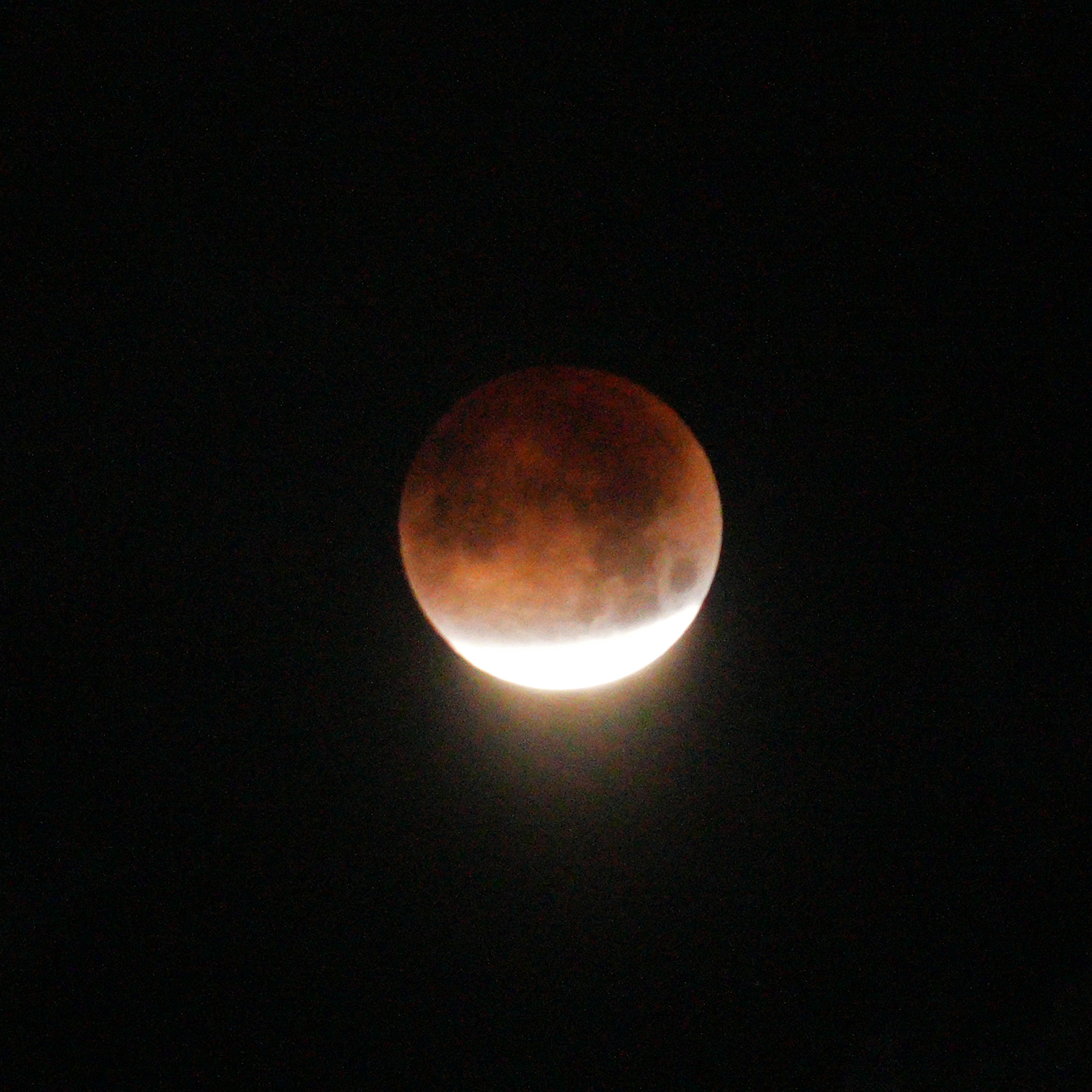
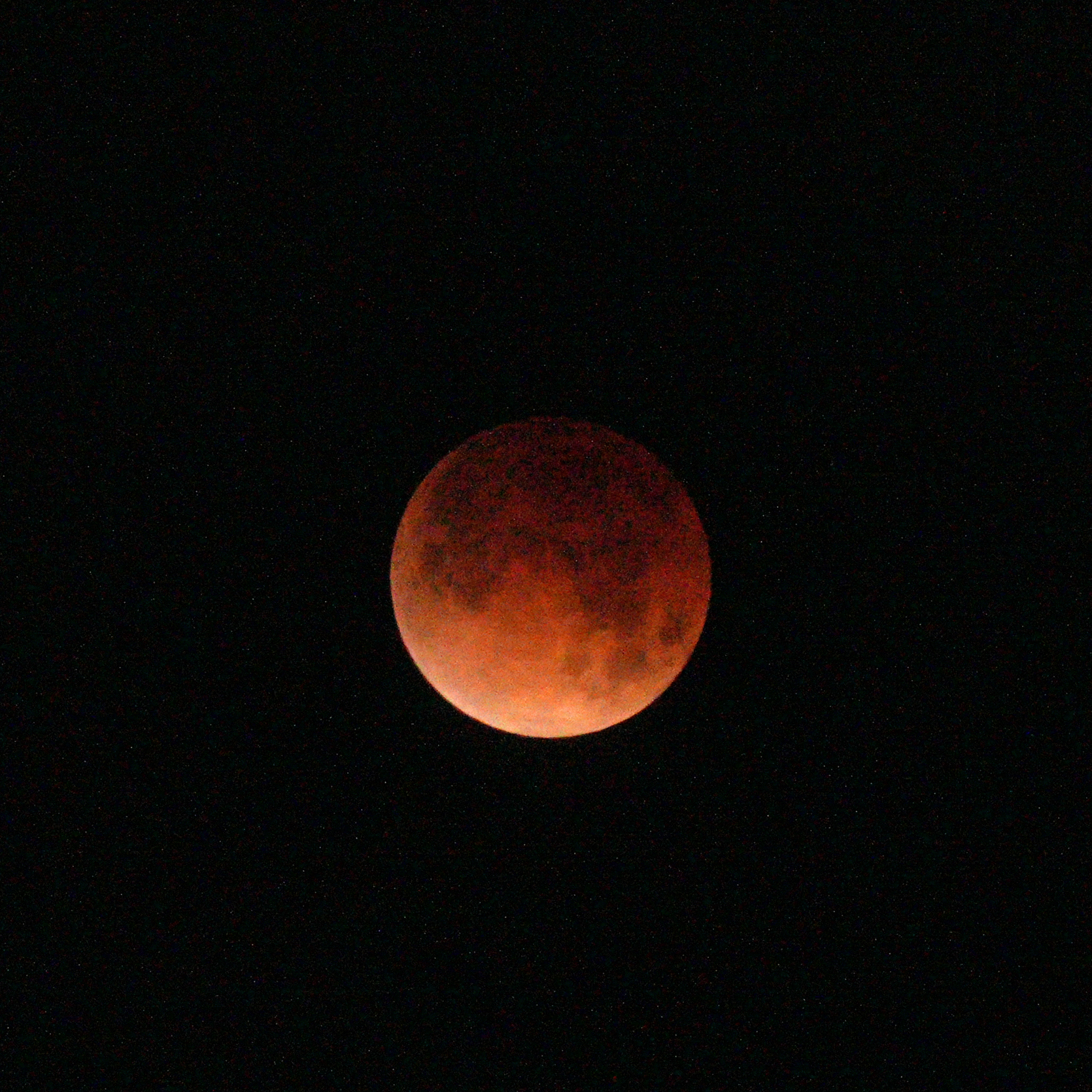
Here are my (totally amateur) pictures of tonight’s total lunar eclipse*.
I used my Canon EOD 7D Mk II digital camera and EF-S 18-135mm lens with image stabilizer.
I just cropped the full size of the pictures from 5472×3648 pixels down to 2000×1500 pixels but otherwise the photos are as recorded by the camera.
*A total lunar eclipse occurs when the sun, Earth and moon align in space with Earth in the middle, leading it to cast a shadow on the moon. During that time, the moon appears to turn a reddish hue, which is why the event is sometimes referred to as a “blood moon.” – nbcnews.com
We set all of our clocks forward by and hour, and now we’re on Daylight Saving Time again here in the United States.
I have to say: the older I get, the more annoyed I get at these ruptures in time, twice a year.
Also: I should really stop clambering up my kitchen counter top to mess with the battery-operated wall clock that is mounted way up there, almost by the ceiling. That is not worth it.
Permanent Standard Time (NOT Daylight Time) is what scientists and sleep experts recommend. I asked ChatGPT why we are still changing the time twice a year here in the US.