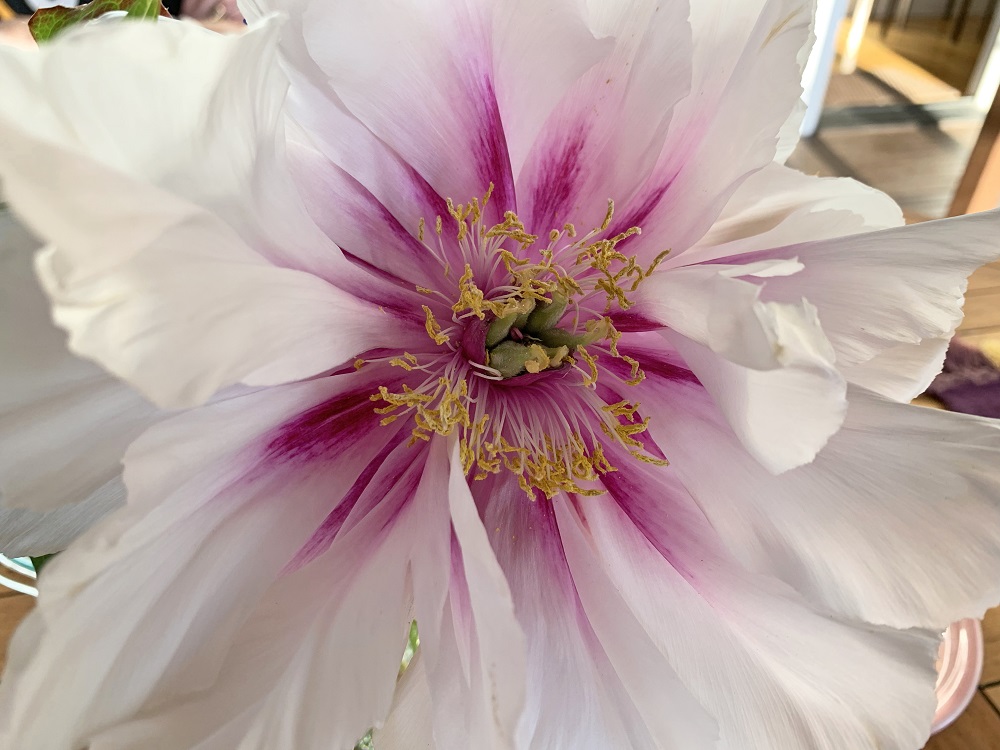
Sunday/ flowers of the heath

heath
/hēTH/
noun
BRITISH
an area of open uncultivated land, especially in Britain, with characteristic vegetation of heather, gorse, and coarse grasses.


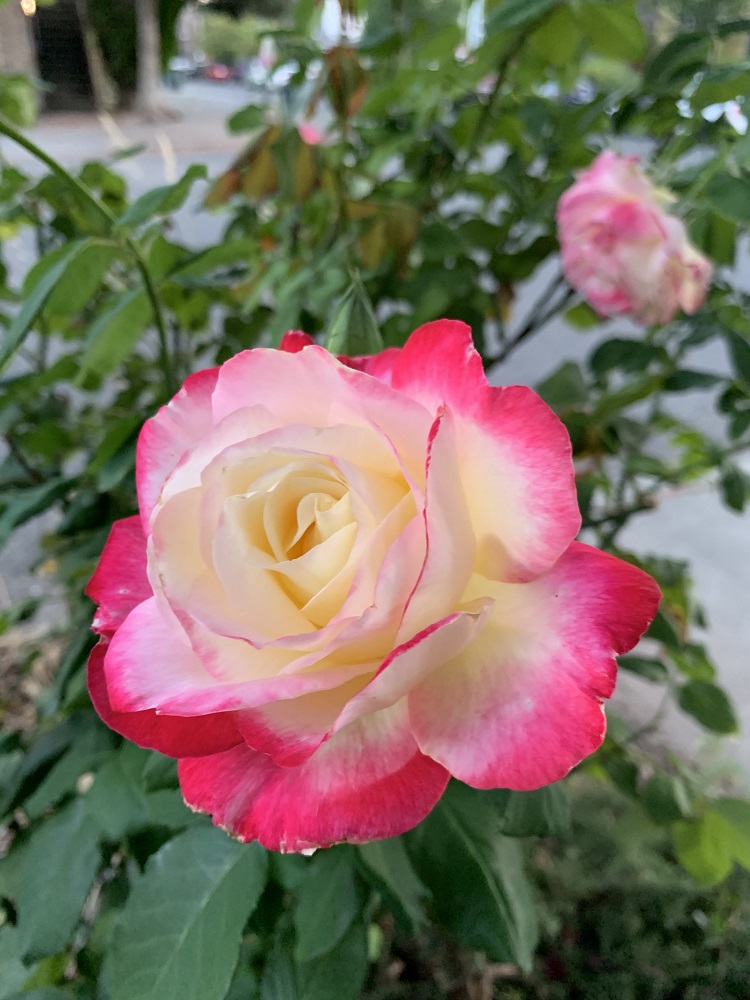
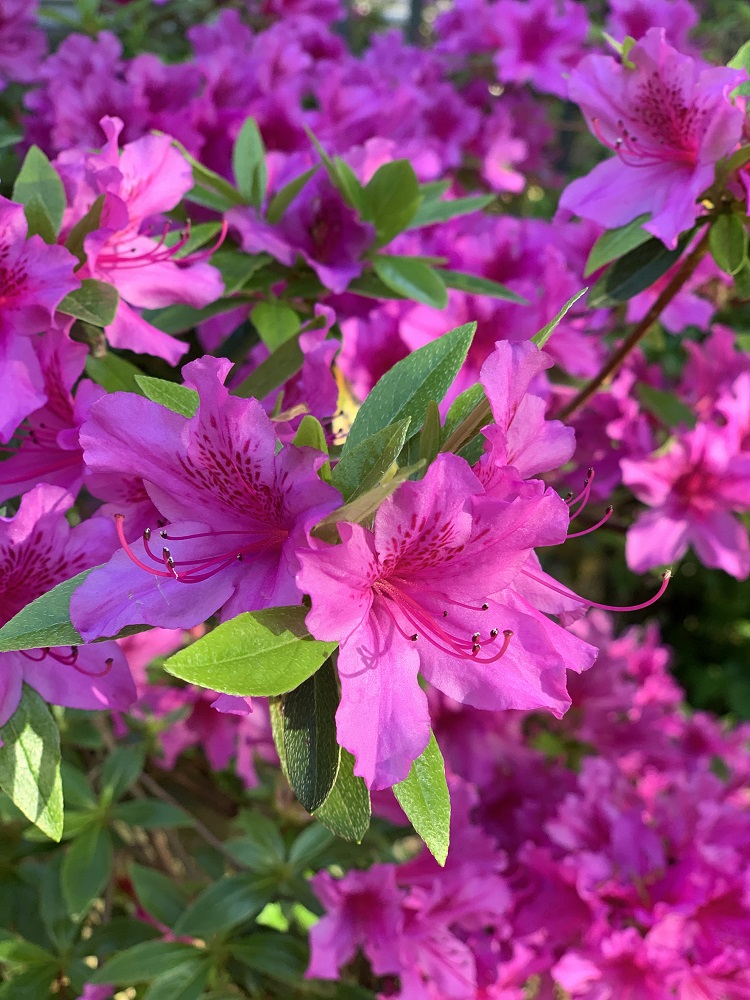
It’s the month of May, so the rhododendron flowers are blooming here on Capitol Hill. These plants belong to Ericaceae, a family of flowering plants, commonly known as the heath or heather family.
Sunday/ more rain

There was more rain today, bringing the April total to 0.95 in (24 mm). This is still far below the average for April (2.71 in / 69 mm).

I played a little tennis indoors this morning, mask on. My friend from tennis volunteers at the big vaccination clinic at the Lumen Field football stadium here in the city. He says they give 8,000 people a jab in the arm there every day, but could take it up to 22,000 if they could get more doses of vaccine.

My Japanese maple (Acer palmatum) has sprouted its new leaves for the season. The red leaves contain anthocyanin that gives them their characteristic color. The leaves do contain chlorophyll (green) for photosynthesis, but the anthocyanin levels are much greater.

Saturday/ the snail mail is here

There was light rain outside and cold weather, all day long (49 °F/ 9 °C).
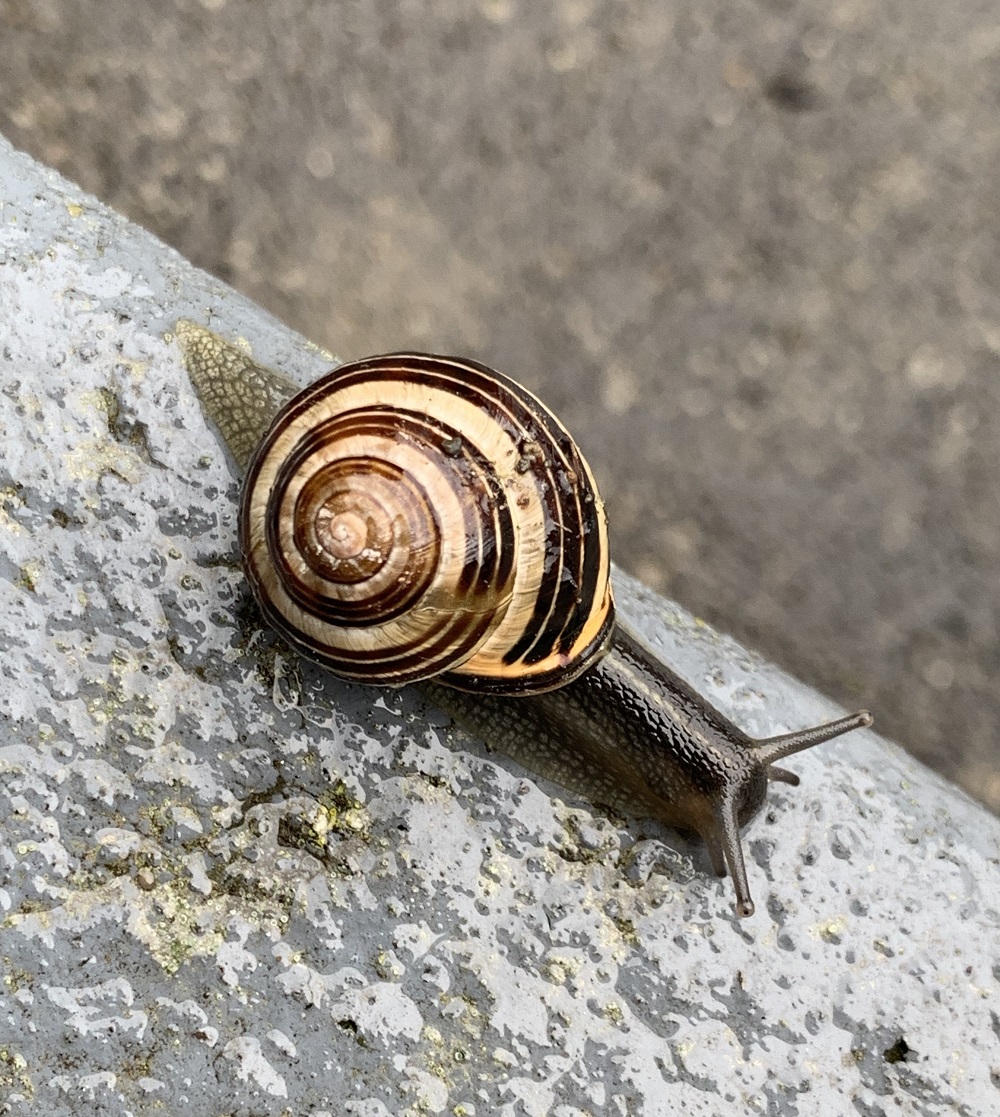
Mister Snail on my porch step, had evidently escaped the boot of the mailman. I put him back in the soil.
I believe it’s a brown-lipped snail (Cepaea nemoralis). It is one of the most common species of land snail in Europe, and has been introduced to North America. The ‘brown lip’ refers to the lip of the shell opening. There is considerable variety in the color shades and striping of the shells, determined by the dominant and recessive genes in the snail’s DNA.

I hesitate to say ‘Happy Earth Day’.
Of course we should celebrate Earth, but earthlings— our governments and corporations, that is— have to enact and execute aggressive policies to reduce green house gas emissions, and plastics production.

At least the Biden-Harris Administration is a force for good.
President Biden recently announced a new US goal to cut greenhouse gas emissions to 52 percent of 2005 levels, by the year 2035. In a virtual summit with more than three dozen countries, he urged other nations to do the same.
Every little bit will help.

Wednesday/ July weather, in April

From the National Weather Service Seattle @NWSSeattle on Twitter:
Average high temp. in Seattle, April 15-21, 2021: 75.7 °F (24.3 °C)
Normal average high temp in Seattle, July 11-17: 75.7 °F (24.3 °C)

Our little Indian summer has come to a close today (temperatures will drop back to the 60s tomorrow), which is a good thing.
It’s way too early on the calendar to have mid-70s highs.
Firefighters from the Washington State Dept. of Natural Resources have responded to 91 wildfires this last week.
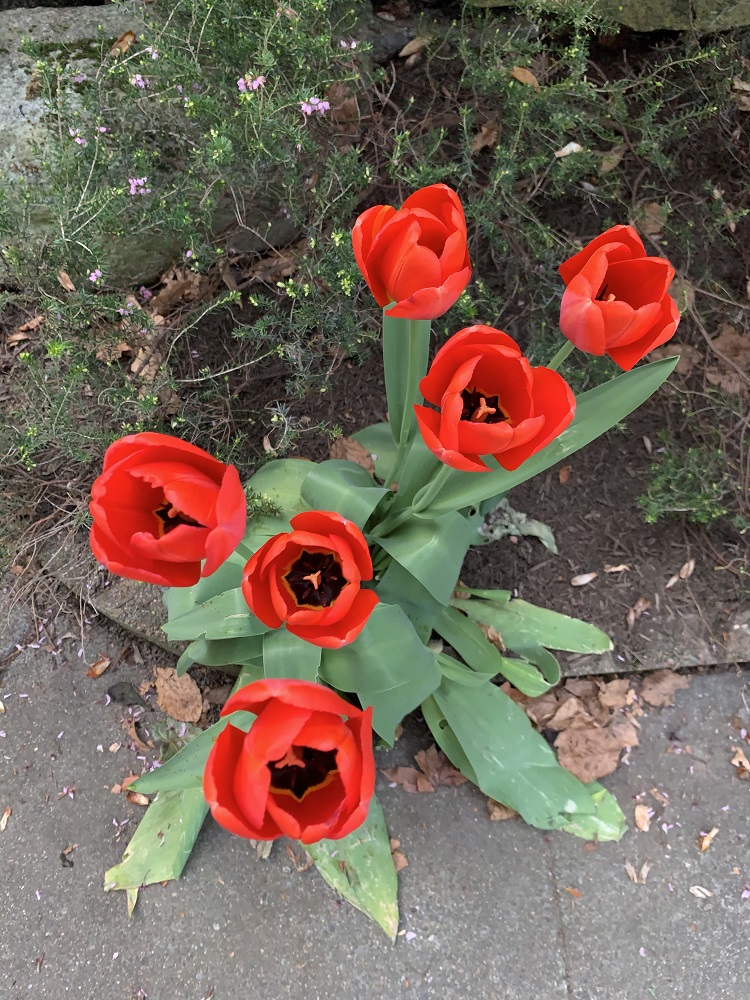
These red tulips seem to like the warm weather. Red tulips are given when love or romance is involved, much like red roses are. I found them on 17th Ave. here on Capitol Hill.

Friday/ the jays, dropping by

Here’s Mr & Mrs Jay*, dropping by for a bit on my front lawn.
It looks like one of them indulged in a little sunning (bottom picture below, lying on the ground, wings spread out, to catch more of the warming rays of the sun).  It was morning and still not very warm, when I took the picture.

Meanwhile, the Washington Department of Fish and Wildlife has announced that backyard bird feeders can be put back up (the number of reports of sick or dead birds across Washington due to the outbreak of salmonellosis, has dropped).

*Steller’s jay (Cyanocitta stelleri); Cyanocitta from the Greek words kuanos (‘dark blue’) and kitta (‘jay’).

Sunday/ a sunny week ahead

My Sunday afternoon started off with a nice game of doubles tennis, but on the way back I was involved a car accident (no injuries, thankfully), that resulted in major damage to my car. Ouch. It might be time to replace my 14-year old Camry, anyway.

The weather people are promising us sun all week, 65 °F (18 °C) by Wednesday, and 75 °F (24 °C) by Saturday.

White Hyacinth flowers (genus Hyacinthus) from my quick walk around the block tonight. These used to come in only pale blue or violet, but nowadays there are lilacs, pinks, white, cobalt blue, cream, apricot and even a blood red.
The name “hyacinth” can be traced back to remote antiquity. The flowers were mentioned by Homer, the great epic poet of Greece, in the Iliad. They are named after Hyacinth, the beautiful youth in Greek mythology. He was the mortal lover of Apollo, Greek god of the sun.

Saturday

It’s Saturday/ Caturday. I like cats, especially the big wild ones.
(The term ‘Caturday’ started with the tradition of posting LOLcats to the message board 4chan on Saturdays).

A cougar with a tracking collar walks through Griffith Park, Los Angeles. Illustrating the problem of animals’ loss of habitat as cities expand, the photo sparked a movement to protect southern California’s last cougars and other wildlife in two large protected areas bisected by the Highway 101 north of LA. Set to be completed by 2022, it will be the world’s largest wildlife overpass. [Picture by Steve Winter/ Prints for Nature]
An artist’s rendering provided by the Resource Conservation District of the Santa Monica Mountains shows a planned wildlife crossing over U.S. Highway 101 in Agoura Hills, Calif. Hoping to fend off the extinction of mountain lions and other species that require room to roam, transportation officials and conservationists will build a mostly privately funded wildlife crossing over the freeway. [Clark Stevens, Architect/Raymond Garcia, Illustration/RCD of the Santa Monica Mountains via AP]

Wednesday/ a temperature shock

Lljubeljana, Slovenia, had its hottest March day (+25.3 °C/ 77.5 °F) on record, and now its coldest April night on record (-20.6 °C/ -5 °F).

There is going to be harsh frost damage to crops. Plants and insects (also fauna that thrive on both) would be hit incredibly hard, notes Scottish meteorologist Scott Duncan on Twitter.

This flaming orange tulip is from yesterday, when it was sunny.
It was ‘cold’ again today, 46 °F (8 °C), some 10 °F (5.5 °C) under the mean temperature for this time of year.

Sunday/ building a nest

Here’s a busy Mr Robin (or would that be Mrs Robin?), pausing for a moment on my garage roof this morning. There must be a nest under construction, nearby.

American robins (Turdus migratorius) are among the first birds in North America to begin laying eggs each spring. They normally have two or three sets of young (broods) in each breeding season.

Thursday/ magnolia blossoms

It was a treacherous day to scroll through Twitter, with all the April Fool’s Day tweets. Google introduced a ‘self-driving’ bicycle, King County Metro was launching an ‘Infinity Bus*’, the Tracks Suit from Sound Transit, and Prince Charles would soon announce that he would ‘pass’ on becoming King (deferring to Prince William instead).
*It offers arrivals and departures at all times, 24/7/365.

Alright .. enough of this, and time to go for a walk, I thought.

These white blossoms are from a Magnolia stellata, a Japanese species of magnolia. I found it by the entrance of the Thomas Street Gardens here on Capitol Hill.

Monday/ spring cleaning on SR20 to start

The spring cleaning of the snow on State Route 20 in the North Cascades will start next week. So it’s still going to be a number of weeks before SR20 can be opened to the public.

Tweet from WSDOT East: ‘The great SR 20/North Cascades spring clearing begins April 5! Our crew will clear the highway of snow, then make any necessary repairs prior to reopening, which usually takes 4 to 6 weeks’. (My note: there is some 8 feet of snow on the road surface here!). 
[Picture from WSDOT East @WSDOT_East on Twitter]
Top: I found the GPS coordinates of the snowy picture at the summit of Washington pass, elev. 5, 477 ft. Then I looked up the summer version of the scene on Google Streetview.
Bottom: The yellow pin on the Google Earth picture marks the spot. Driving north, one would have just left a hairpin bend on State Route 20. The town of Winthrop WA would be about 30 miles back on SR20, to the southeast.

Saturday/ spring blossoms

It was a lovely day (56 °F/ 13 °C), and I chased myself out of the house this afternoon, to go look at the tree blossoms & spring flowers outside.
Tomorrow will be stormy and rainy.

Top to bottom: cherry tree blossoms, wild primrose, asters, magnolia tree blossoms.  I hope I have it right! I’m not a flower expert.

Tuesday/ tea flowers, pink & white

The camellias* are starting to bloom here in the city. The pink one is mine, and the white one from a street nearby.

*Camellias are famous throughout East Asia; they are known as cháhuā (‘tea flower’) in Chinese, tsubaki in Japanese, dongbaek-kkot in Korean, and as hoa trà or hoa chè in Vietnamese. [From Wikipedia]
The tea plant with its little tea leaves, is in fact, a camellia: Camellia sinensis.

Monday/ the many meanings of corona

co·ro·na
/kəˈrōnə/

From the Latin word corona, mid-16th century, meaning ‘wreath, crown’.
Architecture: a circular chandelier in a church, or a part of a cornice having a broad vertical face.
Astronomy: the rarefied gaseous envelope of the sun and other stars.
Biology: the cup-shaped or trumpet-shaped outgrowth at the center of a daffodil or narcissus flower.
Medical: coronavirus is any of a family (Coronaviridae) of large single-stranded RNA viruses that have a lipid envelope studded with club-shaped spike proteins.
Physics: the glow around a conductor at high potential.
Smoking: a long, straight-sided cigar.


It was only 45 °F (7 °C) for my late-afternoon stroll around the block today, but hey, now there is an hour more of sunshine.

Daffodils (genus Narcissus) at the corner of 18th Avenue & Republican St. The cup-shaped structure at the center of the flower is called the corona. Yes, the term has come to have decidedly negative connotations, I guess. Maybe it’s best to just shrug it off. We even have apartment buildings in the city called Corona Apartments and Corona Lofts.

Saturday/ saving the daylight

We had sunny afternoons all week and the high touched 60 (15.5 °C) today.

Daylight Saving Time starts tonight in the United States. (‘Saving’ means shifting the day’s hour markers forward, so that the sun ‘rises’ an hour later, and ‘sets’ an hour later).
Pacific Daylight Time = Universal Time Coordinated (UTC) minus 7 hrs.

The bright sunlight (electromagnetic radiation visible to the human eye) propels the vanes of the radiometer on my kitchen counter top.

Saturday/ Paradise visitor center update

Here is this morning’s picture of the Paradise visitor center on the slopes of Mt Rainier.  That’s a lot of snow, that had been cleared from the parking lot!

The center itself is still closed to visitors, so those vehicles must belong to sightseers or merrymakers looking to sled on the low slopes.
The elevation there is 5,400′ (1,646 m), and the Mt Rainier summit is at 14,411′ (4,392 m).

Wednesday/ more animals

I’m still adding animals to my collection.
These came with the poodle that I posted about on Friday.

The giant anteater (Myrmecophaga tridactyla), also known as the ant bear, is an insectivorous mammal native to Central and South America. It belongs to the same order as sloths, actually. [Schleich Anteater, Catalog No 14844, New for 2020]
The llama (Lama glama) is a domesticated South American camelid, widely used as a meat and pack animal by Andean cultures for more than five centuries. [Schleich Llama, Catalog No 13920, New for 2020]
The fennec fox (Vulpes zerda) is a small crepuscular (active primarily during the twilight period) fox, native to the Sahara Desert and the Sinai Peninsula. Its enormous ears serve to dissipate heat. [Schleich Desert Fox, Catalog No 14845, New for 2020]

Friday/ a poodle called Snowflake

One of the latest animal figures I had ordered from Schleich happens to be a poodle. I am naming the white pooch ‘Snowflake’ .. and no,  not because of the recent snow here in Seattle.

Texas Senator Ted Cruz took his family to sunny Cancun in Mexico on Wednesday night (to the Ritz Carlton Hotel, no less), leaving behind millions of his constituents in freezing homes with no electricity and no water.
That was bad enough, and Cruz returned the very next morning after a media firestorm erupted. It got even worse. It turned out that their family poodle, named Snowflake, was left behind in the freezing house.

Here is ‘Snowflake’. (Schleich® Poodle, part of their Farm World collection, Catalog Number 13917, new for 2020).
Snowflake got left behind in Houston in the Cruz’s freezing house. A security guard at the house assured the photographer that he is taking care of Snowflake.
[Photo Credit: Michael Hardy @mkerrhardy on Twitter]