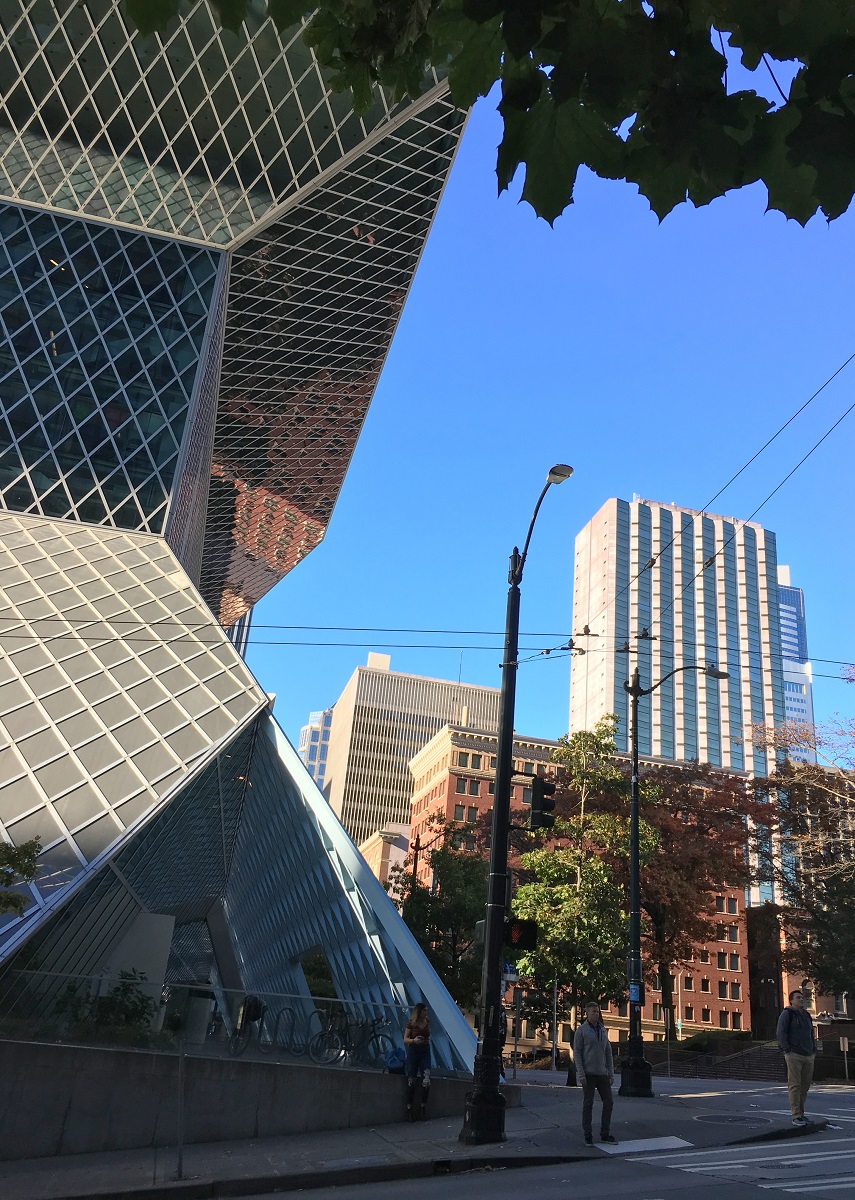
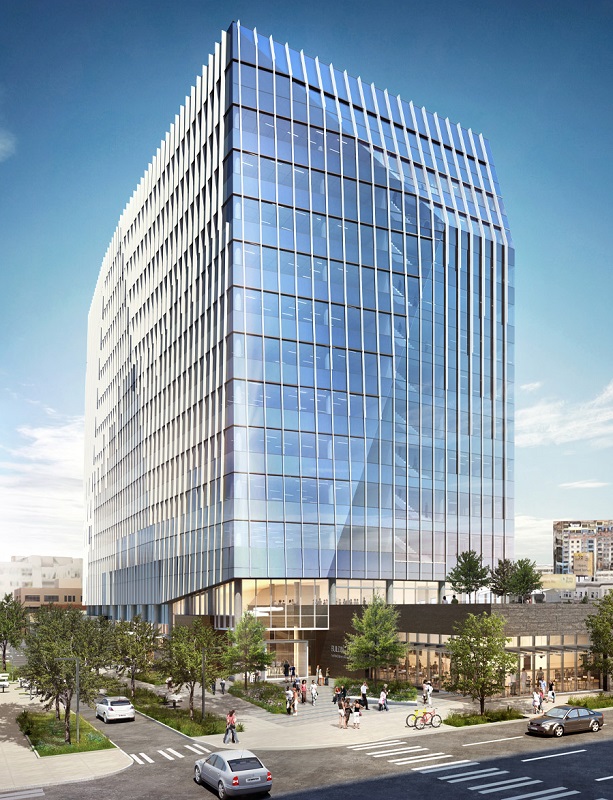
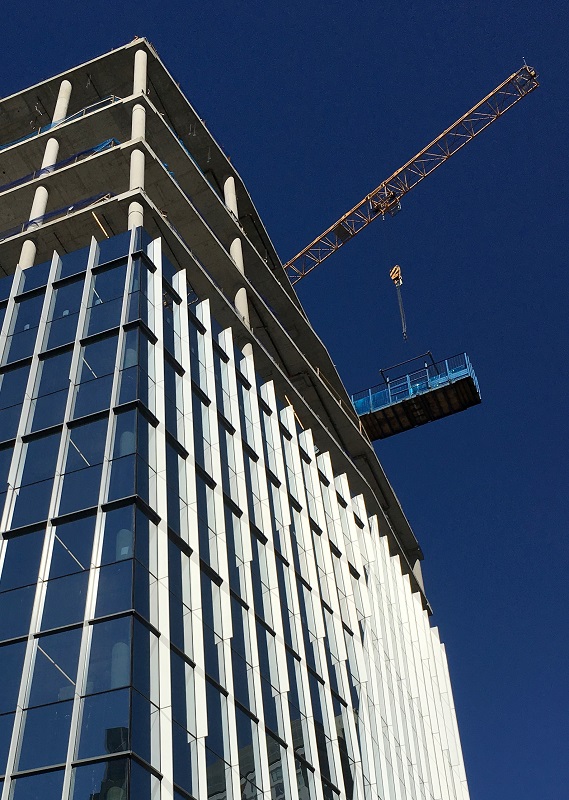
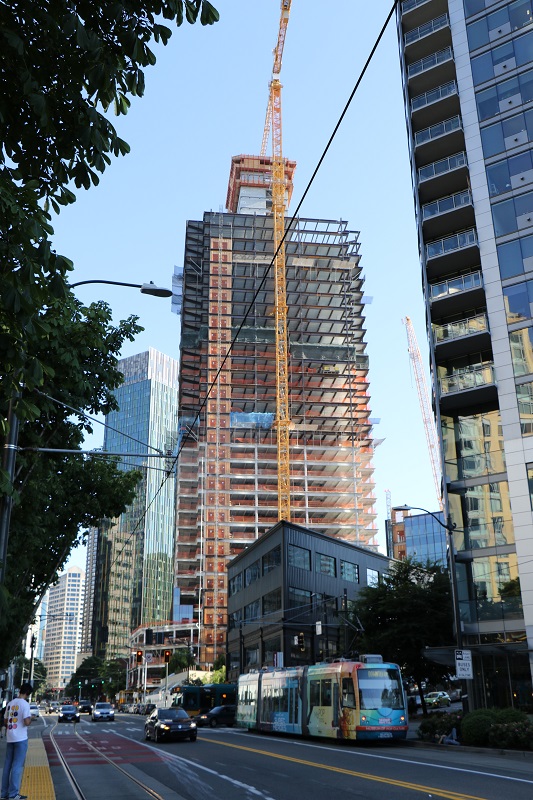
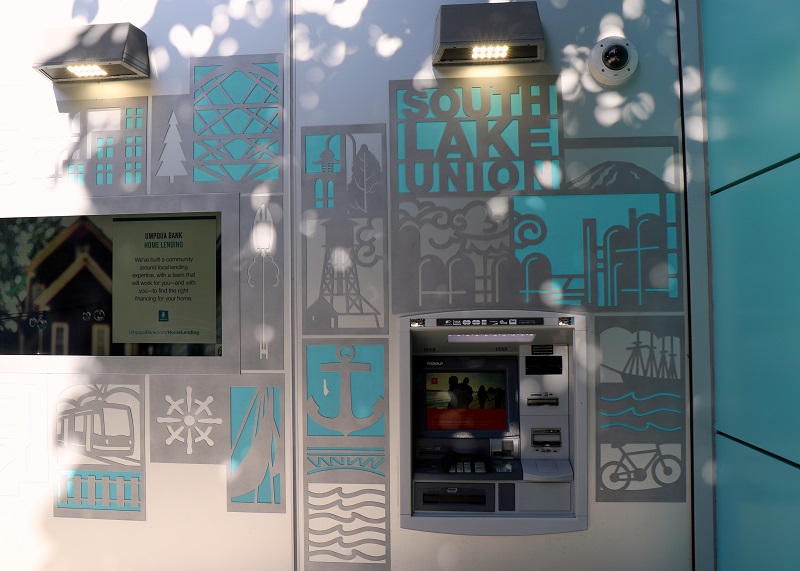
My walkabout today was in South Lake Union, the area next to Seattle’s downtown that is a booming hub for Amazon, Google and the biotech industry. The new Denny Substation and duct banks under the streets (for power distribution) are scheduled for completion in late summer.
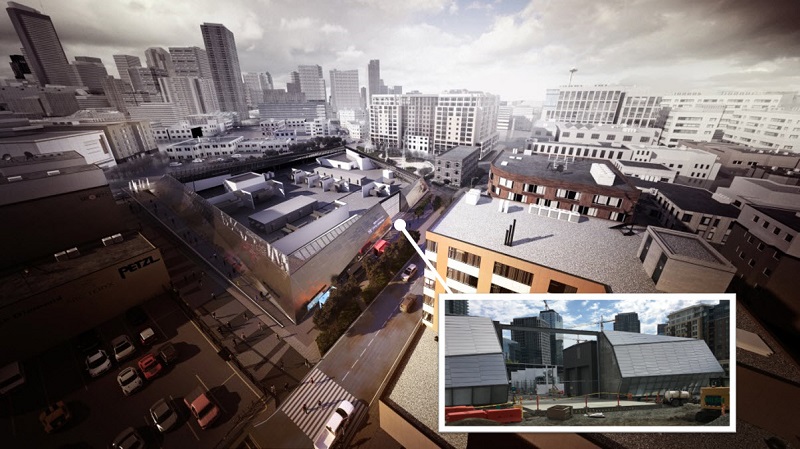
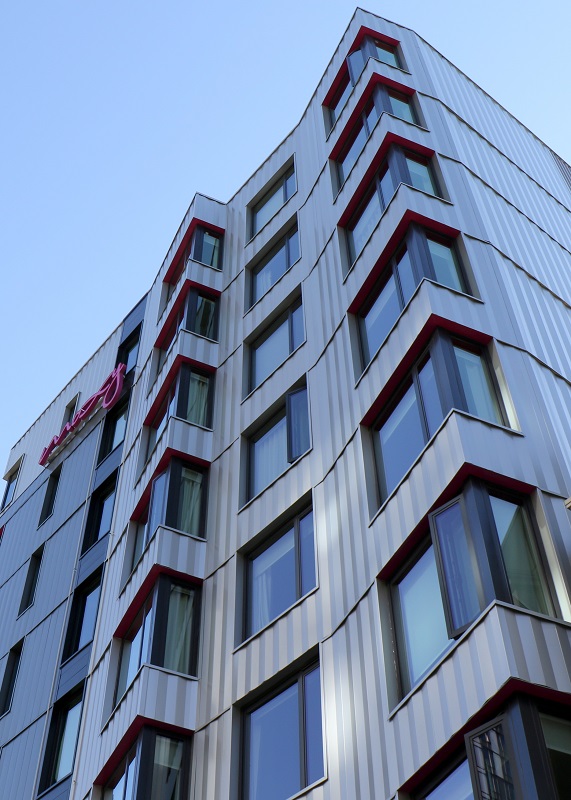
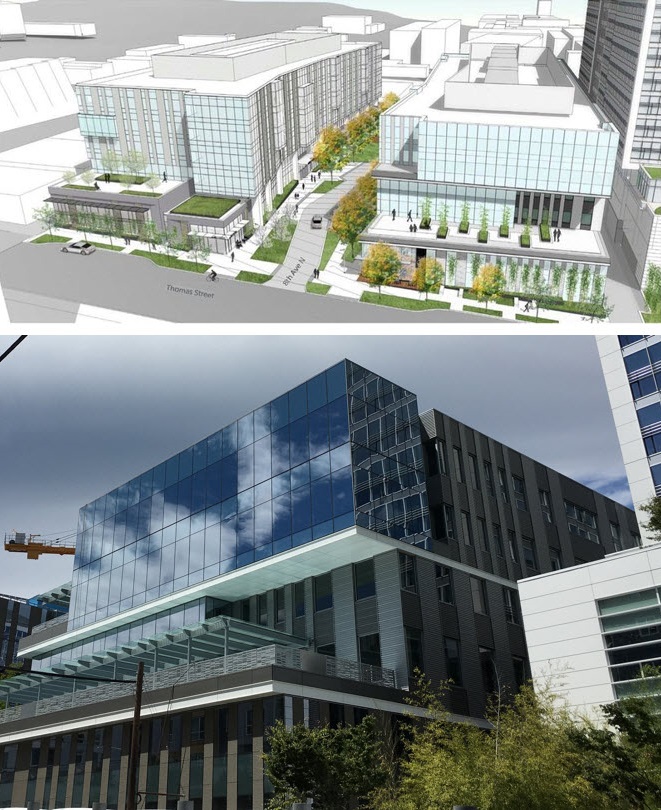
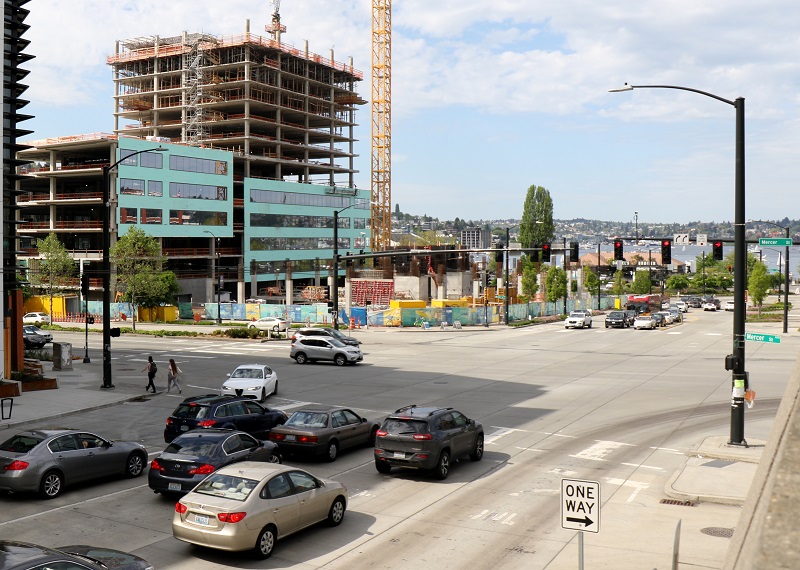
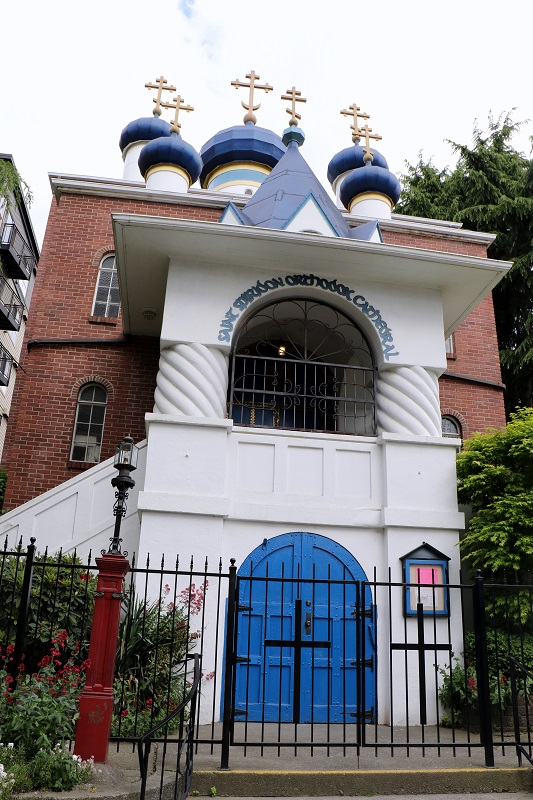
Main picture: An artistic rendition of the completed Denny Substation. (The glass panels and facets on the perimeter will make it look like a museum – or a Frank Gehry creation – from the outside). Inset: I took this picture of main entrance gate at the back, today.The colorful Chroma SLU apartments on Harrison St are brand new. A small one bedroom goes for $1,700 a month, and the two bedrooms for $3,300. Yes, the real estate is expensive, and the developer wants his money back – and then some.Here is one of two new Google office blocks taking shape, on Mercer St. The six floors of seagreen will be the offices, and the additional eight floors on top will be apartments. (Live there and work downstairs at Google? Hmm -no. Definitely too close for comfort/ why not just sleep under your Google desk, then?). That’s Lake Union in the background.The Saint Spiridon church building on Yale Ave is holding its own among all the construction. It was built in 1941 in the traditional Russian Church style, and resembles churches in northern Russia.
It was a brisk 44°F/ 6 °C in the University District this morning at 10 am, where I was this morning. The storm we had on Sunday night was gone. It brought down a little hail at my house, and a thunderbolt so loud, and so close, that it rattled the windows and the glasses up in my kitchen cabinet.
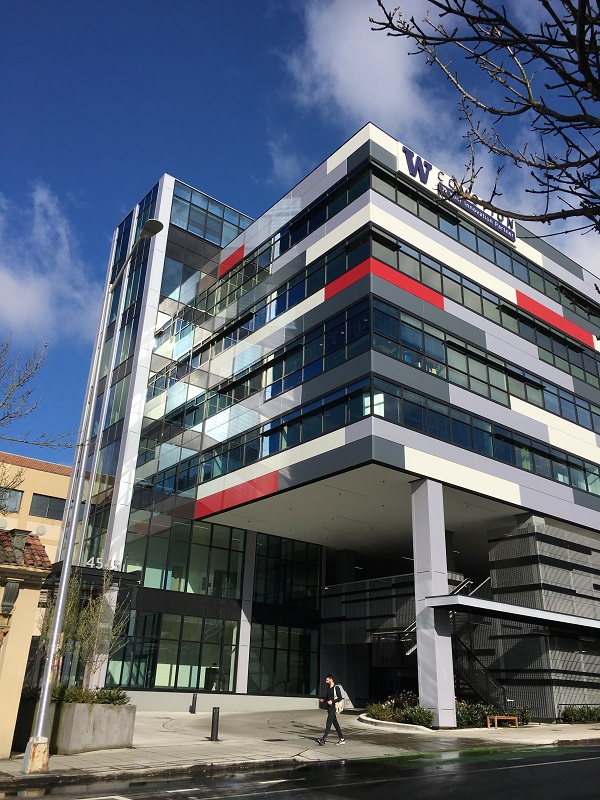
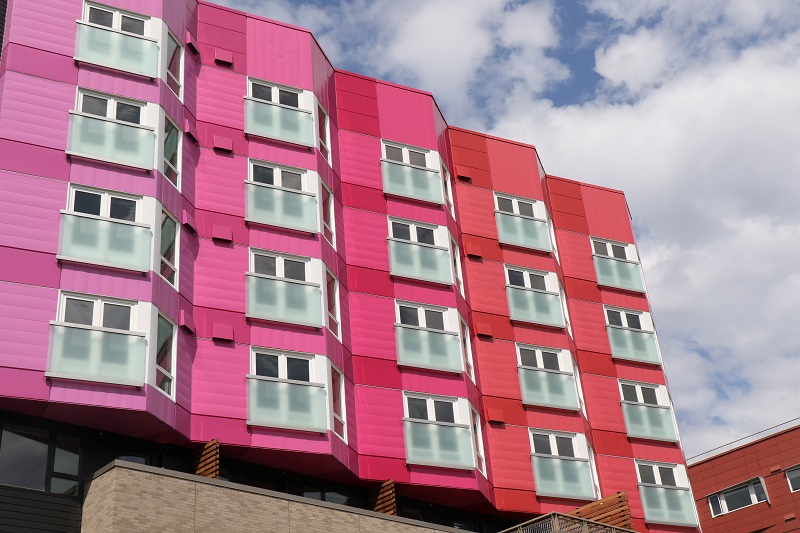
Here’s the colorful facade of the University of Washington’s new 6-storey ‘Comotion’ building at 4545 Roosevelt Way. It is a ‘startup incubation space’, one that enables collaboration with UW’s partners in industry. UW also invites in companies, even if they don’t yet have an explicit connection to the university.
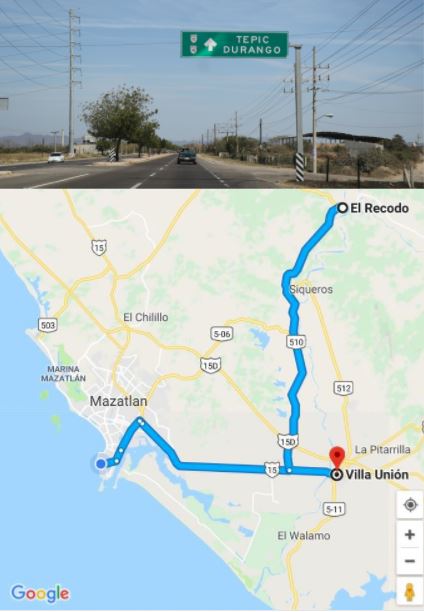
The drive to El Recodo is to the northwest is under two hours. Villa Union is just off Highway 15 on the way back.
On Sunday, we drove out to the town of El Recodo and made a stop at Villa Unión for lunch at a famous seafood restaurant.
We were very lucky to run into a tour guide in El Recodo to show us around. He also phoned ahead to the very popular restaurant in Villa Unión, which allowed us to get in almost right away.
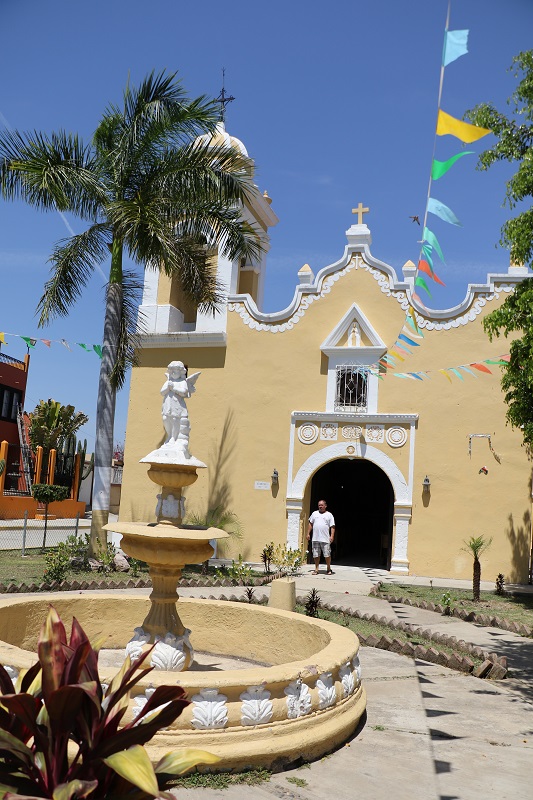
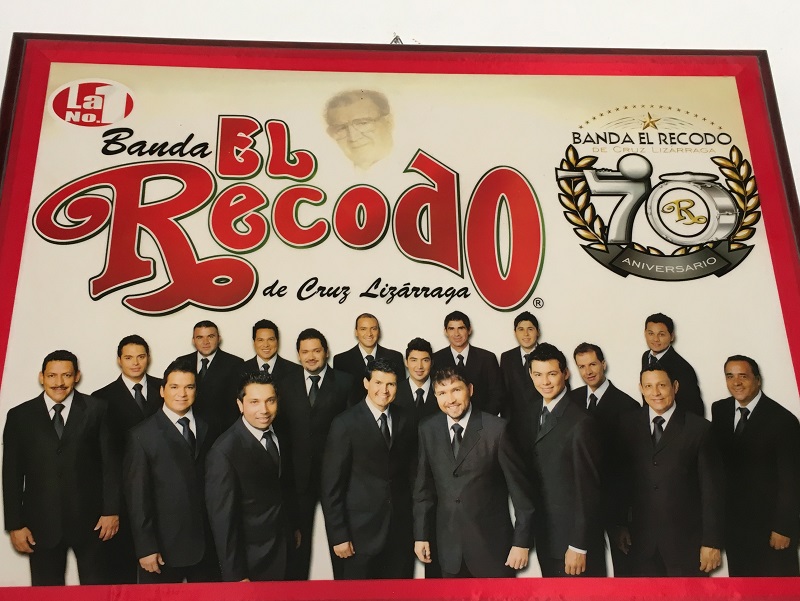
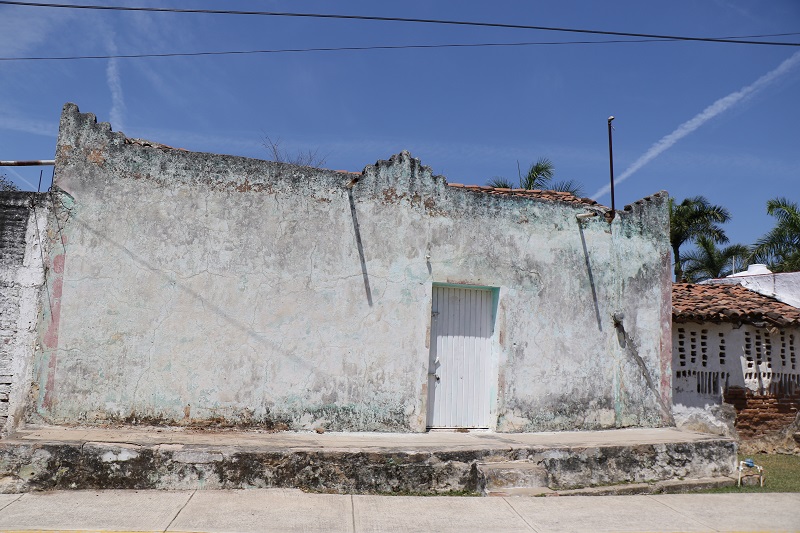
The church off the main street in El Recodo was built in 1855. The bell was made of all kinds of metal that were collected from residents. That’s Samuel, our impromptu tour guide of the church and the town at large. He seems to know everyone there!This is a beautiful Mexican giant cardon or elephant cactus, native to the area.This picture is from inside a little museum dedicated to the famous ‘Banda El Recodo’ band and its founder Cruz Lizarraga (now deceased). It’s the centenary of Cruz’s birthday in 1918.Just an old building with Spanish roof tiles that I liked very much -on a side street in El Recodo.Here’s the Parroquia San Juan Bautista (Parish of San Juan Bautista) in Villa Unión, located on the main town square.
I walked to two beautiful churches here in the city so that I could take a closer look.
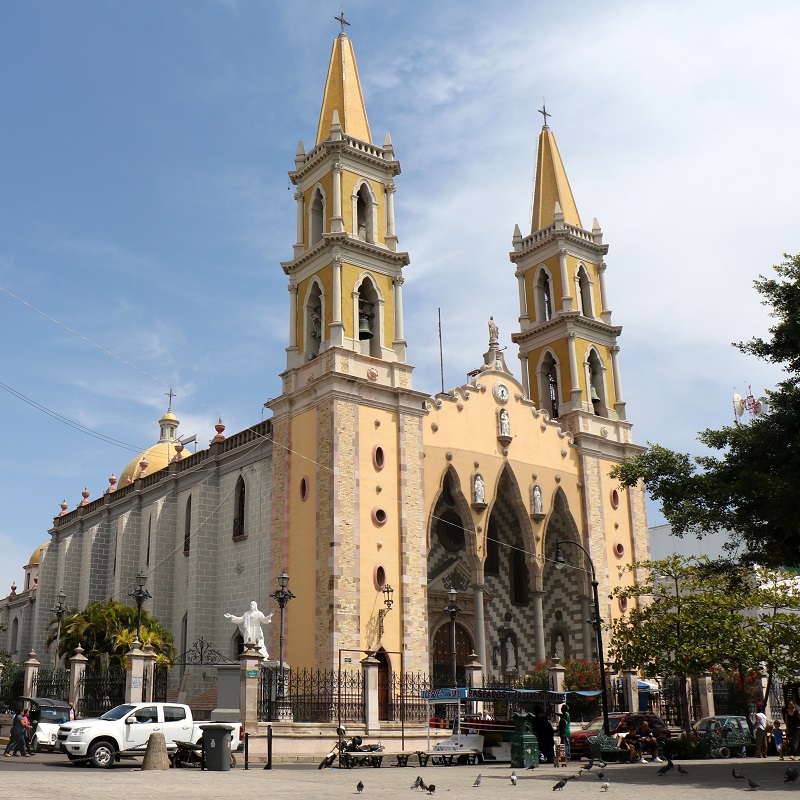
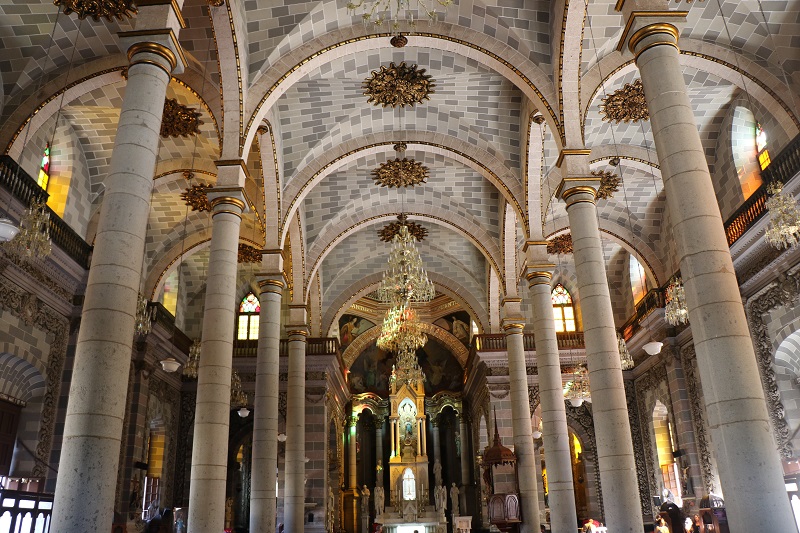
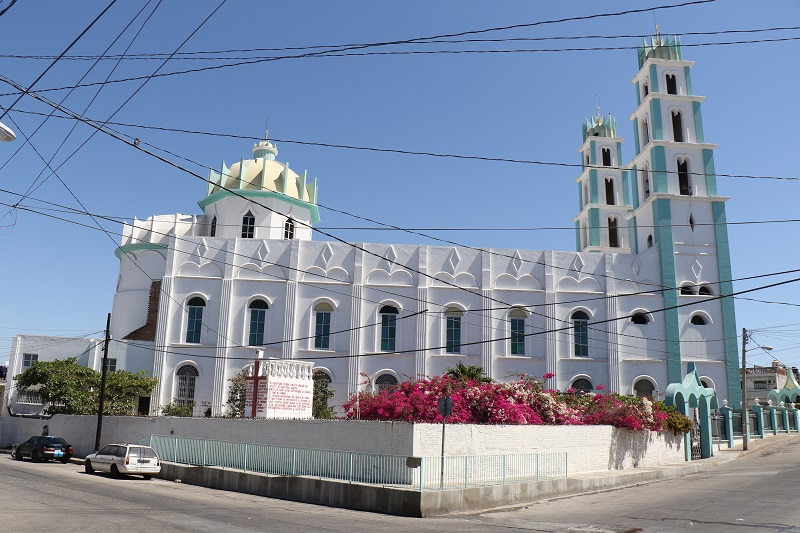
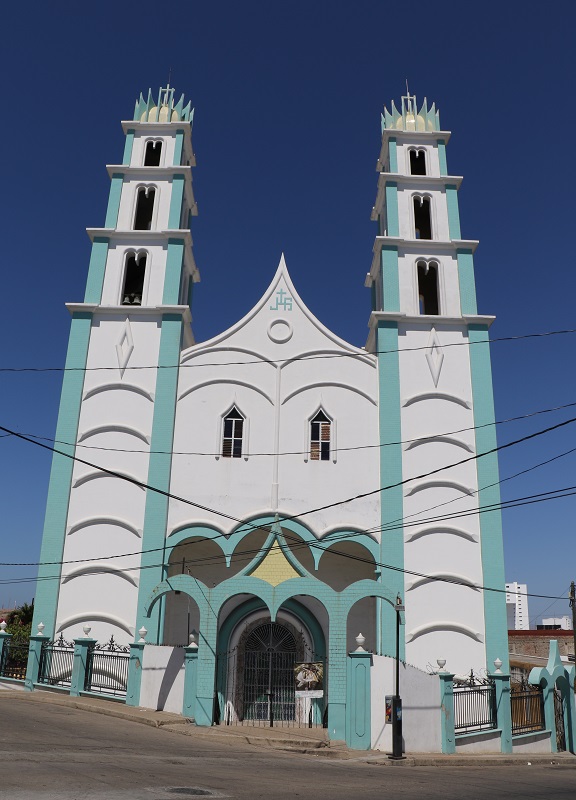
The Cathedral Basilica of the Immaculate Conception is the main religious building in Mazatlan and is located in the historical center. The original building was completed in 1899.This is the inside of the church, looking forward towards the altar.Here is the Parroquia Cristo Rey (Parish of Christ the King). Its style is unusual and I could not immediately find more information about it online.The main entrance to Parroquia Cristo Rey (Parish of Christ the King). Those pesky telephone cables interfere with my picture!
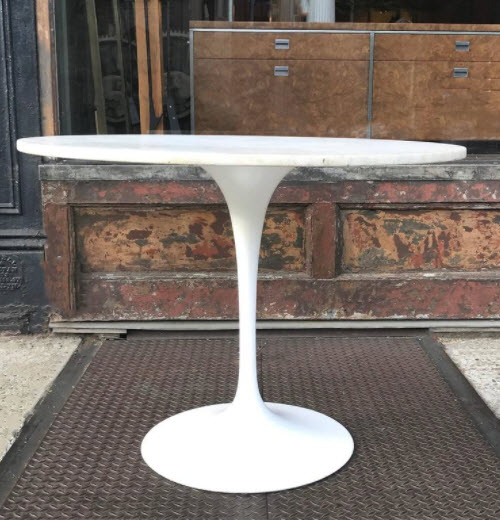
A mid-century modern Eero Saarinen tulip base dining table with white carrara marble top (mid 1960s). Several of these tables, with different tops, are offered on 1stdibs.com. This one will set its new owner back $2,800. [Picture from 1stdibs.com]I read a description today of an ‘Eero Saarinen tulip base dining table with white marble top’ in an article about decorating. Well. Let’s find out what this table looks like, I thought. (Redeem myself a little from the cheap Ikea furniture I still have, by improving my designer furniture knowledge).
Saarinen (1910-1961) was a Finnish American architect and industrial designer, noted for his neo-futuristic style. I also learned that Saarinen was the architect of the Gateway Arch in St Louis.
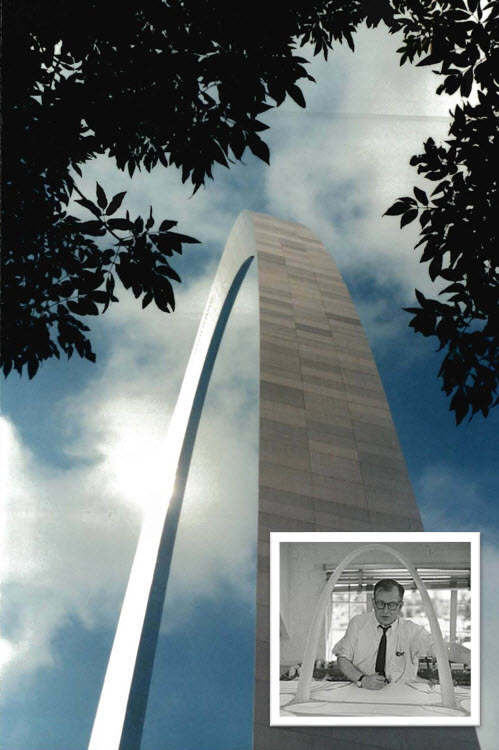
I took this picture of the Arch in St Louis in Oct ’96. (I lived in St Louis from ’95 to ’98). Inset: Saarinen with a model of the Arch in 1957. Construction started in 1963. Sadly, Saarinen never saw the completed Arch. He passed away in 1961, during an operation for a brain tumor.
I saw ‘Black Panther’ (more about it later) in the IMAX theater here in the Pacific Science Center today.
The Pacific Science Center was designed by Minoru Yamasaki for the 1962 World’s Fair in Seattle, and housed the United States Science Pavilion. It is located right by the city’s iconic Space Needle.
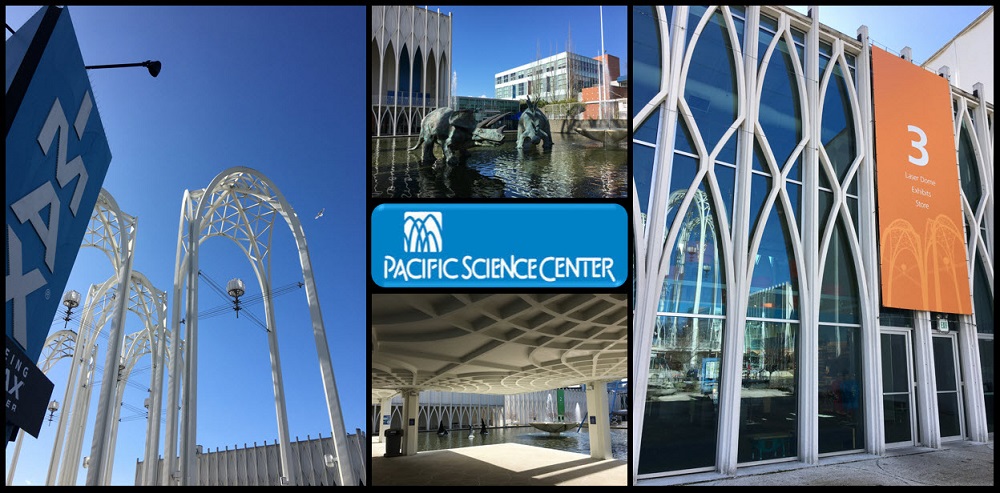
These pictures are from the square inside the Pacific Science Center. The center offers two IMAX theatres: one since 1979, and a bigger one with fancy dual-4K laser projectors, that debuted in 2015. There is still only a handful of these installations in the world.
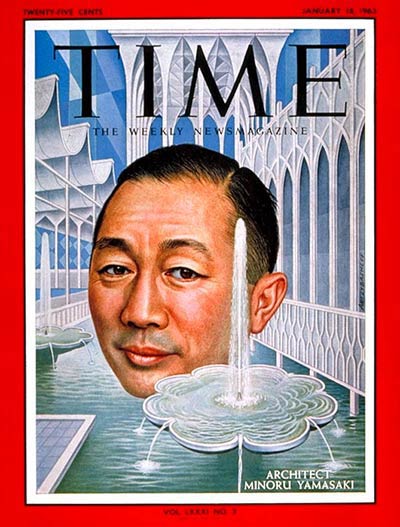
Yamasaki and the Pacific Science Center on the cover of TIME magazine in 1963.
Yamasaki was born in Seattle in 1912, a second-generation immigrant. He graduated from the University of Washington in 1934, and became a very successful architect with his own firm in Seattle.
He was the architect of two prominent buildings in downtown Seattle: the IBM Building (1963) and Rainier Bank Tower (1977). His firm won the contract to design the St. Louis’ Pruitt-Igoe Housing Project in 1953, but the project ended in disaster. It was a big setback for his firm and for his reputation.
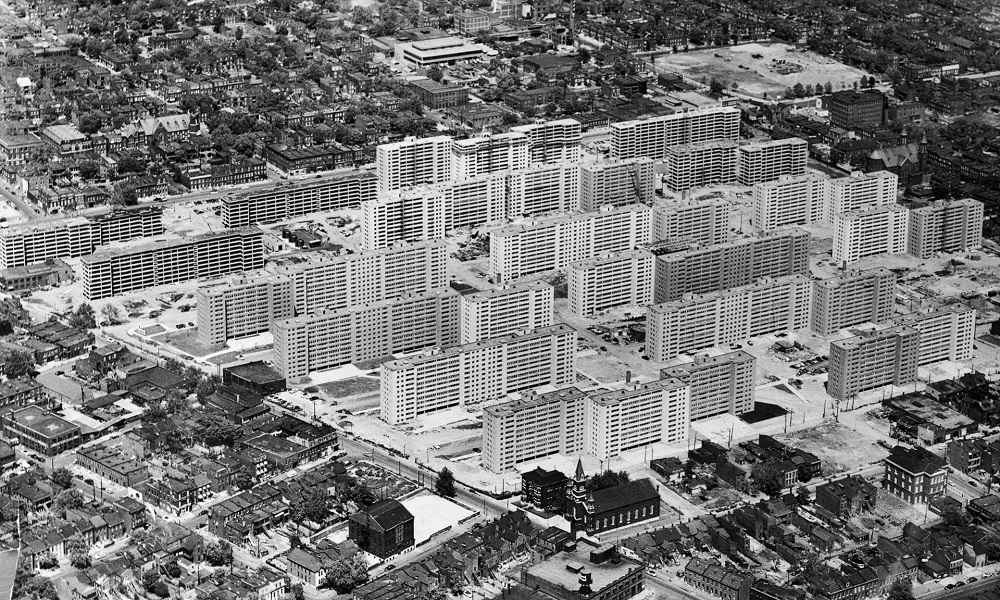
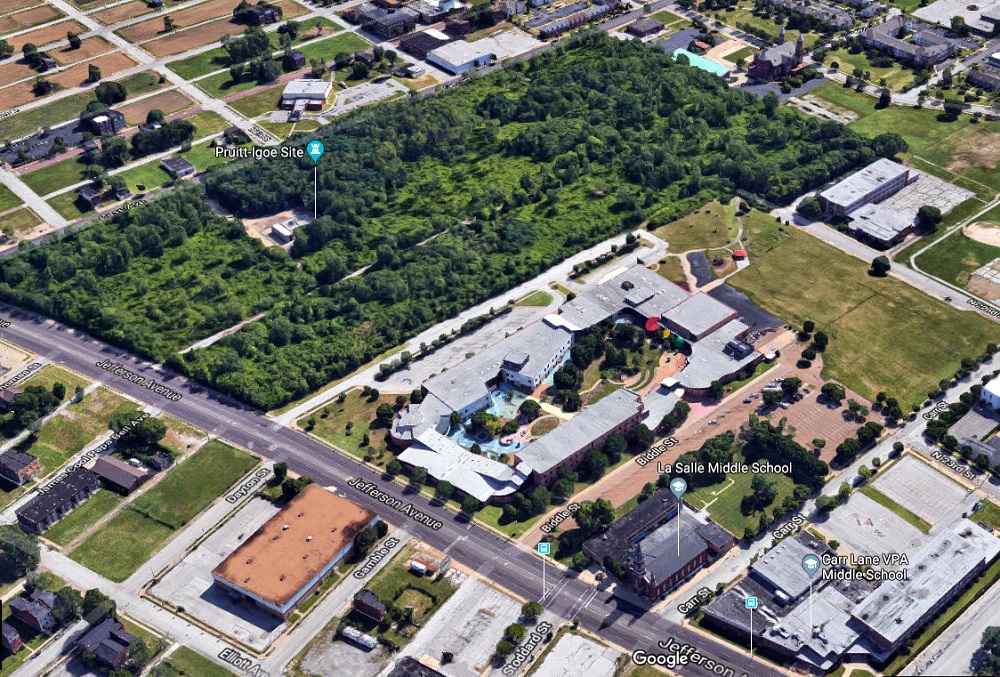
1956: The enormous Pruitt-Igoe public housing complex in St Louis, Missouri, shortly after its completion in 1956. It had 33 eleven-storey towers, a total of 2,870 units. Ultimately, the project was a failure of urban policy (and architecture?) on a grand scale, ending in an infamous, widely televised 1972 implosion of one of Pruitt-Igoe’s buildings. The last one would come down in 1976. [Photograph: Bettmann/ Corbis]2018: Here is a Google Earth view of the same site, today: a woodsy area at the corner of Cass and Jefferson. A private developer called Paul McKee bought the 34 acres in 2016 with a promise to develop it. Just to the north of the green patch, the federal government will build the new Western Headquarters of the National Geospatial-Intelligence Agency. So hopefully, things are looking up for the area after such a long time.
These pictures are from my on Sunday afternoon walk-about to check out the construction projects in downtown and South Lake Union.
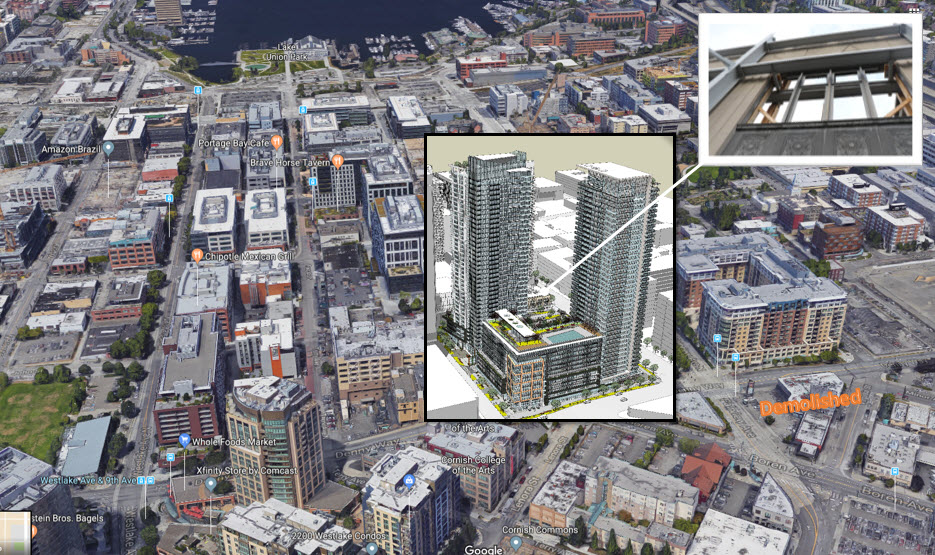
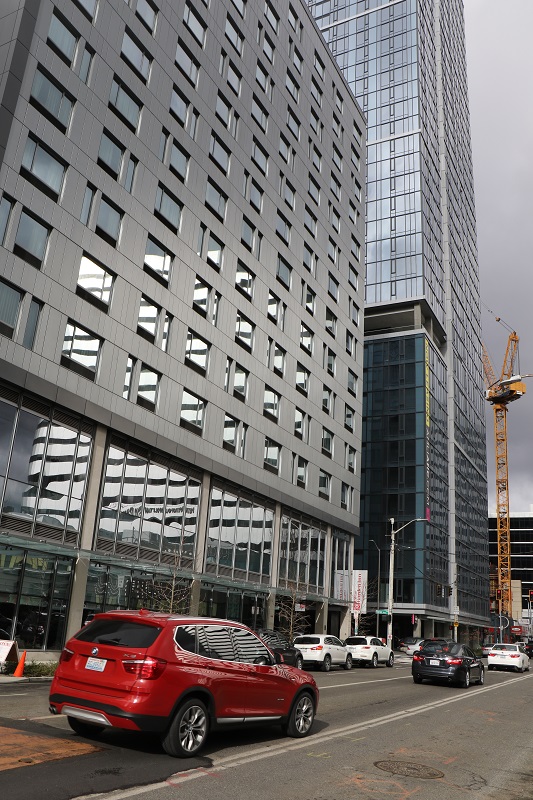
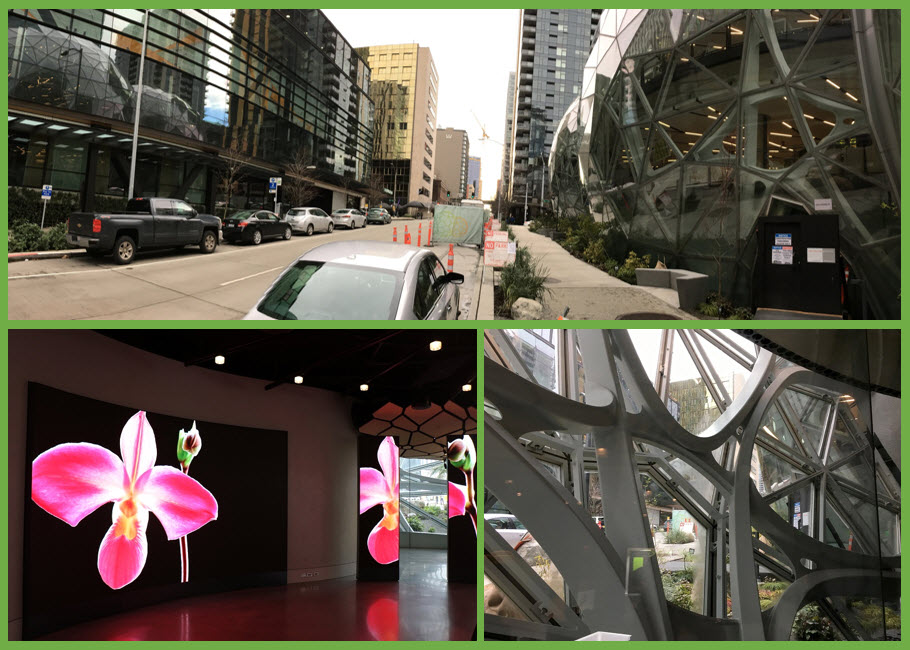
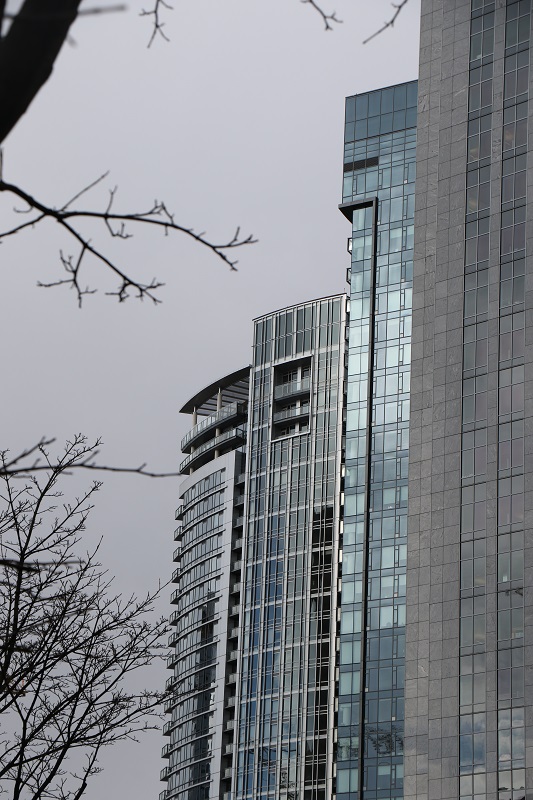
This is 1120 Denny Way: two 41-storey towers containing 1,179 apartments, and 28,000 sq.ft of retail space. It’s still just a hole in the ground, so I pasted a rendering of the buildings onto a Google Maps picture. This is the largest residential construction project in the history of the city, built on two properties that the developer had bought from the Seattle Times newspaper for $62.5 million in 2013. I could not find the estimated construction cost for all of this, but it could easily top $100 million. The little inset in the white frame shows the side facade of the former printing press building of the Seattle Times. The existing green space (park) across from it will be reconstituted after the construction.On the left is a new Hilton Garden Inn hotel, and on the right the newly completed AMLI Arc, a 393-unit, 41 storey apartment tower at 1800 Boren Avenue. (The street surfaces take a beating with these construction projects .. one hopes that that will get fixed up sooner rather than later!).My obligatory check-in at the Amazon biospheres. The clean-up around the spheres is almost complete (top). The little visitor center is open (but no public access to the big spheres), with giant display screens showcasing flowers and plants, and a handful of other table displays. That orchid is a ‘phragmipedium Fritz Schomburg’. The first part of the name is the genus, and it is a hybrid orchid created by a Mr Schomberg.Grays against a gray sky (looking north on Westlake Avenue). It’s been cold, but we have actually had some blue-sky days! From left to right: 2200 Westlake Condos (the two curved columns), then Cirrus apartments and then the Amazon Port 99 building.
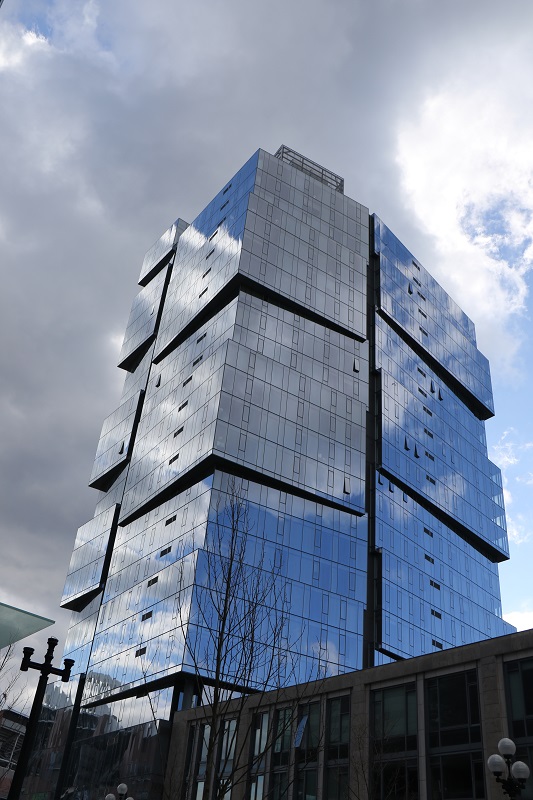
‘The Wave’ is one of a few newly constructed buildings close by Century Link Field (football field) south of Seattle’s Pioneer Square district.
The Wave has a mix of studio, one-bedroom and two-bedroom apartments. The studios start at $1,500 a month, and the two-bedrooms can run up to $6,000 a month, depending on the floor space. The Amtrak station with trains south to Portland and north to Vancouver is right there by these buildings, as is the light rail station to Seatac airport and elsewhere in the city.
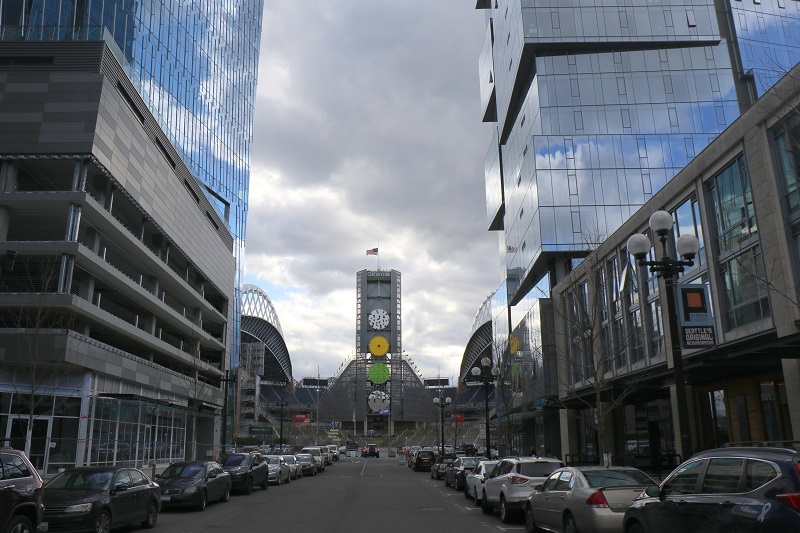
Looking south towards Century Link Field stadium in the center. There is a new Embassy Suites hotel on the left, and the luxury apartment building The Wave on the right. These were constructed on the old north parking lot of the stadium. Fewer parking spaces are needed now that there is a light rail train stop close by the stadium.And here is a full view of The Wave. It is a 26-story building with 333 units. The vertical mass is segmented into blocks that are slightly askew. The highly reflective glass reflect blue sky or the older, historic buildings from Pioneer Square close by. The south-facing units at the top actually offer views right into the stadium. Hopefully solid sound-proofing keeps some of the noise out .. or maybe most residents would not mind the cheering sound of the Seahawks and Sounders fans?
It was a beautiful, crisp, sunny day here in the northwest corner of the United States (56 °F/ 13 °C). I made my way down to Pike Place Market and the waterfront and bought a book at a second-hand book store there. Where are you from? inquired the owner. ‘Oh – South Africa’ I said, simply. My camera bag completed my appearance as an international tourist.
Here’s the Seattle waterfront by Pier 59 today. That’s the Seattle Aquarium, the green building with the solar panels on the roof.
Today was my last day in Cologne. The museums and shops were finally open again after being closed Sunday & Monday. I only made it to two museums, though: the Museum Ludwig and the Chocolate Museum.
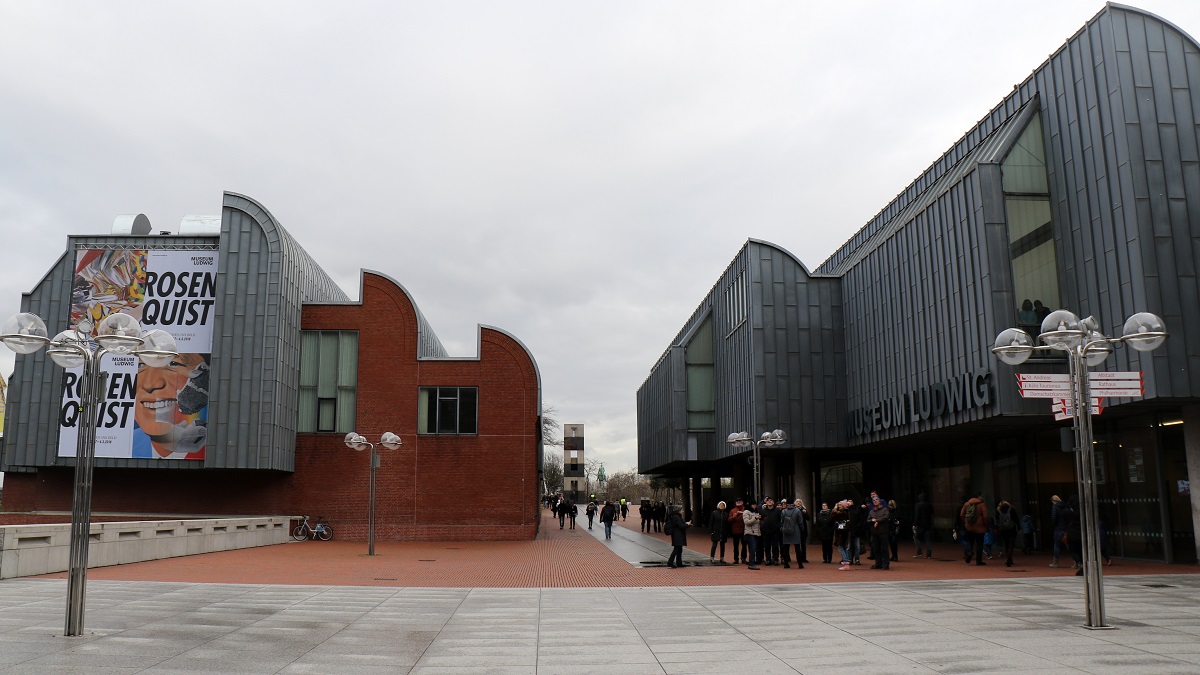
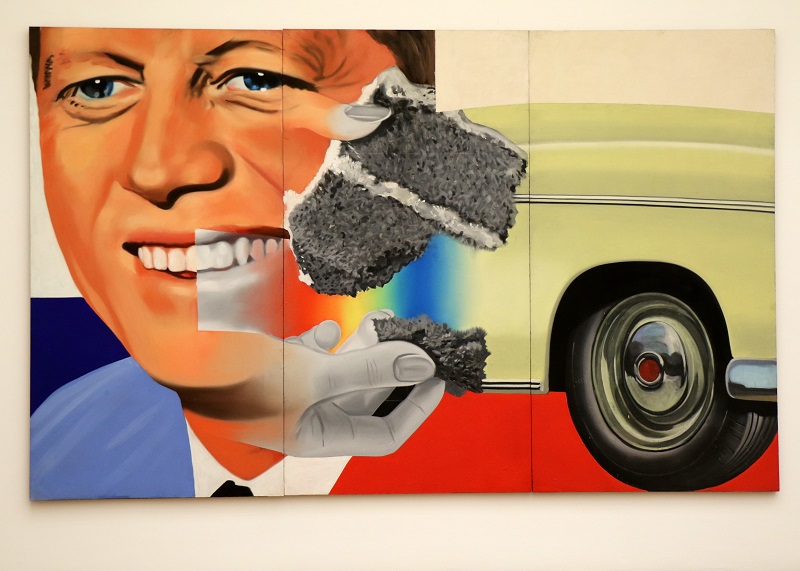
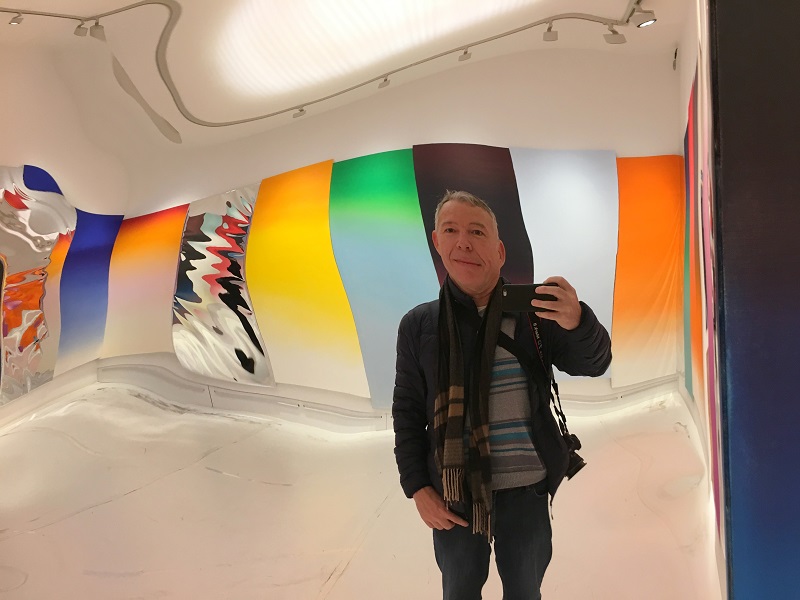
Museum Ludwig was established in 1976. This building near the Cologne Cathedral opened in 1986. The museum has artwork from the collections of lawyer Josef Haubrich (born 1889, died 1961) and of chocolate magnate Peter Ludwig (1925- 1996). It has one of the largest collection of Picasso’s artwork in Europe. The ‘Rosenquist’ sign on the left refers to a current exhibit of art of the American James Rosenquist, a pop-artist and contemporary of Andy Warhol and Roy Lichtenstein, who passed away in March 2017.One of Rosenquist’s best-known pieces from the early 1960s. It is called ‘President Elect’ and is a billboard-style painting, depicting John F Kennedy’s face alongside a rainbow, a yellow Chevrolet and a piece of cake.This is ‘inside’ a Rosenquist work called ‘Horizon Home Sweet Home’ (1970). It is a series of colored canvas panels on a room’s four walls. Some panels have aluminized mylar (plastic) stretched onto a frame, that creates distorted reflections of the other colored panels.
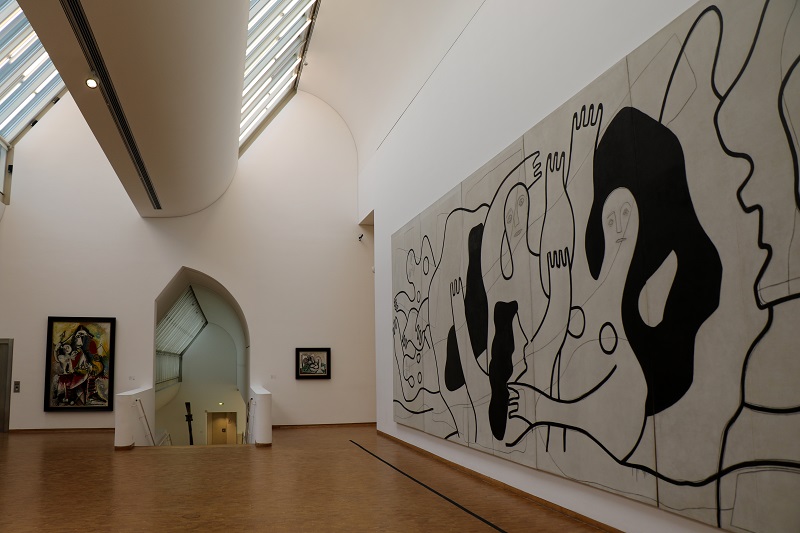
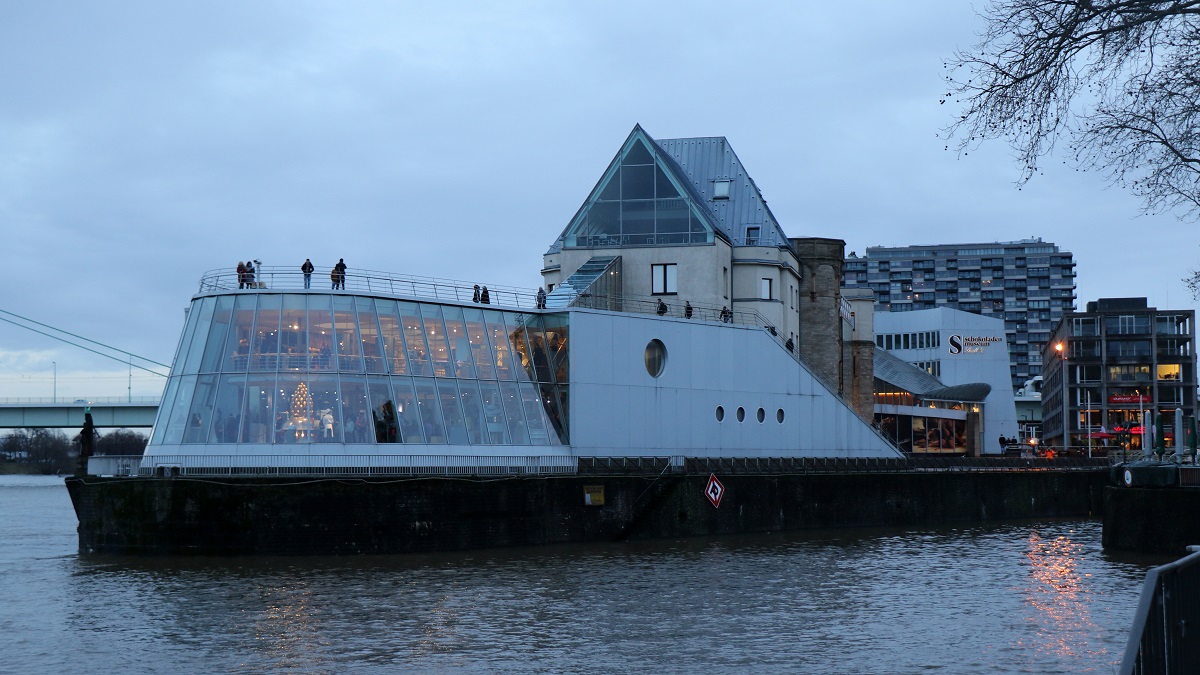
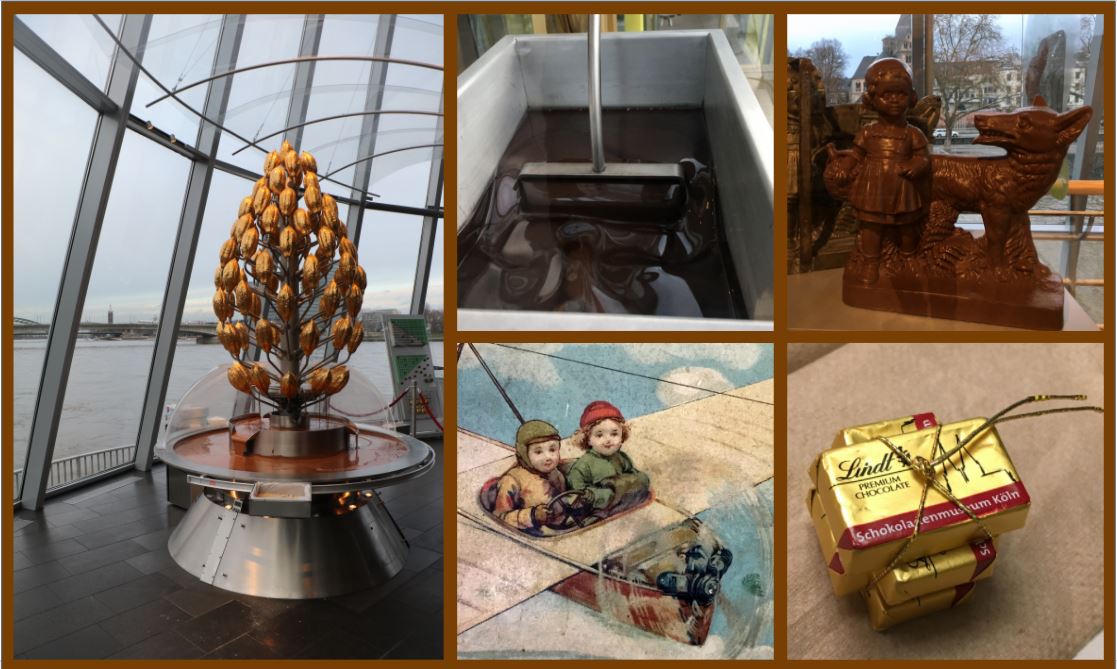
This is upstairs, and I thought the giant mural on the right is a Picasso, but it is not. The artist is Fernand Léger, a contemporary of Picasso, and the painting is called ‘Les Plongeurs'(The Divers), 1942.Here’s the Chocolate Museum. It is on the Rhine, and it looks like a river ship. It’s only 4.30 pm, but the sun is already setting.Sights inside the Chocolate Museum, clockwise from the left: giant cocoabean chocolate fountain | Molten chocolate with roller-stirrer driven by a simple motor, from Lindt | Red Riding Hood and the Wolf in chocolate | A little souvenir handed to one at the exit (entrance fee is €11/ US$13) | one of a large collection of charming old chocolate bar wrappers.
I spent some time in Rheinauhafen (‘Rhine old port’) today. It is a former port facility on the Rhine*, now rebuilt into modern condominiums, offices and commercial buildings. A Microsoft office building was completed in 2008, the main condominium building in 2009, and most of the other buildings a few years before that, or a few years later.
*Cologne is the largest city on the Rhine. Here in Cologne it is the Nieder-Rhein (the lower Rhine).
I did the best I could do with my photo of the three dramatic Kranhäuser (‘harbor crane’) buildings, shot into the sun. They each have two-part outrigger sections that rest only on a slender, fully glazed staircase tower. These are just below the Severin Bridge (yellow on the map), and on the little peninsula in the Rhine. The Microsoft office (picture bottom middle) is across the canal, on the true riverbank.A close-up of the residential building. The green triangular column and spans in the background are of the Severin Bridge. A realtor’s office advertised a few of the units that are for sale. Sample numbers: 2 bedroom, 130m2 (1,400 sqft) unit goes for €1.1 million (US$ 1.3 million). A 3-bedroom was for rent for €3,650 pm (US$ 4,400).These buildings are a little further down south from the Kranhäuser buildings. The ones on the left have an old or classic architecture, but they are almost brand new, from what I can tell. The modern brick and glass building on the right is a high-school. MY high school did not look like that! (I wish it did).I love this old sepia picture, printed onto the glass enclosure of a kiosk, with the – port worker? who was he? – resting his arms on the fence. A great way to acknowledge the rich history of the port.
The circular desk in the main banking hall, under the dome, still used to indicate the date for those that fill out checks (fewer and fewer these days!) and other documentation.
I checked into the First National Bank building in Cape Town on Thursday, in a quest (unsuccessful so far) for a few new 2017 South African 5-rand coins.
The building was designed by famed architect Sir Herbert Baker, and inside the banking hall’s dome there are four beautiful plaques.
There is a lot of history in the plaques, and I did some on-line research to find the full explanation for them.
Top Left: Symbols of Great Britain : Gold lion with a crown for England, Harp for Ireland, Red Lion for Scotland. Bottom Left: Symbols of the Union Of South Africa: Lady with Anchor for Cape Colony, Wildebeest for Natal Colony, Ox Wagon for Transvaal Colony, Orange Tree for Orange River Colony. Top Right: The arms of Van Riebeeck, a shield with three besants superimposed upon the anchor of Good Hope. Bottom Right: The signs of Lombard Street. Bell for 44 Lombard Street, Rose & Crown for 50 Lombard Street, Bible for 54 Lombard Street, Eagle for 56 Lombard Street. Dragon: Wales
Clockwise from left: the front of the MOCAA building | open tops of grain silos on the inside, given new life as six-storey high skylights | looking up from floor 0, by the elevators | utility tunnels from the old grain silo | looking down to the main entrance hall.From top left, clockwise: Julien Sinzogan, born 1957, Benin: La jetée (The Jetty), 2010, colored ink and acrylic on paper | Cyrus Kabiru, born 1984, Kenya: KwaZulu Natal Elephant mask,2015, Pigmented ink print | Thania Peterson, born 1980, South Africa: Location 4, later District 6, 2015, Pigmented ink print | I recorded no notes for the red dog!This room was the highlight of the museum for me. Roger Ballen was born in New York in 1950 but for over 30 years he has lived and worked in South Africa. ‘Ballenesque’ is a retrospective of his work.From rogerballen.com: His strange and extreme works confront the viewer and challenge them to come with him on a journey into their own minds as he explores the deeper recesses of his own.Another Roger Ballen composition of strange and distorted figures and photographs.
Deadlines have to be met, and time costs money – so construction on the new downtown Seattle buildings soldiers on, regardless of the season. The crews do take a break on Sundays, and then I can go check on their progress. Here are two buildings near Westlake Avenue and Denny Way.
This is 2202 8th Ave, a 40-storey condo building, as seen from the south from Blanchard St. The inset below shows Denny Park as a green patch behind the building, and the architect picked an oval shape to ‘provide a visual bridge between the intersecting Downtown and South Lake Union neighborhoods’. The building is near a weird triangular confluence of major streets.This is 2100 7th Ave (‘Amazon Block 21’), viewed from the corner of Blanchard St and 8th Ave. There will be two buildings, an 8-storey and a 24-storey. The bottom picture is an artist’s rendering of the completed project, and is the view when one stands on the opposite side of the construction site (with one’s back to the biospheres). I guess the S on the crane stands for Santa?
Here are a few pictures from downtown San Diego. There are several new condo towers under construction, but the older buildings are the ones that are my favorites.
The San Diego City and County Administration Building, built in a Beaux-Arts/Spanish Revival-style, construction started in 1936, and it was dedicated in 1938 by FDR himself. ‘Good government demands the intelligent interest of every citizen’ .. never truer than in 2017.The Santa Fe Depot (as it was originally designated) station opened in 1915, to accommodate visitors to the Panama-California Exposition. That is the San Diego Trolley in front of it. The station is also a stop for Amtrak and the Coaster commuter train that runs up to Oceanside.The marquee of the Spreckels Theater Building on Broadway, which was completed in 1912. It has been in continuous use ever since, except for a few brief intervals for refurbishing.The Balboa Theatre is a historic vaudeville/movie theater (just a few blocks from the Spreckels Theatre in downtown San Diego), built in 1924.I took the Coaster from Santa Fe Depot station to Solana Beach’s station (picture), where I am staying (single fare ticket $5.50). The train cars are tall with three seating levels, and comfortable inside, and a great way to avoid traffic on I-5.
I managed to walk down 1st Avenue from Pike Place Market to Pioneer Square today, before the rain caught up with me and I had to call it quits. I took a few pictures of the Pioneer Building. For awhile, it was the tallest building in Seattle and Washington state – from 1892 to 1904. In December 2015, the building was purchased by workspace provider Level Office. They renovated the building’s interior to create private offices and co-working space for small businesses.
(Picture & Text From Wikipedia] The Pioneer Building is a Richardsonian Romanesque stone, red brick, terra cotta, and cast iron building located on the northeast corner of First Avenue and James Street, in Seattle’s Pioneer Square District. Completed in 1892, the Pioneer Building was designed by architect Elmer Fisher, who designed several of the historic district’s new buildings following the Great Seattle Fire of 1889. During the Klondike Gold Rush, in 1897, there were 48 different mining companies that had offices there.The Pioneer building’s south side, today. It is difficult to get a picture of the whole front facade (tall trees, other buildings). The original pyramid tower from the first picture is gone now.Intricate stone detail in the top panel with the building name.And here is the stonework arch on the main entrance.
I went down to South Lake Union today to check out the construction on the old Seattle Times Building’s site.
The original Seattle Times Building was completed in 1931 with offices and newspaper printing presses and all. Operations stopped there in 2011, and were moved to Bothell (some 20 miles from of Seattle). The real estate and buildings were sold in 2013 to a company from Vancouver. The developer has to preserve the exterior facade and roof of the Seattle Times Building, since these were designated a Seattle city landmark in 1996. It’s a little weird that only the exterior walls and roof of a building can be designated a landmark! .. but at least some semblance of the old building remains. The developer has already demolished all of the inside, and while the rooftop is not built on, it is getting a make-over with landscaping and seating.
Top left to right: The Seattle Times building in 1946; the side facade of the main building from behind (there is a support framework on the front); Art Deco elements on the side of the building and by the main entrance. Main picture: 1 Exterior landscaped amenity deck for building residents | 2 Double-height indoor amenity space adjacent to outdoor deck | 3 Tall landscaping elements kept back from roof deck perimeter to give priority to the landmark Seattle Times facade | 4 Bridge element connects roofdeck with podium over breezeway | 5 Display of Seattle Times industrial artifact.Here is the proposed massing of the tower buildings around the Seattle Times Building (in red outline). ‘Massing’ in architecture refers to the perception of the general shapes, forms and sizes of a buildings.
Here’s the Seattle skyline as seen from the Bainbridge ferry on Friday afternoon. I stitched together three photos, and marked it up with some of the tallest and most iconic buildings.
The Seattle skyline as seen from the Bainbridge ferry on Friday. The 76-story Columbia Center, 937 feet (286 m) tall, and completed in 1985, is still the tallest of them all. The cruise ship in the foreground is the MS Regatta (1998), operated by Oceania Cruises.
We took a leisurely drive up to Port Townsend on Thursday, with stops at Nordland and Fort Flagler Historical State Park.
Nordland on Marrow Island has a great general store, with canned products from Cape Cleare, Alaska. Fort Flagler was a United States Army fort at the northern end of Marrowstone Island, established in 1897 and closed in 1953. Check out the sign on the fence that says ‘Falling can be deadly’. There’s a 50 ft sheer drop on the other side of it. (Change to ‘Falling will kill you?). Ft Flagler was home to the Seattle Youth Symphony’s Pacific Northwest Music Camp from 1958 to 1989. Today it is open for visitors and has a campground. The Port Townsend ferry is arriving from Coupeville on Whidbey Island. Haller fountain was dedicated in 1906, and Galatea the Greek sea nymph, was added in 1922.This sharp-eyed bald eagle (Haliaeetus leucocephalus) was sitting on a drainage pipe sticking out from a cliff at Fort Flagler. The bald eagles is the national bird of the United States, appearing on most official seals of the U.S. government. They live to about 20 years old.Here’s the Jefferson County Courthouse in Port Townsend. The Romanesque style courthouse was designed by Seattle architect W. A. Ritchie. The Roman numerals on the base of the clock tower reads ‘MDCCCXC’, indicating that the building was constructed in 1890.Here’s the Hastings building on 833 Water Street, constructed in 1889. It was funded by Lucinda Bingham Hastings (1826-1894), the widow of Loren Brown Hastings (1814-1881), a local dry goods merchant, turned to real estate investment after her husband’s death.This bell tower dates back to 1890 and was in service for 50 years. It is a 75-ft tall wooden structure with a 1,500 lb bell (just visible in the top). It is the last such remaining structure of its kind in the United States (it was repaired in 2003). The original brass bell was made to ring in designated patterns that indicated the location of a fire in the city. The patterns were generated by electrical signals sent to the tower from signal boxes throughout the city.
The drive time down to Astoria is slightly less than 4 hrs. We made stops in Shelton and on the Washington State side of the Astoria-Megler bridge, which added to the travel time.This mural is off the main street in Shelton, a town on one of the south-western extremes of Puget Sound. It is a nod to the times when timber was transported by steam locomotives. The town still have lumber yards, but these days the transportation is done mostly by trucks.A rain-coated boatsman outside an antique store in Shelton. Shelton gets a LOT of rain, some 62 inches per year.This is on the Astoria–Megler Bridge: a steel cantilever-through-truss bridge that spans the Columbia River between Astoria, Oregon and Point Ellice near Megler, Washington. Construction was completed in 1966. The road surface and sidewalks are being renovated right now, and there was a short stop on the bridge. (Don’t worry, I’m in the passenger seat!).Here’s a view from the Astoria Riverwalk, on the old wooden piers just east of the bridge. So the Pacific Ocean lies in the distance, on the other side of a bluff in the distance.The Wet Dog Cafe Brewery is where we had a beer and something to eat. It is near Pier 11 on the Astoria Riverwalk. There is a trolley (really a train) that runs along the waterfront between 12 noon and 6 pm.The beautiful John Jacob Astor Hotel building in downtown Astoria. Originally built in 1923, it was renovated in 1986 with 66 apartments of subsidized housing. Businesses moved into the lower floors.The Museum of Whimsey is an art museum housed in a historic 1925 bank building that had been renovated.Hey! Nice to see some gay pride celebration lamppost signs. I see we just missed the parade though : it was this past weekend.
We made it to Astoria with a stop or two along the way (Shelton, Dismal Nitch. There was some rain on the way here, but later in the day it cleared up.
The Astoria column was built in 1926 on Coxcomb Hill in Astoria, financed by Great Northern Railway. The 125-foot (38 m)-tall column has a 164-step spiral staircase case to the small observation deck at the top.
We arrived early enough to check into the motel, and to walk around the waterfront and downtown Astoria.
I love the bobbing buoy on the little Buoy Beer Co. truck. Pronunciation note: In South Africa we say ‘boi’ but I learned that in the USA we say ‘boo-ē’.A map of the ship channel (dredged waterway) in the mouth of the Columbia river. There are pairs of buoys in the water and on land at different elevations, that should line up when looked at from the ship, to confirm that the vessel is in the shipping canal.This is artwork at a little plaza that is dedicated to immigrants in downtown Astoria.These murals are on old warehouses on the Astoria waterfront, a nod to times long gone now, from the last century.Some of the trash cans downtown are decorated with the seafood cannery labels from long ago.