Happy National Chess Day (here in the United States).
I asked Gemini AI to give me an overview of the history of chess machines. Supremacy for humans was already over some 30 years ago, in 1997.
That was the year in which IBM’s supercomputer Deep Blue defeated reigning World Chess Champion Garry Kasparov in a six-game match.
The history of chess machines spans from 18th-century mechanical hoaxes to modern supercomputers and AI.
1. Mechanical Automata & Early Inventions (Pre-Computer Era)
-
- 1770 – The Turk: Built by Wolfgang von Kempelen, this famous life-sized wooden figure dressed in Ottoman clothing appeared to play chess autonomously. In reality, it was a mechanical hoax with a skilled human chess player hidden inside the cabinet. It famously played against historical figures like Napoleon Bonaparte and Benjamin Franklin.
- 1912 – El Ajedrecista: Invented by Spanish engineer Leonardo Torres Quevedo, this was the world’s first true automated chess-playing machine. Using electromechanical electromagnets, it could play an endgame (such as a king and rook against a lone king) without human intervention.
2. The Dawn of Computer Chess (1940s–1950s)
-
- 1948 – Turochamp: Alan Turing and David Champernowne designed the first theoretical chess-playing algorithm. Because early computers were not yet powerful enough, Turing calculated the moves manually by hand on paper.
- 1951 – Ferranti Mark 1 Program: British computer scientist Dietrich Prinz implemented a basic chess algorithm on the Ferranti Mark 1 computer, allowing it to solve “mate-in-two” chess problems.
- 1957 – IBM 704 Engine: Alex Bernstein created the first fully functional computer program capable of playing a complete game of chess from start to finish on an IBM 704 mainframe (taking about 8 minutes per move).
3. Dedicated Chess Computers & Robotic Boards (1970s–1980s)
-
- 1980 – Boris Handroid: One of the earliest commercial chess computers featuring a rudimentary robotic arm to move pieces.
- Early 1980s – Milton Bradley Chess Robots (Phantom, Grandmaster, Milton): Mass-market boards that used internal electromechanical systems and magnets under the board to pull and slide pieces automatically in response to human moves.
- Commercial Dedicates: Standalone electronic chess computers (such as The Chessmaster series) became popular household gadgets in the 1980s.
4. Grandmaster and World Champion Defeat (1990s)
-
- 1988: Deep Thought became the first computer to defeat a chess grandmaster (Bent Larsen) in tournament play.
- 1997 – Deep Blue: IBM’s supercomputer Deep Blue defeated reigning World Chess Champion Garry Kasparov in a six-game match, marking the first time a machine beat a human world champion under standard tournament time controls.
5. Modern Neural Networks & AI (2000s–Present)
-
- Engine Dominance: Traditional engines like Stockfish utilized deep calculation trees and advanced heuristics to surpass human capability by vast margins.
- 2017 – AlphaZero: Developed by DeepMind, AlphaZero used reinforcement learning and neural networks rather than human-programmed heuristics.
It taught itself chess from scratch in just a few hours and overwhelmingly defeated top engines like Stockfish.
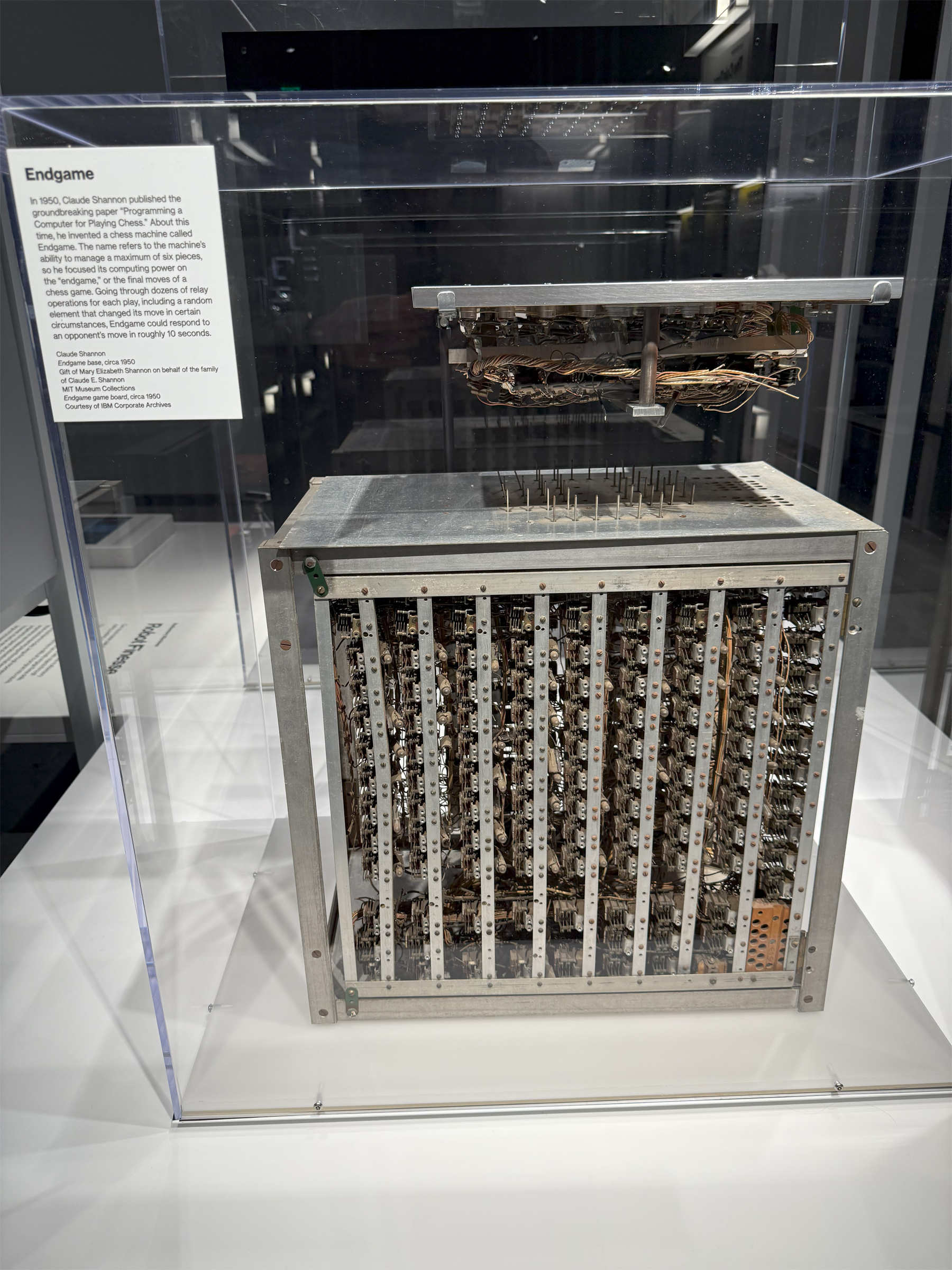
Endgame
In 1950, Claude Shannon published the groundbreaking paper “Programming a Computer for Playing Chess.” About this time, he invented a chess machine called Endgame. The name refers to the machine’s ability to manage a maximum of six pieces, so he focused its computing power on the endgame, or the final moves of a chess game. Going through dozens of relay operations for each play, including a random element that changed its move in certain circumstances, Endgame could respond to an opponent’s move in roughly 10 seconds.
Claude Shannon
Endgame base, circa 1950
Gift of Mary Elizabeth Shannon on behalf of the family of Claude E. Shannon
MIT Museum Collections
Endgame game board, circa 1950 Courtesy of IBM Corporate Archives