
Happy Friday.
Breaking News: The Supreme Court of the United States (SCOTUS) ruled today in a 6-3 decision that Trump’s sweeping tariffs on imports from nearly every U.S. trading partner are unconstitutional.
Last April, in 2025, Trump had claimed that a 1970s emergency statute* (which does not mention the word “tariffs”) allowed him to unilaterally impose the duties without congressional approval.
*The International Emergency Economic Powers Act (IEEPA) of 1977.
It authorizes the President to regulate international commerce, including limiting or taxing imports, upon declaring a national emergency in response to an “unusual and extraordinary threat” from abroad.
The SCOTUS justices for the majority noted that no other US president had invoked the statute to impose any tariffs — let alone tariffs of this magnitude and scope. Tariffs are a tax and the President of the United States must identify clear congressional authorization to exercise it.
The U.S. Treasury has collected about $240 billion in tariff revenue since April 2, 2025. Consumers paid about 90% of that.
Trump is, um— shall we just say, mightily upset— over this ruling, and immediately ordered a new 10 percent tax on all imports to the USA.
For justification, he is using the 1974 Trade Act and a provision called Section 122.
(No president before him had invoked that provision, either.)
Section 122 was designed to address short-term emergencies, not long-term trade policies.
It can only be put in place for 150 days.
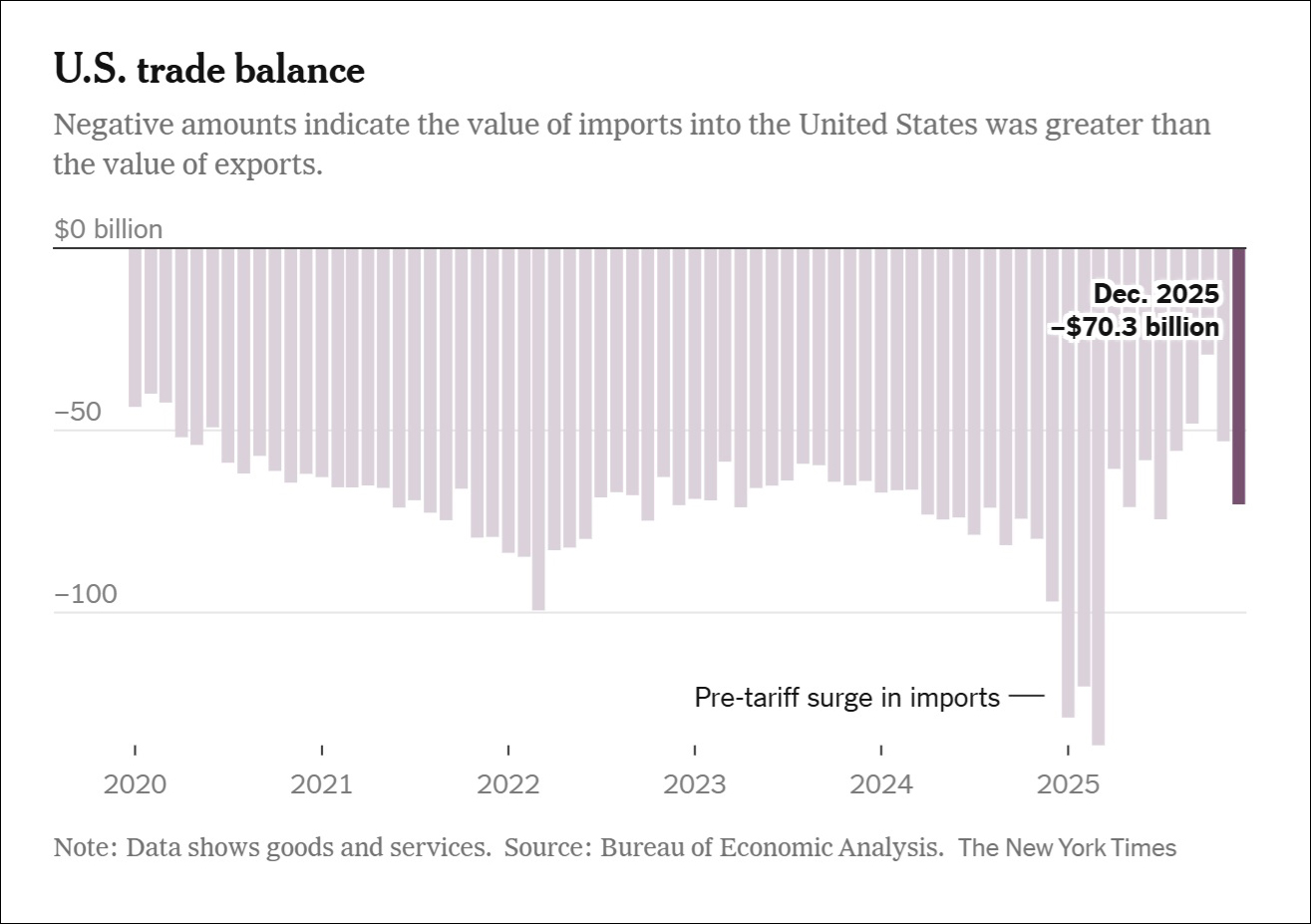
Data released Thursday by the Census Bureau showed the overall US trade deficit with the world narrowed, the result of an expanding trade surplus in services. The trade deficit in goods was the highest on record.
Ben Casselman and Ana Swanson write for the NY Times:
The total trade deficit, including trade in both goods and services, shrank slightly last year, as growth in exports narrowly outpaced growth in imports. But that was entirely the result of an expanding trade surplus in services. The trade deficit in physical goods, which has been Mr. Trump’s focus as he has sought to use tariffs to restore the U.S. manufacturing sector, actually grew in 2025.
The trade deficit grew sharply at the end of the year, rising 32.6 percent in December as imports rose and exports fell.
[Graphic by Keith Collins]