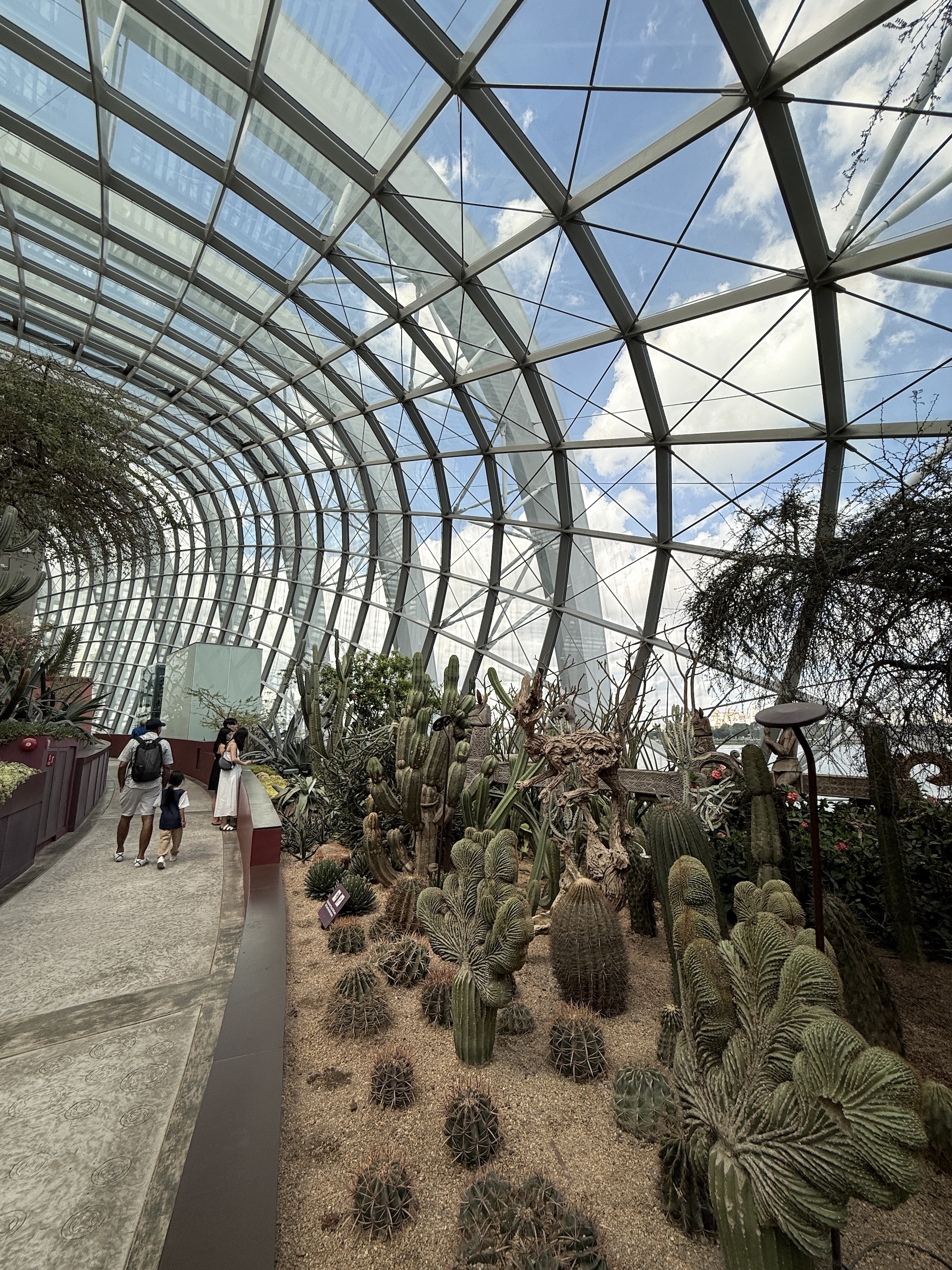
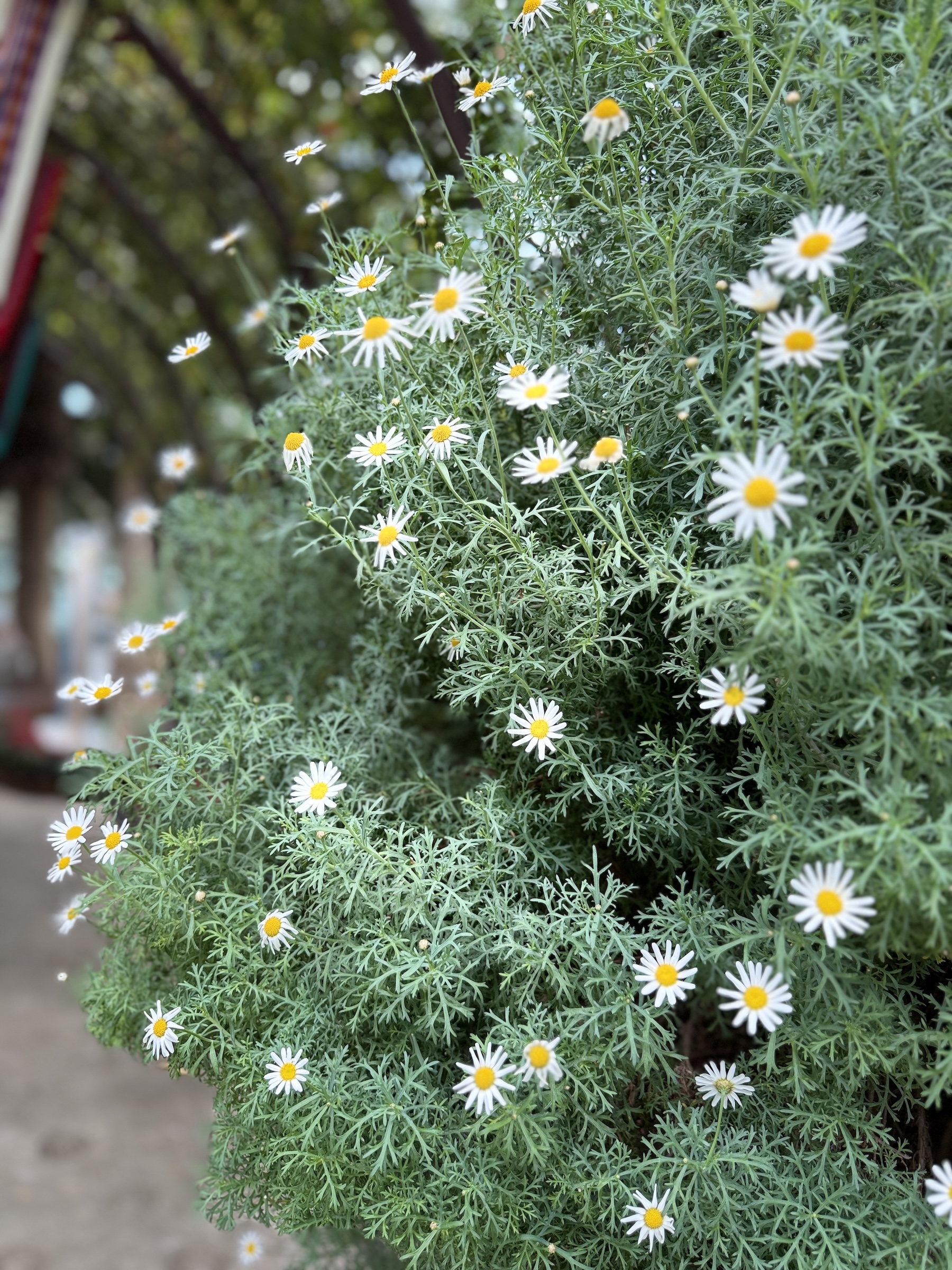
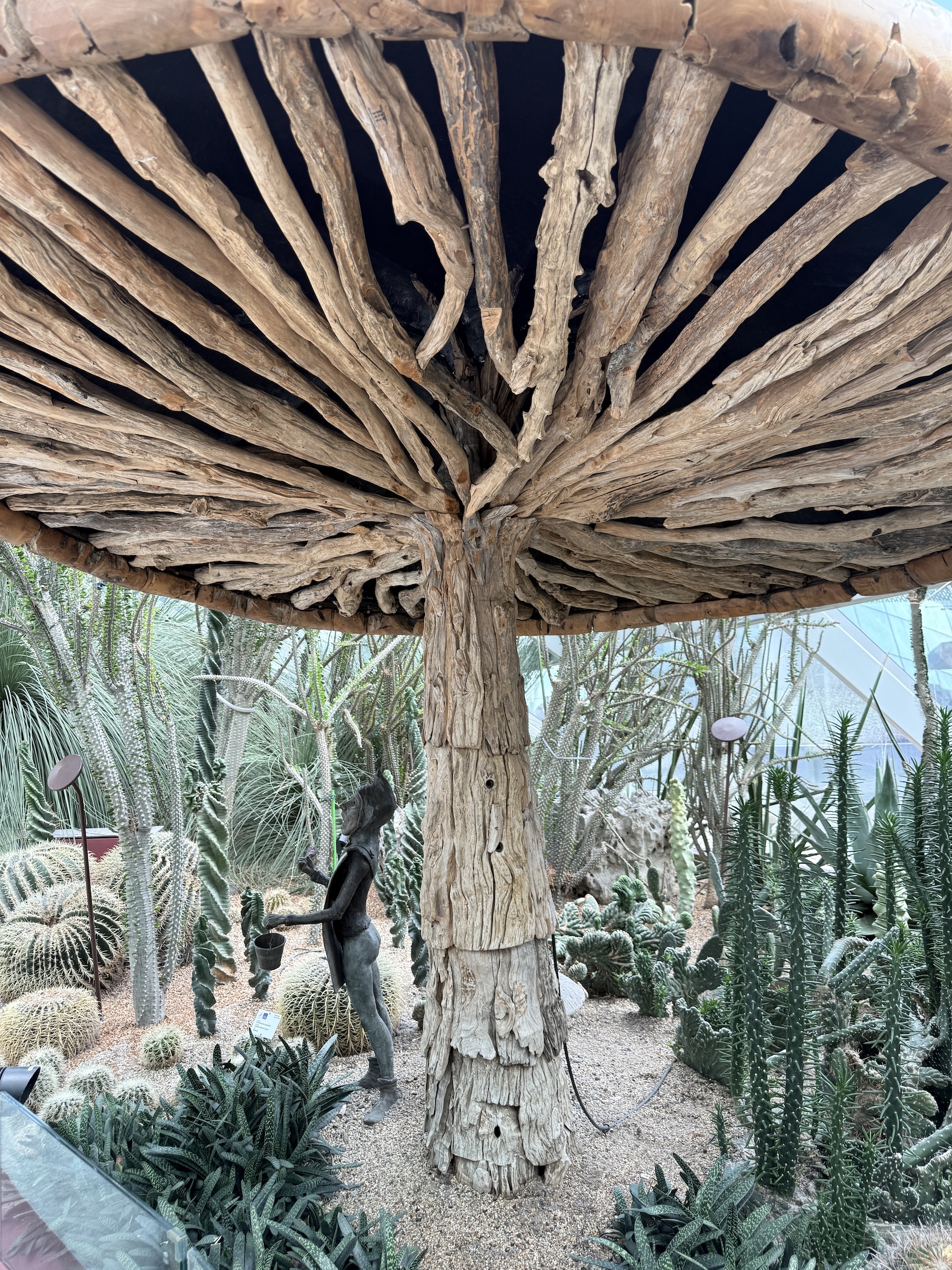
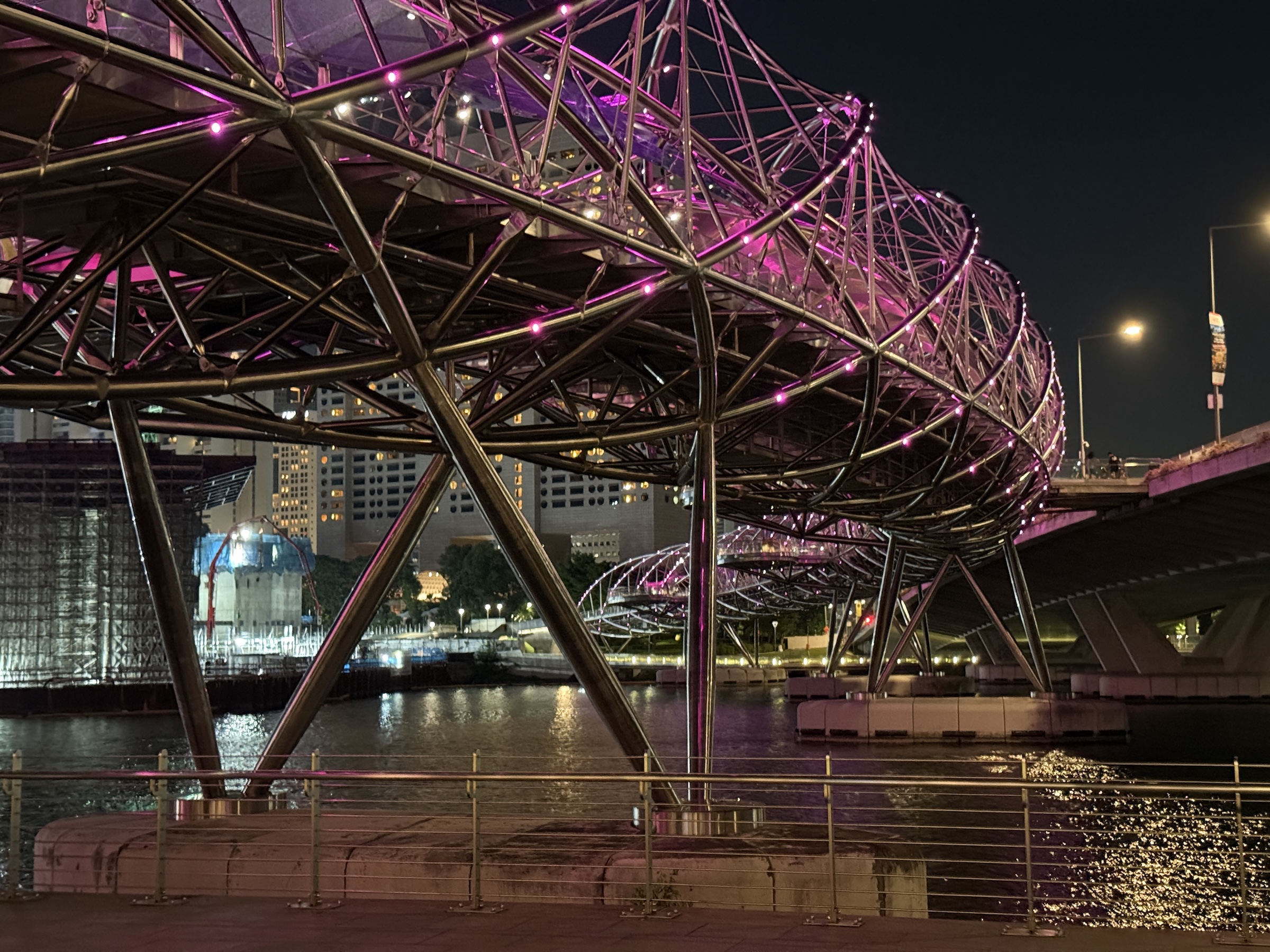
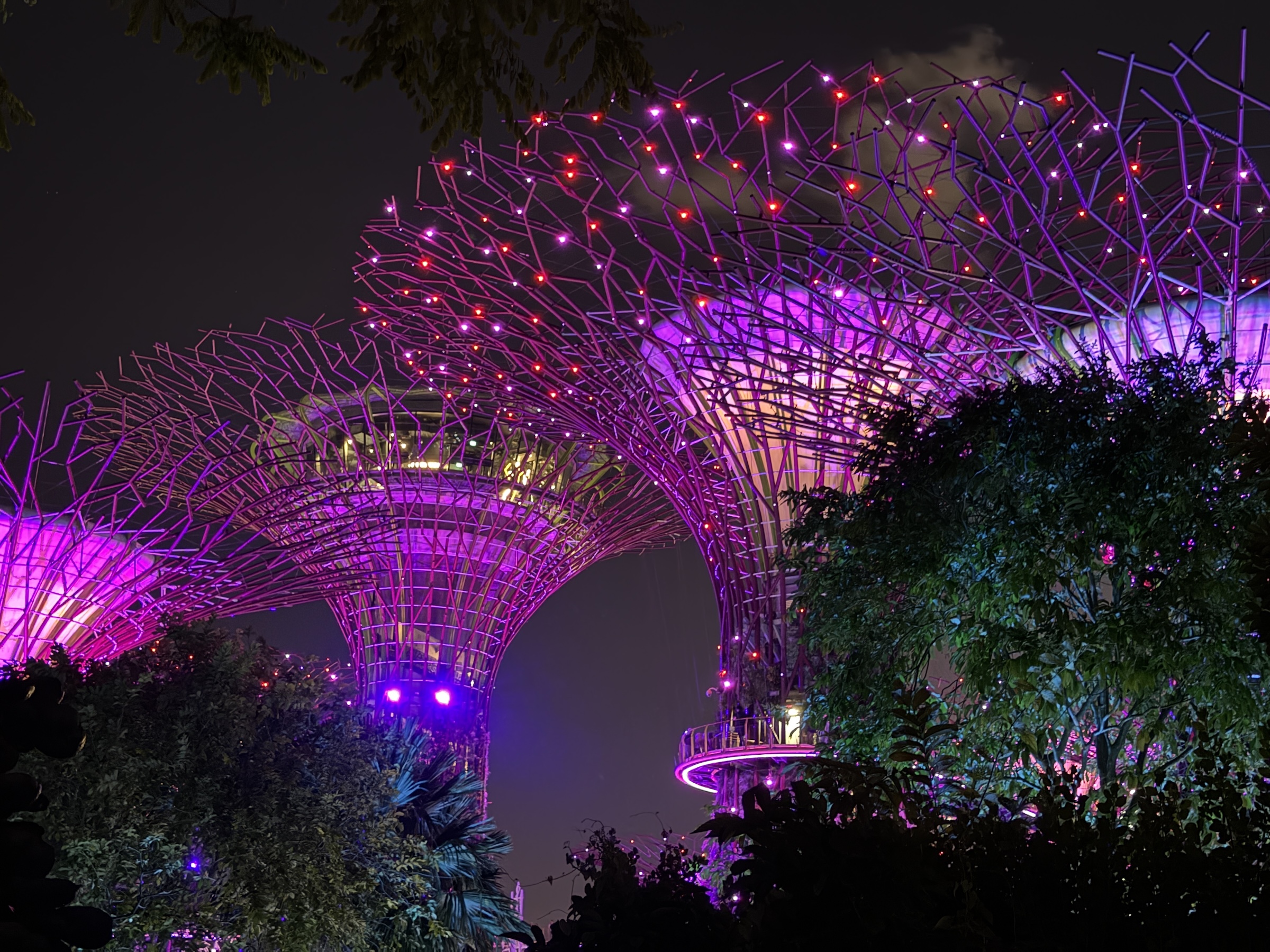
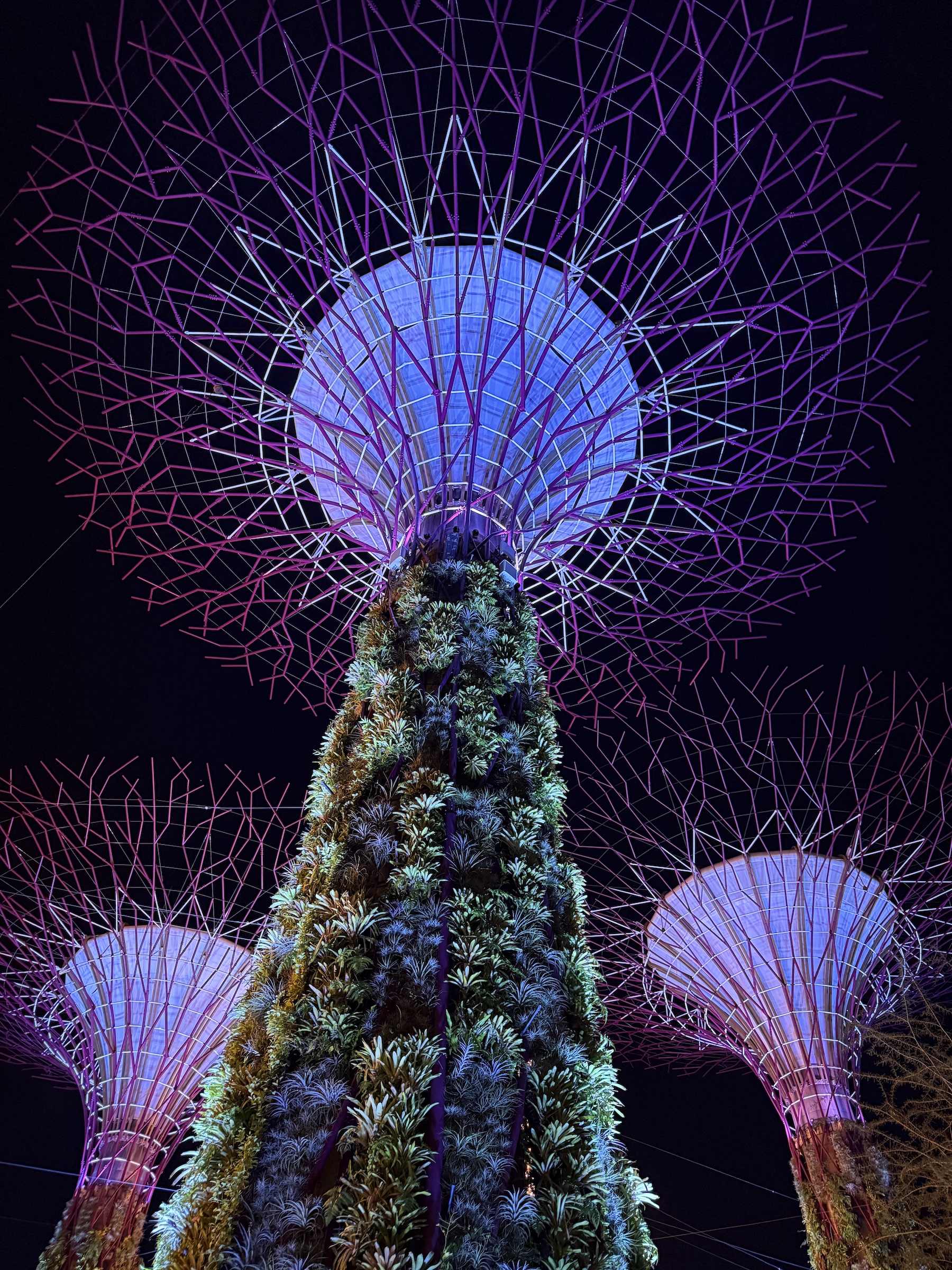
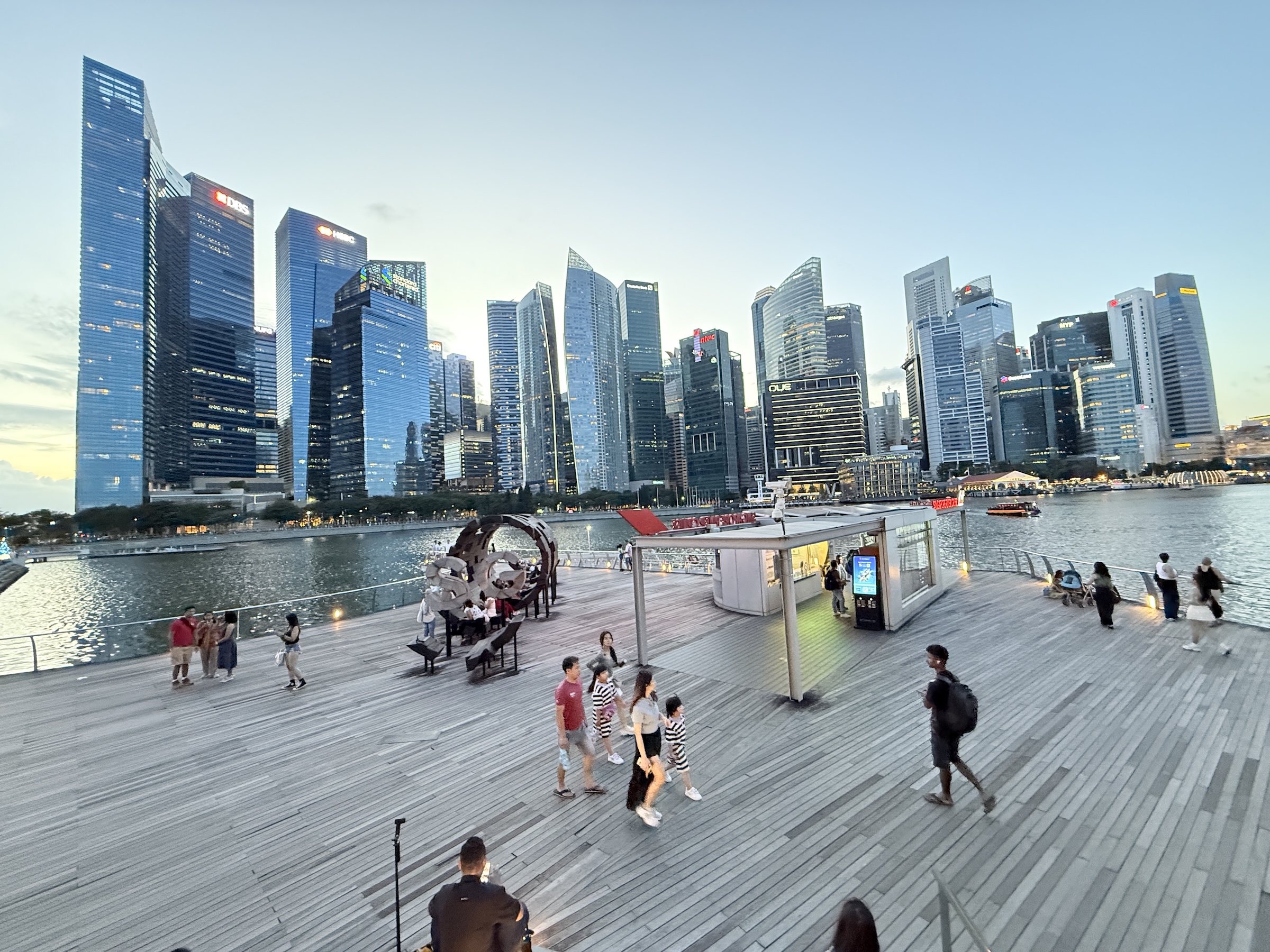
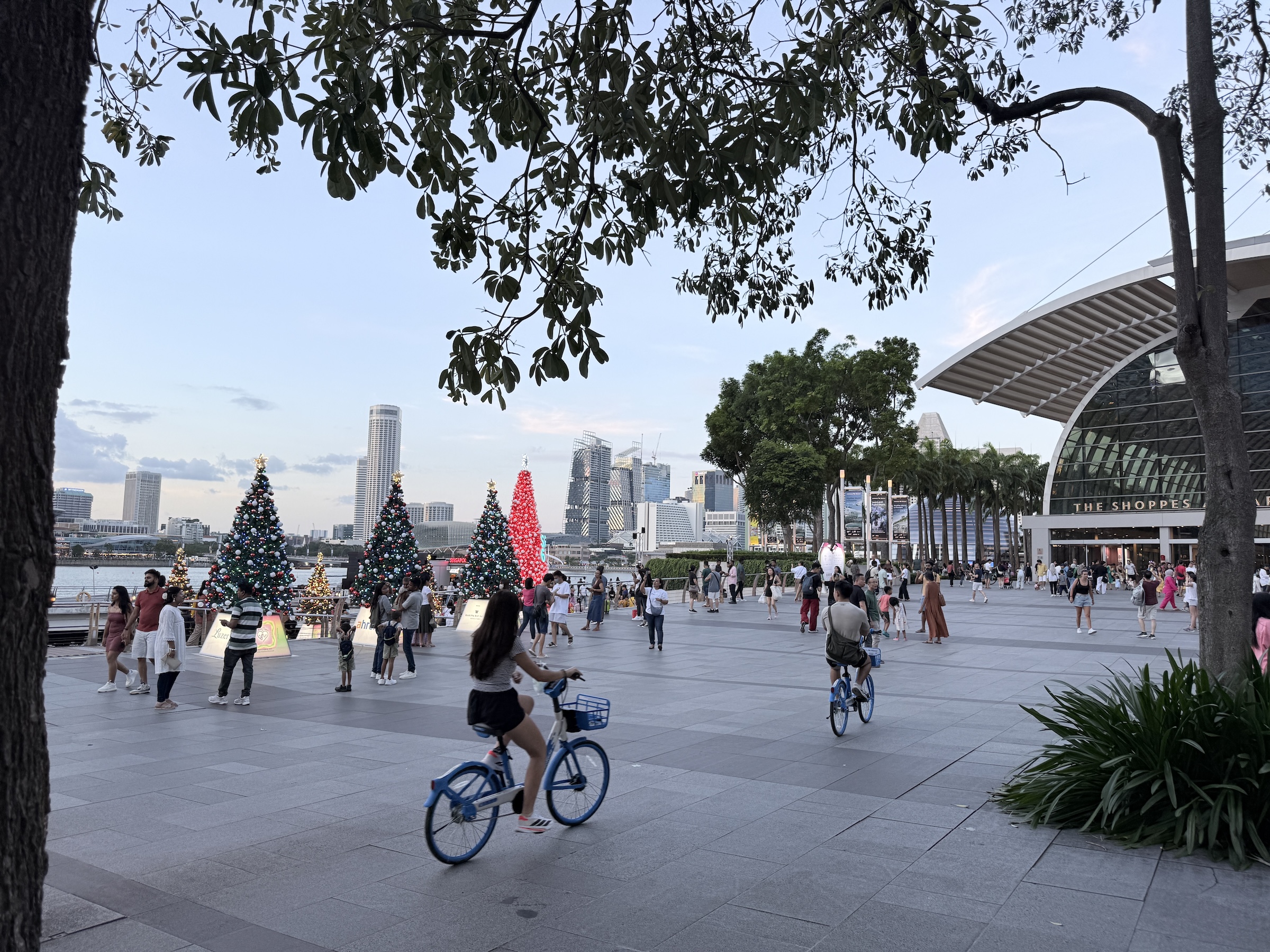
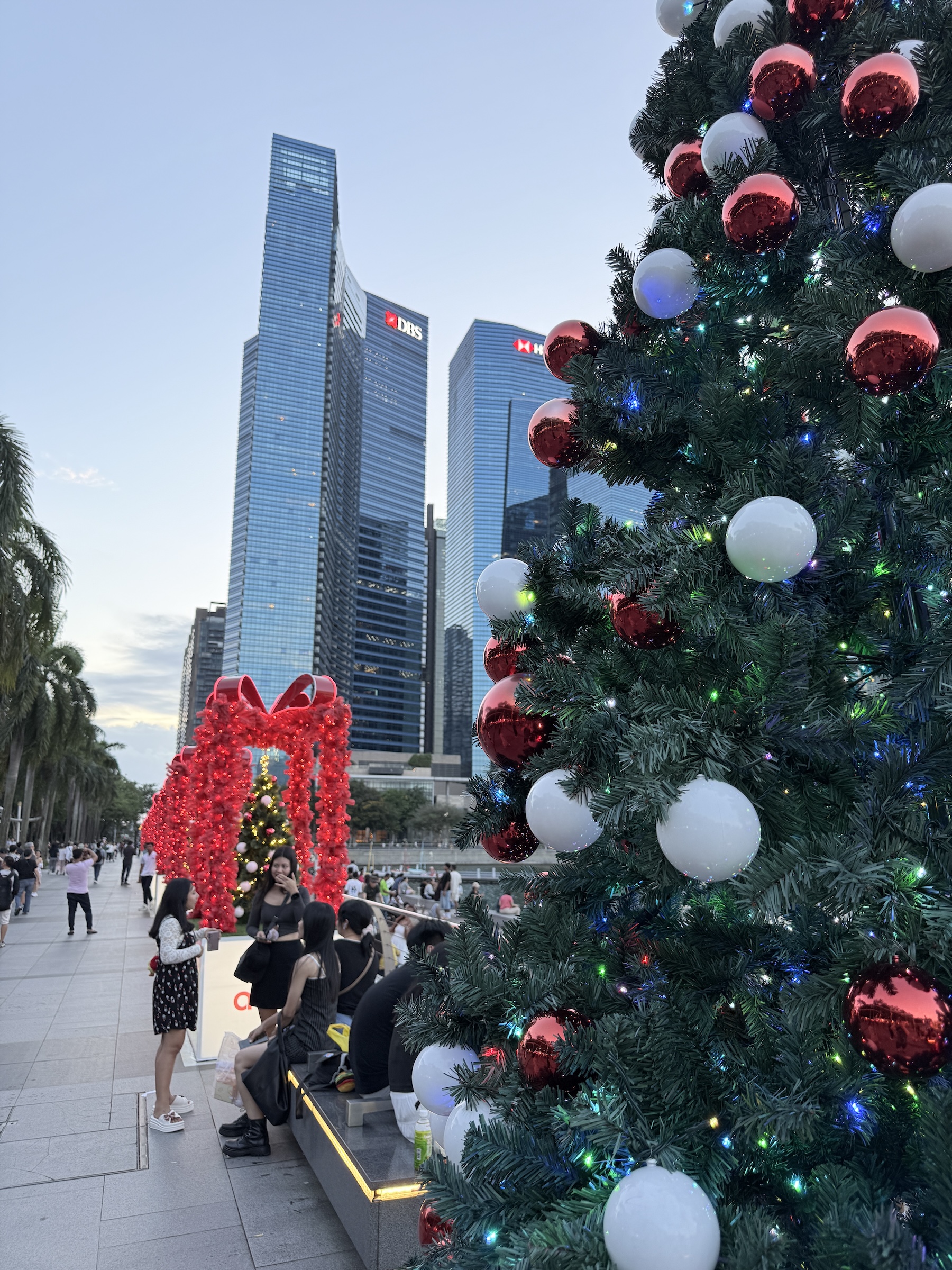
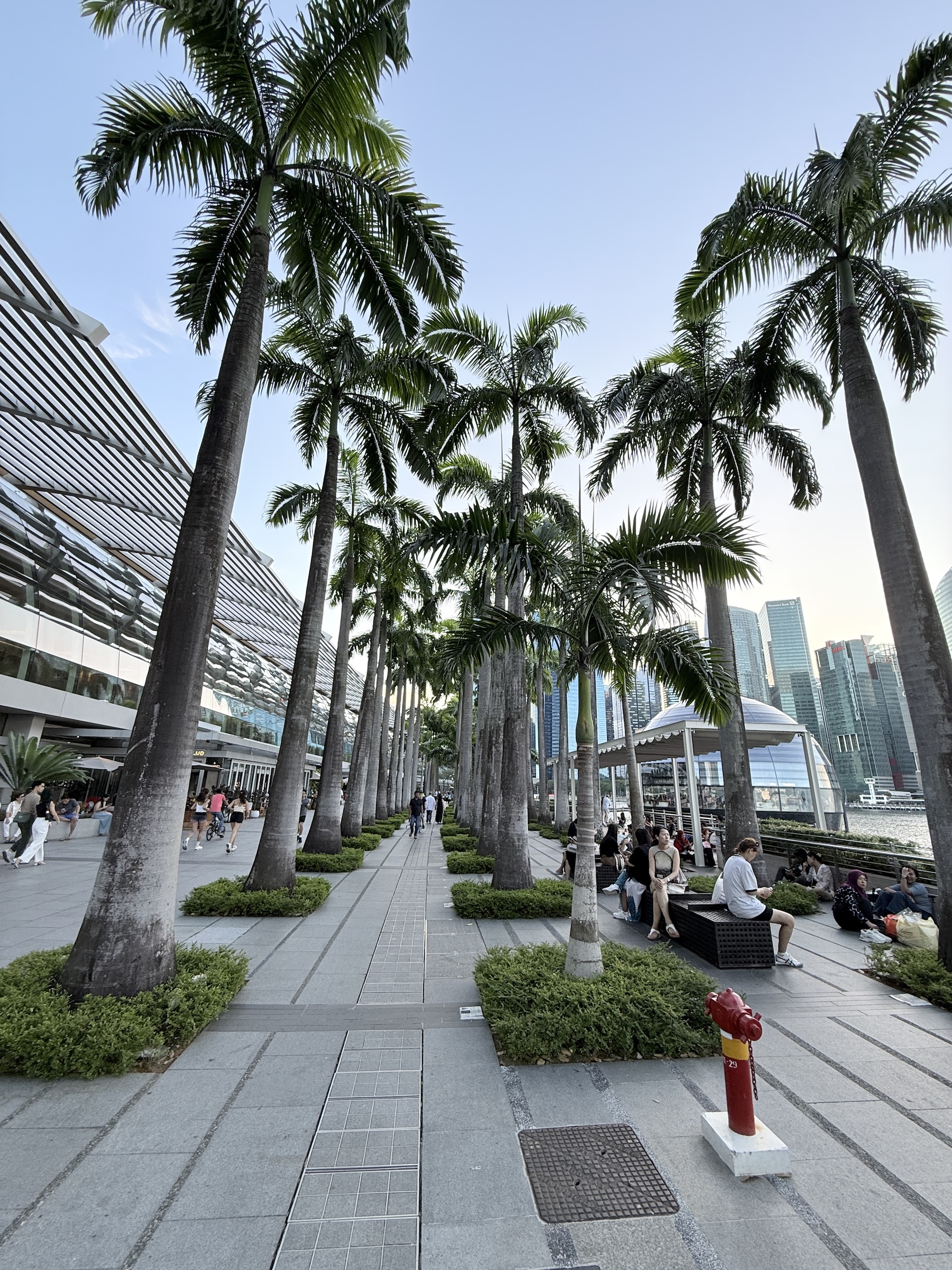
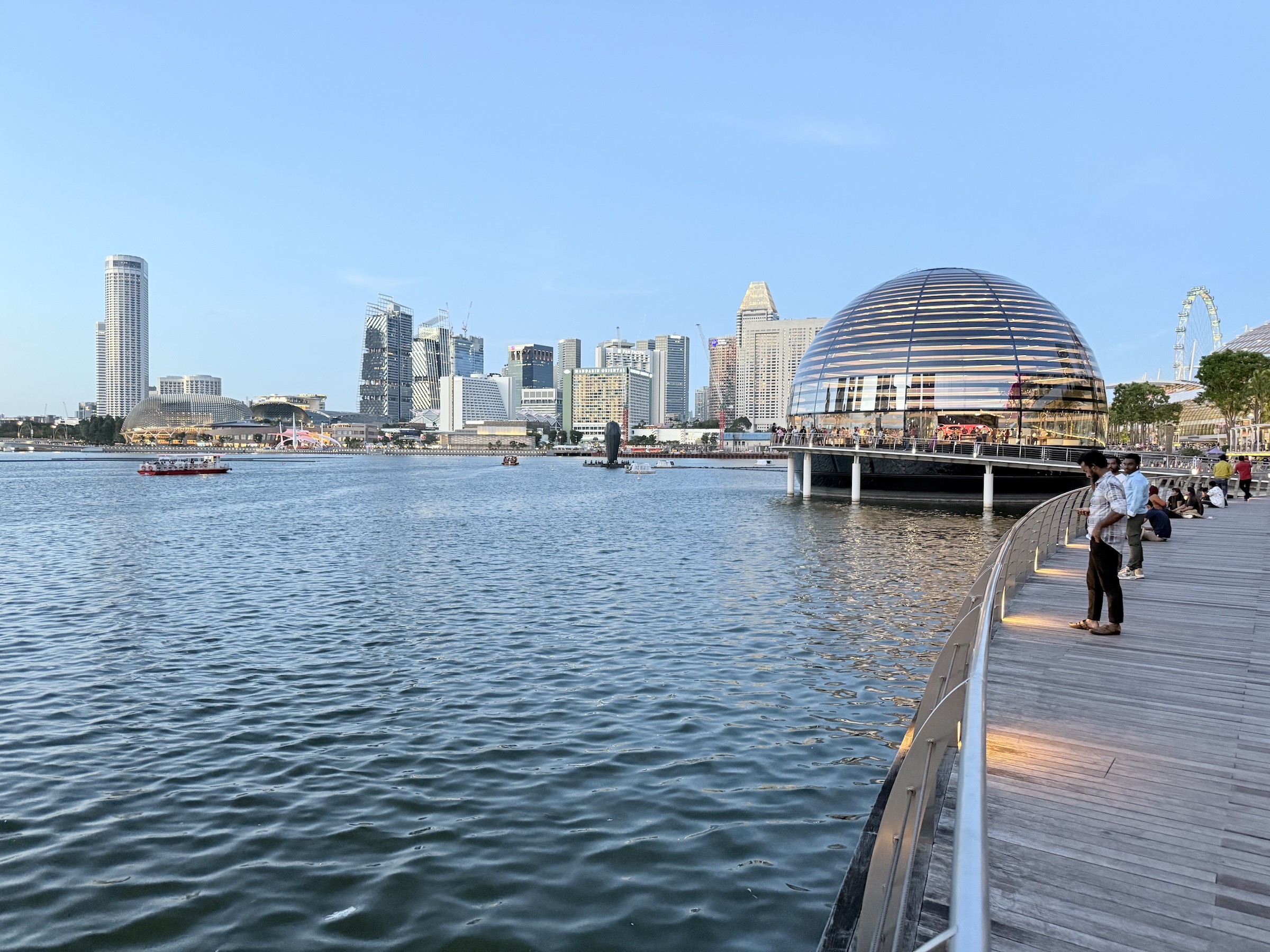
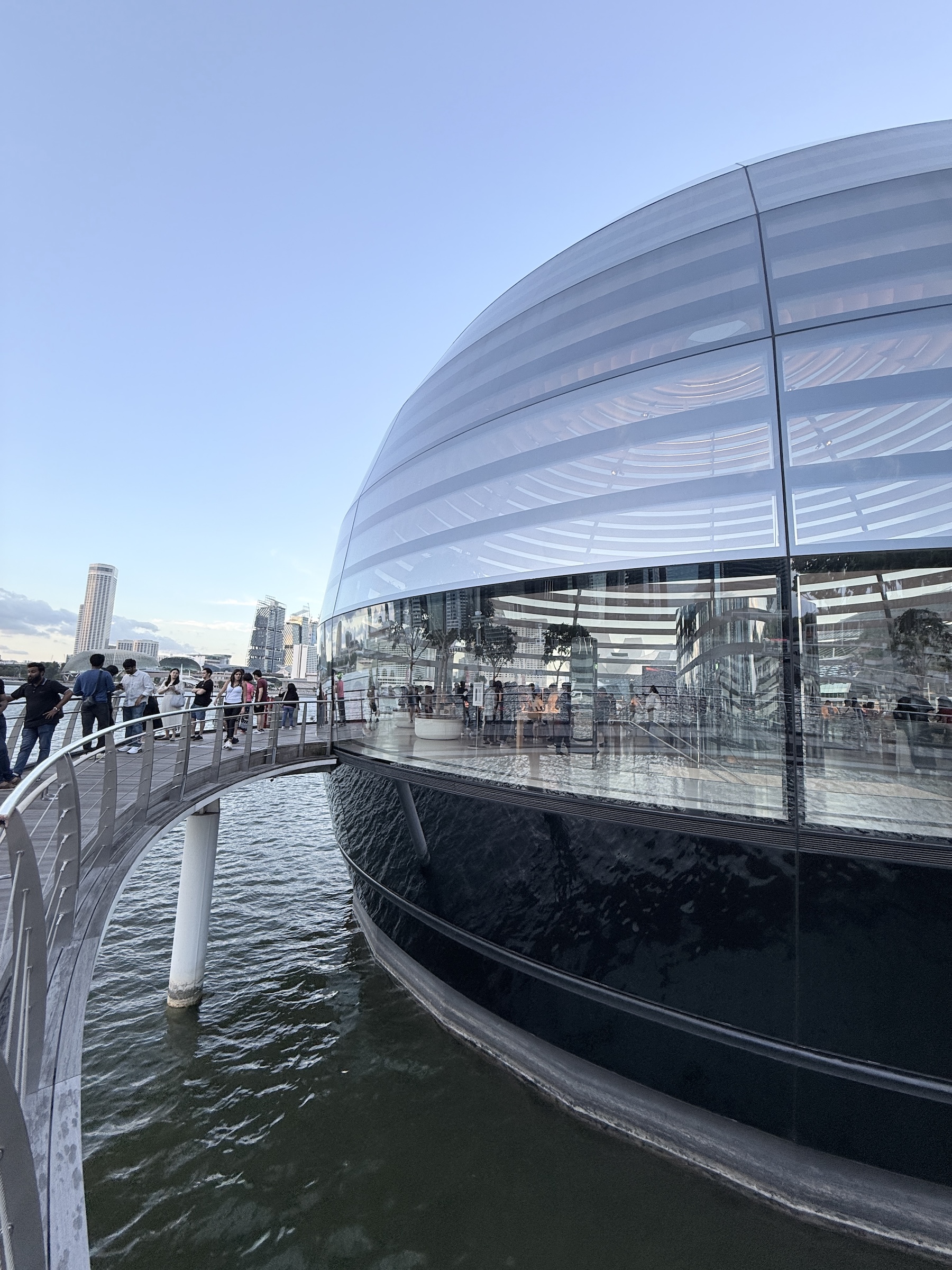
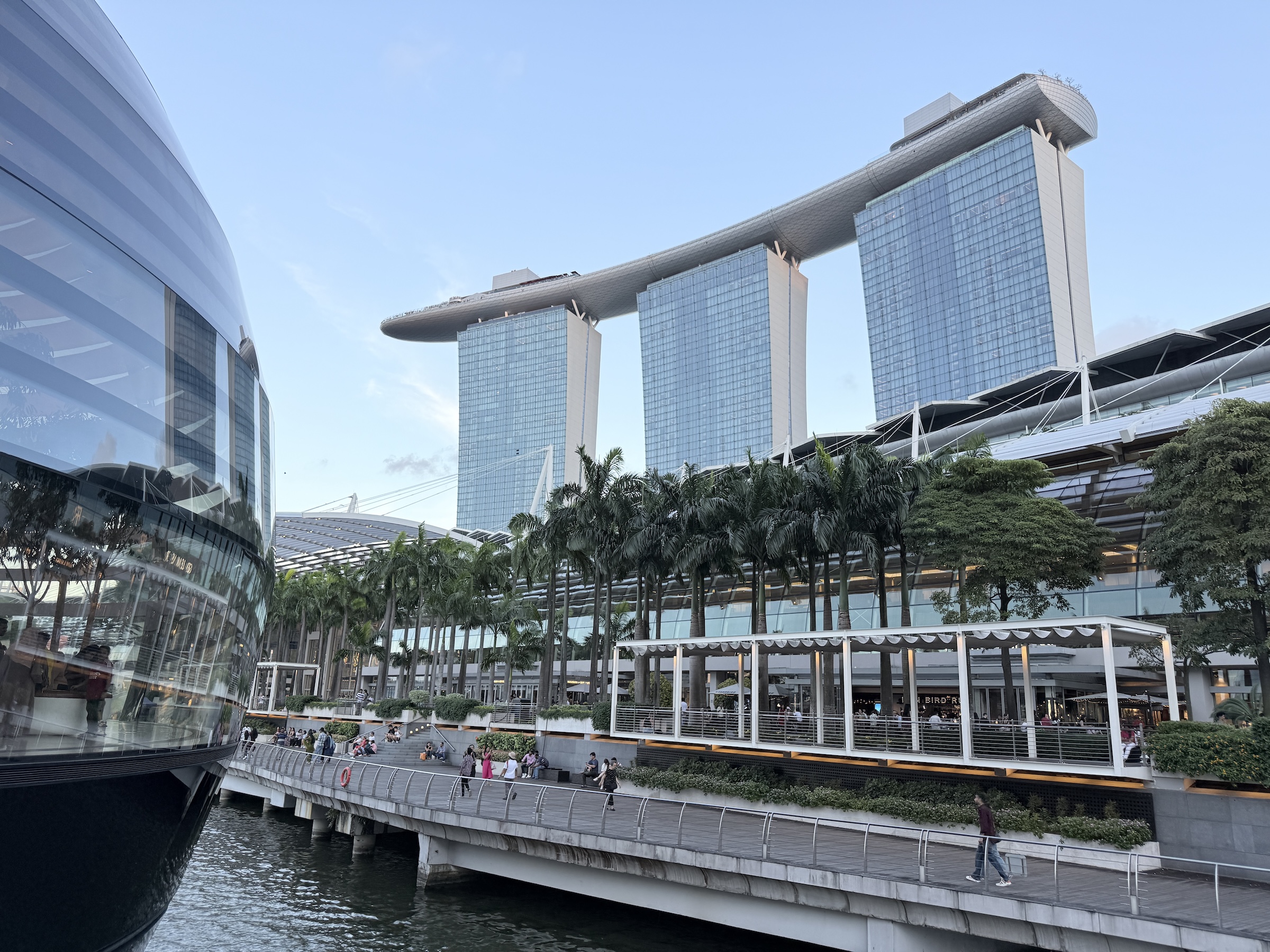
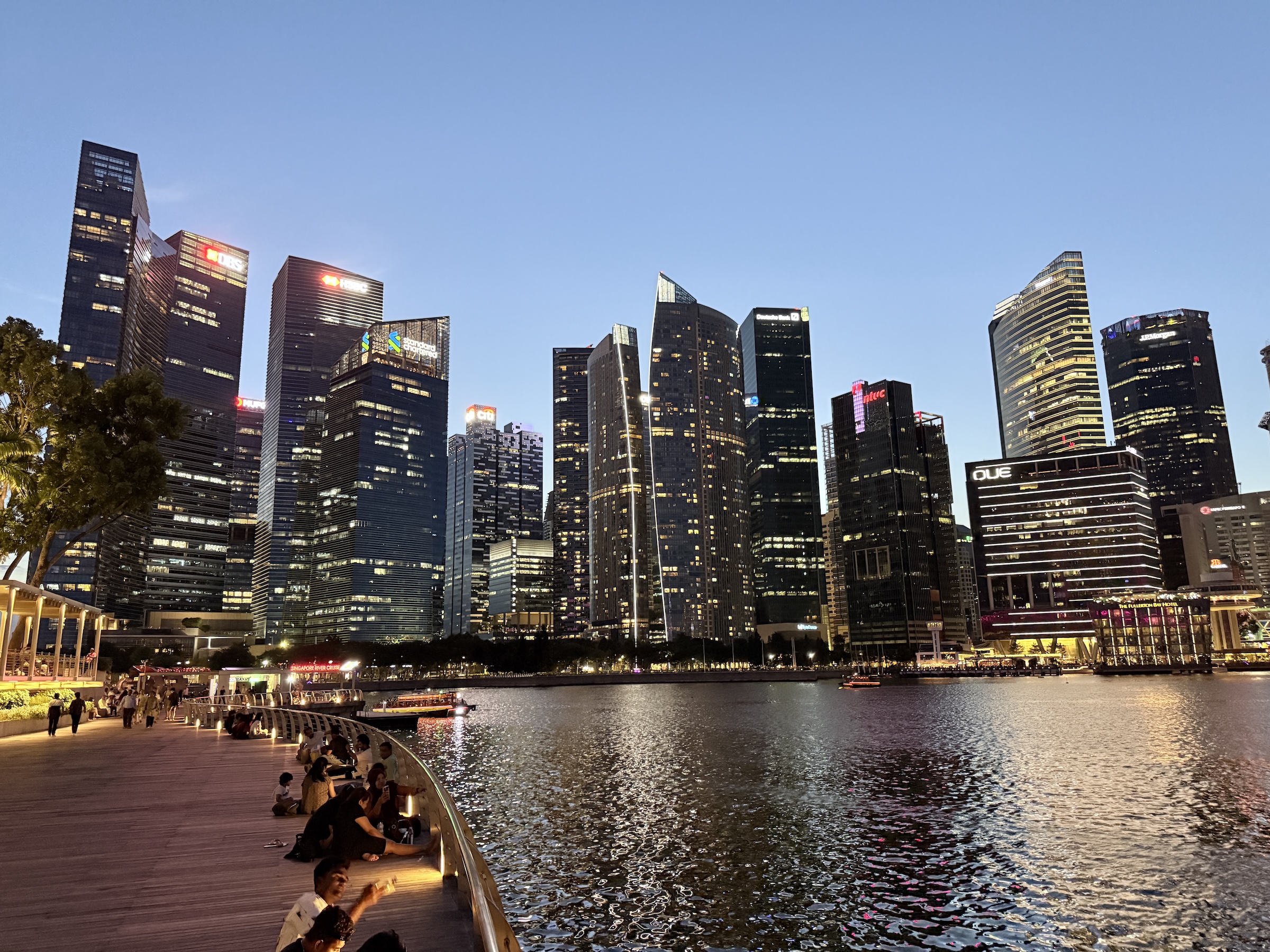
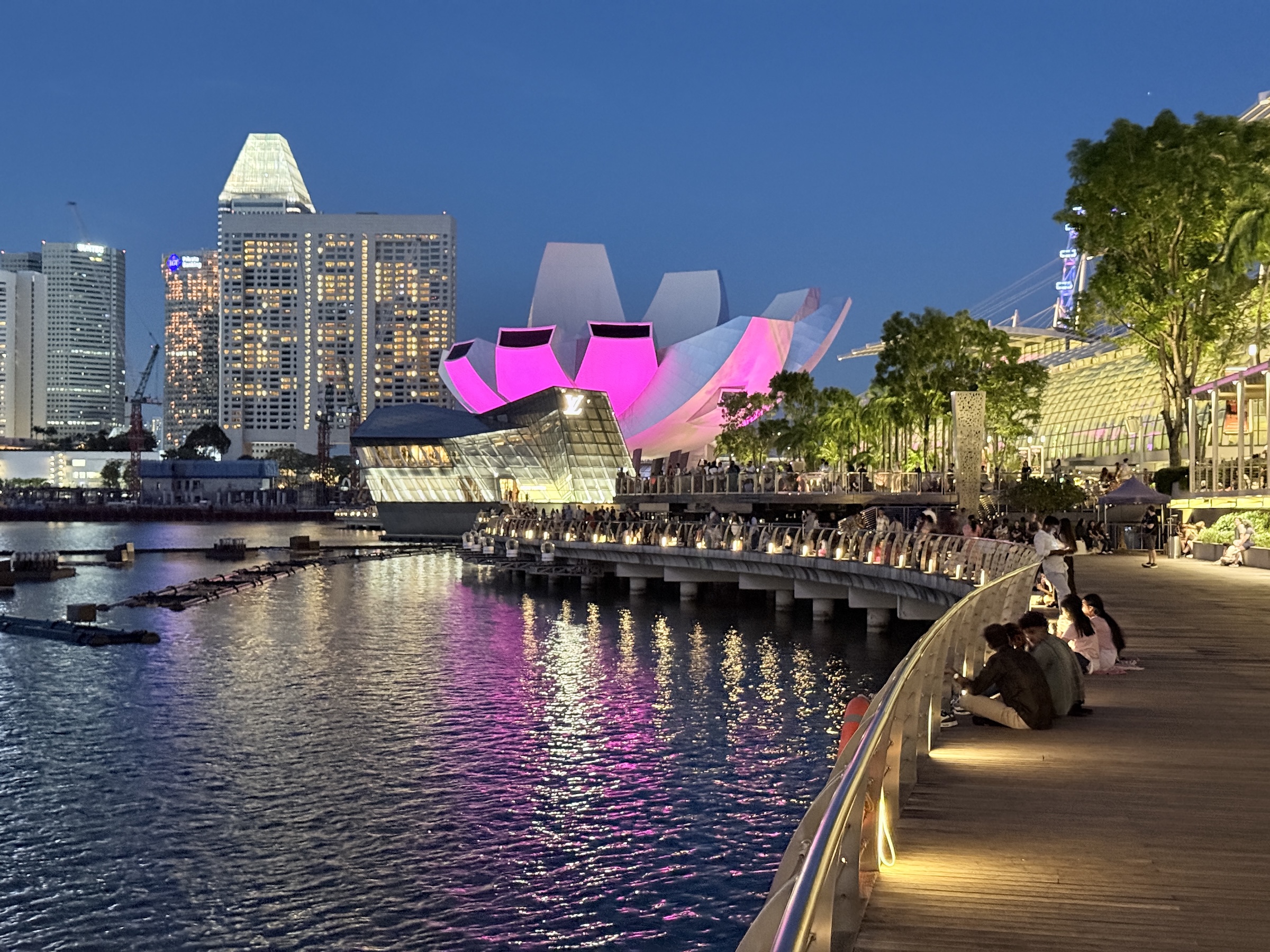
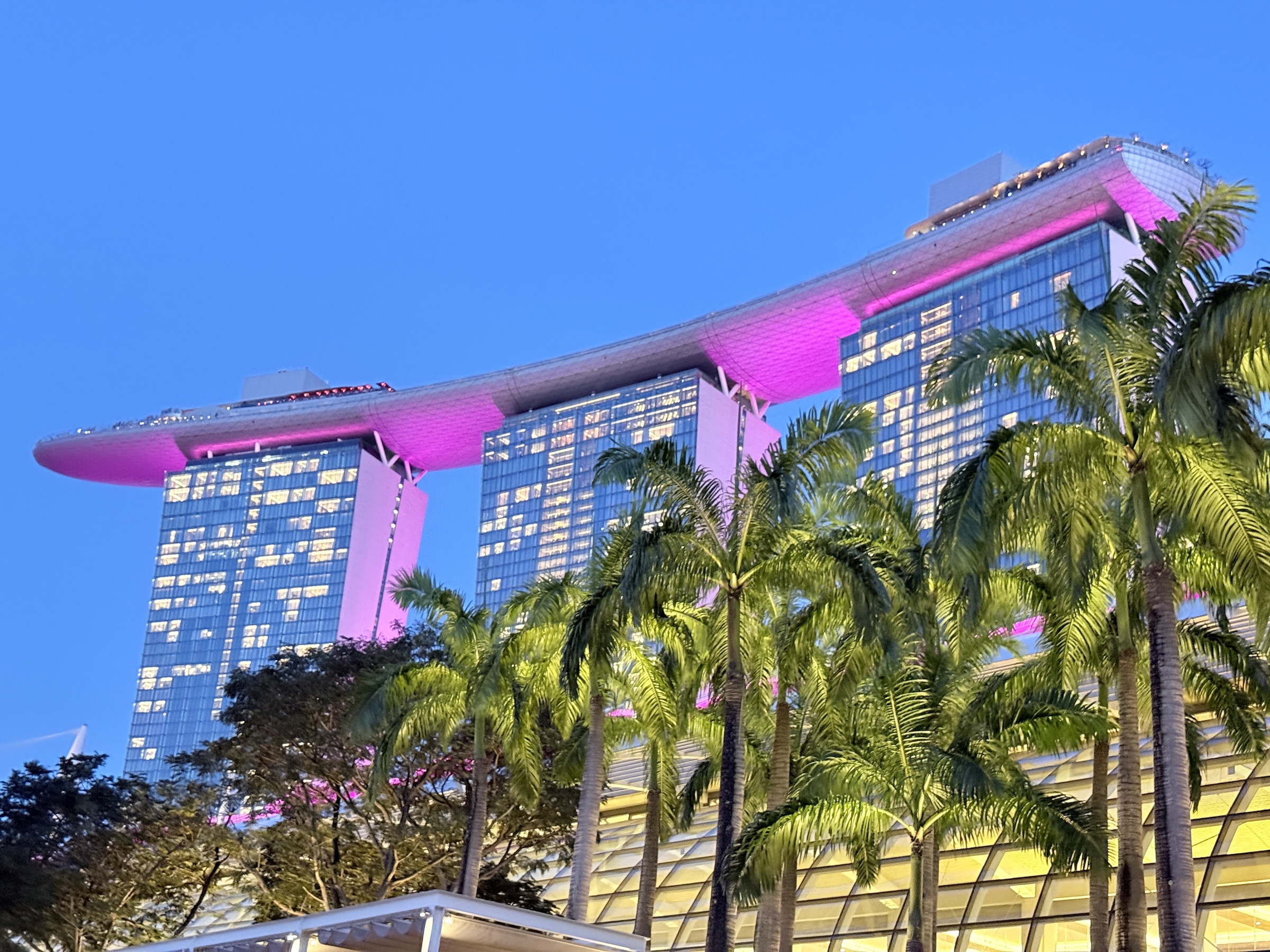
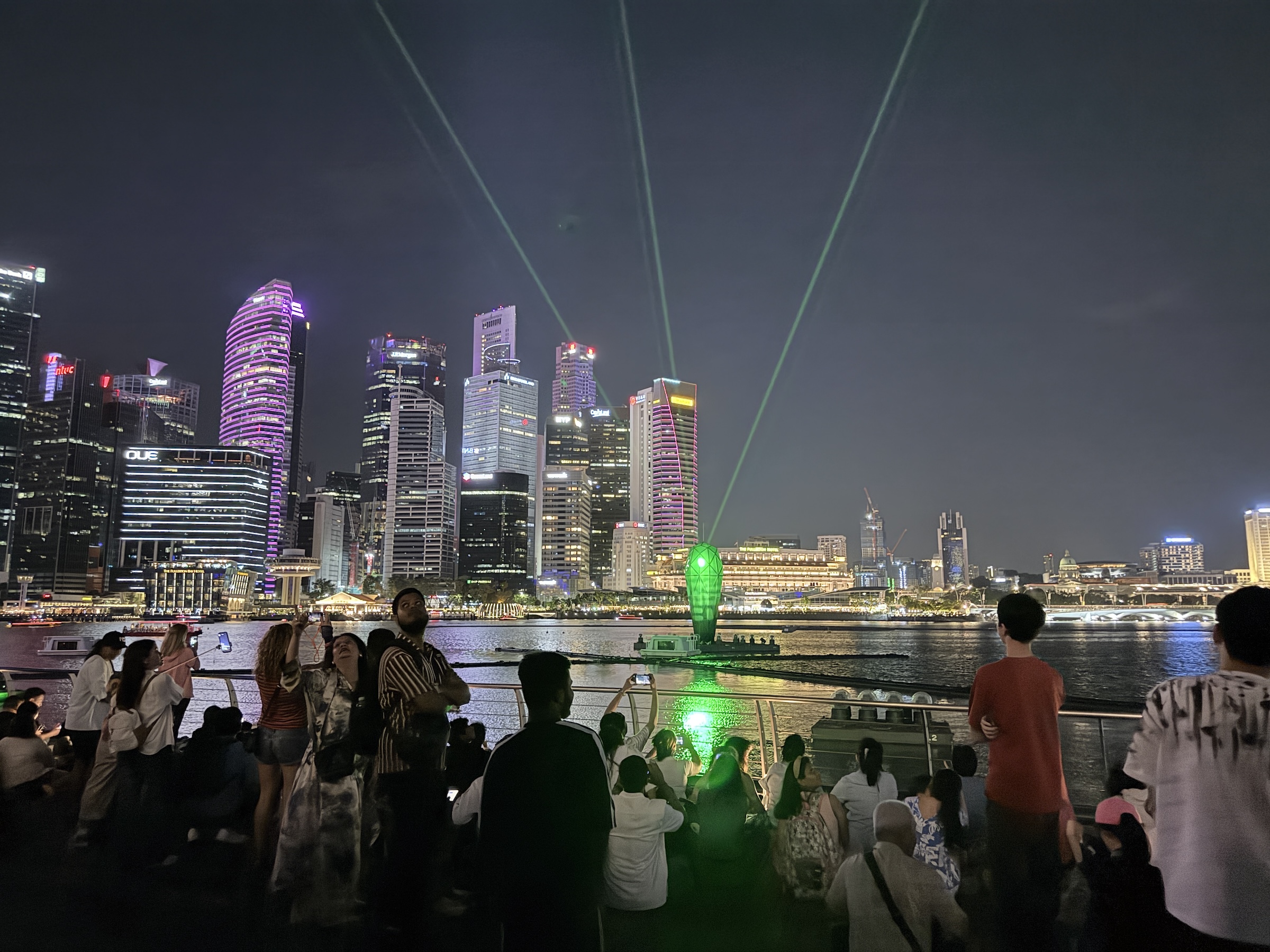
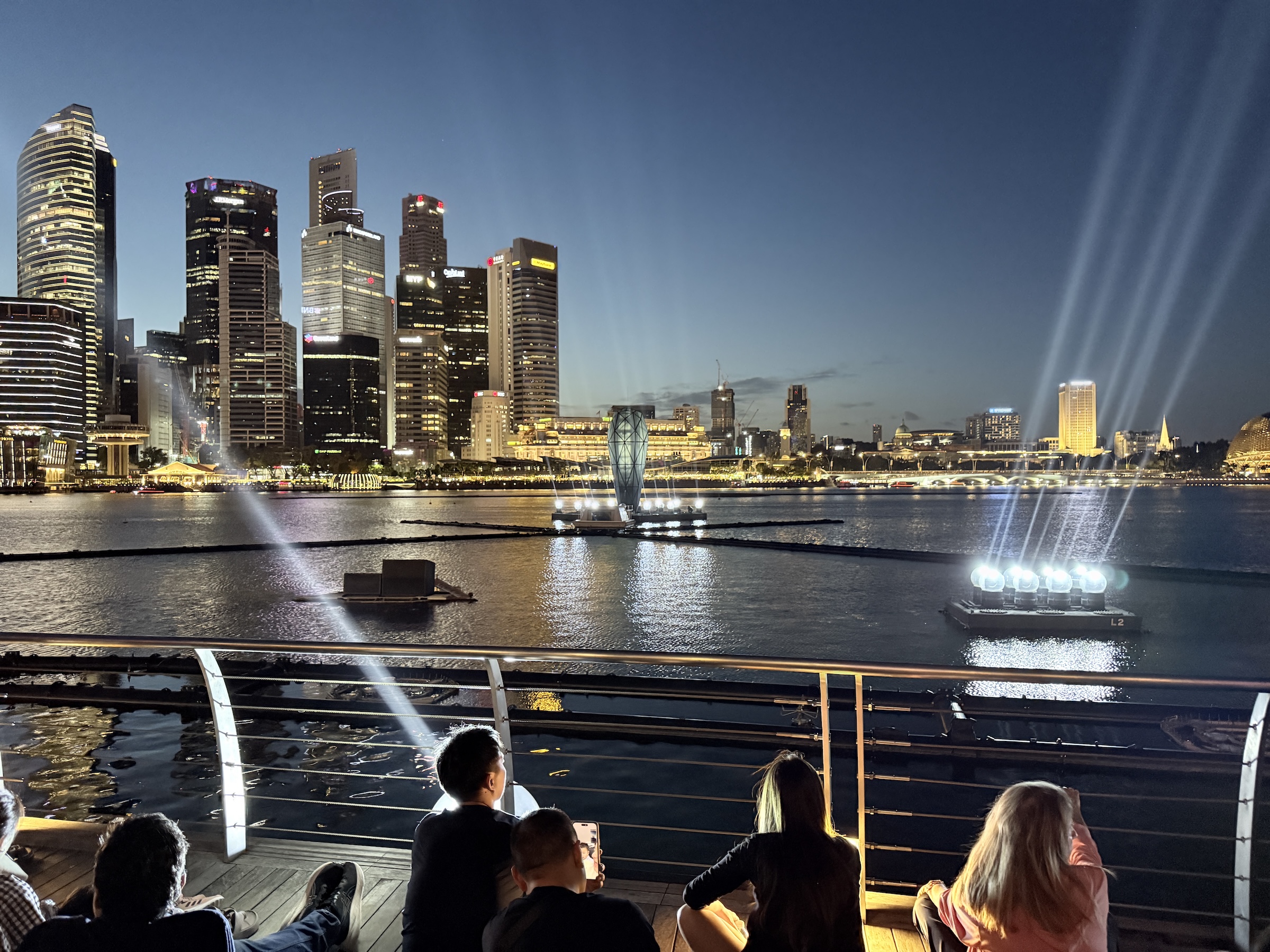
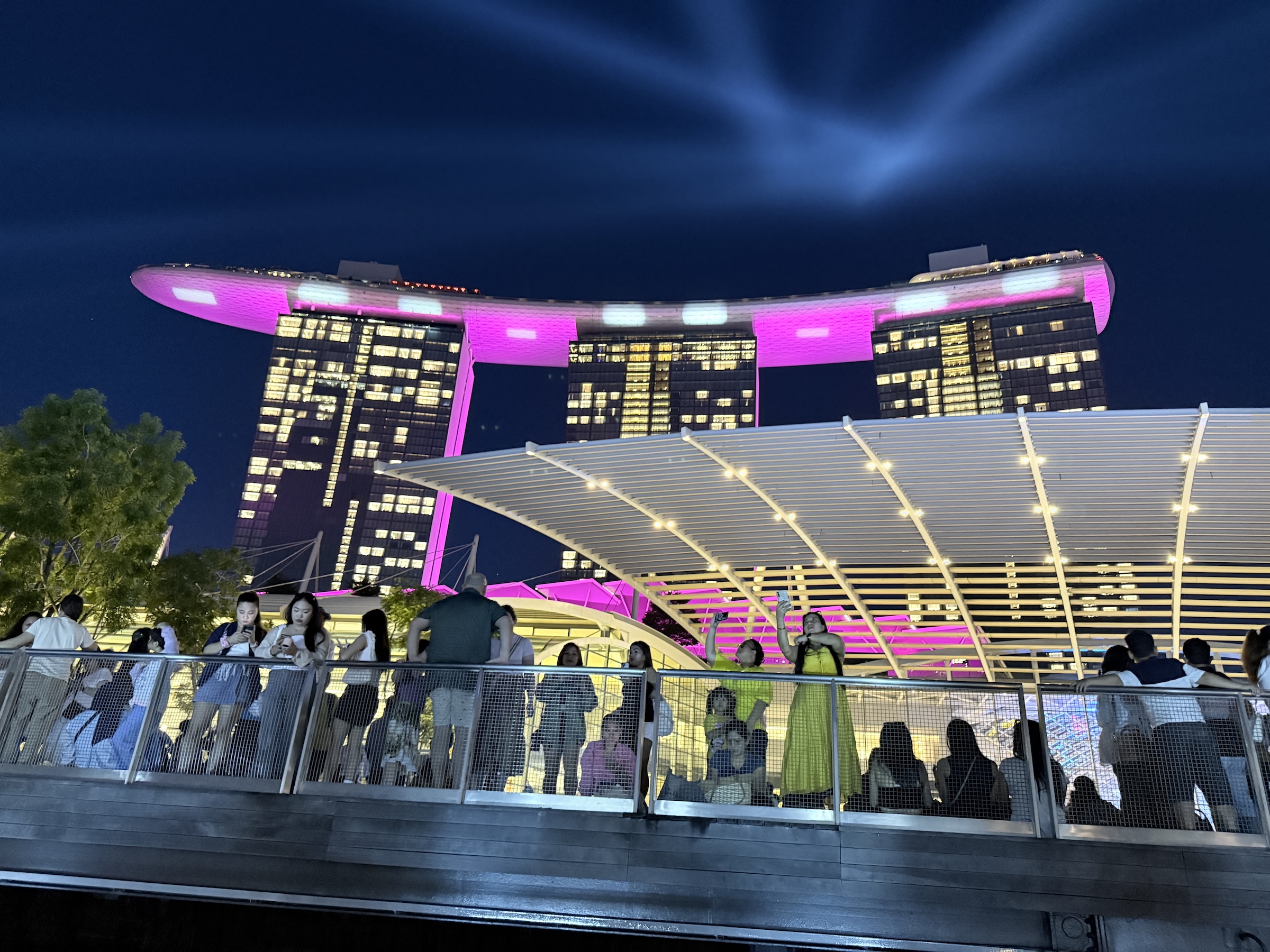
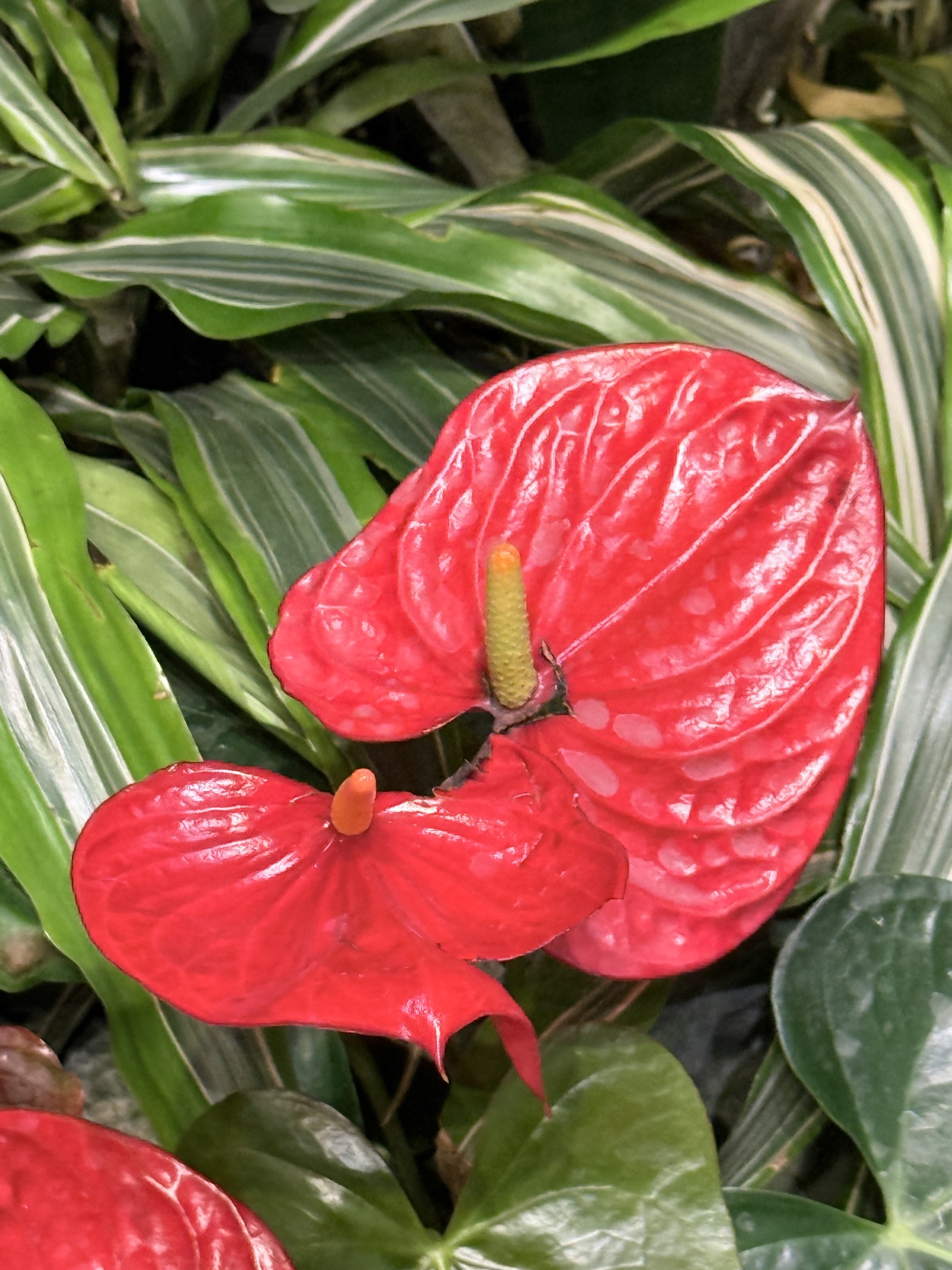
These pictures are all from the Marina Bay Waterfront Promenade where the Marina Bay Sands Hotel is.
The hotel’s grand opening was in February 2011.
It was designed by Moshe Safdie Architects (Safdie Architects), and features three tilted hotel towers linked by a massive, surfboard-like SkyPark at the top, housing gardens, restaurants, and the famous infinity pool, inspired by a deck of cards.
The sphere in the water is an Apple store and the building with the petals of a flower is the ArtScience Museum.
After sunset, there was a laser and fountain show.
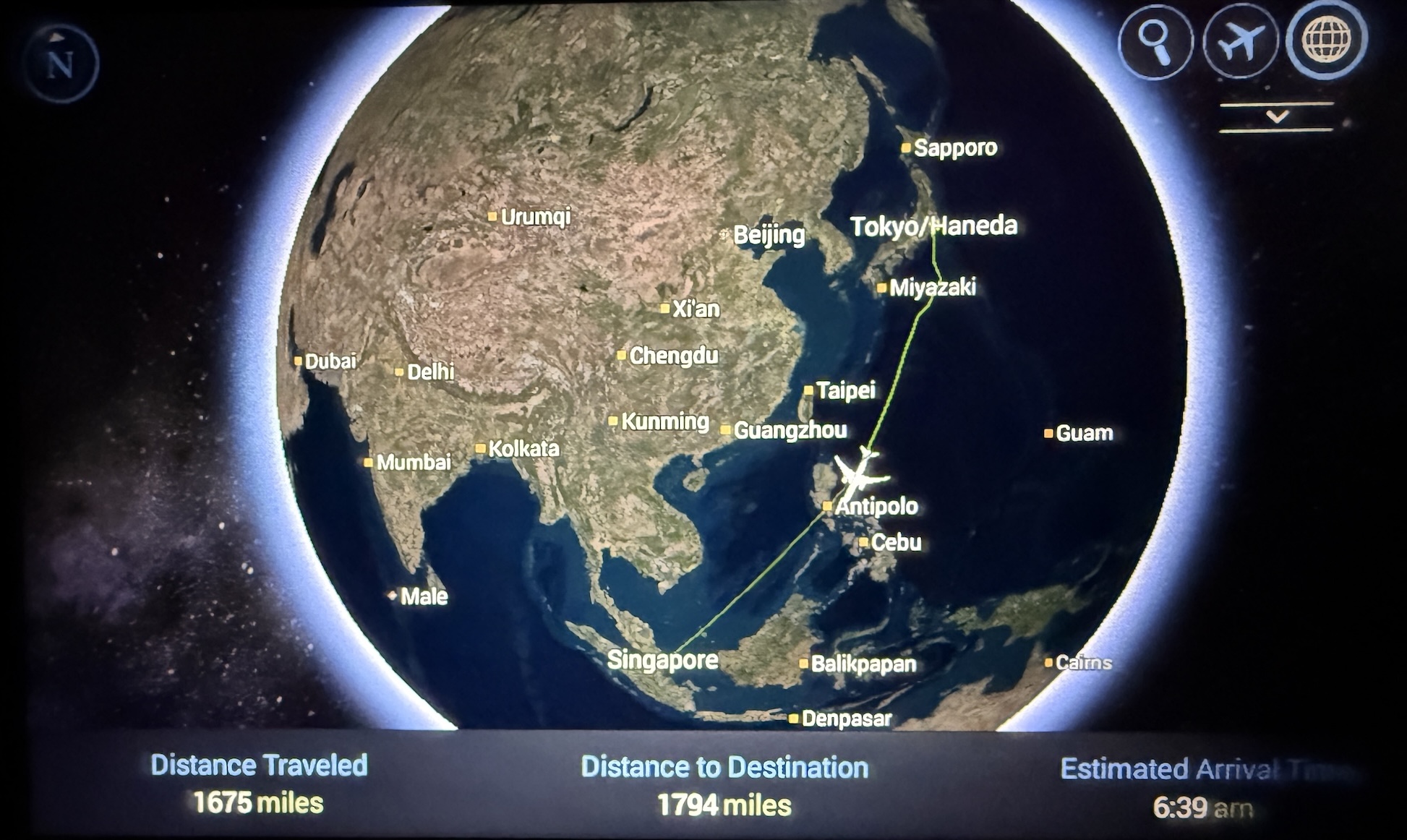
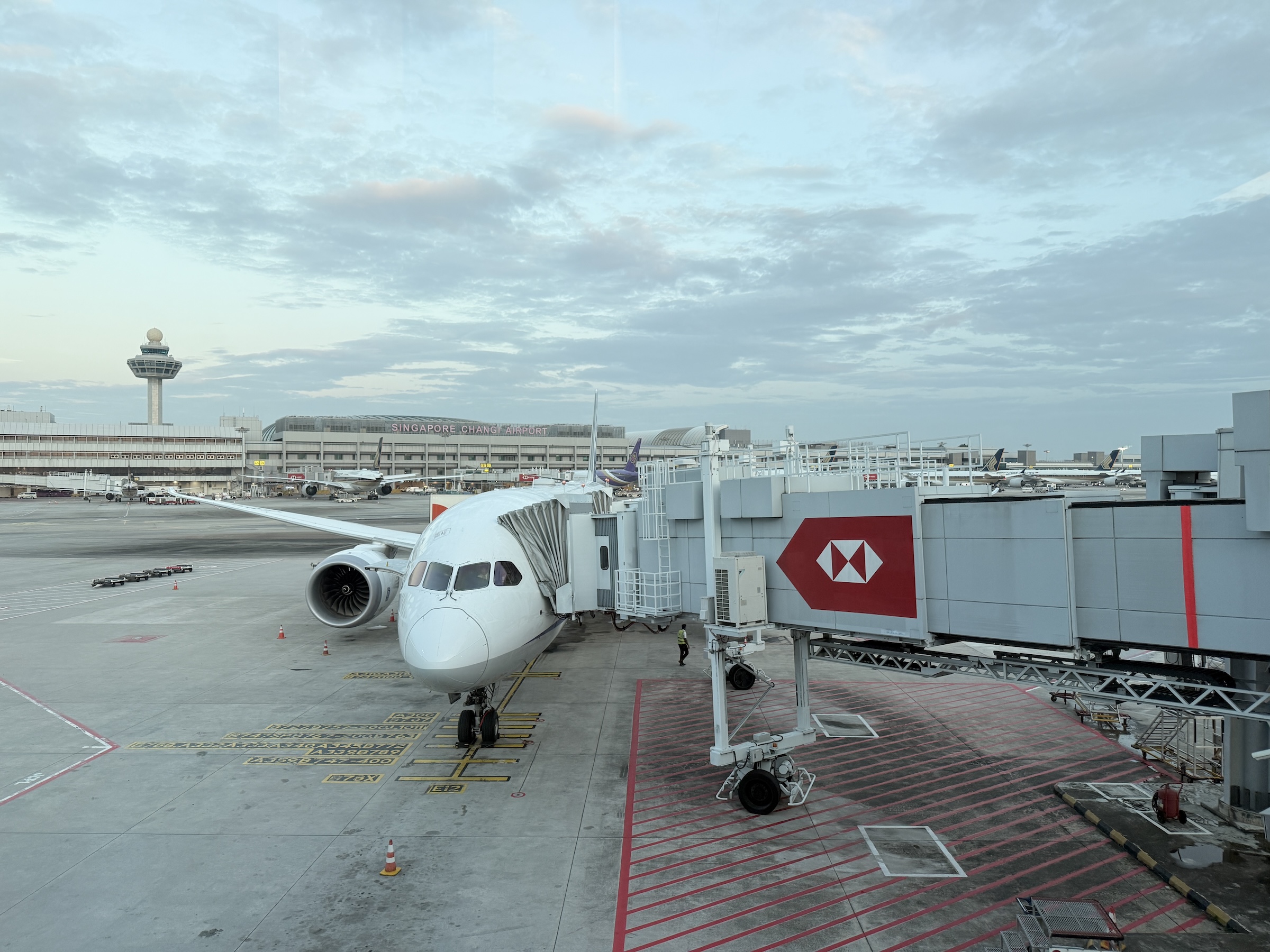
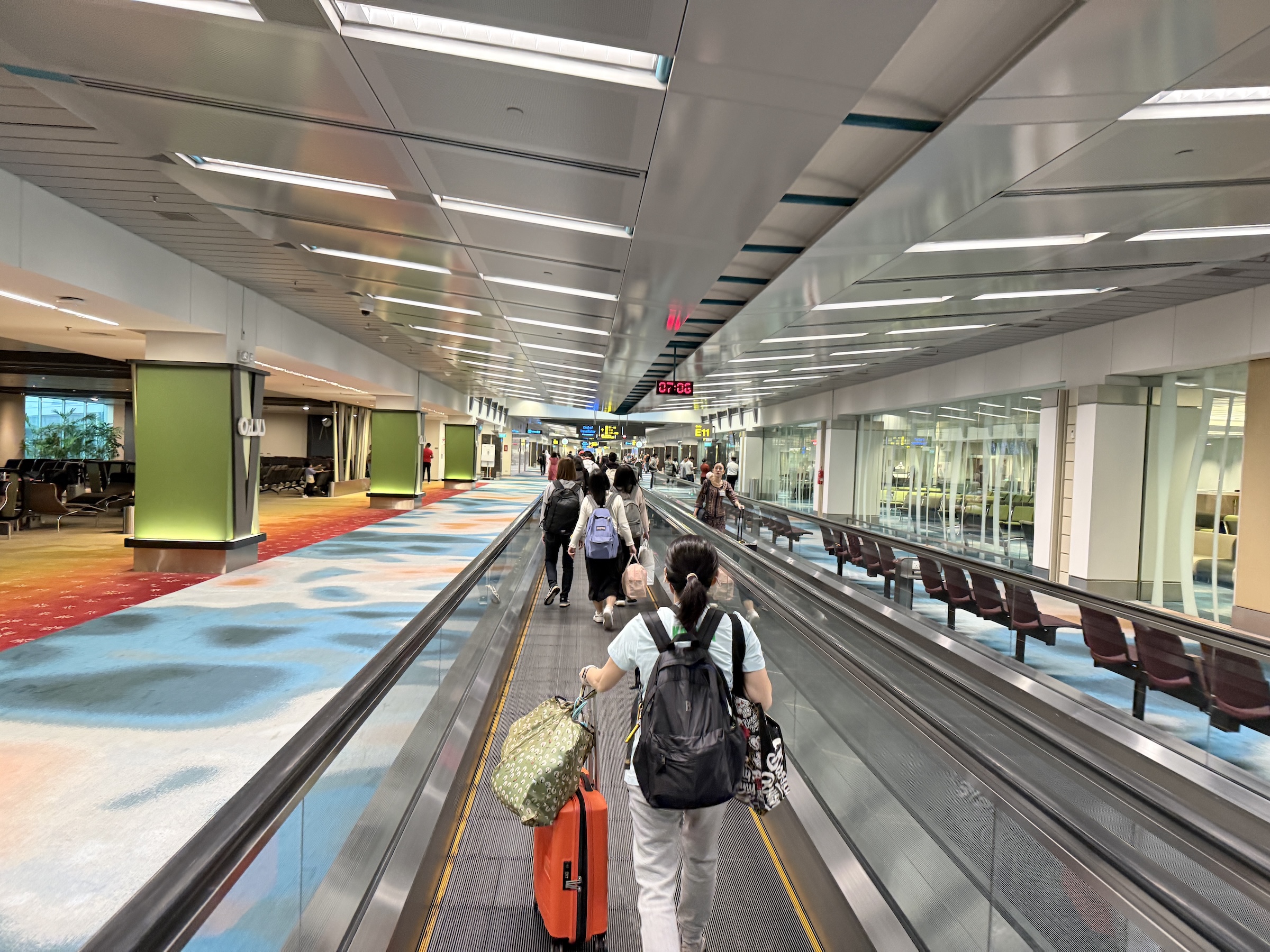
My red-eye flight that departed out of Tokyo after midnight local time (12.35 am), landed in Singapore at 6.55 am.
Passport control and customs was quick and efficient. I interacted with no humans— only with two camera stations.
One did a facial recognition scan (after I had scanned my passport picture page) and the other instructed me to press my right thumb on the glass for a fingerprint. Twenty seconds and done.
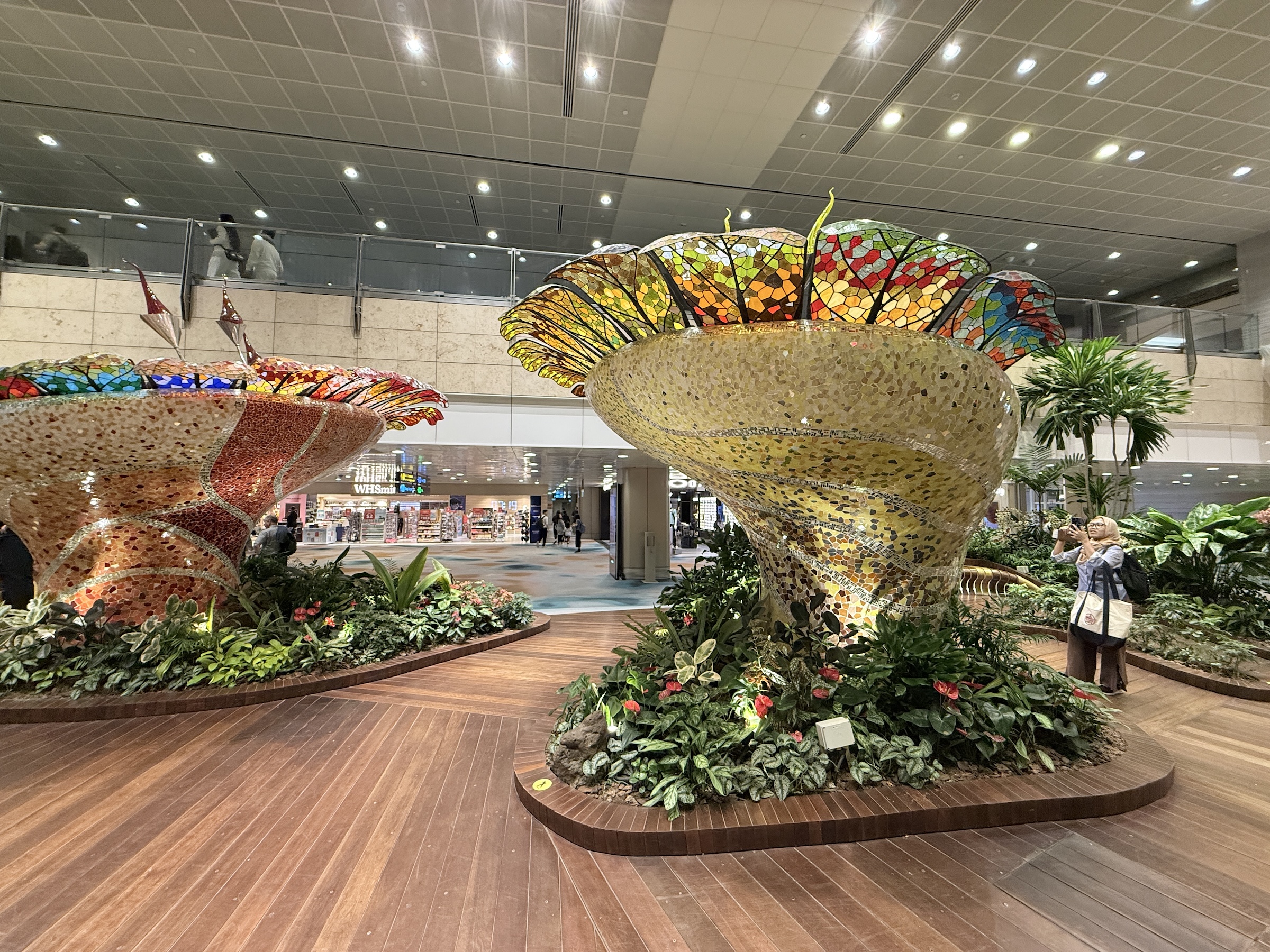
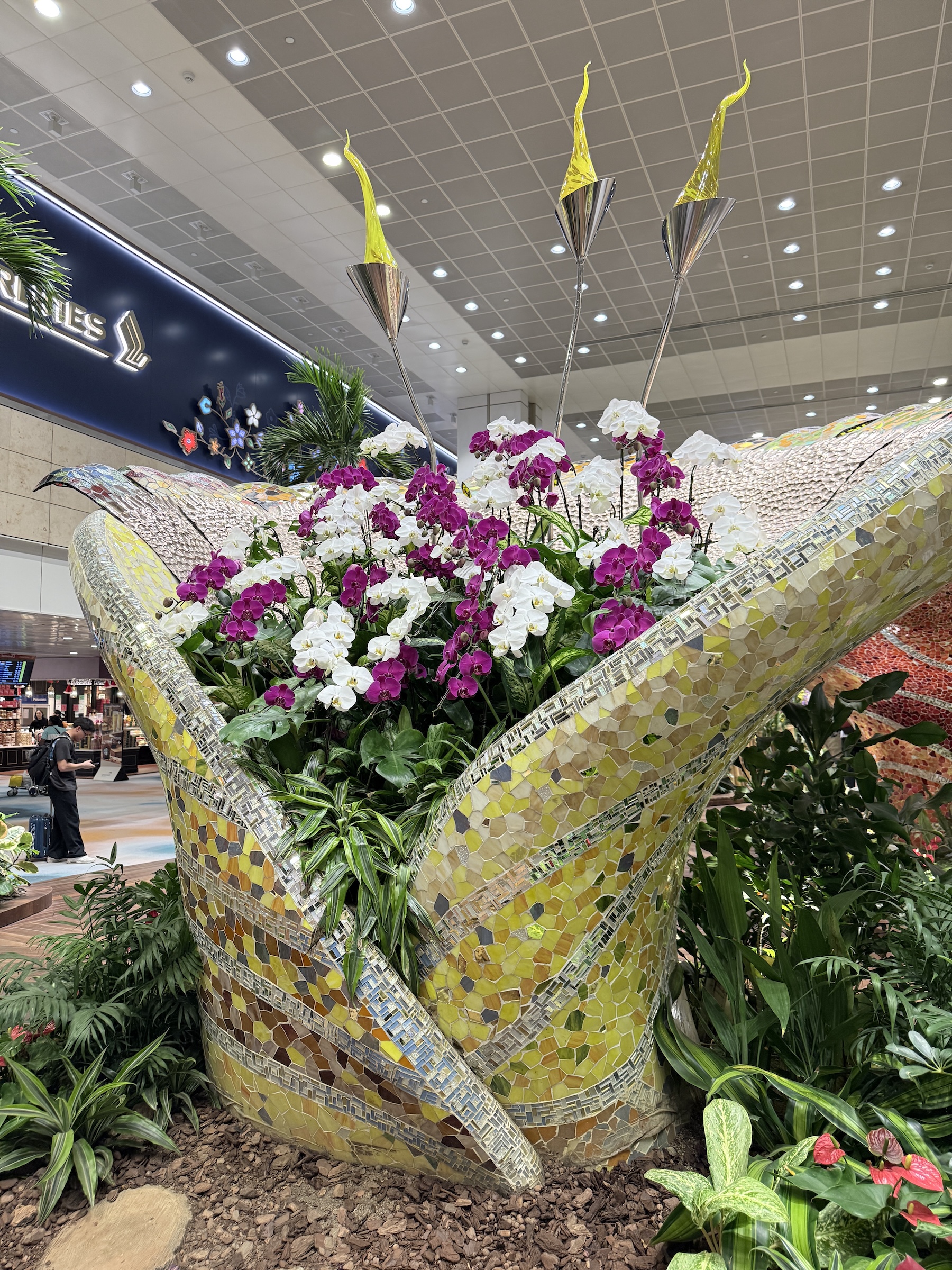
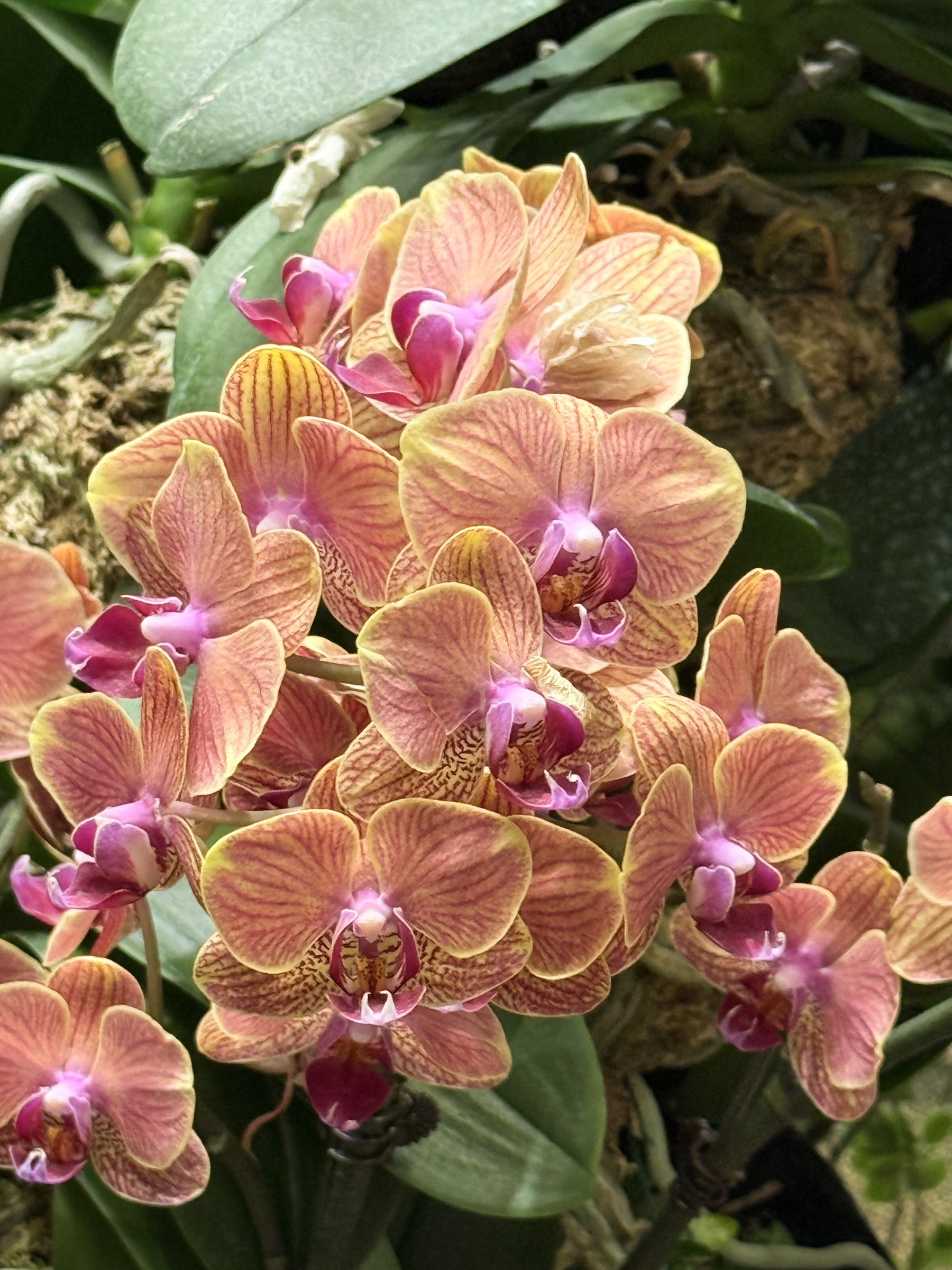
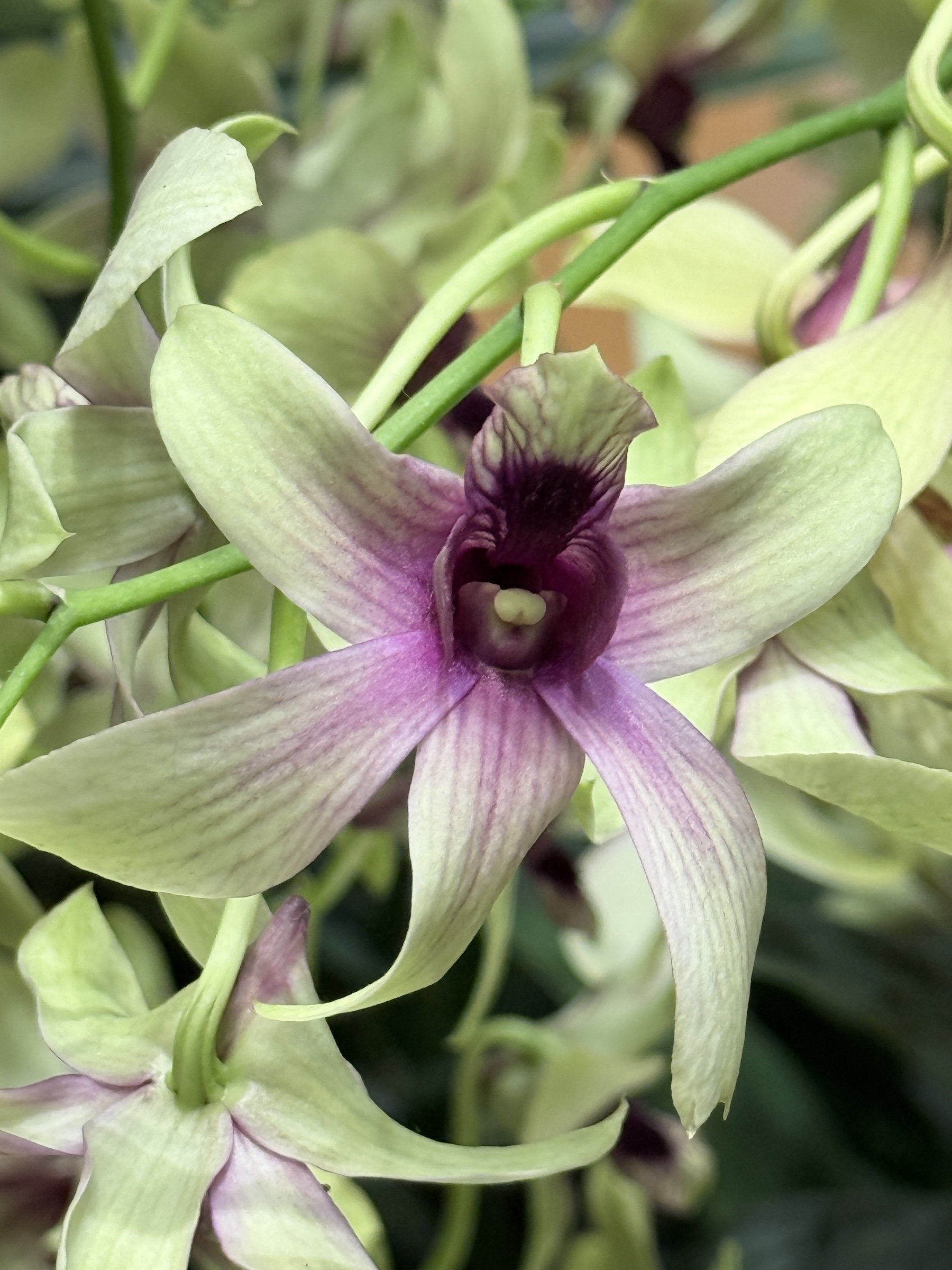
I took a few pictures of the orchids inside the secure area at Changi airport, and then had to move on to pick up my bags and go through passport control.
The mid-day conditions outside— 88°F (31°C) with a little humidity— is a shock to someone now used to Pacific Northwest winter weather.
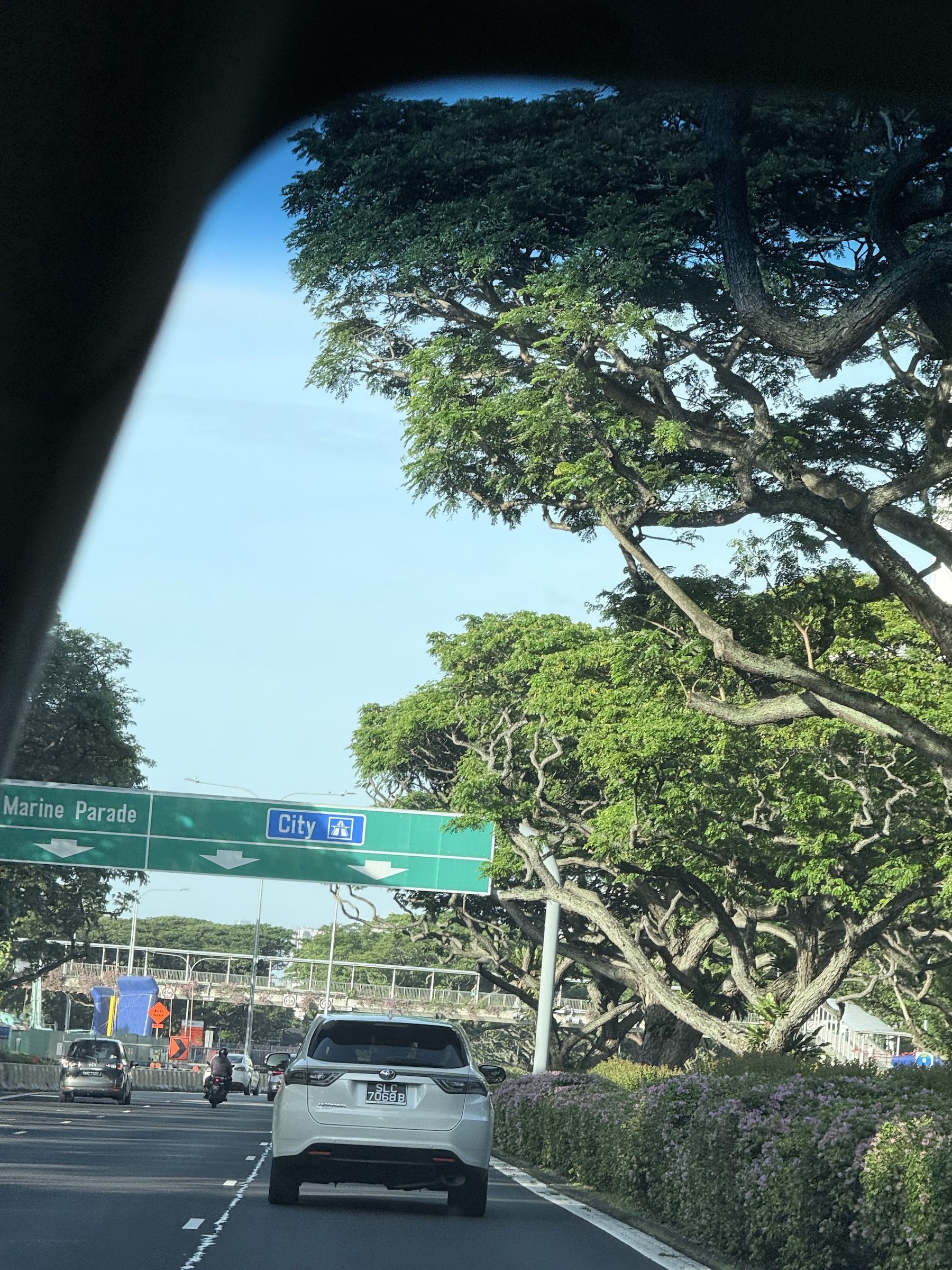
I took a taxi to the hotel, instead of roughing it by walking with my luggage and using the metro train.
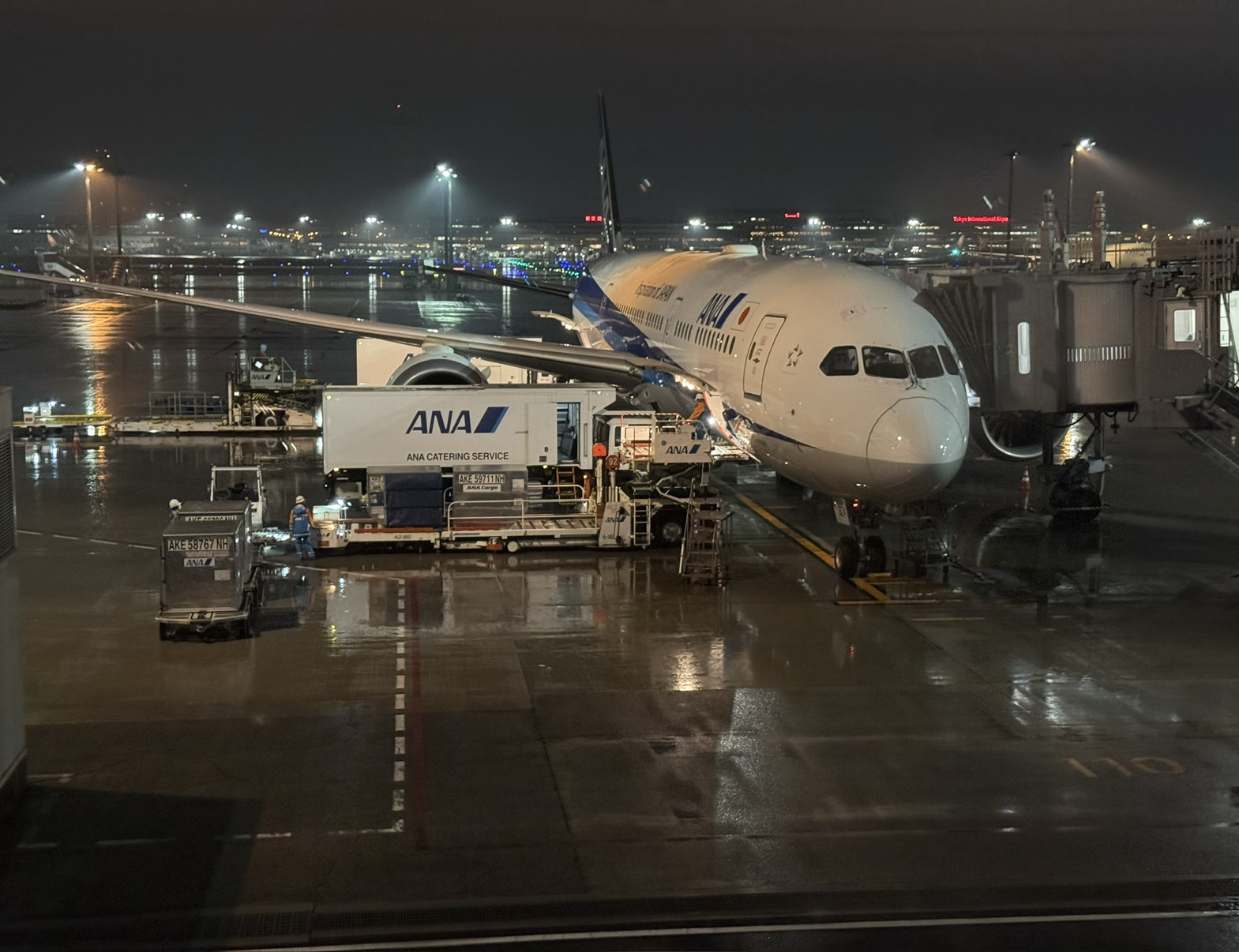
We arrived at Tokyo’s Haneda airport at 6.25 pm Saturday night local time (well past midnight, Friday night Seattle time).
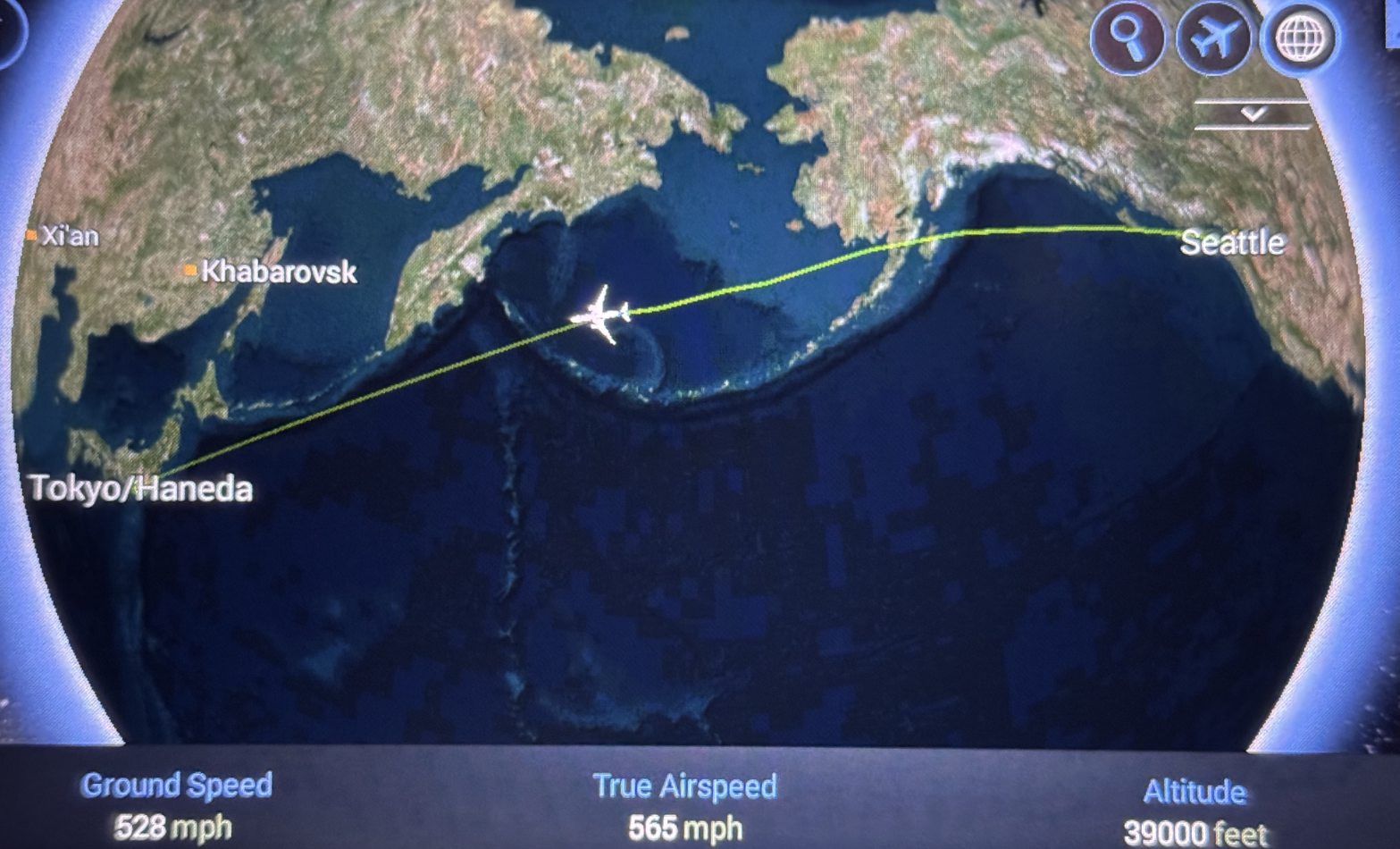
It’s 9 hrs 45 mins from Seattle to Tokyo, crossing the International Date Line (IDL) flying westward. There are two methods to calculate the arrival time in Tokyo: Method A Depart Seattle Friday 15.40 pm Fly 9 hrs 45 mins Arrive Seattle Saturday 1.25 am Arrive Tokyo Saturday 6.25 pm (Tokyo time = Seattle time +17 hrs) Method B Depart Seattle Friday 15.40 pm Arrive Tokyo 6.25 pm Is it Friday or Saturday in Tokyo? It’s Saturday (+1 day) because the IDL was crossed flying west to eastOur All Nippon Airlines ‘Inspiration of Japan’ Boeing 787-9 Dreamliner after arriving at the gate at Tokyo’s Haneda airport. There was a steady rain as we taxied in from the runway.
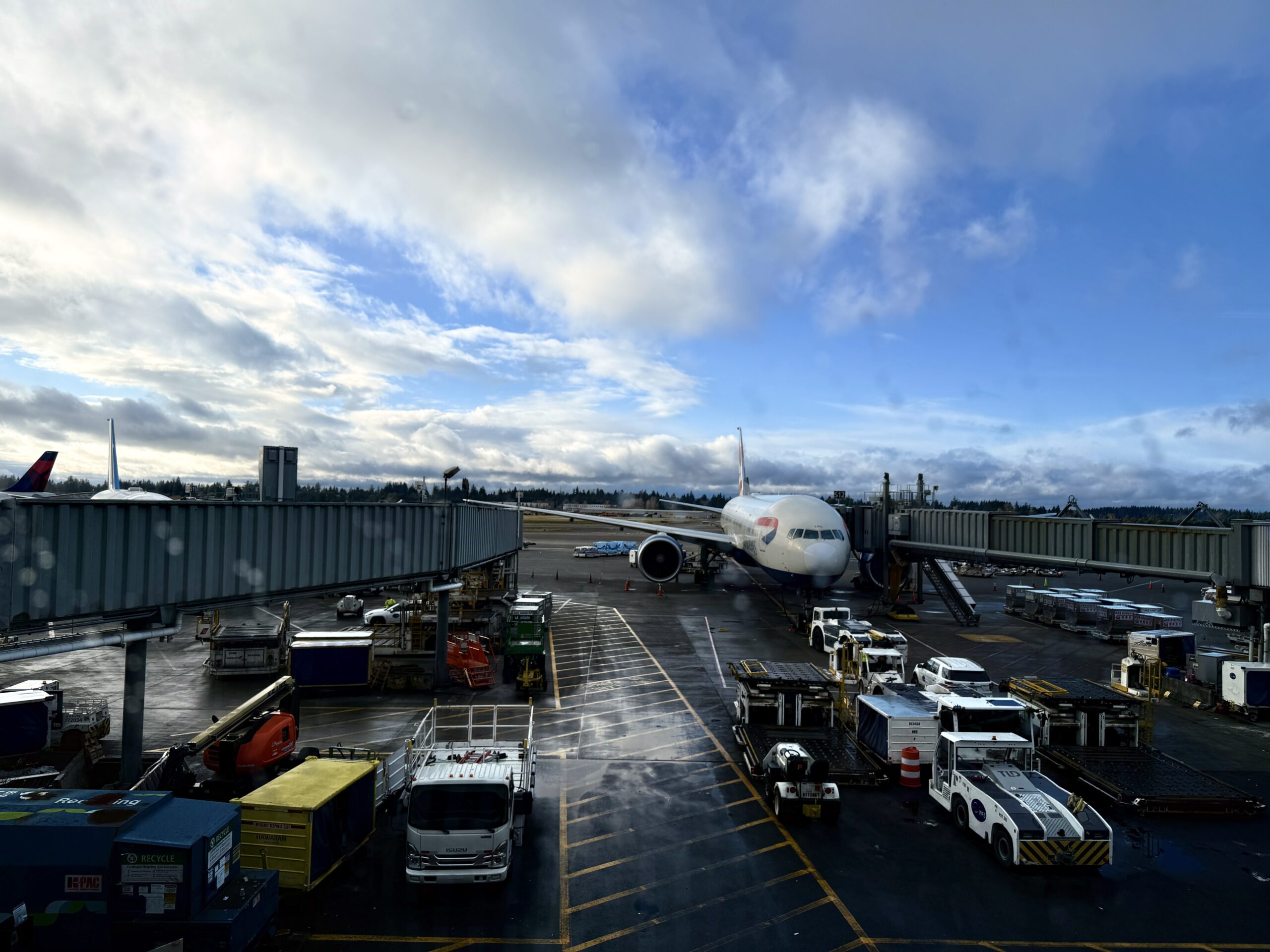
Here’s looking out the window at Gate S15 at Seattle-Tacoma’s South Terminal. This is British Airways 52 that departed for London a half-hour ago at 13.47 pm.
On the left I can see the tail of the All Nippon Airlines Boeing 787-9 Dreamliner that will fly us to Tokyo.
My bags are packed for my trip out tomorrow. (Well, almost. I still have to put a few things in and close them).
I fly out to Singapore on All Nippon Airlines with a stop at Haneda airport in Tokyo, Japan.
I will arrive in Singapore early on Sunday morning local time, and spend two days there before my Princess cruise departs on Tuesday.
We don’t have therapy llamas at Seattle-Tacoma airport— and I really should be OK without needing these gentle beasts for my flight out tomorrow. 😁 (Do they not have a reputation for spitting at you if they find you annoying? I will have to look into that first before I get too close too them). [Page from the online Readers Digest at rd.com]
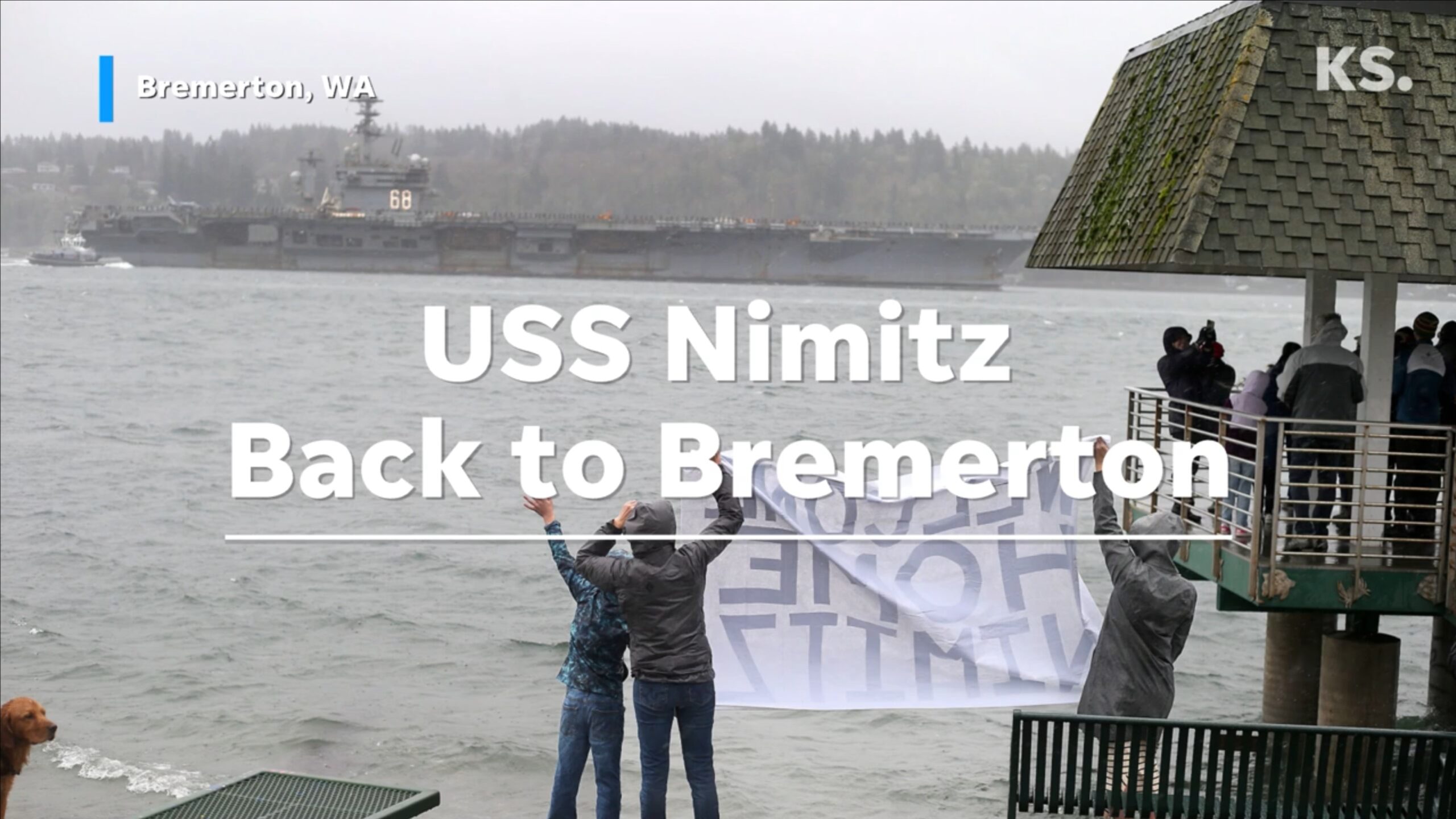
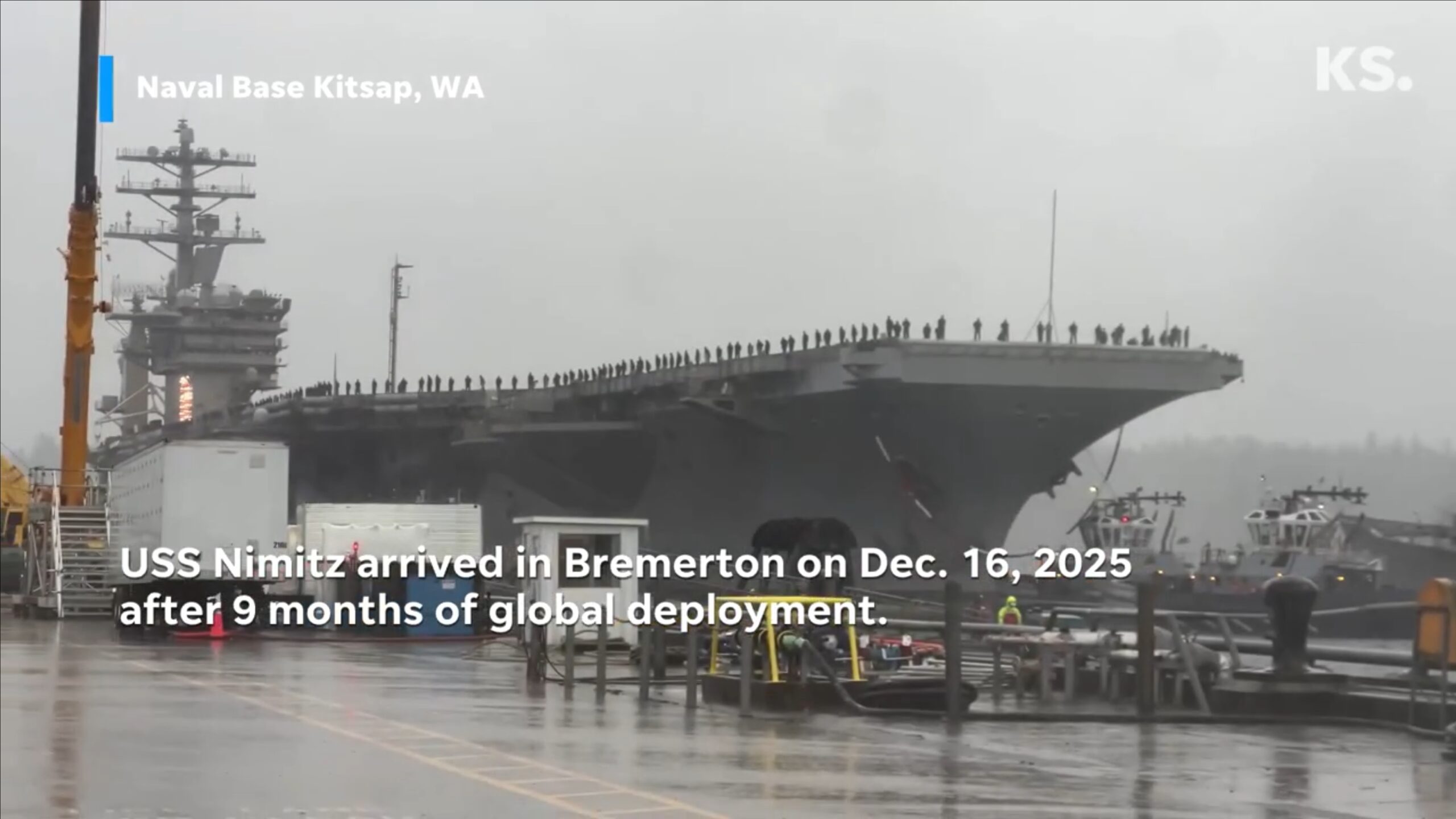
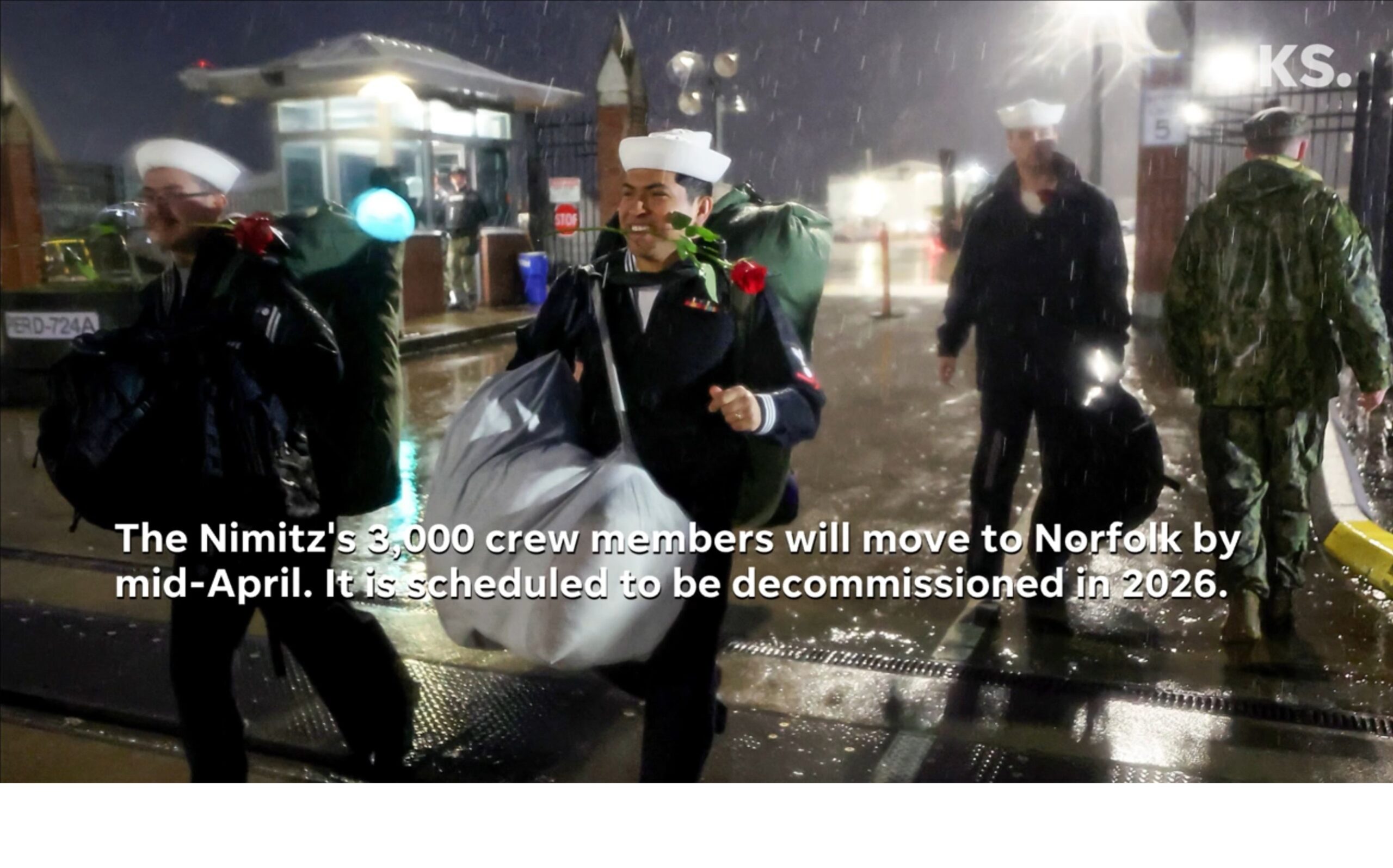
Aircraft carrier USS Nimitz* returned to her home port in Bremerton yesterday after a 9-month deployment— her very last one, after being in service for 50 years.
*Named after World War II Pacific fleet commander Chester W. Nimitz, USN, (1885–1966), who was the Navy’s third fleet admiral.
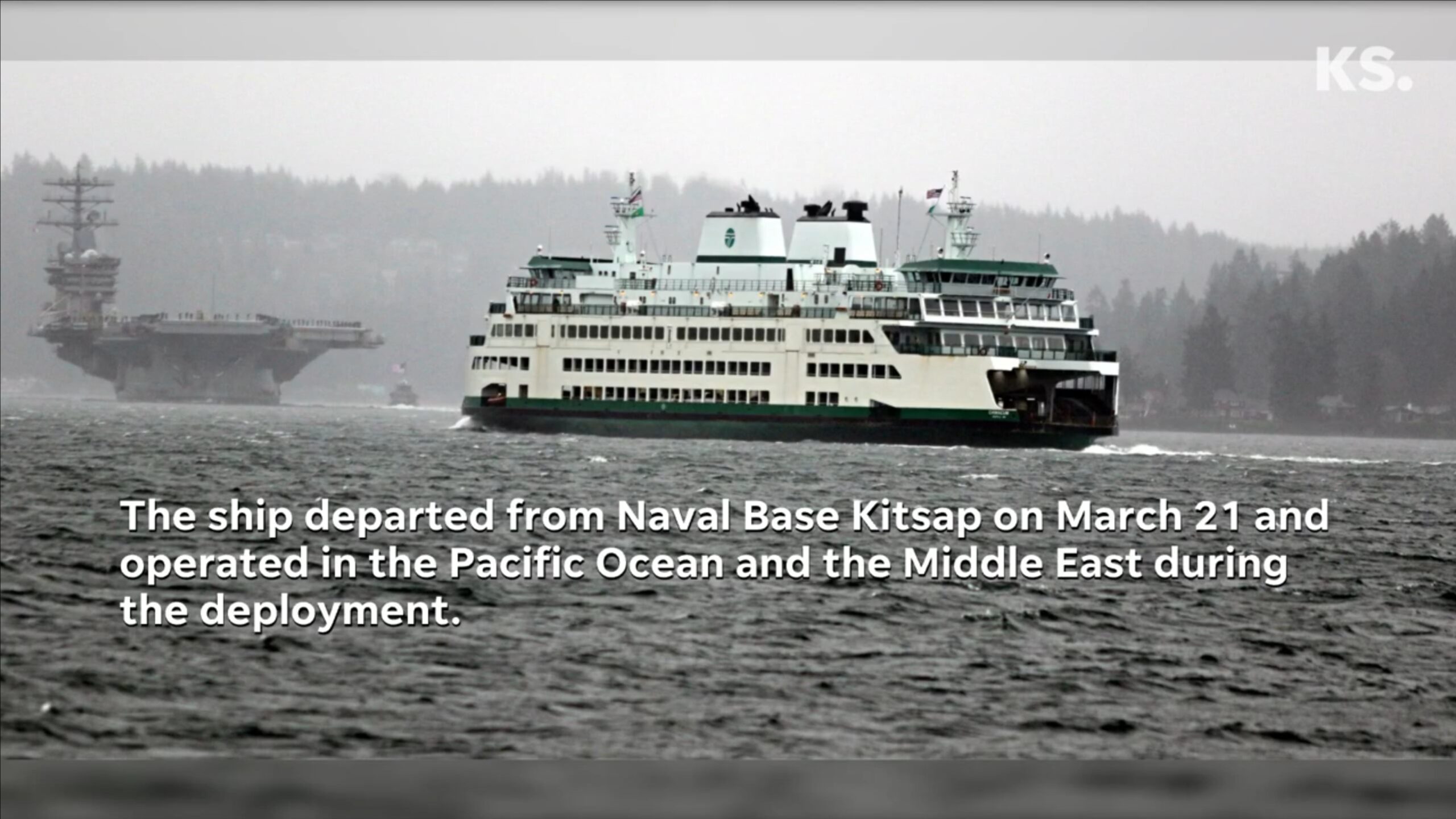
The stills below are from a video posted on kitsap.com.
From navytimes.com:
The USS Nimitz aircraft carrier docked in its homeport of Naval Base Kitsap in Bremerton, Washington, on Tuesday for what is scheduled to be its final visit there. The Nimitz returned from a nine-month deployment to the U.S. 3rd, 5th and 7th Fleets that began March 21 when it set sail from Kitsap.
“We have traveled more than two-thirds of this planet during this nine-month deployment, and I cannot overstate the positive impact Nimitz Strike Group has made as part of our mission to maintain peace through strength by sustaining credible deterrence alongside our allies and partners,” said Rear Adm. Fred Goldhammer, commander of Carrier Strike Group 11, according to a release.
The world’s oldest aircraft carrier, commissioned in 1975 with a service lifespan of 50 years, is set to return to Naval Station Norfolk, Virginia, in 2026 and be decommissioned.
It was 250 years ago when English writer Jane Austen was born— on 16 Dec. 1775 in the village of Steventon, north Hampshire, England.
From Wikipedia:
Austen’s plots often explore the dependence of women on marriage for the pursuit of favorable social standing and economic security.
Her works are implicit critiques of the novels of sensibility of the second half of the 18th century and are part of the transition to 19th-century literary realism.
Her use of social commentary, realism, wit, and irony have earned her acclaim amongst critics and scholars.
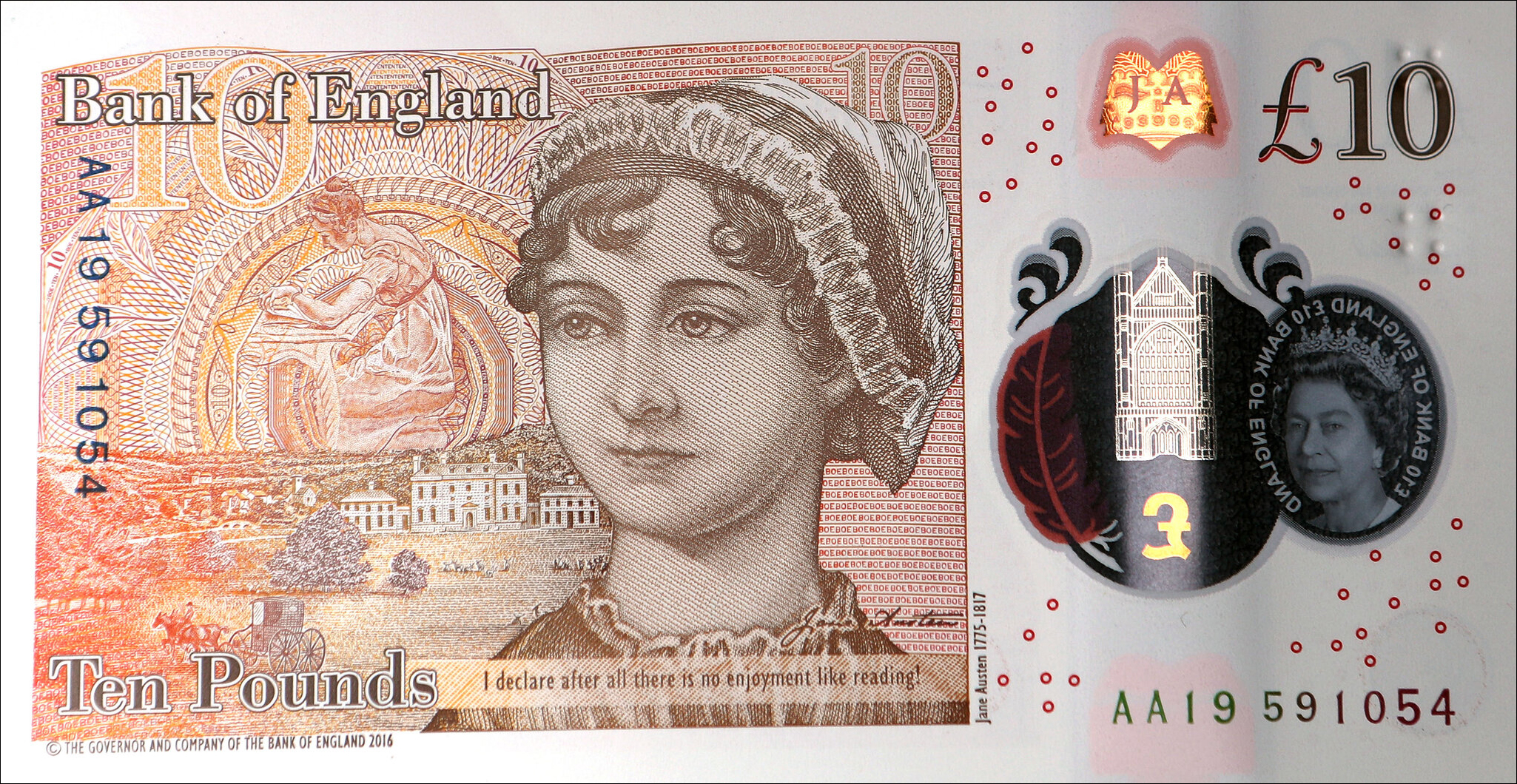
In 2017, Jane Austen’s image was added to the Bank of England’s £10 note. The note carries the quotation, “I declare after all there is no enjoyment like reading!”, said by Caroline Bingley in ‘Pride and Prejudice’ (1813).
P.S. As far back as 2015, then-Treasury Secretary Jack Lew announced that there were plans afoot to ‘feature the likeness of a woman who has played a major role in American history and has been a champion for democracy’ (no specific name was mentioned then). As of now, the U.S. is actively working to feature women on its banknotes, with plans to put abolitionist Harriet Tubman on the $20 bill, replacing Andrew Jackson, with a target release around 2030, coinciding with security updates for other denominations, though the process has faced delays— delays of a logistical and political kind.
The rain has started again, and there was a failure in the levee alongside the Green River in Tukwila at around 11:30 a.m.
King County emergency officials sent out a warning of ‘life threatening flash flooding’ for the nearby low-lying area of some 46,000 residents.
There were no injuries as a result of the breach, though. Soon thereafter the area under threat was narrowed down and involved only about 1,100 people, who were urged to evacuate.
The county’s flash flood warning ended by 6.30 pm.
A crew moves sandbags into a gap where a levee was breached along the Green River in Tukwila on Monday, Dec. 15, 2025. From the Seattle Times: Repairs were underway for the breached levee and were expected to be done Monday evening, said John Taylor, director of the county’s Department of Natural Resources and Parks. But the risk isn’t over. Whole sections of the levees were soaked through after more than a week of heavy rain and high river levels. Already other spots were seeing water seeping through, and county officials expected to monitor the structure through the coming days, with even more rain in the forecast. [Photo by Ellen M. Banner / The Seattle Times]
From the ‘At Home in the Northwest’ supplement to the Seattle Times [Photo by Jiajing Grygriel]From the ‘At Home in the Northwest’ supplement to the Seattle Times [Photo by Jiajing Grygriel]Jiajing Grygriel writes for this Sunday’s ‘At Home in the Northwest’ supplement to the Seattle Times:
The mail carrier slows his van down to a crawl and gapes. “Is that you folks’ statue?” he hollers out the window. “This is amazing. I love it so much!”
A jaw drop is the typical response for people passing by this storybook home in Ballard. The 1936 house looks straight out of the pages of a fairy tale, with its steeply pitched roof, rustic stone chimney and turreted entryway.
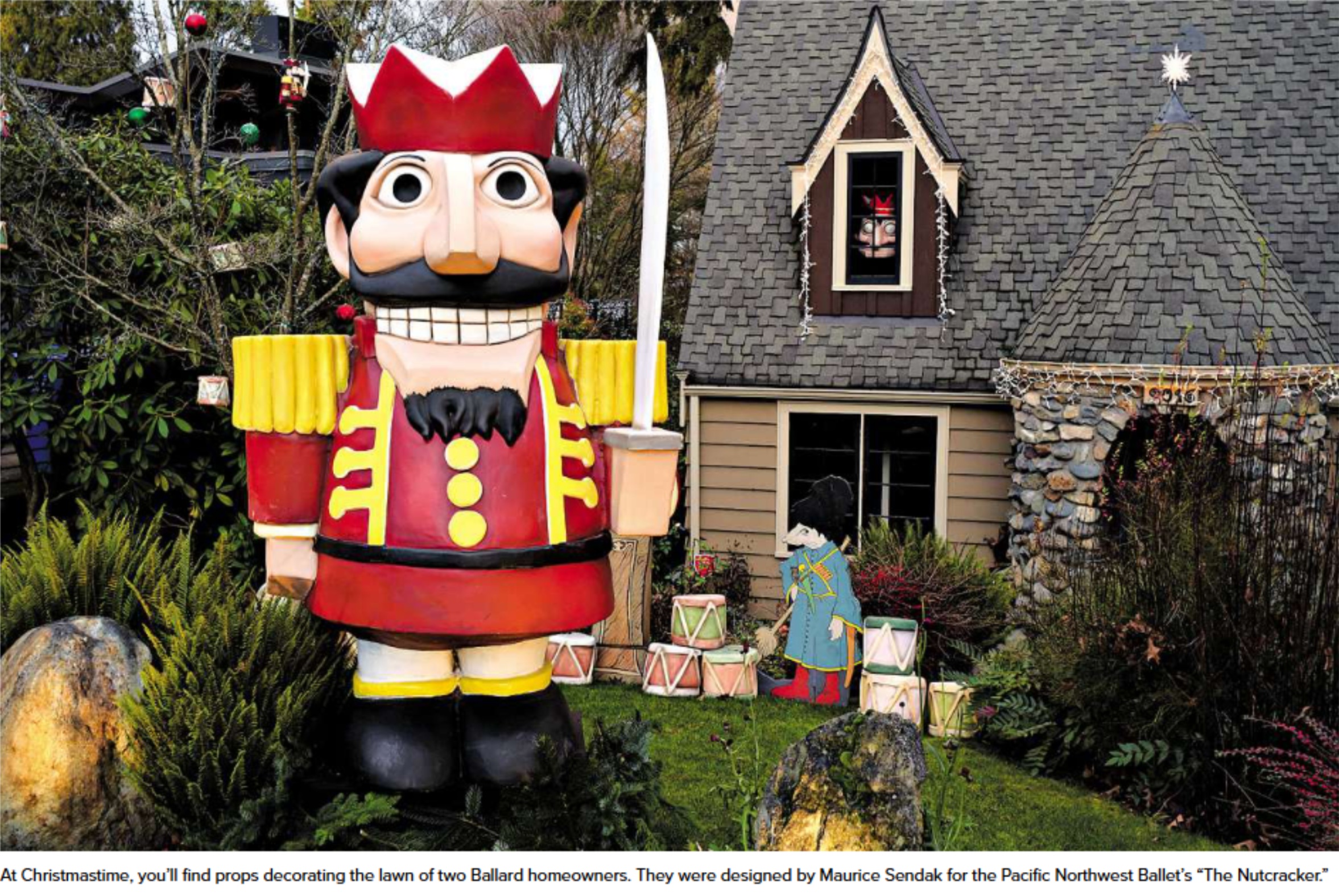
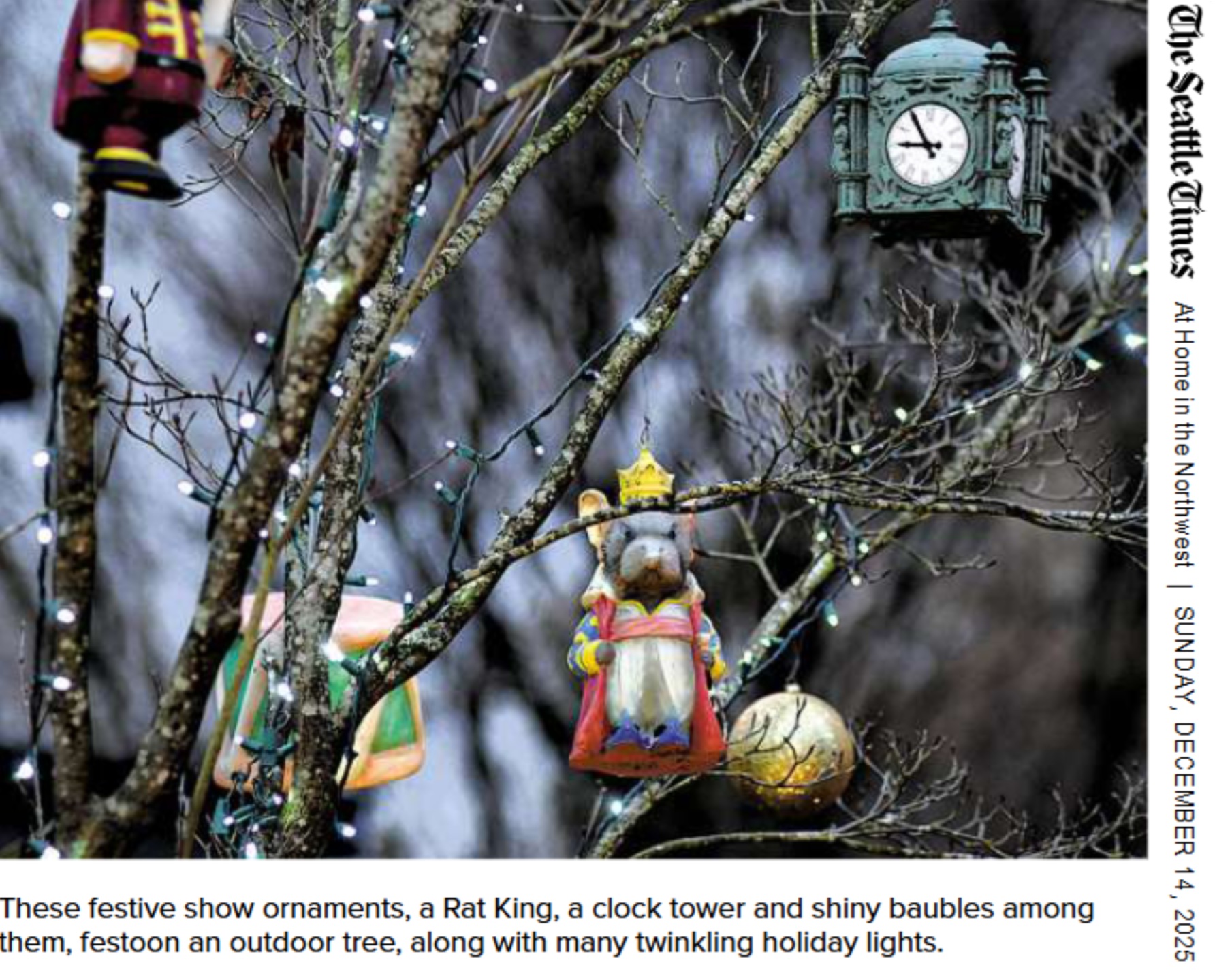
During the holiday season, it’s decked out in Nutcracker figures designed by Maurice Sendak, of “Where the Wild Things Are” fame.
Pacific Northwest Ballet commissioned Sendak to design original art for “The Nutcracker,” which ran from 1983 to 2014.
It was Seattle’s own wild rumpus, a one-of-a-kind “Nutcracker” production.
A 15-foot-tall figurine stands at the end of the driveway. In the front yard and on the deck are three small nutcrackers and two rats – and by small, we mean 8 feet tall.
Three original Sendak ornaments hang in a nearby tree.
It’s the 11th year John Carrington and Scott McElhose have displayed the Sendak Nutcracker at their home, on the corner of Golden Garden Drive and Loyal Avenue Northwest in Ballard.
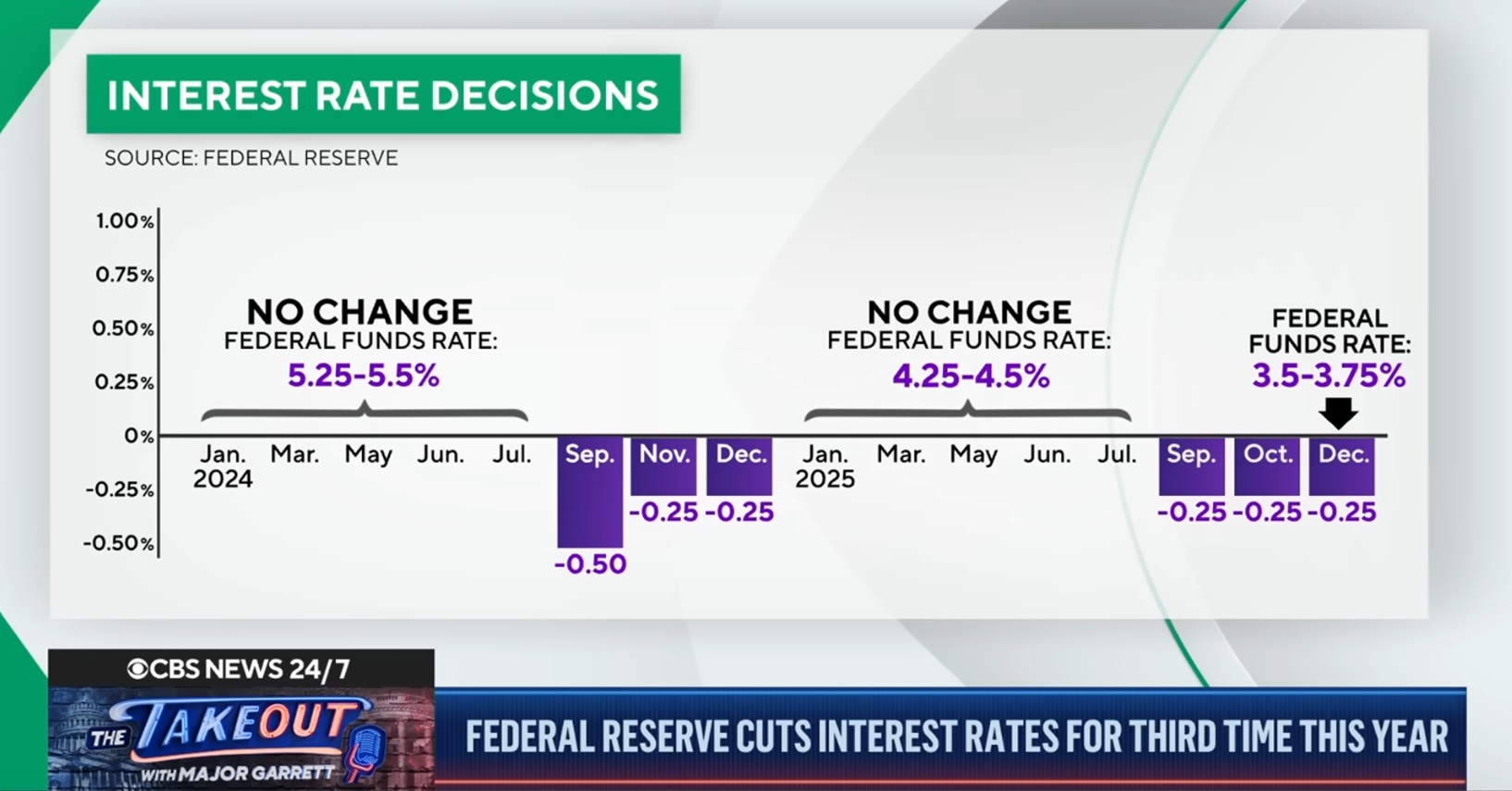
We had another interest rate cut this week, and the Fed indicated that (right now) it sees only one for all of 2026.
Of course, all of that may fly out the window if a person such as Kevin Hassett succeeds Fed chair Jerome Powell in May of next year.
(Hassett is seen as a guy who will do whatever it is to push through Trump’s agenda— and Trump wants interest rates to be closer to 1%).
The rate cut of this week was widely expected. The Fed increased its projected change in real GDP for 2026 to 2.3%, up from 1.8% in September, but the unemployment rate to stay the same at 4.4% — and 4.2% in the longer run (out to 2028). Inflation projected to stay contained: PCE at 2.4% and Core PCE at 2.5%. [Screen shot from CBS News 24/7 program ‘The Takeout with Major Garrett’]
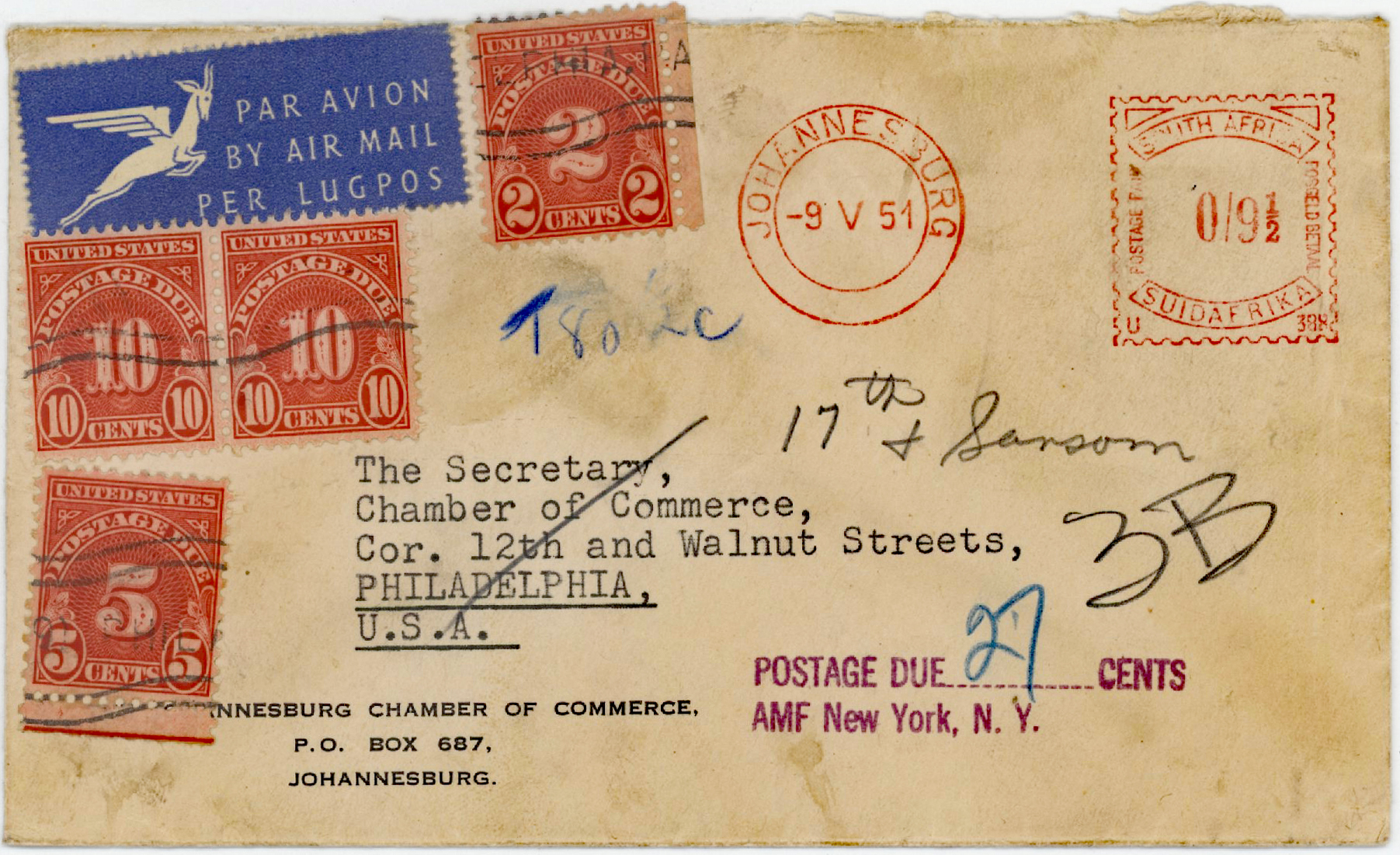
Here’s another interesting envelope that I picked up on Ebay for a few dollars. It was dispatched in Johannesburg to Philadelphia, Pa. The franking on the stamp was done with a metering machine in 1951.
(Franking machines were first used in South Africa in 1926).
The franking of 9½ pennies fell woefully short of what was actually needed, though.
The US post office demanded 27 US cents more for delivery. The last ‘Postage Due’ stamps in the USA were issued in 1985. They were rendered obsolete by tracking technology and the requirement of full prepayment of postage in most cases.
Meter Stamp Printed in South Africa for 9½ pennies, dated May 9, 1951, with Universal “Multi-Value” (MV) metering machine (first used 1933).
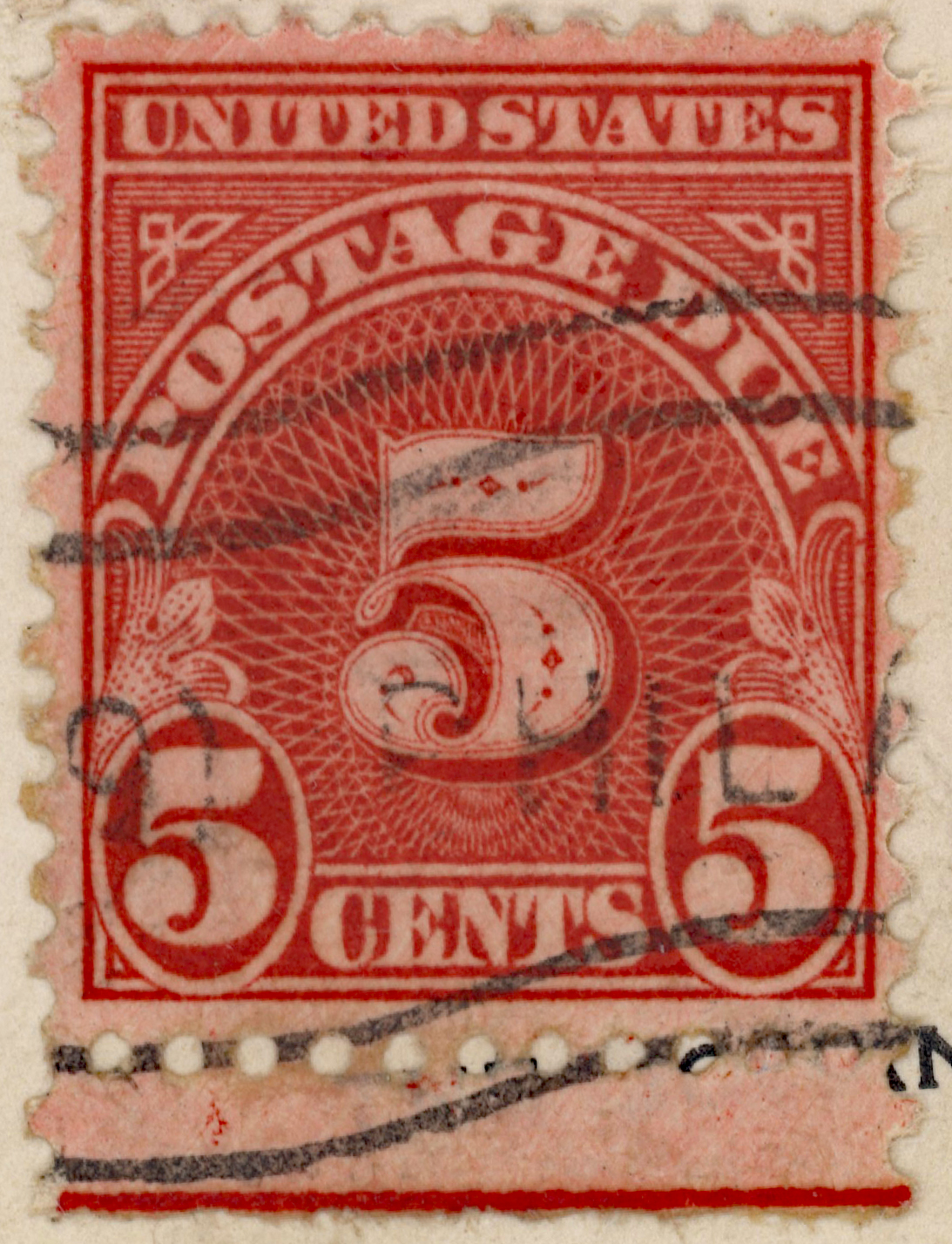
Postage Due Stamps Issued by United States, 1931-1956. Perf. 11×10½ | Engraving by American Bank Note Company | Rotary Press Printing J81 D3 | 2c dull carmine J83 D3 | 5c dull carmine J84 D3 | 10c dull carmine [Sources: Wikibooks.org, 2003 Scott Standard Postage Stamp Catalogue]
Taking a closer look at the engraving detail. The design of the stamp and the fonts resemble the design of a banknote.
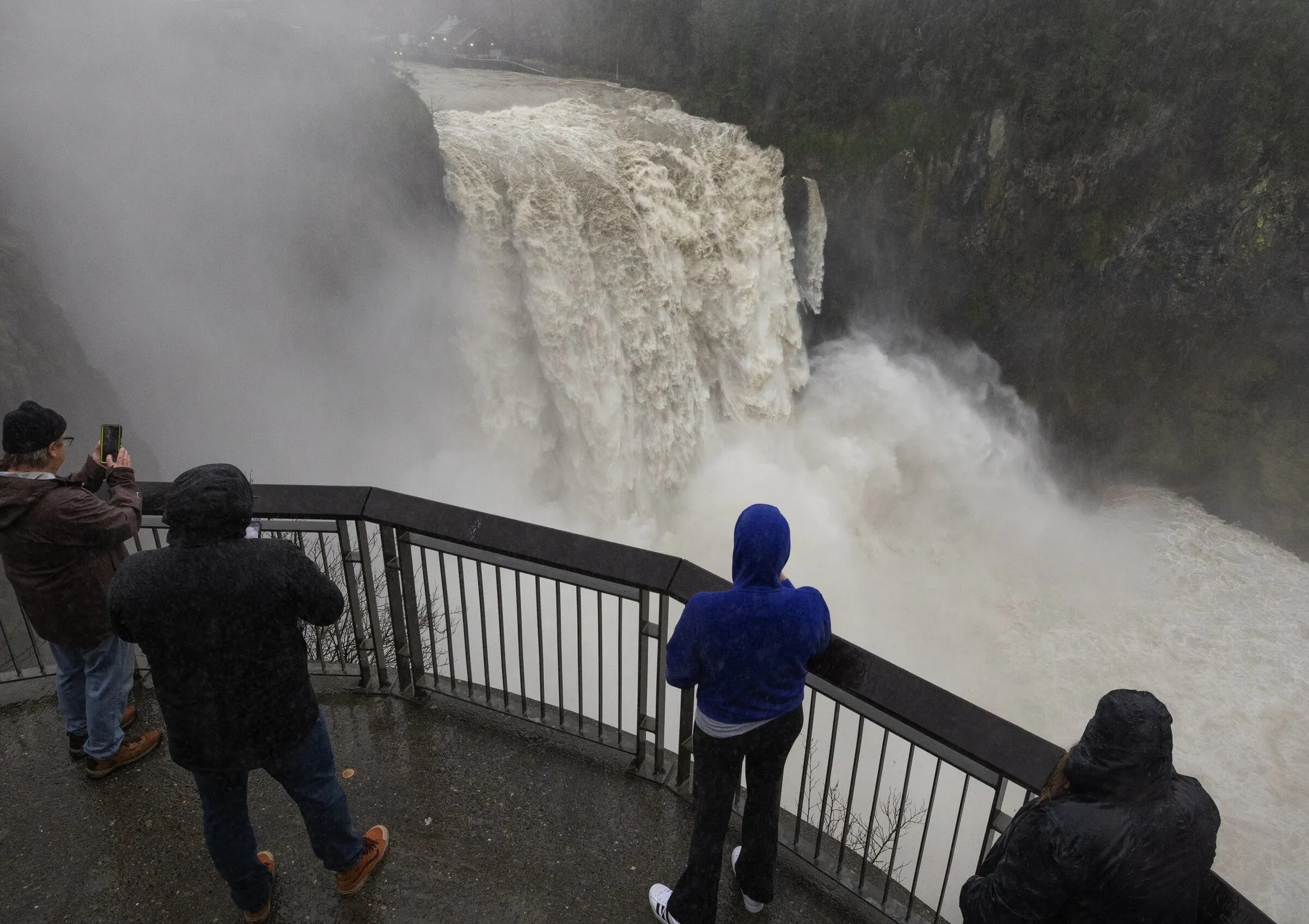
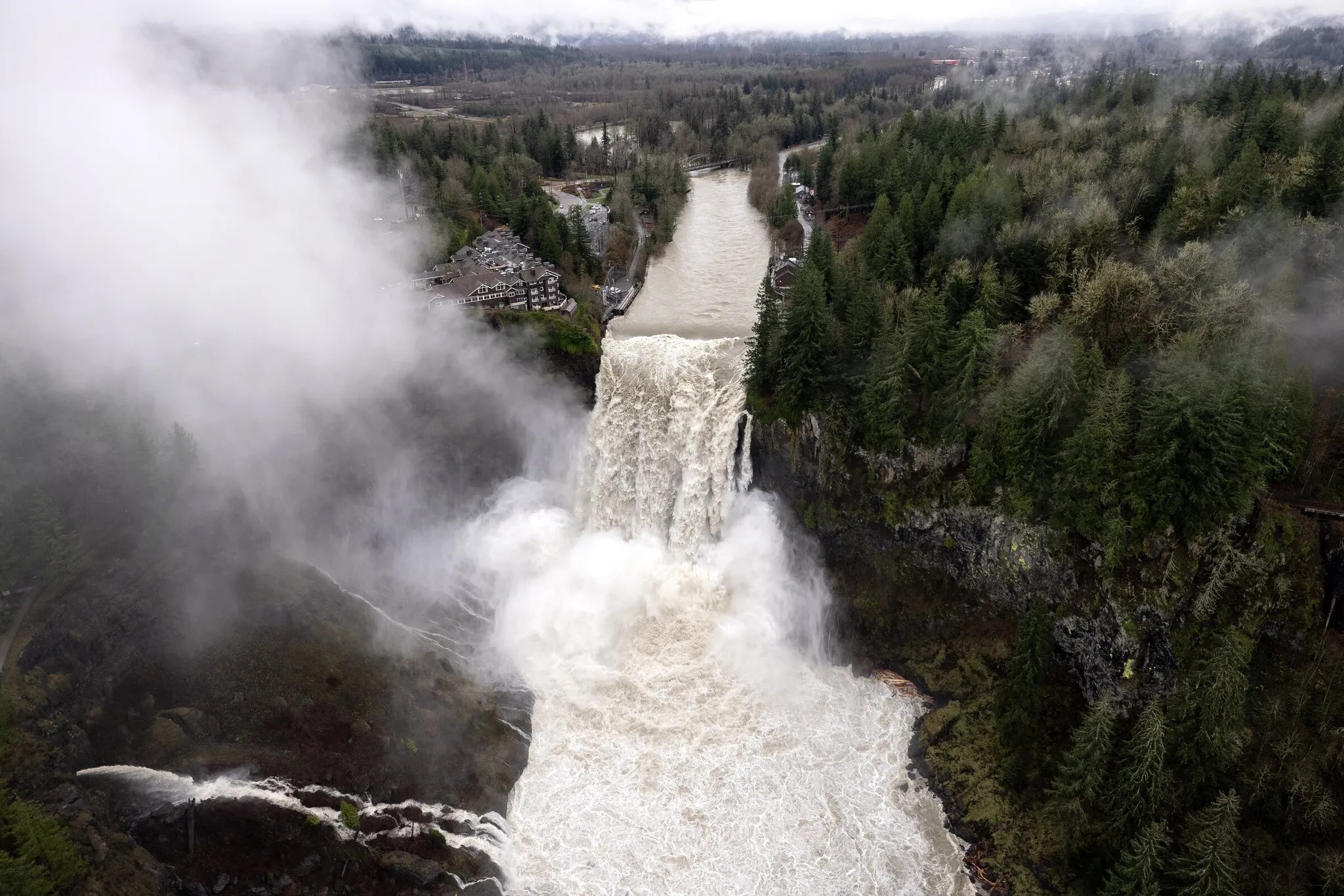
Here are updated pictures of the Snoqualmie Falls from the Seattle Times.
The Snoqualmie river was at major flooding level for much of Wednesday and Thursday.
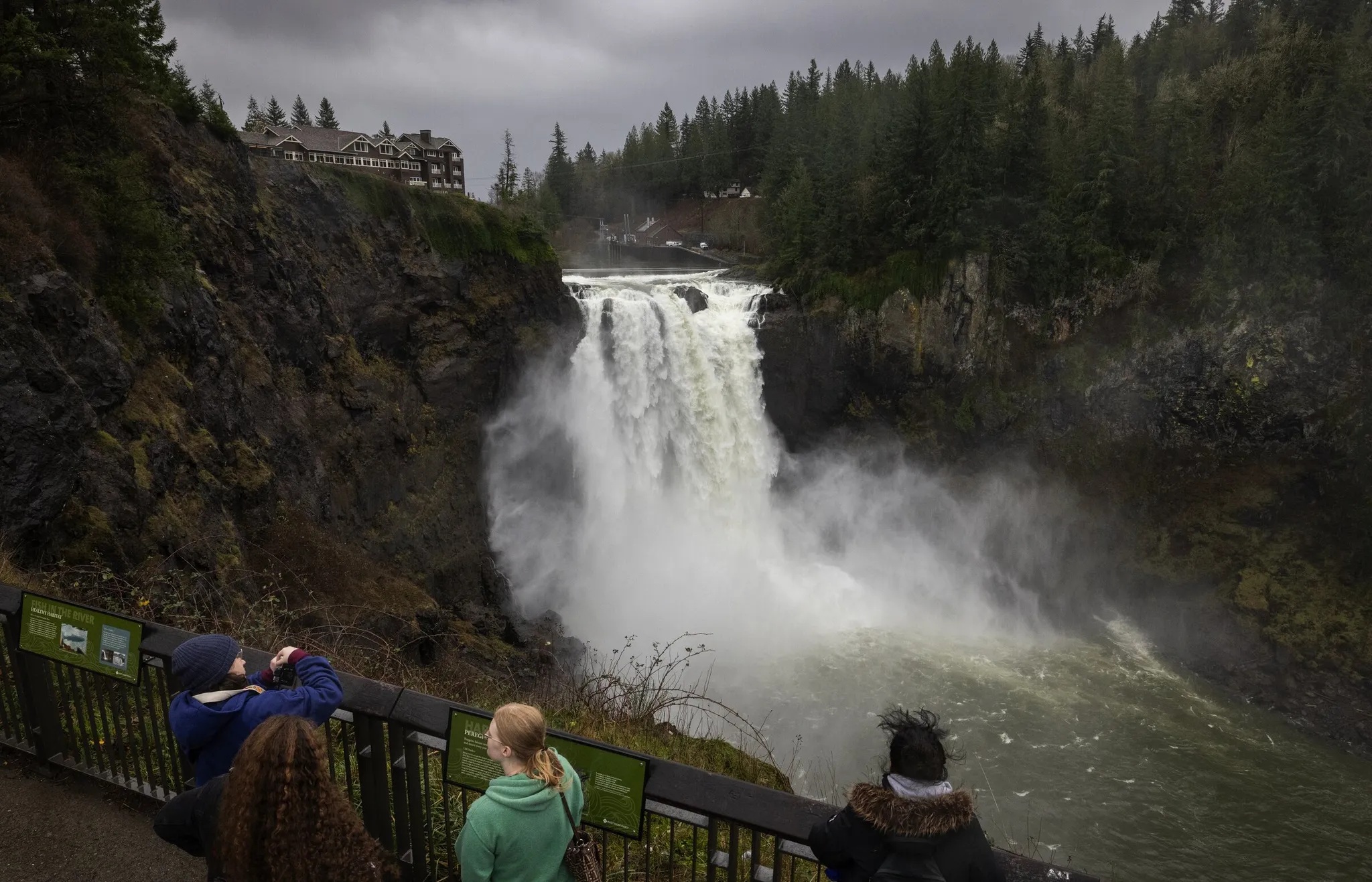
Visitors to Snoqualmie Falls get soaked by a steady mist kicked up from raging Snoqualmie River waters Thursday morning. [Photo by Ken Lambert for The Seattle Times. Caption from The Seattle Times]Snoqualmie Falls roars on Thursday. [Photo by Nick Wagner for The Seattle Times. Caption from The Seattle Times]
The second wave of moisture from a strong atmospheric river filled in across western Washington last night.
All that water is flooding from the western slopes of the Cascade mountains into the streams and rivers below.
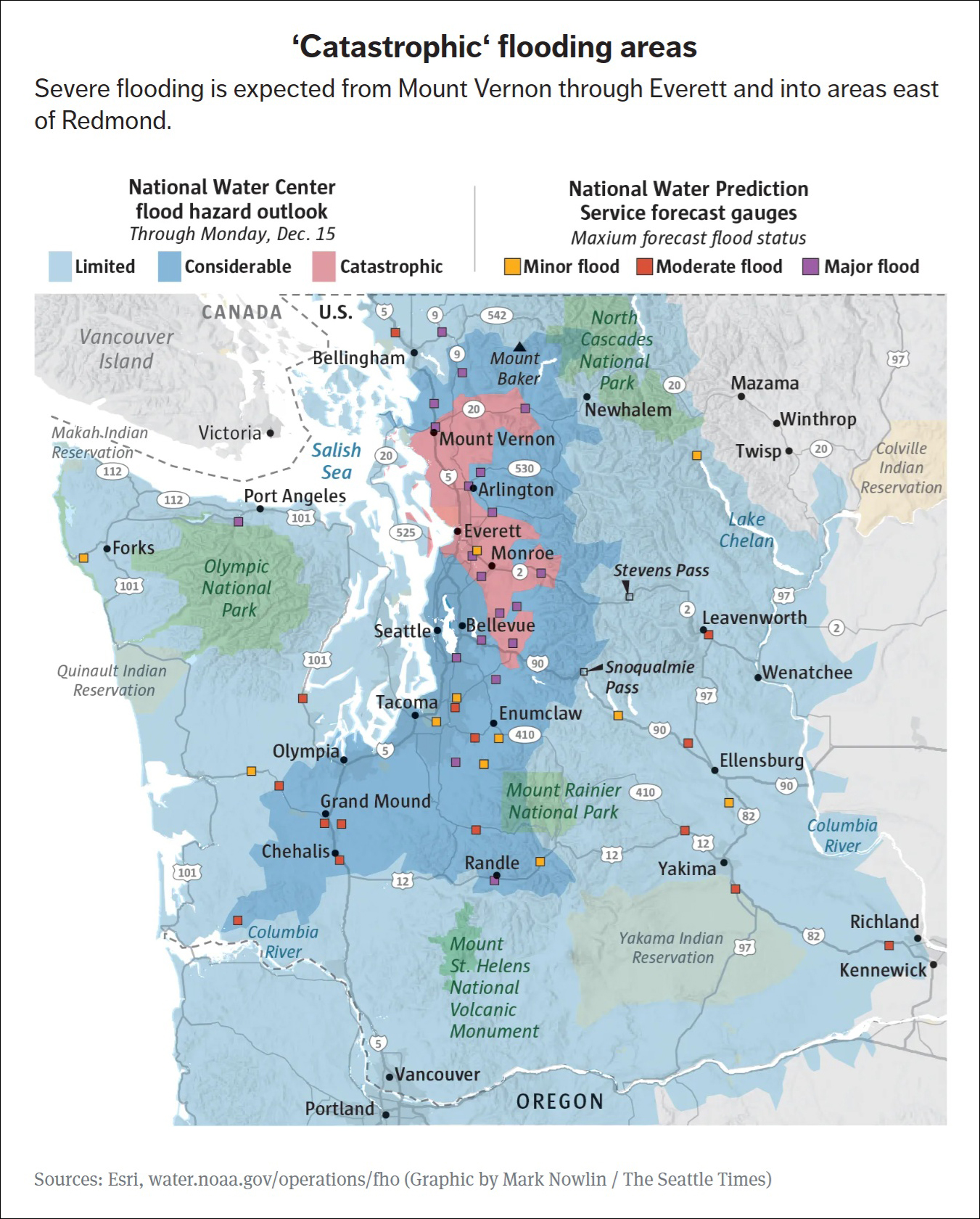
Greg Kim writes for the Seattle Times: River flooding in parts of Western Washington is expected to be “catastrophic,” especially in the coastal lowlands near the Snohomish, Stillaguamish and Skagit rivers, according to a new assessment by the National Weather Service. Areas facing “considerable” flooding stretch from Bellingham through south of Olympia. Catastrophic flooding could bring significant risk to life and property, with a high risk of levees being topped and landslides expected in steep terrain, according to the National Weather Service. It could also mean record floods that destroy roads and structures and require evacuations or rescues of people and property, National Weather Service meteorologist Steve Reedy said.
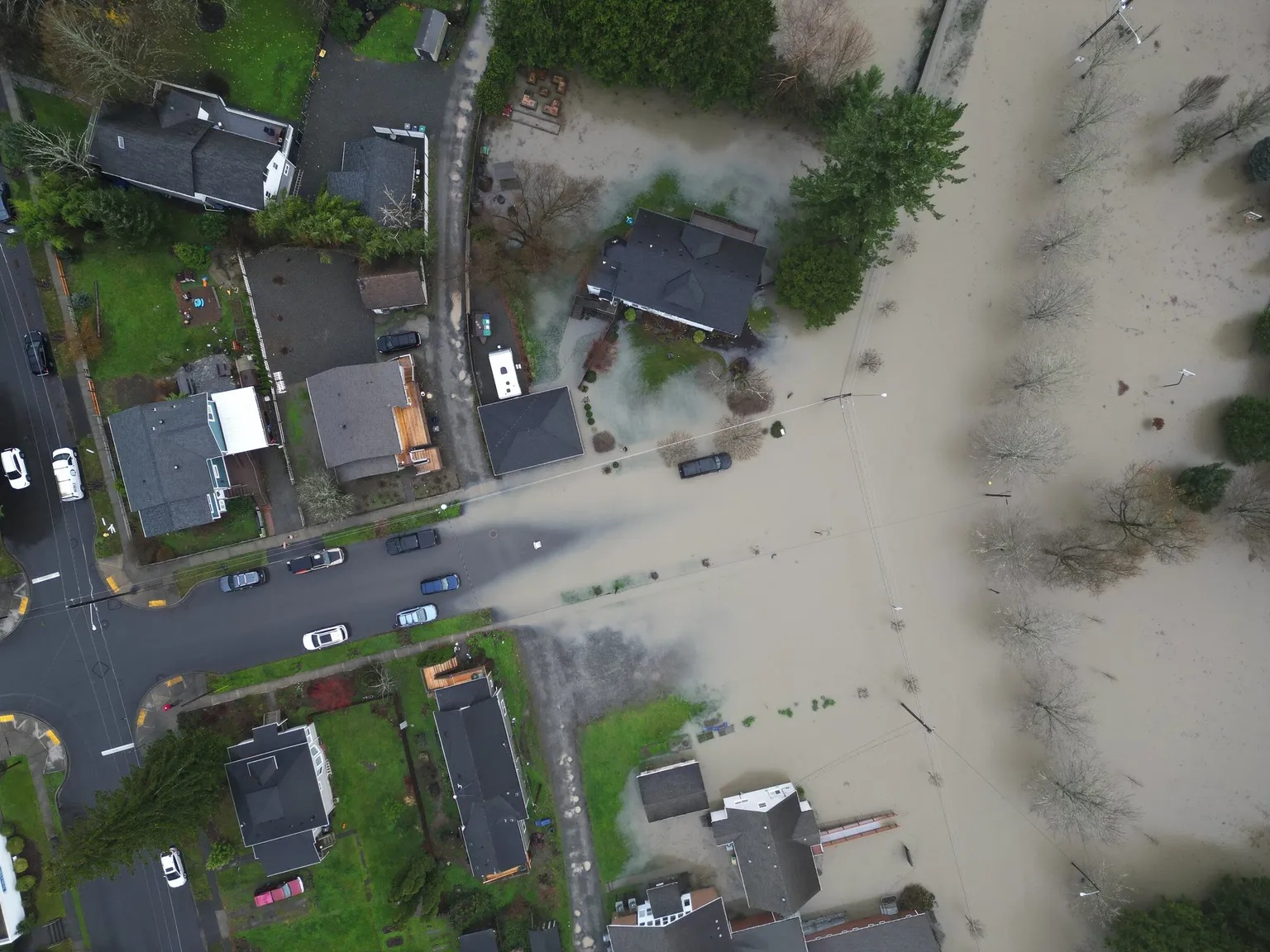
The Snoqualmie River floods over its banks in Snoqualmie at Riverview Park, with water heading towards homes, Wednesday afternoon, Dec. 10, 2025. [Photo by Ken Lambert / The Seattle Times]
Map compiled by Mark Nowlin for Seattle Times with information from ESRI and water.noaa.gov/operations/fho
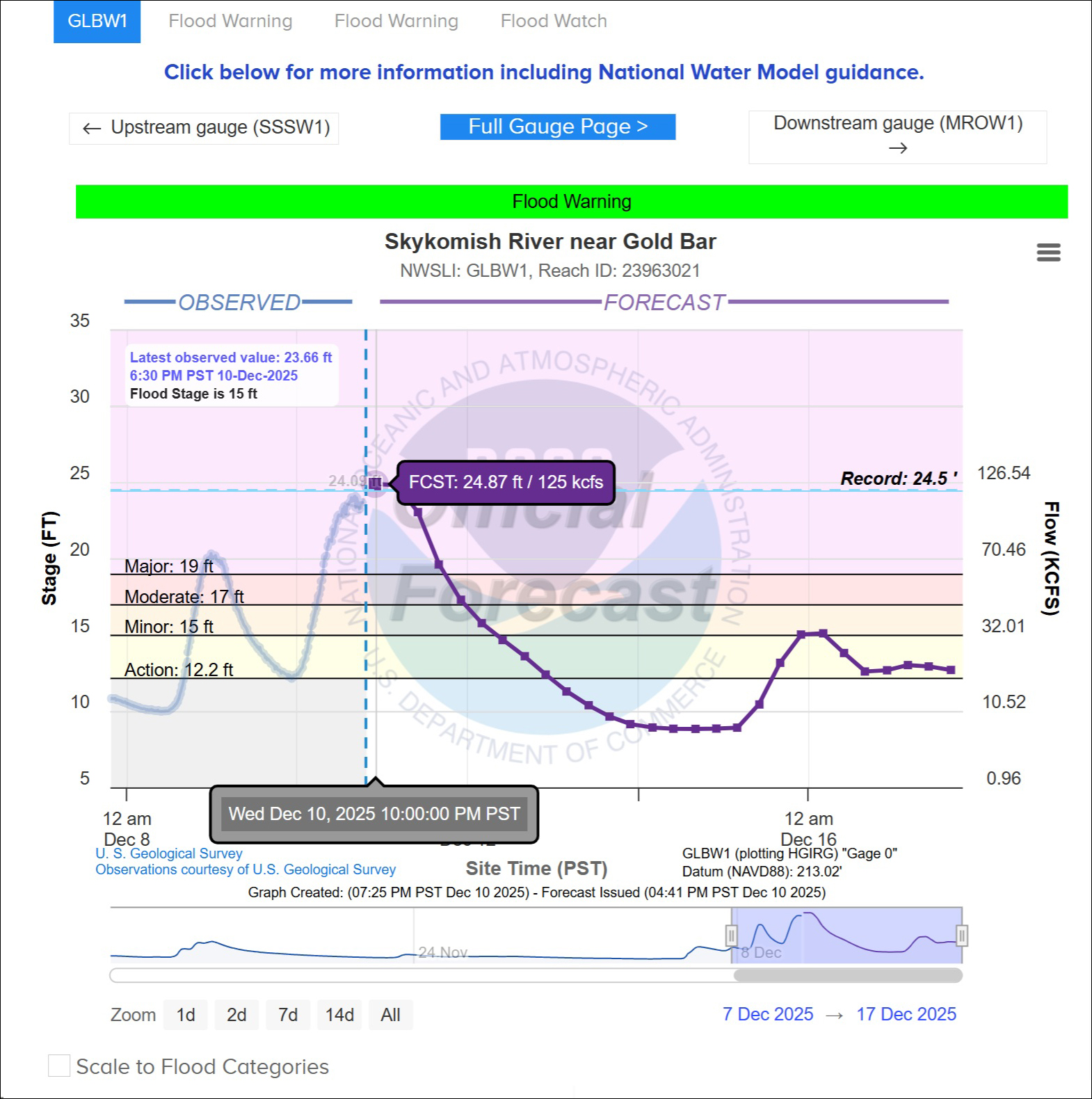
The Skykomish River near Gold Bar is the purple block just east of Monroe on Highway 2 in the map above. The river is projected to top out at its highest level ever, at 24.87 ft. Flood stage is 15 ft. [Graphic from National Water Prediction Service at https://water.noaa.gov/]
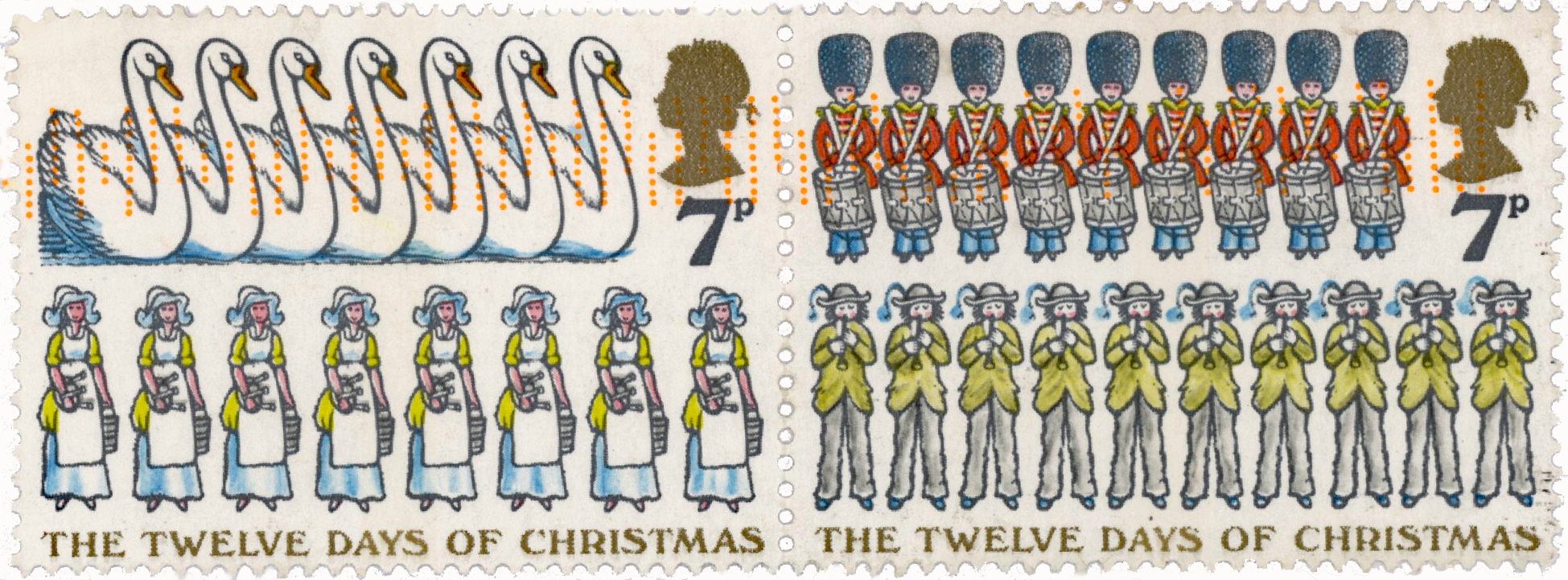
Two of the stamps on one of the outside envelopes for an Ebay purchase from England feature The Twelve Days of Christmas (song).
Great Britain/ Queen Elizabeth II— Christmas Stamps, 1977 Issued Nov. 23, 1977 Perf. 15×14 | One center phosphor band (7p.) | Design D. Gentleman 1046 525 7p. Slate, grey, bright yellow-green, new blue, rose-red and gold | “Eight Maids-a-milking, Seven Swans-a-swimming” 1047 526 7p. Slate, grey, bright yellow-green, new blue, rose-red and gold| “Ten pipers piping, Nine Drummers drumming” [Source: 1997 Stanley Gibbons Stamp Catalogue, Part 1 British Commonwealth, Vol. 1]From Wikipedia:
The lyrics given here are from Frederic Austin’s 1909 publication that established the current form of the carol.
The first three verses run, in full, as follows:
On the first day of Christmas my true love sent to me
A partridge in a pear tree
On the second day of Christmas my true love sent to me
Two turtle doves,
And a partridge in a pear tree.
On the third day of Christmas my true love sent to me
Three French hens,
Two turtle doves,
And a partridge in a pear tree.
Subsequent verses follow the same pattern.
Each verse deals with the next day of Christmastide, adding one new gift and then repeating all the earlier gifts, so that each verse is one line longer than its predecessor:
— four calling birds
— five gold rings
— six geese a-laying
— seven swans a-swimming
— eight maids a-milking
— nine ladies dancing
— ten lords a-leaping
— eleven pipers piping
— twelve drummers drumming
Kai Uyehara and Paige Cornwell write for the Seattle Times:
The opening salvo of a major atmospheric river hit the Pacific Northwest on Monday, drenching much of Western Washington with heavy rain that is forecast to continue at least until Thursday.
The National Weather Service warned of a high risk of widespread and significant river flooding.
South of Puget Sound, the Puyallup, Nisqually, Cowlitz and Carbon rivers were already seeing waters about to spill over their banks by 7 p.m. Monday, with serious flooding expected within hours.
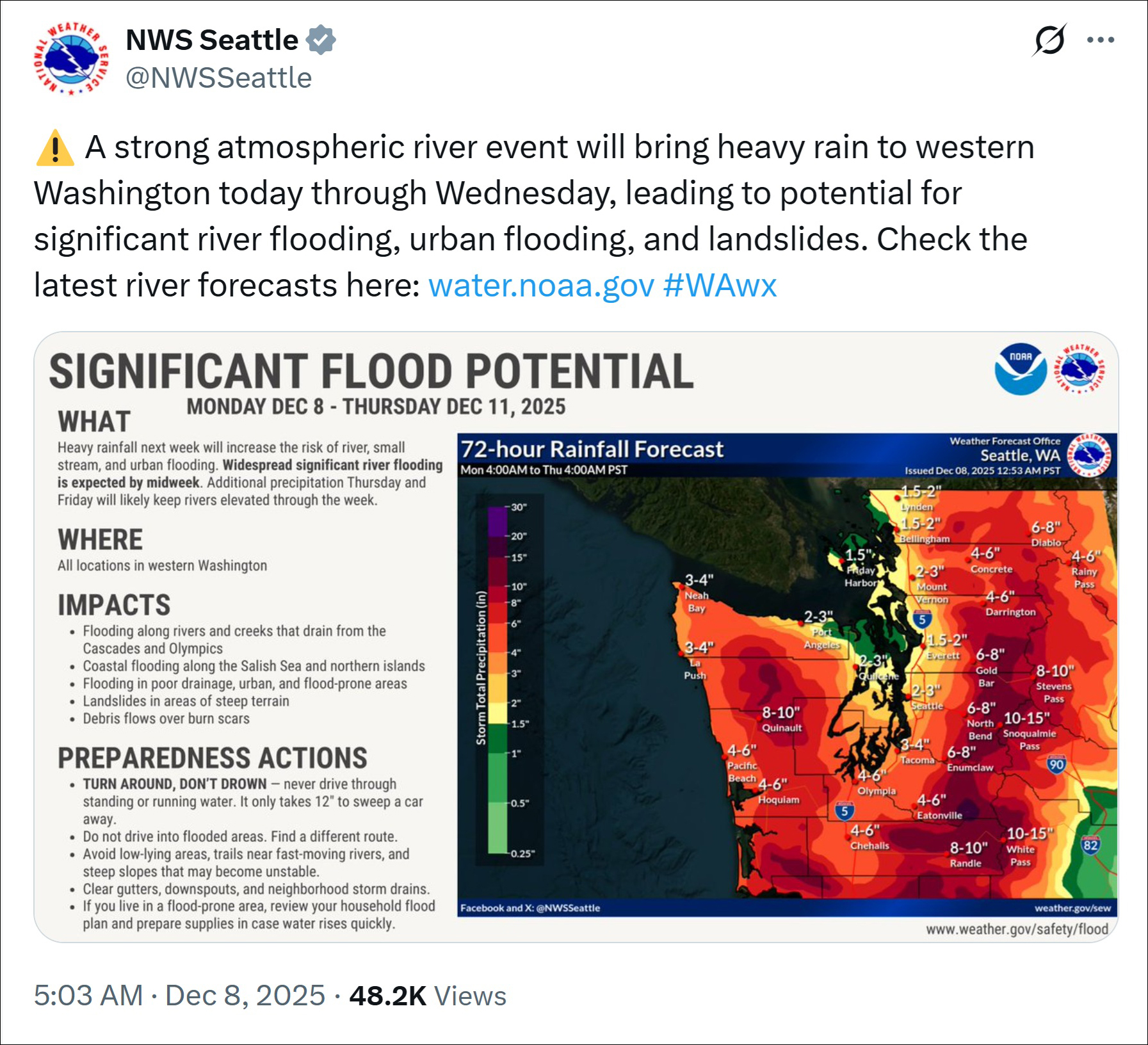
Post by National Weather Service Seattle @NWSSeattle on X. Even though we are in somewhat of a rain shadow here in the city, 2-3 inches over 3 days is still a lot of rain.
People visit Snoqualmie Falls, which is raging, on a rainy Monday, Dec. 8, 2025, in Snoqualmie. The area is under flood risk. [Photo by Ken Lambert / The Seattle Times]
I braved the cold wind outside to do a little self-directed architecture tour on First Hill today.
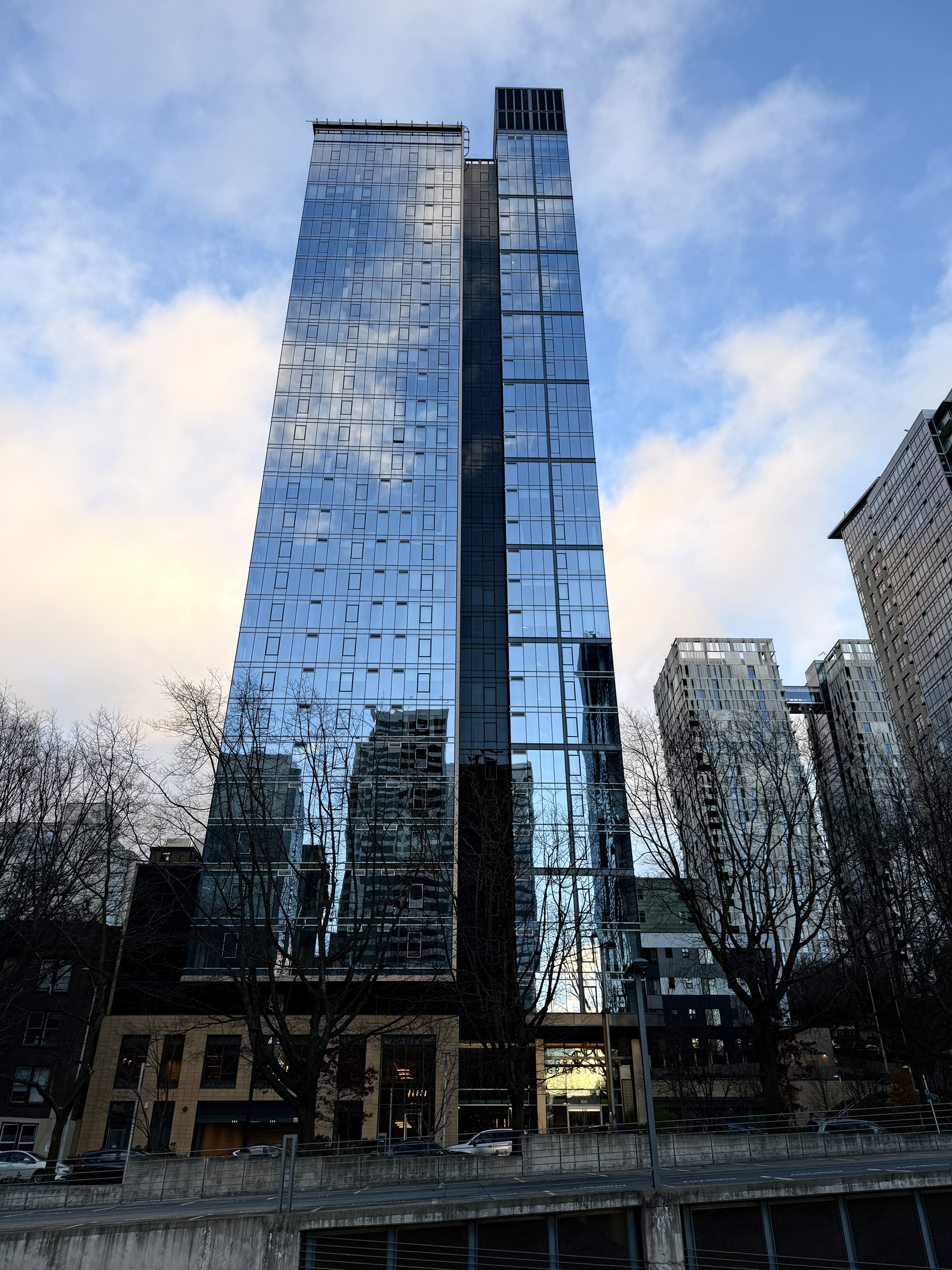
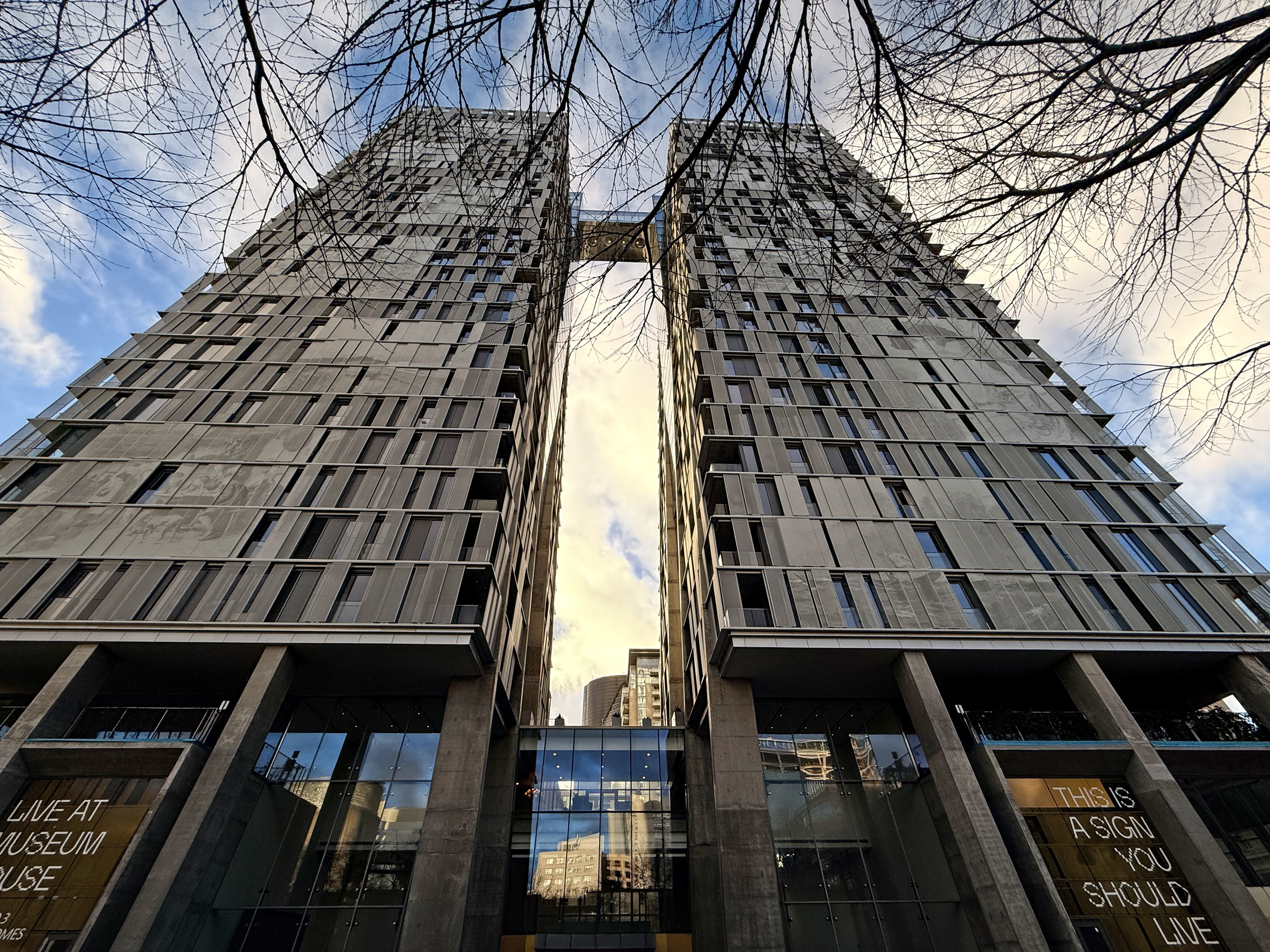
I wanted to take a look at the The Graystone Seattle on Columbia Avenue and the Museum House complex with its twin towers.
The Graystone at 800 Columbia St was actually built in 2021 (how time flies). It has 31 stories and 271 units. This is the view from the parking lot on 8th Avenue, looking northeast. (On the right, just a block or so away, is the Museum House complex with its twin towers).
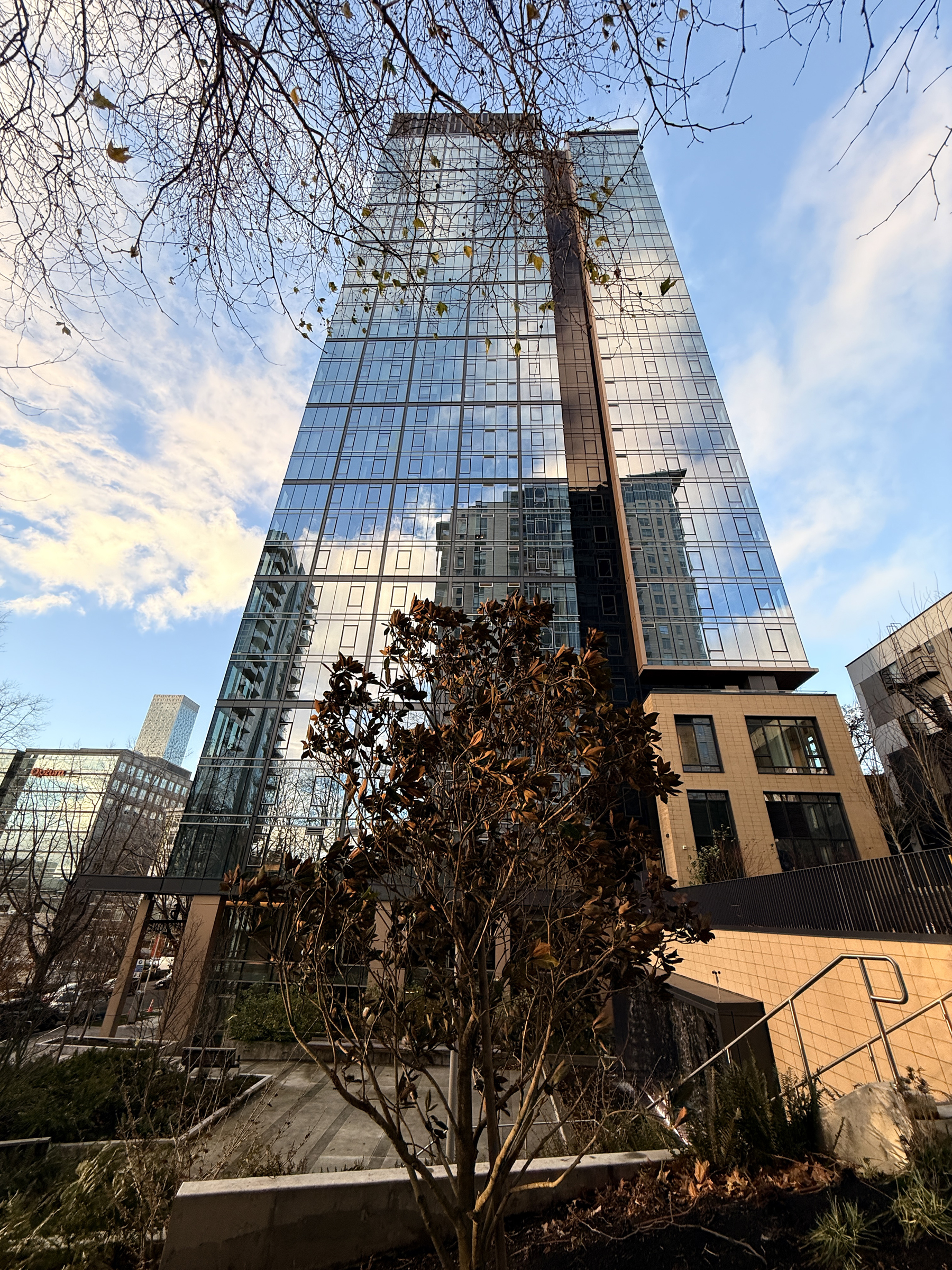
Now I am on Columbia Street, walking up hill. I should have taken a picture without the tree! but there is a waterfall feature on the right that obscures the street view into the condo’s gym somewhat. There are several other amenities of course, such as a rooftop deck and meeting rooms and all that.
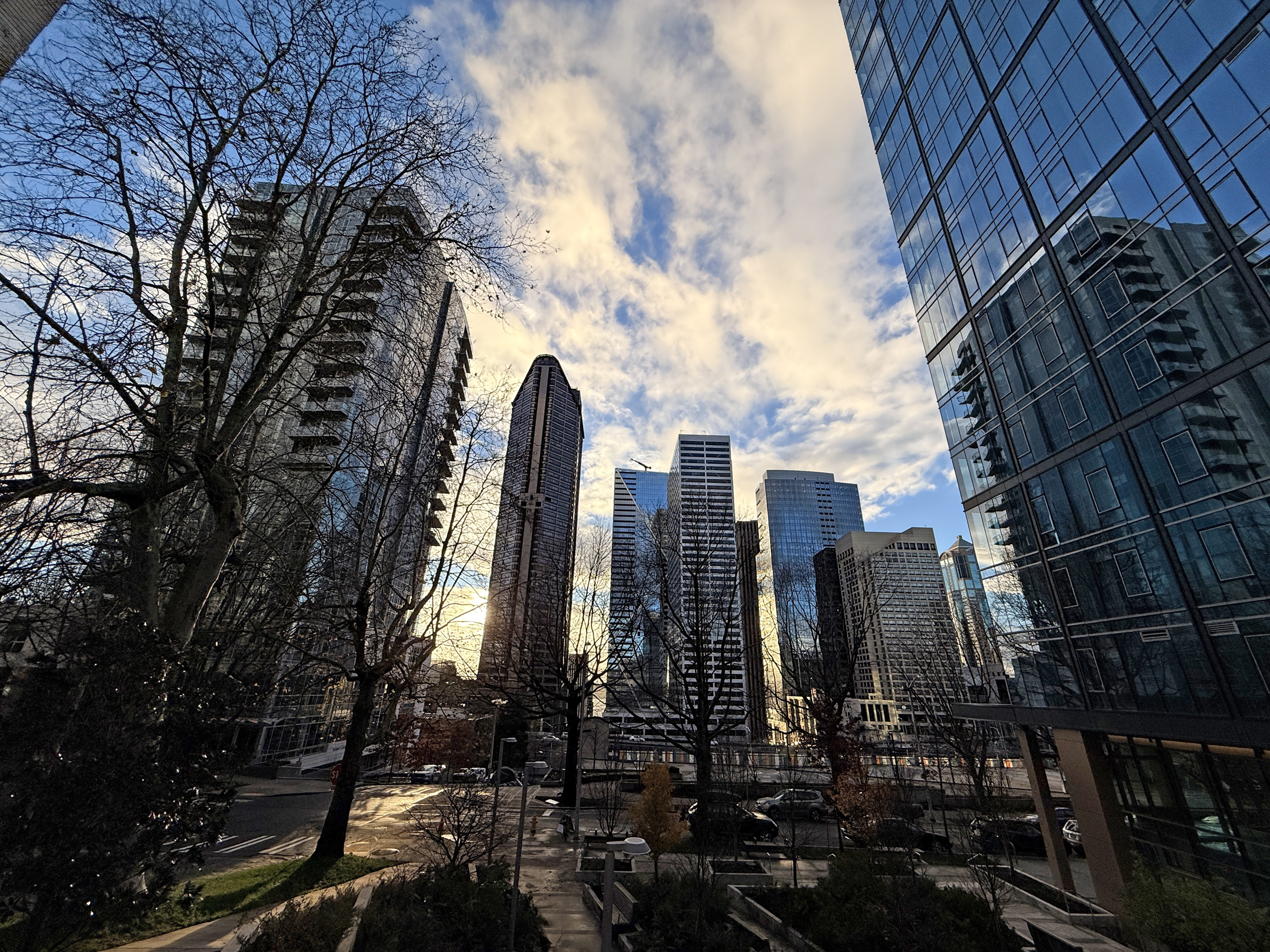
Here’s the view of the downtown skyline, looking towards the west. Interstate 5 is close by, but at a much lower level which dampens any traffic noise one might hear.
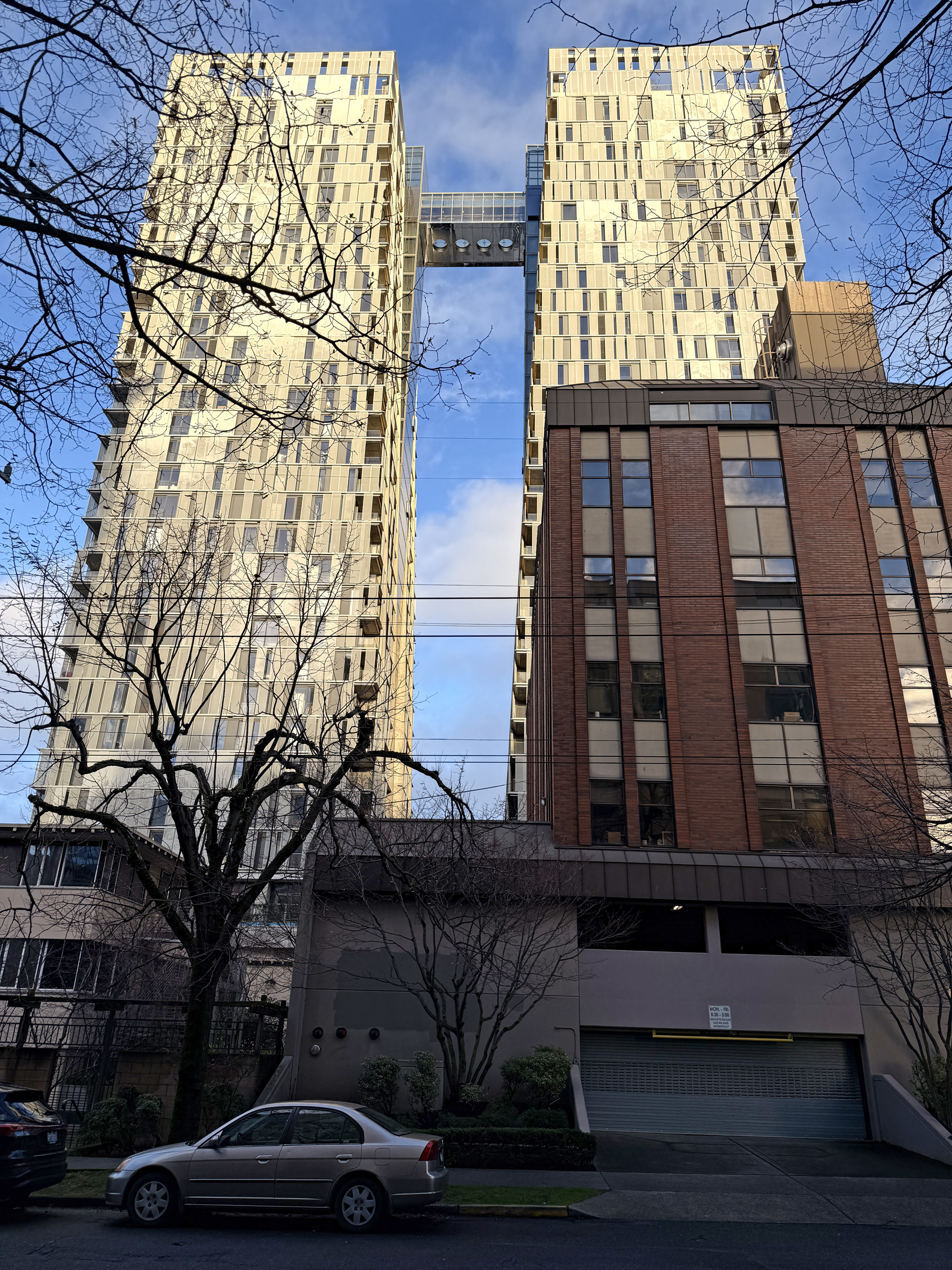
Now walking to the Museum House complex on Terry Avenue. This apartment building opened in March, and features a north tower and a south tower, each with 32 stories. It offers 506 rental units.
Looking up at the main facade of the building. The skybridge is all the way up on Floor 31.
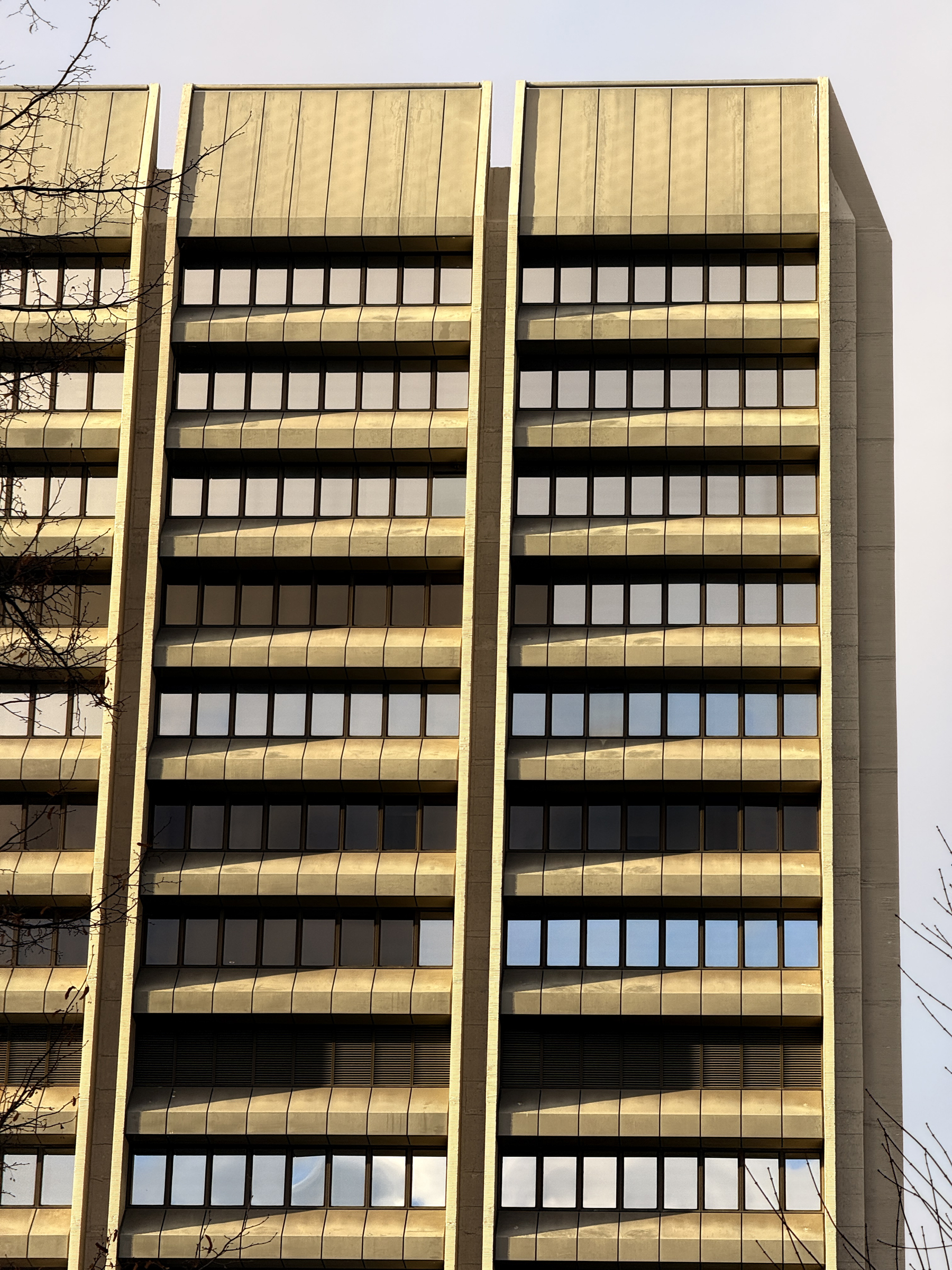
First Hill has several hospitals and buildings with clinics and doctors’ offices inside. This is Cabrini Center on Boren Avenue, completed in 1973 with 18 towers.
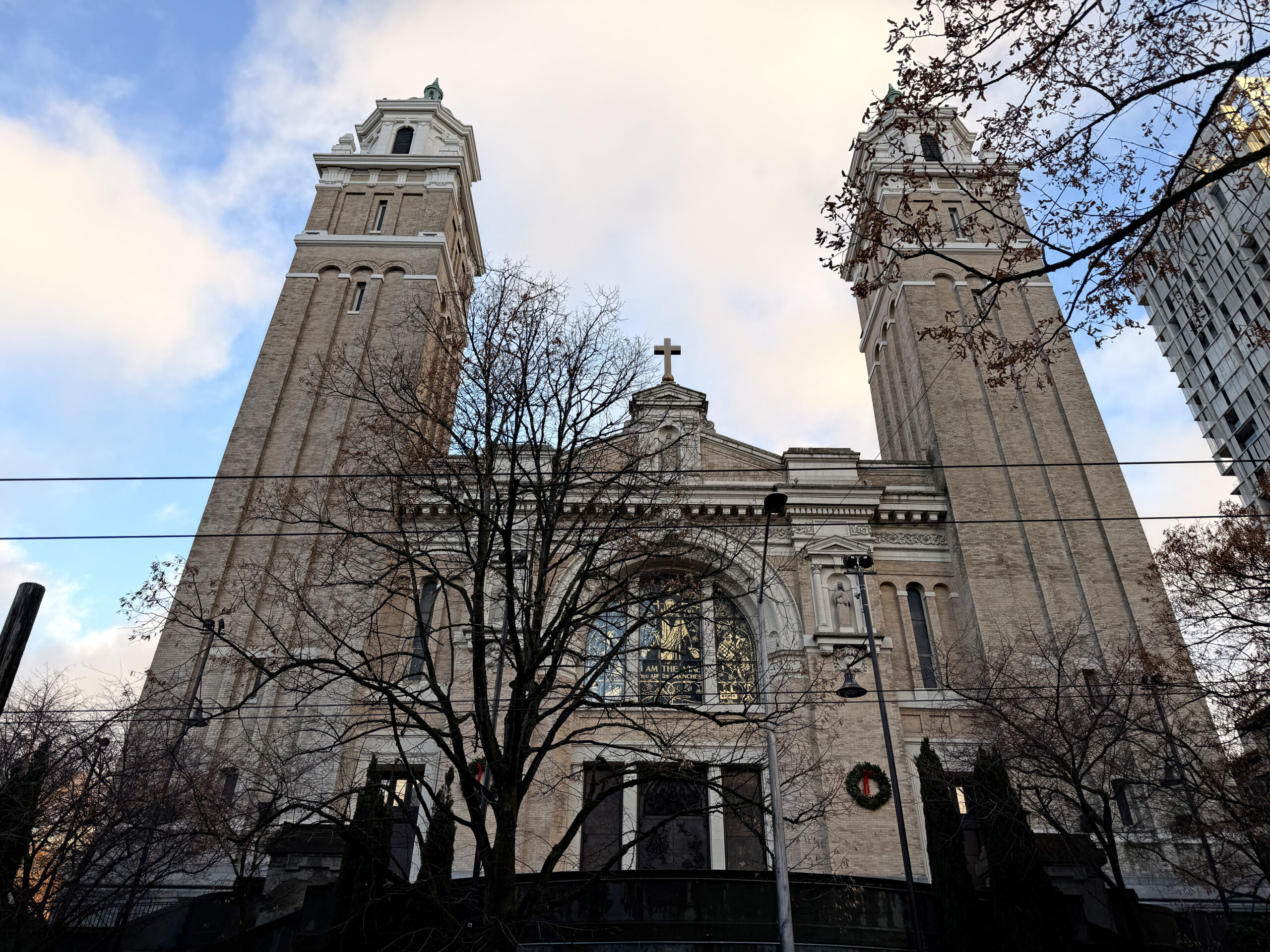
St. James Cathedral is a Catholic cathedral located at 804 Ninth Avenue. It was dedicated in 1907.
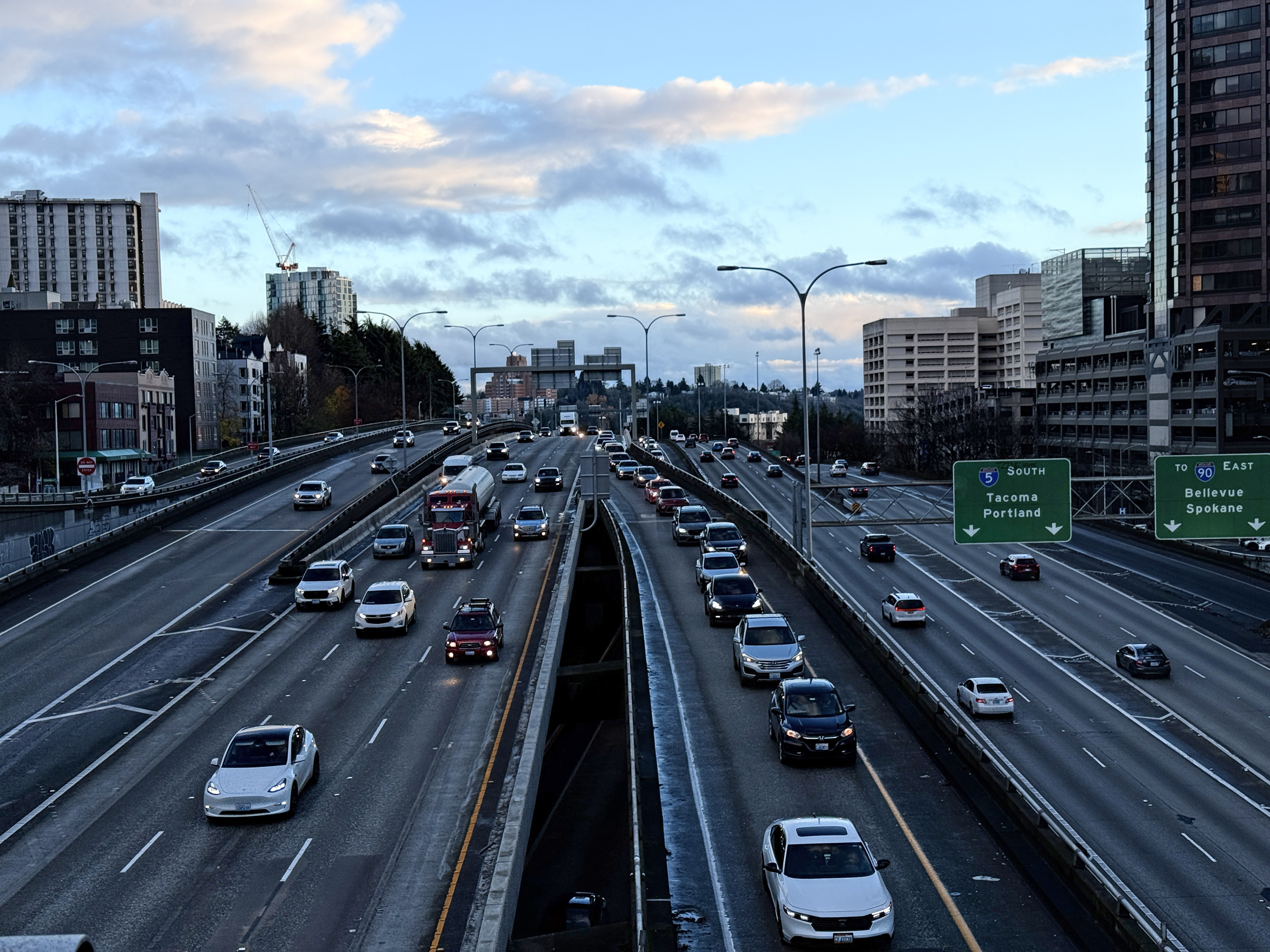
All right. The sun is going to set soon and I am heading to the waterfront. Here’s a look at the traffic on I-5 (looking south).
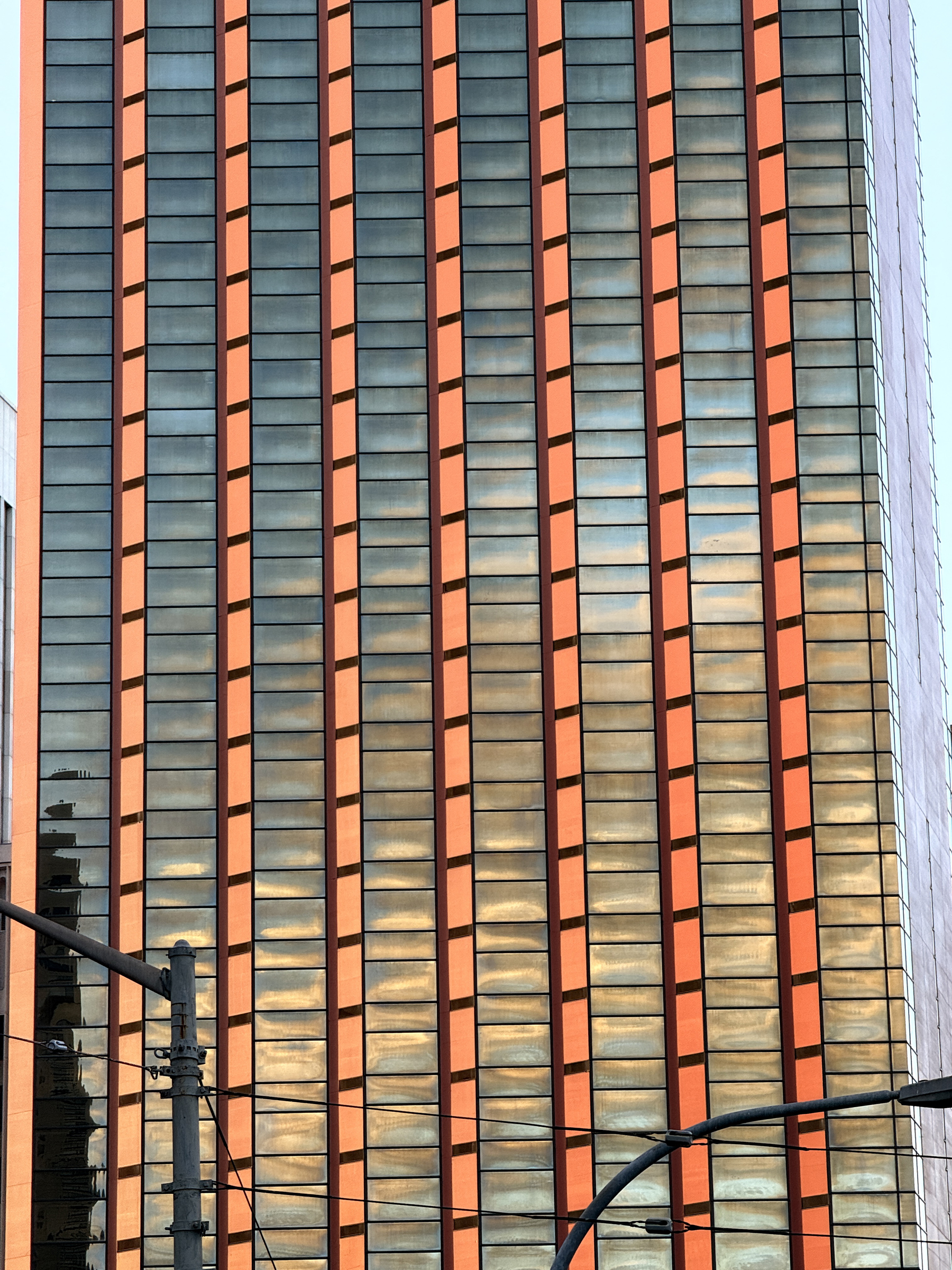
Beautiful colors reflected by the windows of the Crowne Plaza hotel in downtown. The hotel was completed in 1980 and has 18 floors.
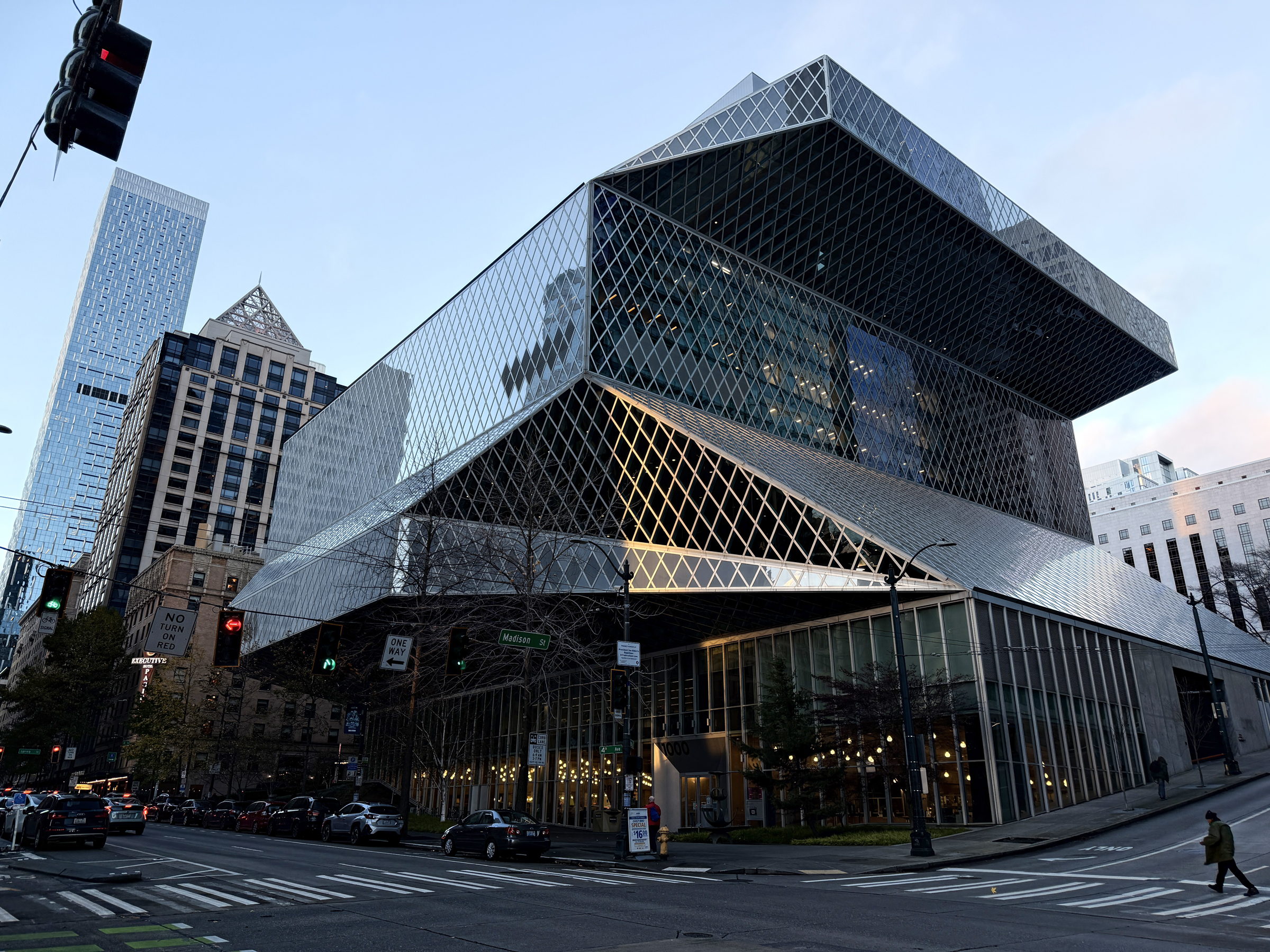
Seattle’s weird library with its faceted frames of glass and steel has 11 floors. It opened in May 2004 to the public.
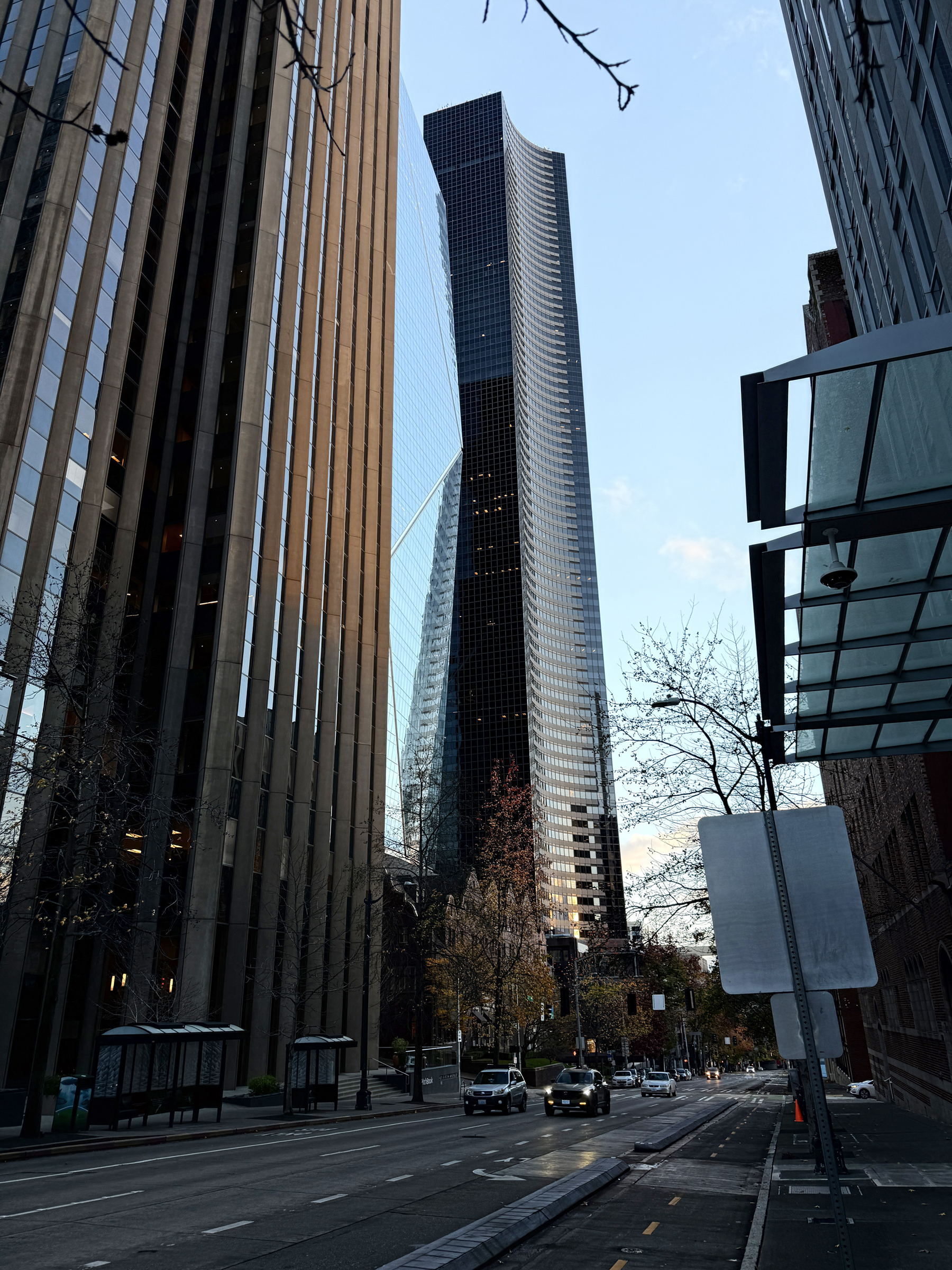
Further south along 4th Avenue is the Columbia Tower, at 76 stories still the tallest structure in the state of Washington. (Getting squeezed out of view from here a little bit by the F5 Tower in front of it that opened in 2017).
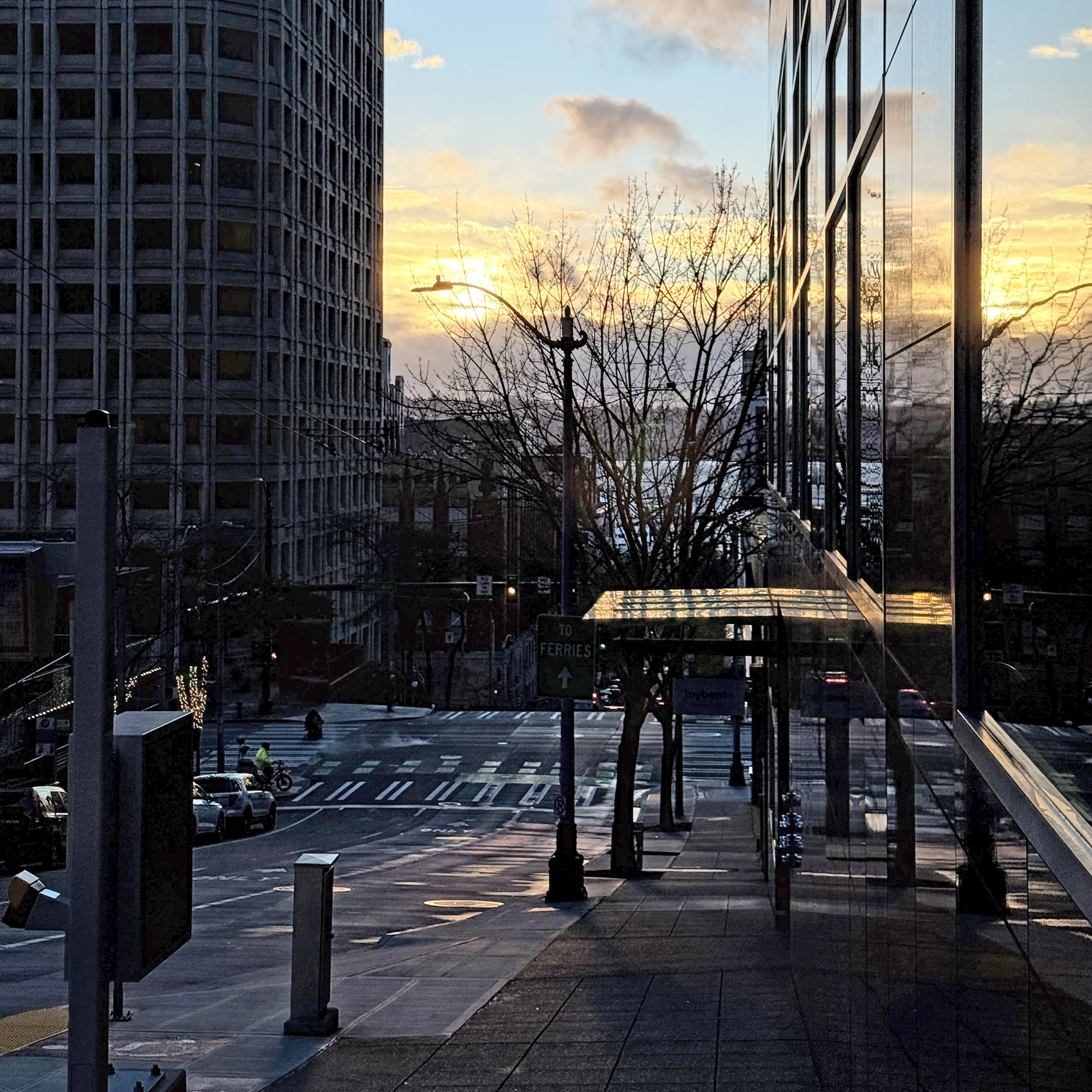
Heading down to the waterfront now. It’s good that I snapped this picture of the sun behind the clouds, because it was gone for the day just a few minutes later.
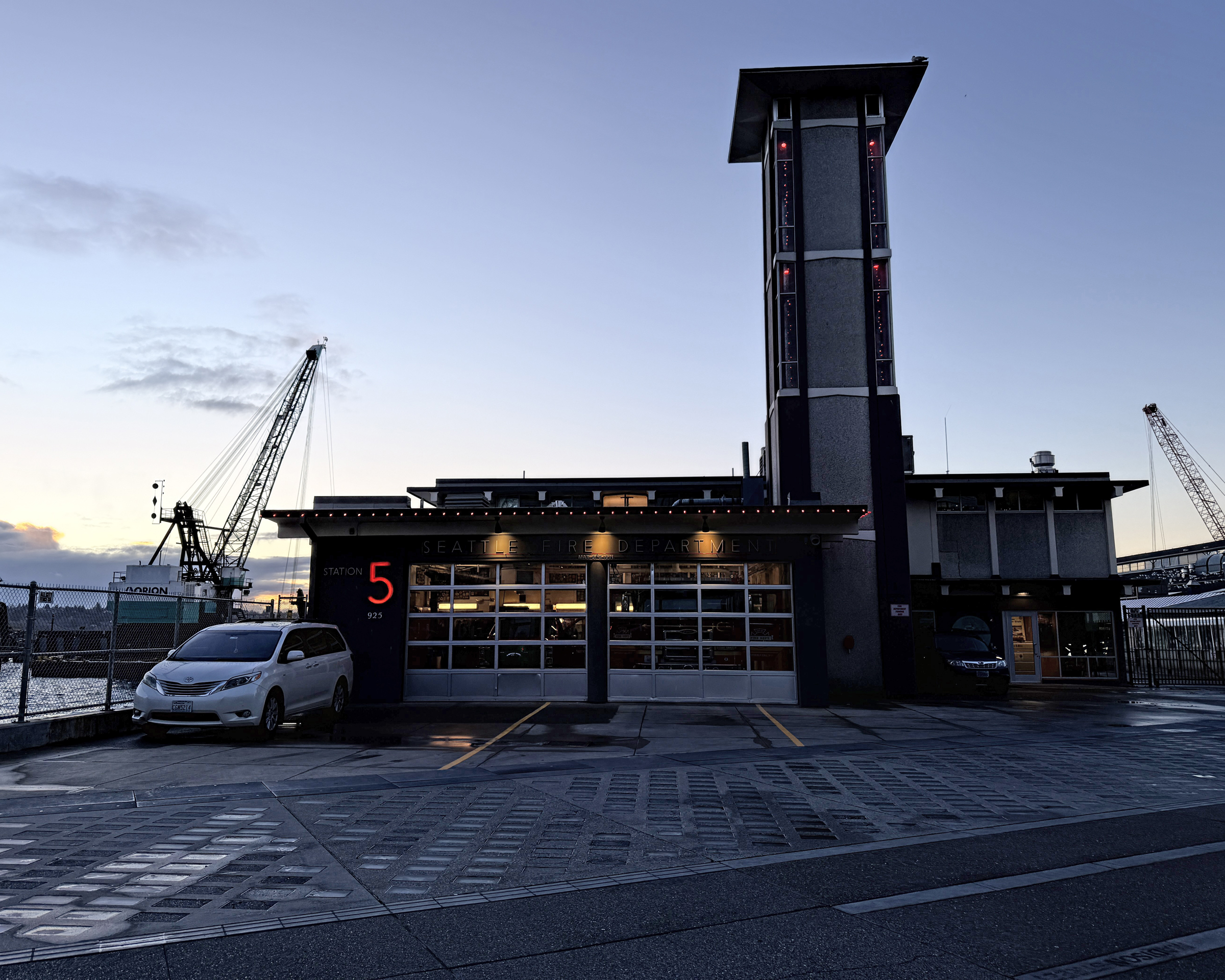
Seattle has 33 fire stations and the one on the waterfront is No 5. The original Fire Station No. 5 building opened here at this location in 1902.
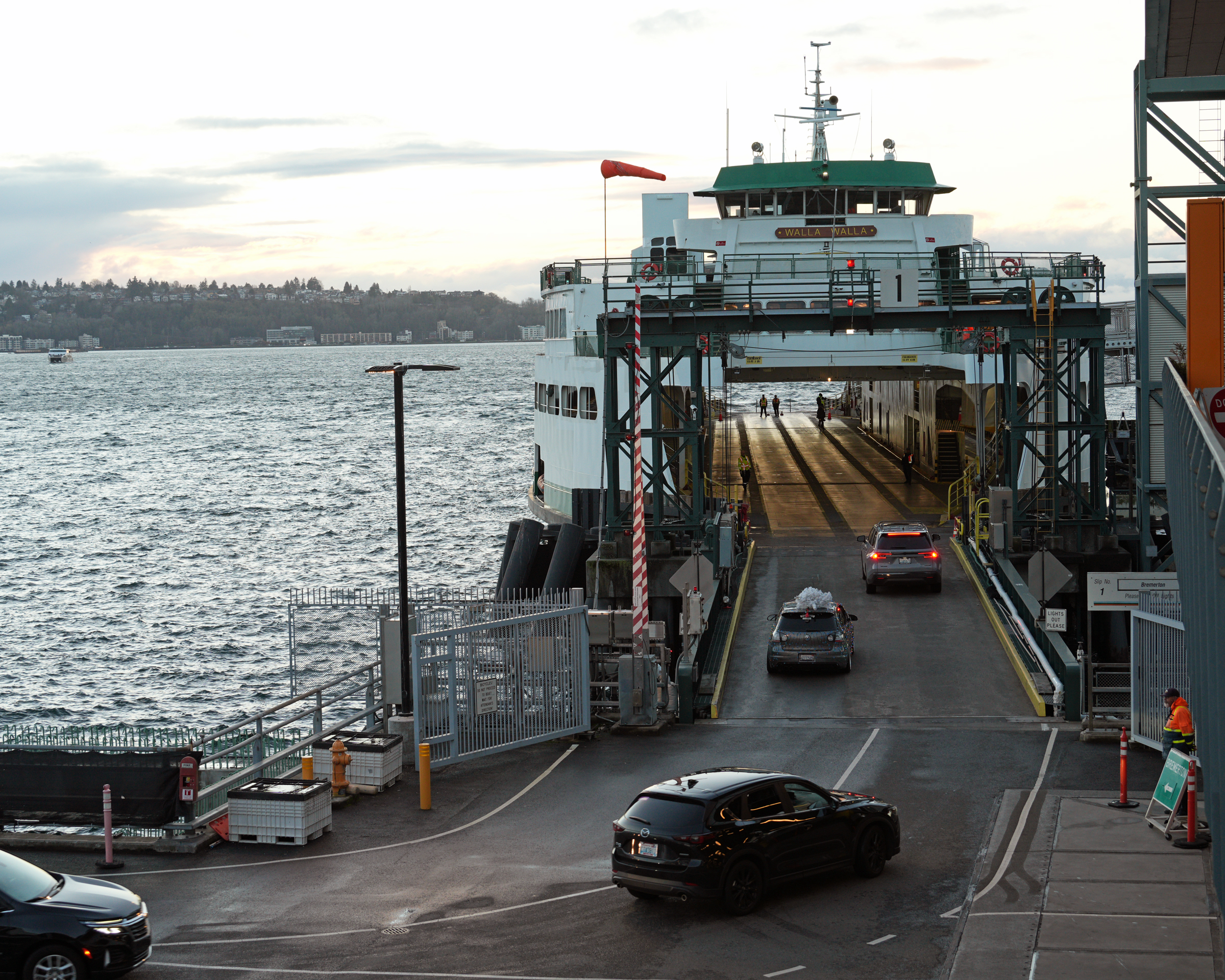
Here are the first cars rolling onto the Walla Walla ferry at Colman Dock (Seattle Ferry Terminal), for its departure to Bremerton. Look at the windsock and choppy water: there is a strong breeze.
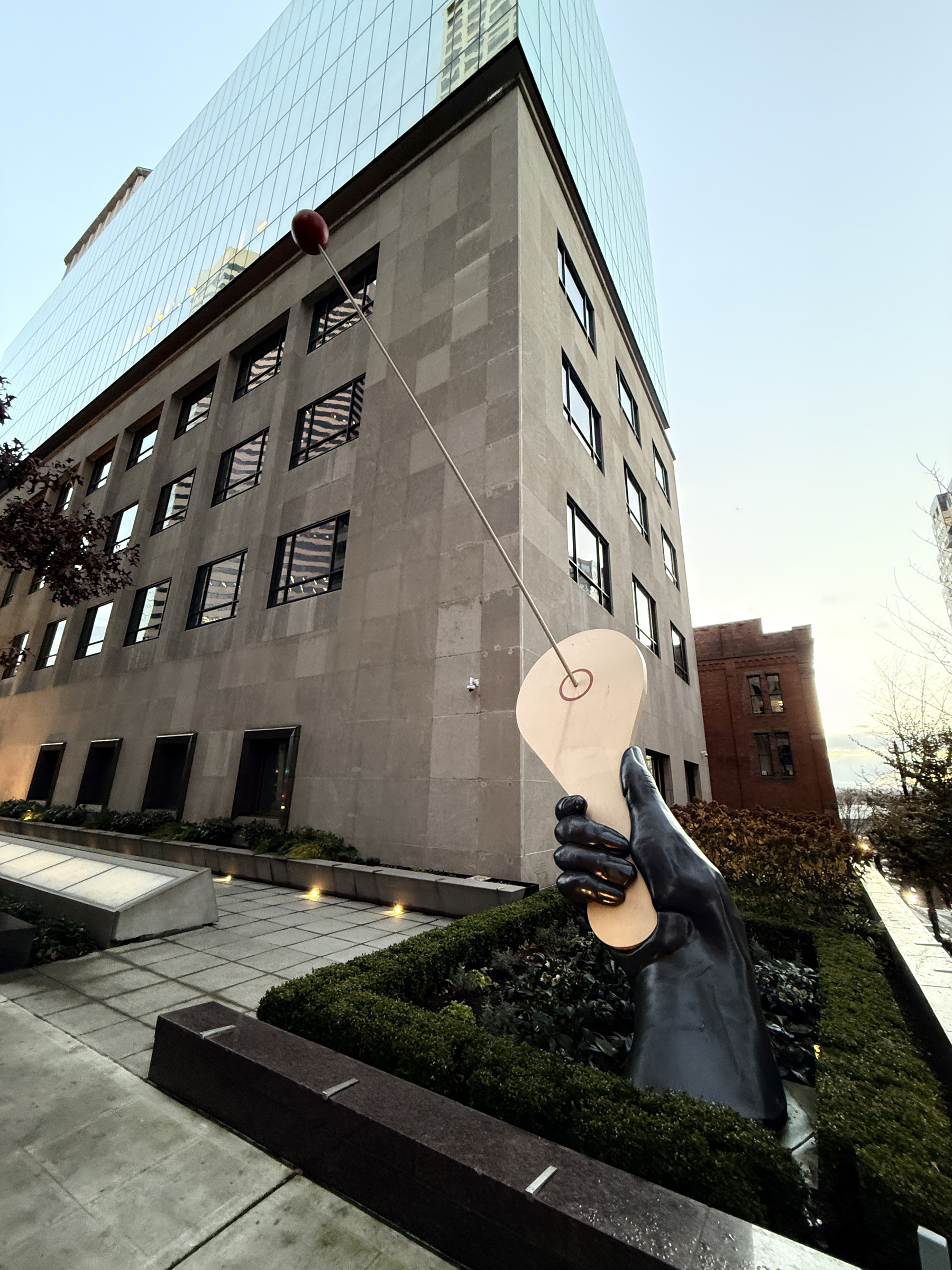
On my way back to the G-line bus stop. Here is “What Goes Up Must Come Down” — the giant paddle-ball sculpture by Catherine Mayer at 2nd Avenue and Spring St. It is about 42 feet tall and made of fiberglass and steel.
There was a break in the rainy weather today here in the city— with a powder blue sky, a little late afternoon sun, and blustery conditions.
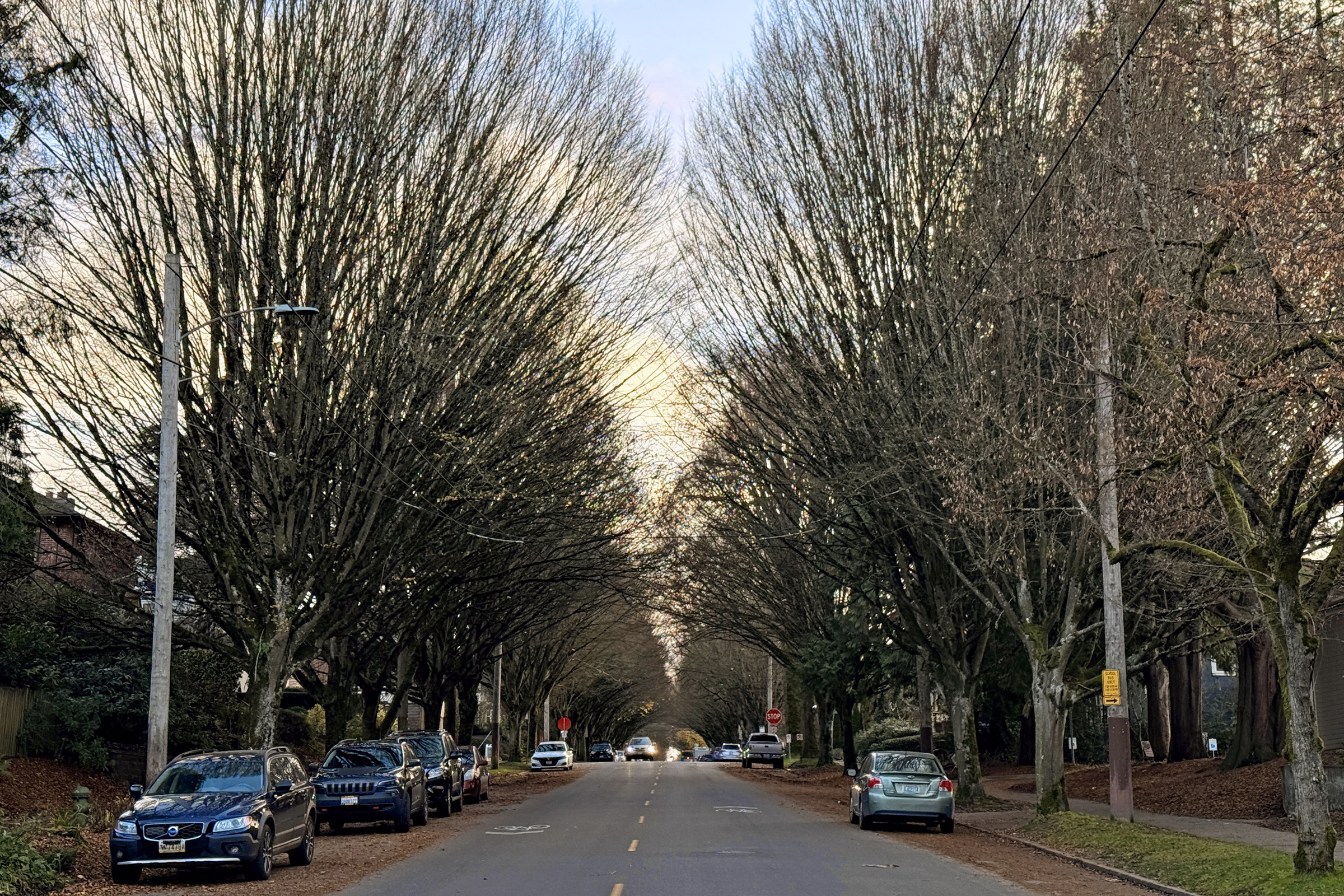
Looking south along 19th Avenue East by Stevens Elementary School (3.10 pm with sunset coming at 4.18 pm). The leaves are all gone now, on the trees that line the street.
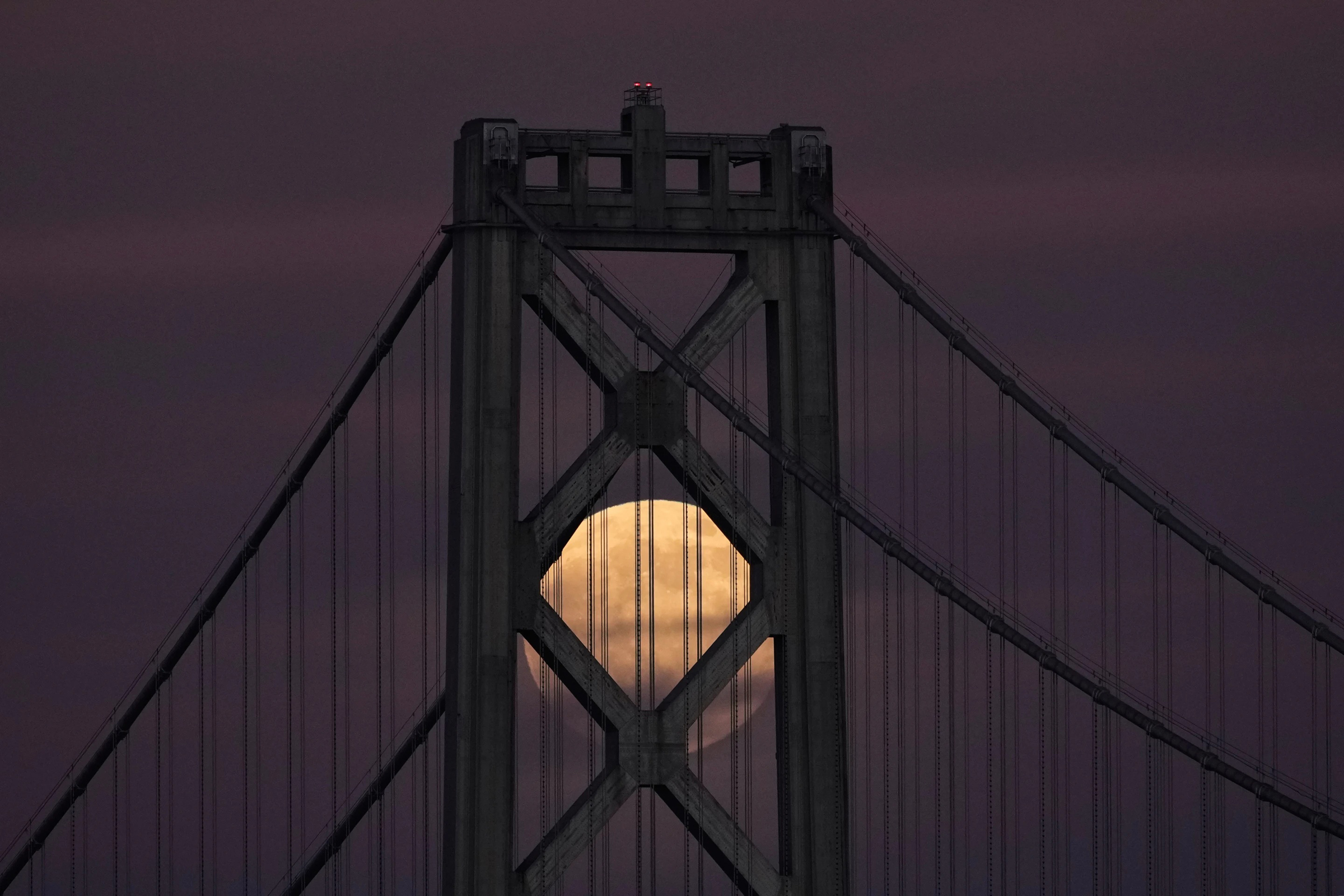
Tonight the last supermoon* of the year— and the third in a consecutive sequence— is out. (There will be a fourth supermoon in this same celestial series in January 2026).
We have cloud cover and lots of rain here in the city in Seattle tonight, so for now I can only look for pictures of the supermoon online.
*A supermoon is a full moon that occurs when the Moon is at or near its closest point to Earth in its elliptical orbit, a point called perigee. This proximity makes the Moon appear slightly brighter and larger than an average full moon, although the difference may be difficult to notice with the naked eye. The term can also technically apply to a new moon, but it is typically associated with the visible full moon.
[Google AI Overview]
A supermoon, the last full moon of the year, rises behind the San Francisco-Oakland Bay Bridge, Thursday, Dec. 4, 2025, in San Francisco. This one is called the Cold Moon. [Associated Press Photo/ Godofredo A. Vásquez]