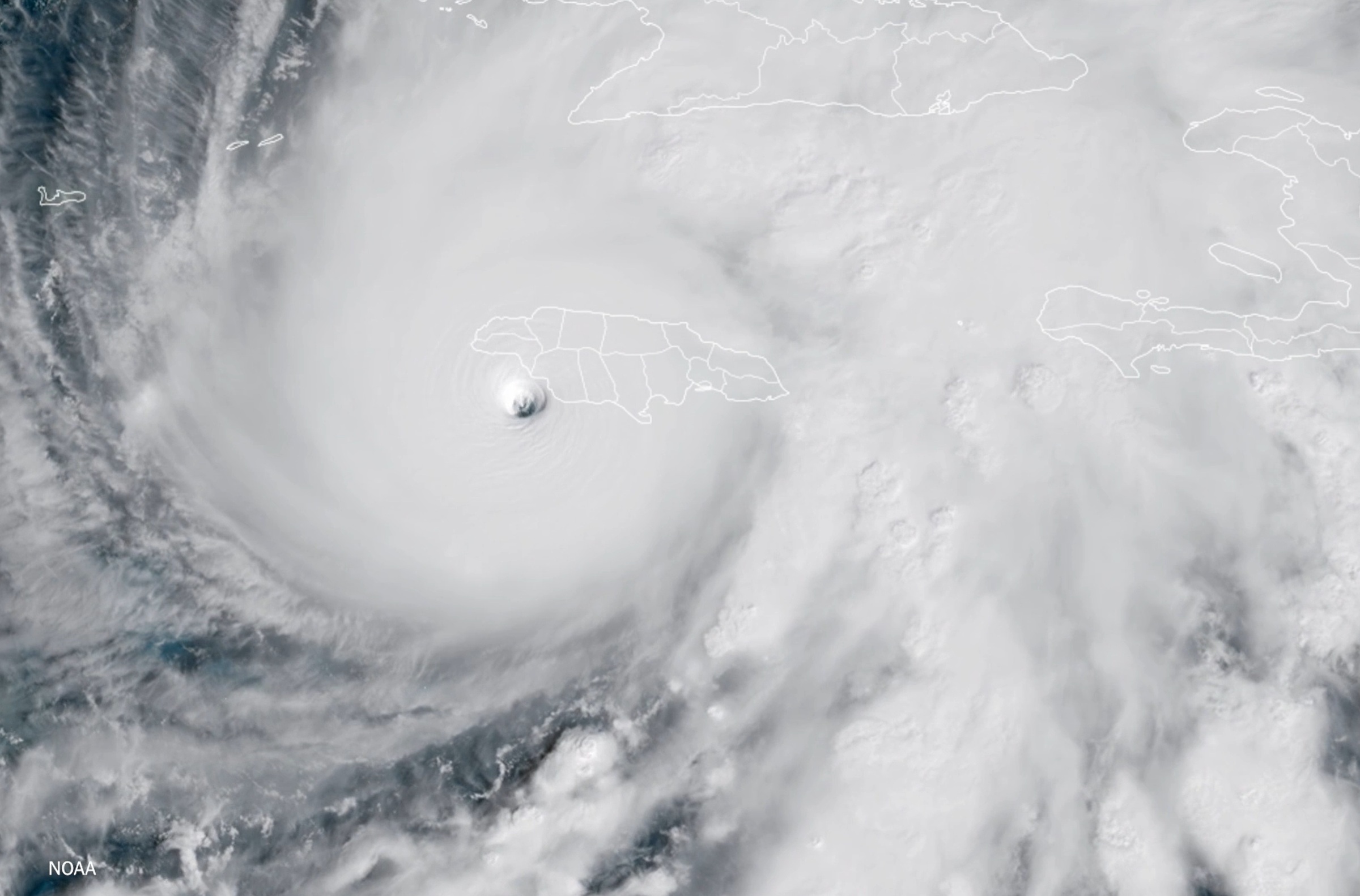
Wednesday/ landfall 🌀

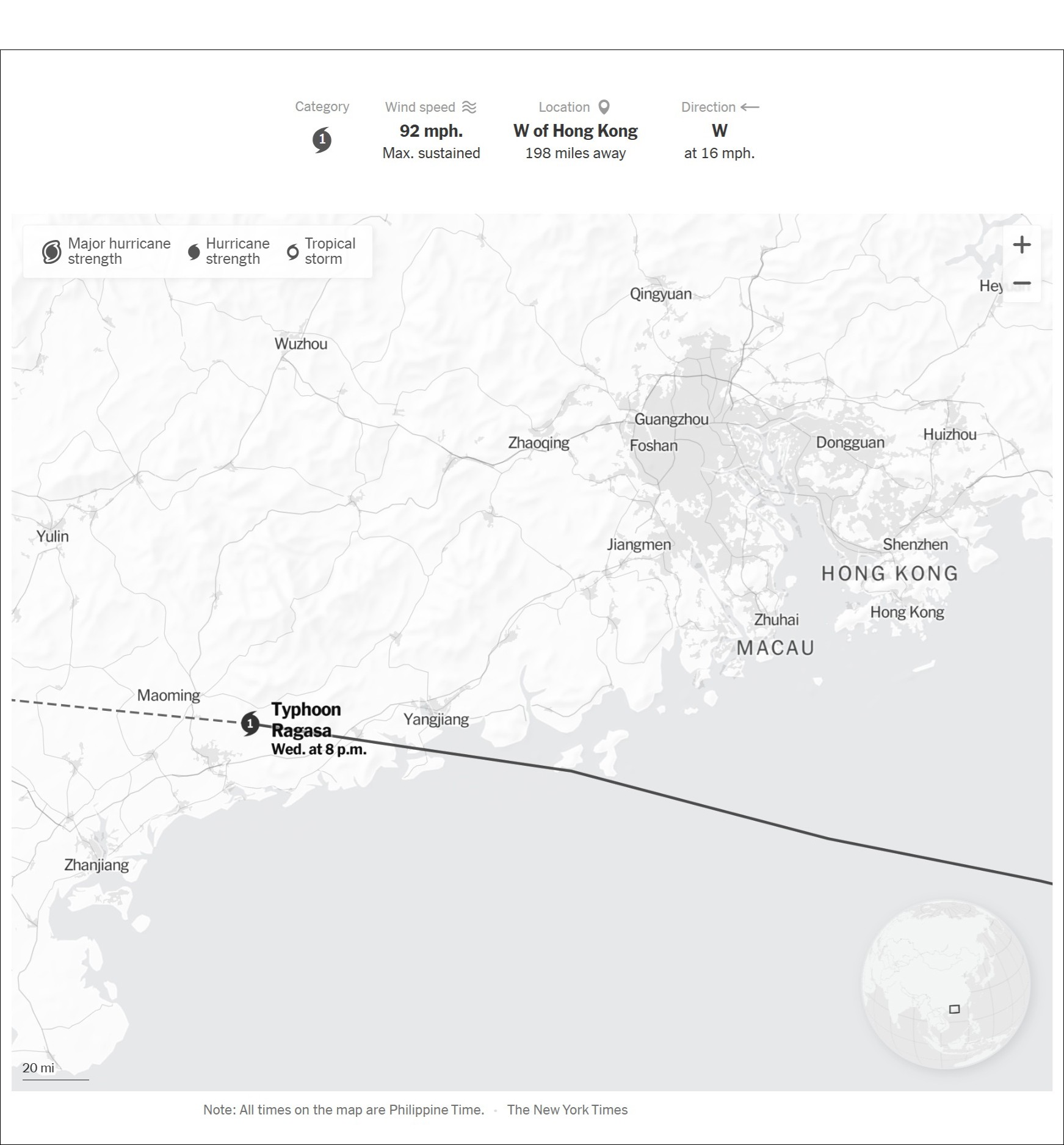
HONG KONG, Sept 25 (Reuters) – Hong Kong resumed flights out of its international airport on Thursday after a 36-hour suspension, reopening businesses, transportation services and some schools after the world’s most powerful tropical cyclone this year lashed the financial hub.
Ragasa brought the densely populated city to a standstill from Tuesday afternoon, after sweeping through the northern Philippines and Taiwan where it killed 14, before making landfall on the southern Chinese city of Yangjiang on Wednesday.

Monday/ a typhoon at autumn equinox 🌏

Happy autumn equinox (spring equinox south of the equator).
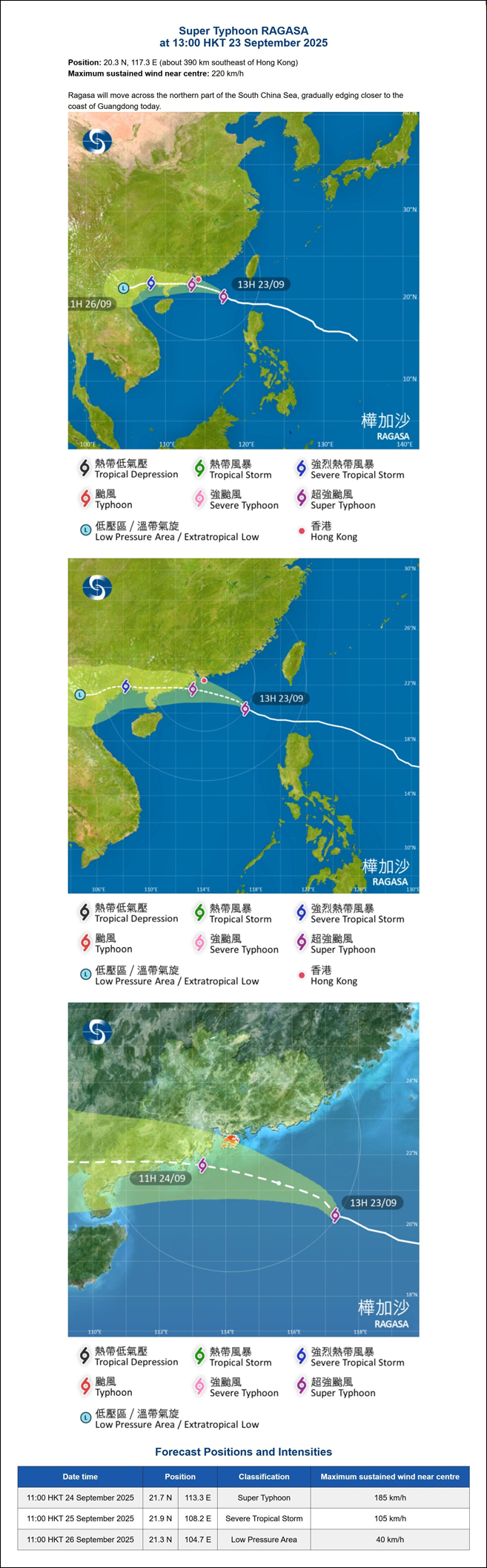
There is a very strong typhoon brewing in the South China Sea— Super Typhoon Ragasa. (Ragasa is Tagalog for scramble.)

The water level in Hong Kong is forecast to rise about 2 meters (6.5 feet), and the maximum water level in some areas could hit 4 to 5 meters (13.1 to 16.4 feet) above the typical lowest sea level.


HONG KONG (AP) — Southern Chinese cities scaled back many aspects of daily life on Tuesday with school and business closures and flight cancellations as the region braced for one of the strongest typhoons in years that has already killed three people and led to the displacement of thousands of others in the Philippines.

Hong Kong’ s observatory said Super Typhoon Ragasa, which was packing maximum sustained winds near the center of about 143 mph (230 kph), is expected to move west-northwest at about 14 mph (22 kph) across the northern part of the South China Sea and edge closer to the coast of Guangdong province, the southern Chinese economic powerhouse.
– Kanis Leung writing for Associated Press
A typhoon and a hurricane are the same type of storm—a powerful tropical cyclone—but they are given different names based on their geographical location. A hurricane is the term used for these storms in the North Atlantic, Central North Pacific, and Eastern North Pacific, while a typhoon refers to a storm of the same intensity and structure that forms in the Northwest Pacific Ocean.
[Sources: Google AI Overview; Hong Kong Observatory]

Thursday/ Akihabara and Tokyo Station 🚆

There was drizzle on and off here in Tokyo on Thursday, at a damp 85°F (30 °C).
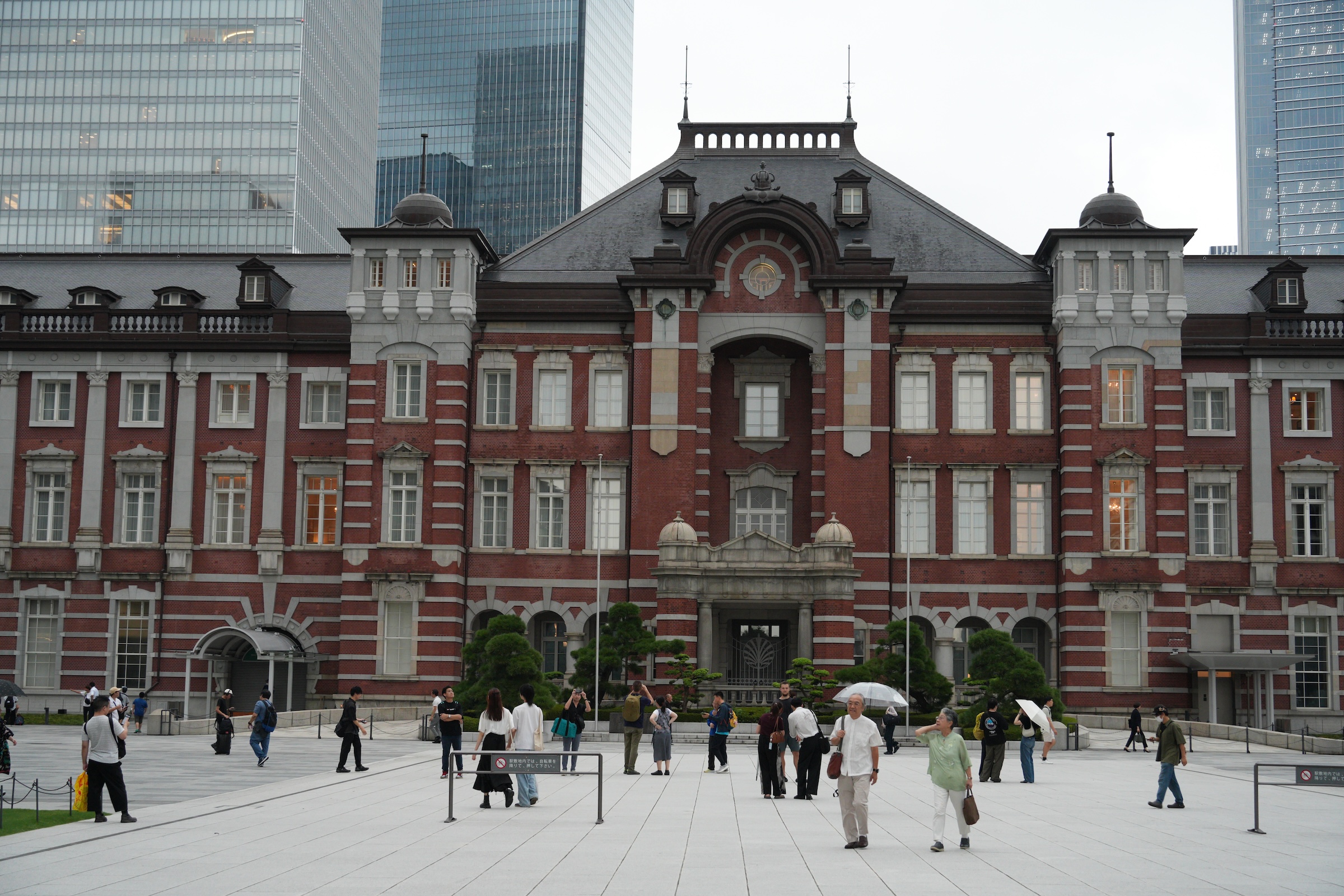
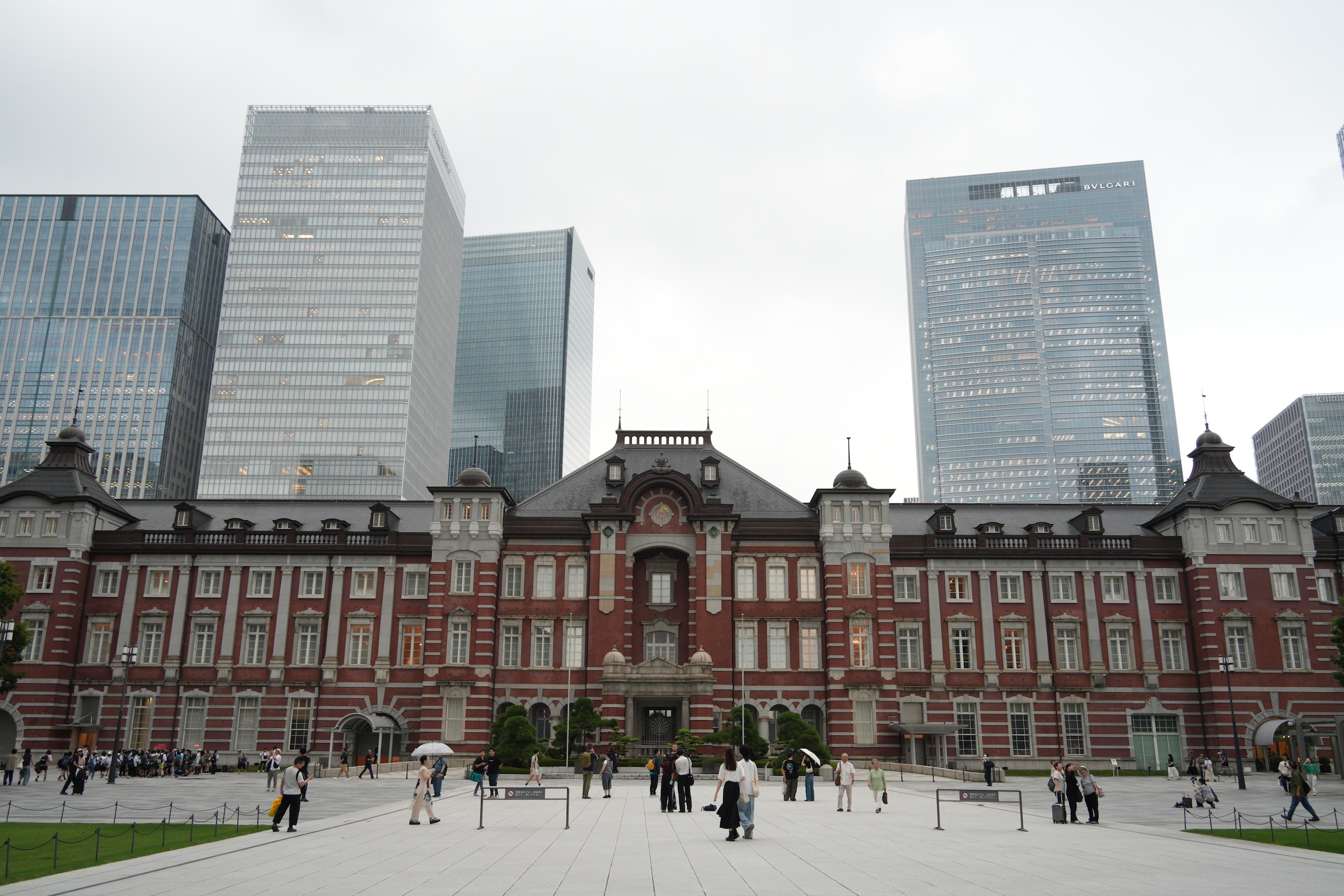
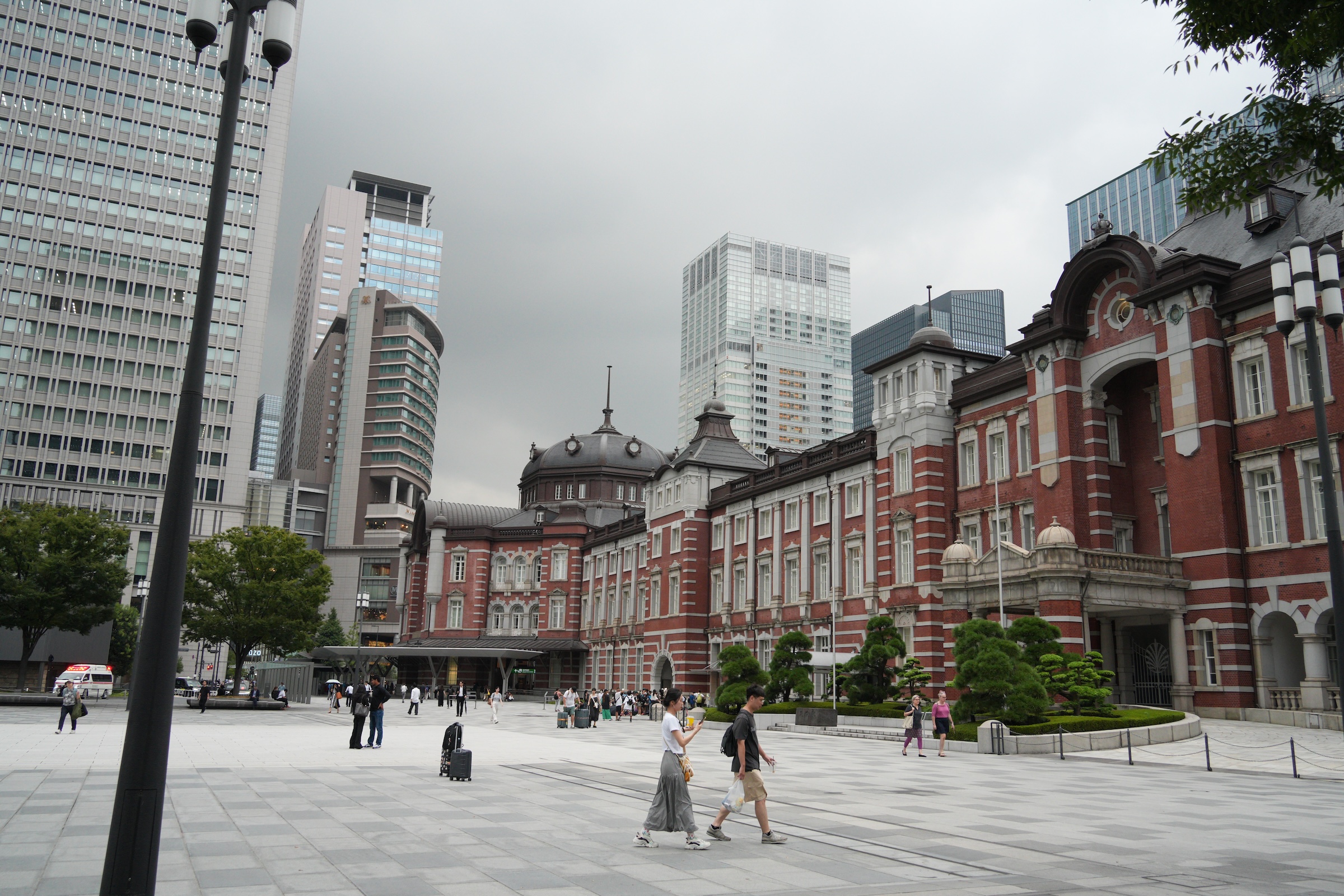
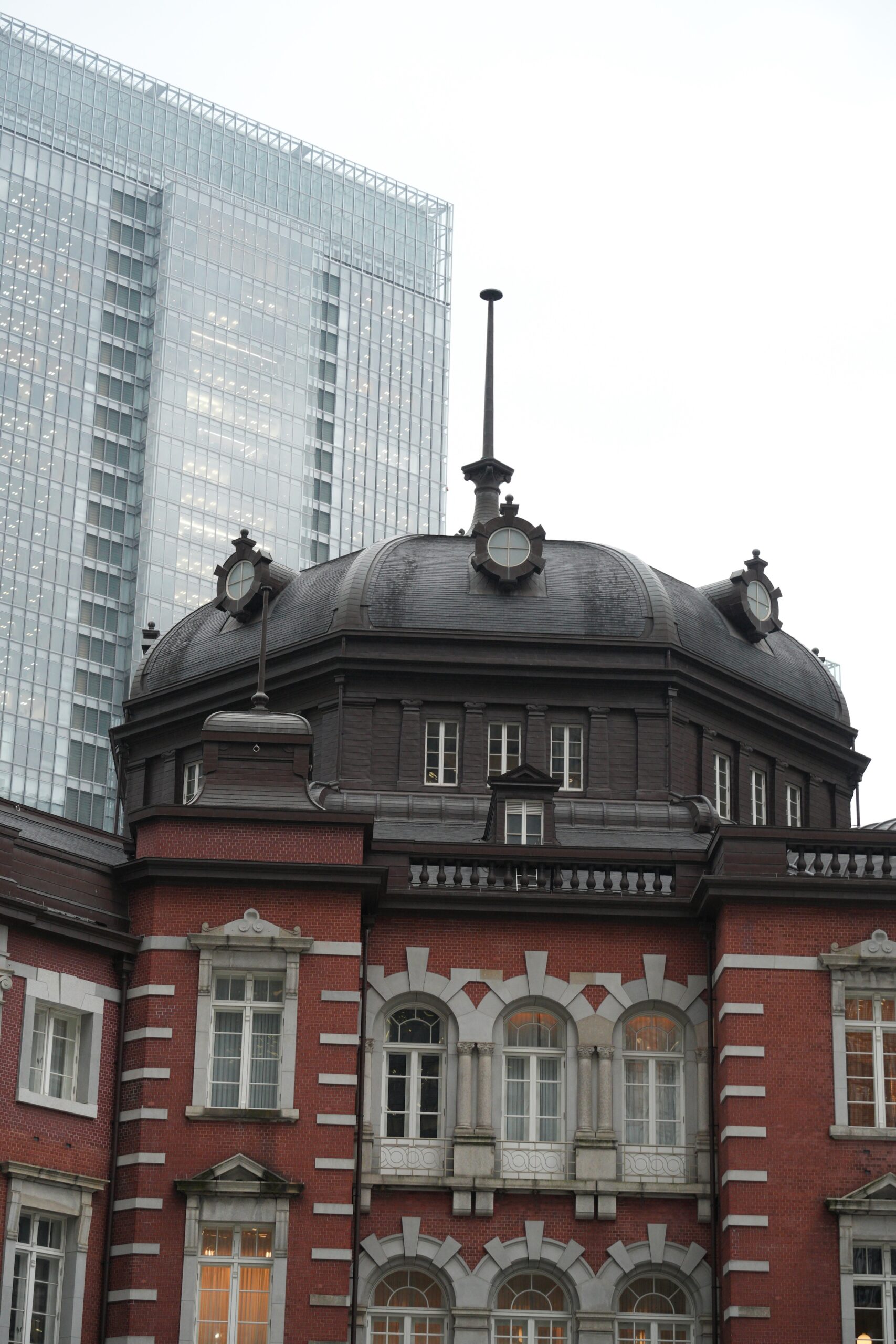
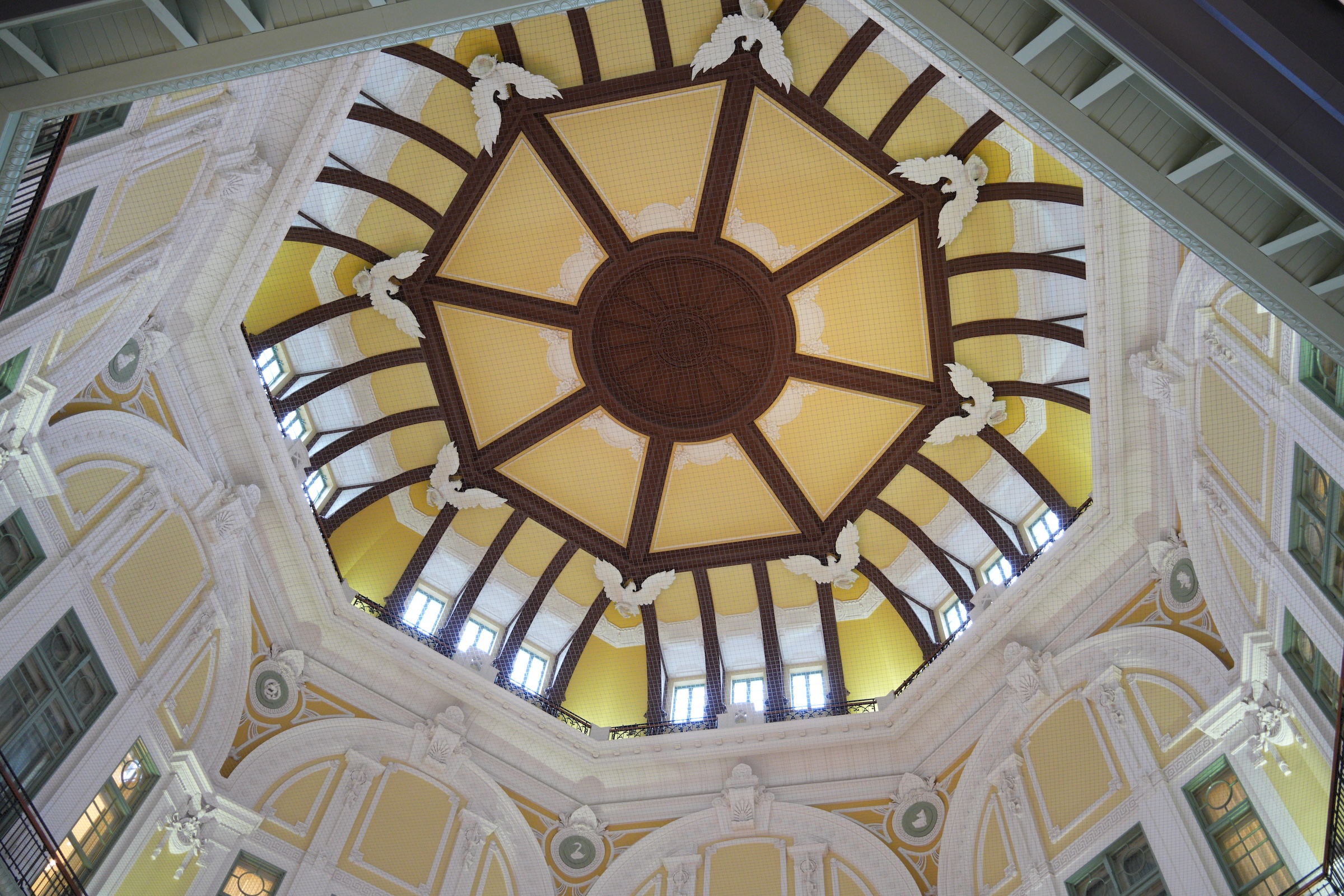
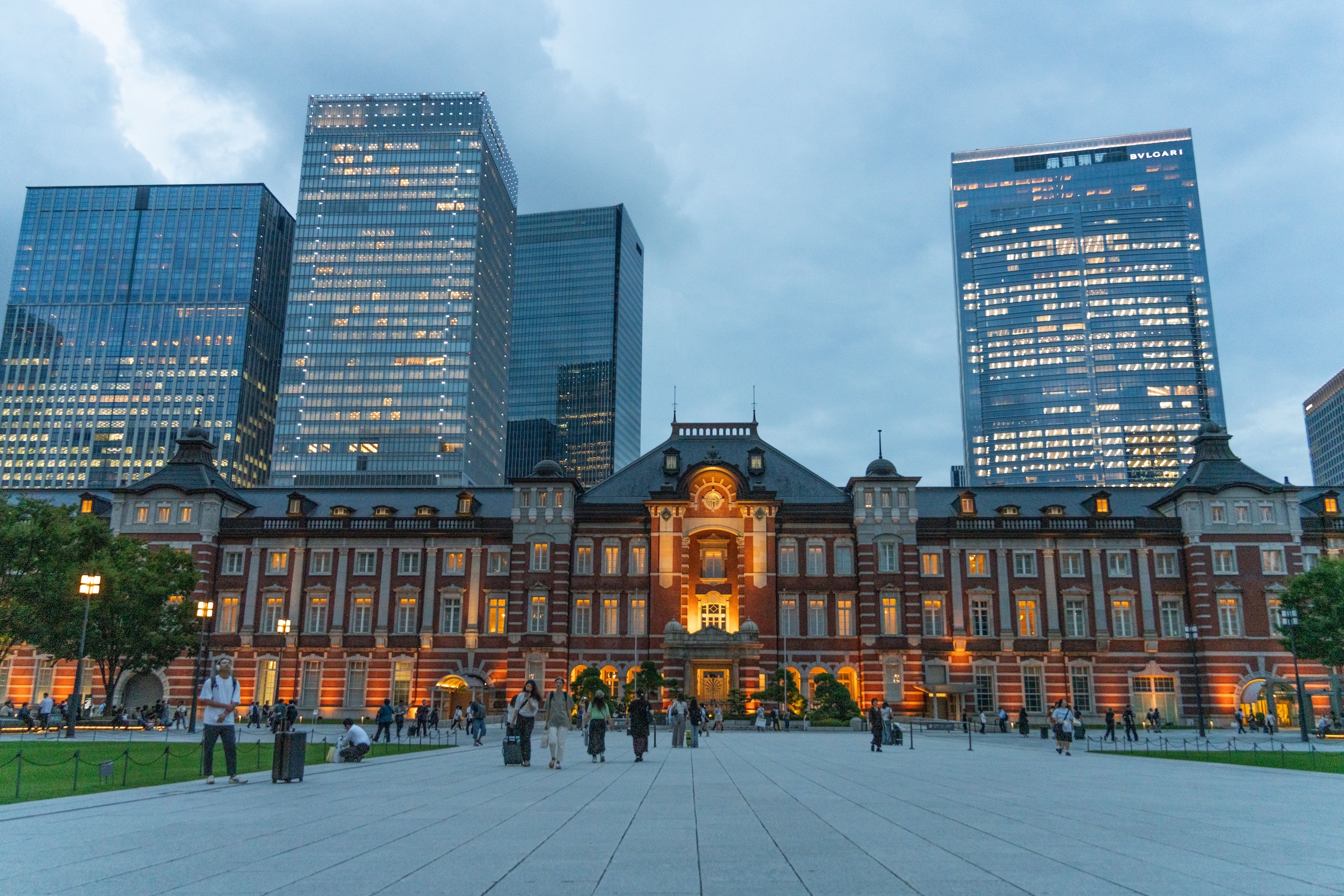
Outside, I could only take pictures here and there with my big camera, but managed to get a few of the iconic 1914 Tokyo Station building (extensively renovated and restored in 2012).
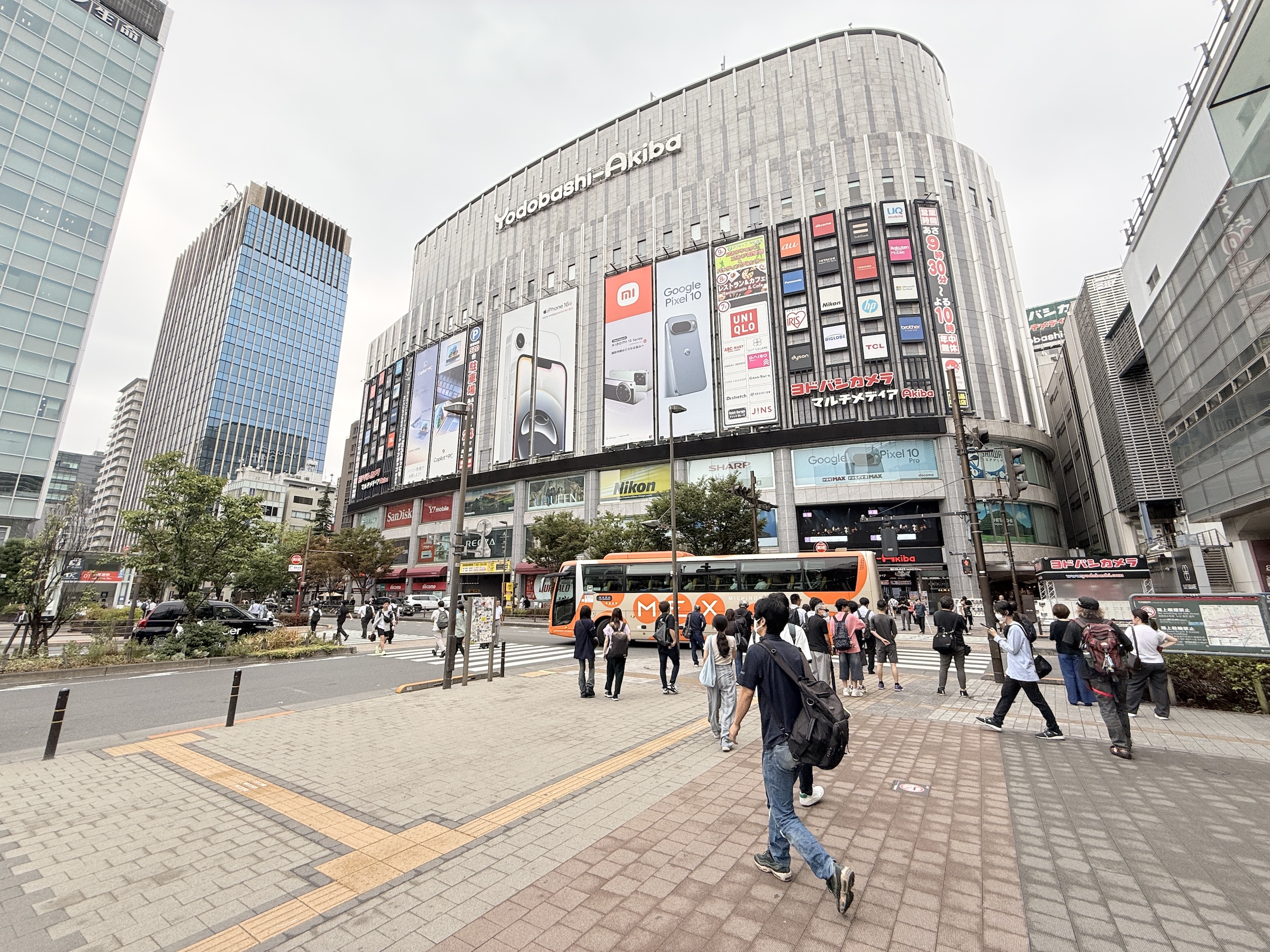
I also made my first run to the Yodobashi Akiba store in Akihabara.
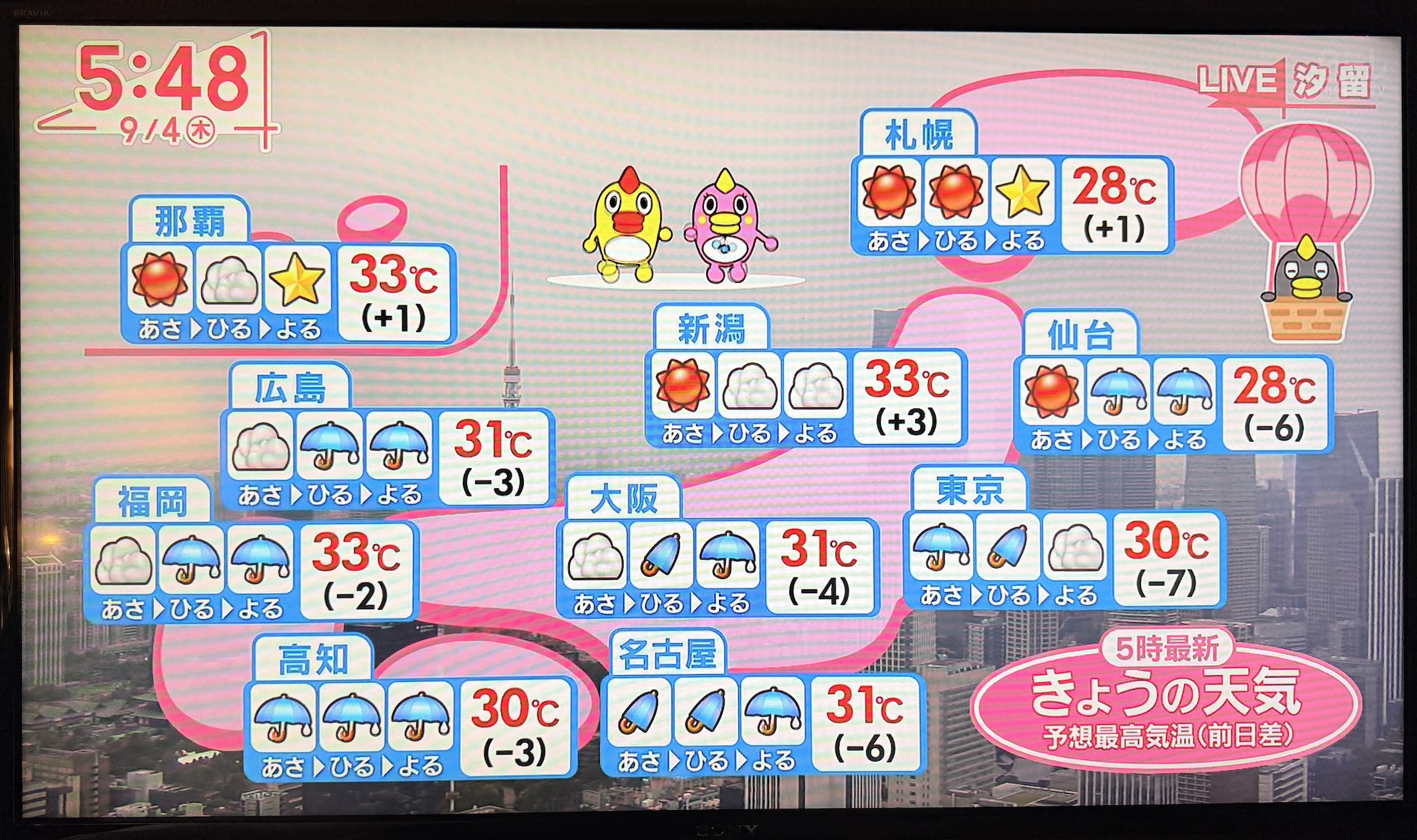
Nice infographic from the hotel room TV. The pink blobs are Japan’s main islands. That’s Tokyo in the bottom right corner, showing that the 30 °C is down 7°C from yesterday (85 °F , down from 99 °F). Yay! .. even though it still feels very warm and humid. (And are those little characters chickens?)
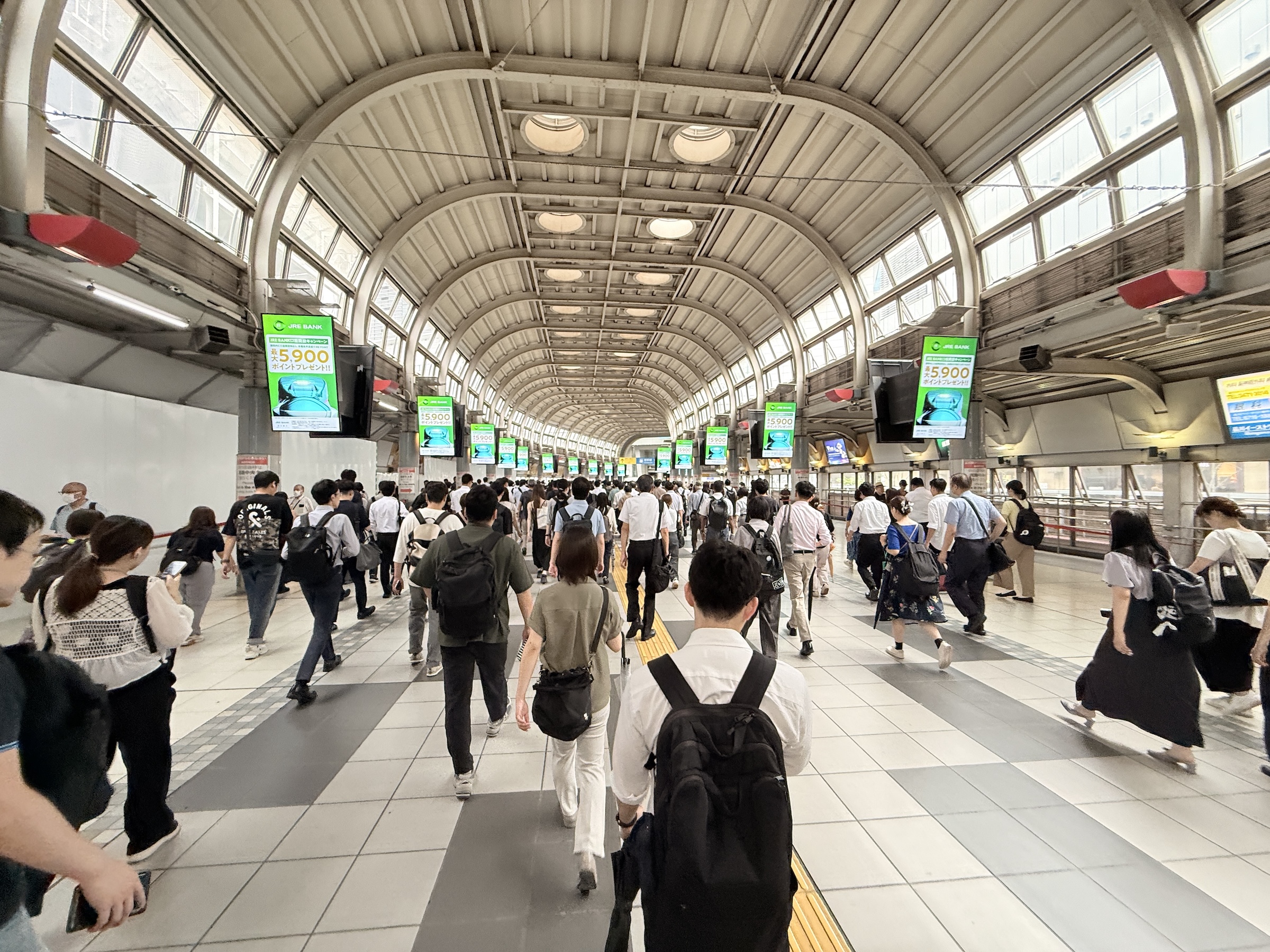
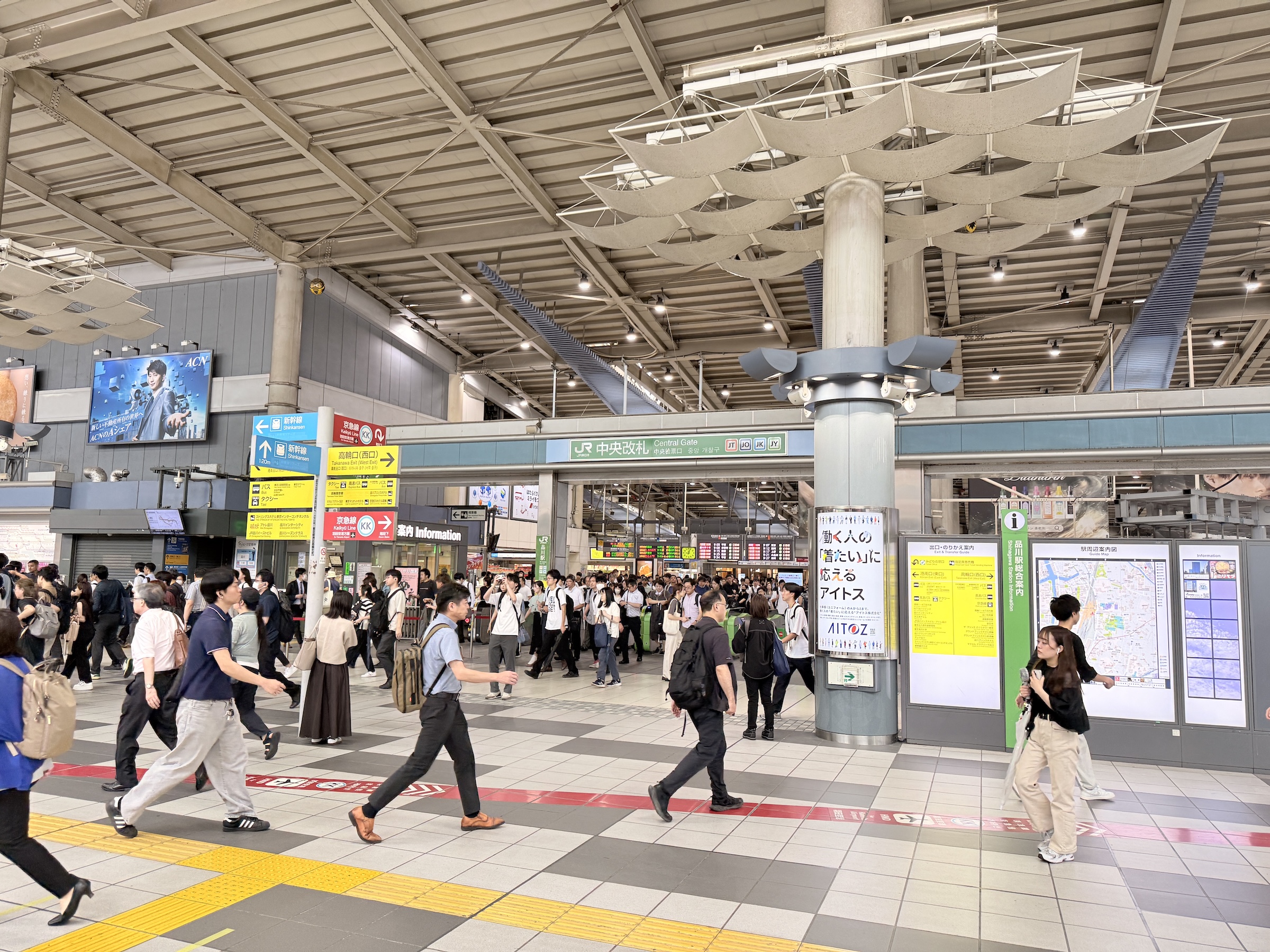
This is about 9.30 am and I caught the tail end of the morning rush hour into, and out of Shinagawa station.
Office workers and a few others (me) streaming out of Shinagawa station. Walk on the sides, if you are coming into the station, said the display screen.
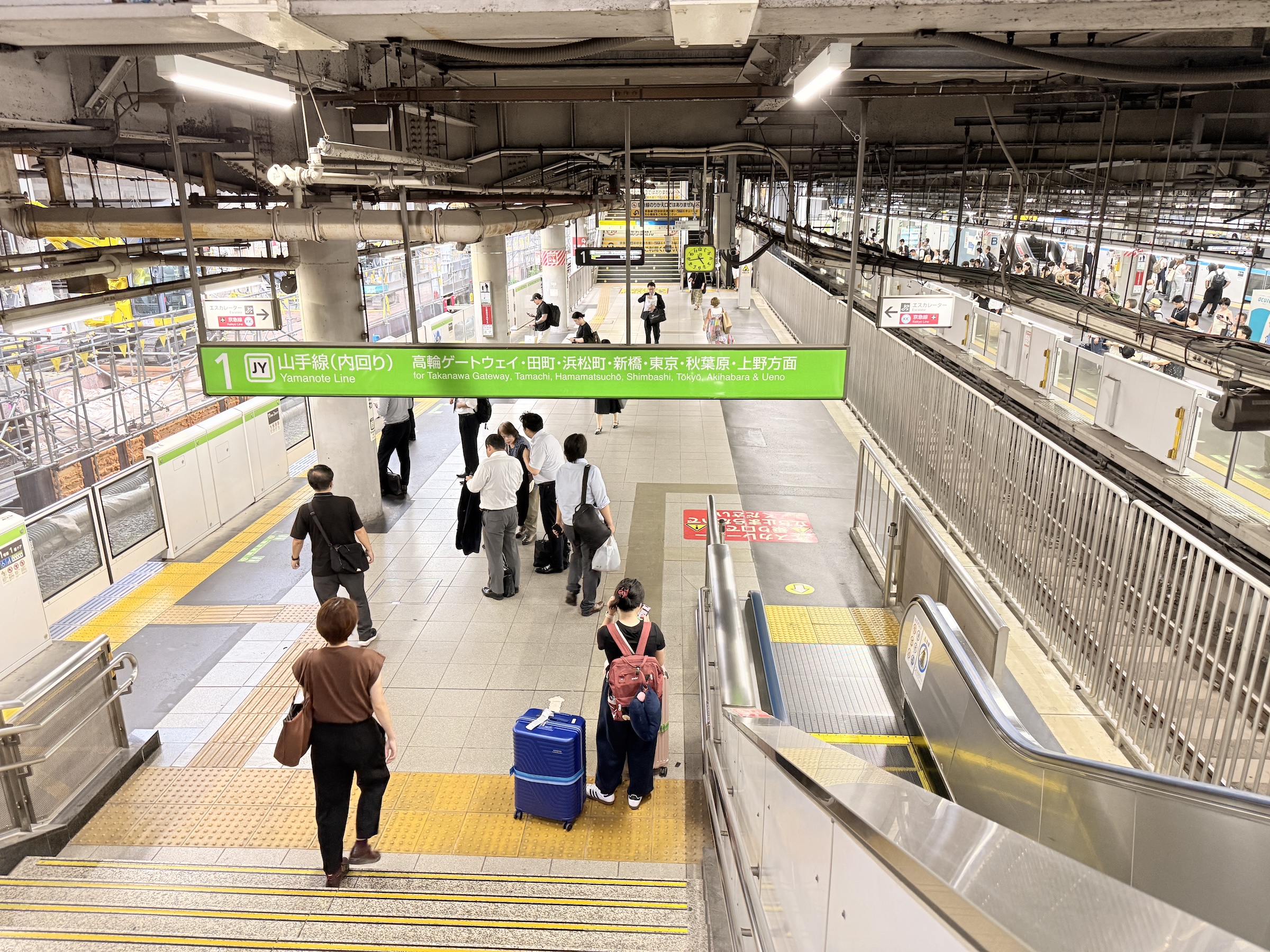
All right, now I’m heading down to the Yamanote Line— the loop line with Shinagawa station on it, near my hotel. This line has been in service for 140 years now (constructed 1885) and is used by some 4 million people every day. The train had left just a minute ago.
Hello, Yodobashi Akiba! It is by Akihabara station, 8 stops to the north of Shinagawa station.
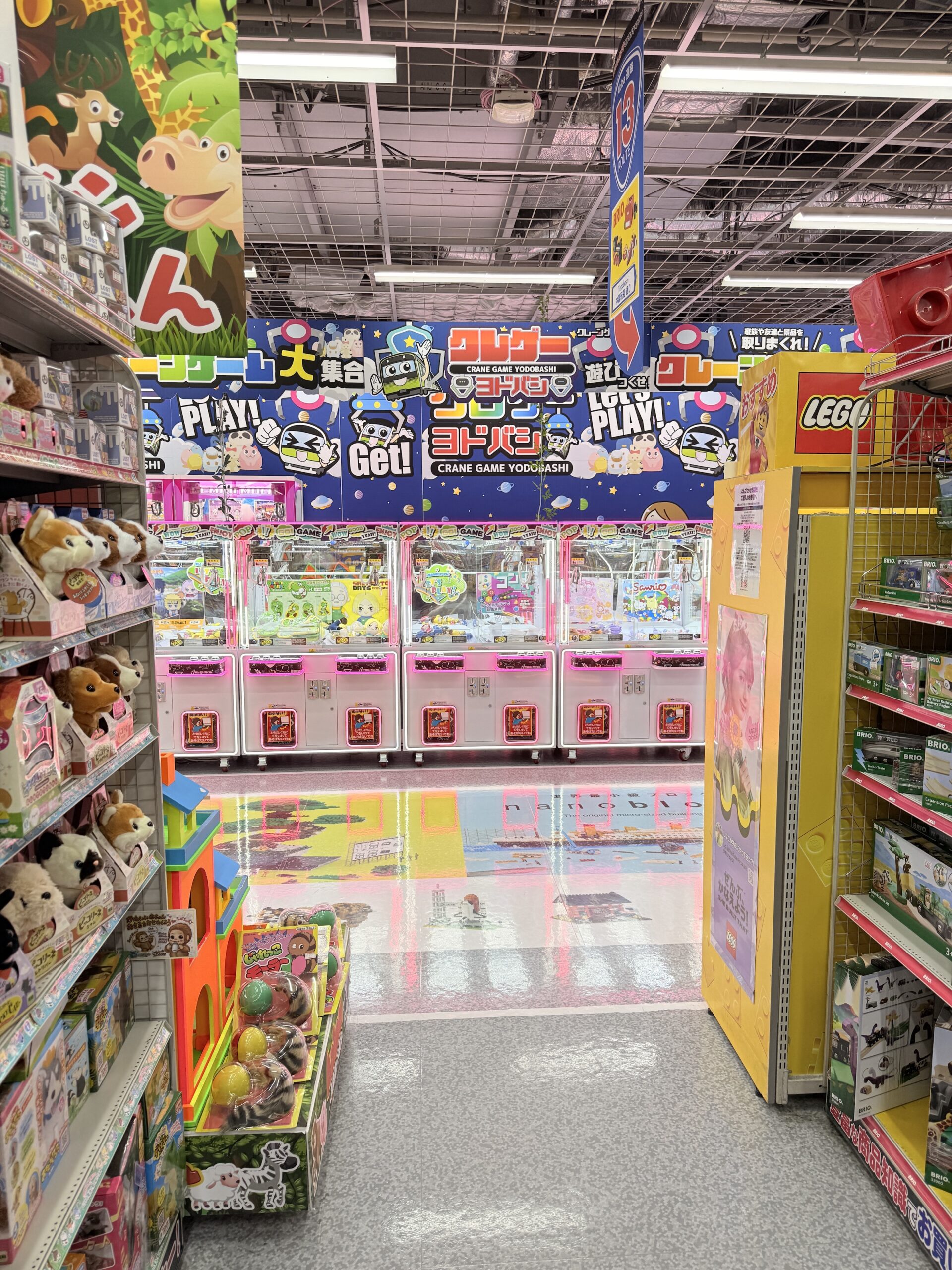
The toys for kids of all ages are on the 6th floor. The bank of pink claw machines was not there two years ago when I last visited.
In Japan, claw machines are most commonly called “UFO catchers” (ユーフォーキャッチャー) or “crane games” (クレーンゲーム). The term “UFO catcher” comes from the appearance of the claw mechanism, which resembles a UFO descending to capture a prize, a term popularized by Sega when they introduced the game in 1985.
[From Wikipedia]
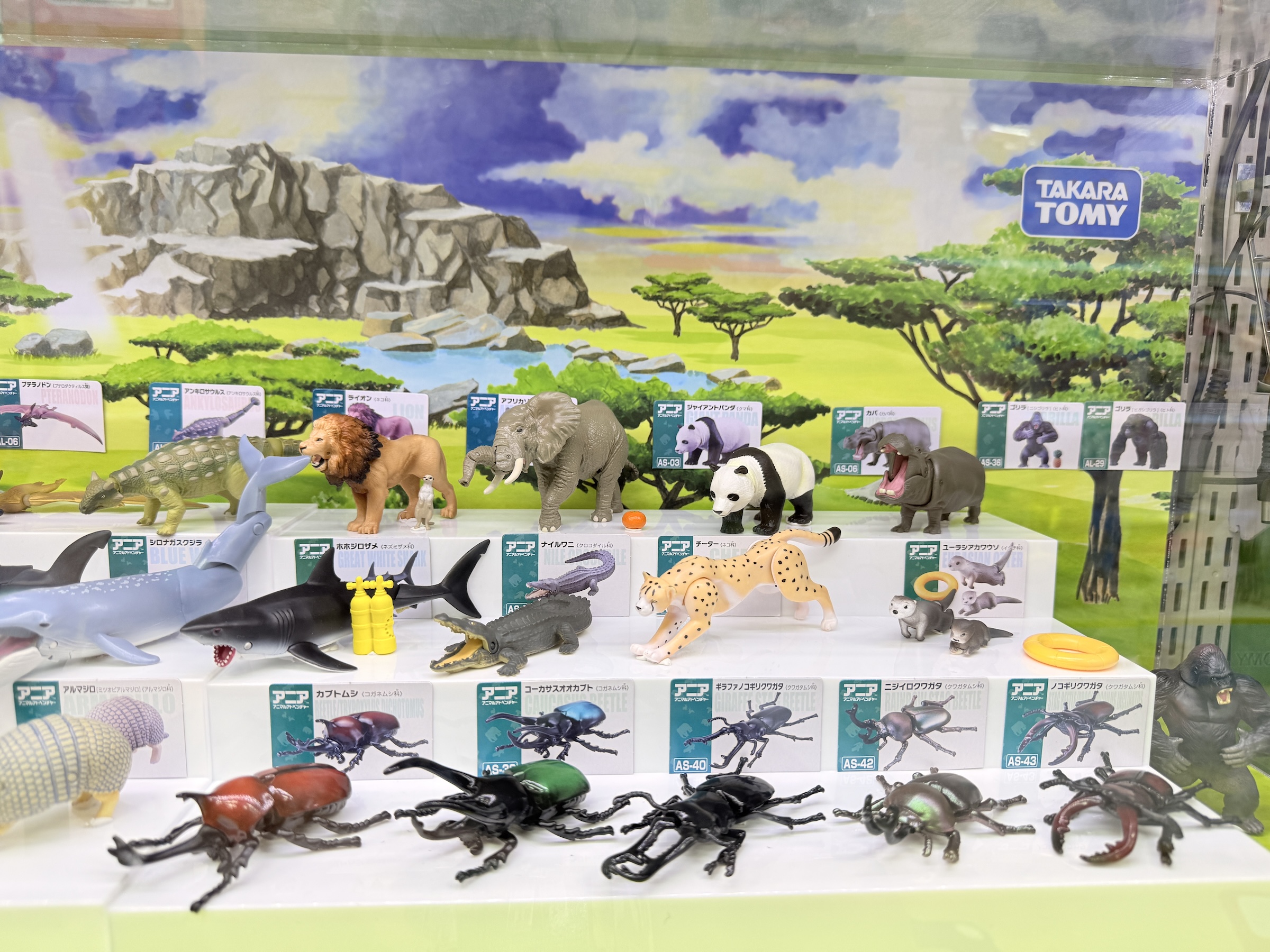
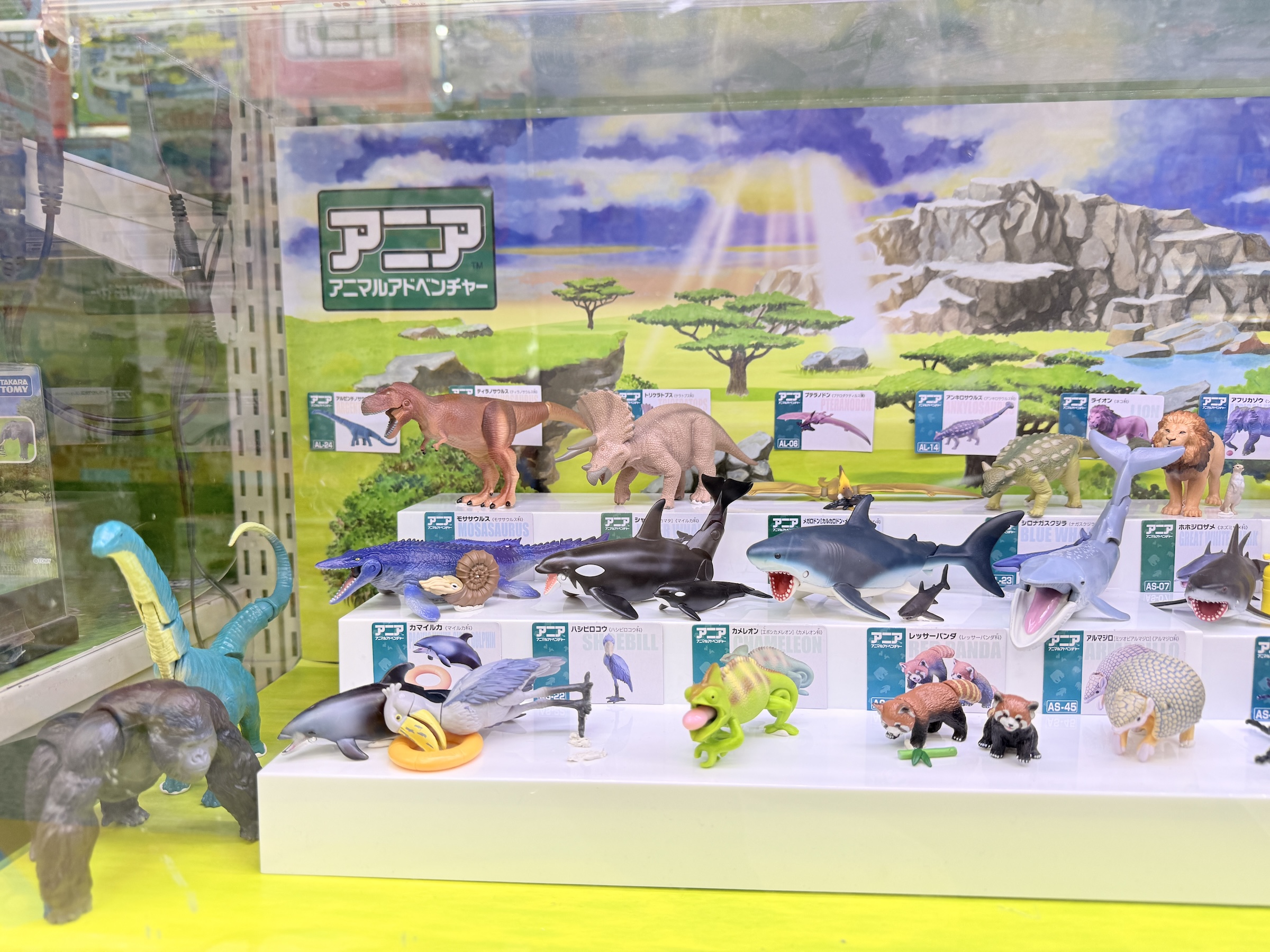
I bought a few of these Takara Tomy animal figures: the lion, the cheetah, a gorilla, a peacock, a shoebill stork.
Help! The shoebill stork fell down (is its bill too big and heavy?) and someone needs to come and fix the display case. The chameleon figure (bottom) has a movable tongue that can be pulled out and pushed back in. Nice. I now regret I did not get the chameleon, as well.
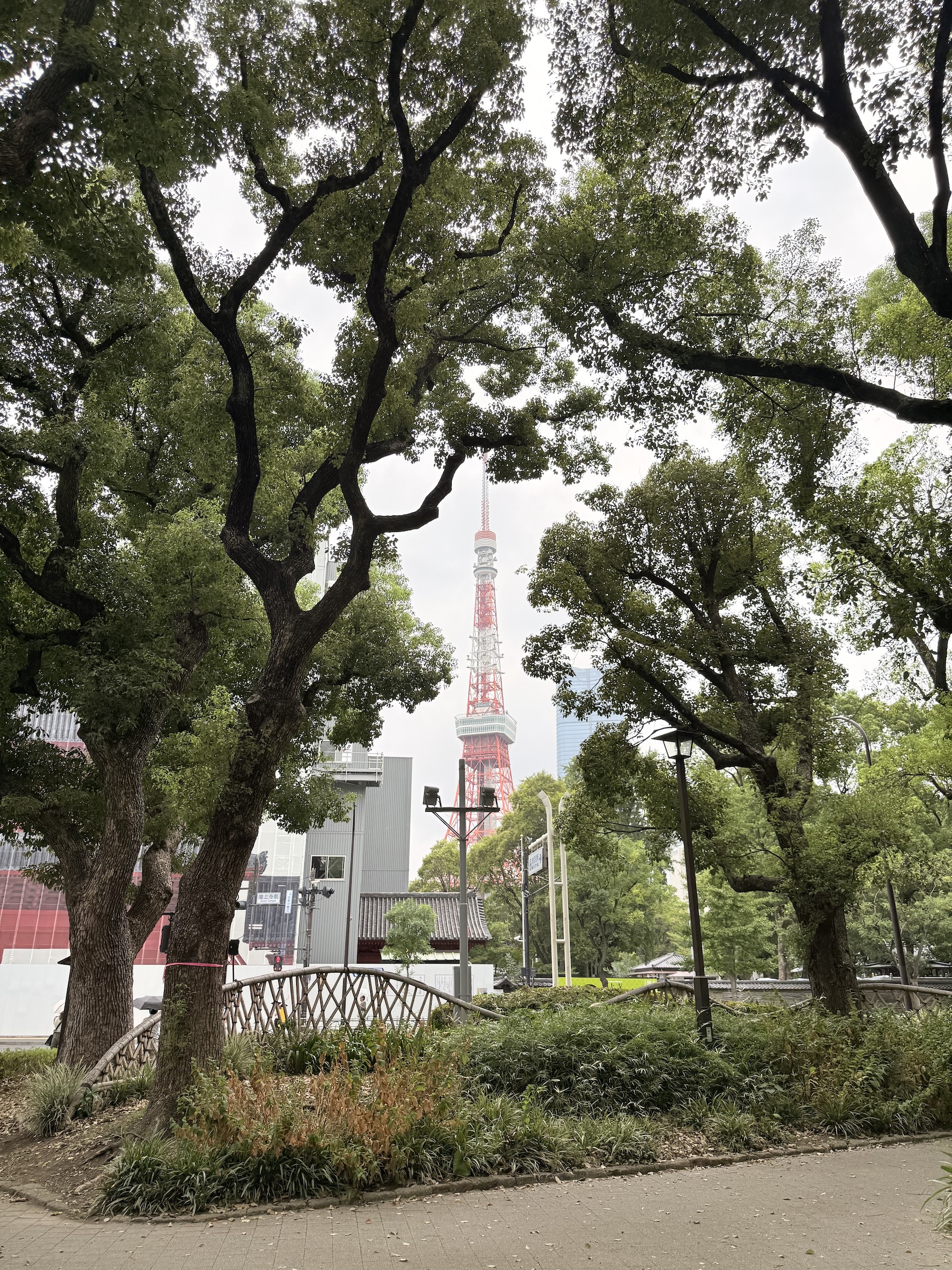
On the way back on the Yamanote line, I saw Tokyo Tower out of the train window by Hamamatsucho station. It seemed nearby and I stepped out and walked the five or six there— kind of regrettting it, because it started to drizzle. This green space near the Tower is called Shiba Park.
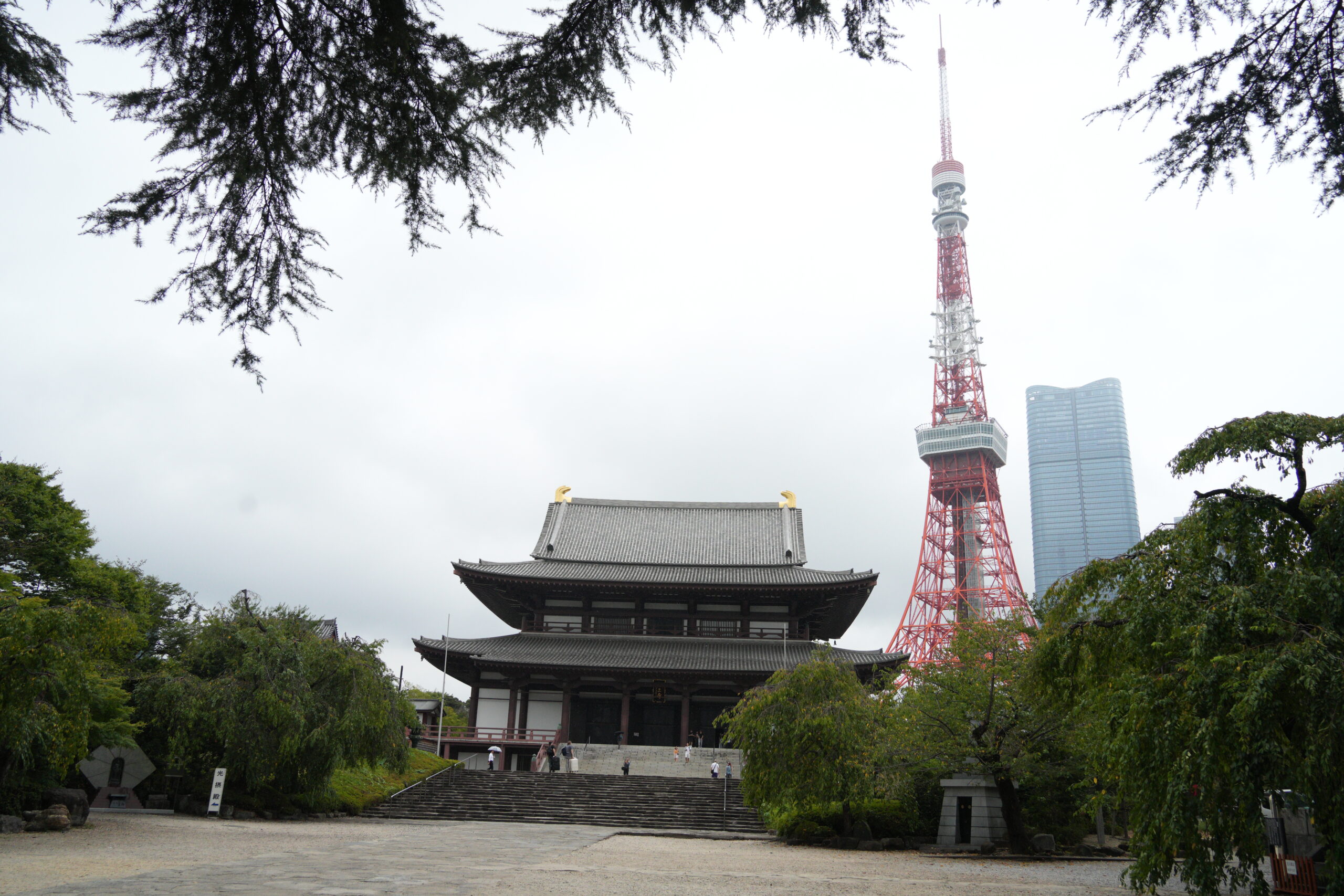
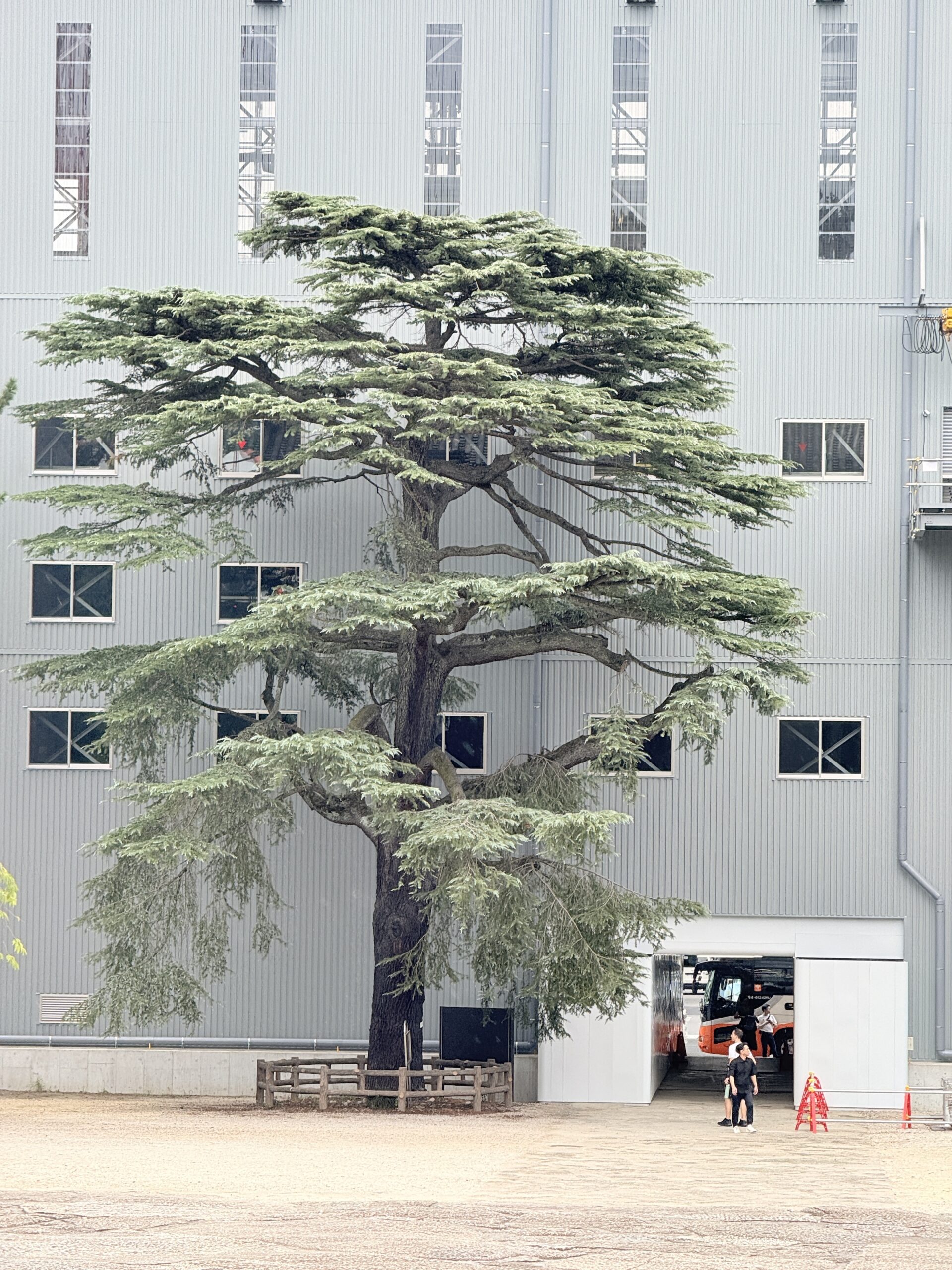
I’m standing under a Himalayan cedar, and that’s the Buddhist temple called Zojo-ji Temple.
From Wikipedia: At its peak the temple grounds had more than 120 buildings, but following the decline of Buddhism during the Meiji period (1868-1912), most of them burned down during the bombing of Tokyo in World War II. Reconstruction began after the war, with the Daiden (great hall) being rebuilt in 1974.
Here’s the Himalayan cedar. A plaque by the tree notes that General Grant (18th President of the United States) planted this tree when he visited Zojo-ji Temple as a guest in 1879 (that’s 146 years ago).  The main gate to the grounds is under renovation and enclosed in a sheet metal building behind the tree.
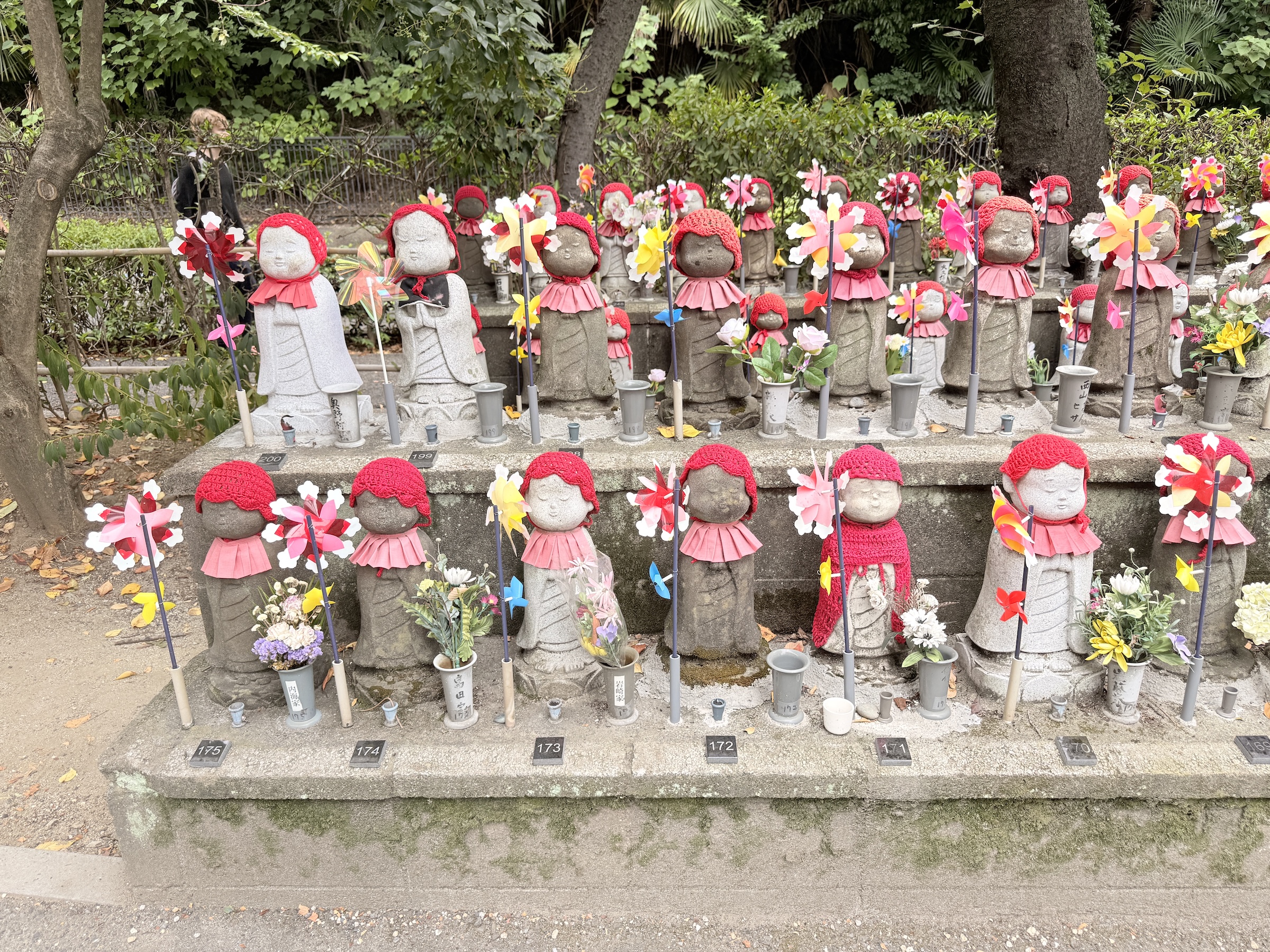
A cemetery by the temple, presumably with ashes from the deceased. The cemetery at Zojo-ji Temple holds the mausoleums of six Tokugawa shoguns* and their families, serving as the family temple for the Tokugawa clan.
*The shogun (short for Sei-i Taishōgun, 征夷大将軍) was the supreme military and political leader of Japan, ruling for nearly 700 years. The rule of the shoguns ended in 1868 with the Meiji Restoration, which was triggered by growing internal discontent and the disruptive arrival of Western powers.
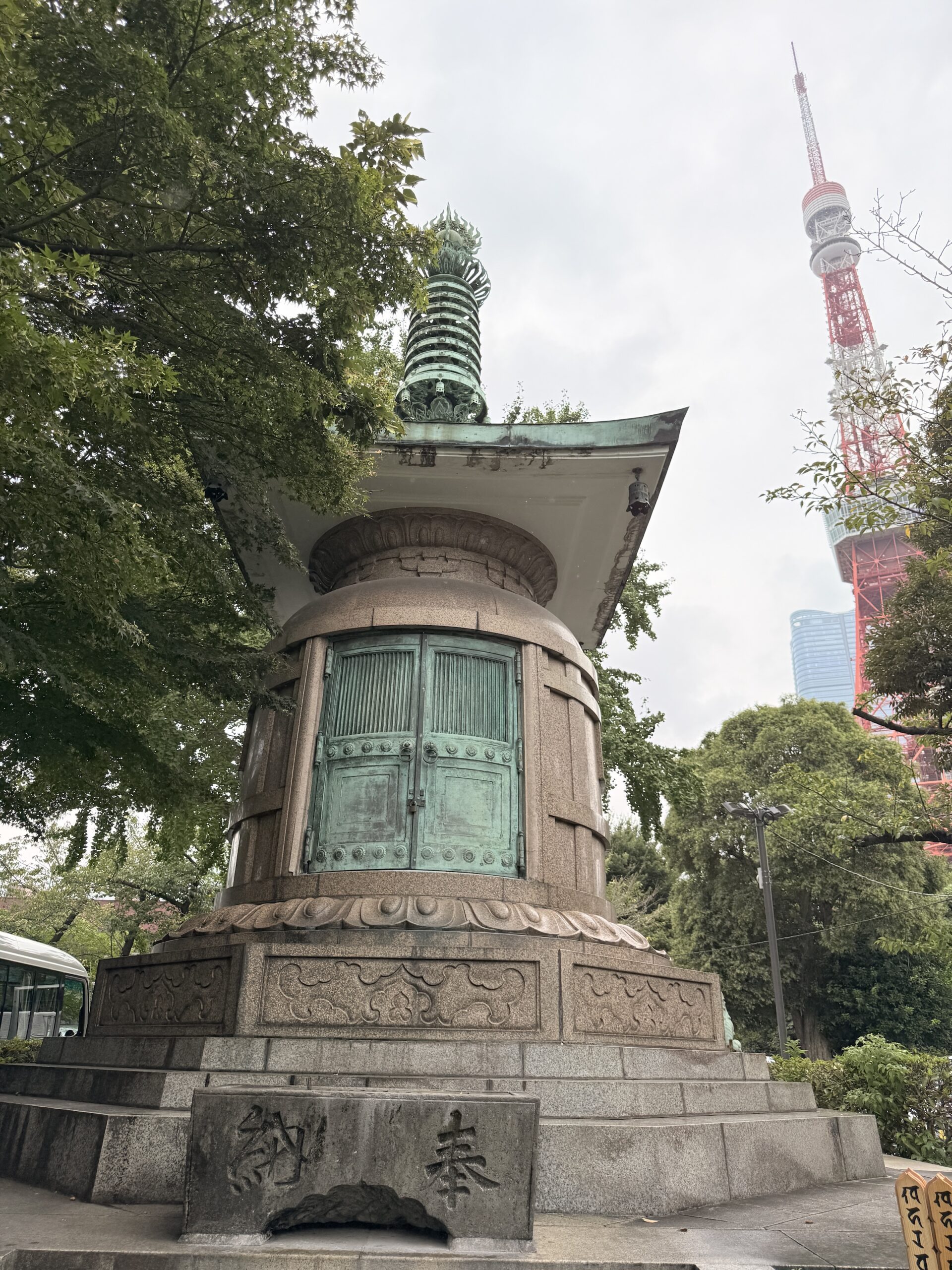
Dai-Nokotsudo, or Shariden, is where the bones of deceased are stored. It is made of stone and was created in 1933.
Here are several pictures of the Tokyo station building, taken late afternoon and early evening. Tokyo Station is surrounded by many modern glass and steel office towers.

Wednesday/ arrival in Tokyo 🗼

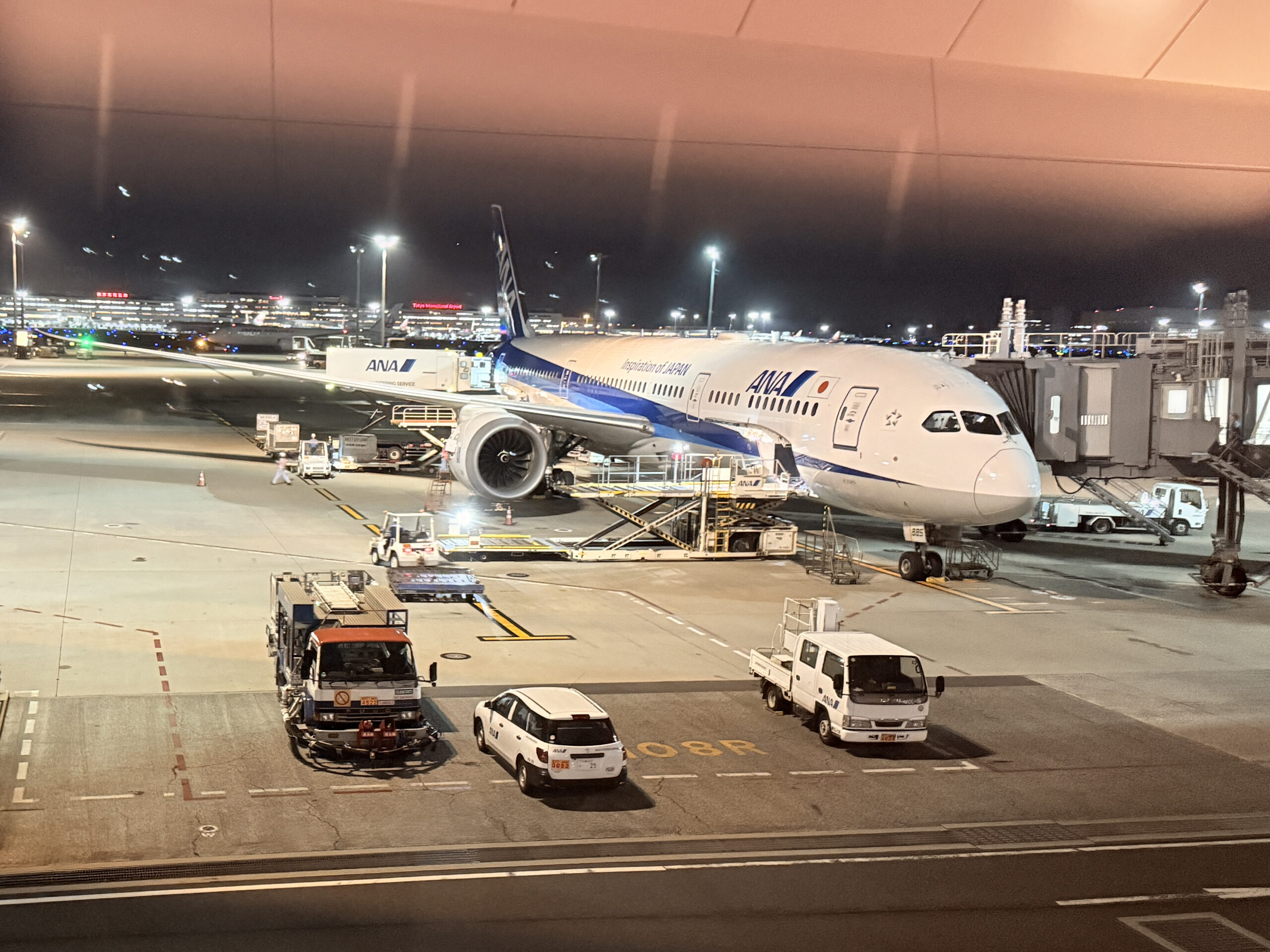
It was a smooth and uneventful flight and we arrived 30 minutes early at Tokyo’s Haneda airport.
It was a short ride (20 mins) on the Keikyu train line to get me to Shinagawa station. I had set up my transit card (Suica card) from my visit two years ago as a digital transit card in my iPhone’s wallet. That way I can tap the reader at the gate with my phone, without even needing to unlock it.

Even though it was only a 6 or 7 minute walk to the hotel from Shinagawa station’s exit, I waited for the hotel’s shuttle bus.
The heat was still oppressive at 8 o’clock— 85 °F (30 °C) and high humidity.

P.S. I turned on my eSIM phone line from global mobile data service provider Ubigi and it works great— a first for me, to use an eSIM phone line for international travel on my iPhone. So it’s farewell to the expensive international service provided by AT&T (expensive, as in 3x or 4x more expensive! Yikes).

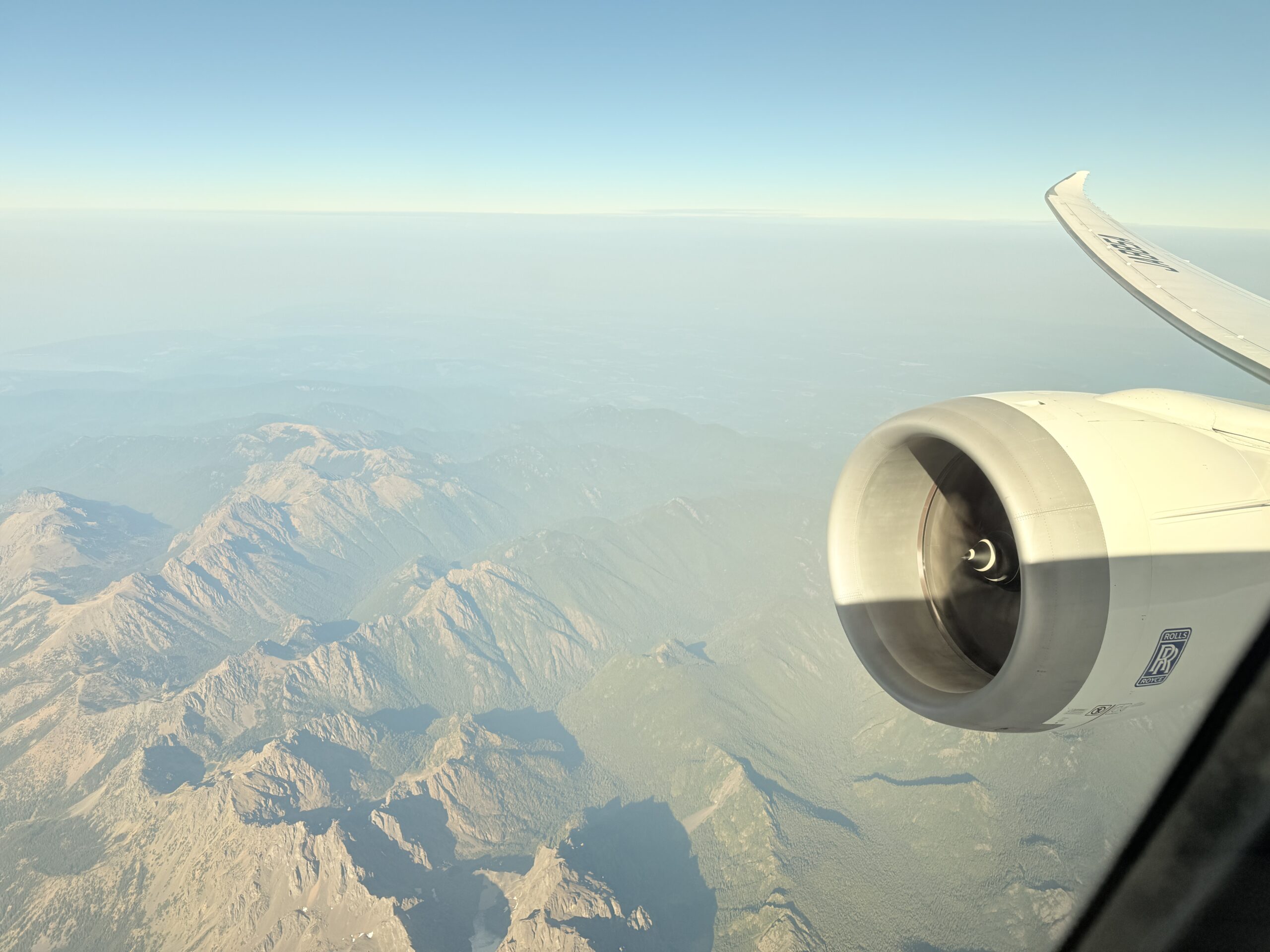
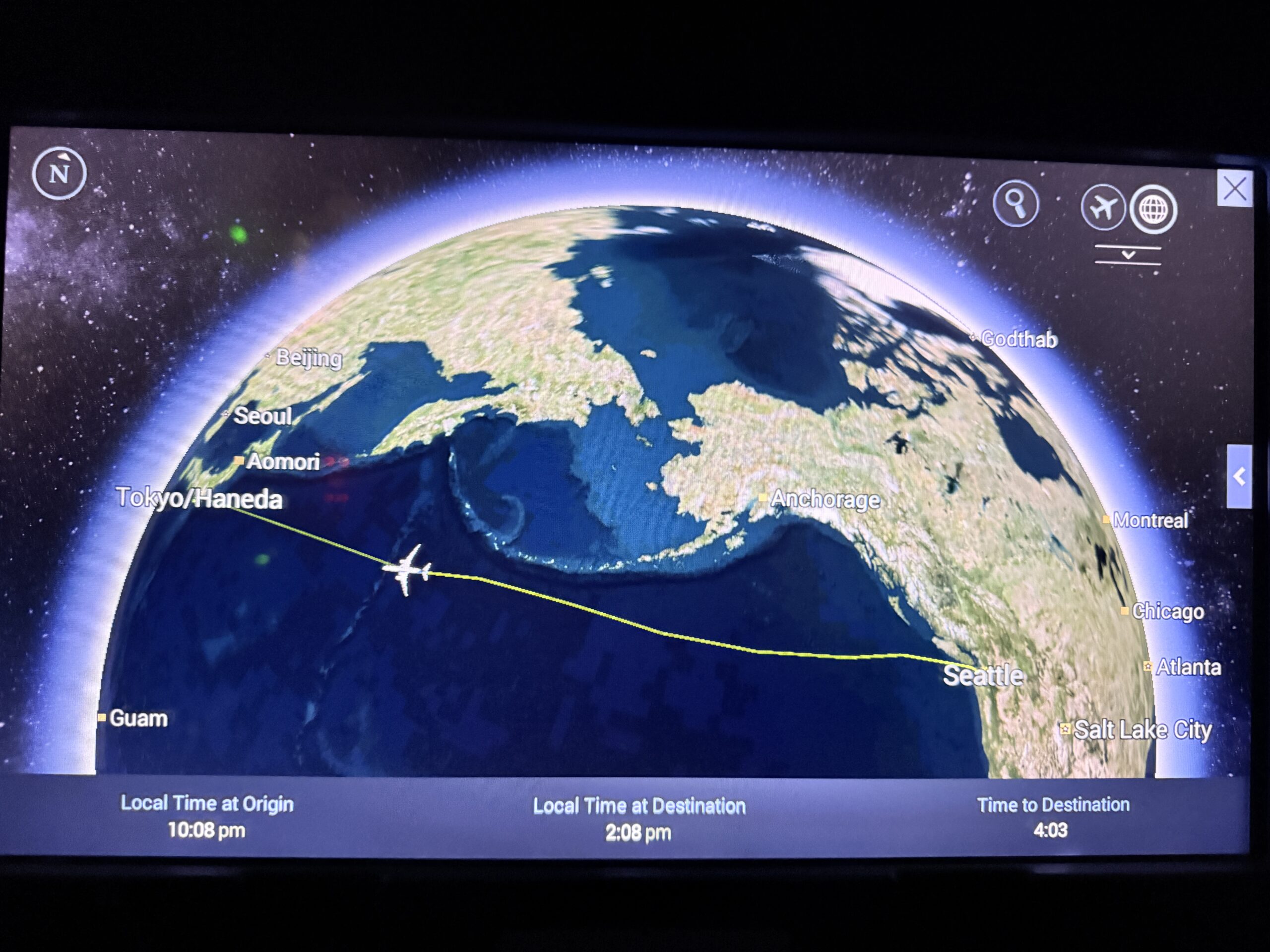
Top to bottom:
Smoky skies over Washington State;
Flying almost due west for 10 hours across the Pacific Ocean;
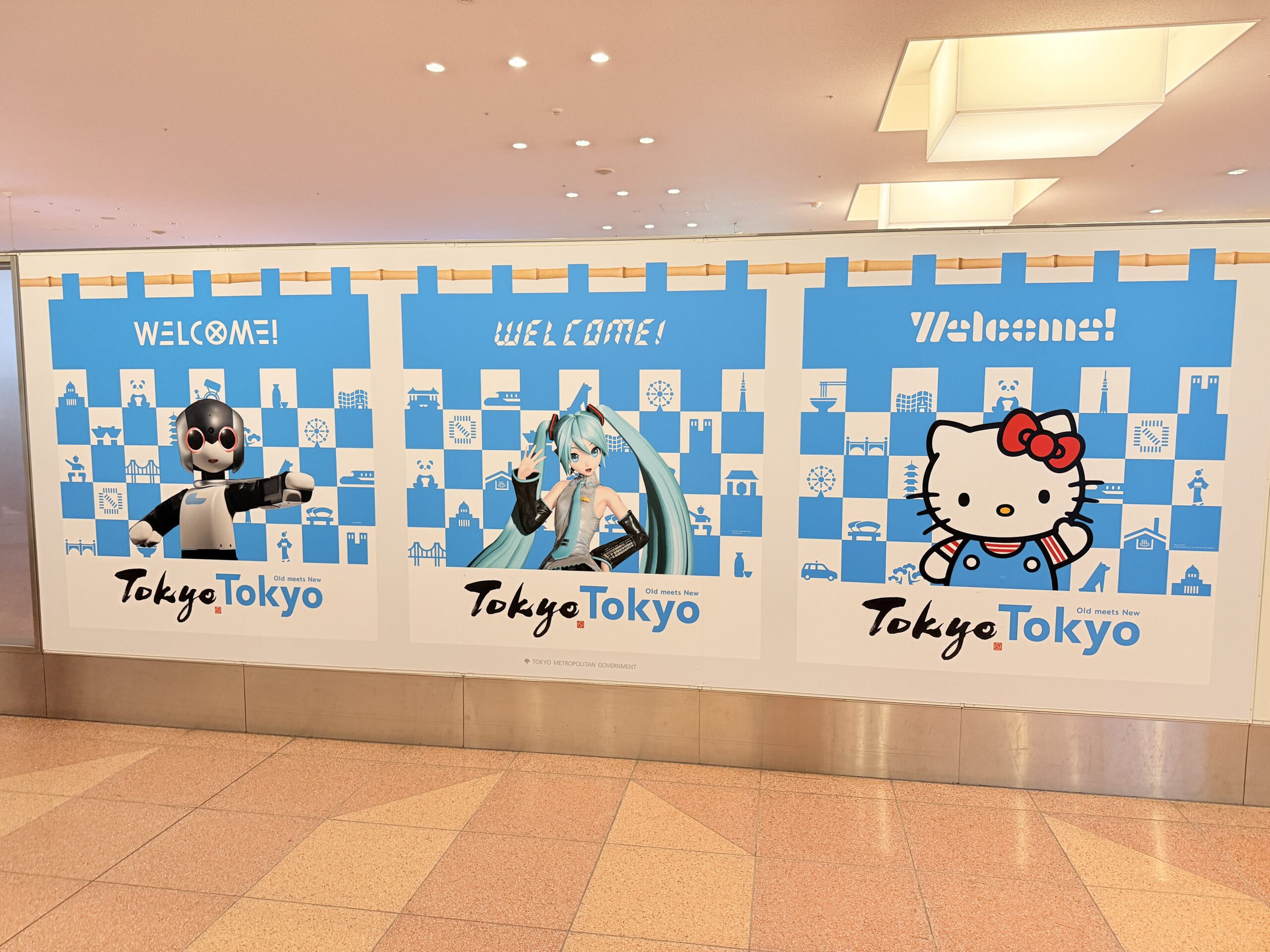
Welcome signs at the exit of the arrivals hall at Haneda airport.
At the gate at Handa airport’s Terminal 3
Monday/ Japan’s scorching summer 🔥

My bags are packed, and I will fly west across the  International Date Line to Tokyo tomorrow.

It’s already Tuesday in Japan, and the highs are going to touch 99°F  (37°C) in Tokyo. By the time I arrive there on Wednesday evening, there will be a little respite from the heat, with rain on Thursday and Friday.

The Japan Meteorological Agency says the average nationwide temperature for the three months of June, July, and August was 2.36 °C (4.3 °F) higher than normal — the largest increase on record since comparable data became available in 1898.
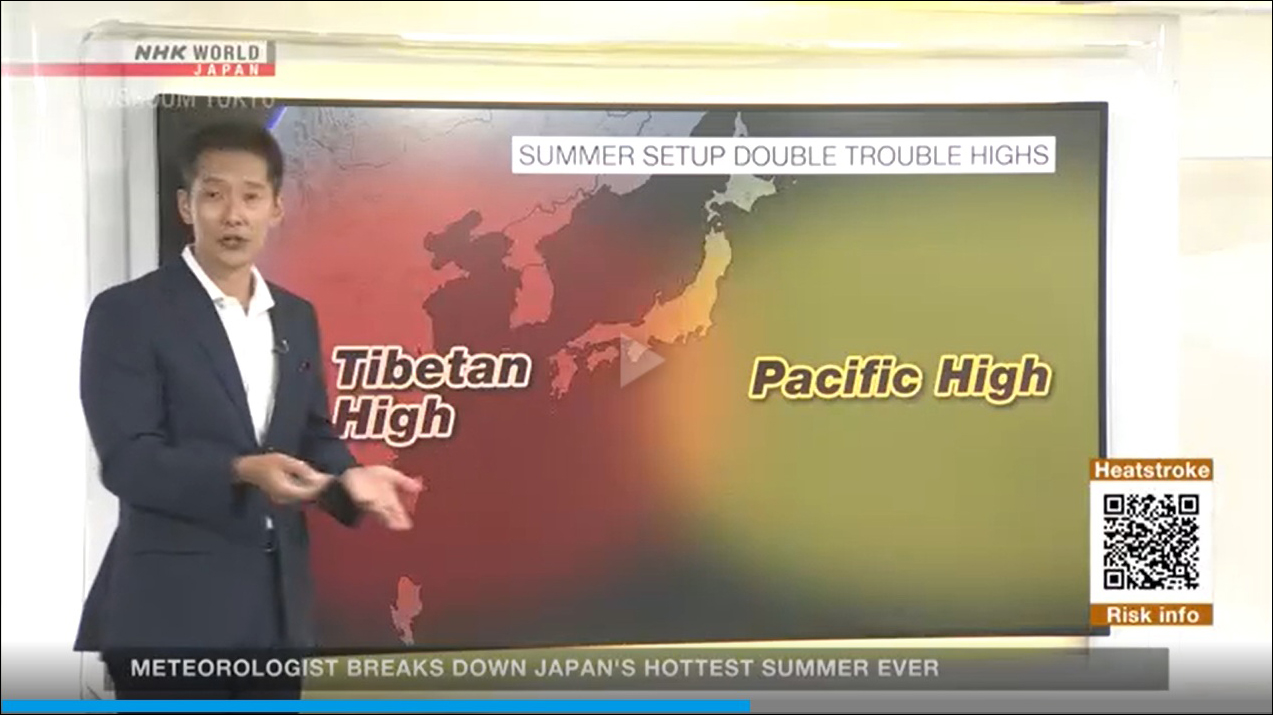
From Google AI Mode, answering the question ‘Why is it so warm in Japan this summer?”
Specific meteorological patterns contributed to the long, intense heat this summer.
High-pressure systems: The Pacific High and the Tibetan High, two powerful high-pressure systems, extended over Japan during the summer. When they occur simultaneously, they create a “tall” high-pressure zone that suppresses cloud formation and produces prolonged periods of clear skies and sunny conditions.
Warming ocean currents: The ocean surrounding Japan has been abnormally warm. The Kuroshio (Japan Current), a warm current flowing northward from the Philippines, has been particularly active, holding the country in a “vice grip of warm water” and driving up temperatures even well into autumn.
[Still from national broadcaster NHK World with a meteorologist explaining the effects of the two overlapping high-pressure systems]

Wednesday/ ash in the air 😷

We’re out of the latest heatwave here in the city.
We had 91°F (33 °C) on Tuesday, but only 75°F (24 °C) today.

The smoke and fine, fine ash flakes in the air have not gone away, though. Officials now say the Bear Gulch fire will burn until winter— one of seven large wildfires in Washington State. It continues to grow and is still only 3% contained.
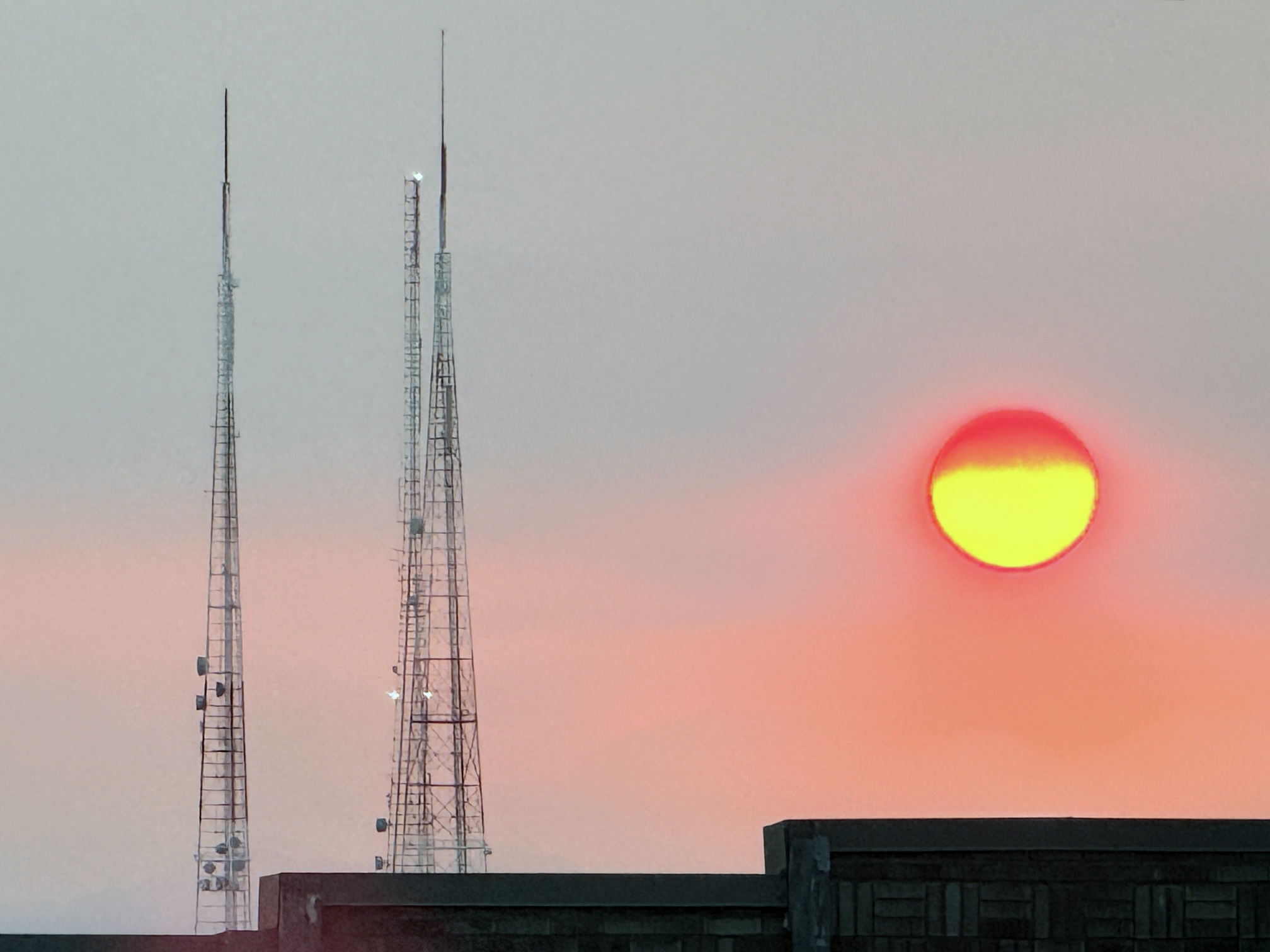
Smoky skies as the sun sets on Tuesday night. I’m looking out from Seattle’s Capitol Hill towards the TV antenna towers on Queen Anne Hill.

Tuesday/ a little rain is coming 🌧

The meteorologists are promising us (well, a 95% chance) that we will get a little rain tomorrow here in the Seattle metro area— actually, as much as 0.45 inches.
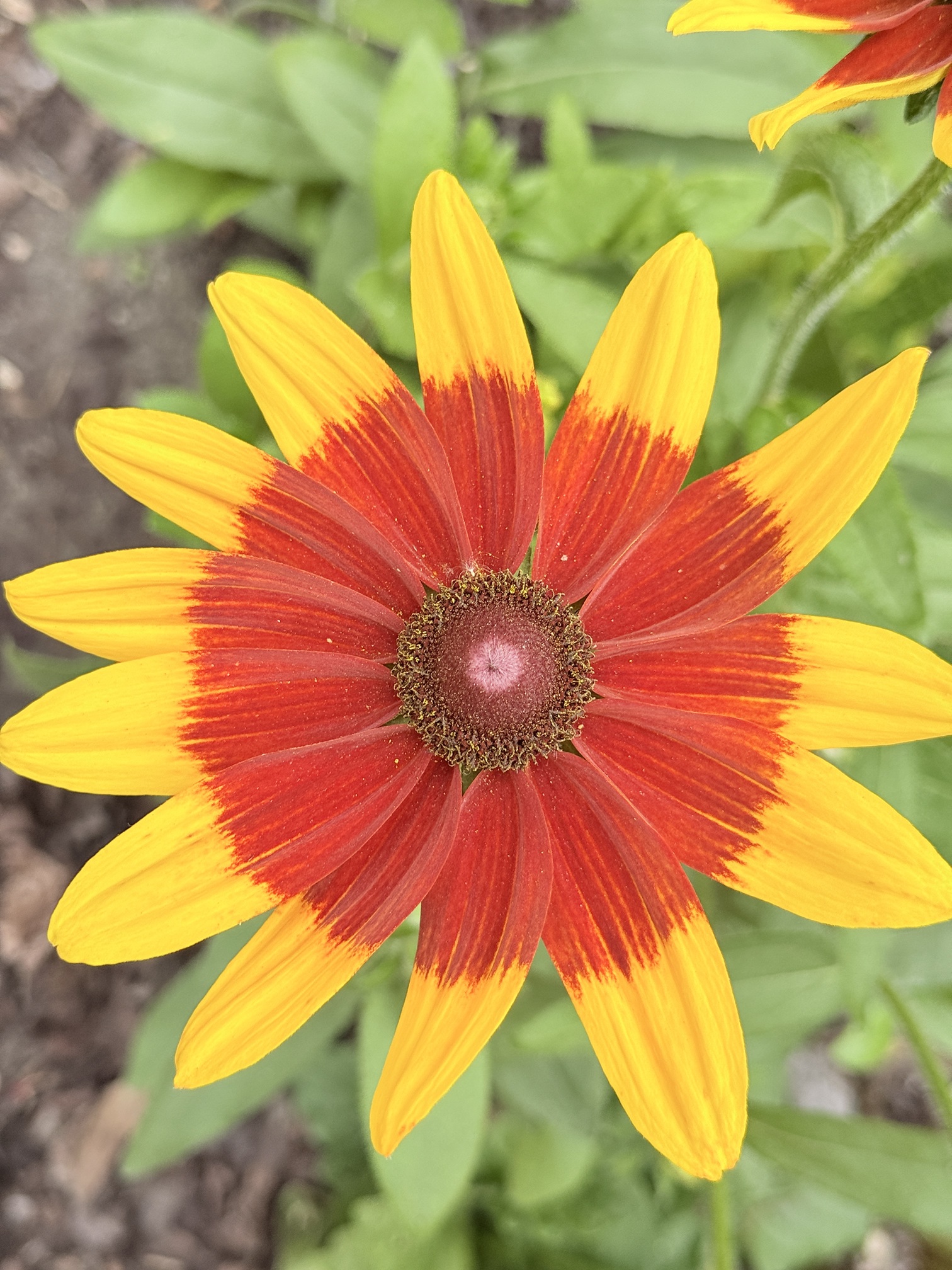
These coneflowers in the Republican Street/ 20th Ave East community garden look just like little suns, drawn with crayons. ☀

Saturday/ it’s wildfire season 🔥

It’s summer, so it is wildfire season— and the dry conditions everywhere in Washington State are not helping.
There was only a trace of rain (less than 0.01 in) this July here in the city.
The last year that had happened was in 2003.
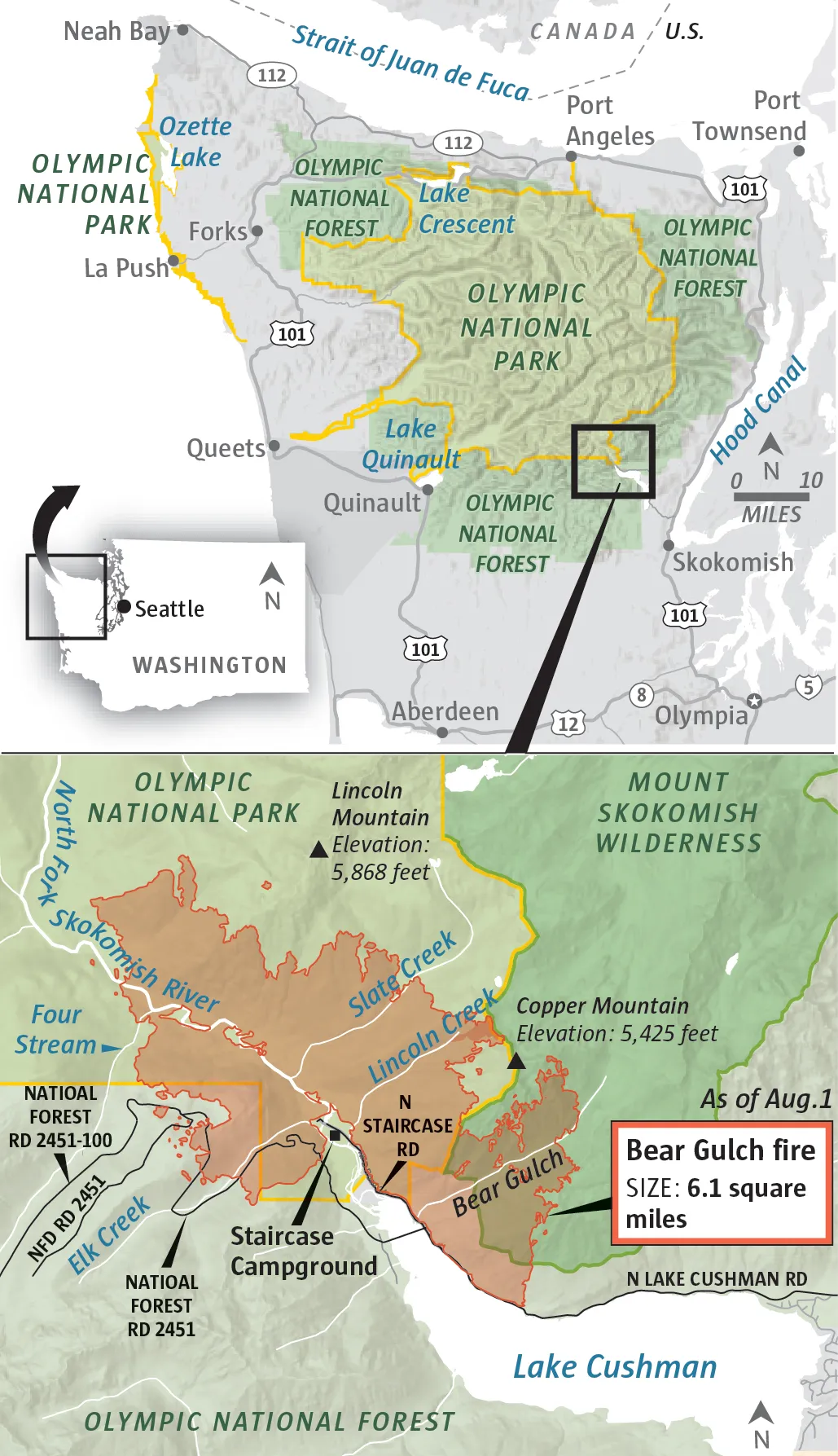
The Bear Gulch fire in Olympic National Park covered more than 7 square miles as of Saturday, data shows, and firefighters had it 3% contained. The human-caused fire was first reported July 6 near the Mount Rose trailhead in Olympic National Forest. Specifics of how the fire started are still under investigation.
[Map from Seattle Times; reporting by Seattle Times climate reporter Conrad Swanson]
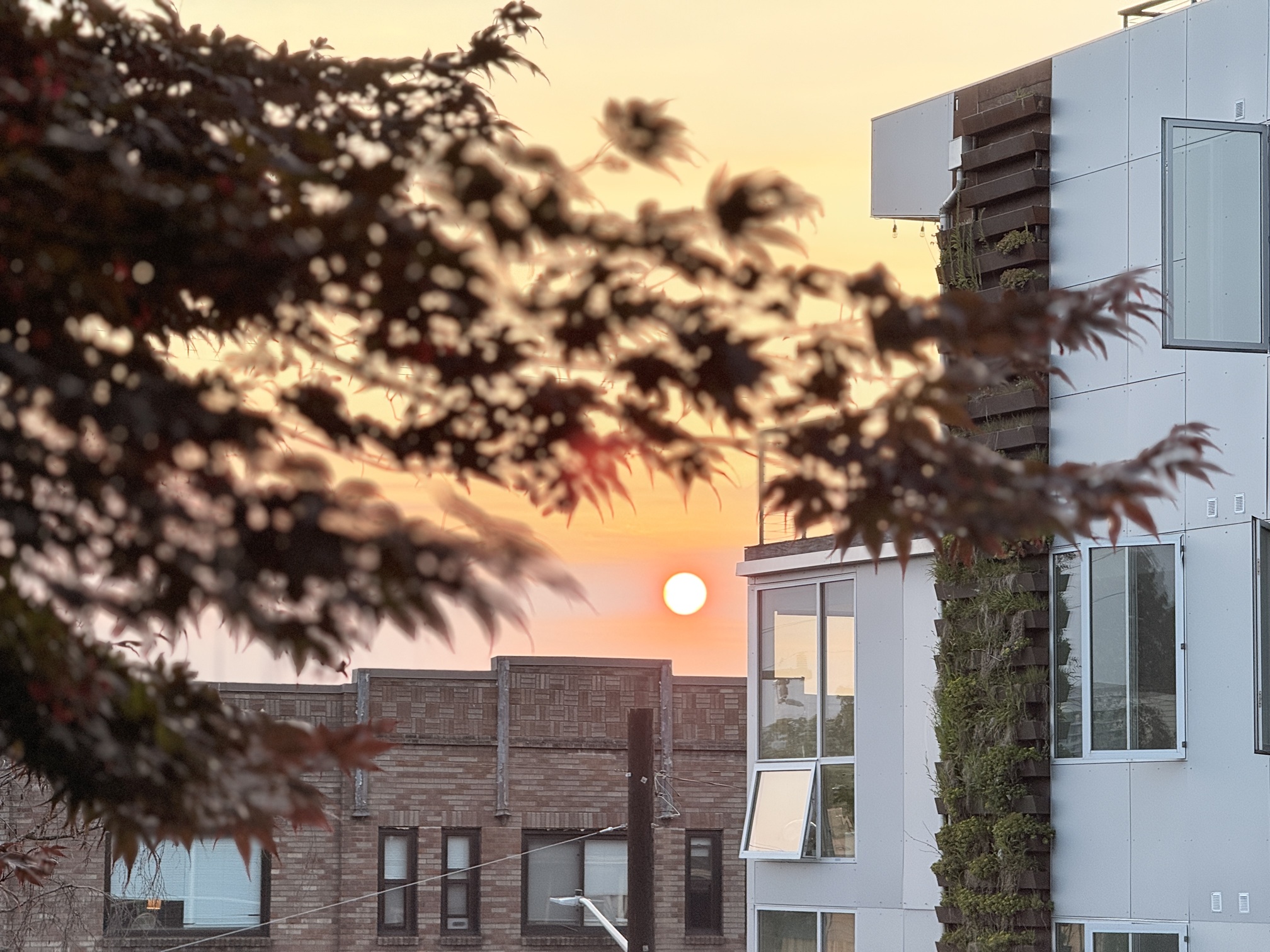
The sun setting through a haze of smoke on Friday night, seen from Seattle’s Capitol Hill.

Monday/ earlier sunsets 🌇

We are having a run of beautiful and mild sunny days here in Seattle.
The high today was 77°F  (25°C).

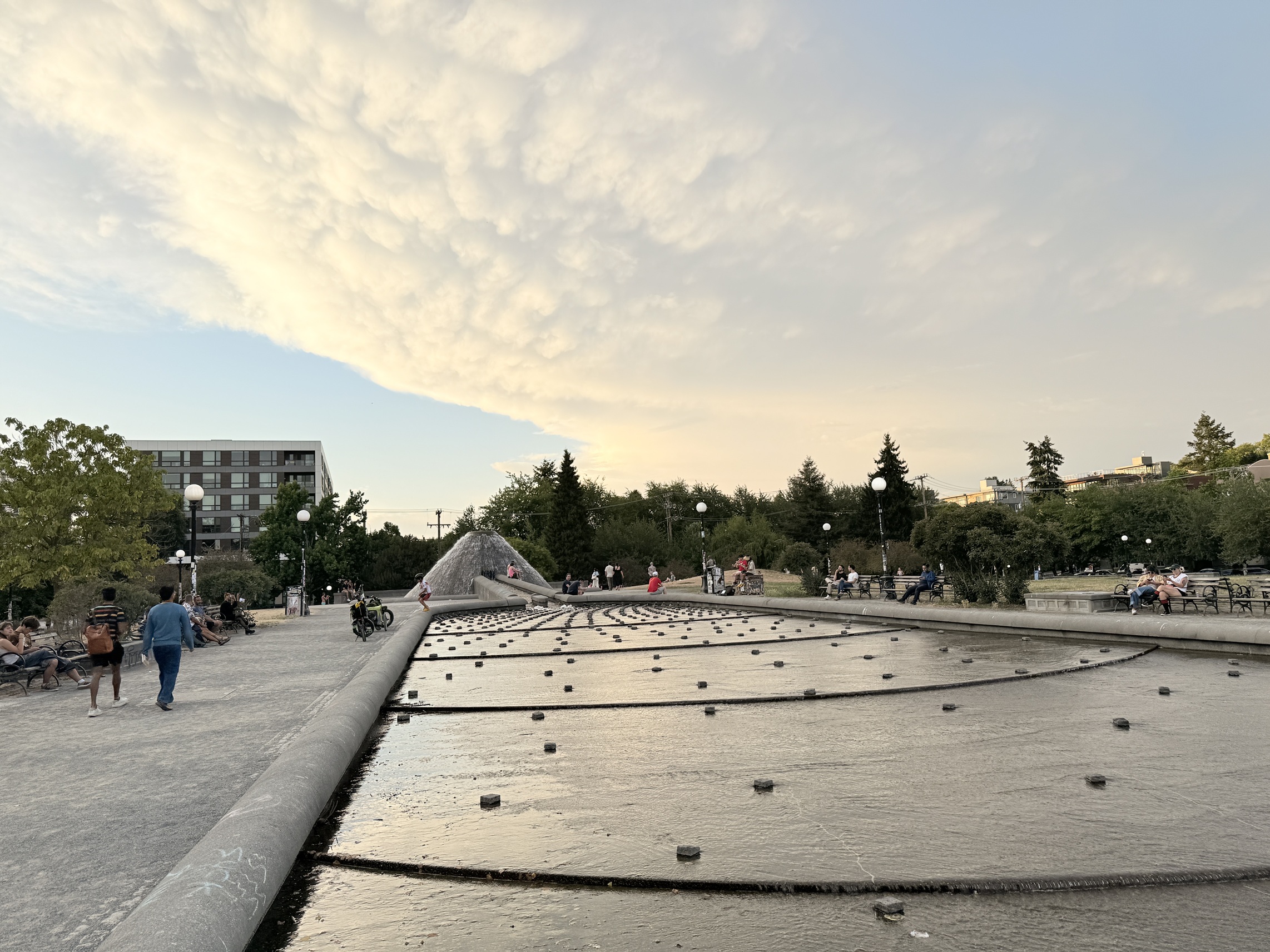
I walked down to the fountain and texture pool in Cal Anderson Park just before sunset.
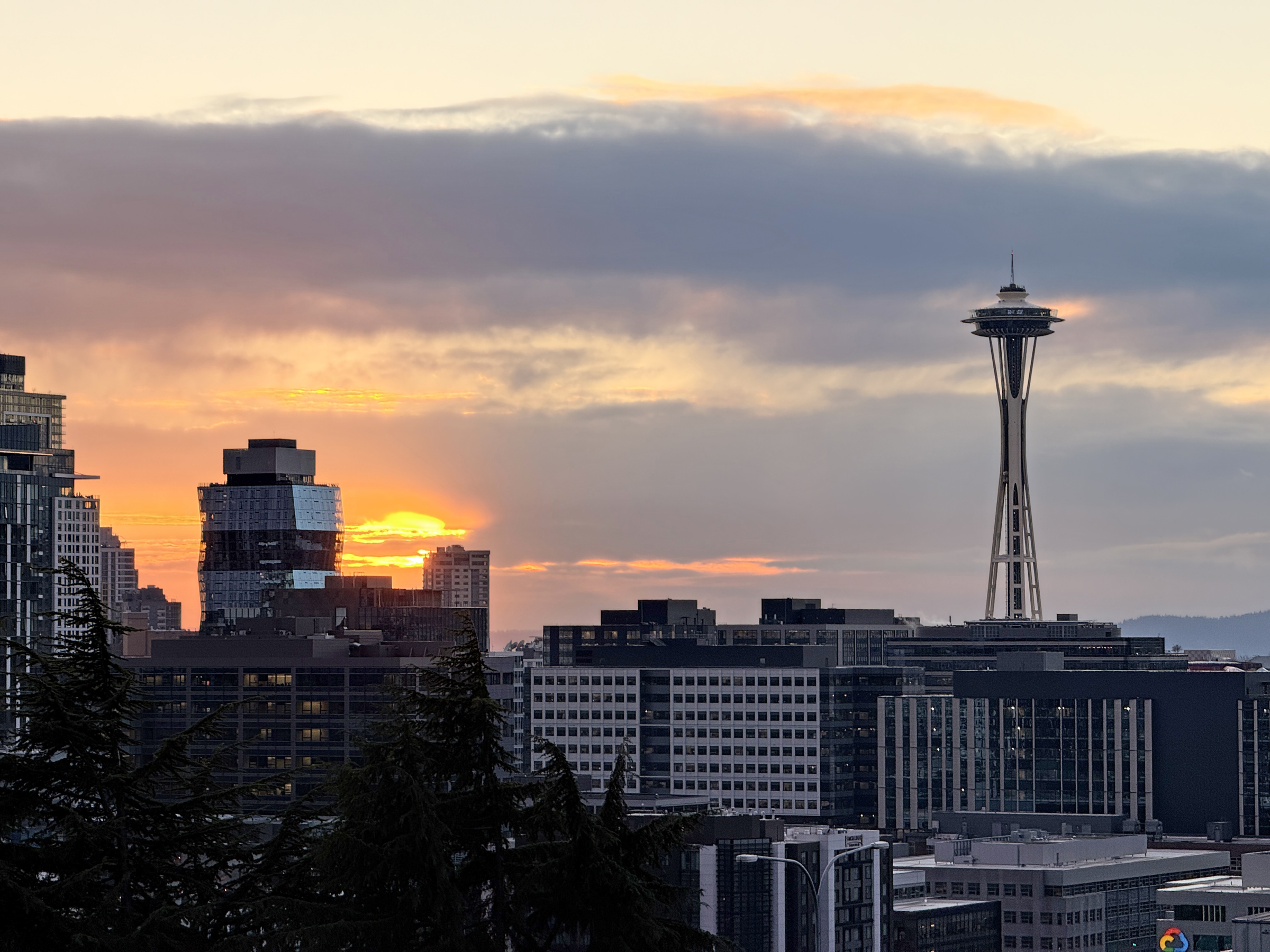
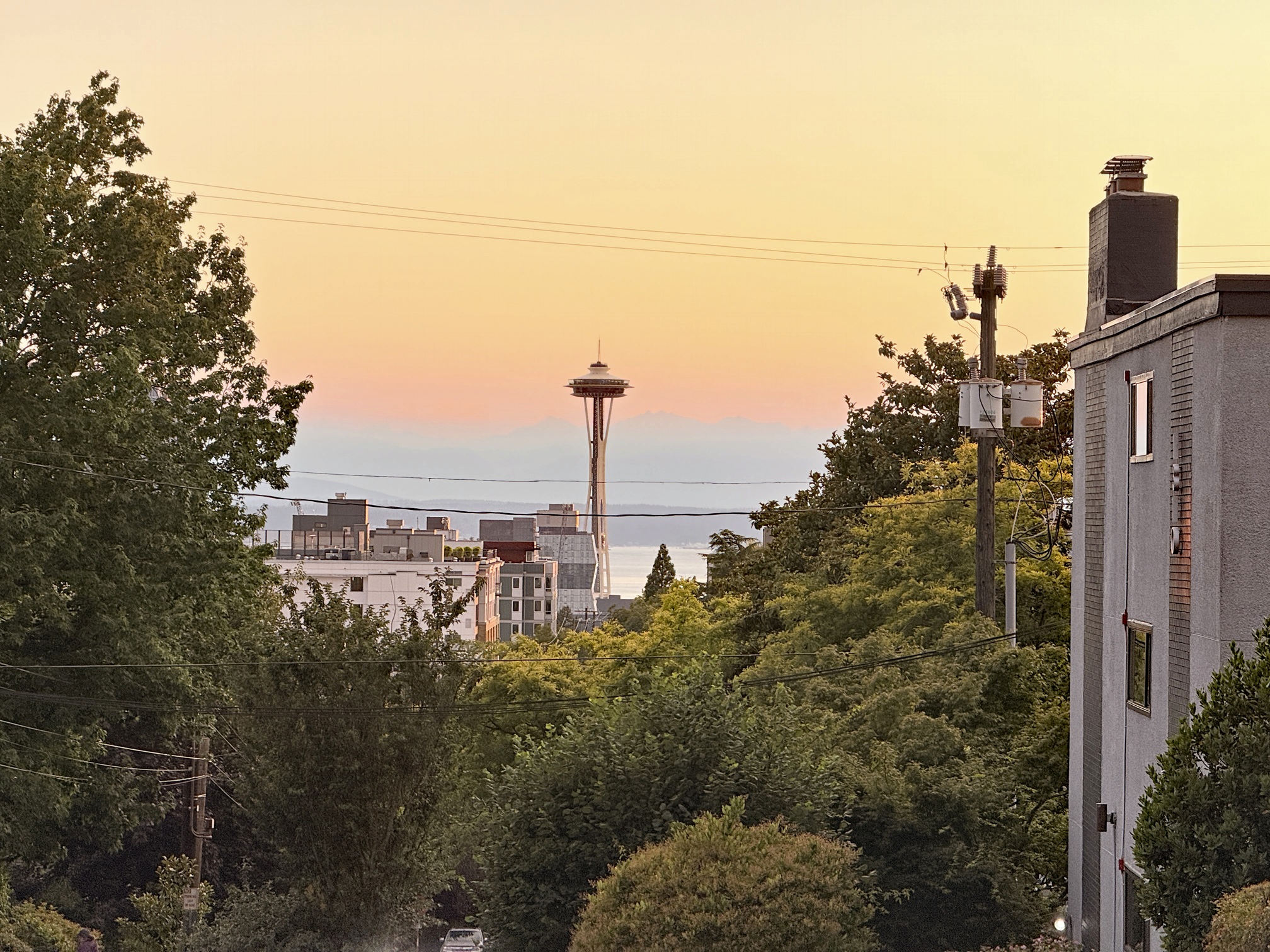
Sunset is now at 8.56 pm and there were beautiful soft blues, pinks and oranges on the horizon, looking out towards the Olympic Mountains behind the Space Needle.
Tuesday/ heating up ☀️

We had 88°F (31°C) here in Seattle today.
The National Weather Service issued a Heat Advisory for today and tomorrow for the Seattle area— with potential for temperatures in the mid-90s (35°C) on Wednesday.
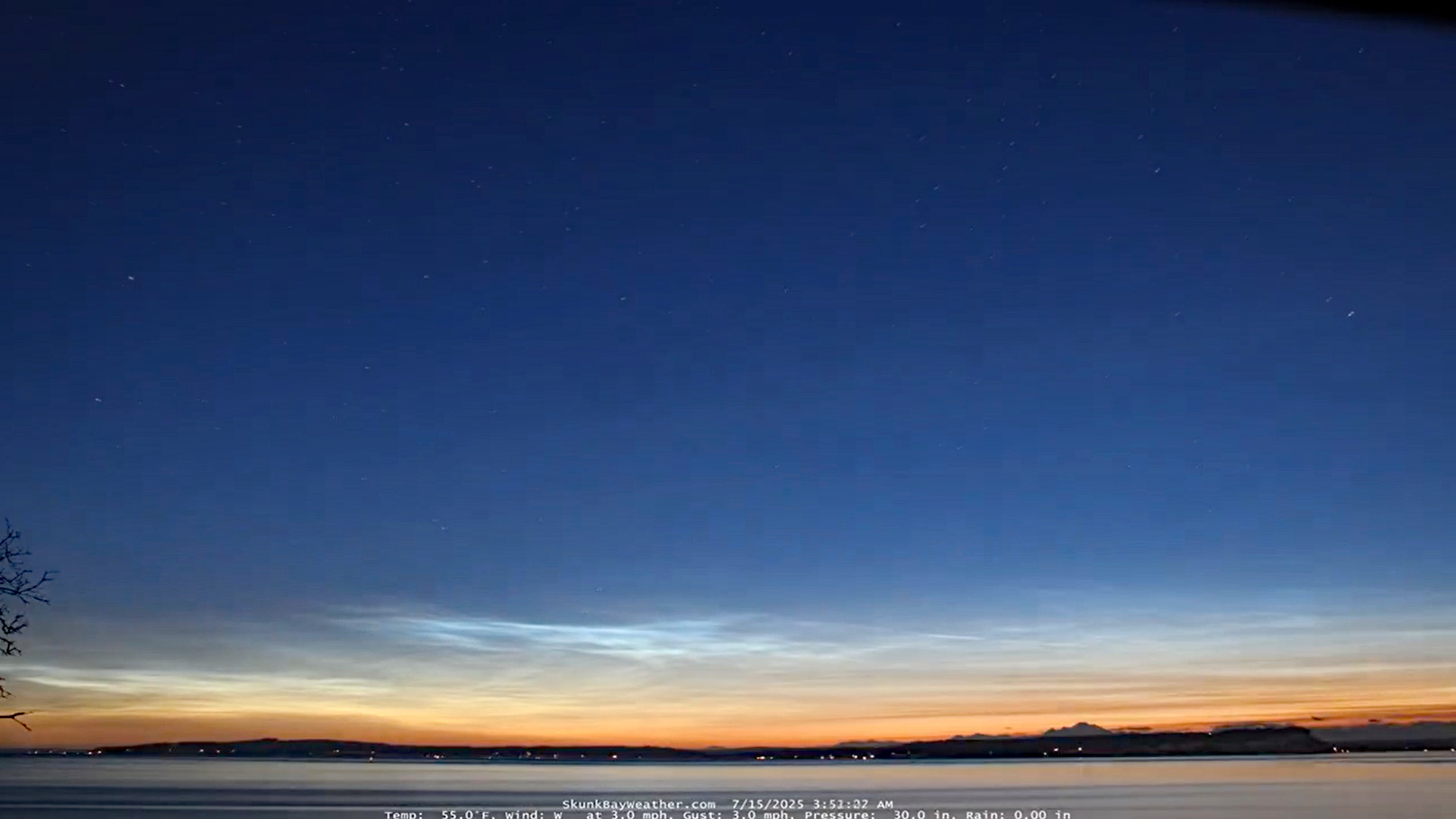
The weather camera by Hansville out on Kitsap peninsula picked up noctilucent clouds early this morning (the faint, bluish-silver or electric blue streaks above the orange colors of twilight).
These are also called night-shining clouds or polar mesospheric clouds. They are composed of ice crystals and form in the mesosphere, the atmospheric layer above the stratosphere, at extremely cold temperatures.
[Still image from a video clip posted by Skunkbayweather @Skunkbayweather on X]

Sunday/ at the Electrify Expo⚡

Three amigos ran out to Marymoor Park by Redmond this morning— the site for the Electrify Expo Seattle 2025.

The all-electric 2025 Lucid Gravity SUV has a starting price of $79,900 for the Touring model and $94,900 for the Grand Touring model, according to Lucid Motors. The Touring model is expected to be available for order in late 2025.
[Source: Google Search Labs | AI Overview]
2025 Tesla Model 3 in Quicksilver, with white seats.
2025 Tesla Model S in Red*. This is the newest Model S, now with a front bumper camera as part of their hardware refresh.
*Or maybe it is the Red Multi-Coat: a premium version of the standard Red, offering a more vibrant and lustrous appearance.
The Tesla Bot. (Google Search Labs | AI Overview: No, the full-sized Tesla Optimus humanoid robot is not yet for sale to the general public. While Tesla is developing Optimus, it is currently focused on internal production for use in its own factories, with external sales planned for 2026.)
A Cybertruck fitted with an after-market camping add-on (mostly providing additional sleeping space).
That’s a metallic green wrap on the truck (all Cybertrucks are offered with a raw, stainless steel exterior).
A different kind of metallic wrap on a Cybertruck, with a rainbow reflection in the bright sunlight. (The high in Seattle was 87°F/ 30.5 °C today).
These Teslas are dressed up in sporty, race car attire, but now starting to show their age/ The new ‘Highland’ Model 3 has been available since early 2024.
Several other electrified means of transportation were on display as well. The well-known Seattle power bike maker Rad Power Bikes is showing off its latest line-up of power bikes (bike with electric motor to assist the rider’s pedaling, and a battery that provides the power).
Look Ma! I’m flying through the air.
A young rider demonstrates gravity-defying freestyle stunts that he can do with his electrified moto-cross bike. (There is a steep up-ramp on the other side that gets him into the air).
A staffer from the booth with electric unicycles (EUCs) showing how it’s done. (It’s much harder than he makes it look). These unicycles are self-balancing personal transporters with a single wheel. Riders control their speed and direction by shifting their weight and using built-in sensors.
I’m in the back seat of a Cybertruck, and we’re just doing a little circuit laid out around Marymoor Park. The center console is a little dusty. There is a Cybertruck ahead of us. A white Tesla (at the top right of the display) is behind us: the view provided by the rear-facing camera on the tailgate. The rearview mirror cannot really be used when the rear glass of the truck is covered.
All done, and we’re heading back to Seattle across the SR-520 floating bridge (that floats on Lake Washington). There is not a lot of snow on the Olympic Mountains this time of year.

Tuesday/ it was a dry June ☀️

From Google Search Labs | AI Overview:
Rainfall in Seattle during June 2025 was 0.40 inches, which is significantly below average.
This amount is 73% less than the 30-year average for June, which is 1.49 inches.
For comparison, here is a summary of June rainfall in recent years:
2024: 2.02 inches
2023: 1.42 inches
2022: 4.98 inches
Historically, June is one of the drier months in Seattle, with the average rainfall being around 1.6 inches. The wettest June on record saw 3.90 inches of rain in 1946.

Too much of a good thing? 🤗
I marveled at the lushness of this lawn– for a newly remodeled house here on Seattle’s Capitol Hill. The lawn started out as tiles of green sod, and there must have been a sprinkler system watering it every day for the last few weeks.

Monday/ a sweltering day as Wimbledon starts 🥵

Strawberryheads in the stands— a nod to the traditional treat of strawberries and cream that is served up every year around the grounds. (Nice to keep the sunlight at bay, but man! I hope those berries offer a little ventilation as well.)
[Image from the official Wimbledon website]
June is done, the year 2025 is at its midpoint, and the Wimbledon tennis tournament at the All England Lawn Tennis & Croquet* Club in London SW19 got underway today.
*Yes, there is still croquet, played on three dedicated lawns, but they are converted into practice tennis courts during the championships.

Here are a few random notes for today:
– The hottest day ever recorded at the Wimbledon tennis tournament was July 1, 2015, with a temperature of 35.7 °C (96.3°F). This record was matched today on the first day of the 2025 tournament, Monday, June 30;
– Frenchman Giovanni Mpetshi Perricard (21, 🇫🇷) hit a serve that clocked in at 153 mph (246 km/h), the fastest ever recorded, anywhere;
– World No 733 Oliver Tarvet (21, 🇬🇧) won his first round match as a qualifier in the main draw. He must now spend most of his £99,000 winnings to retain his amateur status on the NCAA Tennis circuit (he plays college tennis at the University of San Diego and wants to continue doing that for another year or two);
– Tarvet will play Carlos Alcaraz on Wednesday in the second round.
Alcaraz needed five sets today to eliminate Fabio Fognini (38, 🇮🇹) 7-5, 6-7 (5), 7-5, 2-6, 6-1. Fognini is retiring after this season and asked Alcaraz for his shirt after the match to give to his son Frederico (he got it; they are good friends);
– On No. 1 Court, Jiao Fonseca (18, 🇧🇷) became the first 18-year-old to reach the second round since a certain Carlos Alcaraz did it in 2021. Fonseca needed only three sets to get past Jacob Fearnley (23, 🇬🇧);
– Line judges have been a part of Wimbledon since the very first Championships in 1877, but this year the humans have been replaced with Hawk-Eye Live (a system of up to 18 cameras equipped with AI that analyzes footage from the cameras to determine if a ball is in or out).

Thursday/ a little rain ☔

It was another cool and overcast day here in Seattle with 66°F (19°C) and a little rain this afternoon.
The garden dahlia, peony and borage (starflower) are from the P-Patch community garden at Republican St and 20th Ave E.

Friday/ summer solstice 🌞

Happy Friday.
Happy Summer Solstice (here in the northern hemisphere).

The arrival of summer weather has been delayed by a few days here in Seattle, with cool and rainy weather expected this weekend.
The high today was only 62°F (17°C).

The amigos had better luck this morning, finding an open court for pickleball at the Mount Baker Pickleball and Tennis Courts.
On the near side it’s a tennis court, officially, with no pickleball nets. We brought our own net, and it is set up and ready for play.
Over on the far side there is a pickleball lesson is in progress. I am marveling at the number of plastic baskets that the coach had brought to the court.
As far as I can tell there are 57. 

Wednesday/ the strawberry moon 🍓

We had a little bit of June gloom this morning with cool weather and low clouds.
The clouds are mostly gone now, so maybe I will get a good look at Junes’s Strawberry Moon* tonight.

*Named thus not because of the reddish glow, but because strawberries are harvested in June.

Headlines from the New York Times with photo by Gary Hershorn/ Getty Images

Monday/ a touch cooler today ☀️

The Seattle metro area is coming out of the summer’s first heat wave.
A record high for June 8 was recorded at the airport on Sunday (90°F / 32°C).

It was still hot today, with a high of 87°F (31°C).
The amigos went out to the Mt Baker tennis courts for pickleball at 9.30 am before it got too toasty.


Sunday/ Tesla spotting⚡

Here’s June, and the 9.00 pm sunsets of 2025 have arrived here in Seattle.
So even if one is quite late making supper or dinner, there is still plenty of time for an after-dinner stroll.

A brand-new pearl white Model Y that I had spotted tonight.
The driver was looking for parking and as he got out I walked up and said ‘I love your car’.
Yes, it’s already the fourth Tesla his family had bought, he said. He had a Model 3 that he gave to his son, which has since been replaced with a new Model 3. 
This Model Y is a replacement for his old Model Y.
And does your new car have Full Self Driving (Supervised) enabled? I asked. No, the one free month of FSD for the new car has expired, and right now it’s a little too expensive for him to purchase, he said.
(It’s $99/ month to subscribe or $8,000 to purchase outright).

Tuesday/ felt like summer 🌳

It felt like summer today.
The high was near the record for this day on the calendar:
78°F (26°C) today, and the record is 81°F (27°C) recorded on May 6, 1957.

There will be cooler weather again for the rest of the week.

Friday/ another week, done 📆

It was beautiful outside today (68°F/ 20°C).
I walked down to Capitol Hill library to return two books, where I found the latest issue of The Atlantic on the magazine rack, with some unsettling writing inside (see below).

In the upside-down place we find ourselves with the Trump administration, it’s almost a positive that his 42%-or-so approval rating after 100 days in office is the lowest of any modern US president.

P.S. The US stock market held up surprisingly well this week, and April’s jobs report showed a gain of 177,000 jobs, exceeding expectations. Unemployment remains steady at 4.2%, and average hourly earnings rose modestly.

Here are the headlines and taglines from inside:
I Should Have Seen This Coming
When I joined the conservative movement in the 1980s, there were two types of people: those who cared earnestly about ideas, and those who wanted only to shock the left. The reactionary fringe has won.
DAVID BROOKS
—-
The Hollow Men
It takes a special talent to betray an entire worldview without missing a beat.
GEORGE PACKER
—-
America’s Future Is Hungary
MAGA conservatives love Viktor Orbán. But he’s left his country corrupt, stagnant, and impoverished.
ANNE APPLEBAUM
—-
Watching the Rise of a Dual State
For most people, the courts will continue to operate as usual—until they don’t.
AZIZ HUQ