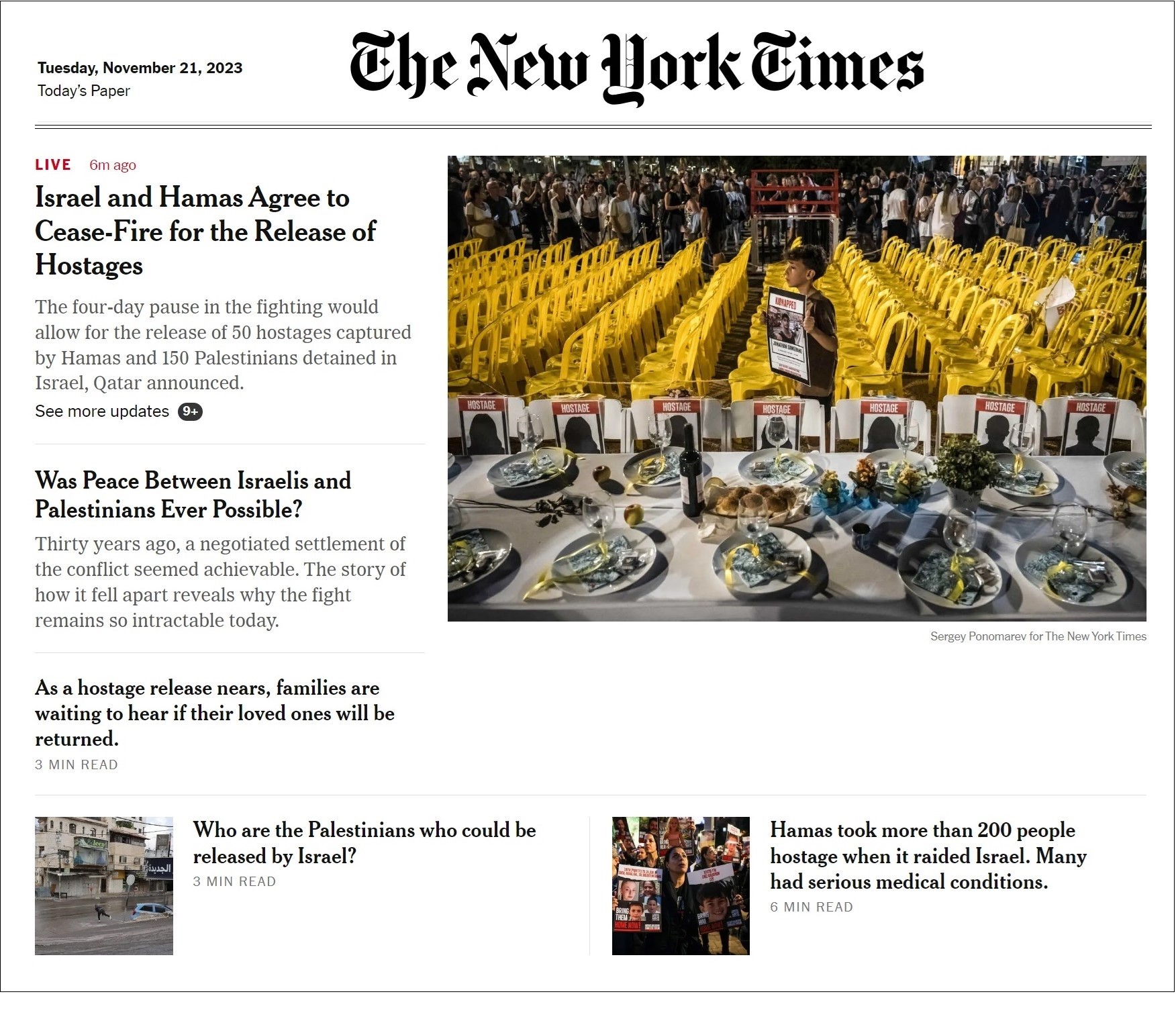
 Good news about the hostages, it seems.
I read in a German newspaper part of the agreement would be for the International Red Cross to visit all the hostages to assess their health.
Haviv Rettig Gur writes in The Times of Israel newspaper of the terrible calculus that is probably made on the part of the Israeli government for the release of the hostages, though:
Hostage deal, even if it fails, shows Hamas’s desperation
The exchange rate for an Israeli hostage is no longer measured in hundreds of released prisoners but in moments of reprieve from looming destruction
The families of Israeli hostages have spent most of the past seven weeks in a kind of limbo, torn between competing arguments for how best to seek the release of their loved ones.
Would pressure on the Israeli government work? Could foreign governments influence Hamas? What does the ground war mean for their loved ones’ chances of survival?
With a deal apparently nearing completion that could release dozens of abducted children and their mothers, many of their families have suddenly gone silent. Hamas, they reason, will try to hold on to children whose families prove most effective in pressuring the Israeli government.
If last week every family tried to draw attention to their missing child, now the race is on to make their child forgettable.
It’s hard to imagine the torment of such a moment.
To families trapped in such a terrible place, nothing about the announced deal feels like an Israeli victory.
Hamas stumbles
Yet it’s hard to imagine a clearer signal of Hamas’s desperation than the deal agreed to by the Israeli government late Tuesday.
In the Shalit prisoner exchange in 2011, the exchange rate was 1,100 Palestinian prisoners, including mass murderers sentenced to life terms, for a single Israeli soldier.
At the time, most Israelis supported the deal and Prime Minister Benjamin Netanyahu and then-defense minister Ehud Barak made sure to stand at Cpl. Gilad Shalit’s side as he set foot back on Israeli soil.
Twelve years later, after many of the terrorists released in that exchange were the ones who planned and executed the October 7 massacre, the calculus has changed.
Hamas abducted too many, including babies and ailing grandmothers, and did so in such cruel ways that the old logic of prisoner exchanges has been forever upended in the Israeli psyche.
As any aspiring gangster knows, there’s a tipping point to extortion when the cost of avoiding violence rises past the cost of the violence itself, when the victim’s incentives flip from payment to vengeful defiance.
At the start of the war, Hamas and Islamic Jihad started to trickle out hostages in ways that showed they didn’t quite grasp the change that had come over Israelis. They tried to delay the ground incursion by promising to release two hostages every few days.
But Israel ignored the gambit, and every ensuing attempt to dangle hostages before it. It launched the ground incursion with no more than a mention of the Israelis held in Gaza.
The new deal
And as the IDF advanced, photos began to leak of soldiers posing in the main centers of Hamas rule, including the parliament building and various headquarters, before demolishing these symbolic buildings.
Some foreign observers were mystified at the practice. Critics complained of “wanton” destruction. But Hamas saw and understood. When Israel telegraphed for three long weeks that it was preparing to enter Shifa Hospital, it was giving the enemy time to escape. It didn’t want a bloody battle in the hallways of a hospital. But it did want to enter that hospital and show Hamas there are no safe places anywhere in Gaza. And Hamas saw and understood.
This is key to understanding the war. Israel isn’t speaking to the West. Its leadership registers Western discourse as a second-tier concern. Its message is for Hamas, and this message is the strategic heart of the war effort: There is nowhere in Gaza we won’t go, no stone or tunnel or building we won’t overturn in pursuit of you. None of the tactics that once kept you safe apply anymore.
Tens of thousands of Hamas fighters have now been underground for nearly seven weeks. Their stores of food and fuel could be running low; they were prepared for an Israeli incursion, but not an open-ended one. Meanwhile, the IDF has systematically destroyed and sealed hundreds of tunnel entrances — upward of 600 at last count — as it slowly tightens the noose around the underground network in northern Gaza. Hamas’s subterranean strategy has been counteracted by a simple and patient Israeli answer: Burying Hamas forces alive in their own tunnels.
Then, all of a sudden, a deal was announced this week that drops the 1,100-to-one formula to three-to-one: 50 hostages for 150 Palestinian prisoners, all of the latter either women or prisoners who were minors at the time of their terror attacks.
But more interesting than who they are is who they are not. No Hamas fighters will be released, in part because Hamas didn’t really demand it. The prisoner release was treated by Hamas negotiators as a face-saving PR exercise. Their priority, Israeli officials say, was the ceasefire.
Hamas first demanded a month-long ceasefire in exchange for a few dozen hostages. Israel didn’t respond. As Hamas losses mounted, its demands shrank. It has now reached 50 hostages for four days’ respite.
But as the length of the lull shortened, new demands surfaced. For six hours each day of the truce, Israel must ground its reconnaissance drones. On Thursday the deal was delayed when Hamas sent through their Qatari representatives more demands for additional unspecified limits on Israeli field intelligence forces.
Israeli officials have explained these demands as part of the hostage release process: Not all the child hostages are in Hamas hands. Its fighters must travel aboveground to collect them from elsewhere in Gaza. They don’t want to be tracked while doing so.
This is, to put it mildly, a strange explanation. There’s a simpler one. A desperate Hamas with many fighters trapped in the steadily tightening noose around Gaza City has negotiated a last-ditch means for saving its northern forces by giving them a brief window to flee south in which the Israelis agree not to watch their escape too closely.
This is why Israeli officials are optimistic that Hamas will ultimately carry out its part of the deal. Hamas needs the time. It is why Israel even accepted the terror group’s transparent preparations to cheat, including the stipulation that the first three days of exchanges need not reach the 12- or 13-per-day rate of Israelis released, but that the number missing from that rate must be made up for on the fourth day. That demand suggests Hamas might be planning to release fewer prisoners for three days and then break the agreement on the fourth.
But Hamas demands are also preparing for the opposite eventuality, stipulating that as long as a roughly 10-per-day release rate is sustained, the deal can remain in force for longer than four days.
Or put another way, Hamas doesn’t know how long its retreat will take and is preparing for all contingencies.
If Hamas reneges, the war resumes, and whatever emotions Israeli leaders may feel — a palpable sense of guilt hangs over every cabinet deliberation — they will broadcast a collective shrug and return to the business of Hamas’s demolition.
Gallant’s grim victory
There’s a bottom line here. On October 29, Defense Minister Yoav Gallant met with the families of the hostages at IDF Headquarters in Tel Aviv. His message to them was buried in the avalanche of news from the front — the IDF had launched its ground war just 36 hours earlier.
The families were desperate. They said the ground war felt like a death sentence for their loved ones. Gallant’s response essentially laid out the Israeli strategy thus far.
Hamas, he said, “is making cynical use of all that is precious to us. They understand our pain and our anxiety.” But for that very reason, there was no way to simply negotiate the hostages out of Gaza.
The ground war would accomplish what political pressure could not. It was “inseparable from the effort to return the hostages. If Hamas doesn’t face military pressure, nothing will move.”
The war now moves south and will drive a whole new potential civilian humanitarian crisis. Hamas in Khan Younis will be just as trapped, but it will have far more troops available, a clearer understanding of IDF strategy and Israeli implacability, and a longer time to have readied the battlefield. It is there that the bulk of Hamas’s forces will find themselves in a pitched battle for survival — and where the hostages will serve as Hamas’s last available currency for buying pauses to regroup, resupply and, if the offer to Israel is generous, even escape.
From Gallant’s perspective, that’s just as it should be.