Every time I look, the gold price is up by hundreds of dollars.
Is there an impending upheaval that buyers of gold expect and that the rest of us are unaware of?
Last year some traders predicted the gold price will cross $5,000 in 2026, and they were right.
It’s only January and it already sits at $5,313.30.
That was+192.70 (3.76%) just for today.
The stamp from Japan is just for fun.
Even the goldfish looks shocked 😲.
From the Definitive Series 1967-69: Fauna, Flora and Japanese Motifs Issued by Japan Post, 1967 Perf. 13½ | Photolitho. | National Printing Bureau 913 A564 | 7 yen | bright yellow-green & deep orange | Goldfish [Sources: 2021 Scott Standard Postage Stamp Catalogue Vol. 4A, stampworld.com]
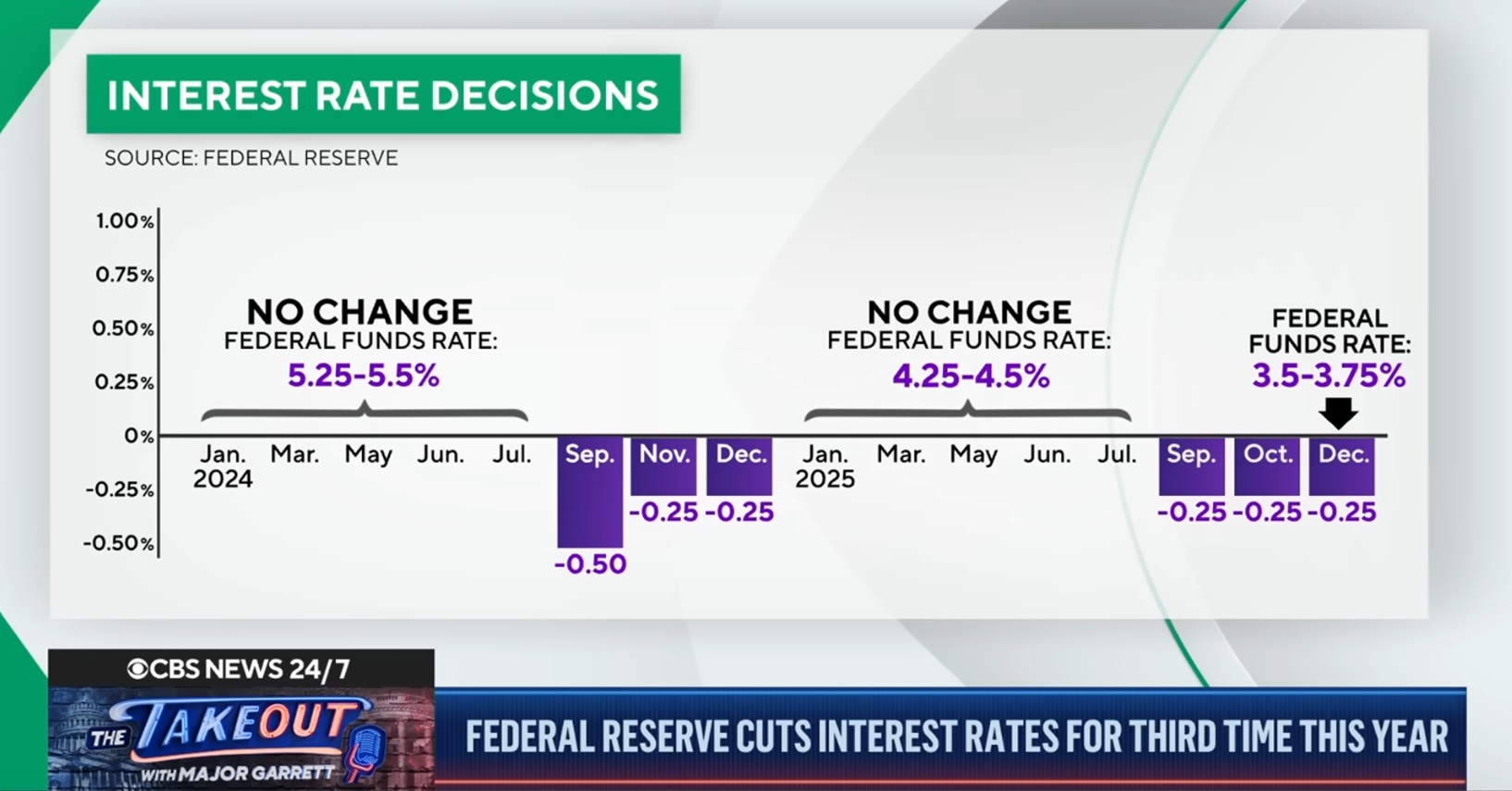
We had another interest rate cut this week, and the Fed indicated that (right now) it sees only one for all of 2026.
Of course, all of that may fly out the window if a person such as Kevin Hassett succeeds Fed chair Jerome Powell in May of next year.
(Hassett is seen as a guy who will do whatever it is to push through Trump’s agenda— and Trump wants interest rates to be closer to 1%).
The rate cut of this week was widely expected. The Fed increased its projected change in real GDP for 2026 to 2.3%, up from 1.8% in September, but the unemployment rate to stay the same at 4.4% — and 4.2% in the longer run (out to 2028). Inflation projected to stay contained: PCE at 2.4% and Core PCE at 2.5%. [Screen shot from CBS News 24/7 program ‘The Takeout with Major Garrett’]
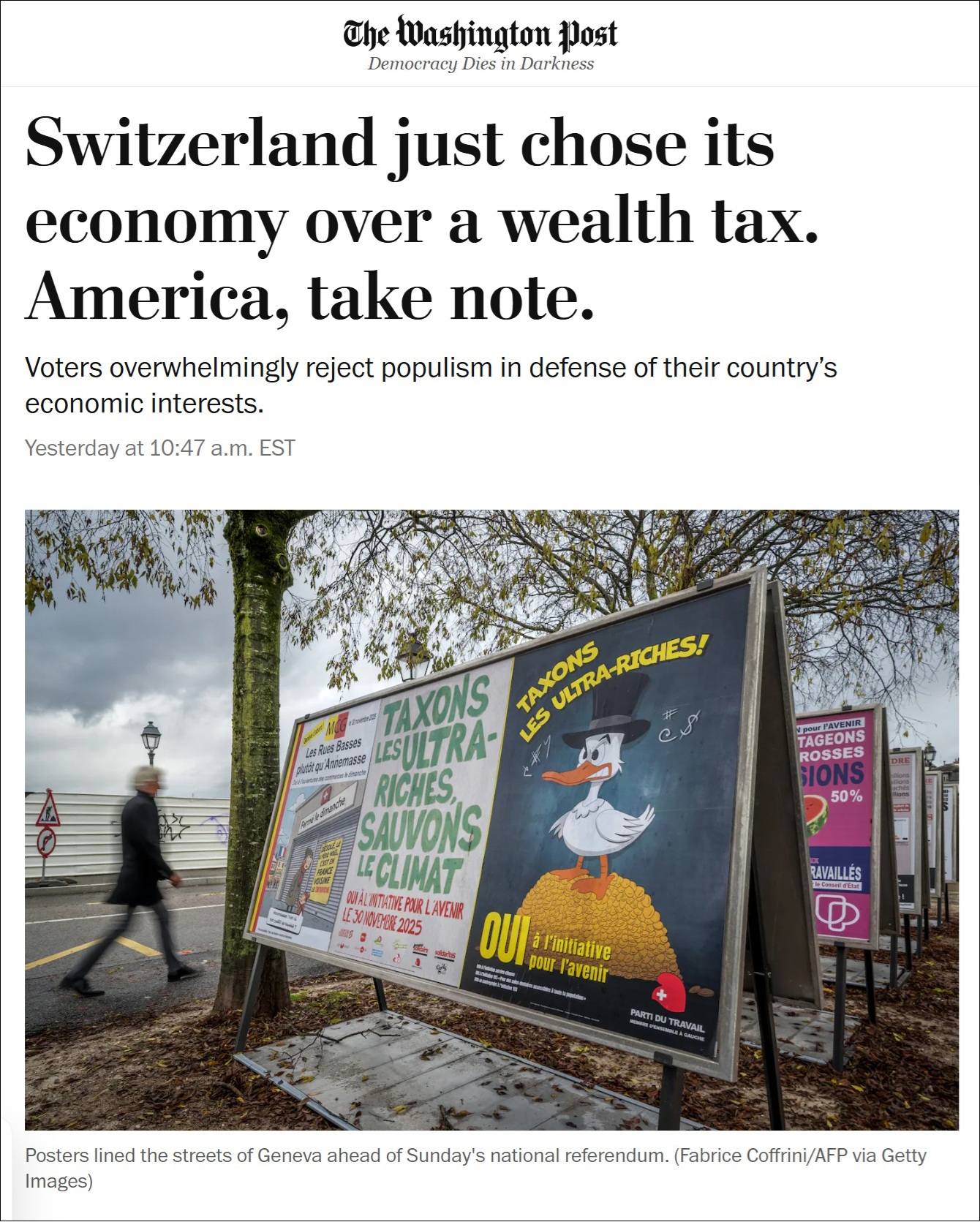
Headlines and editorial below from the Washington Post. [P.S. Is that Scrooge McDuck? The character was created in 1947 for The Walt Disney Company by Carl Barks. Scrooge is an extremely rich duck who lives in the fictional city of Duckburg (which is also Donald Duck and Huey, Dewey, and Louie’s home city) in the fictional U.S. state of Calisota (a blend of California and Minnesota). – From WIkipedia]From the Washington Post Editorial Board:
More than 80 percent of Swiss voters rebuffed a referendum that would impose a 50 percent inheritance and gift tax on assets above 50 million Swiss francs, or about $62 million. The Young Socialists party that proposed the new law says the money would be used to fight climate change. Yet it was so resoundingly rejected that it may deter others on the continent from following suit. Switzerland is a wealthy country, but most people do not have a fortune so large that would be directly affected by this referendum. Instead, the electorate made a rational decision to keep what helps make the country so wealthy: a stable and predictable business climate with relatively low taxes. The Swiss understood that taking that away would hurt even those without huge inheritances. Switzerland has a wealth tax administered locally, but its rates are minuscule and apply to almost everyone. In 2023, the country’s tax-to-GDP ratio ranked 31st out of the 38 countries in the Organization for Economic Cooperation and Development. Even a sniff of a massive inheritance or wealth tax had the country’s richest residents looking for other options to take their capital, such as Dubai, Abu Dhabi and Singapore. The top 10 percent of asset holders generate 86 percent of wealth tax revenue. The top 10 percent of salary earners contribute 53 percent of that revenue. Not all these people would leave, of course, but only a portion of them departing would devastate the country’s finances. This is why the federal government opposed the initiative. An inheritance tax is also complicated and inefficient. How does one value exotic assets like fine art? And if someone privately owns a large company, succession planning becomes a nightmare when the government is taking a share of the firm upon death. Some taxation is necessary, but levies on property and other forms of consumption are far fairer. Taxing work is not ideal, but an income tax is easier for a government to maintain than claiming unrealized gains that are part of someone’s estate. America’s federal inheritance tax kicks in this year at $13.99 million for individuals, and some states add a levy on top of that. This will increase to $15 million in 2026 under the One Big Beautiful Bill Act and will be adjusted annually for inflation starting in 2027. Something all 2028 presidential candidates, Democratic and Republican, should be willing to answer: Do they think this tax should go up, down or stay the same? Do they, like the Swiss, want to prioritize healthy public finances, or do they want to make a political point of taxing the ultra-rich? It will be a telling indicator of which direction both parties are headed.
Happy Black Friday.
The stock markets in the USA were open for a short session today.
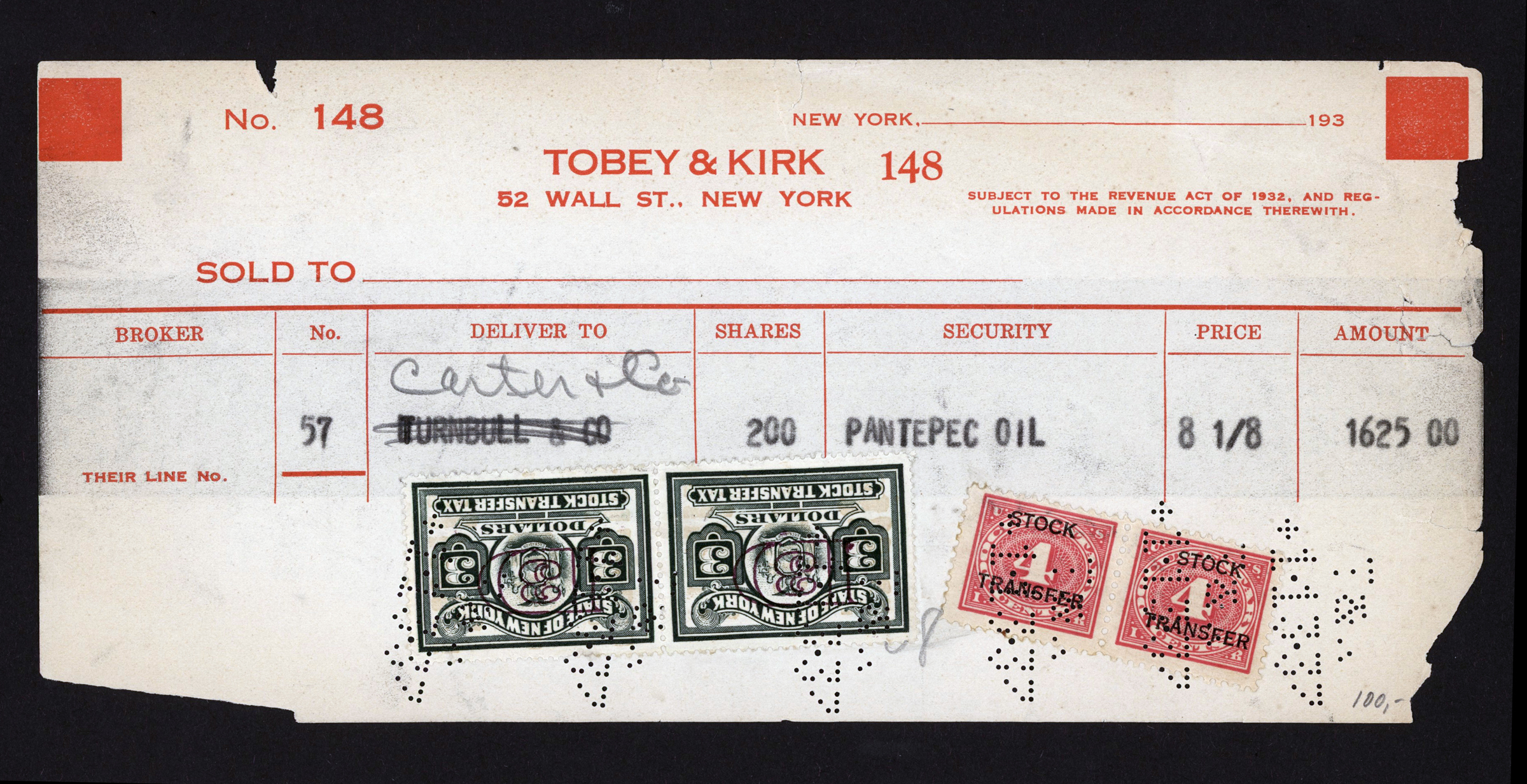
The mailman delivered a large set of stock transfer tax stamps that I had bought from a seller in Luxembourg.
I stumbled upon the stamps on Ebay and could not resist.
Below is a sample. I will post more of them when I have sorted and arranged them on pages.
Here’s what I have found out so far: Tobey & Kirk was a prominent stockbroker firm located at 52 Wall Street, in New York’s financial district. Pantepec Oil Company was an oil company founded by William F. Buckley Sr. in 1913, with operations primarily in Mexico and Venezuela. This transaction show the sale of 200 Pantepec Oil shares for $8.125 for a total amount of $1,625. The stock transfer tax stamps on the paper slip were first issued in 1936. If I read the perfin (pin hole) cancellation on the stamps correctly, they indicate a transaction date of 1.13.37 (Jan. 13, 1937). In 1937, the United States had a federal stock transfer tax in effect, which had been significantly increased in 1932 as part of the government’s response to the Great Depression. The red stamps (2x 4c) are for federal stock transfer taxes. I suspect there were more federal stock transfer tax stamps on the slip that are now missing. (The federal transfer tax was typically roughly equal to the New York State transfer tax at the time. ) The green stamps (2 x $3.00) are the NY State stock transfer tax stamps.
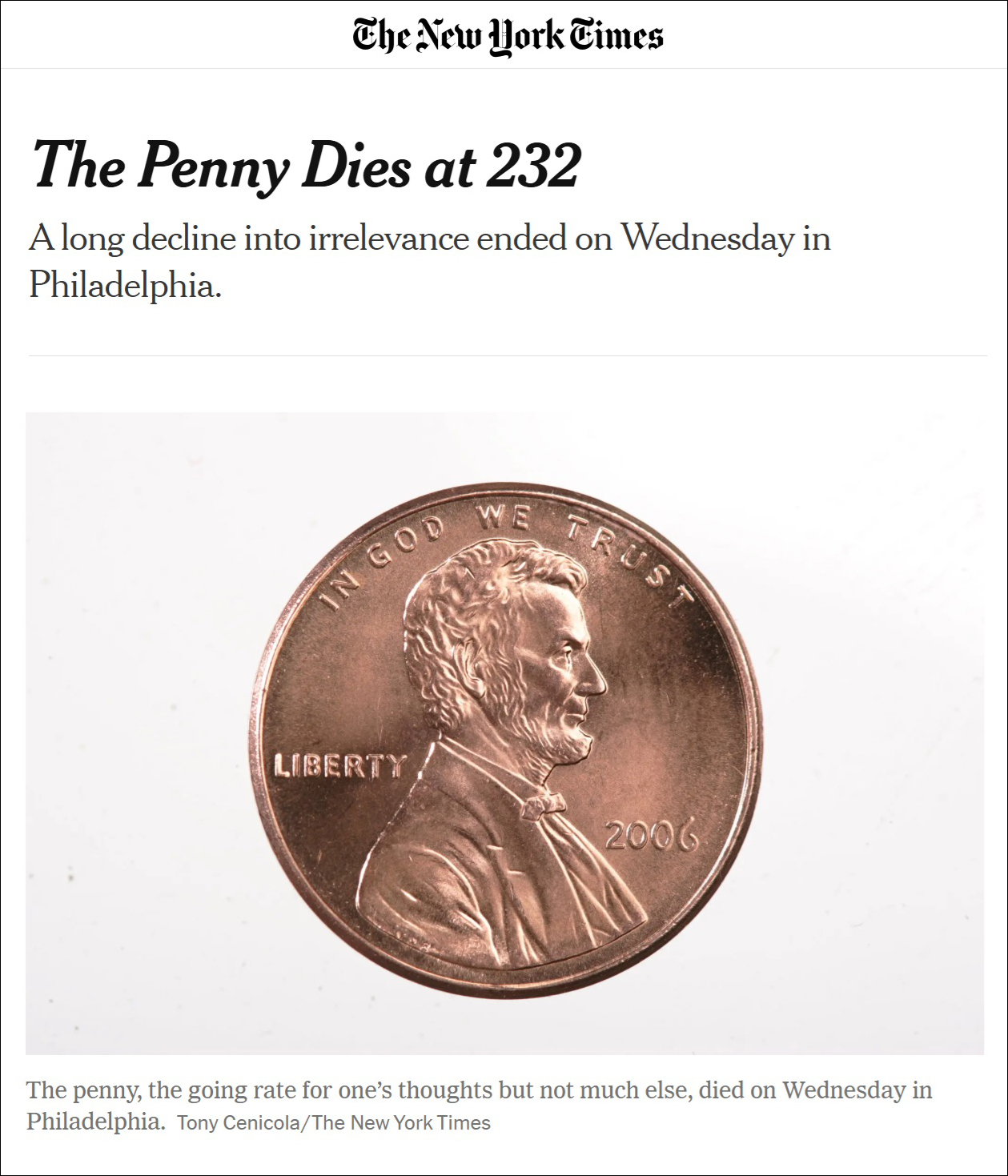
The American penny died on Wednesday in Philadelphia. It was 232.
The cause was irrelevance and expensiveness, the Treasury Department said.
Nothing could be bought any more with a penny, not even penny candy. Moreover, the cost to mint the penny had risen to more than 3 cents, a financial absurdity that doomed the coin.
The final pennies were minted on Wednesday afternoon in Philadelphia. Top Treasury officials were on hand for its final journey. No last words were recorded.
It sounds like at least fentanyl, rare earth metals and soybeans were discussed at the Trump-Xi summit today. Beijing will ease the restrictions on rare earth exports and start buying soybeans from American farmers again.
According to Trump, the relaxing of export restrictions on Nvidia’s latest chips was not discussed.
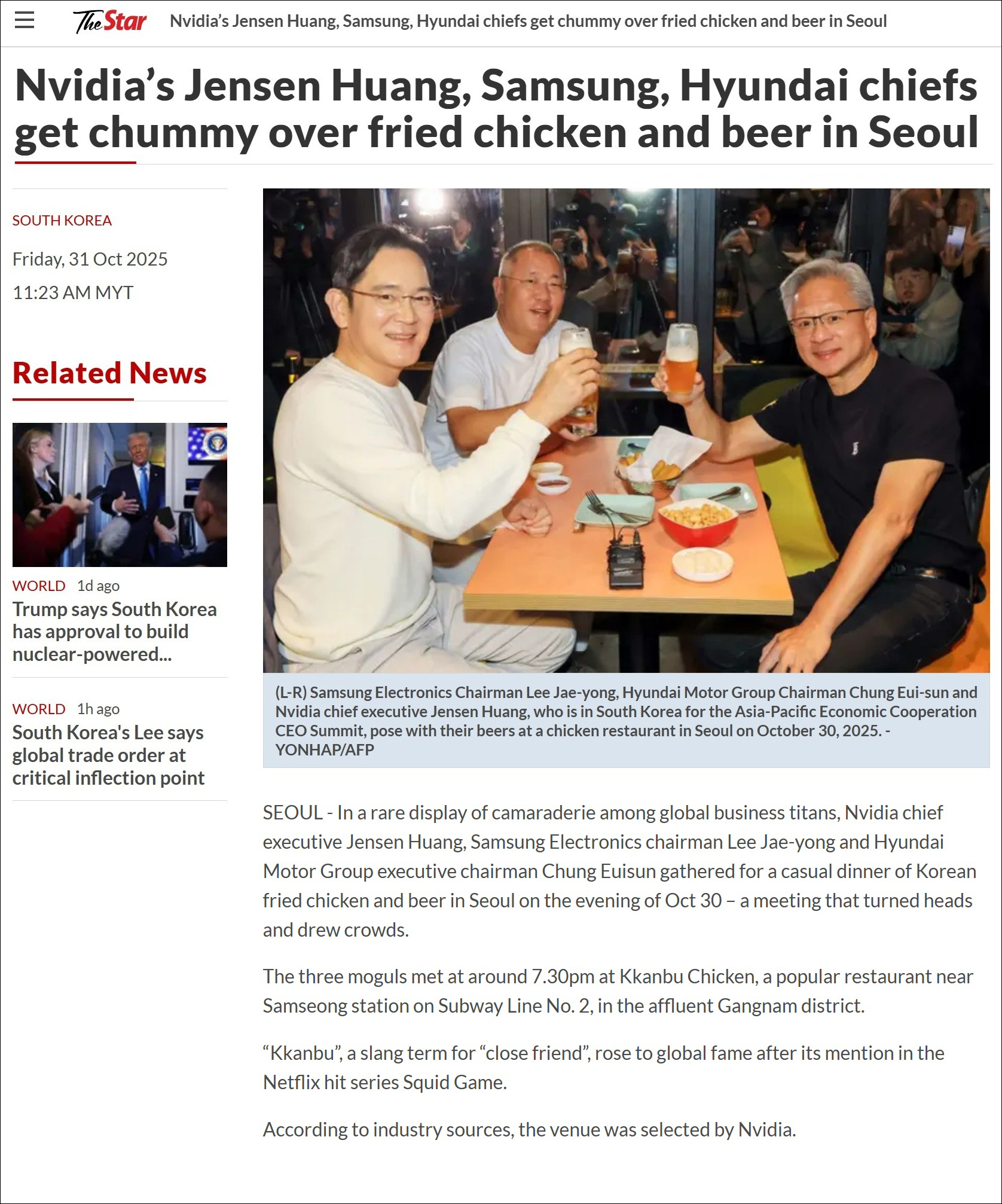
Meanwhile, Nvidia CEO Jensen Huang had beer and fried chicken with the CEOs of Samsung and Hyundai in Seoul, South Korea*.
It was clearly a marketing stunt, because there was a throng of journalists and photographers present as well.
*Samsung has a multi-faceted relationship with Nvidia, serving both as a supplier of memory and a foundry partner for specialized chips. Hyundai will presumably use Nvidia’s chips for its self-driving cars of the future. Does Tesla use Nvidia chips for its self-driving cars? No, Tesla does not use Nvidia chips for its vehicle’s self-driving computers, having switched to its own custom-designed chips in 2019. However, Tesla still uses Nvidia GPUs in large clusters for training its AI models, and has also recently purchased Nvidia chips for its new AI5 inference platform, which will be used in its new Cortex 2 AI data center alongside Tesla’s custom AI5 chips. – Google AI Overview.
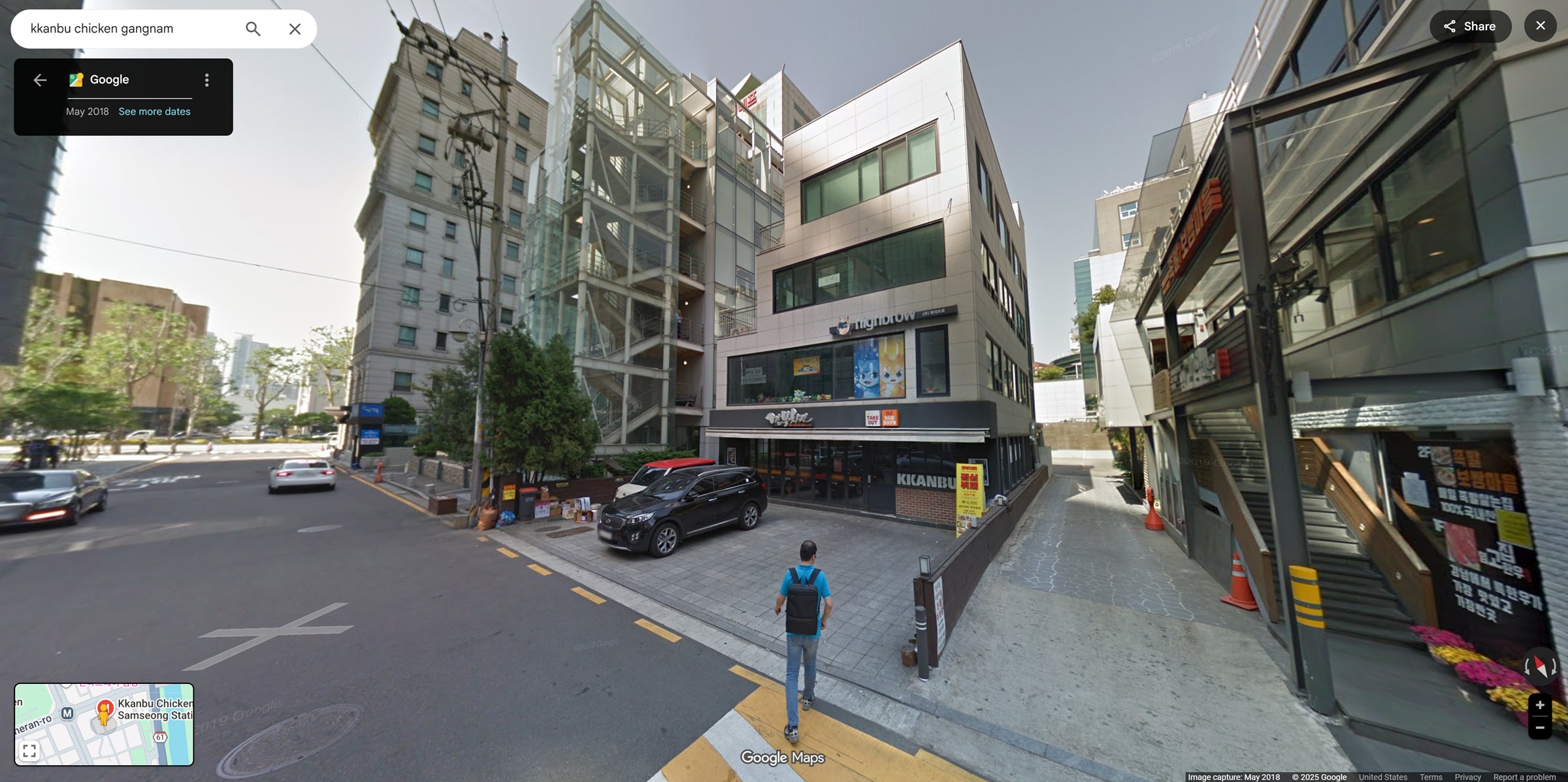
Reporting from The Star (더스타 in Korean) magazine’s website.I looked up the Google Streetview image of Kkanbu Chicken in Seoul’s Gangnam district. This is an image from 2018 but presumably not too much of the buildings and surroundings have changed.
Happy Friday from a very wet Seattle.
The city had about one inch of rain today, with windy weather and more on the way tomorrow. We also had the last 6 pm sunset for the year (but we could not see the sun at all today 😉).
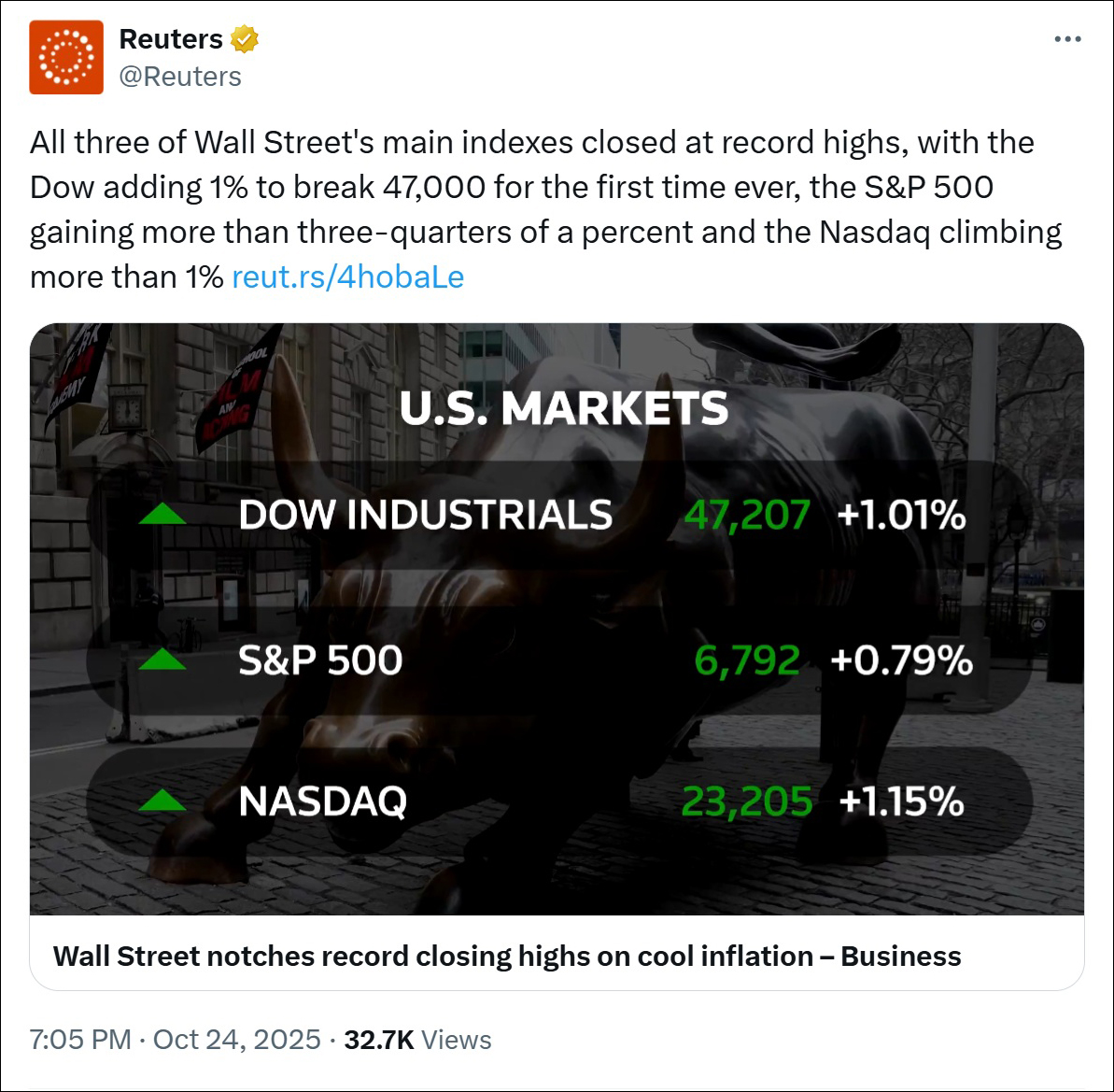
The three US stock market indexes are again at a record high, even though it’s still October (many years past, a volatile time for the markets).
I do not understand why this is the case.
From what I glean on YouTube and elsewhere, lots of other bad numbers are also at a record high (or close to it, compared to the last 10 years or so): the gold price, bitcoin, credit card debt, student loan debt, the US national debt, mortgage rates.
The US government has now been shut down for 25 days. Hello?
Uncertainly over tariffs with America’s largest trading partners (China, Canada) drags on, unresolved.
About 1.9 million Americans have been looking for employment for 27 weeks or longer now— and we’re told that AI is soon going to kill millions of entry-level jobs for humans.
The Sep. 2025 inflation number that came out today (3%) is actually the highest since January.
Reuters calls the 3% inflation ‘cool’ just because it came in below the 3.1% that was expected. At 3%, inflation is actually the highest it has been since January. What also gets lost in a headline of ‘cool inflation’ that is that nothing is cheaper (of course) —and some staple items are up by a LOT more, depending where you are and where you shop (orange juice 10%, coffee 19%, beef 7%, pet food 8%).
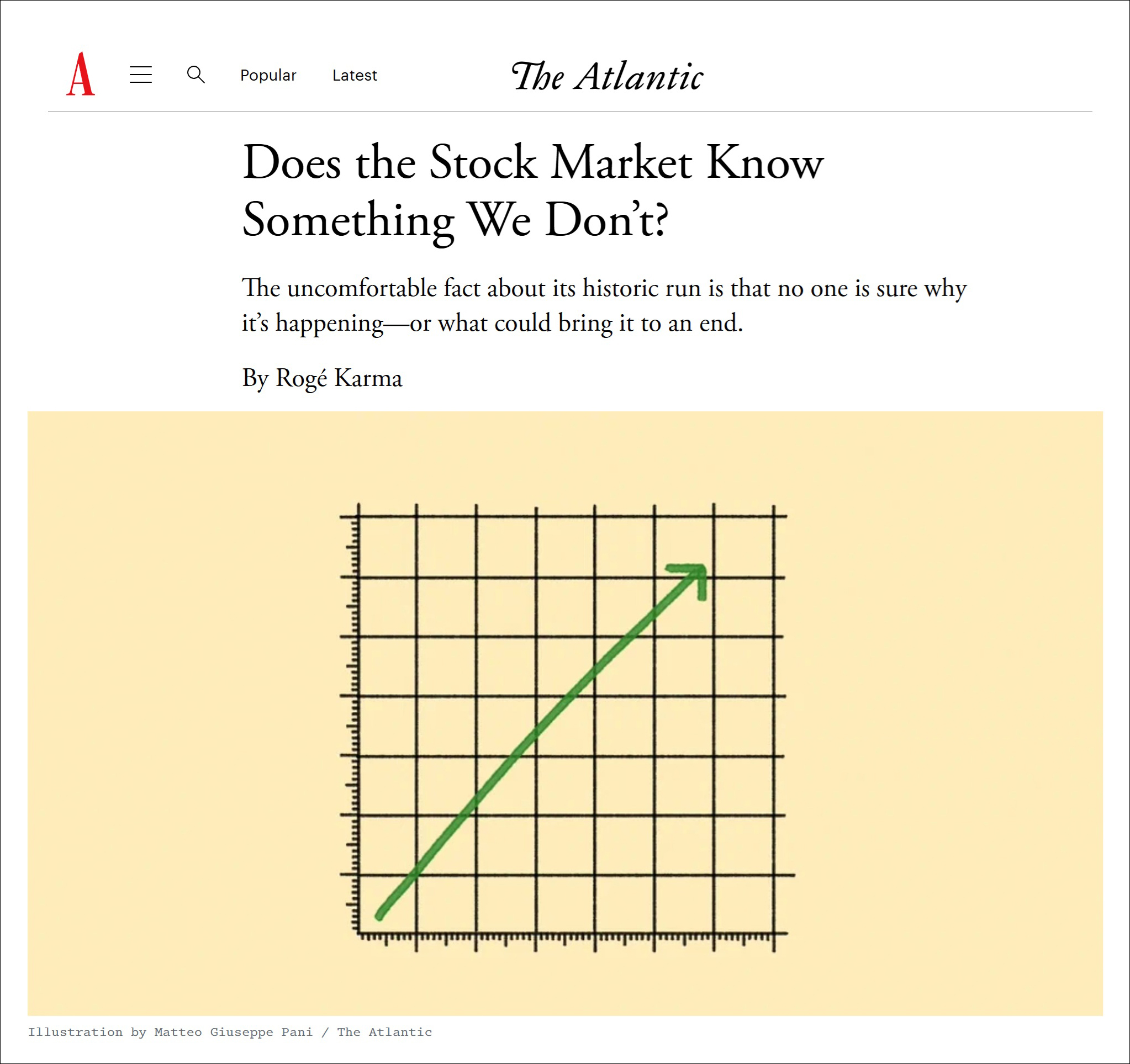
Headlines and image from The Atlantic magazine online.
Can anything stop the stock market? The U.S. economy recently weathered the worst pandemic in 100 years, the worst inflation in 40 years, and the highest interest rates in 20 years. Yet from 2019 through 2024, the S&P 500 grew by an average of nearly 20 percent a year, about double its historical average rate. Despite President Donald Trump’s erratic economic policies, which include the highest tariffs since the 19th century, the market is already up by about 8 percent in 2025.
As the stock market soars ever higher, the theories of why it rises have suffered the opposite fate. One by one, every favored explanation of what could be going on has been undermined by world events. The uncomfortable fact about the historic stock-market run is that no one really knows why it’s happening—or what could bring it to an end.
-Rogé Karma, staff writer at The Atlantic.
Monday, Aug. 11, 2025 S&P 500: +8.6% year-to-date. Nasdaq Composite:+11.1% year-to-date (new all-time high). Dow Jones Industrial Average:+4.8% year-to-date.
We do know that the US stock market is overvalued— but by how much?
Rogé Karma closes out his excellent article by noting that the explosion of passive funds* over the past 15 years could explain why the market has become less sensitive to real-world shocks and headwinds.
It might keep going up, or something unforeseen may bring it down dramatically.
*A passive fund is an investment fund, like an exchange-traded fund (ETF) or index fund, that aims to match the performance of a specific market index, rather than trying to outperform it.
Happy Friday.
It’s not a happy Friday on the economic news front.
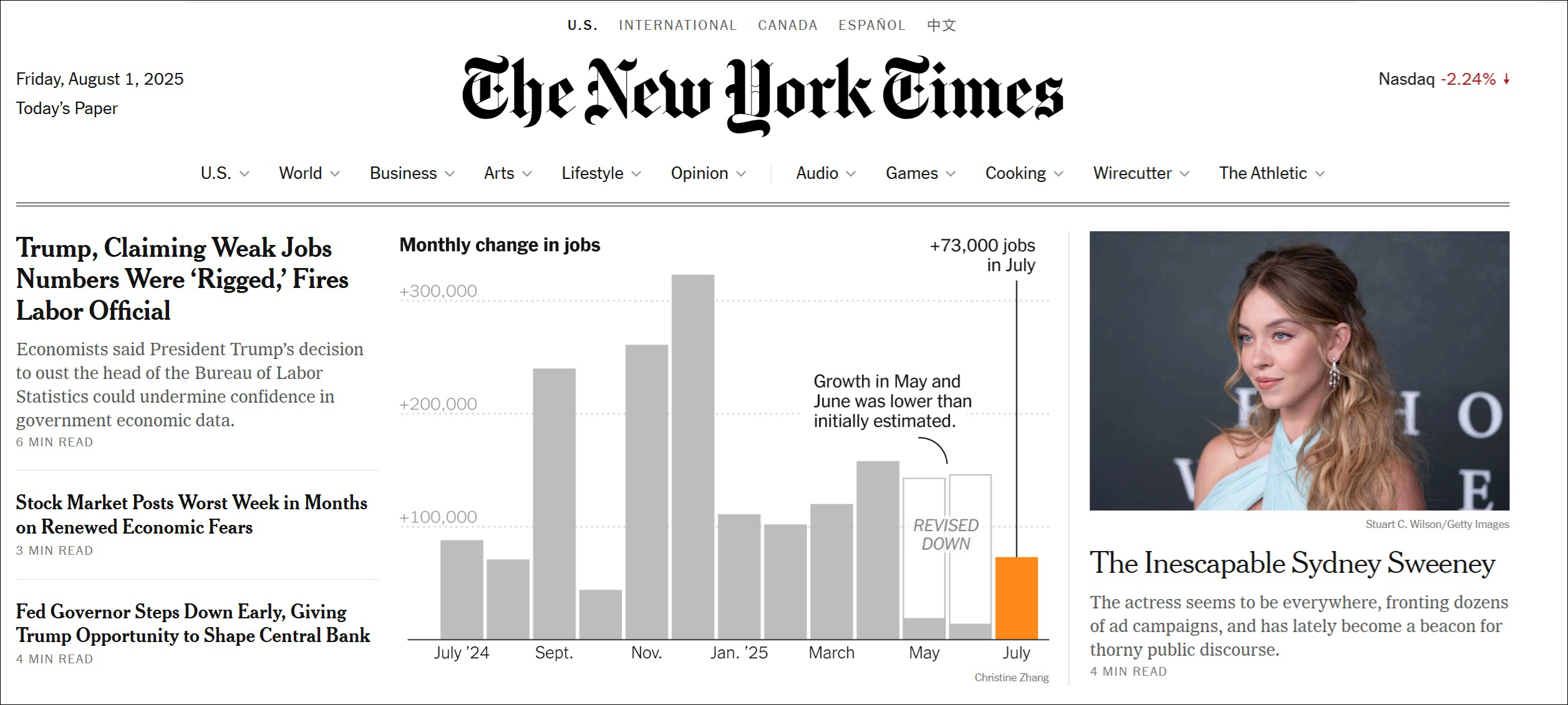
Only 73,000 jobs were added to the US economy in July, and the numbers for May and June were revised down dramatically.
Headlines from the New York Times. Trump fires Labor Official Trump fired the head of the Bureau of Labor Statistics (commissioner Erika McEntarfer, a Biden appointee). Will that make the numbers look better, then? Will we believe the numbers? Fed Governor Steps Down Early For a moment I thought Jerome Powell (Federal Reserve Bank Chair) is retiring early, but it’s a governor (one of seven members) of the Federal Reserve Board, Adriana D. Kugler, that is stepping down. Fed Chair Powell’s term expires in May 2026, but Trump seems determined to fire him or try to fire him, as well.
Trump Administration Live Updates: Uncertainty Looms Hours Before Tariff Deadline
President Trump held a news conference at the White House without providing clarity about what will happen to the global trading system in less than eight hours. As of midnight, the stiff tariffs that the president announced on April 2 would go into effect, unless the president signs an executive order to stop them.
– Ana Swanson writing for the New York Times live blog, 2.00 pm EDT
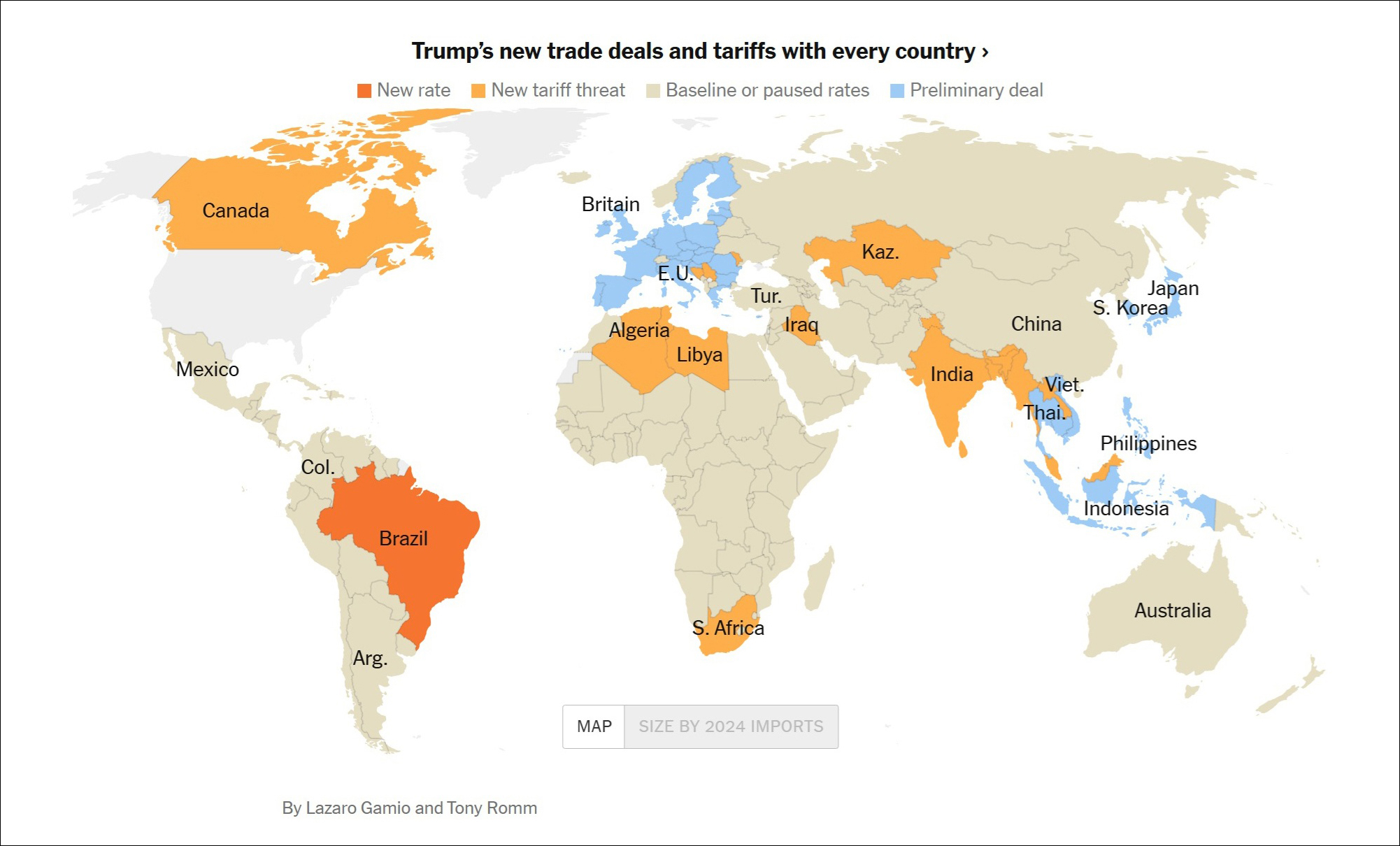
The NYT: ‘Dozens of countries remained in limbo with only hours to go before President Trump’s trade-deal deadline, with tariffs of as much as 50 percent set to snap into effect at 12:01 a.m. Friday’. [Graphic by Lazaro Gamio & Tony Romm/NYT]Mexico is getting another 90 days to reach a trade deal, but there is no such extension for Canada (the USA’s second-largest trading partner, the giant orange square) as of now. What will happen if no extension is given to Canada? The Trump administration will raise the tariff on Canadian exports to the U.S. that are not compliant with the Canada-U.S.-Mexico trade agreement (CUSMA) to 35 per cent – not including tariffs on specific sectors, like automobiles, steel and aluminum. [From globalnews.ca, graphic by Lazaro Gamio & Tony Romm/NYT]
Happy Friday.
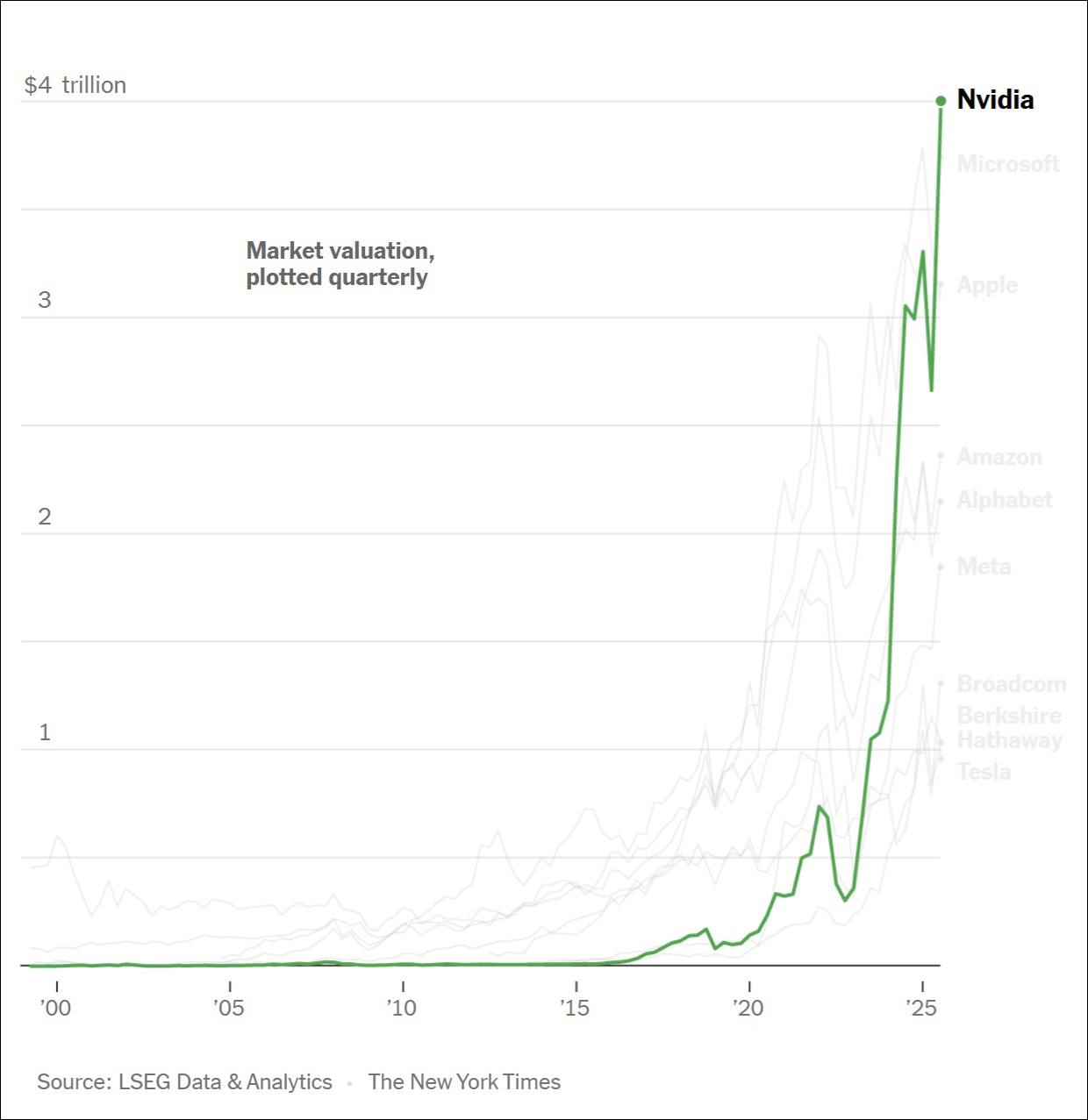
The stock markets in the US closed the week out with the world’s first four trillion dollar company: Nvidia (NVDA), listed on the NASDAQ stock exchange.
Here’s Tripp Mickle reporting for the New York Times from San Francisco: Nvidia spent three decades building a business worth $1 trillion. It spent two years turning itself into a $4 trillion company. On Thursday, the world’s leading provider of computer chips for artificial intelligence became the first public company worth $4 trillion, after its stock ended the day trading just above $164 a share. It achieved the milestone before an array of better-known tech heavyweights, including Apple and Microsoft. Nvidia’s rise is among the fastest in Wall Street history, and a testament to investors’ belief that artificial intelligence will deliver an economic transformation that rivals the Industrial Revolution’s.
From Tripp Mickle’s report for NYT: Apple and Microsoft, the market’s two largest companies in recent years, have led the way toward the $3 trillion mark. But Nvidia’s rise is unprecedented. In two years, it went from being valued at $1 trillion to becoming the first company with a market capitalization of $4 trillion. … Early this year, its shares fell 17 percent and it lost $600 billion in market value on a single day after the Chinese company DeepSeek claimed it could train a cutting-edge A.I. system with a tiny fraction of the Nvidia chips U.S. companies were using. Investors’ fears proved to be overblown, and Nvidia recovered. But the breakthrough showed the volatility that comes with being an A.I. bellwether. [Graphic by Karl Russell and Blacki Migliozzi/ NYT]
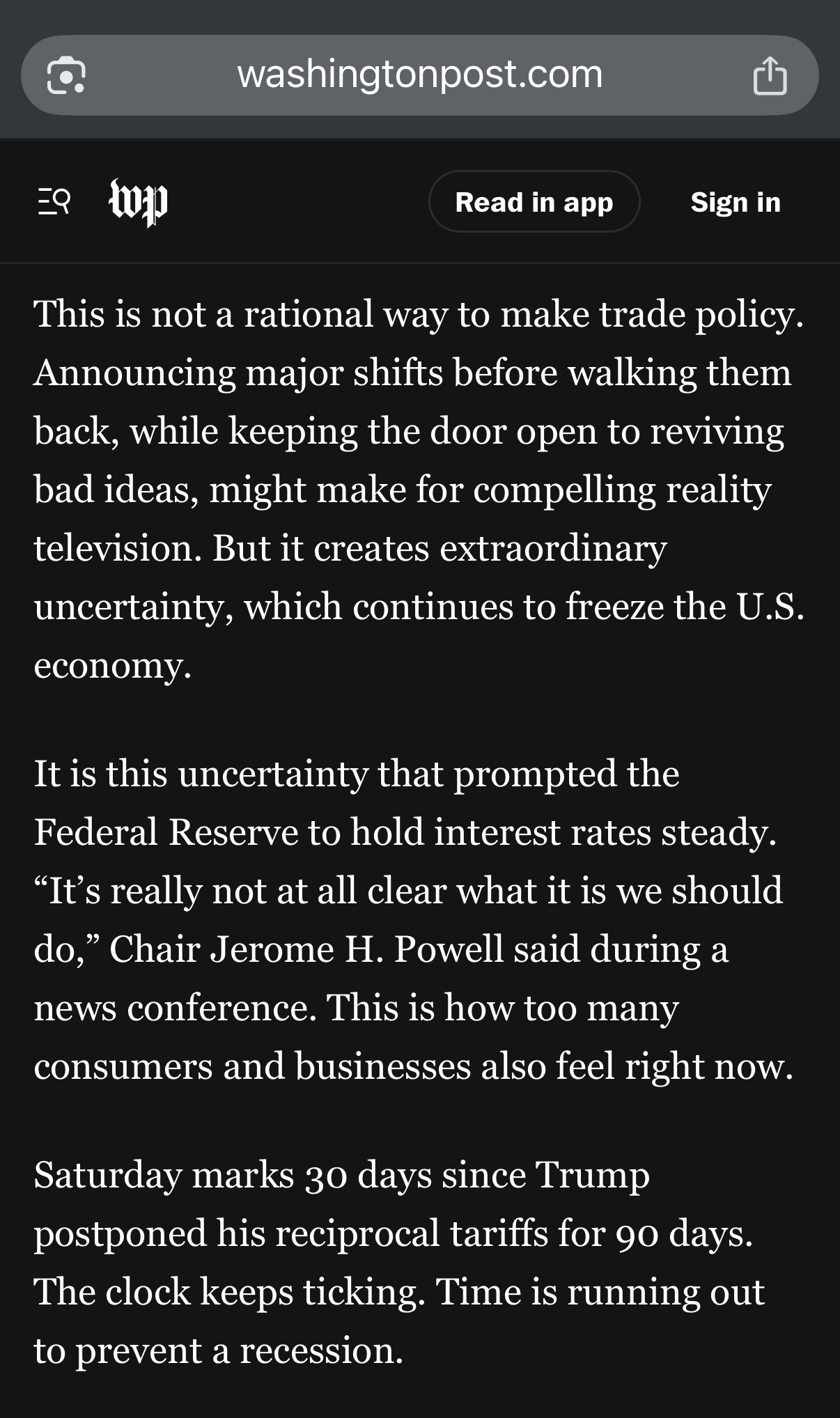
“It’s really not at all clear what it is we should do”
– Fed Chair Jay Powell explaining at a news conference this week why the Federal Reserve Board decided to keep interest rates steady (instead of cutting them)
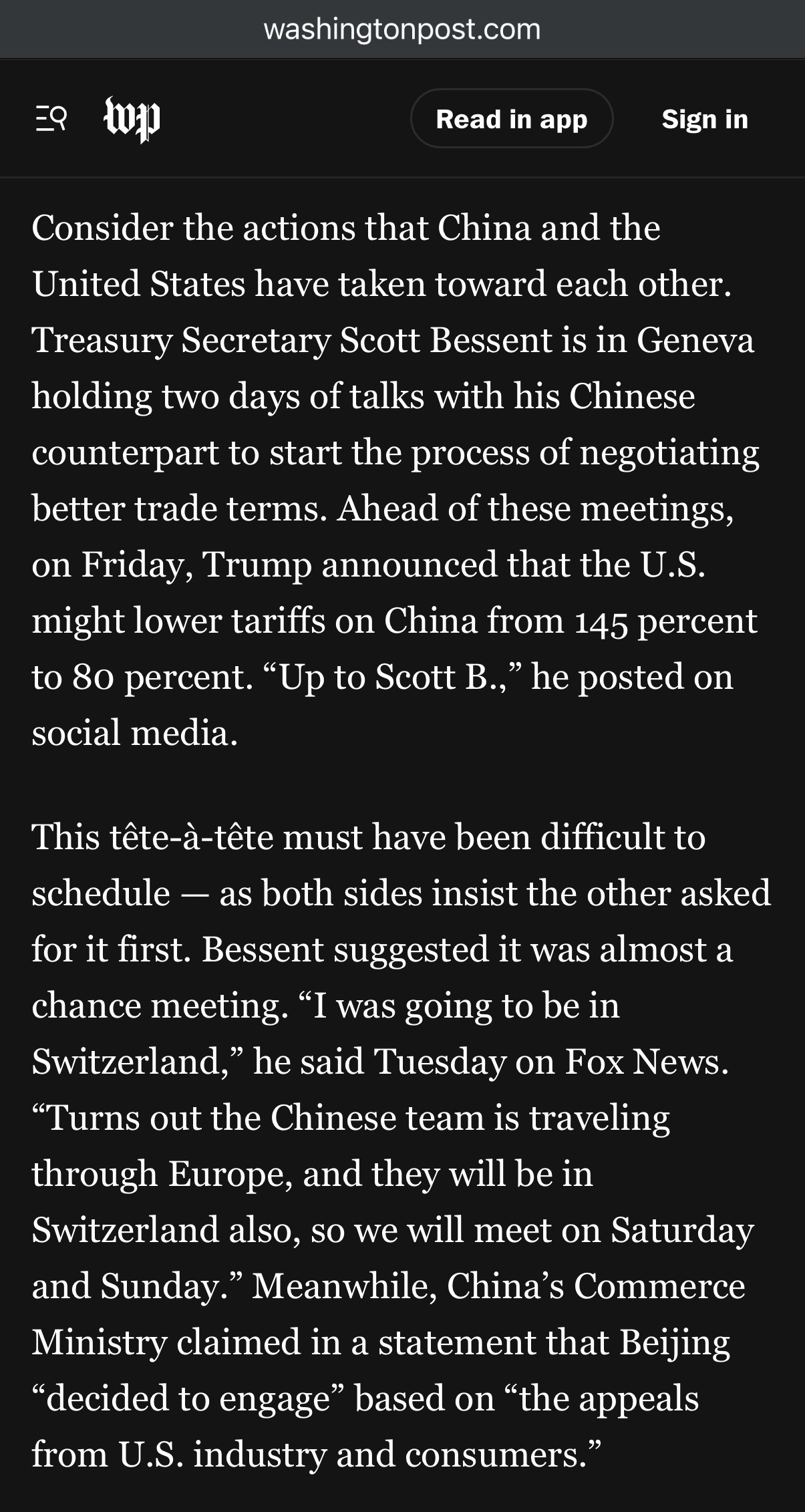
We are 30 days into the 90 day-hold that was announced by Trump for the (ridiculous) reciprocal tariffs on April 9. Now he ‘might’ lower the rate from 145% to 80%.
And what were the tariffs before all of this insanity?
Average US tariffs on Chinese exports now stand at 124.1 percent. These tariffs are more than 40 times higher than before the US-China tariff war began in 2018 and are already 6 times higher than the average US tariff on China of 20.8 percent when the second Trump administration began on January 20, 2025.
[Source: Peterson Institute for International Economics]
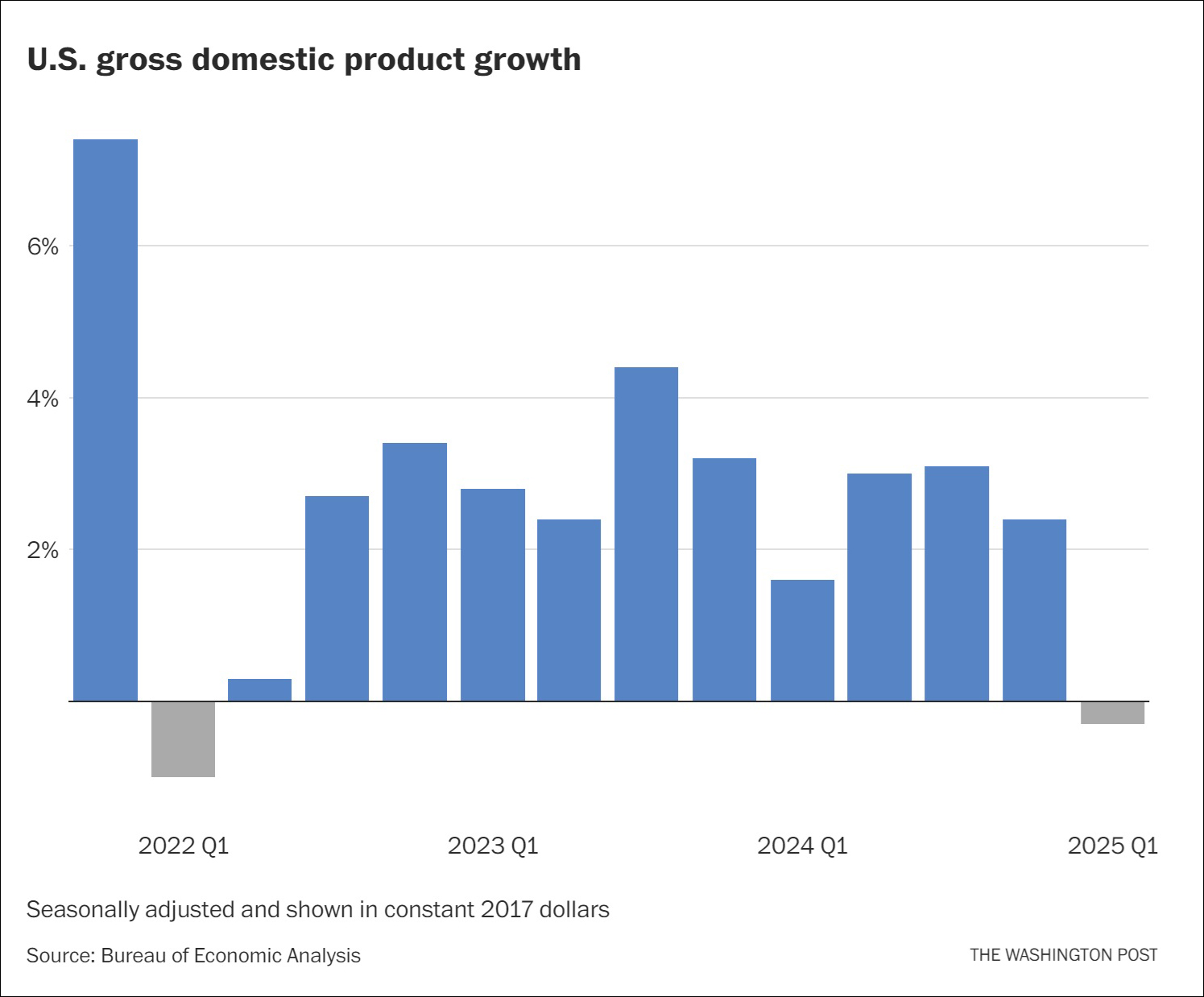
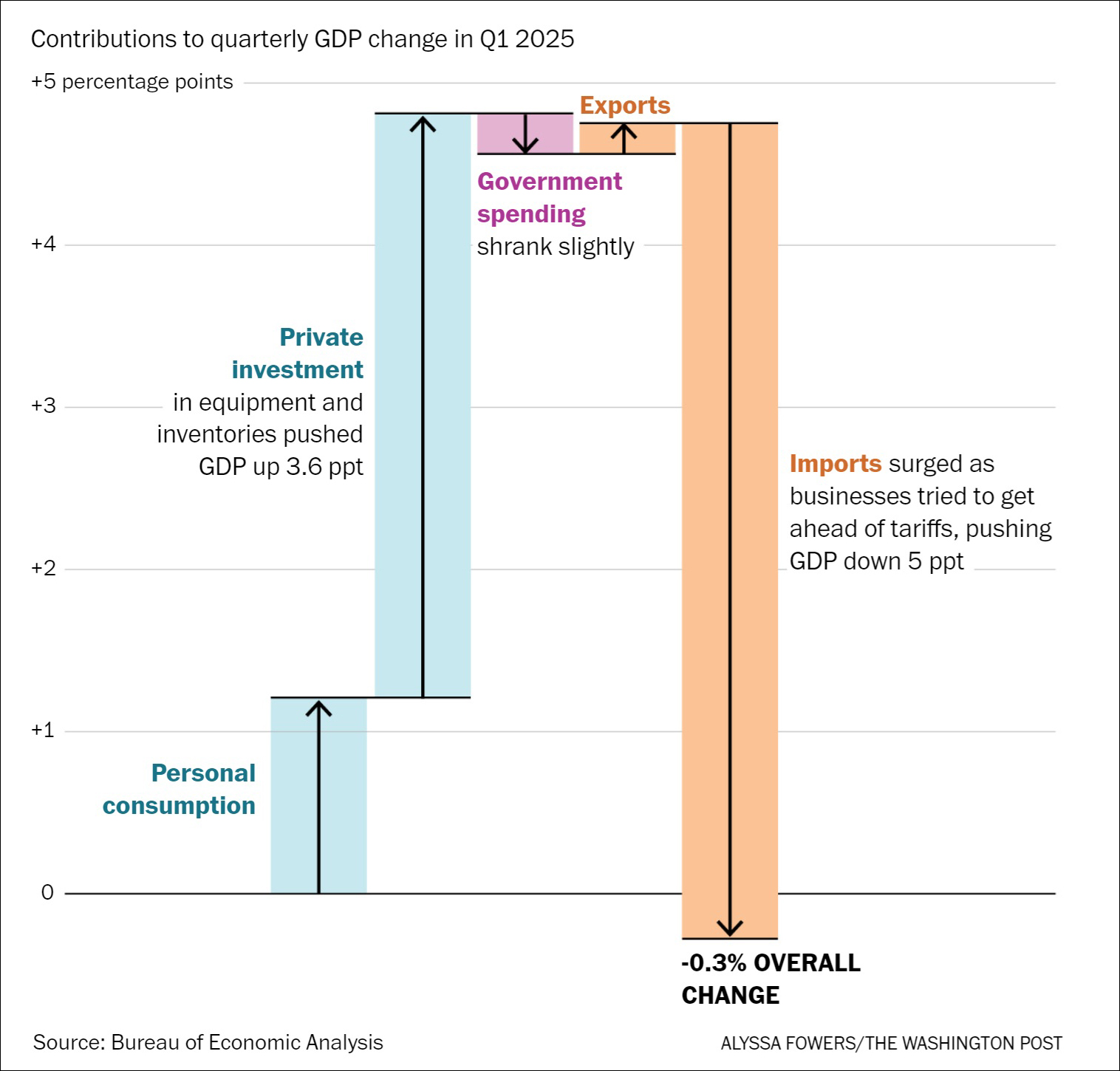
The U.S. economy shrank in the first three months of 2025, contracting by an annualized rate of 0.3 percent — a stark reversal after nearly three years of solid growth, as tariff-related uncertainty upended spending patterns and raised fears of an impending recession.
– Abha Bhattarai writing in the Washington Post
The new report on gross domestic product, released by the Bureau of Economic Analysis on Wednesday morning, showed the first deceleration of the U.S. economy since the pandemic-fueled supply chain woes of early 2022. [Graph and text from the Washington Post]This economic slowdown came primarily from a dramatic increase in imports — which count against GDP — as businesses rushed to purchase foreign goods ahead of President Donald Trump’s promised tariffs. The trade deficit — the difference between incoming and outgoing goods — is the widest it has ever been, which is expected to be a significant drag on economic growth. Sales of American-made goods to other countries help bolster GDP, while purchases of foreign-made products count against it. [Graph and text from the Washington Post]
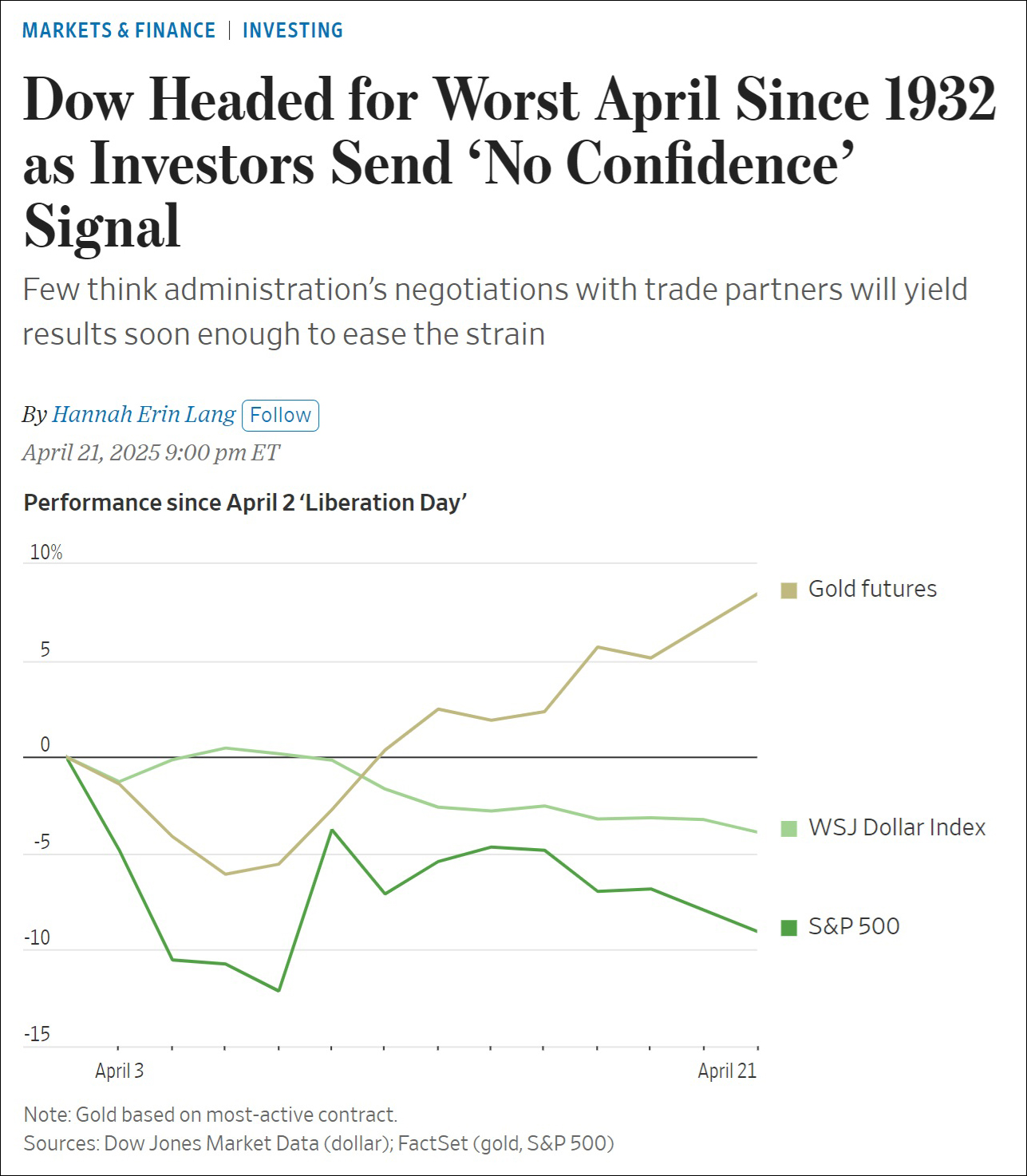
Headlines and graphic from the Wall Street Journal online.
Another Monday, and another big down day in the US stock market.
The latest is that Trump is threatening to fire Fed chair Jerome Powell. (Can he do that? Powell, has repeatedly stressed that his firing is not permitted by law, but I don’t think that will stop Trump).
Here are excerpts from Heather Long’s opinion piece in the Washington Post, titled ‘There’s only one way the U.S. avoids a recession”
The alarming signs just keep coming since President Donald Trump announced massive global tariffs on “Liberation Day.” The price of gold has soared to an all-time high as people rush for the ultimate safe asset. The U.S. dollar has tanked to a three-year low as investors would rather own about anything that isn’t American. As if the tariff chaos wasn’t enough, Trump is also threatening to “terminate” Federal Reserve Chair Jerome H. Powell, one of the only trusted economic leaders the nation still has. … The United States is probably not in a recession today, but it’s looking inevitable that it will be soon unless the White House dramatically shifts on trade. There’s only one way the U.S. avoids a recession: if Trump stops the tariff madness.
Trump has ushered in an economy of distress, even among the rich. His tariffs are the highest since the Great Depression. Americans are terrified that prices are going to spike again, and they might lose their jobs. Businesses are equally alarmed and entering an almost-comatose state as they wait to see what happens with trade, budget cuts and taxes. Traffic at the Port of Los Angeles, the major hub for Asian imports, has dried up so much it resembles early covid days.
… “I think we’re going into a recession,” said Neil Dutta, head of economic research at Renaissance Macro Research. “What’s the upside case for the economy? Even if we go back to where we were before the trade stuff and Trump just declares victory, so much damage is done, it’s hard to undo.”
There’s no safety net left to stop a downturn. The Fed isn’t going to come to the rescue and cut interest rates to prop up the economy because there’s too much concern about inflation returning. Trump is slashing government spending, especially on many areas that help the poor. Congress isn’t going to do a big stimulus package with “stimulus checks” for most Americans as it did during the pandemic. Meanwhile, consumers no longer have a ton of savings to cushion price hikes or job losses as they did coming out of covid. And the bond market freak-out has only made it more difficult — and expensive — for anyone trying to refinance their loans.
If layoffs really start to pick up, consumer spending will nosedive and a downturn is almost certain. Already, there’s been a surge in Americans who are paying the bare minimum on their monthly credit card bills — an early sign of widespread distress. The number of “minimum payers” is at a 12-year high, according to the Philadelphia Fed.
LONDON, April 9, 3:16 AM PDT (Reuters) – Global markets took a beating again on Wednesday as U.S. President Donald Trump’s eye-watering 104% tariffs on China took effect, and a savage selloff in U.S. bonds sparked fears that foreign funds were fleeing U.S. assets.
So what happened today is that the US bond market started to melt down early this morning New York time. (If you don’t know what that means: investors around the world started to question the global safe-haven status of the United States by dumping their US Treasury bonds. Do we really want a start another 2008-style global financial crisis?).
Trump backed down (some) from the tariffs, and the day ended with the Dow Jones up 7.8%, S&P 500 up 9.5%, Nasdaq up 12.16% today.
What’s not to like about that? Let me tell you.
The original Trump Tariff Tantrum that started all this turmoil is only on a 90-day timeout. The 10% tariff that remains in place right now with US trading partners, is far, far higher than for any other OECD country. The trade war that Trump had started with China has arrived at a stunning 125% for imports from China and a stunning 84% export tariff to China. (In reality: a trade embargo between the countries with far and away the world’s two largest economies).
The American consumer is going to get killed.
Apple’s, Walmart’s and the profits of countless other companies big and small, in America and in China, will be obliterated.
Millions of Americans are going to lose their jobs.
The only question to ask is when the 2025 Trump Recession will start.
Or has it started already, because nobody has any confidence that this clown’s show 🤡 will ever end?
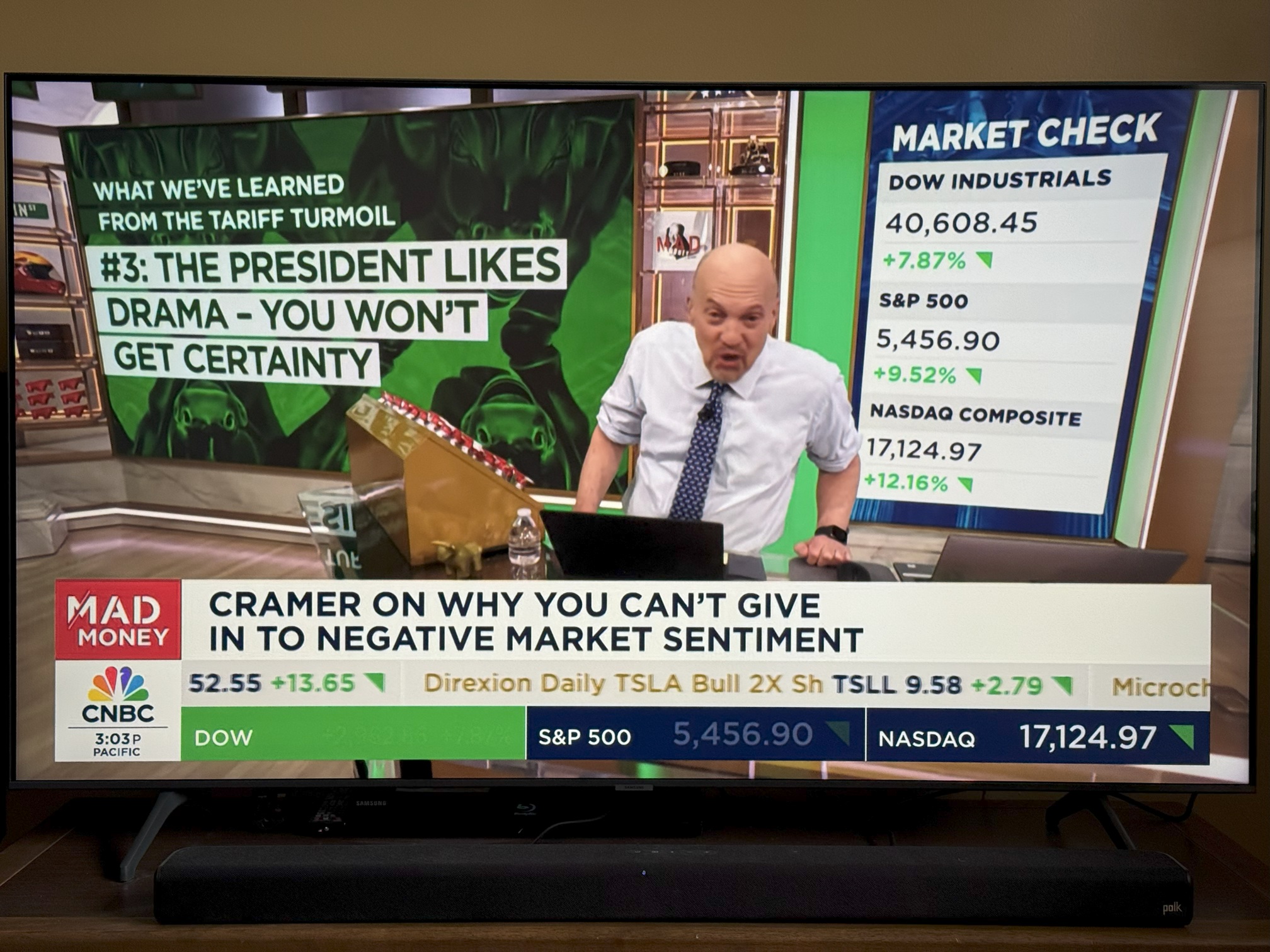
I watched way too much CNBC this morning, and still checked in at the start of Jim Cramer’s Mad Money show at 3.00 pm local time to see what he would say. Jim Cramer on ‘What we’ve learned from the tariff turmoil’: 1. Nobody Ever Made a Dime Panicking. (Do not make investments, or get out of investments because of rash, fearful or irrational emotions.) 2. Bulls Make Money, Bears Make Money, Pigs Get Slaughtered. (Don’t be greedy. If you had taken an investment position and made a reasonable profit on it, be happy and stay put. Or sell it, and don’t regret later that you did not make even more money.) 3. The President Likes Drama — You Won’t Get Certainty. (Translation: The President that had run casinos into the ground as a “businessman”, likes to gamble with your life savings and your retirement money on the world’s financial markets.) 4. Don’t Bet Against Good Companies. (Companies like Apple and Microsoft and Walmart have been around a very long time and have weathered many storms. They will find a way around the tariffs, or become profitable again after taking a hit.) 5. Staying The Course In The Markets Is Always The Winning Strategy. (There are huge down days and huge up days in the market, which cannot be predicted. So do not try to ‘time the market’ and to miss the down days and catch the up days.) [Screenshot from CNBC’s Mad Money with Jim Cramer’]
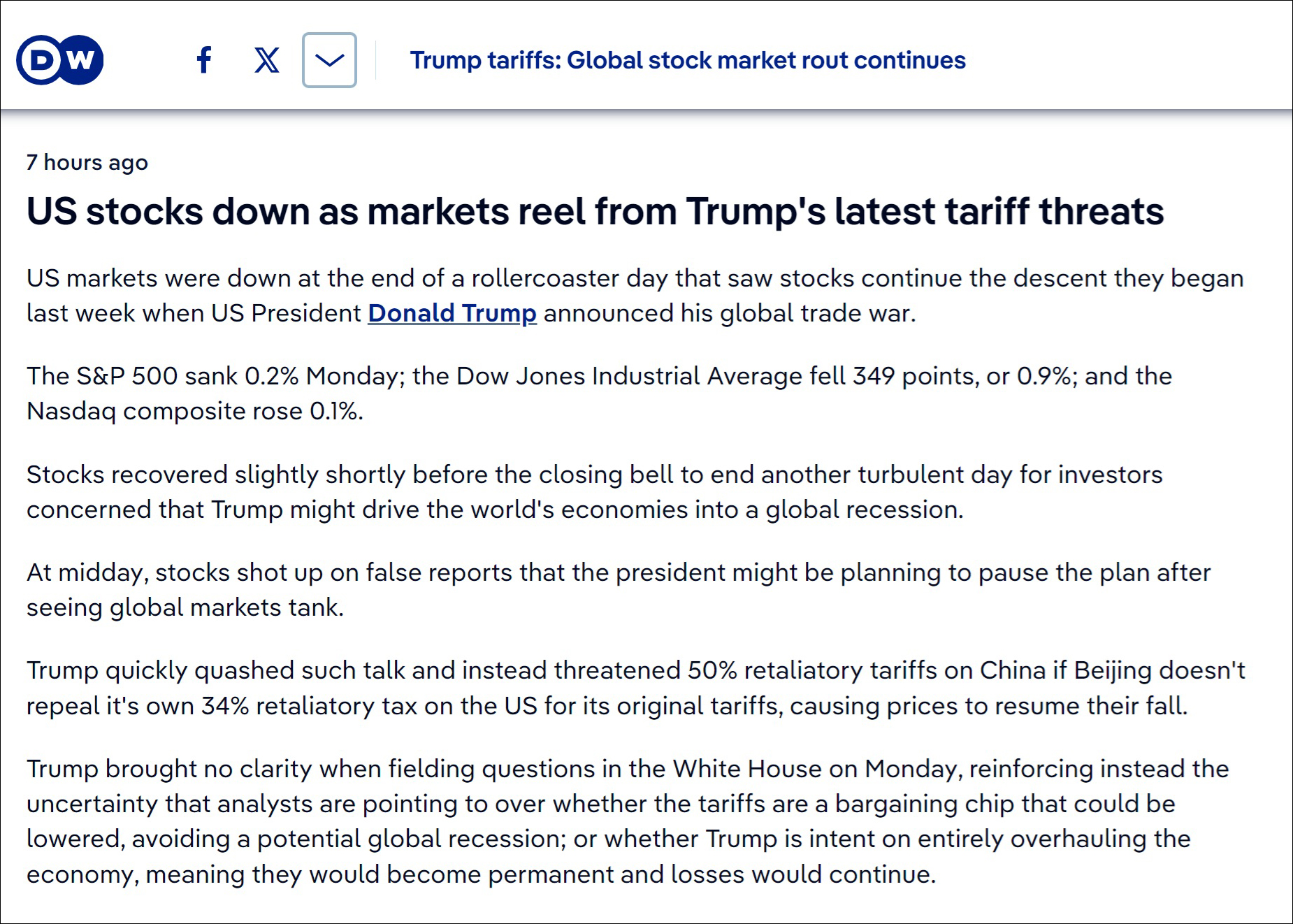
The uncertainty and the global stock market rout continued today, as reported by Deutsche Welle.
It’s going to be a long week on Wall Street for those traders on the floor .. and for all of us.
Singapore must brace itself for more shocks to come, said Prime Minister Lawrence Wong in a recorded video on Friday (Apr 4), warning that the global calm and stability that once existed “will not return anytime soon”.
– Summary of a video posted on YouTube* by Mediacorp, a Singaporean public broadcast service.
*Look up “PM Lawrence Wong on implications of US tariffs for Singapore | Full video” on YouTube. It’s just 5 minutes— but it’s also a 5-bell fire alarm.
So .. I really did not find tonight’s Saturday Night Live cold open skit with James Austin Johnson as Trump unveiling his tariffs, funny.
Maybe the US stock market indexes need to sink another 5% on Monday, and then 5% more on Tuesday.
Will enough Republican senators and Republican House members then stand up and do something?
President Donald Trump (James Austin Johnson) addresses his tariffs and their impact on the stock market during a speech. [Still from tonight’s Saturday Night Live cold open]
It was hard for me all morning, not to mull over all the turmoil in the US financial markets, and to wonder how this man-made descent into insanity will end.
What the hell? Apple will suddenly start building iPhone factories in the United States— so that Americans will gleefully pay $3,500 for an iPhone?
A good March US jobs report (+ 228,000 jobs, unemployment 4.2%) was eclipsed by ..
.. Dow Jones down another 5.5%, S&P 500 down another 6%, Nasdaq down another 6% today.
At this rate, it has to be 100% certain that there will be a recession in the United States later this year (and sooner than anyone had thought).
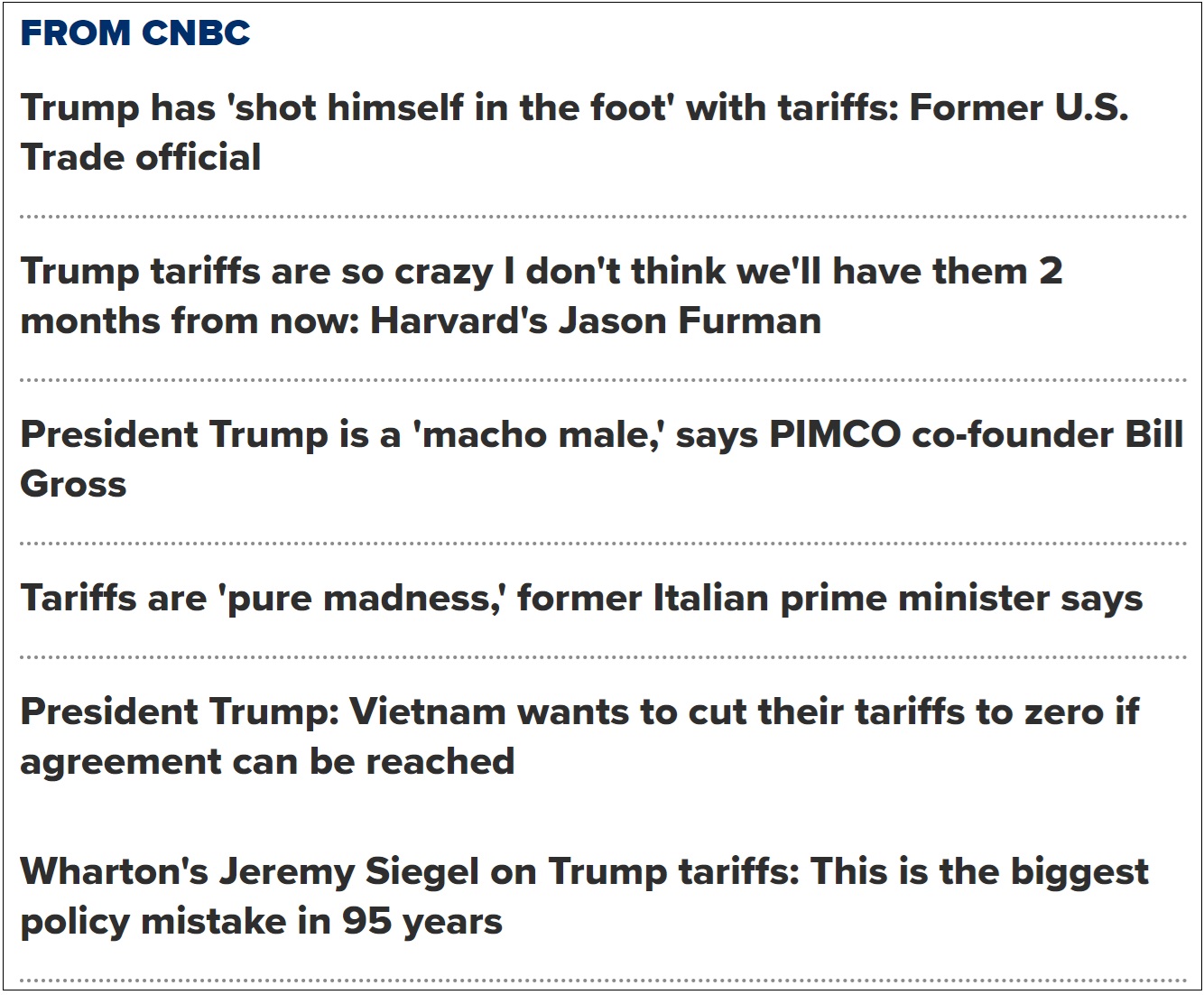
Headlines from CNBC online, the Wall Street cheerleader TV channel here in the US. In case it’s not easy to tell, let me tell you: these are all very bad headlines. Tesla (TSLA) is down another 10.5% for the day. ‘Unprecedented brand damage’ (by Elon Musk) writes JPMorgan Chase & Co analyst Ryan Brinkman in his downgrade of the stock. Bigger picture, I would say America is suffering (another) round of ‘unprecedented brand damage’ around the world.
So .. Dow Jones down 4%, S&P 500 down 5%, Nasdaq down 6% today.
One would think there was another 9/11 or October 7 terrorist attack somewhere in the world, or a new and frightful pandemic breaking out.
But no, it’s just the President of the United States— foisting his kindergartner-level understanding of tariffs and international trade, on America’s financial markets, and the world at large.
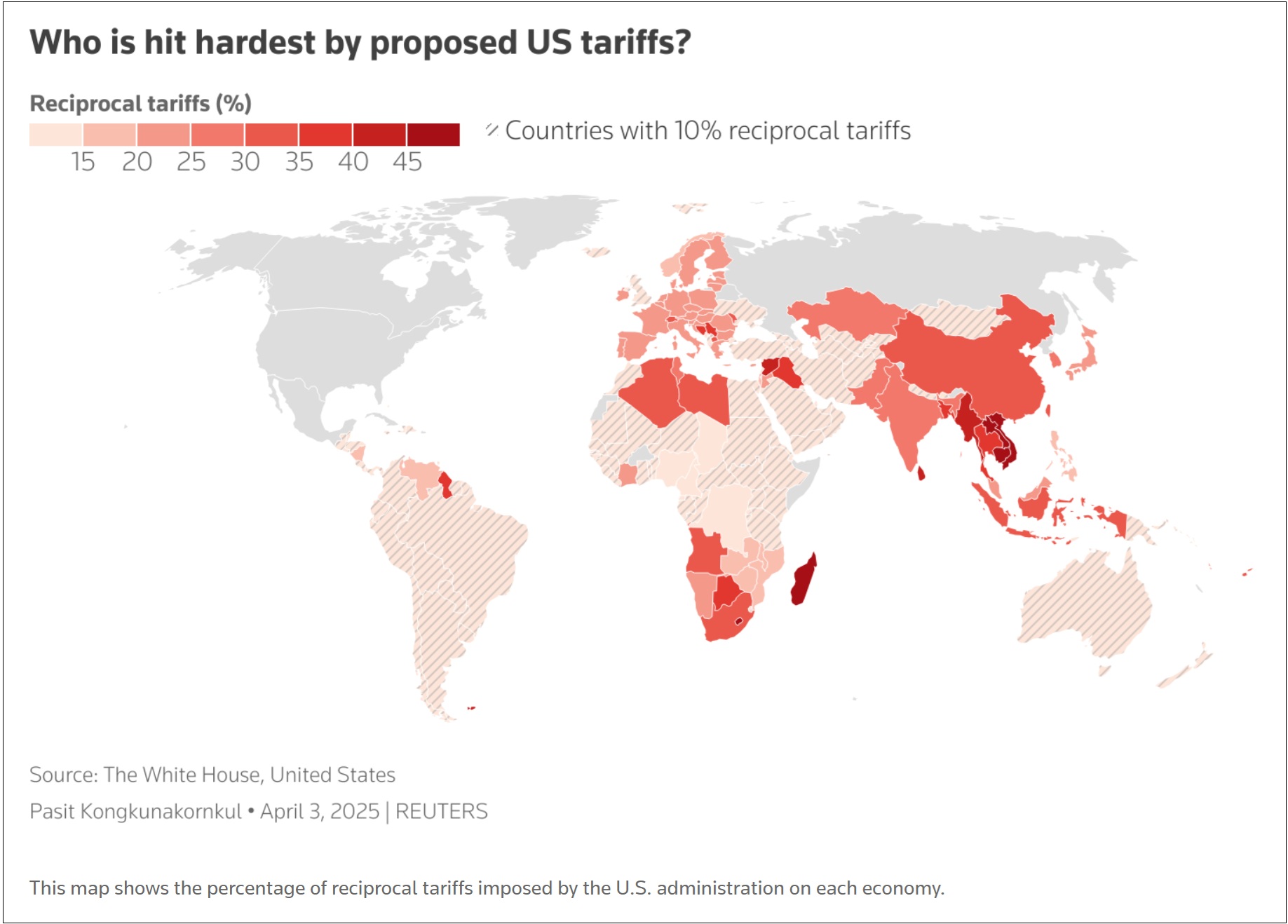
What substantive harm has tiny, land-locked and impoverished Lesotho ever done to the United States? Its modest economy is going to be decimated (hit with 50% tariffs, see below).
For China, 34% on top of 20% a previously implemented for a total 54%. 31% for South Africa. 50% for Lesotho (the dark dot inside South Africa). From Aljazeera.com: The Trump administration has imposed a steep 50 percent tariff on Lesotho, a small, impoverished African nation of two million people – the highest tariff levied on any country. The measure delivers a severe blow to Lesotho’s economy, which relies heavily on exports for its modest $2bn gross domestic product (GDP). United States President Donald Trump, who mocked Lesotho last month as a country “nobody has ever heard of”, announced it as part of a sweeping set of “reciprocal tariffs” laid out on Thursday. Trump’s new tariffs were calculated based on the US trade deficit with each country, divided by the total value of imports from that nation. As a result, smaller economies with limited imports from the US – such as Lesotho and Madagascar – were hit hardest. Lesotho’s trade surplus with the US is largely driven by diamond and textile exports, including Levi’s jeans. In 2024, its exports to the US totalled $237m, accounting for more than 10 percent of its GDP, according to Oxford Economics.Outside, away from the TV coverage, radio, and social media, there were blue skies, pinkish tree blossoms, and sunshine today 🌞 (a high of 55 °F/ 13°C here in the city).
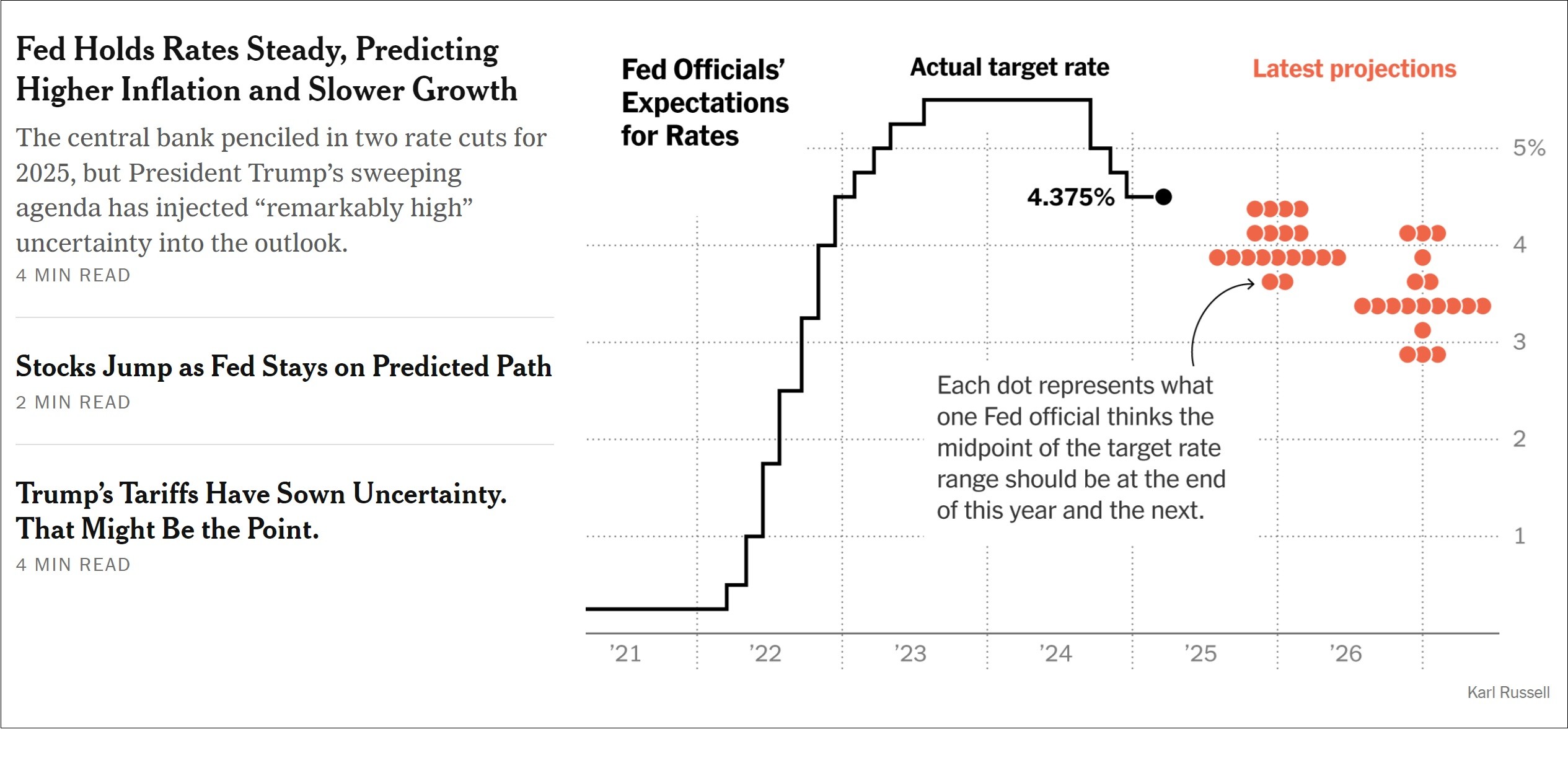
The central bank’s decision to hold interest rates at 4.25 percent to 4.5 percent extends a pause that has been in place since January, following a series of cuts in late 2024 that lowered borrowing costs by a percentage point.
When — and to some extent whether — the Fed ultimately follows through with cutting rates again this year remains dependent on Mr. Trump’s economic plans, including the sweeping tariffs he has threatened or imposed. Wednesday’s meeting marked the central bank’s most direct acknowledgment to date that the president’s policies are set to have a real impact on the economy.
–Colby Smith reporting from Washington for the New York Times
So you’re going to pay more for your new home mortgage, you car loan, your student loan, your credit card loan, the eggs, the bread, the milk, whatever you buy at the grocery store. Oh! — and a lot more for just about everything else you buy. The United States has entered into a trade war with Canada, Mexico and China (see below what bankrate.com says).
A recession is coming, this year or next.
Has to, with all this going on, right? I hope I’m wrong.
Bankrate.com on Mar. 4: Tariffs are a tax imposed on goods that the U.S. imports from other nations. President Donald Trump’s 25 percent tariffs on imports from Mexico and Canada, initially announced in February but delayed for a month, took effect Tuesday, along with an additional 10 percent tariff on goods from China. (In February, a 10 percent tariff went into effect on all imports from China.) Economists, supply chain analysts and tax experts interviewed by Bankrate said that consumers often end up bearing the burden of tariffs, as companies pass along higher production costs to consumers.