Mathematicians are now almost certain the earth-shattering artificial-intelligence-created proof of the Riemann hypothesis is real.
This morning Anthropic mathematician Levent Alpöge claimed to have used the company’s Claude AI model to solve the Riemann problem, perhaps the most important open quandary in mathematics.
The hypothesis, first posed in 1859 by mathematician Bernhard Riemann, suggests that a hidden pattern underlies the distribution of the prime numbers—those numbers that are divisible only by themselves and 1.
Now researchers have verified that the proof does seem to do what Alpöge claims. Alpöge initially checked the work by writing out the proof using the programming language Lean.
If a Lean-coded proof compiles error-free, this is usually taken as confirmation that the logic and math in each step is correct.
– Clara Moskowitz writing for Scientific American
Happy Friday.
The proof of the Riemann hypothesis would be a monumental occasion.
Thousands of other mathematical theorems begin with “Assuming the Riemann hypothesis is true . . .”.
Once the proof has been vetted, all of those conditional results automatically become proven facts.
There is a competing human proof on the table now as well. Hours after Alpöge’s announcement, American Mathematical Society president Ravi Vakil shared a 940-page draft proof of the Generalized Riemann Hypothesis written entirely without AI by Stanford postdoc Alessandro Masullo.
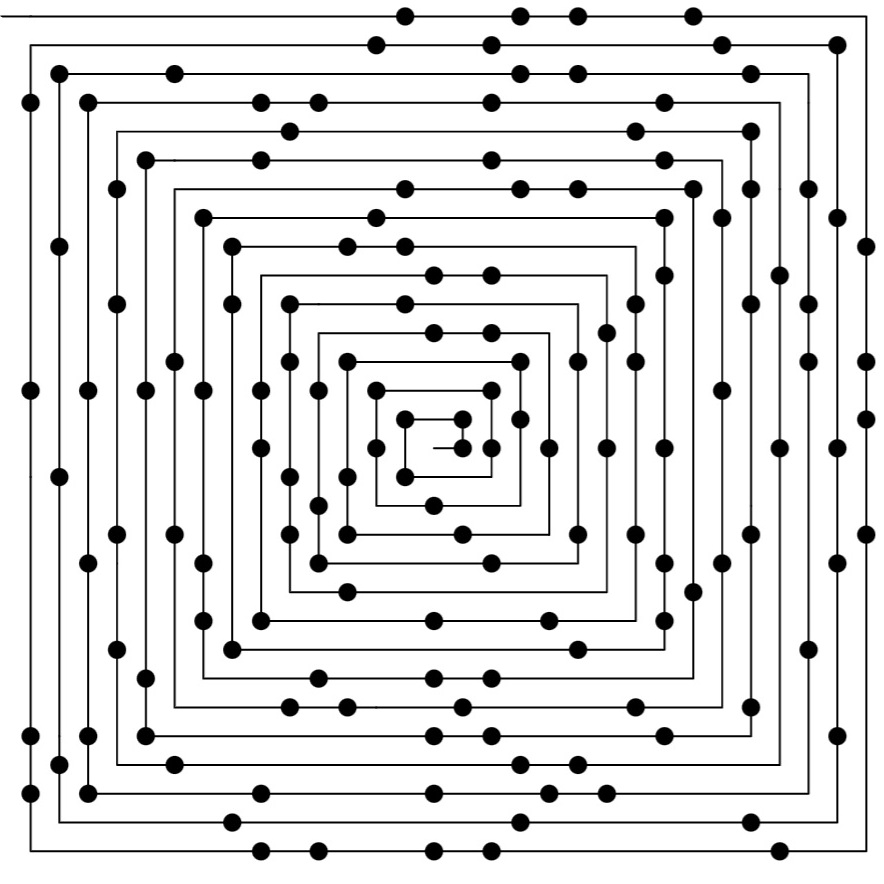
The Ulam spiral (or prime spiral) is a grid plot of consecutive positive integers arranged in a square spiral with prime numbers highlighted, devised by mathematician Stanisław Ulam in 1963. Highlighting primes reveals unexpected diagonal lines with high prime densities rather than a purely random scatter.