
As part of the ever-expanding scope of my collection of South African stamps, I have started to collect revenue stamps of the South African colonies.
(Before the establishment of the Union of South Africa in 1910, South Africa consisted of four British colonies: the Cape Colony, Natal, Transvaal, and the Orange Free State.)
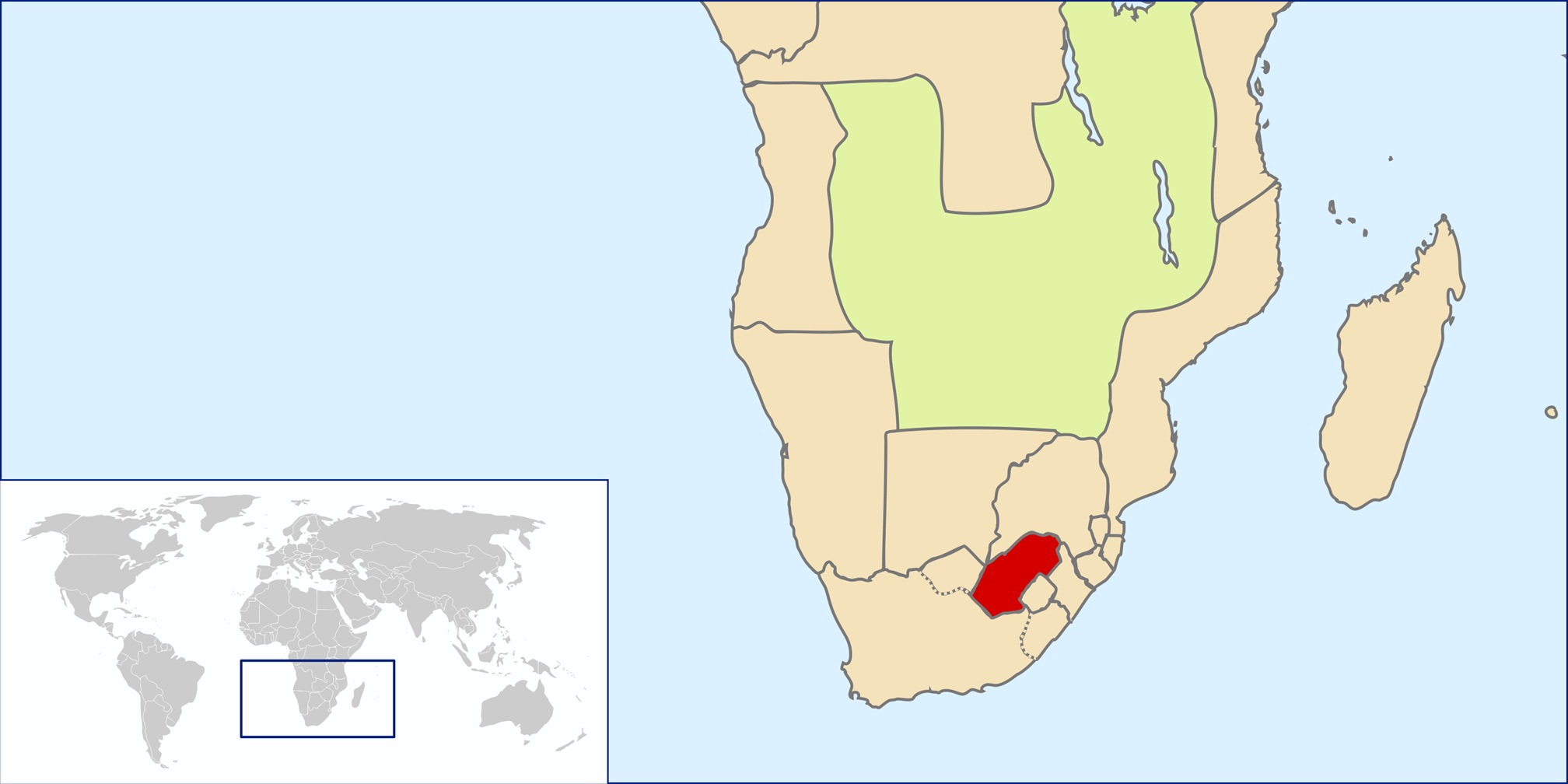
*A suzerain is a person, state or polity who has supremacy and dominant influence over the foreign policy and economic relations of another subordinate party or polity, but allows internal autonomy to that subordinate.
This yellow revenue stamp with green ink from the Cape Colony is affixed to a checque (using the queen’s English— Queen Victoria) that was issued in 1897 by the Harrismith branch of the National Bank of the Orange Free State.
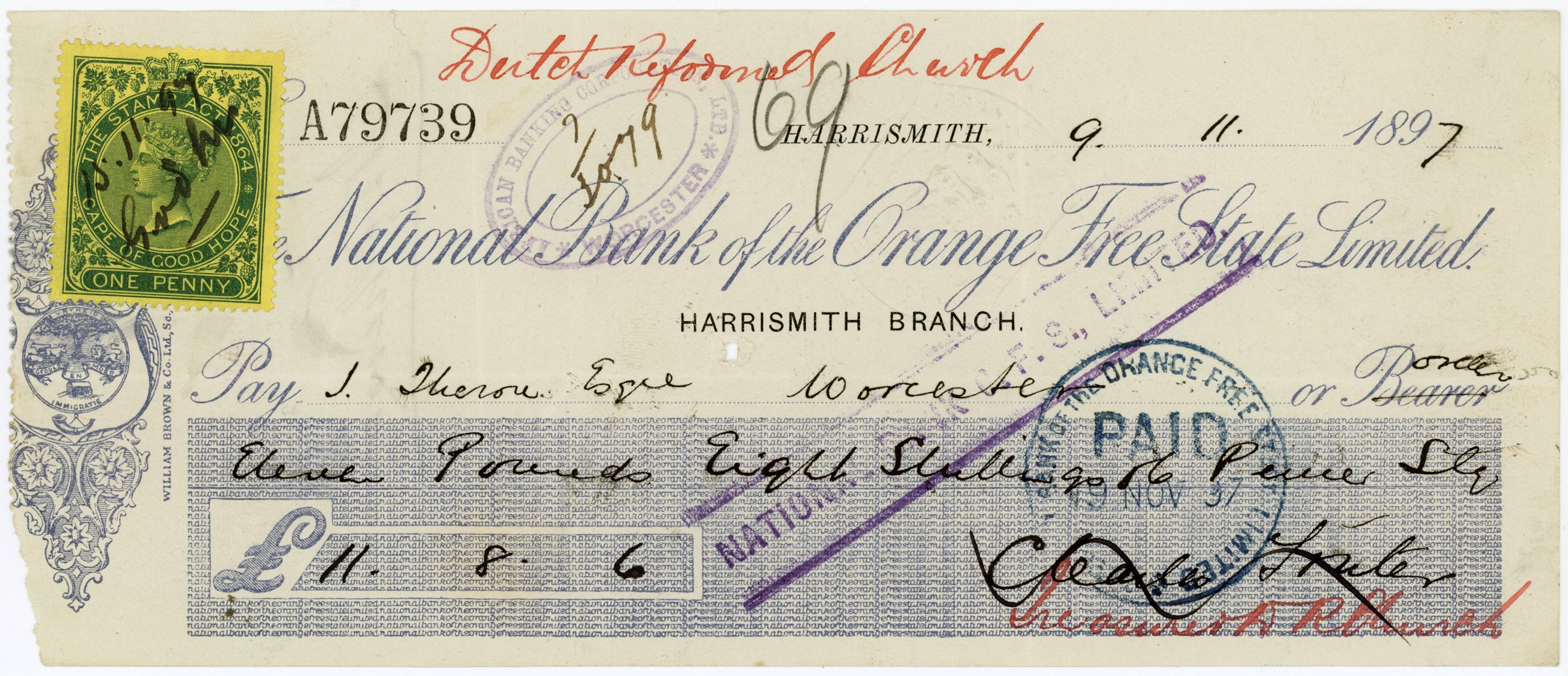
First issued in 1865 by the Cape Colony | Perf. 14 |Rotogravure
One penny (1d) | green on yellow paper| Queen Victoria’s profile in classical style* surrounded by grapevine and vine leaves in the corners, symbolizing the Cape Colony’s viticulture | Crown at the top, denoting British authority
*Queen Victoria of the United Kingdom of Great Britain and Ireland, queen from 1837 until her death in January 1901.
The Cheque
Written by the treasurer (Charles Truter) of the Dutch Reformed Church on Nov. 9, 1897 to Esquire J. Theron. (Esquire here is the title of a young nobleman).
The cheque is from the Harrismith branch of the National Bank of the Orange Free State, written for an amount of 11 Orange Free State pounds*, 8 shillings, 6 pennies.
*Like the South African pound, it was divided into 20 shillings, and a shilling into 12 pennies.
On the far left of the check is the coat of arms of the Orange Free State.
The cheque was printed by William Brown & Co. of Old Broad Street in London.
Security features at the time included the fine print at the bottom of the check, and so-called fugitive printing, that would use ink that would change, fade, or disappear under specific conditions, if it was tampered with.
The revenue stamp was affixed to the cheque on Nov. 15.
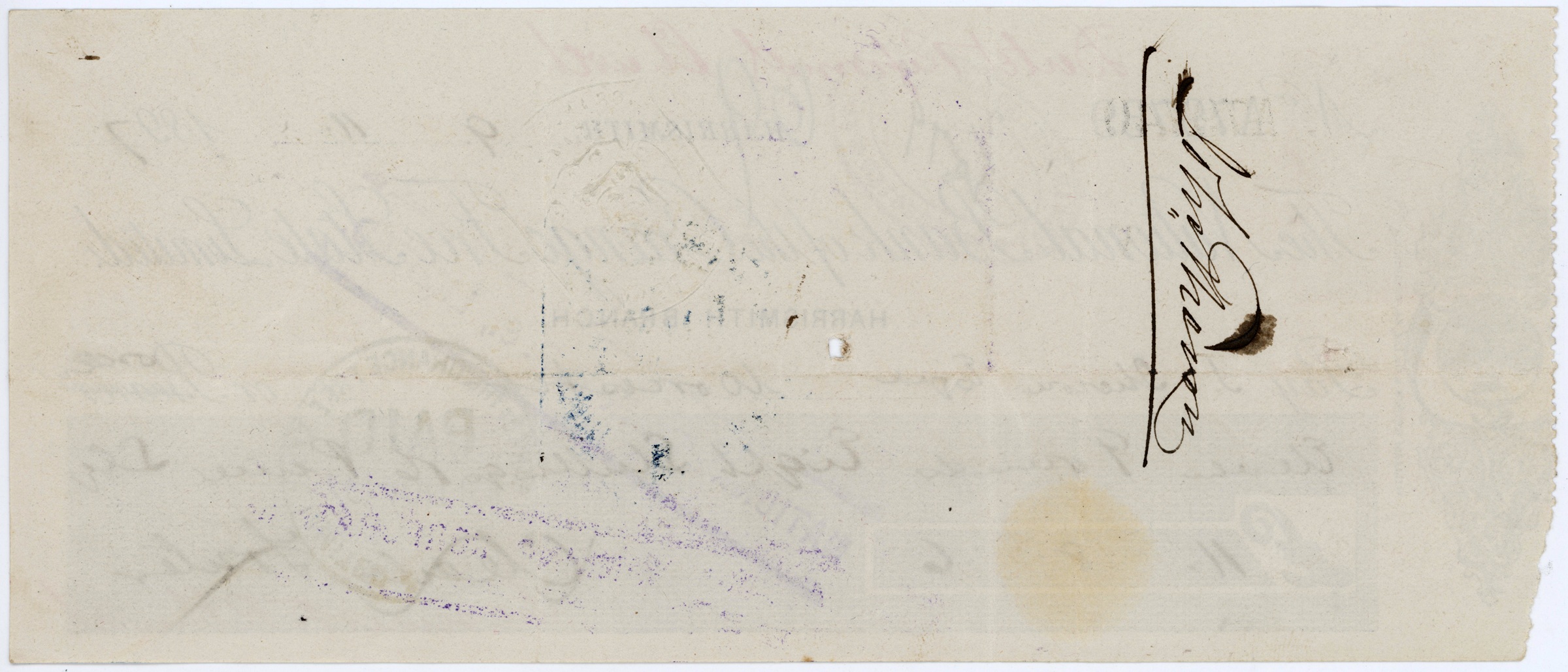
The check was stamped ‘Paid’ on Nov. 19. It seems Esquire Theron had the amount of the check paid into his account at the African Banking Corporation Ltd. in the town of Worcester in the Cape Colony.
A hole was punched in the check to also indicate it has been cashed.
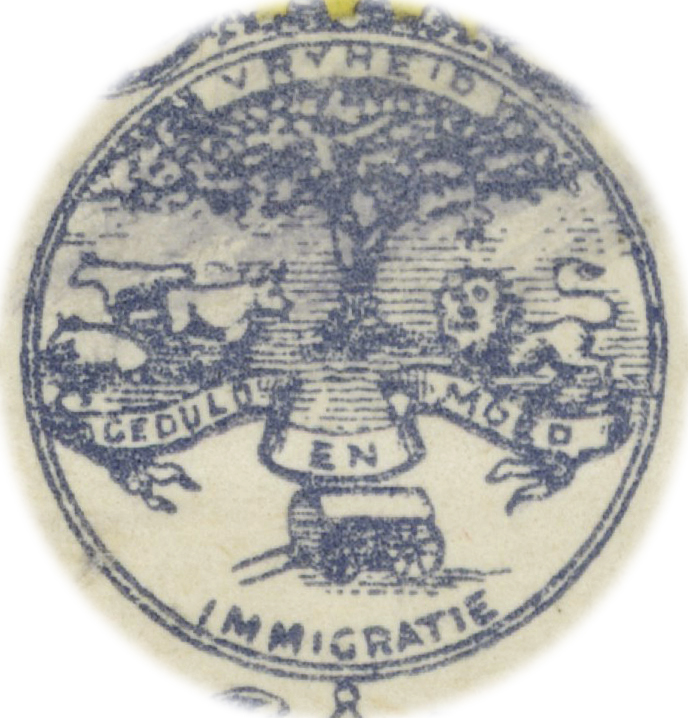
VRYHEID (freedom) at the top, and GEDULD EN MOED (patience and courage) on the ribbon.
IMMIGRATIE (immigration) at the bottom, presumably a call to Europeans, or settlers from other South African colonies to emigrate to the Orange Free State colony.
The livestock look like cattle (the OFS coat if arms image on Wikipedia shows sheep).
The lion on the right must mean ‘courage’, right?
The ox wagon signifies the trek that the pioneers made from the Cape Colony to escape British rule, to establish their own independent Orange Free State republic.