
My phone and watch buzzed a dozen times from my Japan-based NHK app tonight, with tsunami warnings (because of the 8.8 earthquake on the Kamchatka peninsula).
By now the first waves have reached Hokkaido in the north of Japan, though, and it seems the waves will be no more than a few feet high.
Why was this the case? I asked Chat GPT’s AI chatbot.
Great question — and a very reasonable one, given how large-magnitude earthquakes like the 8.8 off the Kamchatka Peninsula can sometimes generate devastating tsunamis. But not all big earthquakes produce massive waves. Here’s why this particular one likely produced only a small tsunami (a few feet):
1. It was very deep
2. It was likely within the subducting slab
3. The tsunami threat is highly dependent on the type of fault motion
4. Energy was spread over a wide area
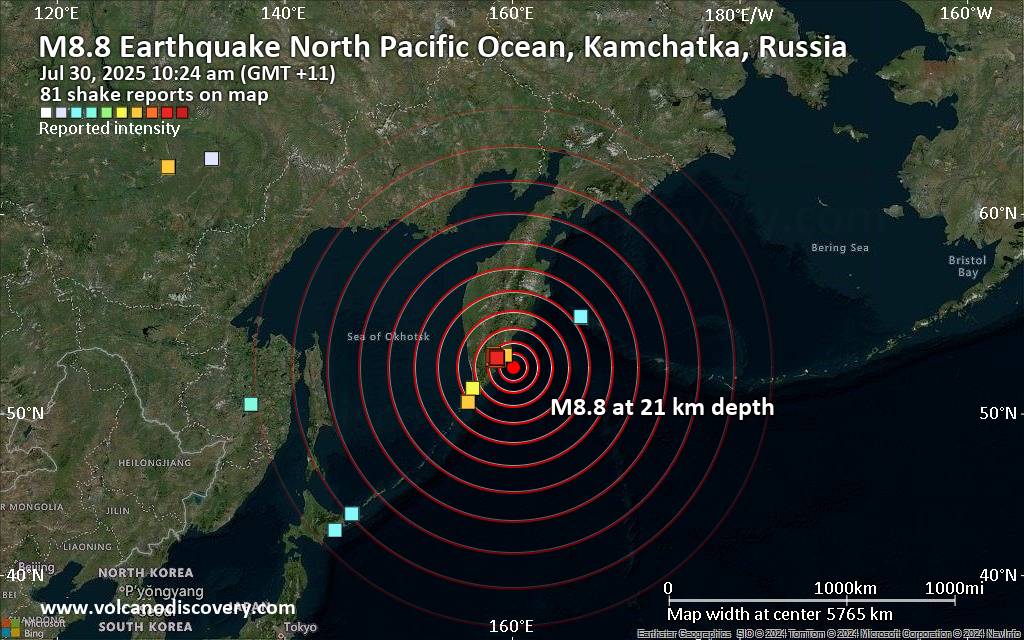
Depth: 21 km 13 mi
Time: GMT 2025-07-29 23:24:50.842
Epicenter: 2025 Kamchatka Peninsula, Russia Earthquake
Agency: USGS (United States Geological Survey)
For this extremely strong earthquake, 64 aftershocks (above mag. 2) have been detected so far. The strongest was a magnitude 7.2 quake that hit 53 seconds after the mainshock in 81 km (50 mi) distance, in 94 km southeast of Vilyuchinsk, Yelizovsky District, Kamchatka, Russia, on Wednesday, Jul 30, 2025 on 11:25 am (Kamchatka local time GMT +12). The most recent aftershock occurred 5 hours ago 217 km south of Petropavlovsk-Kamchatskiy, Kamchatka, Russia, and had a magnitude of 4.9.
The majority of reports came from Petropavlovsk-Kamchatskiy (58 reports), a city with more than 180,000 inhabitants in Kamchatka in 119 km (74 mi) distance northwest of the epicenter, Russia, Yelizovo (10 reports), a town with 41,000 inhabitants in 140 km (87 mi) distance northwest of the epicenter, and Yakutsk (4 reports) (2,085 km or 1,295 mi to the northwest) in Sakha.
[Source: volcanodiscovery.com]