Friday morning/ homeward bound

It’s time to go home!
It’s Friday morning and I am taking the train back to Schiphol airport to catch the flight to Reykjavik, and then on to Seattle.
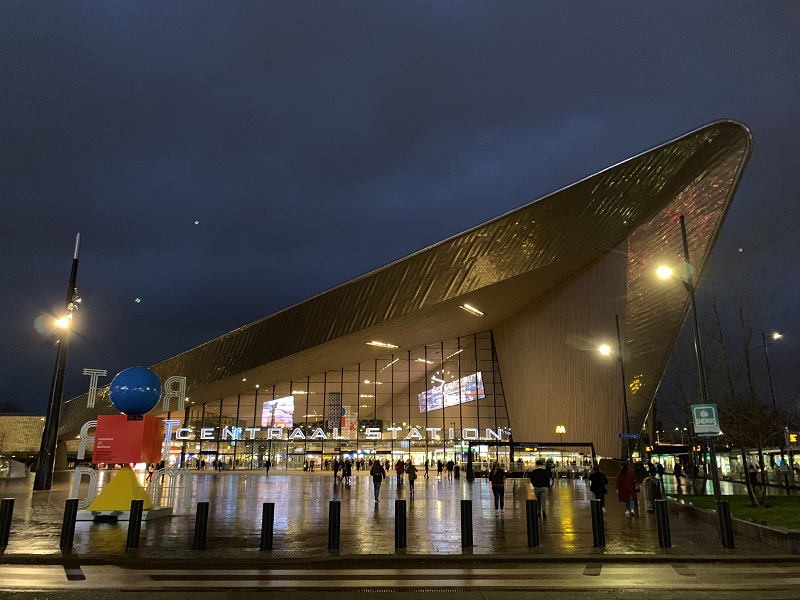
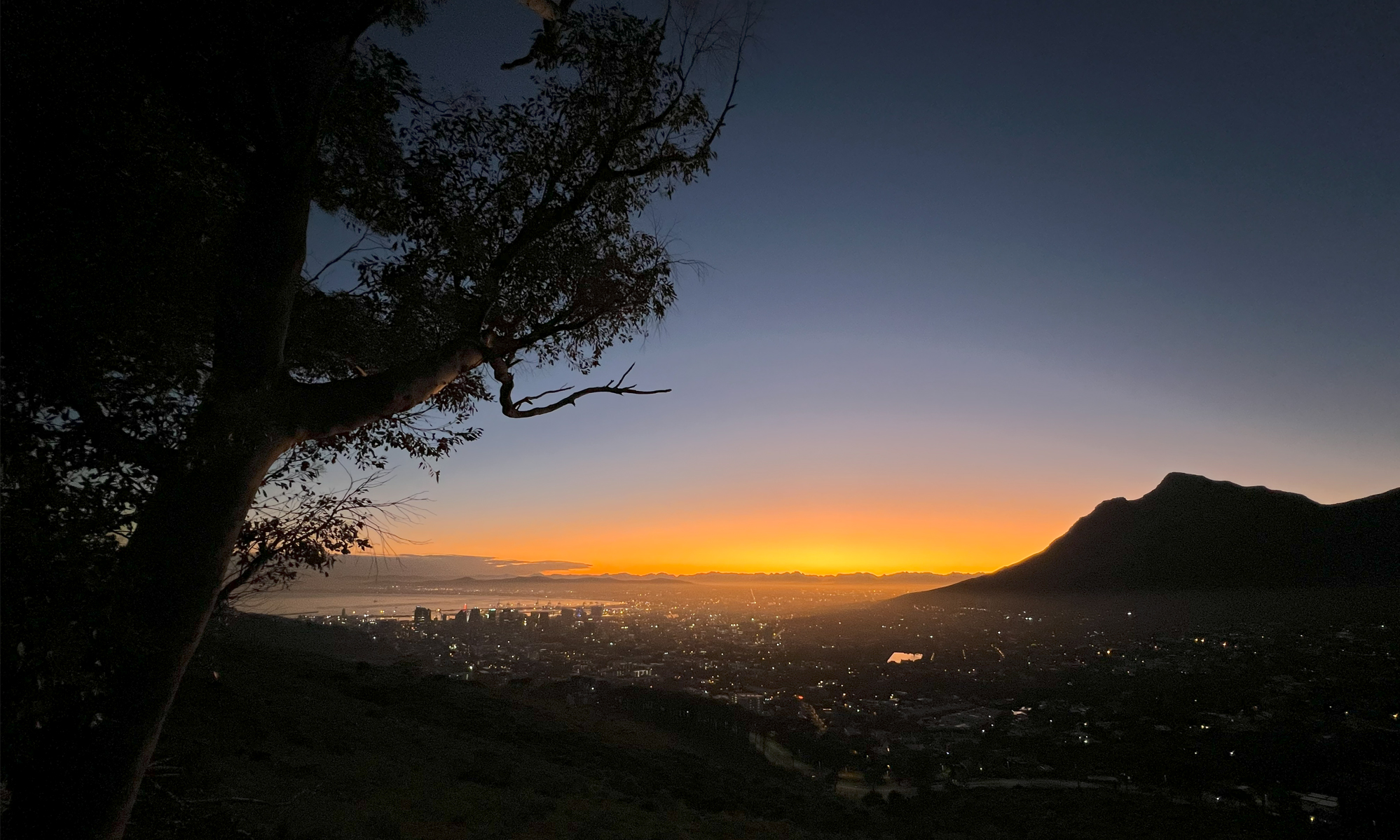
Rotterdam’s Centraal Station on Thursday night. There was a blustery wind and a little rain.

Thursday/ Delft & Den Haag (The Hague)

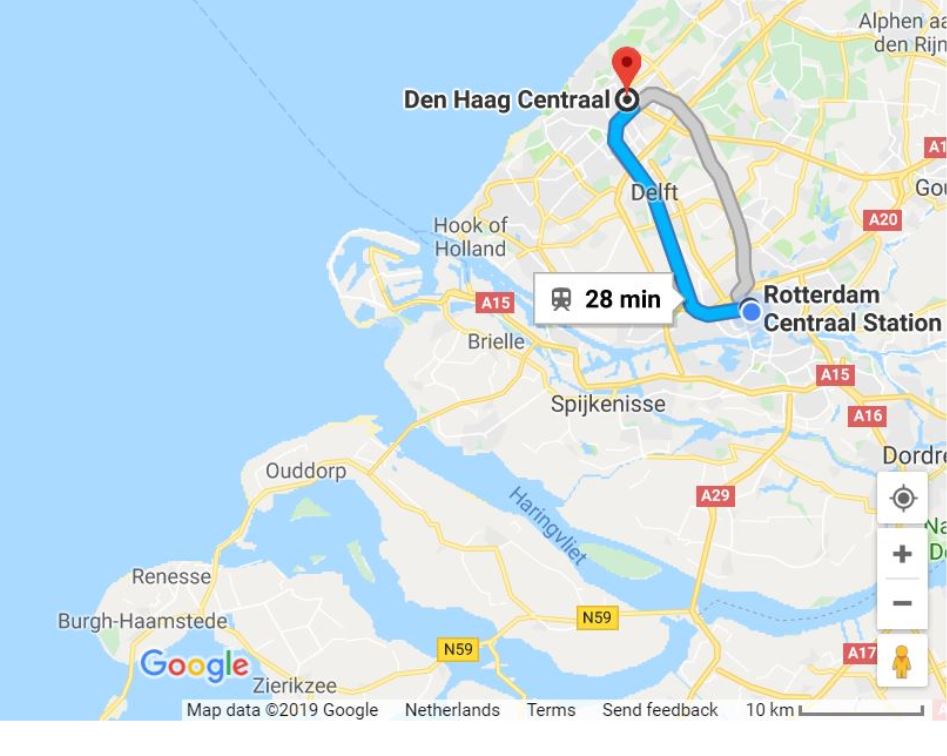
I took the short train ride out to Delft and The Hague today. The sun and the balmy weather of Wednesday were gone, and it was foggy and cold until early afternoon.
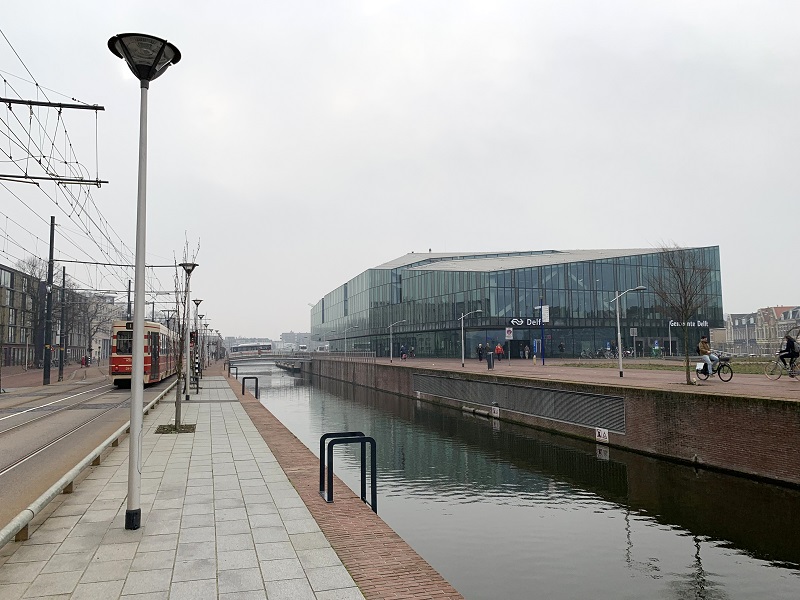
Here is Delft train station building as I look back at it, with its 2015 remodeling. I am walking towards the Markt, the main square in Delft. (Note: That’s a streetcar on the left of the picture, not a train).
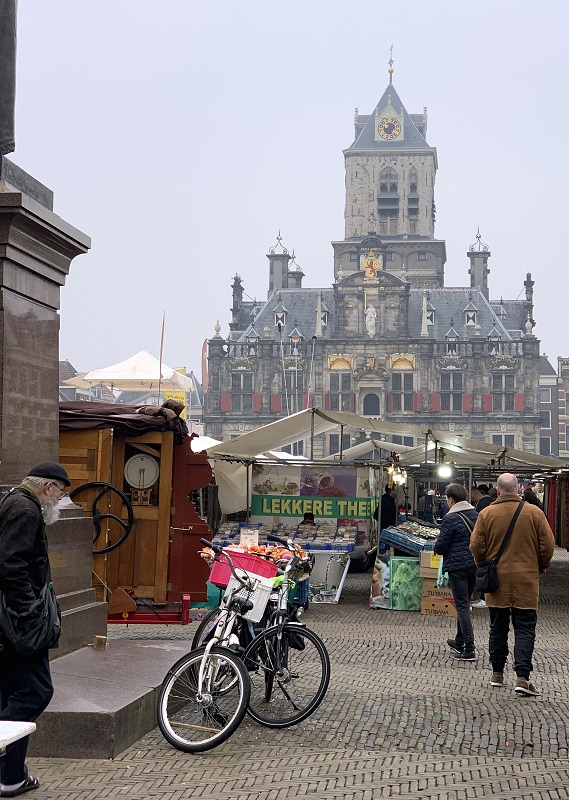
It was foggy and barely 10 am by the time I got to the Markt square, and the stall owners that sold food and souvenirs were still getting everything ready. ‘Lekkere Thee’ (tasty tea), says the banner in the middle. That’s the Delft Town Hall in the distance.
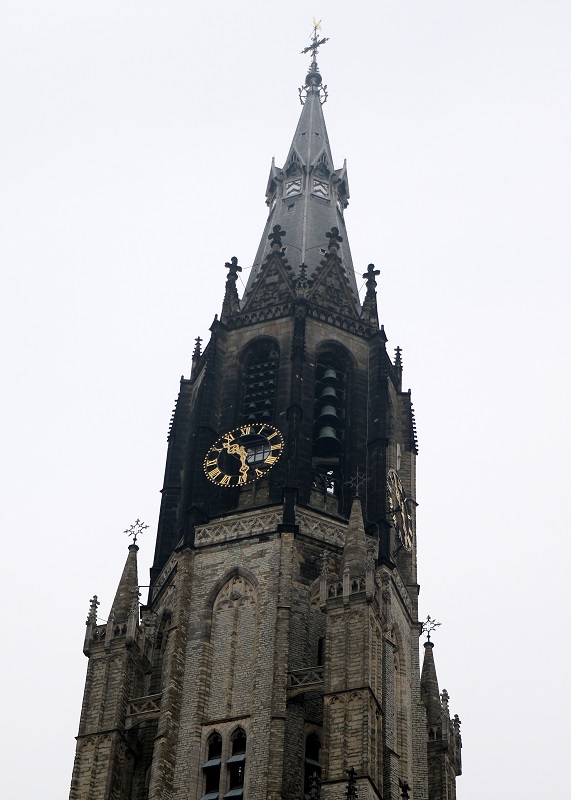
The Nieuwe Kerk (New Church) towers over the Markt town square at 108 m (356 ft). It is not new, of course! Its construction in the Gothic style was completed in 1496.
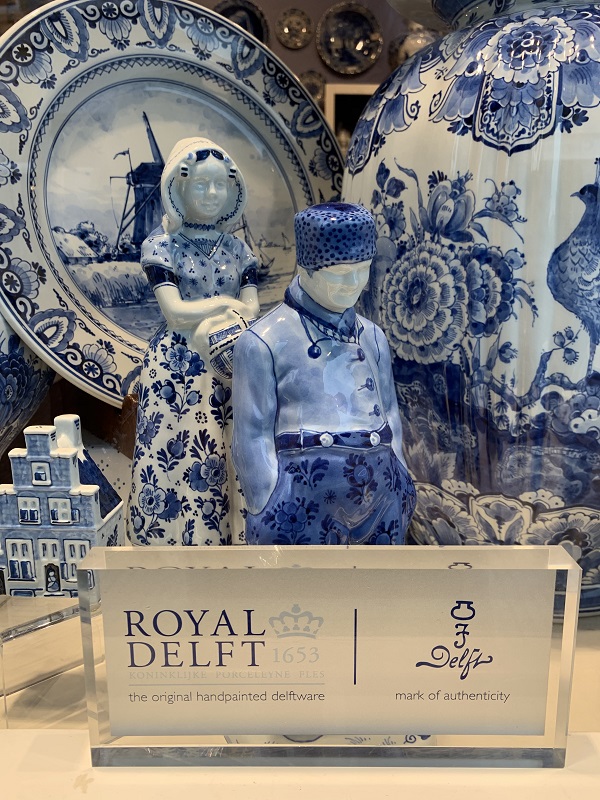
I took a look at the famous blue Royal Delft porcelain ware, but did not buy anything new. (I already have some). These hand painted pieces are much more expensive than the mass-produced ones.
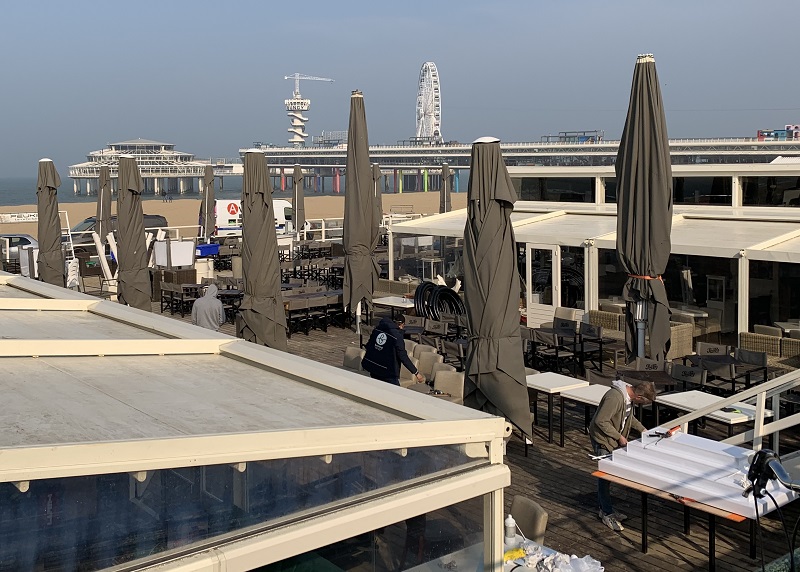
Now on to The Hague. I was determined to get a glimpse of the North Sea, and found it at the beach and promenade at Scheveningen. There is also a pier with a Ferris wheel, and all the businesses are getting ready for the summer season’s visitors.
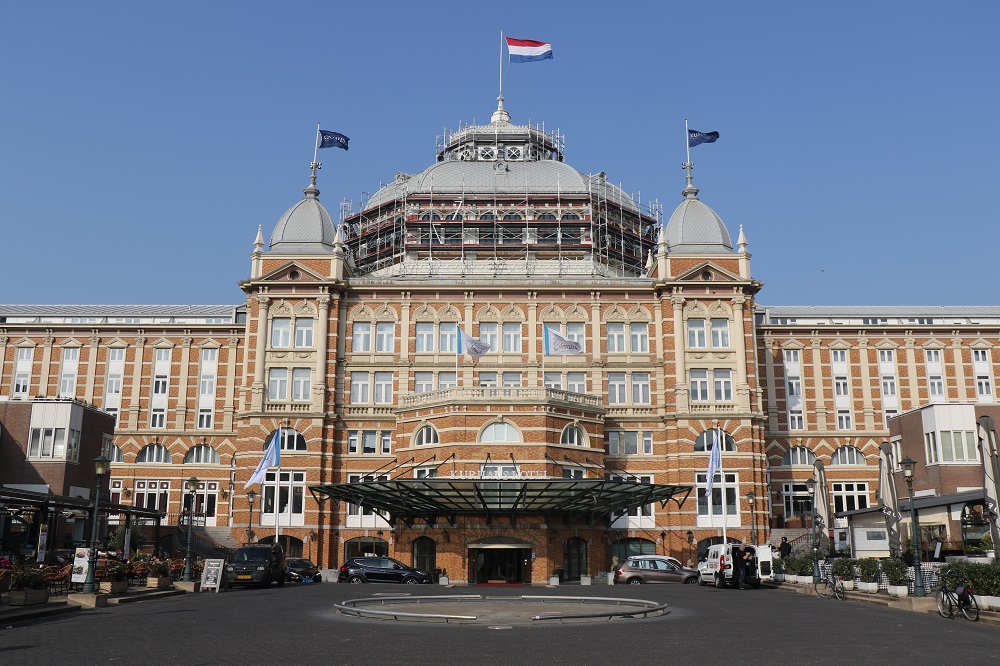
Nearby is the Kurhaus Hotel, with the flag of the Netherlands on its main dome, itself undergoing renovations for the summer.
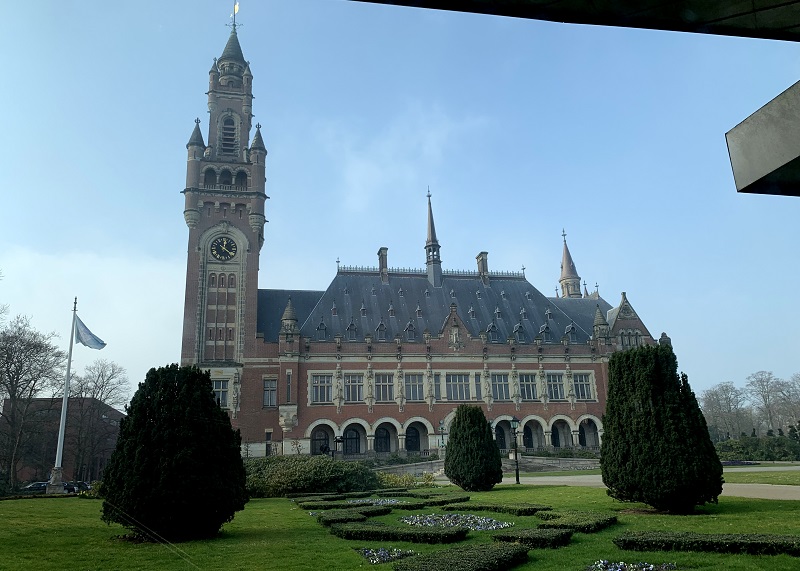
The Vredespaleis (Peace Palace) was marked on my map, and I went out to check it out. Only the little museum was open though, and this is the closest I could get. The building (opened 1913) houses the International Court of Justice, the Permanent Court of Arbitration, The Hague Academy of International Law and the Peace Palace Library.
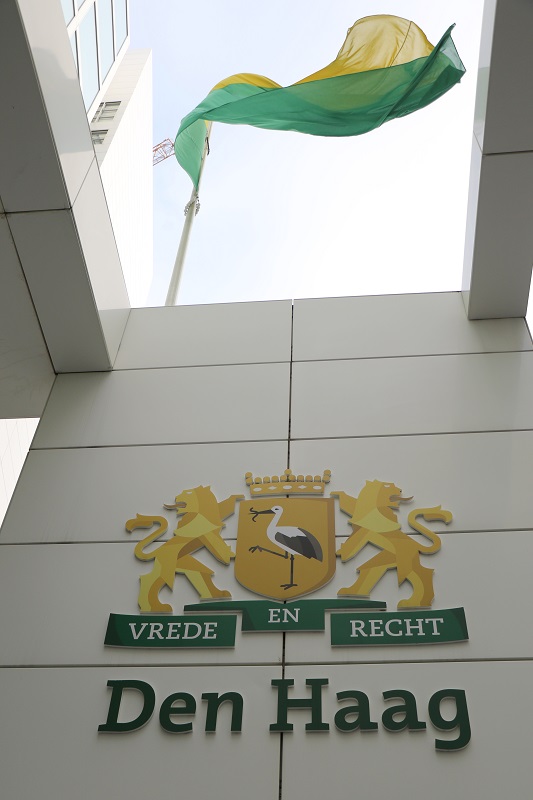
Here’s the entrance to the modern city hall of The Hague. The stork on the city’s coat of arms has a black eel in its beak. The words ‘Vrede en Recht’ (Peace and Justice) was added in 2012 – a nod to the city’s global recognition as the home of international justice and accountability.
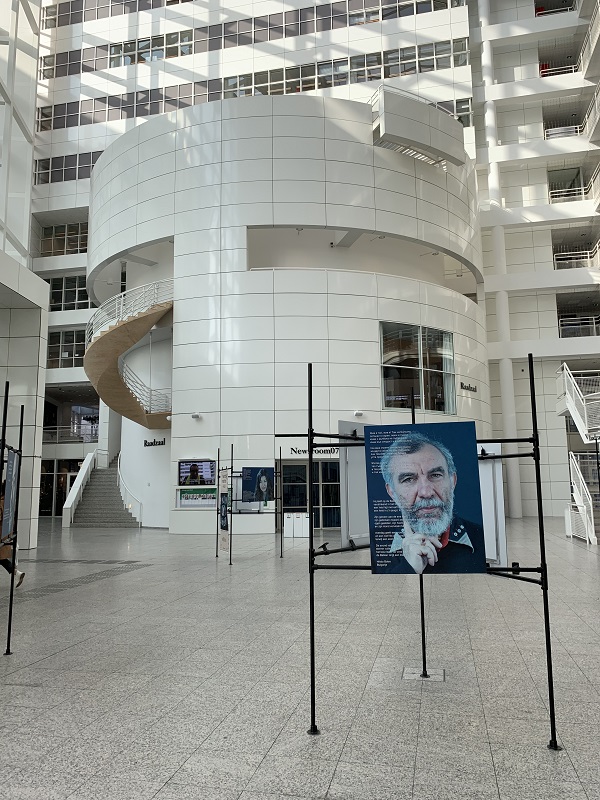
In the foyer of The Hague City Hall building, there are pictures of several human rights activists.
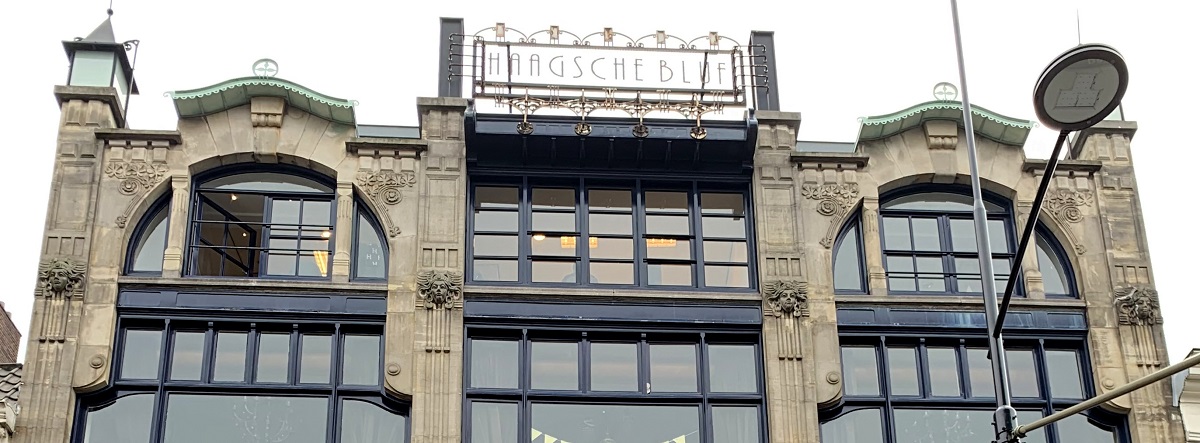
The facade of the Grandcafé Haagsche Bluf in the city center. I love the art deco styling of the building.
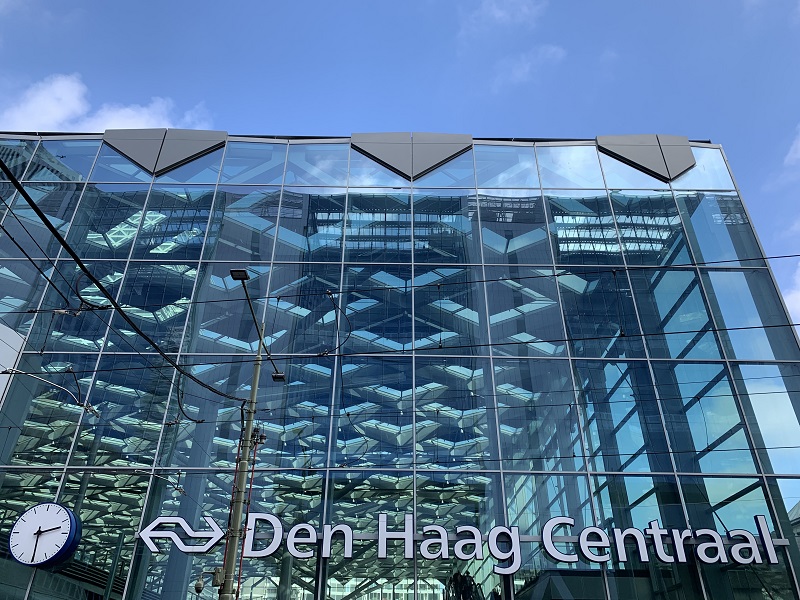
Here’s the main entrance to Den Haag Centraal station, its 2015 renovation showing nice blue glass panels and a diamond pattern in the roof.

Wednesday/ exploring Rotterdam

It was a gorgeous day here in Rotterdam, with the day temperature reaching 17°C/ 62°F. Here is a selection of sights from today.
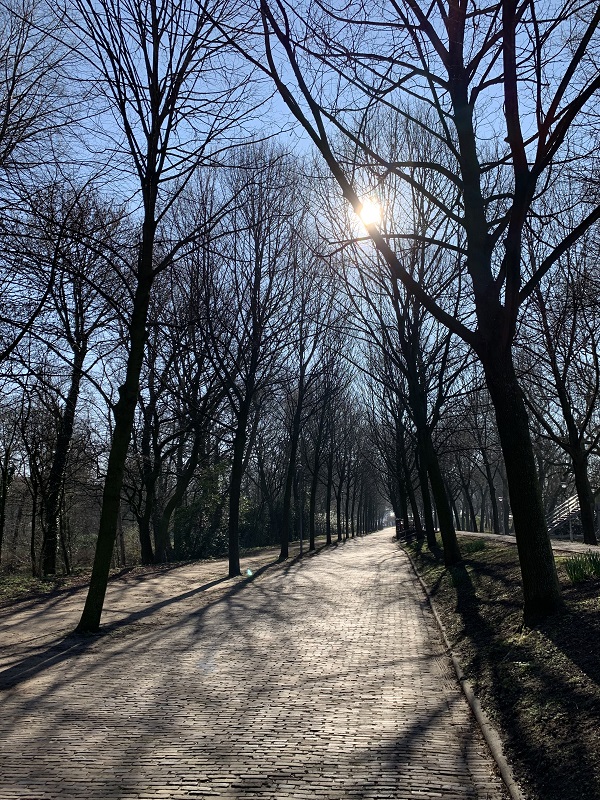
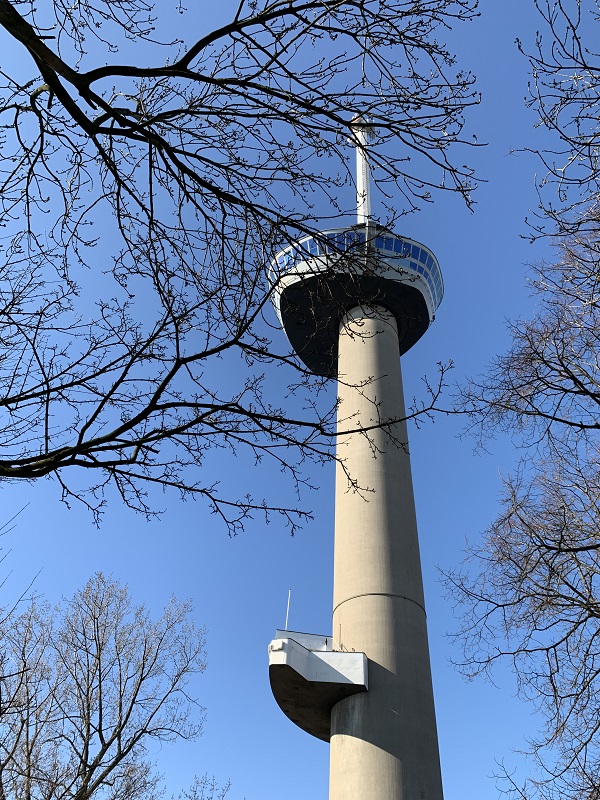
This bike path & foot path is next to Het Park (‘The Park’), on the way to the Euromast.
Euromast is an observation tower (185 m/ 606 ft), built for the 1960 Floriade (an international exhibition). The tower is a concrete structure. It was built on a concrete block weighing some 2,000 metric tons, so that the center of gravity is below ground.
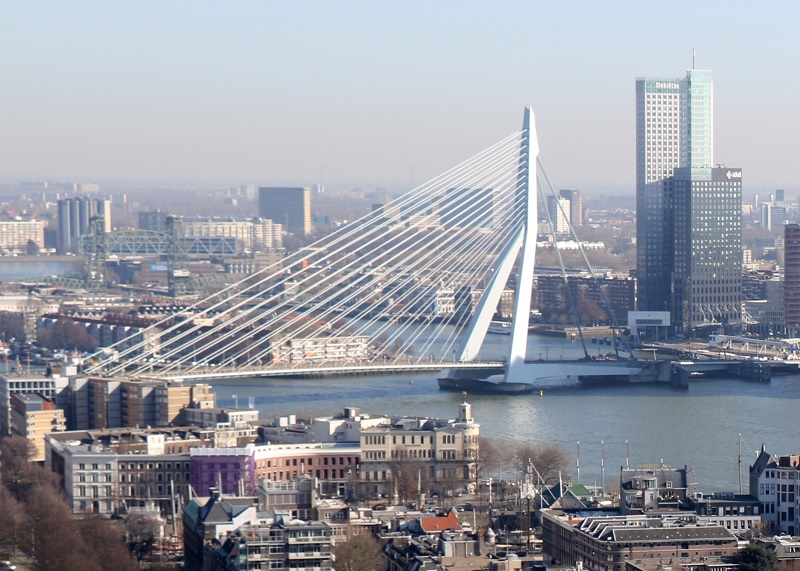
Here’s a view of the Erasmus Bridge (139 m/456 ft high, 802 m/ 0.5 mi long), from the panorama platform at 85 m (278 ft), drawn a little closer with my camera’s zoom lens. The bridge is a combined cable-stayed and bascule bridge over the Niewe Maas river. The bridge was named after Desiderius Erasmus, a prominent Christian Renaissance humanist. It opened in 1996.
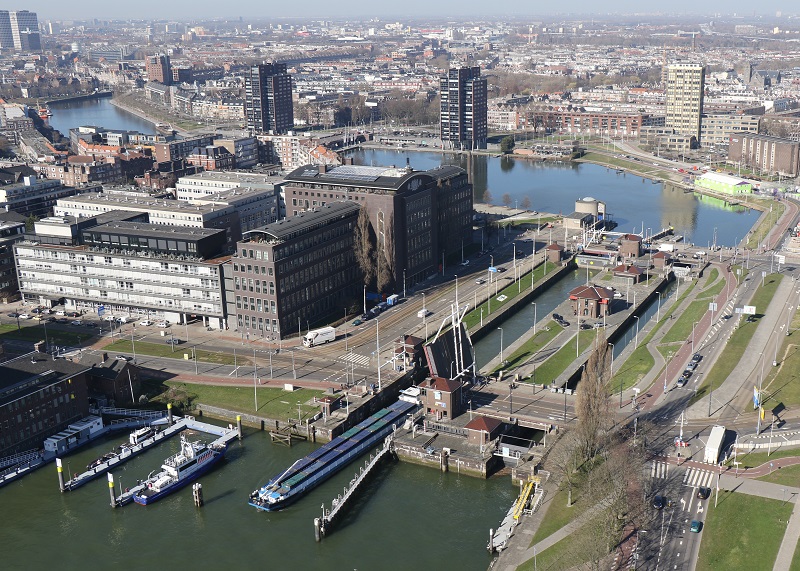
Another view from the panorama platform. Look for the flat barge with the blue containers. It first entered the lock at the top (middle right of the picture), then water was pumped in to raise the barge by some 6 ft, and right now it is making its way under the second drawn bridge, into the canal.
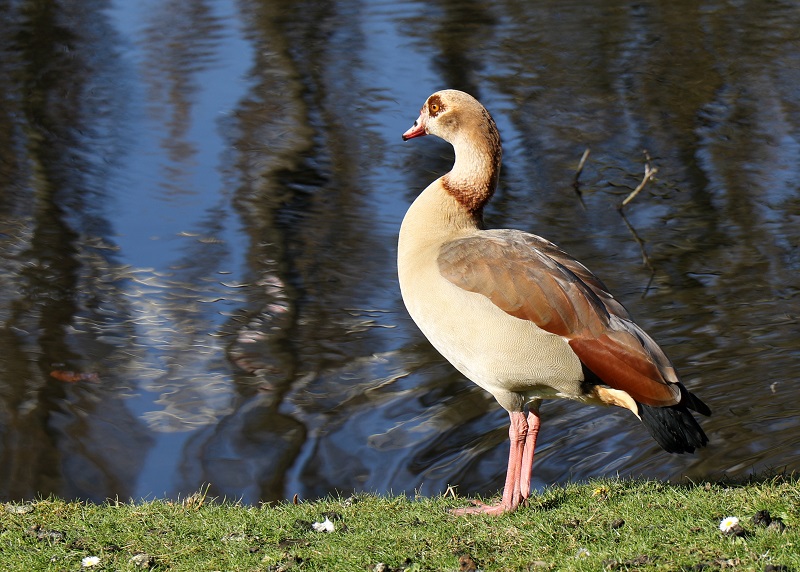
This Egyptian goose (‘Kolgans’) is native to Southern Africa, but I guess one finds them in many other places in the world, as well. This is at a little lake in Het Park (‘The Park).
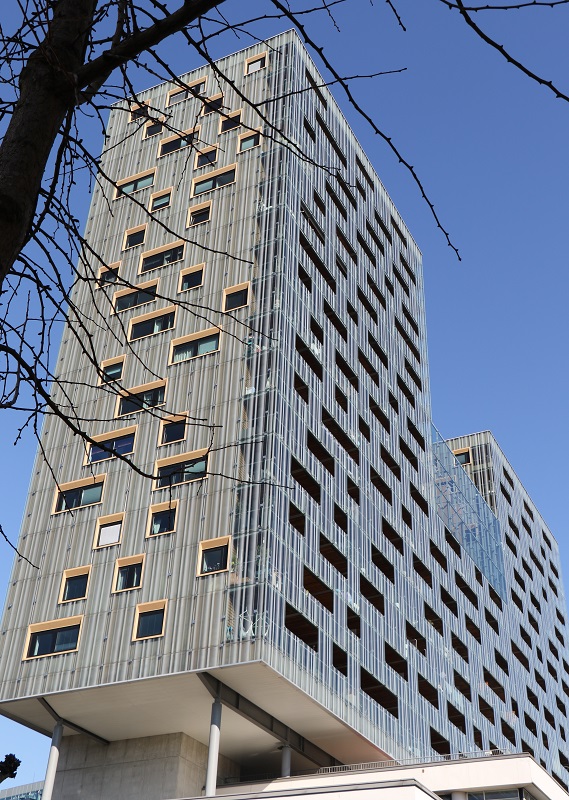
This eye-catching apartment building is close to Eendrachtsplein. I still have to look up its name and construction date.
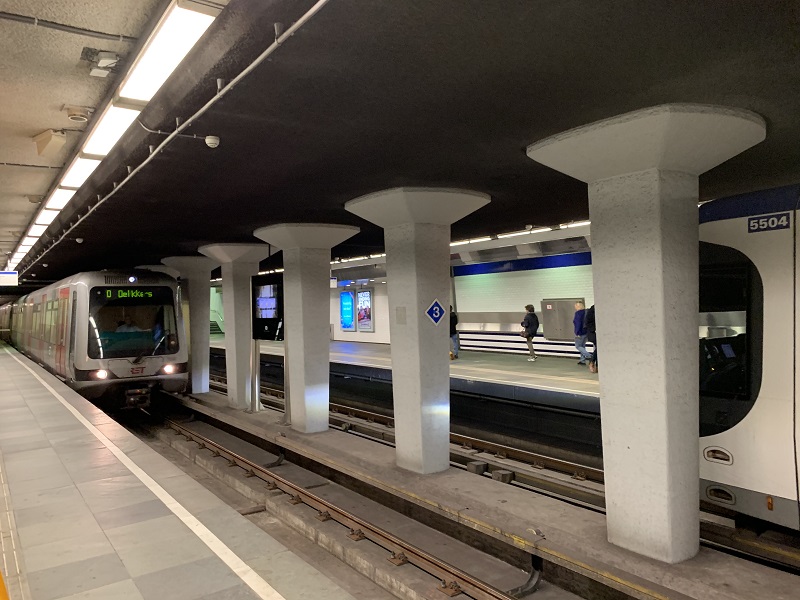
This is the Metro train at Beurs station, a suburban train that runs to the outer suburbs of Rotterdam. It took me to Leuvehaven by the waters of the Niewe Maas river.
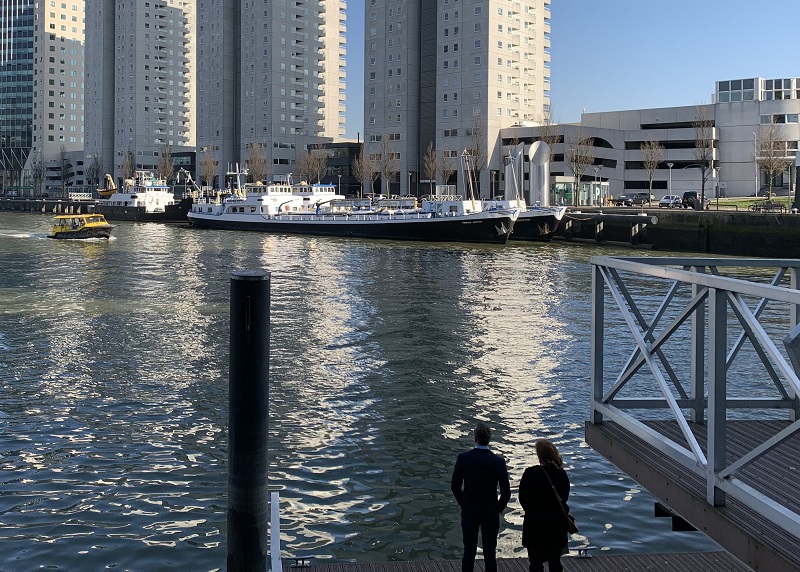
Here’s the Rotterdam Water Taxi, coming to pick up a couple at a stop on a canal close to Leuvenhaven station. The Niewe Maas river is on the other side of the buildings.
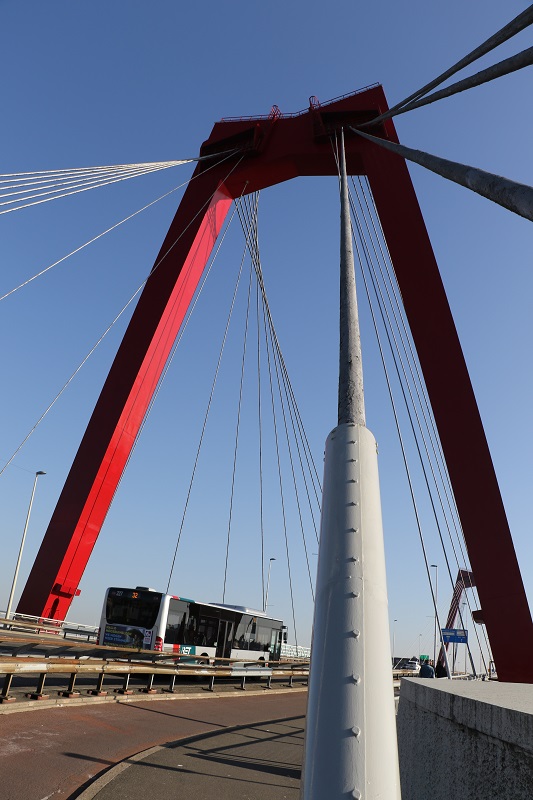
I started at the Erasmus Bridge (seen earlier from the Euromast), and then walked to the red Willemsbrug (Willem’s Bridge, named after named after King Willem III of the Netherlands, and of course, after ME too). Opened: 1981 | Height: 65 m 213 ft | Length: 318 m / 0.2 mi.
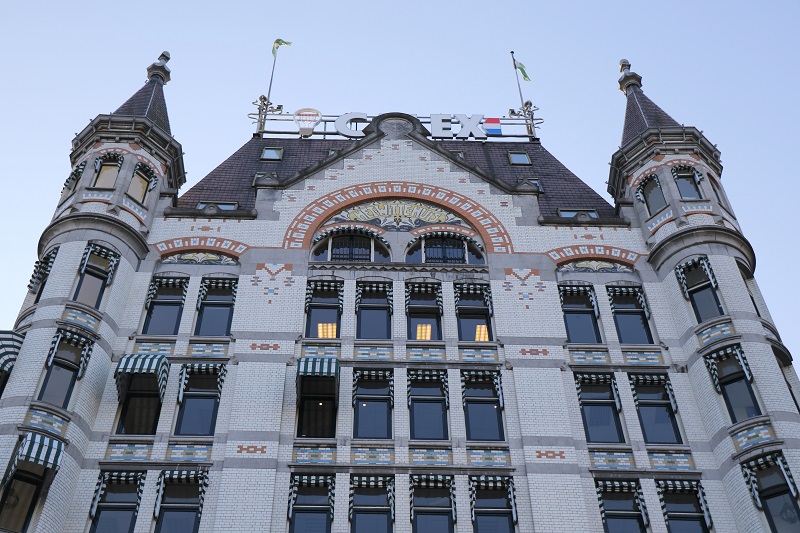
The gorgeous Witte Huis (‘White House’) is near Willemsbrug. It was built in 1898 in the art nouveau style, and was for long the tallest office building in Europe (the first ‘hoogbouw’ = tall build, at the time, with 10 floors).
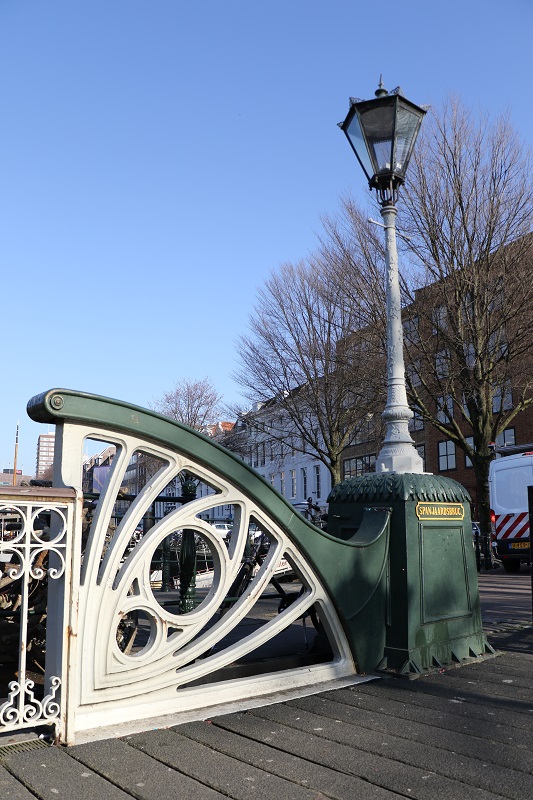
This is the little Spanjaardsbrug (‘Spanish Bridge’) in the Oude Haven (‘Old Harbor’). The bridge was built in 1886, and I just love the art elements of the Victorian age, that went into it.
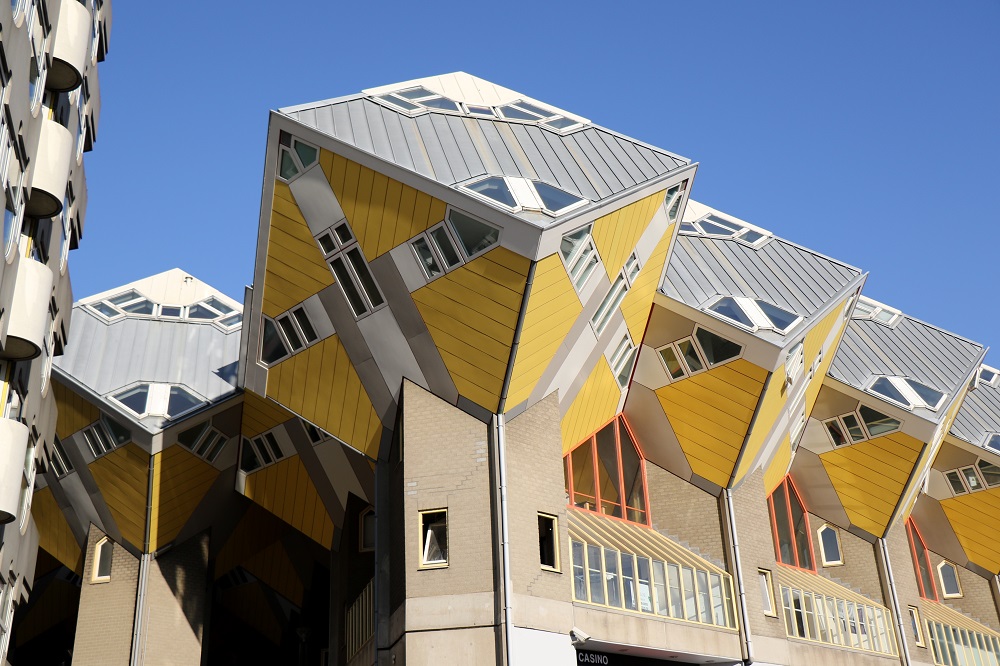
The crazy Cube houses at the Oude Haven is a set of innovative houses designed by architect Piet Blom. Yes, there are actually people living in them, and the design’s main purpose is said to optimize the space inside (hmm, OK). I was surprised to find out they had been built in 1977, already.
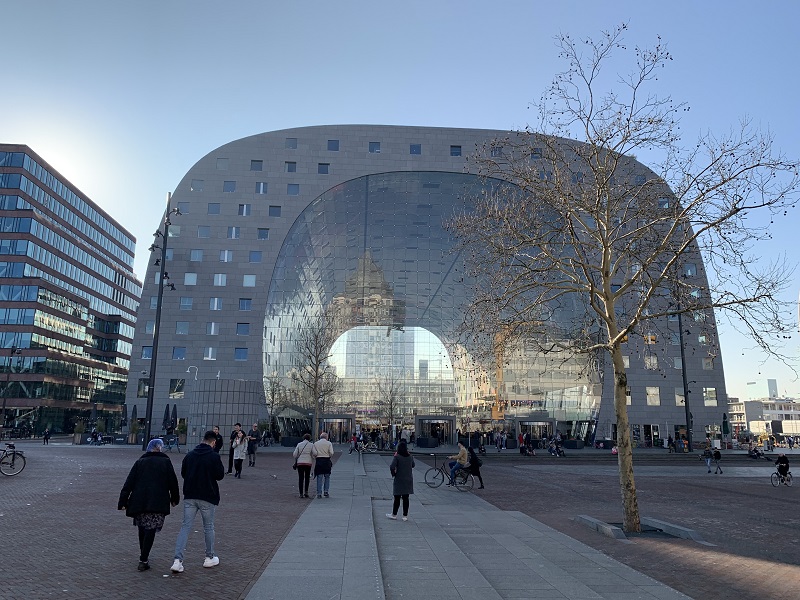
The Markthal (Market Hall) nearby, is a new residential and office building (2014) with a market hall underneath.
Beautiful and enormous mural artwork inside the Markthal. This depiction of a caterpillar might just be the largest in the world.
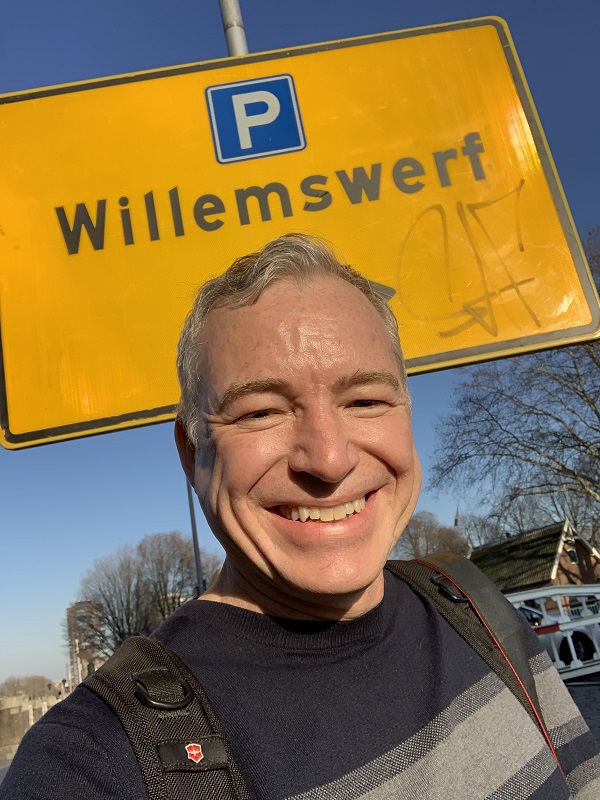
.. and finally, Willem says: Come to Willemswerf (Willem’s Yard) to park your car in Rotterdam!

Tuesday/ arrival in Rotterdam

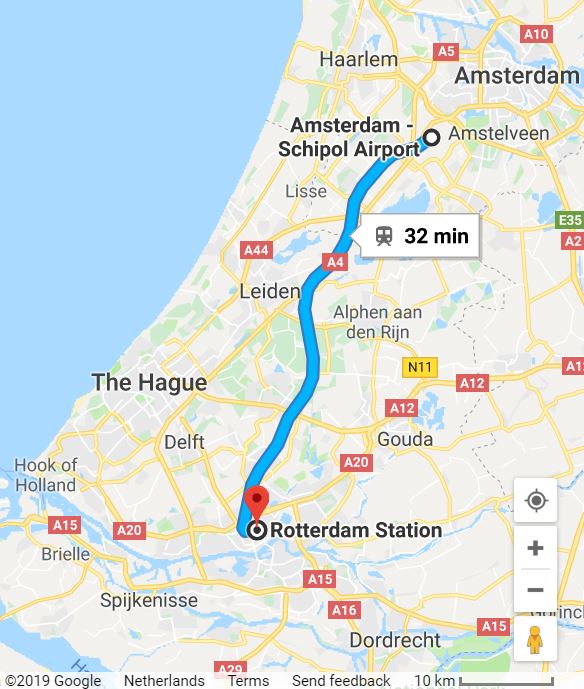
It’s a 32 min ride on the Intercity Direct from Schiphol airport down to Rotterdam Centraal station. The Sprinter is a little bit cheaper but takes quite a bit longer since it stops at 5 or 6 stations on the way.

I arrived at Amsterdam’s Schiphol Airport at about 11.15 am this morning.
I had to spend a little time at Schiphol to figure out how to use my OV-chipkaart* for the train ride down to Rotterdam, but that’s OK. Now I know how to use it in Rotterdam, as well.

*Cannot load money onto it at the ticketing machine with an American credit card! (USA cards do not have PIN numbers). No need to buy a fare ahead of time, but if you travel 1st class, you tap the card once at the station/ platform entrance as usual, and then a second time on the platform next to the train, for the 1st class surcharge.
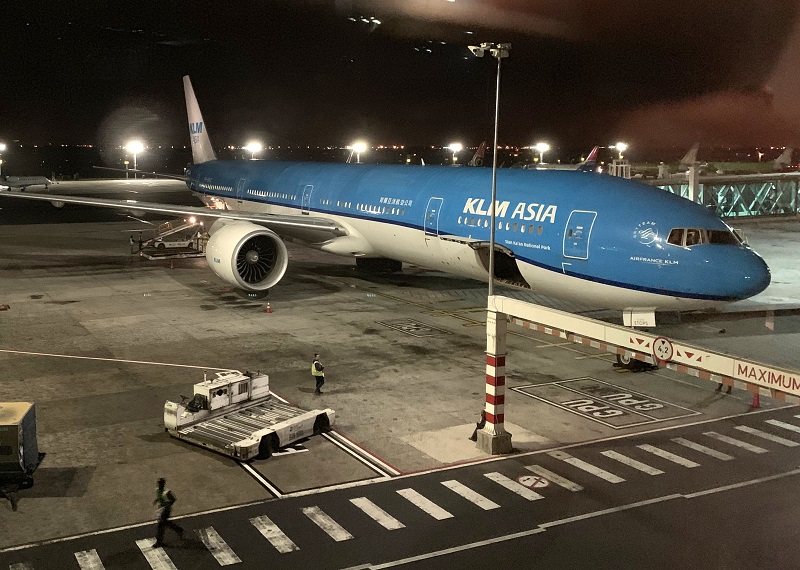
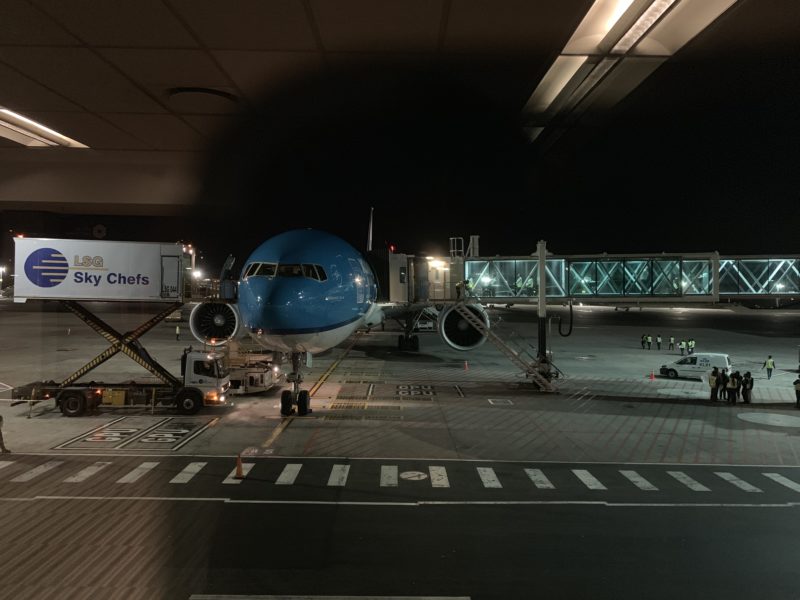
Here is KLM Airlines’ Boeing 777 at the gate at Cape Town International airport. It took 11 hrs 20 mins to reach Schiphol in Amsterdam. It feels SO GOOD to walk off the plane and stretch one’s legs after all that time.
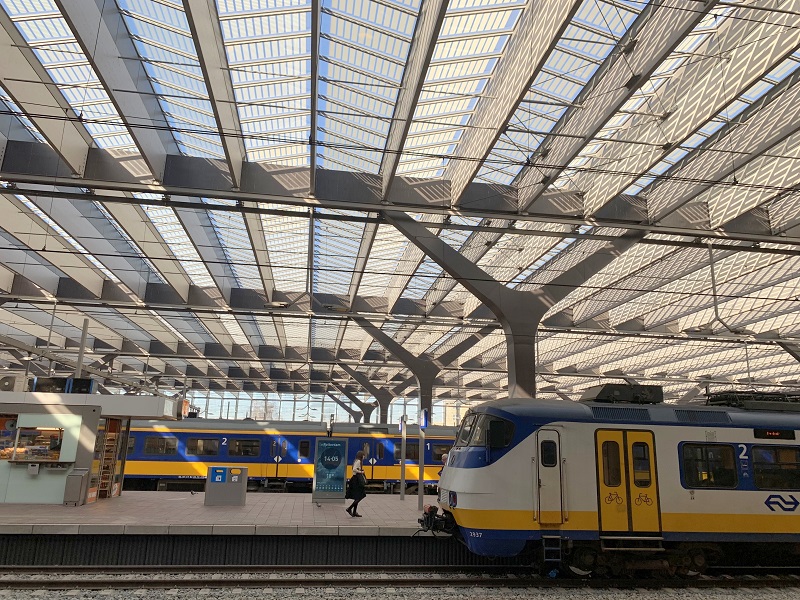
Here are the train tracks at Rotterdam Centraal Station, after I had arrived on the Intercity Direct from Schiphol (32 mins).
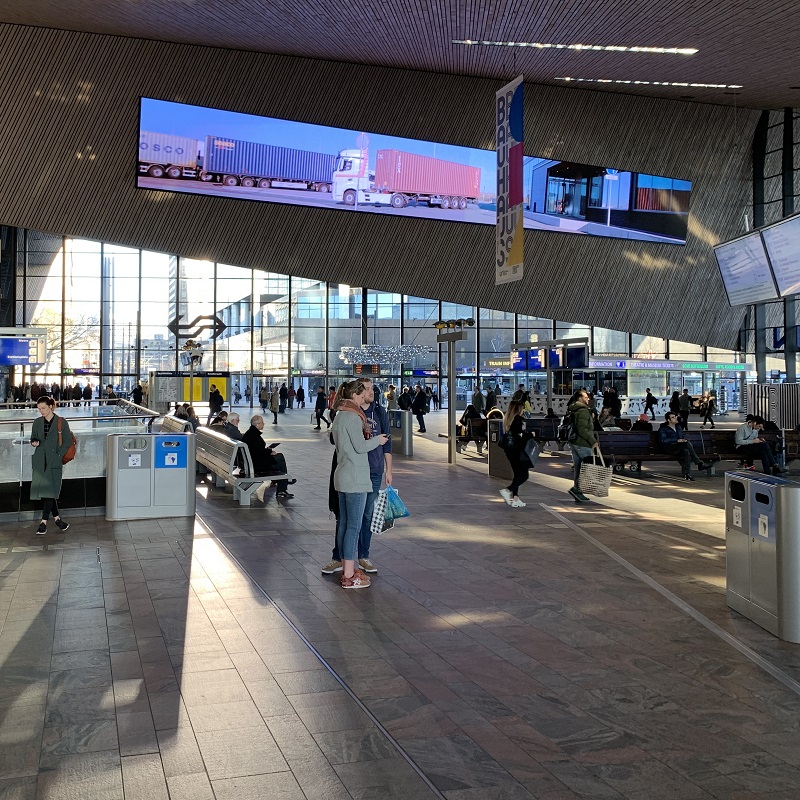
Inside Rotterdam Centraal Station. That’s a giant oblong strip of LCD TV screen at the top.
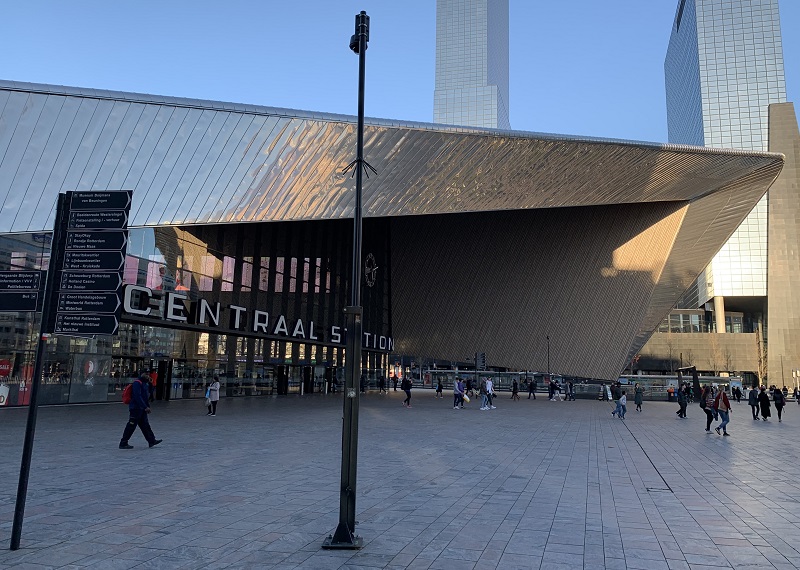
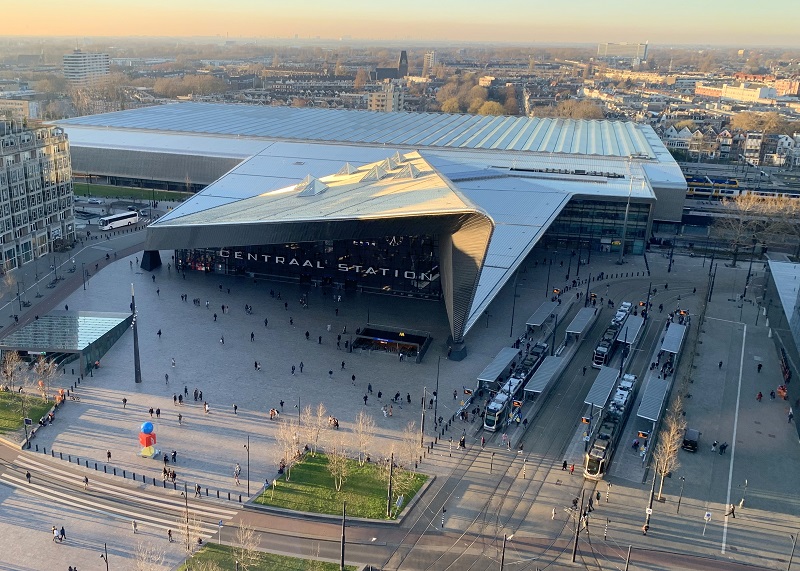
The main entrance to Rotterdam Centraal Station with its sweeping, metal-clad entrance.  This station building was designed by a team of Dutch architects and officially opened in March 2014.
Here’s a view from the 12th floor of the Marriott Hotel across from the train station, where I stay. Look to the right of the picture for the street cars that stop at Rotterdam Centraal. Watch out for them! they do not stop at smaller intersections. Another hazard when crossing intersections are the bike lanes with cyclists and moped riders.

Monday/ at Cape Town airport

My stay in Cape Town has come to an end. I went to see my mom one last time, and cleared out of the nice AirBnB apartment that I had rented.

I am taking the red-eye flight up to Amsterdam’s Schiphol airport, and will go and stay in Rotterdam for a few days, before I fly home to Seattle out of Amsterdam.
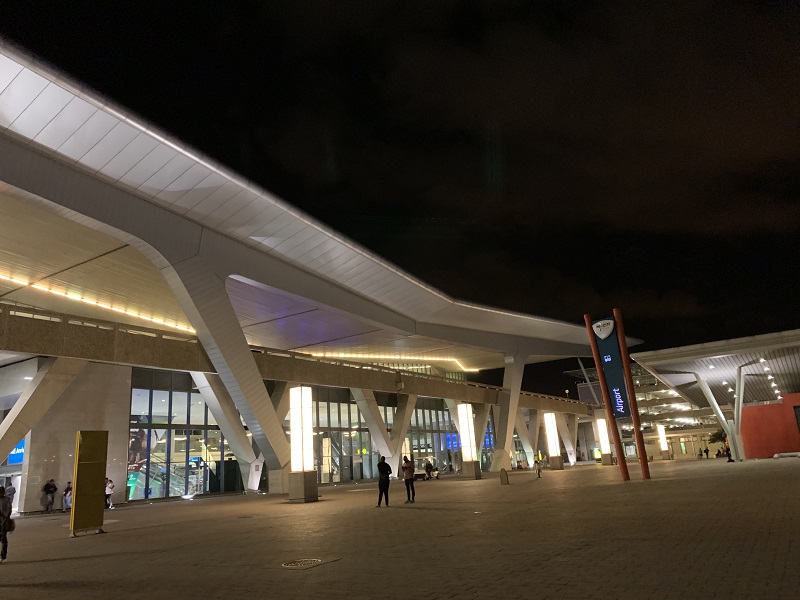
Here’s the entrance to the check-in and departure lounges at Cape Town International Airport. The rental car drop-off is close enough so that one can walk to the departure lounge – very nice.
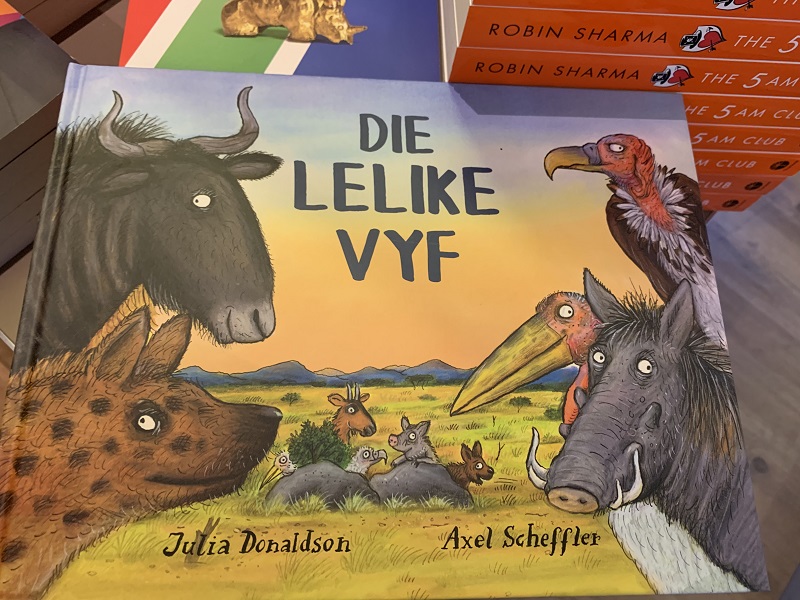
Children’s book with cute animal faces at the book store: ‘The Ugly Five’ (as opposed to the Big Five: lion, leopard, rhinoceros, elephant, and Cape buffalo). The ‘ugly ones’ on the book’s cover are the wildebeest, the hyena, the vulture, the Marabou stork, and the warthog.

Sunday/ Table Mountain, blue

We drove up along the Atlantic coastline to the suburb of Table View today.
Table View is short for ‘Table Mountain View’.
The beach called Bloubergstrand (‘Blue Mountain Beach’) is close by.
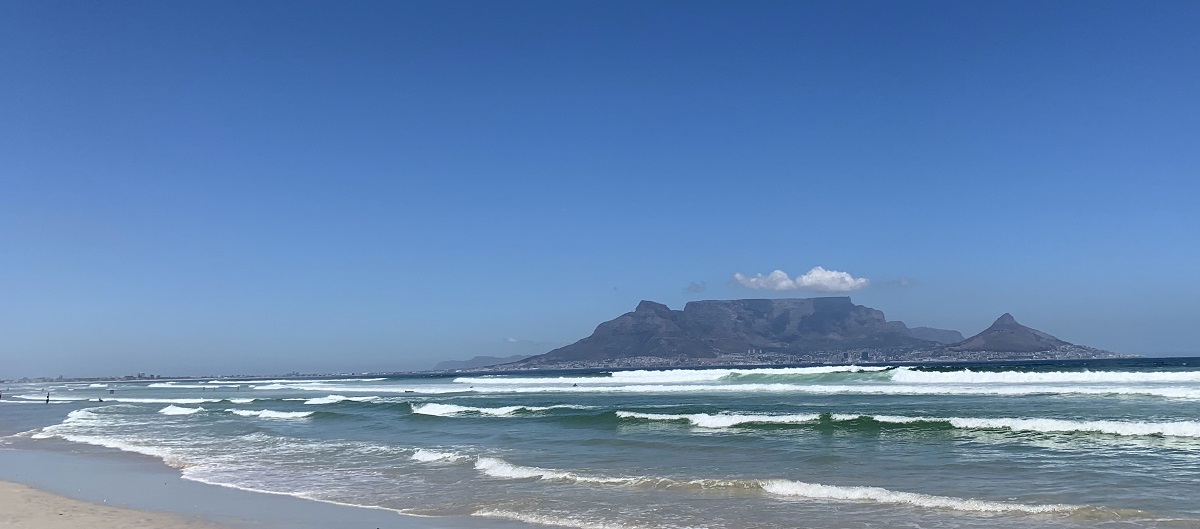
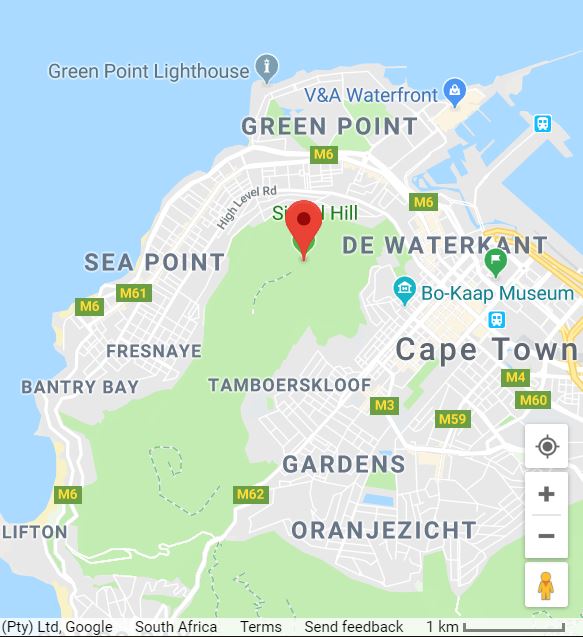
Table Mountain is blue (kind of) when viewed from Bloubergstrand. Today there was just a puff of cloud on the mountain. 

Saturday/ the noon gun on Signal Hill

Table Mountain is at the bottom of this map, with Lion’s Head at the left and Signal Hill (elevation 350 m/ 1,150 ft) towards its northwest.

My friend Marlien and I went to see the firing of the noon gun on Signal Hill today. There’s a single-lane strip of tarred road that winds up to the top of the hill.
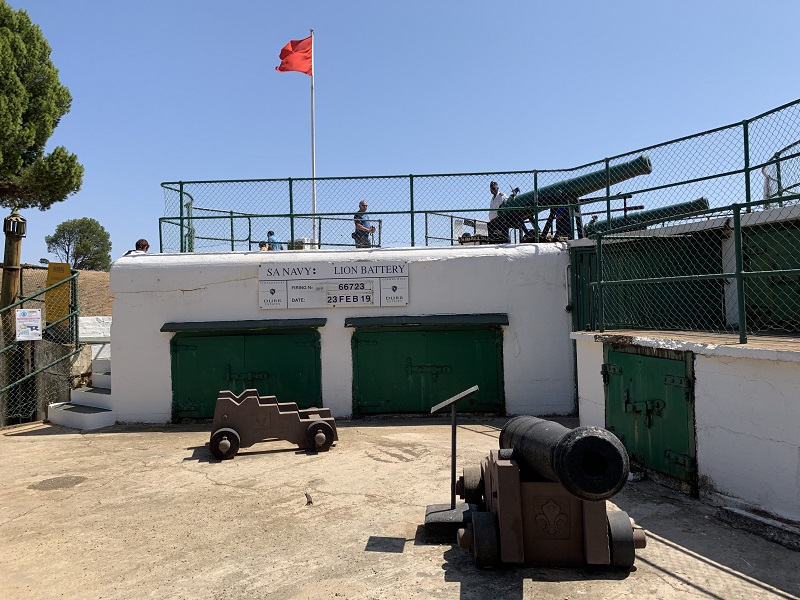
Here’s the Lion Battery with the two noon guns at the top. A time signal at noon has been fired by one of these guns since 1806. (Two guns so that one can serve as a backup). The two guns used are the oldest guns in daily use in the world.
Protect your ears! We all wore ear plugs. The cannon blast at close range reaches a sound level of 170 dB, the loudest bang many people would experience, ever. The bang is produced by a 1.5 kg/ 3.3 lb bag of gun powder.
The fuse is triggered remotely these days. Most of the on-lookers stood at the back of the cannon a good 50 ft away. The gunner that oversees the firing of the canon, announces ‘One minute’, ‘Thirty seconds’ ’10-9-8 .. 3-2-1′ . A few milliseconds before noon, an electrical signal is sent from the Astronomical Observatory’s atomic clock. The burst of energy zips across a telephone line, and ignites the firing cap on the cannon. At 12 noon sharp the gunpowder explodes with a loud Ka-Boom!

Every day – except Sundays and national holidays – the gun on Signal Hill is fired exactly at noon.

Friday/ Stellenbosch buildings

Here are some of my favorite buildings in Stellenbosch, from my visit there yesterday.
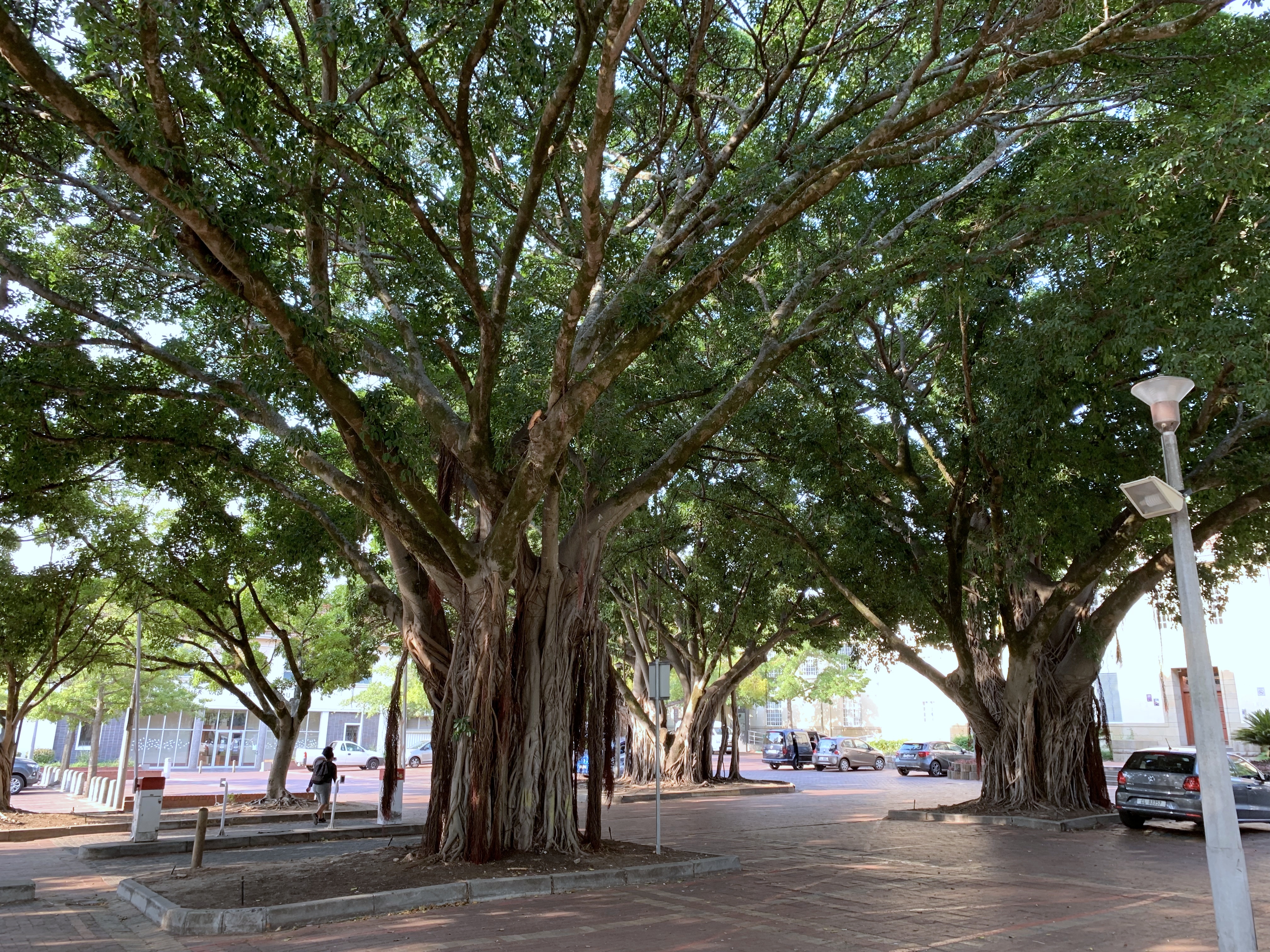
These giant ficus trees are behind the main administration buildings of the University of Stellenbosch.
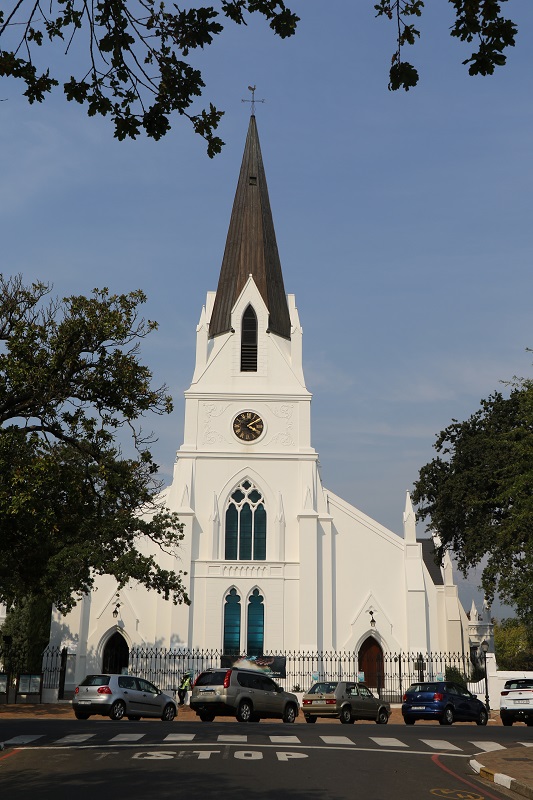
The Moederkerk (Mother Church) on Drostdy St has a neo-gothic tower designed by Carl Otto Hager from Dresden, Germany. The building was completed in 1863.
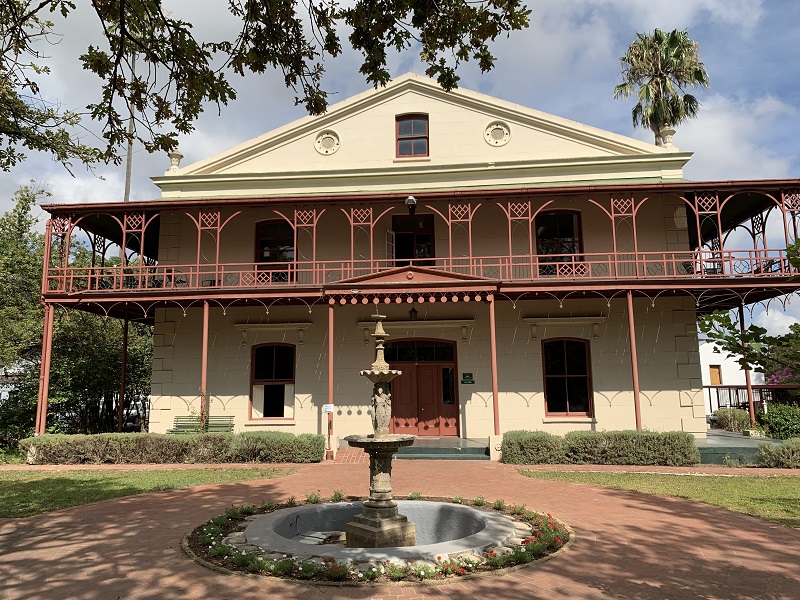
Erfurt House, named after the town Erfurt in Germany. Johan Marthinus (Jan) Beyers built the imposing double story residence in 1876 with a wood and cast iron balcony on all sides of the building.
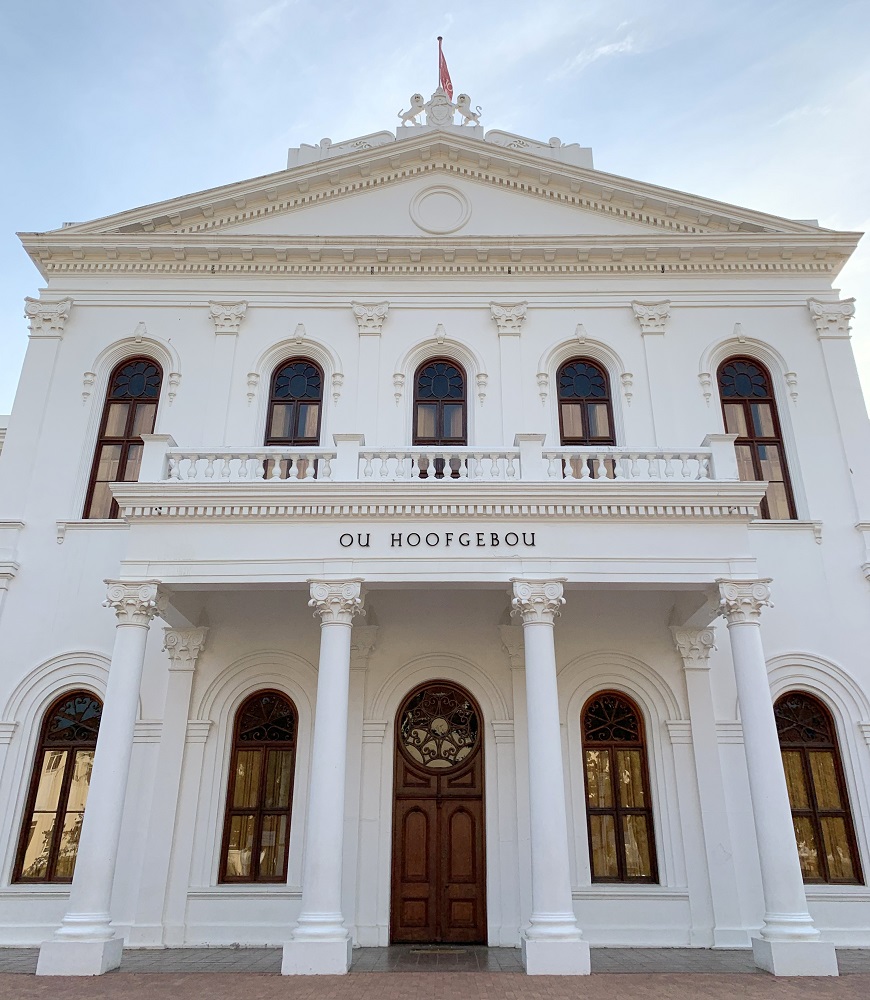
The Old Main Building (‘Ou Hoofgebou’) of the University of Stellenbosch. This building was also designed by Carl Otto Hager. It was completed in 1883 for what was named Stellenbosch College at the time. The flag on the flagpole indicates that the University oF Stellenbosch celebrated its centenary in 2018.
The building for the Bloemhof Girls’ High School on Andringa Street now houses Stellenbosch University Museum. It was built in the Flemish Renaissance Revival style and completed in 1907.

Thursday/ sugarbush (I want you so)

The sugarbush is from the protea family. The ‘flowers’ are actually flower heads with a collection of true flowers in the center, surrounded by bracts (modified leaves). In days gone by, the nectar used to be collected and cooked into a syrup.

A famous Afrikaans folk dance song goes like this:
Suikerbossie ek wil jou hê (Sugarbush I want you so)
Wat sal jou mama daarvan sê (What will your mama say of that)

Dan loop ons so onder deur die maan (Then we walk under the moon)
Dan loop ons so onder deur die maan (Then we walk under the moon)
Ek en my suikerbossie saam (My sugarbush and I together)
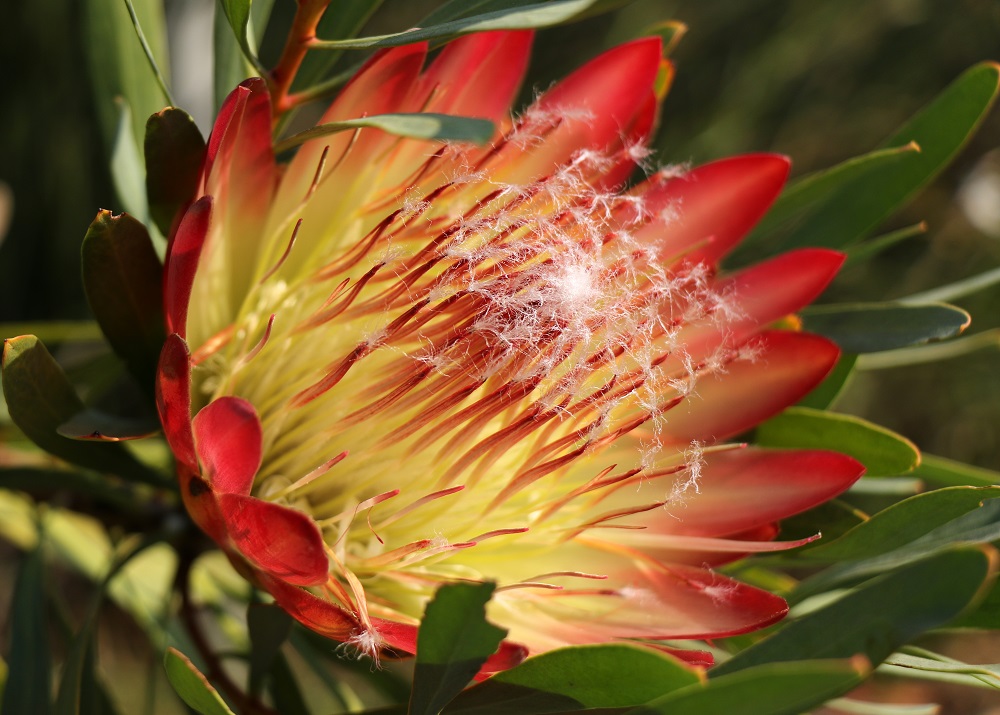
I found this beautiful sugarbush (Protea repens) flower in the Stellenbosch Botanical Garden today.

Wednesday/ hibiscus in a hat

This guy at a traffic light stop in Rondebosch had a hibiscus flower in his ostentatious hat.
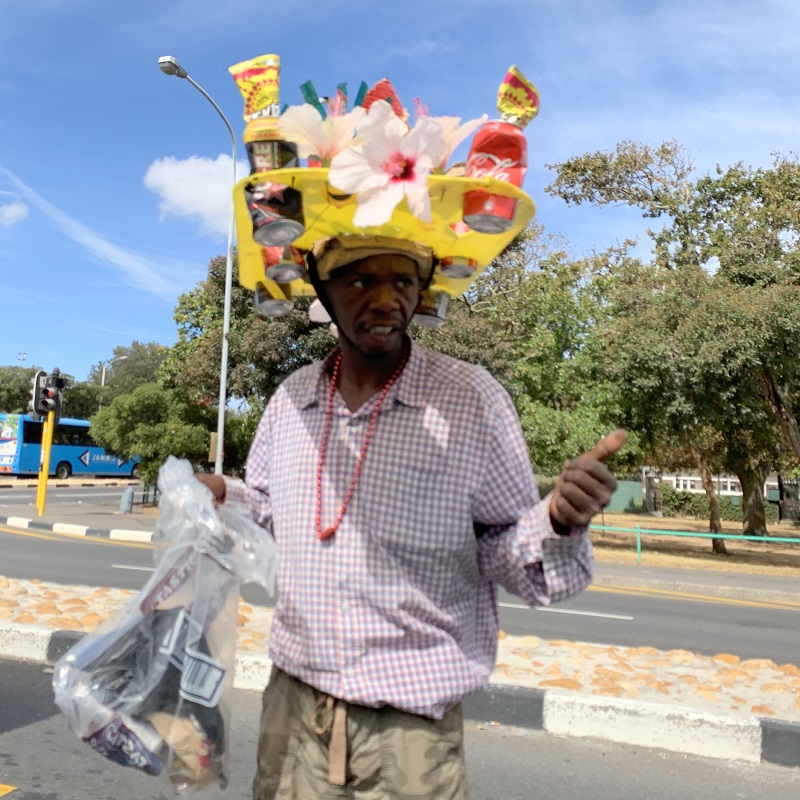
‘What’s up? What are you doing?’ I asked this guy in Rondebosch at a traffic stop. The light was about to change, and I could not get if he collected cans & plastic for recycling, or simply to help drivers get rid of trash! Anyway, ‘You’re doing good work’, I said, and gave him a little money.
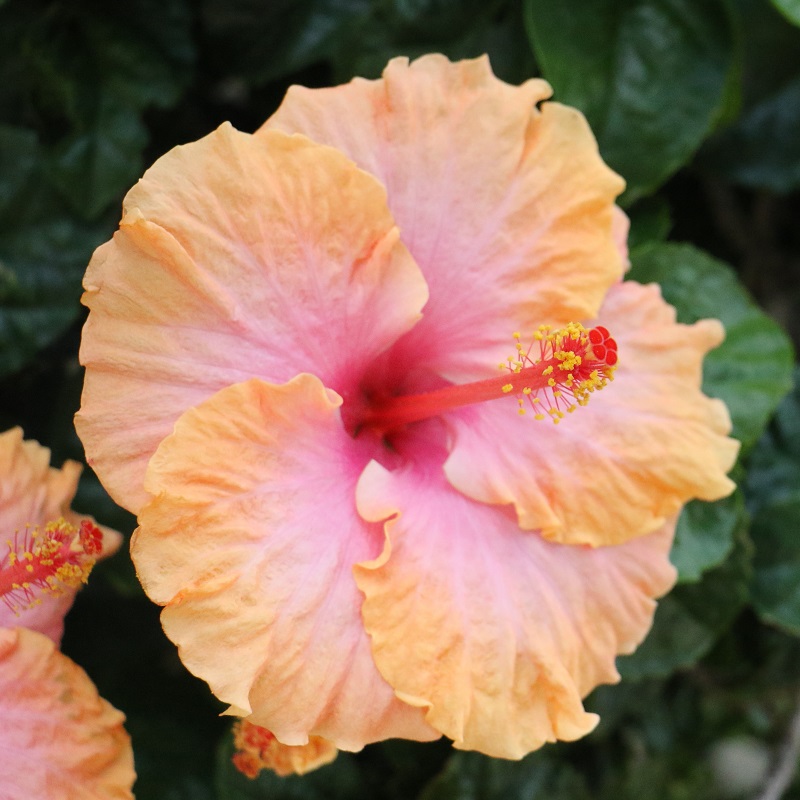
There are plenty of these beautiful hibiscus flowers to be seen in the suburbs around the slopes of Table Mountain. I found this one in a fence in the suburb called Gardens.

Tuesday/ I’ll have an ‘ystervark’

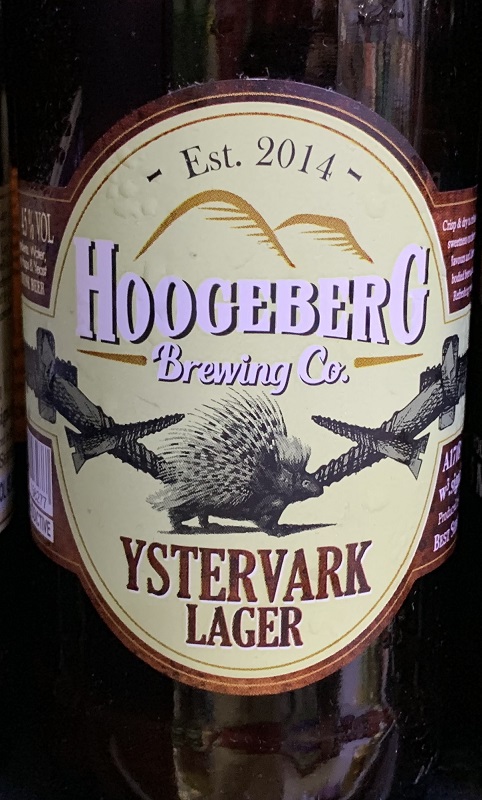
There is aardvark and then there is yster- vark (porcupine). Local craft brewing company Hoogeberg (‘High Mountain’) named one of its lagers Ystervark. (I still have to try it).

The Ystervark is a ‘hybrid lager’, which means it was fermented at the higher temperatures usually used for ales. The time and temperatures used in beer fermentation is not an exact science, and allows brewers to be creative.

Monday/ art from the Baraka gift shop

This artwork was outside a gift shop called Baraka in the little Cape Quarter shopping mall here in Cape Town.

Check out the cool South African themed posters on their website.
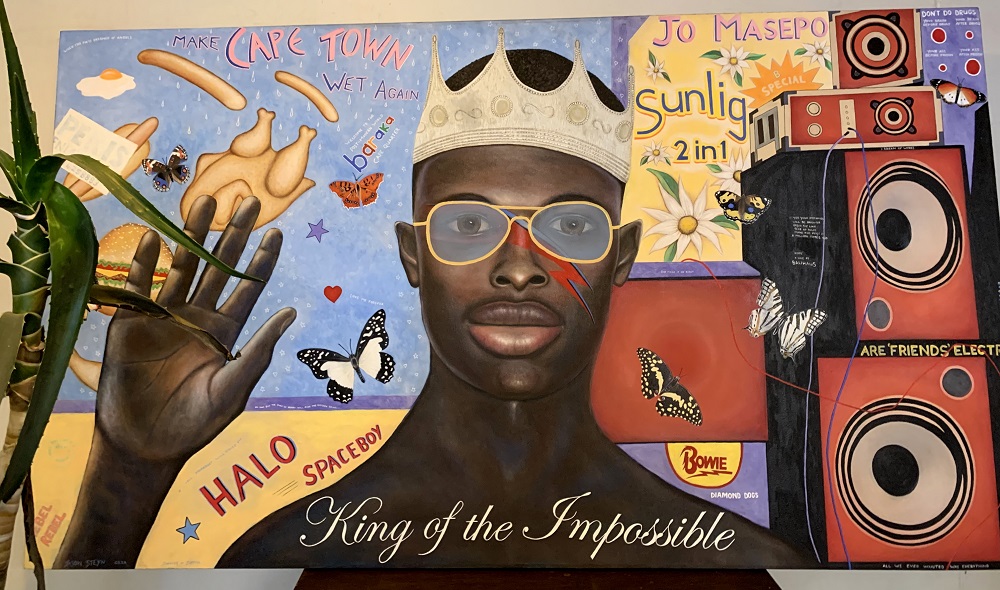
‘Halo Spaceboy’, says the ‘King of the Impossible’ with his ‘Aladdin Sane’ make-up (the lightning bolt, from the David Bowie album cover). ‘Make Cape Town Wet Again’ says the text in the background, no doubt a play on Donald Trump’s infamous 2016 campaign slogan ‘Make America Great Again’.

Sunday/ blue skies at the Waterfront

Here is Table Mountain, basking under blue skies on a beautiful summer day, seen from the Victoria & Alfred Waterfront in Cape Town.
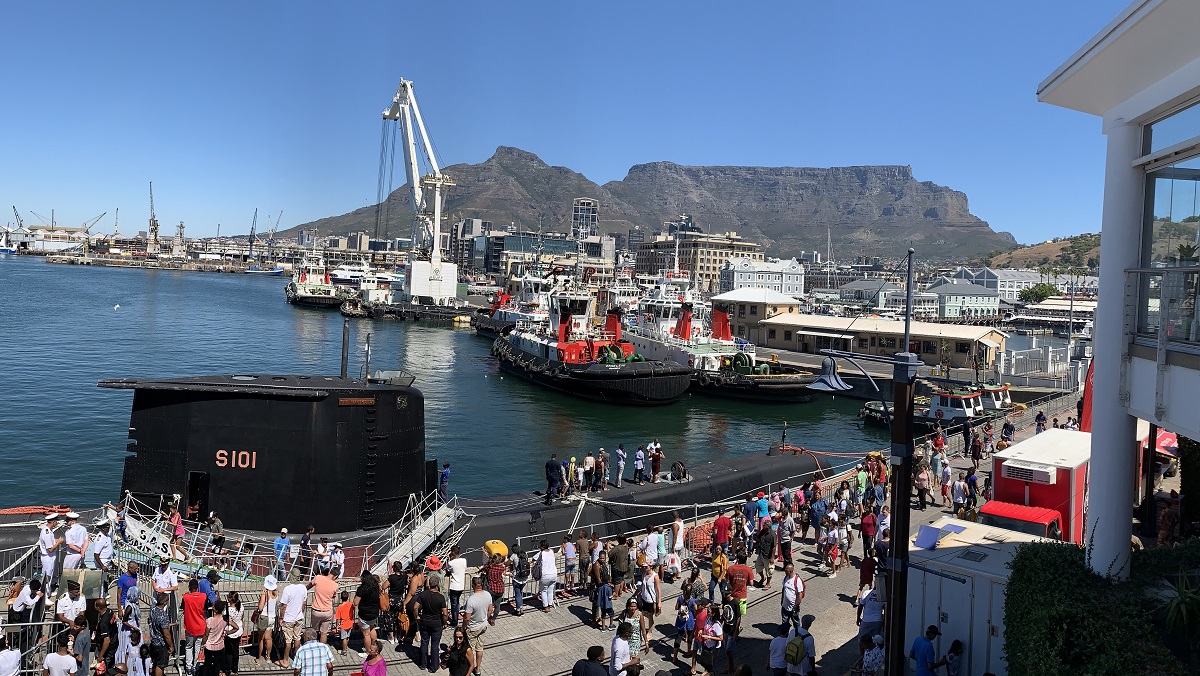
The submarine on display at the V&A Waterfront (as part of Armed Forces Day 2019), is the SAS Manthatisi. She was built in Kiel, Germany, commissioned in 2005, and is named after the female warrior chief of the Batlokwa tribe. Her home port is the naval base in Simon’s Town.

Saturday/ the ‘Bo-Kaap’

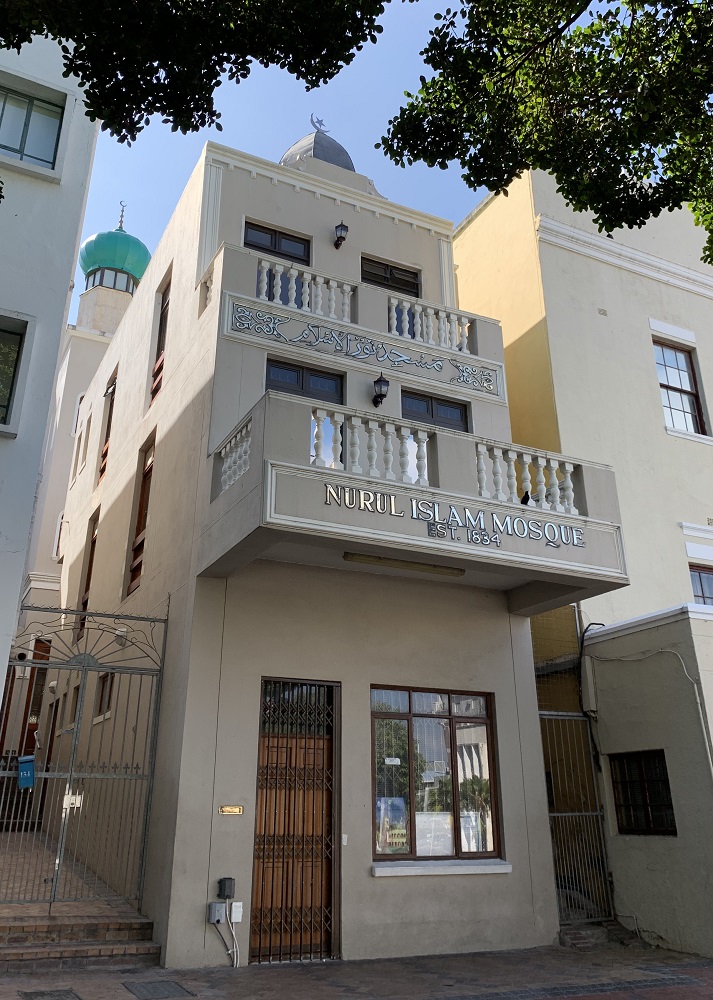
The Bo-Kaap (pronunce ‘boo-uh-carp’) is a former township on the slopes of Signal Hill, above the Cape Town city center. It is the historical center of Cape Malay culture in Cape Town. The Nurul Islam Mosque, established in 1844, is also located in the area. Here are a few pictures that I took today.
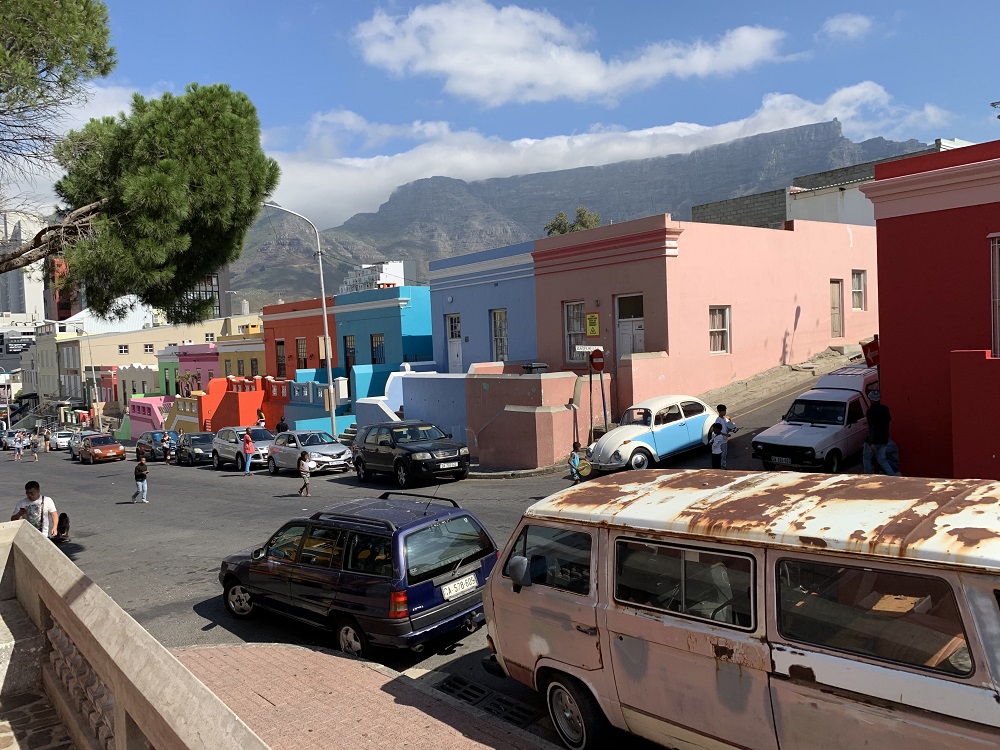
This is a scene on Wale Street. I love the Volkswagen Beetle with the blue doors. The backdrop is Table Mountain, of course.
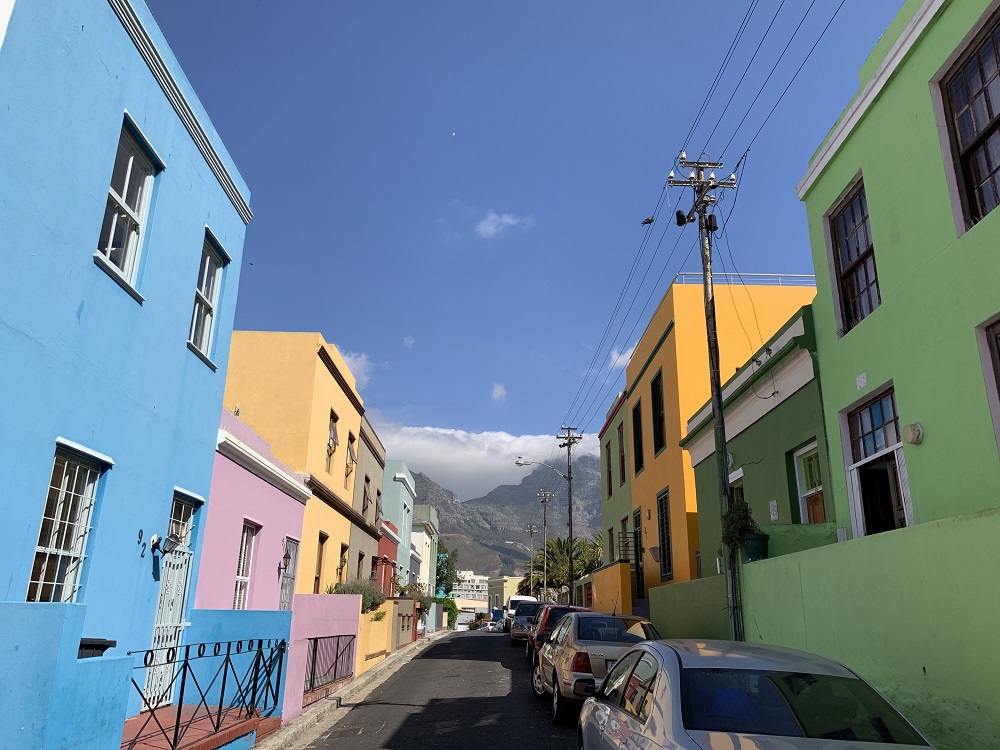
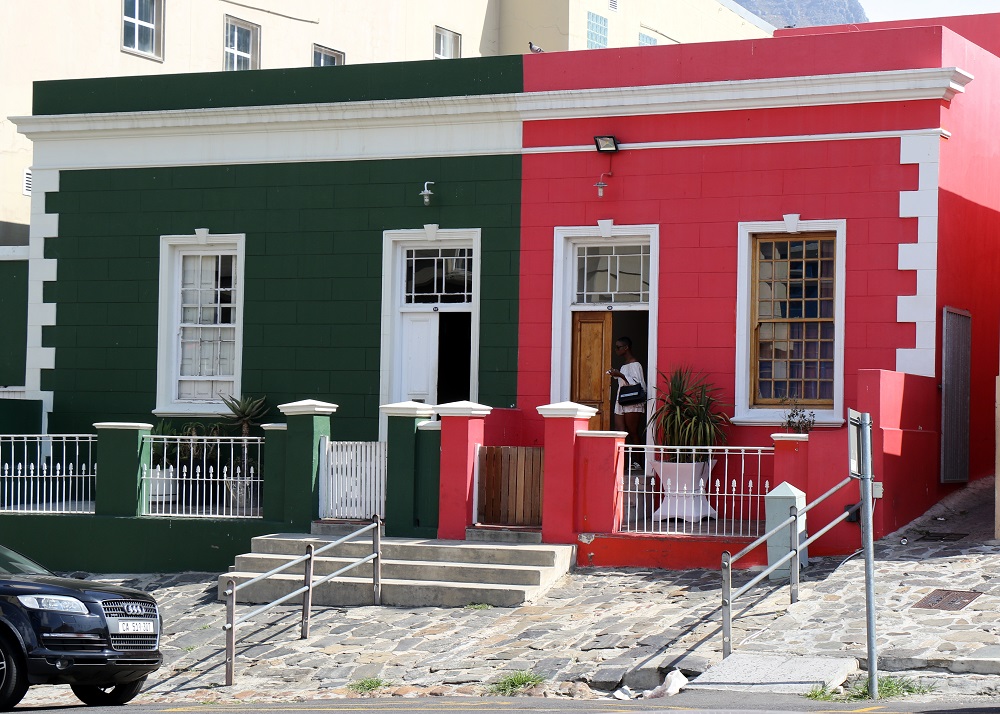
Gorgeous dark green and – Salmon? Coral Pink? houses on Wale Street.
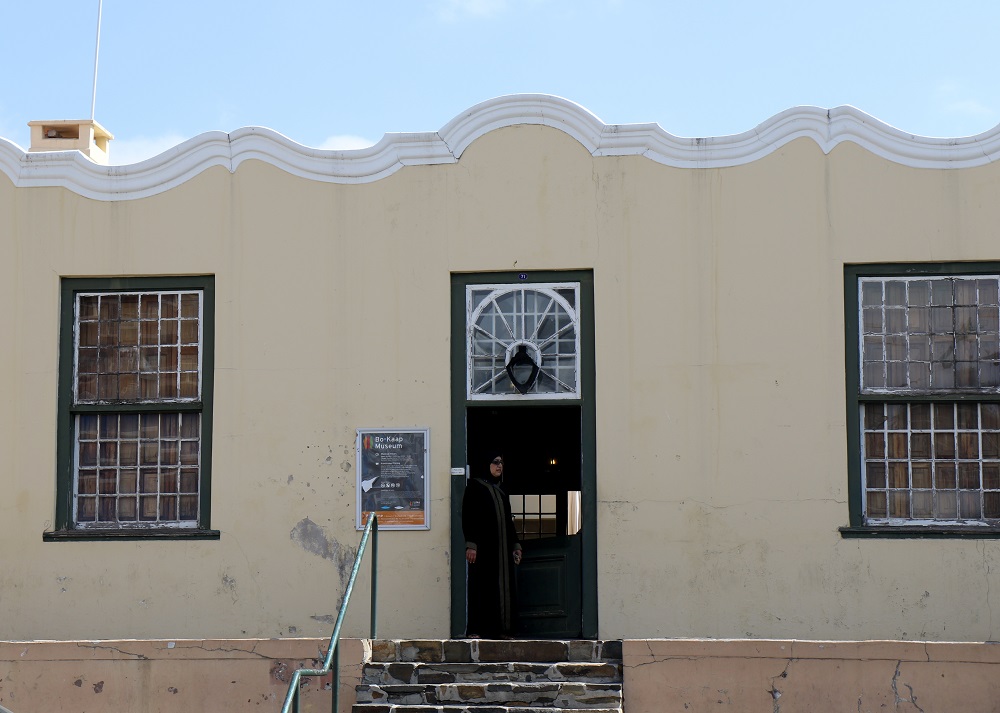
This is the entrance to the Bo-Kaap Museum on Wale Street. I love the wavy cornice on the roof line.
This is Dorp Street.
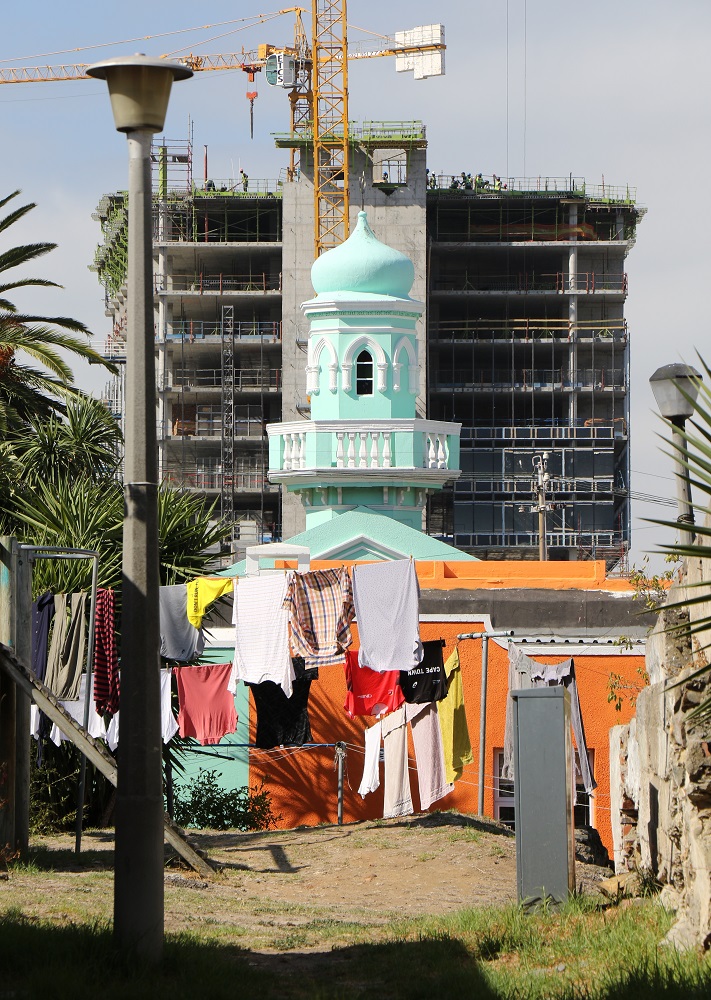
The minaret of the mosque called Masjid Boorhaanol Islam on Longmarket St, holding its own against a massive development project a few blocks away. Efforts to designate Bo-Kaap as a heritage area have been underway since 2013, and it may finally be approved this year by the Cape Town City Council. Still, the status does not entirely prohibit new construction; it simply stipulates that new construction should be subject to much more scrutiny to ensure it fits in with the existing structures.
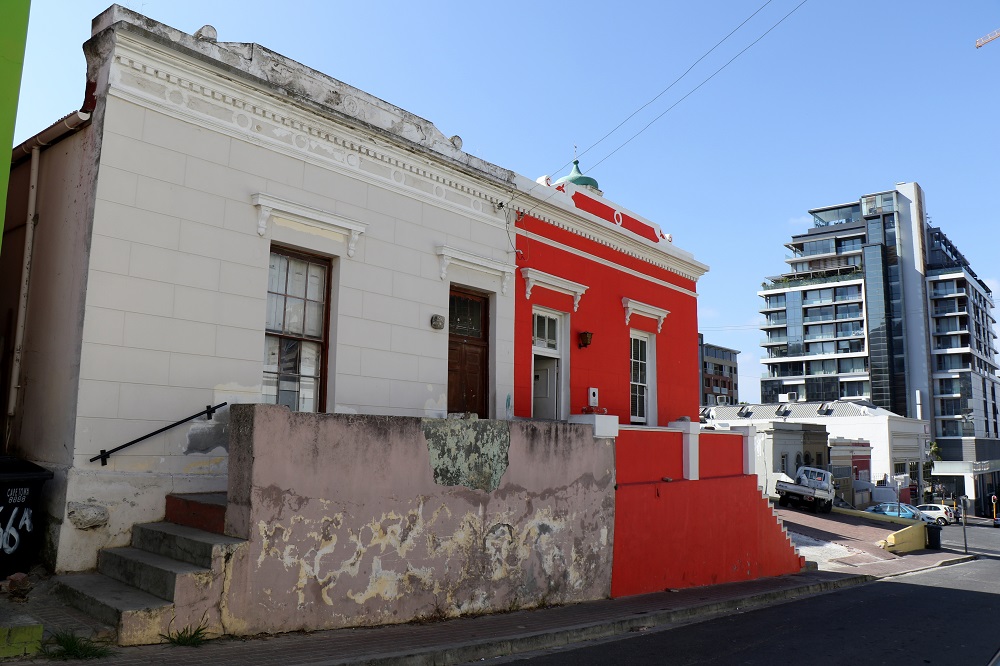
A view of the old and the new. This is on Chiappini Street.
Here is the Nurul Islam Mosque, located off Buitengracht Street, and established in 1834.
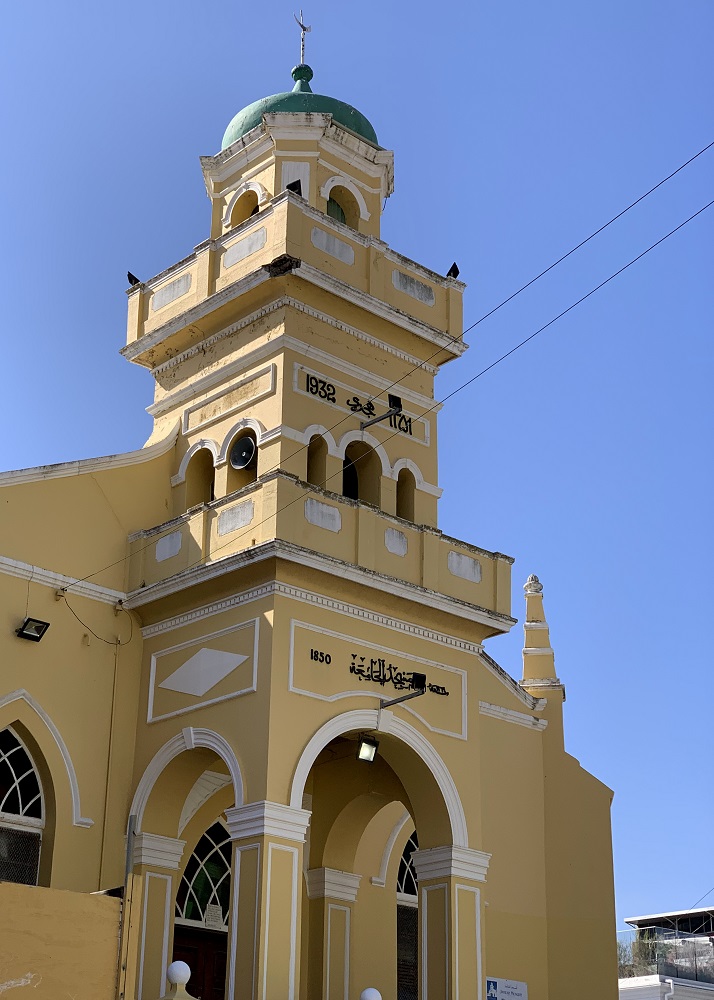
The Jameah Mosque on Chiappini Street was built in 1850.  It is also known as the Queen Victoria Mosque, as patronage of the British Crown, when the Cape Colony was under British rule.

Lucky Friday

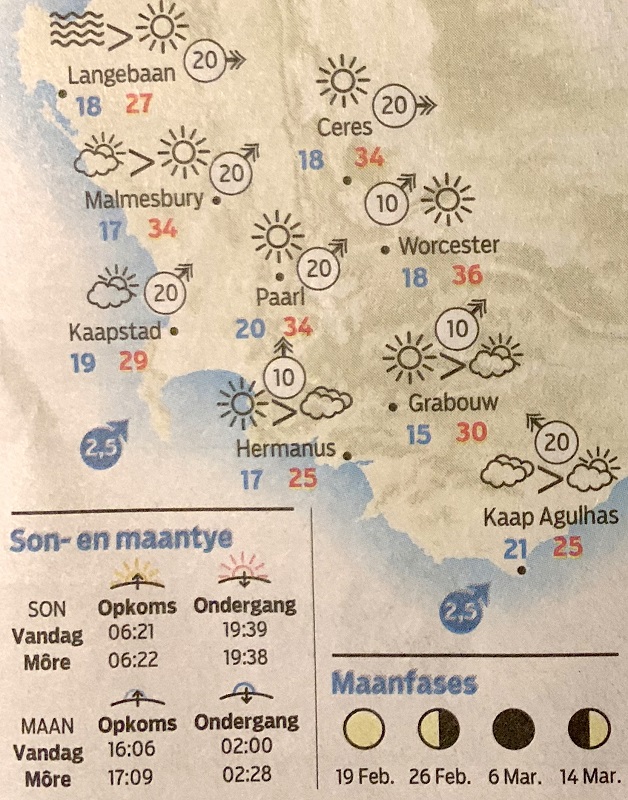
Cape Town highs today: 29 °C/ 84 °F and partly sunny. The days are still long: 13 h 15 mins. [Graphic from ‘Die Burger’].
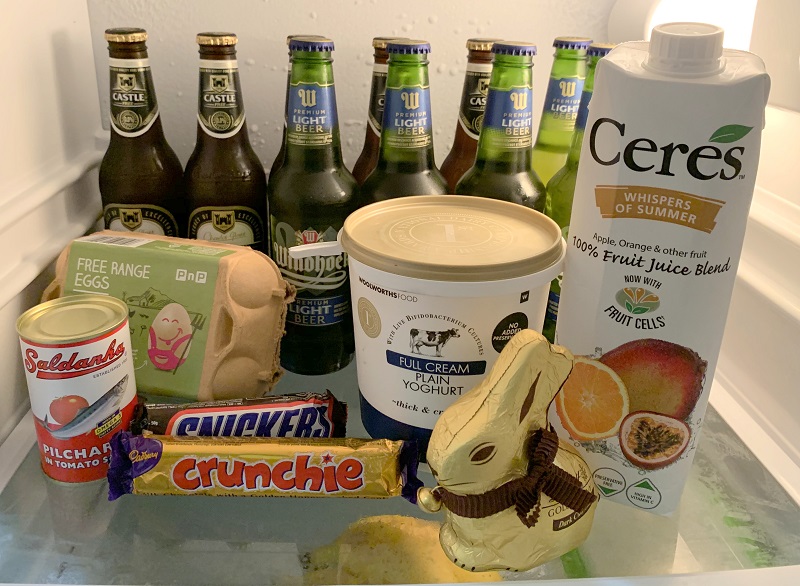
A peek into my refrigerator here in my AirBnB apartment. The canned fish (Saldanha Pilchards) are from the chilly waters of South Africa’s west coast | Castle lager now has a non-alcoholic version | another favorite are the Windhoek Lights (2%), brewed in the German tradition in Namibia | the Crunchie bar has a crisp honeycomb center covered with chocolate | Ceres makes the world’s best fruit juice blends (this one very romantically named ‘Whispers of Summer’) | Woolworths (‘Woolies’) is the place to go for fine foods and yogurt | The Lindt rabbit comes from Switzerland, of course. I had to get it because the dark chocolate ones are hard to come by in the United States!

The weather was much cooler today.
There were no power outages, and tonight a lucky South African may win the largest local lottery jackpot ever: R 210 million/ US $14 m*.

I have beer in my fridge, and some of my favorite South African snackies, so life is good.

*A fraction of the obscene amounts offered in United States lotteries – but drawing 5% each year of US$ 14 m comes to $700,000. Plenty to live a lavish life, anywhere in the world.

Thursday/ it was a scorcher

It was a scorcher here today in the northern suburbs of Cape Town.
My little rental car’s dashboard gauge hit 39.5°C/ 103°F at one point!

There is no water supply crisis in Cape Town the way there was just a year ago (dam levels at 57% vs 25% a year ago). Even so: I try to use water sparingly. As someone said: the best time to save money, electricity, water, is when you still have plenty.

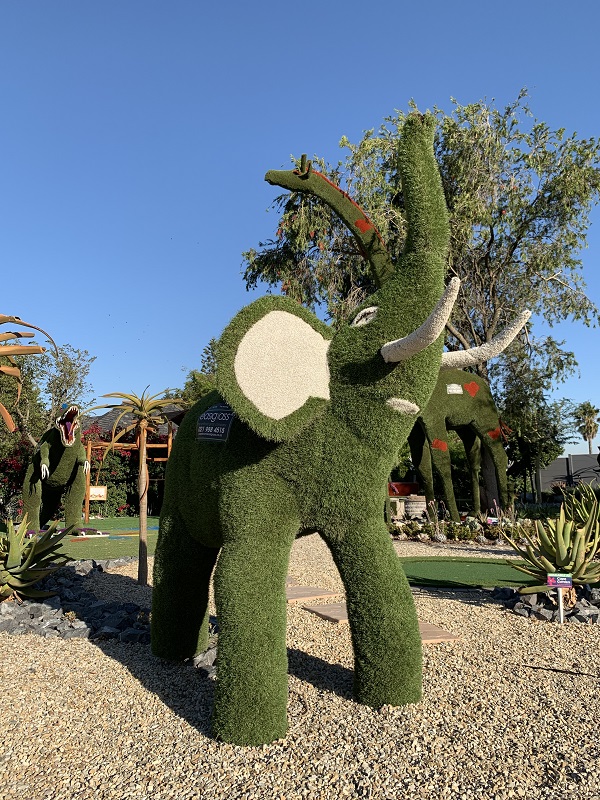
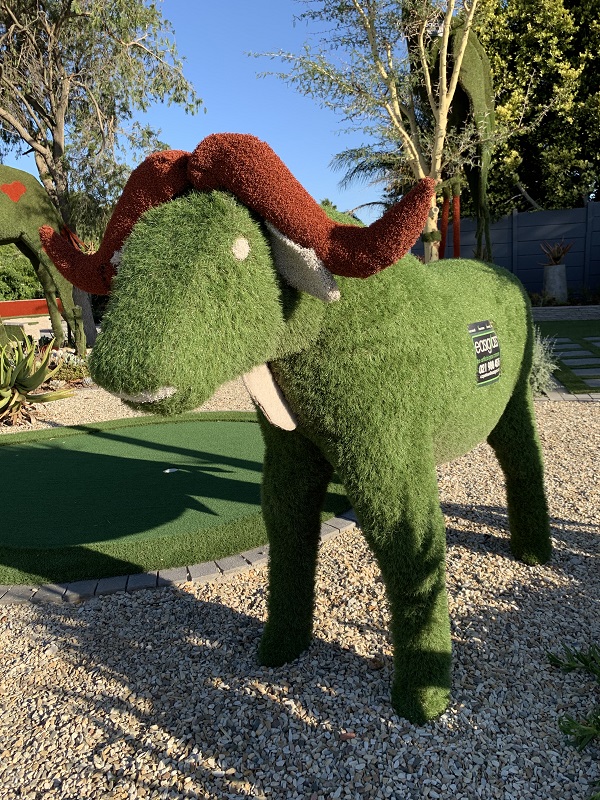
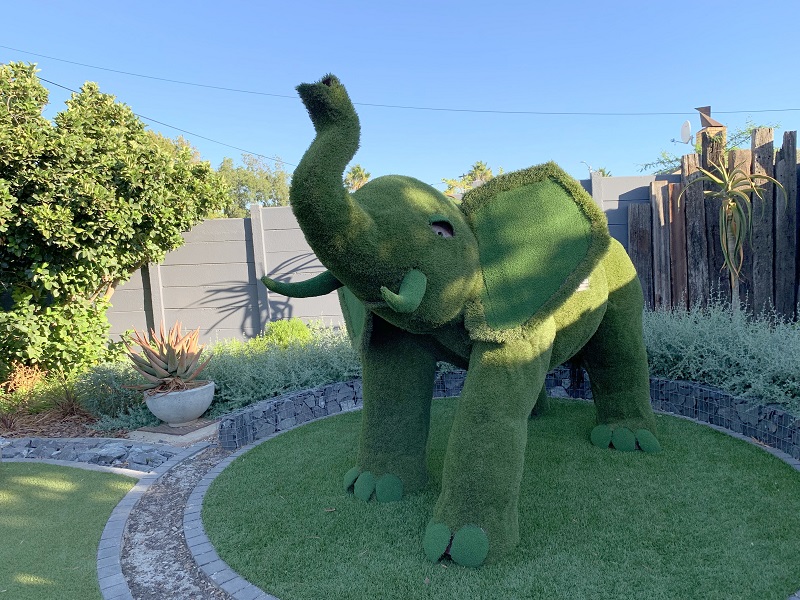
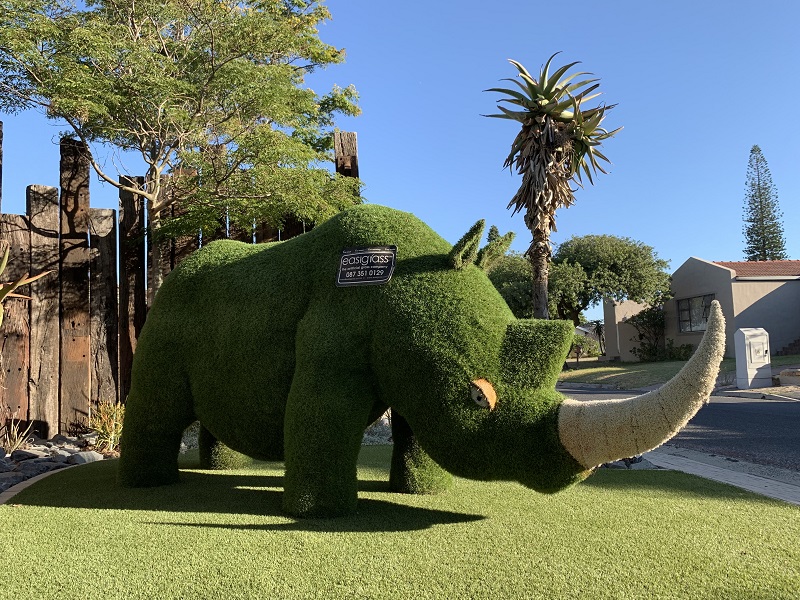
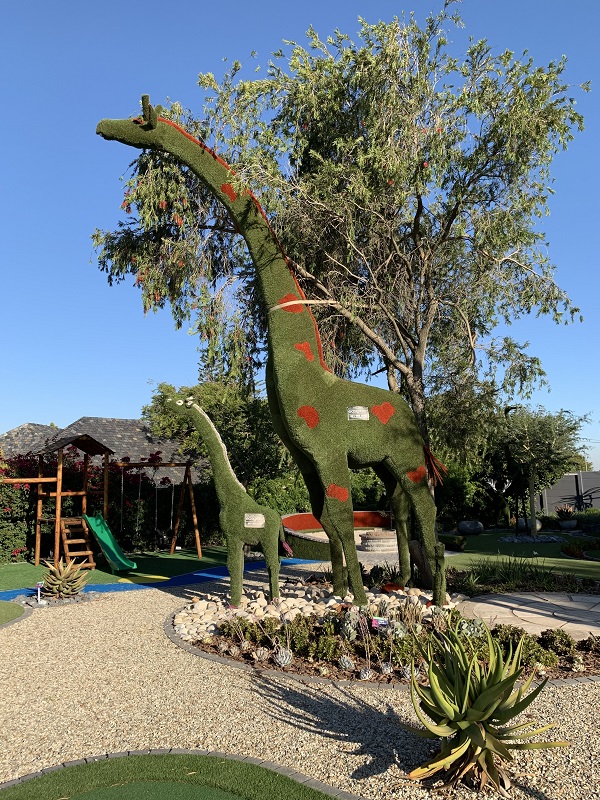
P.S. Check out the cool safari animals that I found today on Eversdal Road in Durbanville. They advertise artificial turf. I think the rhinoceros will make quite a statement, if I were to install one in my front yard in Seattle!
Wednesday/ the new ‘Public Enemy No 1’

It used to be, many years ago, that we would call South Africa’s national telephone company, Telkom, ‘Public Enemy No 1’. (They were a monopoly, and their services were mediocre at best).  Well,  these days that title belongs to South Africa’s electrical utility company, Eskom.

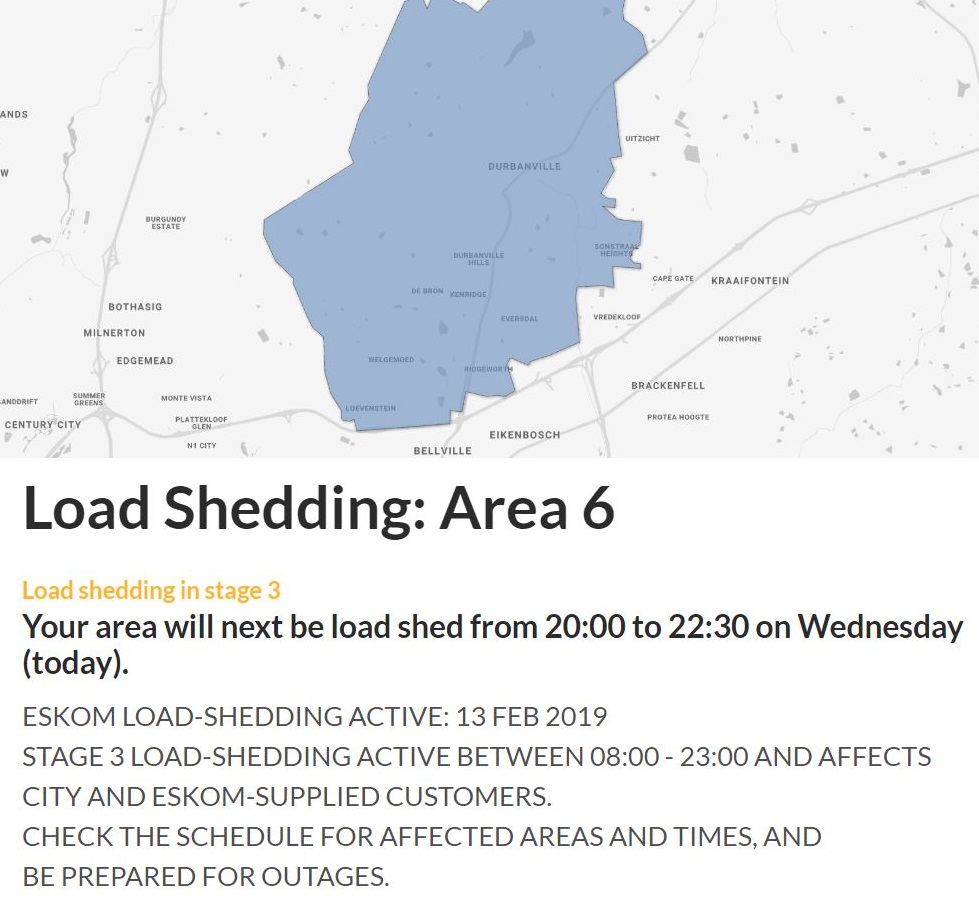
On Sunday, unexpectedly, the utility announced that it had to resort to Stage 3 Load Shedding mode, with widespread power outages. There were more on Monday, on Tuesday, and today. For Stage 3, Eskom implements rolling blackouts per published time periods and areas around the country, that forces a cut in the national power consumption by 3,000 MW.  (About 10%. The country’s power consumption needs at this time of year is around 30, 000 MW).

It now appears that there are major problems with the start-ups of the two brand-new power stations called Medupi (dry-cooled, coal-fired, 6x 800 MW) and Kusile (coal-fired, 6x 800 MW) , and that the utility was not forthcoming about it.

A team of Italian engineers (power supply & power grid experts) has been called upon to come and help devise strategies to get Eskom’s operations to a better place.  They cannot come soon enough .. even though I am sure we have South African engineers that are completely up to the task, if only they were given the opportunity by Eskom’s senior management.
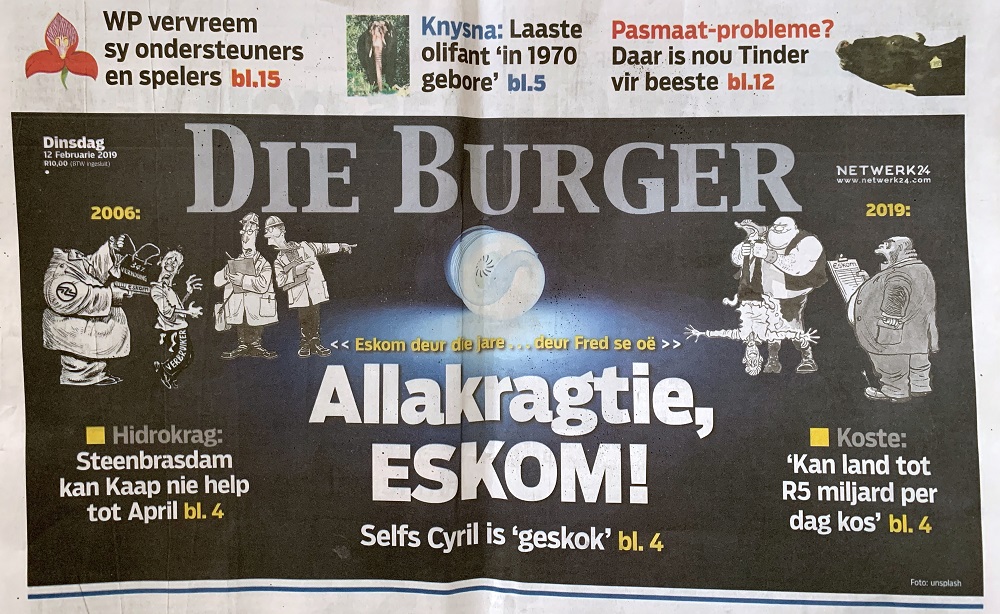
Front page of Die Burger (‘The Citizen’) newspaper from Tuesday: ‘What the Hell, Eskom!’ .. and ‘Steenbras Dam cannot help until April’ (to generate hydroelectric power) | ‘Even Cyril (Ramaphosa, President), is shocked’ | ‘Could cost the country up to R5 billion (US$ 357 million) per day’ (per the Organisation Undoing Tax Abuse).
Here’s an online notice of the outage that happened tonight in my area. These power outages hit large and small businesses particularly hard, of course.

Tuesday/ arrival in Cape Town

I made it in to Cape Town.
The flight out of Schiphol airport was 10 ½ hrs, on a Boeing 777 from KLM.
It was midnight by the time I had checked in to the airport hotel with my rental car.
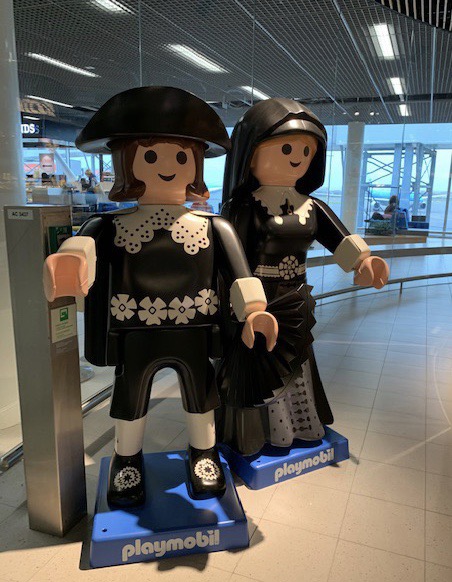
Life-size LEGO figures of  Dutch colonialists at Schiphol airport, outside the airport’s mini-Rijksmuseum.
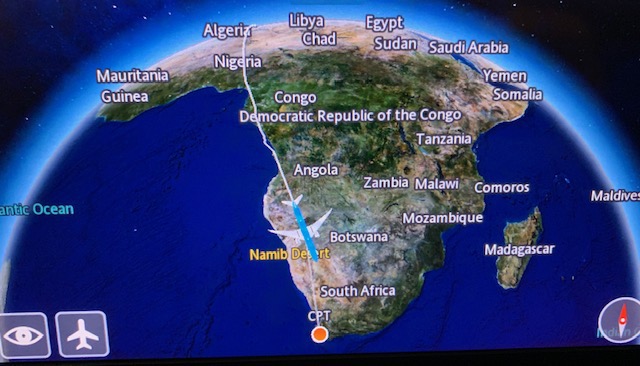
Over the Namib desert, with 2 hrs to go.
Our Boeing 777, at the gate at Cape Town International Airport. A lot of Dutch people were on board, looking to catch the back end of the summer weather in Cape Town.

Monday/ in Amsterdam

My flight made it into Schiphol airport at 12 noon local time, after the connection I had made in Reykjavik.

From Schiphol, I took the train to Amsterdam Central station.
The OV chipkaart that I had bought there, does the same as the Orca card that we have in Seattle, and more. The passenger uses it to tap on readers at train stations and on trains and buses, to pay the fare. The cards can be used anywhere in the Netherlands on local trains, trams and buses, and even on regional trains. Just not on ferries, yet.
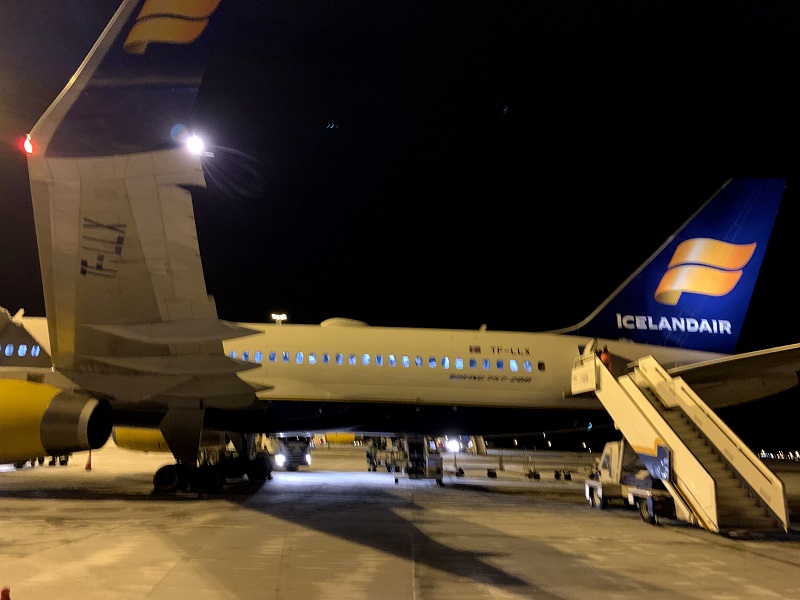
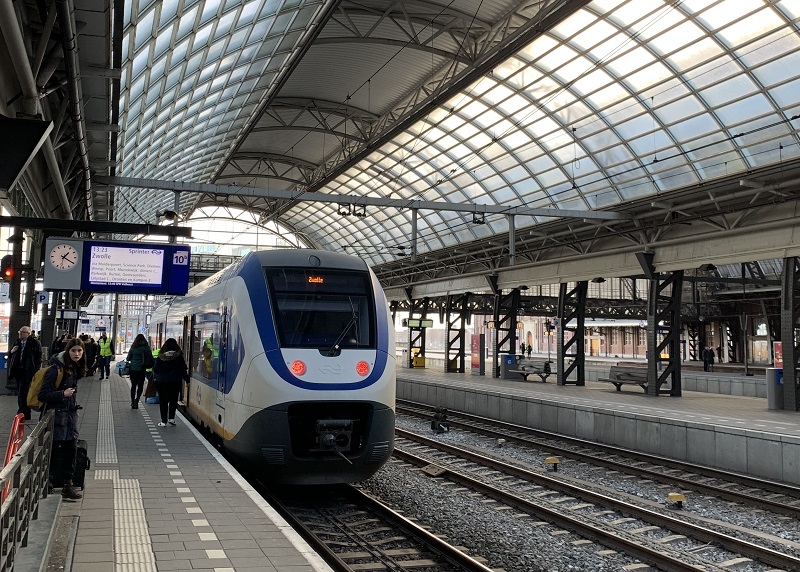
The Boeing 757 that got us from Seattle to Keflavik airport. It is 6 am, and we are stepping into the terminal shuttle bus. It was 5 °C (40 °F), but man! it felt 10 degrees colder, with the icy windchill that whipped across the tarmac.
This is Amsterdam Central station, and I had just stepped off the train called the Sprinter. It’s just a 17 min run from Schiphol to Amsterdam Central.
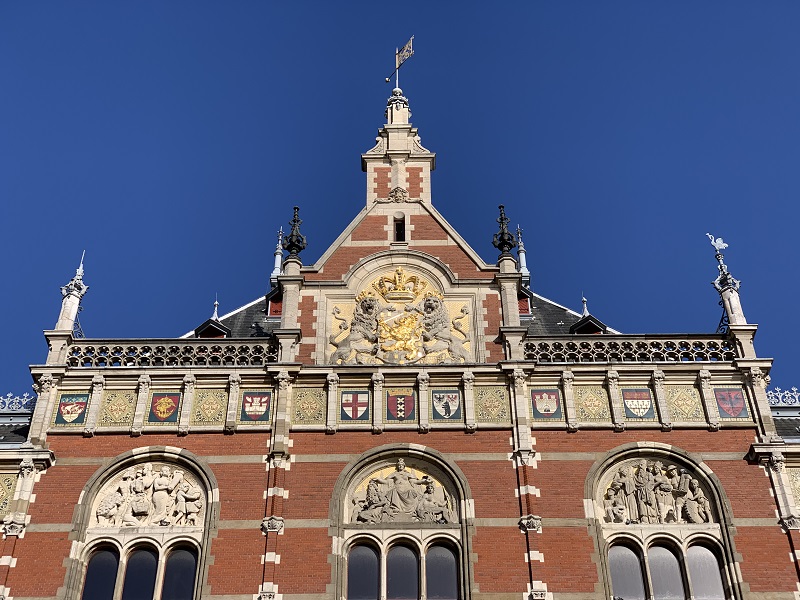
The main facade for the Amsterdam Central Station building. Built from 1881 to 1889, it was designed by famous Dutch architect Petrus J.H. Cuypers. I cheated a little by just aiming at the top: there is construction and remodeling going on at the bottom, behind a fence.
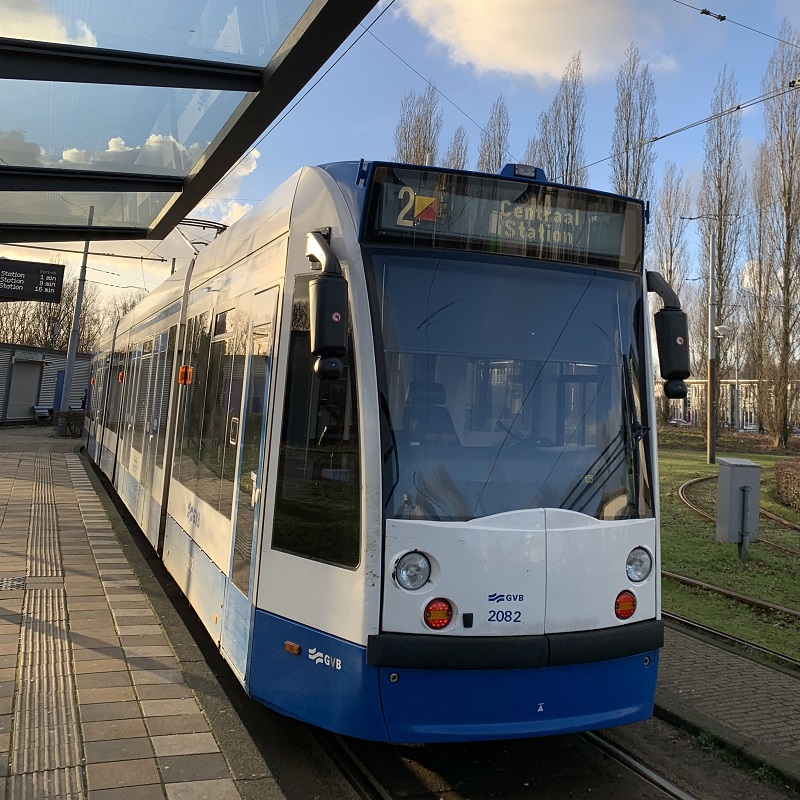
I just had a few hours until sunset, and so I took the No 2 tram line from Central Station down to Nieuw Sloten and back. It is a great way to check out the scenery and the city.  The No 2 runs by several canals and town squares (Koningsplein, Keisersgracht, Prinsengracht, Leidseplein), as well as by the grounds of the Rijksmuseum.
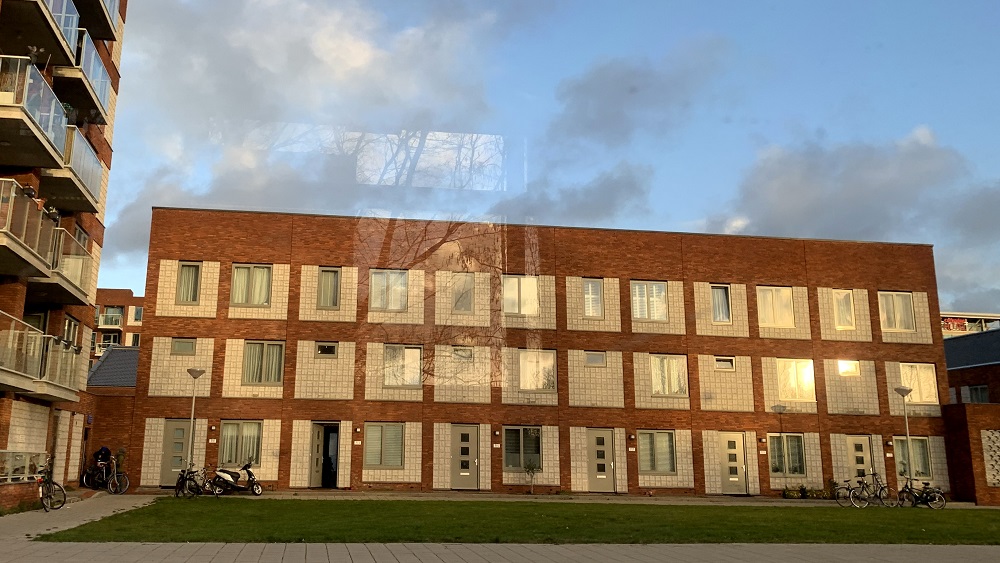
Outside of central Amsterdam, and looking out from the tram, one finds plenty of 60’s and 70’s apartment buildings. These are built in a much simpler, modern style (than the traditional Dutch style). I like this one a lot: all straight lines, rectangles and squares.

Sunday/ Amsterdam bound

I made it to the airport, and it looks like my flight is on time.
I had to negotiate two blocks of bumpy, snowy sidewalk to the bus stop with my roller bags, but it was not too bad. It was easy from there: bus to the Capitol Hill train station, and train to the airport.

Now it’s 7½ hours to Reykjavik on Iceland Air, and another 3 to Amsterdam, where I will overnight on the way to Cape Town, South Africa.
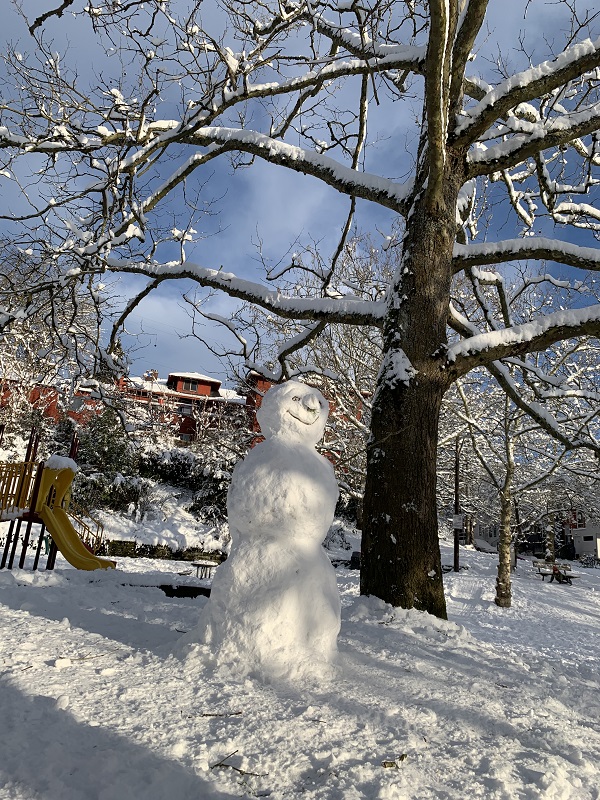
I found this snowman in the little Spring Street park on Saturday afternoon.
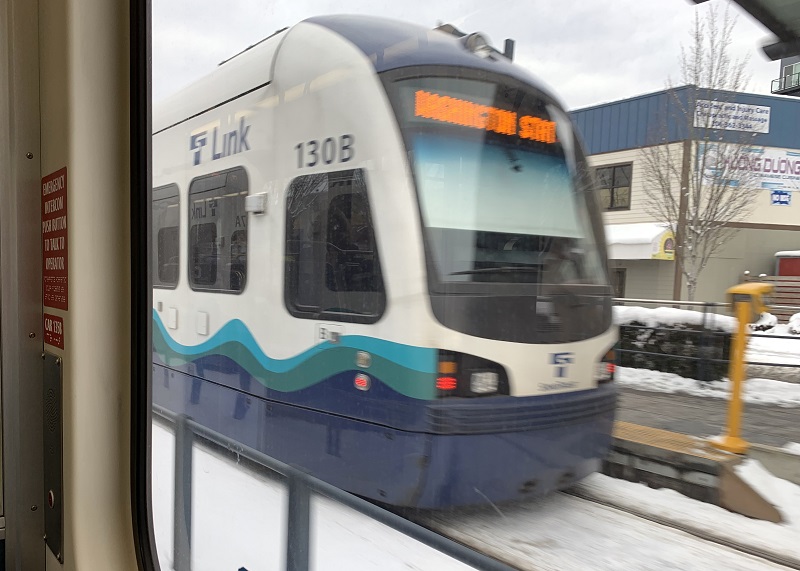
Here’s the view at Othello station as my Link Light Rail train passed another on the way to the airport today.  I don’t think the Transit Authority had to take special measures to clear snow from the train tracks on Saturday. The Light Rail operated its normal Saturday schedule – unlike the metro buses, which had to switch to limited snow routes (routes that steer clear of the steeper inclines made slippery by snow and ice),