
Happy Friday.
I’m reading up about the stamps from Greenland that had I bought at the stamp show from a friendly guy from Nuuk, at the Greenland booth at the stamp show.

Issued Jan. 31, 2025
Perf. 13 | Design: Miki Jacobsen | 40 mm x 30 mm | Offset Lithography | Printing: Gutenberg AG | Paper: FSC SecurPost 110g/ m2 | No watermark
01100788 19.00 Kr | Multicolored | SIRIUS Patrol with provisions and dog sled
The headquarters of the SIRIUS patrol is Daneborg, located on the east coast of Greenland, close to 74 degrees north latitude. The headquarters is completely cut off from the outside world. To get there, you have to fly in a small propeller plane from Iceland. At the station, twelve men and 80 sled dogs are each other’s only company for a radius of about 250 kilometers. There are not many distractions outside of work. There is mail from home six to seven times a year.
SIRIUS’ northernmost station is called Station Nord. Five men are stationed here year-round. The main task is to keep a large runway free of ice, but there are also many other tasks. On the patrols, the menu is freeze-dried food, powdered milk, chocolate and rye bread, but after arriving at the station, there is food in abundance, as well as videos, music and even a shower. Everything is in sharp contrast to the patrols’ harsh living conditions. Station Nord is therefore a very popular place to stay for the patrols.
In a modern era, when surveillance of Northeast Greenland could easily be carried out using satellites or aircraft, the SIRIUS patrol may seem redundant.
However, the fact is that, according to international conventions, sovereignty can only be enforced by entering the areas that a country possesses. So the unique Danish military unit will probably continue to operate in Greenland’s northernmost regions in the future. [Sources: stampworld.com, stamps.gl/greenland-collector, Google AI]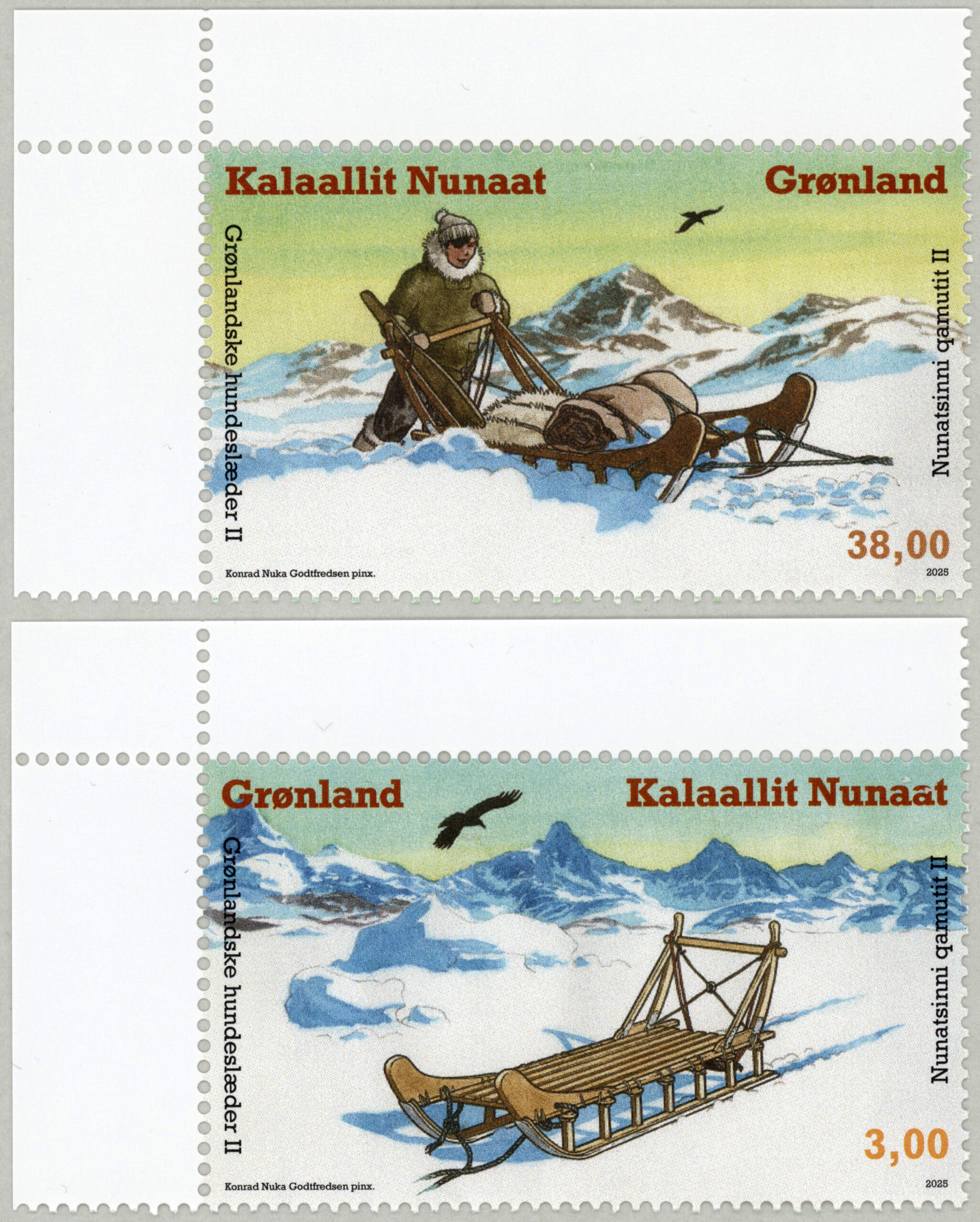
Issued Jan. 31, 2025
Perf. 13 | Design: Konrad Nuka Godtfredsen | 56 mm x 33 mm | Offset Lithography | Printing: Gutenberg AG | Paper: FSC SecurPost 110g/ m2 | No watermark
895 AEK 3.00 Kr | Multicolored | East Greenlandic sled
896 AEL 38.00 Kr | Multicolored | Greenlander with East Greenlandic sled
[Sources: stampworld.com, Google AI]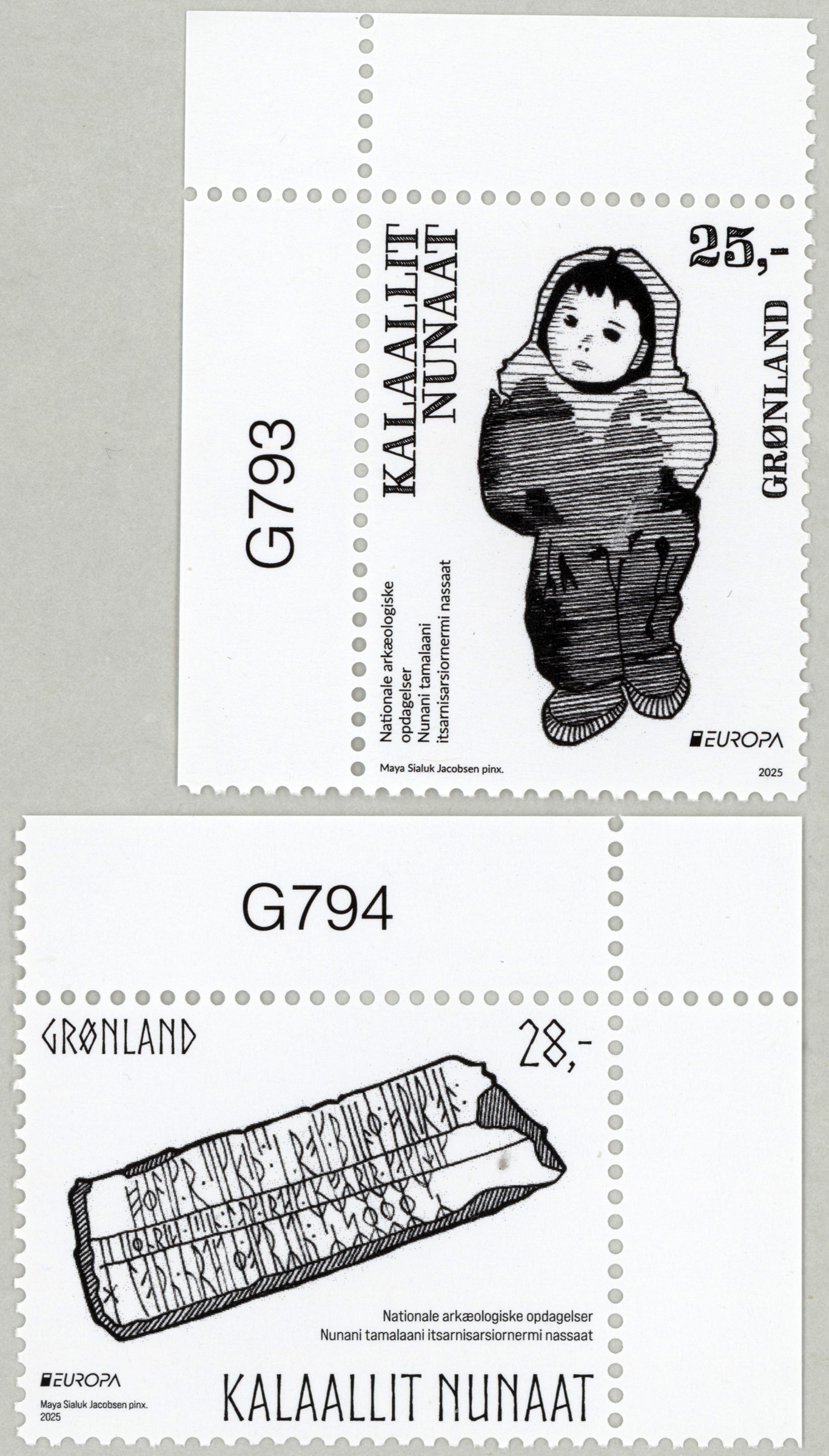
Issued May 26, 2025
Perf. 13 | Design: Maya Sialuk Jacobsen | 30 mm x 40 mm, 40 mm x 30 mm | Offset Lithography | Printing: Gutenberg AG | Paper: FSC SecurPost 110g/ m2 | No watermark
902 AER 25.00 Kr | Black and white | Boy with animal skin clothing from the Thule culture
More:
Qilakitsoq is an abandoned Inuit settlement on the Nuussuaq Peninsula on the West coast of Greenland, about 450 km north of the Arctic Circle. The settlement is renowned for the discovery of eight mummified bodies from the Thule culture in 1972. The discovery was made by two local reindeer hunters, Hans and Jokum Grønvold. In two graves were the mummies of six women and two boys. They comprise three generations with close familial links across the graves. Although the causes of death are unknown, they probably died at the same time in the Autumn shortly after arriving at the Winter settlement. They were wrapped in animal skins and fully clothed. They were equipped for a long journey to the underworld, carefully prepared according to ancient, traditional rites. They had extra skins and clothing to afford them a safe journey and a good life in the realm of the dead. The five oldest women have almost identical facial tattoos that can express both kinship and social status. The youngest woman of about 20 years is not tattooed. Perhaps she was either unmarried or childless. Tattoos have been in common use among Inuit women for thousands of years. There were amulets on and among their clothing. The Inuit probably employed these amulets to muster strength and protection from evil spirits. The mummies from Qilakitsoq have since afforded valuable insights into the life of the Inuit who lived in the area some 500 years ago. The stamp reproduces the most recognisable and most iconic of the eight mummies. It is presumed to be a small boy of about six months. While the gender is based on the clothing, the age has been ascertained from the development of teeth and bones through radiographic examination.
903 AES 28.00 Kr | Black and white | The Kingittorsuaq rune stone
More:
The Kingittorsuaq rune stone was found in 1824 by a man called Pelimut. The discovery was made on top of the mountain on the small island of Kingittorsuaq about 20 km north of Upernavik. At the highest point of the island, he saw three collapsed cairns placed in a triangle formation. Near the largest of the cairns, he spotted a stone with several markings that he did not recognise. The stone, which is known as the Kingittorsuaq Runestone, bears medieval rune inscriptions. It is conclusive evidence that Norsemen in Greenland on their fishing trips along the West coast of Greenland reached as far North as North of the present-day town of Upernavik. The stone, which currently resides in the National Museum in Copenhagen, has been dated to the Middle Ages between 1250 to 1333 AD. The last part of the runic script remains undecipherable as it appears to be a group of meaningless characters. However, the first part of the writing on the runestone translated from Old Norse reads: “Erling, son of Sigvath and Baarne Thordar’s son and Enriði Á’s son, on Saturday before Rogation Day raised this stone and rode…”
[Sources: stampworld.com, europe-stamps.blogspot.com, Google AI]
Issued Sep. 12, 2025
Woven cloth with embroidery | 100% Recycled polyester | 55 mm x 42 mm | Mfg. by Hämmerle & Vogel (Austria) | Self-adhesive
909 AEY 75 Kr | Stylized, white-and-blue embroidered dove carrying an olive branch
Part of an international joint initiative where multiple postal services worldwide issued identical embroidered stamps. It features the exact same dove motif across over a dozen postal organizations (including the UN, Switzerland, Austria, and the Faroe Islands) with only the country name and local currency varying.
[Sources: stampworld.com, Google AI]
Issued May 23, 2026
Perf. 13 | Two stamps in minisheet (140 mm x 80 mm) | Design: Martin Mörck | Stamps 40 mm x 30 mm | Offset Lithography | Printing: Gutenberg AG | Paper: FSC SecurPost 110g/ m2 | No watermark
01100819 25.00 Kr | Multicolored | Leif the Lucky’s discovery of Vinland*
01100820 37.00 Kr | Multicolored | Thor Solberg’s flight aboard the Leif Eriksson biplane**
*Leif Eriksson, also known as Leif the Lucky, was a Norse explorer who is thought to have been the first European to set foot on continental America, approximately half a millennium before Christopher Columbus did.
Vinland is the coastal region of North America (Newfoundland & eastern Canada) explored and temporarily settled by Norse Vikings around 1000 CE.
**Thor Solberg was a Norwegian-born aviation pioneer who made the first successful flight from the United States of America to Norway in 1935. He made the journey, which started in New York City, in an open-cockpit single-engine aircraft with no landing instruments.
[Sources: stampworld.com, stamps.gl/greenland-collector, Google AI]